CAA News Today
Committee on Women in the Arts Picks for June 2015
posted by CAA — June 10, 2015
Each month, CAA’s Committee on Women in the Arts selects the best in feminist art and scholarship. The following exhibitions and events should not be missed. Check the archive of CWA Picks at the bottom of the page, as several museum and gallery shows listed in previous months may still be on view or touring.
June 2015

Poster image for Bluestocking Film Series 2015
Bluestocking Film Series 2015
SPACE Gallery
538 Congress Street, Portland, ME 04101
July 17–18, 2015
Founded in 2011 by the director and independent filmmaker Kate Kaminski, the Bluestocking Film Series promotes filmmakers who “place female protagonists front and center.” As explained in their mission statement, they “encourage and promote production of narratives driven by strong, complex female protagonists, characters who are as fully-developed, heroic, complex and flawed as their male counterparts,” all this with a preference for “well-structured, highly visual, cutting edge, provocative films, especially ones that explore the plurality and variety of women’s relationships.”
The series focuses on narrative films more than documentaries, and each accepted film must also pass the Bechdel Test. This year an estimated fourteen to sixteen films will be screening over two nights and one afternoon at the SPACE Gallery in Portland, Maine. A special afternoon program, free for low-income girls, was added after Bluestocking received a number of strong films addressing issues of adolescence and coming of age, Kaminiski said. The Irish filmmaker Maureen O’Connell will also join the festival in Maine for the US premiere of her film, Girls.
The Bluestocking Film Series issued a call to filmmakers this year in their Blue Collar Heroine Challenge, seeking films that spotlight the lives of working-class women. “Truly diverse representations of women wage earners who are competent, quick-witted, and enterprising are practically taboo,” Kaminski explained. The challenge was delivered to help fill this void while portraying women who work in skilled manual-labor jobs, including “pink collar” jobs, and in many ways “an ordinary heroine.” Unfortunately, Kaminiski said, they received no films that met the criteria 100 percent. “The fact is, these films may not yet exist,” she said, “and this is the reason why we do.”
Reductress
Online Satirical Women’s Magazine
“The mission of Reductress is to take on the outdated perspectives and condescending tone of popular women’s media, through the eyes of the funniest women in comedy today,” begins the about page on the Reductress website. “Also, we want people to think we’re pretty.” Begun in 2013 by the comedians Beth Newell and Sarah Pappalardo, the online “news” magazine takes aim at all subjects, from news to entertainment, love, sex, and a category called “womanspiration.”
Headlines subtly and not-so-subtly jab at a breadth of issues. Perform a quick search for art, museum, or films and their titles and one will find the art and film industry is not immune to their satire. Titles include: “New Movie Has Women In It,” “Secret Colony of Female Directors Found in a Remote Cave,” “Slave To The Night: Dafna Remembers Art Basel,” “MPAA Gives Film NC-17 Rating for Actress’s Graphic Enjoyment of Dessert,” and (but not limited to) “Date Night Ideas That Will Lead to an Explosive Argument,” which includes the helpful paragraph titled “A Scream-Fight at a Museum.”
Only a short two years into online publication, the authors are adjusting to the increasing talk of feminism in mainstream media. In an interview with the Daily Beast from May 3, 2015, Pappalardo is quoted, “all of a sudden the magazines that we were parodying are talking about feminism and taking it seriously.” But, she says, these are attempts “to be relevant in feminism and co-opt the movement, while still propagating the same messages that make us feel inadequate.”
Milcah Bassel: Father Tongue
Kniznick Gallery
Brandeis University, Women’s Studies Research Center, Epstein Building, 515 South Street, Waltham, MA 02453
April 13–July 16, 2015
The Kniznick Gallery in the Women’s Studies Research Center at Brandeis University features the Hadassah-Brandeis Institute artist-in-residence Milcah Bassel and her work, Father Tongue. The large-scale wall drawings produced at the gallery are based on five letters of the Hebrew alphabet, exploring the “patriarchal roots of this ancient square alphabet through a personal, feminist, and abstract lens.” Bassel, who was raised in Israel, describes her multidisciplinary work as “an experiential investigation of body-space relations incorporating installation, hand-made objects, drawing, photography, video and performance.”
In Father Tongue, Basel explains in an interview with the Brandeis University student newspaper, the Justice, she chose to revisit five specific letters because they are all constructed of right angles and often used frequently as building blocks in Hebrew. As a child, Basel said, her earliest experiences with the alphabet were watching her father, a Jewish scribe, copy letters. This dominantly visual experience, coupled with her career as an artist and transition from an Orthodox family into a secular background, has allowed her, as Basel expressed, to “reclaim the alphabet for myself.”
Basel’s installation treats the space as if the audience is reading Hebrew, from right to left, compiling the five letters in a repetitive, but recognizable pattern. For audiences that read Hebrew this arrangement maintains the relationship to the language, while for others it remains purely within the visual realm.
A video of the installation is available on the WSRC Facebook page.
Pathmakers: Women in Art, Craft, and Design, Midcentury and Today
Museum of Art and Design
2 Columbus Circle, New York, NY 10019
April 28–September 27, 2015
The Museum of Art and Design (MAD) presents Pathmakers: Women in Art, Craft, and Design, Midcentury and Today, an exhibition that position women at the center of the midcentury narrative unveiling their meaningful contributions to modernism in postwar visual culture. As the exhibition curator Jennifer Scanlan states, “Through Pathmakers, MAD aims to expand the historical view of the postwar period, to showcase important artists and designers, and to introduce names that have been overlooked.”
In the 1950s and 1960s women had a significant impact in the use of alternative materials such as textiles, ceramics, and metals, making of craft and design media an important professional pathway. Pioneering women achieved success and international recognition, establishing a model of professional identity for future generations of women.
Pathmakers features more than one hundred works from a group that had a significant impact as innovative designers, artists, and educators, and that came to maturity along with the Museum of Arts and Design itself, which was founded in 1956 as the center of the emerging American modern craft movement. The exhibition includes contributions of European émigrés, such as Anni Albers and Maija Grotell, and highlights Ruth Asawa’s singular installation of hanging sculptures, Marianne Strengell’s Forecast Rug (a commissioned piece by the Aluminum Company of America that aimed to bring this industrial material into the home market), a wide selection of Eva Zeisel’s designs, Margaret Tafoya’s “bear paw vessels” (which merge traditional Pueblo ceramic techniques with contemporary form), and Gabriel A. Maher’s DE___SIGN, in which the artist looks at stereotypically male and female posture and clothing.

Cover of the exhibition catalogue for Sonia Delaunay
Sonia Delaunay
Tate Modern
Bankside, London SE1 9TG United Kingdom
April 15–August 9, 2015
Tate Modern presents the first retrospective of the pioneer of abstraction Sonia Delaunay in the United Kingdom. The exhibition explores the breath of Delaunay’s seventy-year career, providing a unique opportunity to discover one the most versatile and inspiring artist of her time.
Through painting, sketches, graphic, textile, fashion, and even furniture designs, dynamic forms and vibrant colors capture the spirit of modernity, while celebrating urban life, technology, and travel. Perhaps the most modern aspect of her creative process lies in the artist’s willingness to go beyond the traditional confines of fine art. Delaunay embraced fashion, textile, costume and set design, interior decoration, architecture, and advertising, developed and launched her own fashion house, and established her name as a brand.
The artist, born in Odessa as Sara Stern in 1885, developed a unique creative partnership along with her husband, the artist Robert Delaunay, since 1910, and together they approached abstraction distinctively through “simultaneism.” After Robert’s early death in 1941, Sonia continue exploring a variety of media and producing experimental and innovative art until the late 1970s.
The exhibition’s installation allows viewers to navigate her creative path in chronological order throughout twelve sections: Early Years, in which is made evident the influence of Paul Gauguin and the German Expressionists in her early paintings; Towards Abstraction, which introduces the collaborations with Robert Delaunay; Modern Life; Portugal and Spain, which focuses on her work in advertising and design while the couple refuged in these countries during the outbreak of WWI; and Flamenco and Ballet, which displays the opening of Casa Sonia and her first commissions in clothing and custom designs that blossomed in the early 1920s, when the Delaunays returned to Paris. This is made further evident in the section Fashion and Textile through an overwhelming collection of sketches, textiles, and designs, along with a series of fashion shoots displayed as photographs and videos.Through the remaining sections—Poetry and Theatre, Rhythm and Abstraction, Paris, Abstraction and Everyday Life, Gouaches, and Reinventions—viewers can follow Delaunay’s inspirational path, a creative journey that never ceased until her death in Paris in 1979. She was 94.
Yvonne Rainer: The Concept of Dust, or How do you look when there’s nothing left to move?
Museum of Modern Art
Werner and Elaine Dannheisser Lobby Gallery, Fourth Floor, 11 West 53rd Street, New York, NY 10019
June 9–14, 2015
The Museum of Modern Art presents the East Coast premiere of Yvonne Rainer’s The Concept of Dust, or How do you look when there’s nothing left to move? (Moving On), an ongoing work-in-progress that intertwines formal dance with an intimate approach of aging and mortality, as well as humor, through language, music, and movement, which when combined creates a somewhat melancholy ambiance. The performers of this piece have been given the freedom to initiate and/or abort the movement phrases as they wish, making spontaneous decisions throughout the forty-five-minute duration of the piece. Rainer, a founding member of New York’s pioneering Judson Dance Theater, has developed a form known as “performance demonstrations” or “composites,” which combine fragments of choreography with spoken monologues, projections, films, and sounds.
Steffani Jemison: Promise Machine
Museum of Modern Art
11 West 53rd Street, New York, NY 10019
June 25–27, 2015
1:00 PM and 4:00 PM
The Museum of Modern Art presents Promise Machine, a multipart commission of the Brooklyn-based artist Steffani Jemison, in conjunction with the exhibition One Way Ticket: Jacob Lawrence’s Migration Series and Other Visions of the Great Movement North. Jemison (American, b. 1981) works across media and explores ideas of improvisation, repetition, and the fugitive in black history and vernacular culture inspired by the Utopia Neighborhood Club, a Harlem-based women’s social-service organization that directly supported Jacob Lawrence.
Promise Machine comprises a reading group and performance inspired by the notion of utopia that Jemison will premier as a new musical performance with original libretto by the artist and a score composed collaboratively with Courtney Bryan.
Guerrilla Girls: #ProvokeProtestPrevail’s
FUG
Bruce High Quality Foundation University, 431 East 6th Street, New York, NY 10009
June 13, 2015
6:00 PM
FUG is a new project space of New York’s freest art school, the Bruce High Quality Foundation University (BHQFU). Through merging exhibitions, public programs, classes, and workshops, the project will host BHQFU’s visiting artist residency program, which supports artists and collaborative projects from around the globe through three- to six-week residencies.
As the culmination of #ProvokeProtestPrevail’s, the Guerrilla Girls BroadBand exhibition (May 1–June 14, 20154), and as part of its community outreach, BHQFU invites participation in a group action and live “guerrilla” performance that pays an homage to the Russian feminist punk protest group Pussy Riot. Supporting the reproductive rights through the power of music, participants will collaborate on a performance of a Pussy Riot song and edit it into a music video to be shared. For this, instruments, performers, and voices welcome. A closing party will follow.
Call for Submissions: The Robert H. N. Ho Family Foundation Greater China Research Grant 2015
posted by CAA — May 14, 2015
Application Deadline: 30 Jun 2015
Asia Art Archive (AAA) announces a call for proposals for The Robert H. N. Ho Family Foundation Greater China Research Grant. With support from The Robert H. N. Ho Family Foundation, the grant offers a one-year fellowship to support researchers to study AAA’s collection, and develop historical research projects on topics relating to contemporary art in mainland China, Taiwan, and Hong Kong.
With a panel of judges, including professional curators and scholars in the field, AAA will assess and select the applicant based on his or her knowledge of contemporary art in the Greater China Region, relevant experience in the field, proposed methodology, and the substance of the proposed research together with its practicability and feasibility.
APPLICATION GUIDELINES
Scope
Applicants are welcome to propose their own topics, but are encouraged to draw on AAA’s extensive collection of primary source documents from the Greater China Region. Applicants can develop research proposals that explore specific periods of time, themes, or phenomena in contemporary art from a broad Chinese context.
Eligible Applicants
Postgraduates, including pre-doctoral fellows and currently enrolled PhD candidates with a research focus on contemporary art or Greater China studies; and independent scholars and writers with solid research and publication track records.
Project Completion
The selected project is expected to begin in September 2015 and to complete September 2016. The grantee will be required to submit interim reports updating AAA on his or her progress of the project. Upon the project’s completion, the grantee must submit to AAA all documents and original materials collected during the course of the project, a written paper, a complete bibliography, and an inventory of collected materials. The project will conclude with two public presentations by the grantee (one at AAA, Hong Kong).
Applicants are required to provide tentative timelines for the project.
Budget
AAA will award US$15,000 (approx. HK$120,000) to the successful candidate. Budgets should allow for a two-month residency in Hong Kong, research trips to Mainland China and/or Taiwan during the AAA residency, and acquisition of new materials.
Applicants are required to provide line item budgets with their proposals.
Enquires & Proposal Submission
Please send enquiries and proposals to Asia Art Archive via email to research@aaa.org.hk with:
- CV (academic history, relevant past projects, and at least two references)
- Research project description (objectives, approach, and background)
- Tentative timeline
- Budget proposal
Applicants may be contacted for additional information.
Sponsor: The Robert H. N. Ho Family Foundation
Asia Art Archive
Asia Art Archive is an independent non-profit organisation initiated in 2000 in response to the urgent need to document and make accessible the multiple recent histories of art in the region. With an international Board of Directors, an Advisory Board made up of noted scholars and curators, and an in-house research team, AAA has collated one of the most valuable collections of material on contemporary art in the region – open to the public free of charge and increasingly accessible from its website. More than a static repository waiting to be discovered, AAA instigates critical thinking and dialogue for a wide range of audiences via public, research, residential and educational programmes.
11/F, Hollywood Centre, 233 Hollywood Road, Sheung Wan, Hong Kong
Tel: + 852 2844 1112 | Website: http://www.aaa.org.hk
CAA’s Webinar on Fair Use in Teaching and Art Practice Is This Friday, May 15!
posted by CAA — May 11, 2015
 Register now for the next webinar in CAA’s series on fair use in the visual arts, meeting this Friday, May 15 at 1 PM EDT. Join the lead principal investigators of CAA’s new Code of Best Practices in Fair Use for the Visual Arts, Patricia Aufderheide, university professor in the School of Communication at American University and Peter Jaszi, professor of law in the Program on Information Justice and Intellectual Property at American University’s Washington College of Law, for an in-depth look at the Code’s sections on fair use in teaching and art practice. Registration for the live event is free and open to the public thanks to a generous grant from the Andrew W. Mellon Foundation.
Video recordings of the first two webinars in this series are now available for CAA members. To access, log into your account on collegeart.org and click on the “Webinars” tab in the left-hand navigation column. Recordings of each webinar in the series will be made available to members the week following the event.
CAA will issue Certificates of Participation to those who attend all five webinars in the series. Registration secures you a spot in all three remaining webinars, however you may attend any number of the remaining webinars through this registration. The webinars will cover the following topics:
May 15, 2015, 1:00-2:00 PM (EDT): Fair Use in Teaching and Art Practice
May 29, 2015, 1:00-2:00 PM (EDT): Fair Use in Museums and Archives
June 5, 2015, 1:00-2:00 PM (EDT): Fair Use in the Visual Arts: A Review
New in CAA’s Journals
posted by CAA — May 11, 2015
Art Journal Open and Art Journal
The online Art Journal Open has just launched a new conversation series by the curator Dina Deitsch. In three interviews, she discusses the creative process with artists whose work she has included in exhibitions. In the first installment, “Floating Cabins and Shifting Landscapes: William Lamson in Conversation with Dina Deitsch,” she speaks with the artist William Lamson about his video Untitled (Walden), on view in the exhibition Walden, revisted, which Deitsch organized for the deCordova Sculpture Park and Museum.
Art Journal Open also publishes select content from each issue of Art Journal. Content from the Winter 2014 issue includes “In, Around, and Afterthoughts (On Participation): Photography and Agency in Martha Rosler’s Collaboration with Homeward Bound” by Adair Rounthwaite; a review of Claire F. Fox’s Making Art Panamerican: Cultural Policy and the Cold War by Dorota Biczel; and “Primal Matter: An Annotated Bibliography for Ceramics” by Brian Molanphy.
caa.reviews
caa.reviews is committed to the continual publication of scholarly book and exhibition reviews on diverse topics and geographic regions. Recently published book reviews include Kristina Kleutghen on Performing China: Virtue, Commerce, and Orientalism in Eighteenth-Century England, 1660–1760 by Chi-ming Yan (John Hopkins University Press, 2011) and Rachel Weiss on Grupo Antillano: The Art of Afro-Cuba, edited by Alejandro de la Fuente (University of Pittsburgh Press, 2013). Recent exhibition reviews include Francis K. Pohl’s review of Marsden Hartley: The German Paintings 1913–1915 at the Los Angeles County Museum of Art (LACMA) and Jane McFadden’s review of Time, Space & Matter: Five Installations Exploring Natural Phenomena at the Pasadena Museum of California Art.
The Art Bulletin
Articles forthcoming in the June issue of The Art Bulletin include “Building and Writing San Lorenzo in Florence: Architect, Biographer, Patron, and Prior” by Marvin Trachtenberg; “Van Dyck between Master and Model” by Adam Eaker; “Rococo Representations of Interspecies Sensuality and the Pursuit of Volupté” by Jennifer Milam; and “Félix Vallotton’s Murderous Life” by Bridget Alsdorf.
The June issue will also include book reviews about art and time in antiquity, eighteenth-century eye miniatures, and postwar art and politics in Europe and the United States.
Taylor & Francis Online
In addition to their print subscription(s), CAA members receive online access to current and back issues of Art Journal and The Art Bulletin. To access these journals, please log into your CAA account and click the link to the CAA Online Publications Platform, hosted by Taylor & Francis Online.
Taylor & Francis also provides complimentary online access to Word and Image, Digital Creativity, and Public Art Dialogue for CAA members.
Committee on Women in the Arts Picks for May 2015
posted by CAA — May 10, 2015
Each month, CAA’s Committee on Women in the Arts selects the best in feminist art and scholarship. The following exhibitions and events should not be missed. Check the archive of CWA Picks at the bottom of the page, as several museum and gallery shows listed in previous months may still be on view or touring.
May 2015
Natalie Frank: The Brothers Grimm
Drawing Center
35 Wooster Street, New York, NY 10013
April 10–June 28, 2015
The Drawing Center presents Natalie Frank, The Brothers Grimm, in which Frank explores “eccentric narratives alive with sexuality and violence; stories in which the female characters in particular undergo vast emotional, physical, and intellectual transformations.” Presented in twenty-nine drawings made in gouache and pastel, Frank dissects the fairytales of Jacob and Wilhelm Grimm by focusing attention on the roles of women, recasting the complex feminist protagonists.
Frank, who began drawing from life at thirteen years old, began to quickly explore her own narrative in her drawing, exploring perversity, fetish, playacting, women, and the body, among other themes. Through the Grimm drawings, Frank said she was captivated by the politics of sexuality and magic. “They inspire a refreshing and new way for me to approach making a picture,” she commented in an interview with Bomb Magazine. “I want my paintings to take a lesson from my drawings: not to be illustrative, but to be more formally transgressive.” Each subject is cast in a surreal landscape, “engaging the intersection between body and mind, reality and fiction, the series can be seen as a contemporary feminist reimagining of a symbolist legacy.”

Installation view of Diego Rivera and Frida Kahlo in Detroit at the Detroit Institute of Arts
Frida Kahlo: Diego Rivera and Frida Kahlo in Detroit
Detroit Institute of Arts
5200 Woodward Avenue, Detroit, MI 48202
March 15–July 12, 2015
Presenting work by artists Diego Rivera and Frida Kahlo, the Detroit Institute of Arts celebrates the connections between the city and two iconic Mexican painters, as well as the museum’s new ownership of the work after a tumultuous refinancing by the City of Detroit. Kahlo, in Diego Rivera and Frida Kahlo in Detroit, takes on a much smaller but no less intense presence in the exhibition. On view is Henry Ford Hospital, painted after her miscarriage in July 1932, in which she depicts herself laying in a pool of blood on a floating bed, “disturbing symbols float above like surrealist balloons connected to umbilical cords,” including a fetus, two spinal columns, a snail, machinery, and a woman’s torso.
The year in Detroit was a turning point in the career of Kahlo as she matured into her artistic identity, creating a fierce personal style. The twenty-three pieces on view by Kahlo expose her work at the forefront of self-expression, focusing on her own life and her experiences—expressions that had never been painted before by any artists. “Frida began work on a series of masterpieces which had no precedent in the history of art—paintings which exalted the feminine qualities of endurance of truth, reality, cruelty, and suffering,” Rivera wrote later. “Never before had a woman put such agonized poetry on canvas as Frida did at this time in Detroit.”
Also among the works by Kahlo on view is Self-Portrait on the Borderline between Mexico and the United States, in which the artist paints herself with a Mexican flag in one hand and a cigarette in the other at the divide between and industrialized scene from Detroit and symbols of her homeland.
Fouzia Najar: Semiotics of Islam: A Primer for Kuffar
Online Video
Run time: 7:07
Inspired by Martha Rosler’s film Semiotics of the Kitchen (1975), Fouzia Najar presents Semiotics of Islam, using letters of the alphabet to present objects and terms from Muslim culture. The short, experimental film begins by projecting onto the body of the poet and actor, Adeeba Rana, news broadcasts highlighting the representation of Muslim culture through mainstream media. The film then proceeds from the letter A to demonstrate articles of clothing worn by Muslim women. As she reaches the letter H for “Hijab” Najar again projects political pundints onto Rana’s body as they discuss jihad in raised, frantic voices. In relationship to Rosler’s film, “the oppressive force on the woman in my piece is the media,” Najar explains in an interview with Apogee Journal.
In contrast to the news media’s frenetic use of the word jihad, when Najar reaches J for jihad, which she defines in a parenthetical subtitle as struggle, she films Rana quite calmly struggling to open a jar of olives.
“One of the biggest misconceptions with second-wave feminists, but also the mainstream media and the world think that Muslim women need to be saved. The problem is that they’re not giving Muslim women the agency to do it themselves,” Najar says in the interview. While her film is aimed at all audiences, she does leave references only for the initiated. For example, at the end of the film, as she thanks her mother, the text flashes three times in homage to the Prophet. Najar is ultimately not concerned with communicating everything to all audiences but allowing the audience to hear the divide between the mainstream understanding and hers when it comes to the semiotics of language.
Björk
Museum of Modern Art
11 West 53 Street, New York, NY 10019
March 8–June 7, 2015
The Museum of Modern Art presents an immersive sonic and visual landscape of the multifaceted work of Björk. This retrospective exhibition of the Icelandic artist chronicles more than twenty years of a creative journey of sound, film, visuals, instruments, objects, and costumes that reflect her creative uniqueness and her collaborative style.
As an introduction, four instruments created to be used by Björk in Biophilia (2011) are scattered in the museum’s lobby. A gameleste, a pipe organ, a gravity harp, and a Tesla coil play songs at different points throughout the day. Perhaps the most impressive—installed in front of the Museum Sculpture Garden’s glass windows that enhances its appreciation—is a Gravity Harp that use the natural motion of four pendulums with eleven-string cylindrical harps on the ends.
On the Marron Atrium located in the museum’s second floor, two spaces have been constructed to house the artist’s videos. The first one is dedicated to Black Lake, a new sound and video installation, commissioned by MoMA, for a song from her new album Vulnicura (2015). After Black Lake, there is a black box, perhaps where the “soul” of the exhibition lies. Here viewers can feel immersed where the artist exposes her core in its most extreme and complete form: a loop screening of a retrospective in music videos, from Debut (1993) to Biophilia.
For the Songlines section, located in the third floor of the exhibition, a first come, first served booking is requested. Here each character unfolds through sound, objects, images, and fictional biographical narratives that unveil personal and poetic narratives, that draw on recurrent themes throughout Björk oeuvre, such as a feminist approach to the rural and urban landscape, nature, and technology. Bridging the experimental and the popular, the organic and the technological, the personal and the universal, Björk reminds us that these are all connected and essential in the journey of being an artist, the journey of being human.
As the project curator Klaus Biesenbach mentioned: “The ‘90s, my (and Björk’s) generation was all about relational aesthetics, it’s all about collaboration.” Tracing Björk’s seemingly instinctive and experimental journey for two decades, it become evident the sensitivity of a unique vision, a vision that reflects the confidence and trust exposed along her creative process.

Installation view of Monir Shahroudy Farmanfarmaian: Infinite Possibility. Mirror Works and Drawings 1974–2014 at the Solomon R. Guggenheim Museum in New York (photograph by David Heald and © Solomon R. Guggenheim Foundation)
Monir Shahroudy Farmanfarmaian: Infinite Possibility
Solomon R. Guggenheim Museum
1071 Fifth Avenue, New York, NY 10128
March 13–June 3, 2015
The Solomon R. Guggenheim Museum presents Infinite Possibility. Mirror Works and Drawings 1974–2014, the first museum solo exhibition by the Iranian artist Monir Shahroudy Farmanfarmaian in the United States. The exhibition examines the artist’s creative practice during four decades, including many projects from Monir’s personal collection, and works that have not been displayed publicly since the 1970s.
Born in Qazvin, Iran, in 1924, Farmanfarmaian has spent her formative years (1945–57) and her exile during the Islamic Revolution (1979) in New York. In 2004, she returned to Iran, where she reestablished her studio and resumed working with some of the same craftsmen she had collaborated with there in the 1970s. Farmanfarmaian has been making art for seventy years and is still very much a practitioner. Her work combine the heritage of traditional Iranian craft, particularly that of architectural Islamic decoration, with the Western philosophies of Minimalism and abstraction that informed her contemporaries, artists friends like Frank Stella and Robert Morris.
Infinite Possibility includes works on paper, plaster and mirror reliefs, and large-scale mirror sculptures, installations that the artist refers to as “geometric families.” Her practice is characterized by a merging of visual and spatial experience along with the aesthetics of Islamic architecture and decoration. The artist stated that her work is largely based on geometry, a geometry that allows “infinite possibilities.” The exhibition also reflects Farmanfarmaian’s geometric vision in a domestic context, as the exhibition closes with an installation of double doors of frosted glass that she originally fashioned for her New York apartment in the 1980s.
As with many artists of her time, her life and creative process has been influenced by Iran’s political circumstances. In fact, her works on paper were originally born while the artist was deprived of her Tehran studio for a decade after leaving once again for New York when the revolution broke out. Farmanfarmaian, the most celebrated contemporary artist working in mirror mosaic, was and remains a pioneer abstract artist both as an Iranian and as a woman.
Helena Almeida: Inhabited Drawings
Richard Saltoun Gallery
111 Great Titchfield Street, London W1W 6RY United Kingdom
March 27–May 22, 2015
Richard Saltoun Gallery presents Inhabited Drawings, the first London solo exhibition dedicated to the acclaimed and influential Portuguese artist, Helena Almeida. Born in Lisbon in 1934, Almeida was one of the leading women artists working in Europe during the 1970s and 1980s. This exhibition presents a selection of works from her most iconic series from the period.
Inspired by the neo-concrete movement gathering momentum in Brazil under the charismatic leadership of Hélio Oiticica and Lygia Clark, and following their desire to liberate color into three-dimensional space, Almeida began experimenting with ways of breaking with the boundaries of a canvas. The artist, who represented Portugal at the Venice Biennale in 1982 and 2005, has continuously questioned traditional media, exploring ways in which to interact with the pictorial bidimensionality by placing her body as the subject of her work. By “inhabiting” them, as the title of this exhibition suggests, Almeida performs sensitively choreographed movements in dialogue with simple, everyday objects. Using photographs—taken by her husband and collaborator, the architect Artur Rosa—as backdrops for pieces, the artist reflects on the perception and perennial nature of performance.
Almeida is not a photographer, and yet the majority of her work takes exhibiting form in black-and-white photography. She does not refer of her oeuvre as self-portraits, but virtually all of her artworks depict the artist over her forty-year career. She uses a particular shade of blue, a blue that is very similar to that of Yves Klein. For Study for Inner Improvement (1977), Almeida created a sequence of photographs in which she appears as if eating blue paint. Since the artist had in the past protested at Klein’s use of women as objects in his artworks, chewing up of Klein’s “dominated” blue, appears as a liberating act for women and artists everywhere. Furthermore, having grown up in Portugal under the right-wing regime of Antonio Salazar, Almeida has created artworks that were not just about physical liberation, but psychological emancipation as well.
Affiliated Society News for May 2015
posted by CAA — May 09, 2015
American Society for Aesthetics
The American Society for Aesthetics (ASA), an association for aesthetics, criticism, and theory of the arts, will mark the twenty-fifth anniversary of the founding of the ASA Feminist Caucus Committee with a full day of workshop discussions, followed by a celebratory reception, on Saturday, November 14, 2015. The Feminist Caucus Committee anniversary is part of the annual ASA conference, to be held November 11–14 at the Desoto Hilton in Savannah, Georgia. Noted scholars will discuss the evolution and contributions of feminist scholarship within philosophical aesthetics and the history of the ASA and its publication, The Journal of Aesthetics and Art Criticism. Topics will include: “Forty Years of Feminist Scholarship in Aesthetics,” “The Influence—Hidden or Otherwise—of Feminist Scholarship in Aesthetics,” and “Feminist Pedagogy and Curricula in Aesthetics.” For more information, please visit http://www.aesthetics-online.org/feminist/ or contact Peg Brand.
American Society of Hispanic Art Historical Studies
The American Society of Hispanic Art Historical Studies (ASHAHS) announced an award at its business meeting at the CAA Annual Conference in February 2015. The Eleanor Tufts Book Award, which recognizes an outstanding English-language publication in the area of Spanish or Portuguese art history, went to Glaire D. Anderson for The Islamic Villa in Early Medieval Iberia: Architecture and Court Culture in Umayyad Córdoba (Burlington, VT: Ashgate, 2013).
Art Libraries Society of North America
The Art Libraries Society of North America (ARLIS) met in Fort Worth, Texas, from March 19 through 23, 2015, for its forty-third annual conference. The conference’s theme, “New Frontiers on the Old Frontier,” allowed members to explore current and emergent interests in the art and visual-information profession. The society awarded the George M. Wittenborn Memorial Book Award to Arthur K. Wheelock Jr. of the National Gallery of Art for Dutch Paintings of the Seventeenth Century. The ARLIS/NA Distinguished Service Award was given to Daniel A. Starr, deputy chief librarian at the Metropolitan Museum of Art.
Read about incoming members of the executive board.
Association for Modern and Contemporary Art of the Arab World, Iran, and Turkey
The Association for Modern and Contemporary Art of the Arab World, Iran, and Turkey (AMCA) has awarded the 2015 Rhonda A. Saad Prize for Best Graduate Paper in Modern and Contemporary Arab Art to Christopher Barrie for “Myth and Mythology on the Nile: The Surrealism of Georges Henein and ‘Abd al-Hadi al-Gazar.” Barrie is a master’s degree student in Middle East politics at the School of Oriental and African Studies at the University of London. His paper analyzes the treatment of myth in the poetry of Henein and the visual art of al-Gazzar. The paper challenges understandings of al-Gazzar’s “Contemporary Art Group” as the first example of a purportedly authentic national Egyptian art and instead looks to analyze the dialogical interpenetration of the cosmopolitan and the local in al-Gazzar’s work.
Association of Academic Museums and Galleries
Save the date for next annual conference of the Association of Academic Museums and Galleries (AAMG) in Washington, DC: the weekend of May 20, 2016.
AAMG is in the process of compiling standards and documentation for Best Practices for University Museums and Collections. Once compiled, this can serve as a companion guide for accreditation as well as a resource for working within a parent institution. Please contact Barbara Rothermel, director of the Daura Gallery and assistant professor of museum studies at Lynchburg College, directly with documents, suggestions, or comments about practices with which you are most concerned.
Information about the AAMG Summer Leadership Seminar 2016 (rolling deadlines) is coming soon. Questions about the leadership seminar can be directed to David Robertson.
Association of Historians of Nineteenth-Century Art
During its 2015 Annual Conference, CAA presented Petra ten-Doesschate Chu, past president of the Association of Historians of Nineteenth-Century Art (AHNCA), board member at large, and managing editor of Nineteenth-Century Art Worldwide, with its 2015 Distinguished Teaching of Art History Award. Chu also received a certificate of appreciation from AHNCA’s membership for her organizational leadership and for the establishment of Nineteenth-Century Art Worldwide. Also at the CAA conference, AHNCA sponsored a two-part session entitled “What Is Realism?”and a shorter session on “Future Directions in Nineteenth-Century Art”; both were well attended. AHNCA’s major session for CAA’s 2016 conference will be “Between the Covers: The Question of Albums in the Nineteenth Century.”
During the AHNCA business meeting, Yvonne Weisberg extended her term as treasurer, but her successor must be in place by February 2016. Thus the organization now seeks nominations for the position; please send these via email to Peter Trippi, AHNCA president. Caterina Pierre also agreed to continue as newsletter editor.
AHNCA’s recent and upcoming activities include attending a Mellon lecture by Penelope Curtis, director of Tate Britain, at the Yale Center for British Art (April 23); a tour of the Pennsylvania Academy of the Fine Arts exhibition about artists’ gardens, with the curator Anna O. Marley (April 25); a tour of Sotheby’s nineteenth-century European art sale, with the expert Seth Armitage (May 1); and a visit to the Lowe Art Museum at the University of Miami with the museum’s director, Jill Deupi (May 12).
Historians of Islamic Art Association
The Historians of Islamic Art Association (HIAA) has announced the winners of its recent grant and essay competitions. Anna McSweeney, a senior teaching fellow in Islamic art and archaeology at SOAS, received a Grabar Fellowship to complete the research for her book, The Alhambra Cupola at the Museum für Islamische Kunst, Berlin.Natalia Di Pietrantonio, a doctoral candidate at Cornell University, was awarded a Grabar Travel Grant to deliver a paper at the 2015 Association of Art Historians conference at the University of East Anglia. Sugata Ray, assistant professor of art history at the University of California, Berkeley, received the 2014 Margaret B. Ševčenko Prize for his essay, “Shangri La: The Archive-Museum and the Spatial Topologies of Islamic Art History.” The Grabar Grants and Fellowships Program, which supports the scholarly activity and professional development of graduate students and postdoctoral scholars in Islamic art, was established in memory of Professor Oleg Grabar. The Ševčenko Prize, awarded annually for the best unpublished article written by a young scholar on any aspect of Islamic visual culture, honors the memory of Margaret Ševčenko, the longtime managing editor of Muqarnas: An Annual on the Visual Cultures of the Islamic World.
International Center of Medieval Art
The International Center of Medieval Art (ICMA) will present sessions and receptions at the fiftieth International Congress on Medieval Studies, to be held May 14–17, 2015, at Western Michigan University in Kalamazoo. Sessions presented by the organization include the “Cross in Medieval Art,” “Moving Women, Moving Objects,” and “Super Medieval! Visual Representations of ‘Medieval Superheroes.’” This last session is sponsored by the organization’s student committee. Two receptions are planned, one for all members and another for students.
International Sculpture Center
The International Sculpture Center will host the twenty-fifth International Sculpture Conference, “New Frontiers in Sculpture,” to be held November 4–7, 2015, in Phoenix, Arizona. The conference will feature panel discussions at Phoenix Art Museum and Arizona State University; special programming at Bollinger Atelier; optional trips to James Turrell’s Skyspaces and Cosanti, among others; gallery hops, the annual ISC members’ littleSCULPTURE show; and much more. Registration opens in June. For more information and to join the mailing list for updates, please visit www.sculpture.org/az2015.
Italian Art Society
The Italian Art Society (IAS) has announced information regarding the sixth annual IAS/Kress Lecture in Italy: Nino Zchomelidse of Johns Hopkins University will present her paper “Scena Sacra Scena–Tribuna Civica: Il ruolo dell’ambone nella Campania medievale” on May 20, 2015. The lecture will take place in the Dipartimento degli studi umanistici of the Università degli Studi di Napoli Federico II. The Emerging Scholars Committee of IAS has inaugurated a new mentoring program that will match established scholars with graduate students and junior scholars with similar interests.
On May 15, IAS will host three linked sessions on the topic “Civic Foundation Legends in Italian Art” at the 2015 International Congress on Medieval Studies, to be held at Western Michigan University in Kalamazoo. IAS will also sponsor a long session titled “Beyond Texts and Academies: Rethinking the Education of the Early Modern Italian Artist” at the next CAA Annual Conference, taking place February 3–6, 2016, in Washington, DC.
The deadline for IAS/KRESS travel grants for scholars undertaking transoceanic travel to the annual meeting of the Sixteenth Century Society and Conference in Vancouver is May 20, 2015. Please consider writing for the IASblog on any topic related to Italian art from prehistory to the present.
IAS has announced its new executive board: Sheryl E. Reiss, president; Anne Leader, executive vice president; Frances Gage, vice president for program coordination; Martha Dunkelman, treasurer and membership coordinator; and Sean Roberts, secretary.
Mid-America College Art Association
The School of Art in the College of Design, Art, Architecture, and Planning (DAAP) at the University of Cincinnati will host the biennial conference of the Mid-America College Art Association (MACAA), October 26–28, 2016. This follows the 2014 conference, “Mash Up,” which was hosted by the University of Texas at San Antonio. Jeffrey Adams, current MACAA president, and Kate Bonansinga, director of DAAP’s School of Art and site coordinator, are working with the MACAA board and DAAP faculty to develop ideas for sessions for the conference and a potential theme. Since the 1930s MACAA has provided a forum for artists/teachers of America to discuss and debate the issues of our profession, to share ideas and information of mutual benefit, and to affirm the friendships and collegiality that bind us together. The College of Design, Architecture, Art, and Planning at the University of Cincinnati has as its primary mission the creation of a better visual and design environment. Through excellence in educational programs, research, creative works, and service to the community, the faculty, the students, and administrative officers of DAAP are dedicated to achieve this mission.
National Art Education Association
The National Art Education Association (NAEA) invites you to participate in Summer Vision, joining a professional learning community and spending four days in America’s heartland or the nation’s capital exploring art, architecture, nature, and the museum as a work of art!
New Media Caucus
The New Media Caucus (NMC) has reported the results of its recent elections. The new board members are: Nadav Assor, assistant professor, Connecticut College; Rachel Clarke, associate professor, California State University, Sacramento; Renate Ferro, visiting assistant professor of art, Cornell University; Meredith Hoy, assistant professor, Arizona State University; Patrick Lichty, assistant professor, Columbia College Chicago; Jessye McDowell, assistant professor of art and exhibitions and lectures coordinator, Auburn University; Carlos Rosas, associate professor, Pennsylvania State University; Daniel Temkin, independent artist; and Stephanie Tripp, associate professor of communication, University of Tampa.
The newly elected officers are: Jim Jeffers, treasurer, assistant professor, Indian River State College; A. Bill Miller, chair, Communication Committee, assistant professor, University of Wisconsin, Whitewater; and Joyce Rudinsky, chair, Events Committee, associate professor, University of North Carolina.
These artists and scholars will be joining the following: Vagner Whitehead, president, associate professor, Oakland University; Mat Rappaport, secretary, associate professor, Columbia College Chicago; Pat Badani, editor-in-chief of Media-N Journal, independent artist and scholar; Victoria Bradbury, researcher at CRUMB, Sunderland, United Kingdom; Mina Cheon, interdisciplinary professor, Maryland Institute College of Art; Kevin Hamilton, associate professor, University of Illinois, Urbana-Champaign; Barbara Rauch, associate professor, Ontario College of Art and Design University, Toronto; Josua Selman, president, Artist Organized Art; and Jessica Westbrook, assistant professor, School of the Art Institute of Chicago.
Pacific Arts Association
The Pacific Arts Association-Europe conference will be held July 2–4, 2015, at the Museo de América in Madrid, Spain. The presentation of papers is open to any topic within the theme of “Recent Research in Pacific Arts.” Presentations can be either thirty minutes (twenty to twenty-five minutes of talk, five to ten minutes of discussion) or ten-minute reports on current exhibition projects or work in progress in museums or galleries. For more information, please contact adama@adamaamerica.com.
Pacific Arts Association-Pacific is calling for interest in its 2015 conference on “Trading Traditions: The Role of Art in the Pacific’s Expansive Exchange Networks,” to be held at the Fa’onelua Conference Centre in Nuku’alofa, Tonga, September 30–October 4, 2015. The conference theme examines the role art has played in the exchange of objects, peoples, technologies, and ideologies in the prehistoric, historic, or modern Pacific. It is not limited to “physical” exchanges but also addresses complex social, economic, and political arrangements and interactions among interconnected systems, structures, and peoples. For further information, please write to Karen Stevenson.
Public Art Dialogue
Public Art Dialogue (PAD) sponsored two sessions at CAA’s 2015 Annual Conference in New York. “Museums and Public Art: Coexistence or Collaboration,” chaired by Harriet Senie and Cher Krause Knight, featured papers by Kasia Ozga (“False Advertising? Public Art and Monographic Exhibitions”),Glenn Wallace (“‘Western Exposure’: The Contemporary Art Museum, Public Art, and the Global City”),Andrew Wasserman (“Sites of Counter Culture: Navigating a Future Bowery”), and Carole Anne Meehan(“Raising Expectations for the Public Sphere”). The artist Norie Sato chaired a second session, “Student Debt, Real Estate, and the Arts”; participating in the panel were Tom Finkelpearl, commissioner of New York City’s Department of Cultural Affairs and the artists Caroline Woolard and Paul Ramirez Jonas. Finkelpearl received the 2015 PAD award for achievement in the field of public art. This award recognizes an individual whose contributions have influenced public art practice.
Society for Photographic Education
Each spring, the Society for Photographic Education (SPE) hosts a forum for the presentation of artistic work and research to a community of peers. SPE has announced the call for proposals for “Constructed Realities,” the fifty-third national conference, to be held March 10–13, 2016, in Las Vegas, Nevada. SPE is accepting proposals for the 2016 conference with a submission deadline of June 1, 2015. Topics are not required to be theme-based and may include but are not limited to: image-making, history, contemporary theory and criticism, new technologies, effects of media and culture, educational issues, and funding. SPE membership is required to submit, and proposals are peer reviewed.
The presentation formats are:
- Graduate Student: short presentation of your own artistic work and a brief introduction to your graduate program
- Imagemaker: presentation of your own artistic work (photography, film, video, performance, installation, multidisciplinary approaches)
- Lecture: presentation of a historical topic, theory, or another artist’s work
- Panel: group led by a moderator to discuss a chosen topic
- Teaching: presentations, workshops, demos that address educational issues, including teaching resources and strategies; curricula to serve diverse artists and changing student populations; seeking promotion and tenure; avoiding burnout; and professional exchange
Please www.spenational.org for information on SPE membership and full proposal guidelines.
Society for the Study of Early Modern Women
The Society for the Study of Early Modern Women (SSEMW) has announced the following awards for 2014 at its annual meeting, held during the Sixteenth Century Society and Conference in New Orleans, Louisiana, last October:
- Best Book: Melinda S. Zook, Protestantism, Politics, and Women in Britain, 1660–1714 (Palgrave Macmillan, 2013)
- Honorable Mention: George McClure, Parlour Games and the Public Life of Women in Renaissance Italy (University of Toronto Press, 2013)
- Josephine Roberts Award for a Scholarly Edition: Barbara Torelli Benedetti, Partenia, a Pastoral Play, ed. and trans. Lisa Sampson and Barbara Burgess-Van Aken (Toronto, 2013)
- Best article: Diane Wolfthal, “Household Help: Early Modern Portraits of Female Servants,” Early Modern Women: An Interdisciplinary Journal 8 (2013): 5–52
- Best collaborative project: Noelia S. Cirnigliaro and John Beusterien, eds., Touching the Ground: Women’s Footwear in the Early Modern Hispanic World 14.2 (2013). Special issue of the Journal of Spanish Cultural Studies
- Honorable Mention: Anne J. Cruz and Maria Galli Stampino, eds., Early Modern Habsburg Women: Transnational Contexts, Cultural Conflicts, Dynastic Continuities (Burlington, VT: Ashgate, 2013)
- Best Translation: Pere Torrellas and Juan de Flores, Three Spanish Querelle Texts: “Grisel and Mirabella,” “The Slander against Women,” and “The Defense of Ladies against Slanderers,” ed. and trans. Emily Francomano (Toronto, 2013)
- Best Teaching Edition: Valerie Worth-Stylianou, ed. and trans., Pregnancy and Birth in Early Modern France: Treatises by Caring Physicians and Surgeons (1581–1625) (Toronto: Centre for Reformation and Renaissance Studies, 2013)
- Best Digital Scholarship, New Media, and Art Project: Caroline Bowden, principal investigator, 2012–13; James Kelly, project manager, 2012–13; along with Jan Broadway, David Horne, Katherine Keats-Rohan, and Michael Questier, coinvestigator and principal investigator, 2008–11), Who were the Nuns: A Prosopographical study of the English convents in exile 1600–1800
Society of Architectural Historians
The Society of Architectural Historians (SAH) is accepting abstracts for its sixty-ninth annual international conference in Pasadena and Los Angeles, California, April 6–10, 2016. Please submit abstracts by June 9, 2015, for one of the thirty-eight thematic sessions, the Graduate Student Lightning Talks, or the open sessions. The thematic sessions have been selected to cover topics across all time periods and architectural styles. SAH encourages submissions from architectural, landscape, and urban historians; museum curators; preservationists; independent scholars; architects; and members of SAH chapters and partner organizations.
SAH is accepting applications for the 2015 H. Allen Brooks Travelling Fellowship. The prestigious $50,000 fellowship allows a recent graduate or emerging scholar to study by travel for one year. The deadline to apply is October 1, 2015.
Registration is open for the 2015 SAH Field Seminar, “Architecture in the Rio de la Plata Basin: Between Tradition and Cosmopolitanism.” The seminar features a customized itinerary and includes visits to sites not open to the general public, supplemental lectures, and a significant educational component designed to enhance your experience of the region’s built environment.
Society of Historians of Eastern European, Eurasian and Russian Art and Architecture
The Society of Historians of Eastern European, Eurasian and Russian Art and Architecture (SHERA) seeks proposals of papers for its sponsored 2½-hour session, “Exploring Native Traditions in Eastern Europe, Russia, and Eurasia,” at CAA’s 2016 Annual Conference in Washington, DC. Within a broad historical and geographical framework of the region, which assimilated and reacted to a succession of cultures from Greek, Roman, and Byzantine to Mongol, Ottoman, and Soviet, the session seeks to balance the significance of international contacts and the experiences of artists who worked primarily in their native land. Artists expressed regional identities through distinctive themes and motifs in every art form; some made use of traditional techniques and designs, or represented provincial spaces, distinct ethnicities, and social customs. Papers may focus on individual artists or on broader institutional contexts that affected evolving concepts of regionalism and nationalism. The discussions might also address contemporary tensions surrounding regional and national identity. Interested contributors should see CAA’s 2016 Call for Participation and send proposals with other required materials to the session’s chair, Alison Hilton. The deadline for proposals is May 8, 2015.
Southeastern College Art Conference
The application for the 2015 Southeastern College Art Conference (SECAC) Artist’s Fellowship, which carries a $5,000 award, is August 1, 2015.
New directors to the Board of Directors were elected in February:
- Alabama: Wendy Deschene, Auburn University
- Kentucky: Boris Zakic, Georgetown College
- Louisiana: Jill Chancey, Nicholls State University
- North Carolina: Lawrence Jenkens, University of North Carolina at Greensboro
The new issue of the Southeastern College Art Conference Review (vol. 16, no. 4, 2014) is now available.
The next four conferences will take place:
- October 21–24, 2015: Pittsburgh, Pennsylvania
- October 19–22, 2016: Virginia Tech with Hollins University, in Roanoke, Virginia
- October 25–28, 2017: Columbus College of Art and Design, in Columbus, Ohio
- October 17–20, 2018: University of Alabama in Birmingham
Visual Resources Association
The Visual Resources Association (VRA) honored the recipients of the organization’s highest honors at a members and awards dinner on March 12, 2015, during the VRA’s thirty-third annual conference in Denver, Colorado. Maureen Burns of IMAGinED Consulting received the Distinguished Service Award for her contributions to visual resources and image management. Comments from Burns’s nominators and a description of her engagement with visual-resources advocacy, service to the profession, and long-term involvement with VRA and the VRA Foundation throughout her career can be found online. VRA presented the Nancy DeLaurier Award for distinguished achievement to the editors of Cataloging Cultural Objects (Chicago: American Library Association, 2006). The editors are: Murtha Baca, head of the Getty Digital Art History Access Program; Patricia Harpring, managing editor of the Getty Vocabulary Program; Eliza Lanzi, director of digital strategies and services at Smith College; Linda McRae, retired director of the Visual Resources Library at the University of South Florida; and Ann Baird Whiteside, librarian and assistant dean for information resources for the Graduate School of Design at Harvard University. The Nancy DeLaurier Award nomination and acceptance remarks by Patricia Harpring are available online. VRA publishes images and information about the awards presentation on its website.
Committee on Diversity Practices highlights for May/June 2015
posted by CAA — May 09, 2015
CDP Highlights
The CAA Committee on Diversity Practices highlights exhibitions, events, and activities that support the development of global perspectives on art and visual culture and deepen our appreciation of political and cultural heterogeneity as educational and professional values. Current highlights are listed below; browse past highlights through links at the bottom of this page.
May/June 2015
Kahlil Joseph: Double Conscience
Museum of Contemporary Art
Los Angeles, California
March 20, 2015–August 16, 2015
“Kahlil Joseph: Double Conscience is MOCA’s presentation of Kahlil Joseph’s m.A.A.d, a double screen projection that is a lush portrait of contemporary Los Angeles. The camera sinuously glides through predominantly African American neighborhoods, pausing to capture quotidian moments—driving in a car, a marching band, the barbershop—that are suffused with creativity, joy, and sadness. The split screen divides the viewer’s attention, and alludes to the history of auteur cinema—a form of filmmaking pioneered by French director Jean Luc Godard—which sacrificed linear narrative for experimentation with the formal and political possibilities of filmmaking. m.A.A.d extends this tradition of formal experimentation by crossing the wires of music videos, amateur film footage, and moments of magical realism. The two-part projection may also slyly evoke philosopher W.E.B. Dubois’s early twentieth century concept of “double consciousness,” a psychological description of Black life in America. The film’s verbally dense and thick booming soundtrack, provided by hip-hop artist Kendrick Lamar, adds yet another layer to this prismatic account of contemporary life in Los Angeles.” (http://www.moca.org/museum/exhibitiondetail.php?&id=503)
More information: http://www.moca.org
UNDER THE MEXICAN SKY: Gabriel Figueroa—Art and Film
Museo El Barrio
New York, New York
March 4, 2015–June 27, 2015
“From the early 1930s through the early 1980s, the Mexican cinematographer Gabriel Figueroa (1907–1997) helped forge an evocative and enduring image of Mexico. Among the most important cinematographers of the Golden Age of Mexican Cinema, Figueroa worked with leading directors from Mexico, the United States and Europe, traversing a wide range of genres while maintaining his distinctive and vivid visual style.
In the 1930s, Figueroa was part of a vibrant community of artists in many media, including Diego Rivera, Jose Clemente Orozco, Edward Weston and Manuel Alvarez Bravo, who sought to convey the country’s transformation following the trauma of the Mexican Revolution. Later, he adapted his approach to the very different sensibilities of directors Luis Buñuel and John Huston, among others. Figueroa spoke of creating una imágen mexicana, a Mexican image. His films are an essential part of the network of appropriations, exchanges and reinterpretations that formed Mexican visual identity and visual culture in the mid-twentieth century and beyond.
The exhibition features film clips, paintings by Diego Rivera, Jose Clemente Orozco, Manuel Rodriguez Lozano and José Chavez Morado, photographs, prints, posters and documents, many of which are drawn from Figueroa’s archive, the Televisa Foundation collection, the collections of the Museo de la Estampa and the Museo Nacional in Mexico. In addition, the exhibition includes work by other artists and filmmakers from the period such as Luis Buñuel, Sergei Eisenstein, Edward Weston, and Tina Modotti that draw from the vast inventory of distinctly Mexican imagery associated with Figueroa’s cinematography or were heavily influenced by his vision.” (http://www.elmuseo.org/under-the-mexican-sky/)
More information: http://www.elmuseo.org
Imagining New Worlds: Wilfredo Lam, Jose Parla, Fahamu Pecou
High Museum of Art
Atlanta, Georgia
February 14, 2015–May 24, 2015
“Imagining New Worlds traces the lengthy career of Wifredo Lam (1902-1982), perhaps best remembered as a member of the Surrealist group in the 1940s. Born in Cuba to a Chinese father and mother of African and Spanish descent, Lam gave expression to his multiracial and cultural ancestry through a signature hybrid style of painting that blended Surrealism, magical realism, modernism, and postmodernism. The exhibition begins with the academic work made while studying painting in Madrid, and includes the fantastical mid-century canvases that incorporate figures from the syncretic religion Santéria. His work is informed by a cross-cultural fusion of influences such as Afro-Cuban symbolism and Negritude, a movement that rejected the French colonial framing of African identity.” (http://www.high.org/Art/Exhibitions/Imagining-New-Worlds.aspx)
More information: http://www.high.org
Kehinde Wiley: A New Republic
Brooklyn Museum of Art
Brooklyn, New York
February 20, 2015–May 24, 2015
“The works presented in Kehinde Wiley: A New Republicraise questions about race, gender, and the politics of representation by portraying contemporary African American men and women using the conventions of traditional European portraiture. The exhibition includes an overview of the artist’s prolific fourteen-year career and features sixty paintings and sculptures.
Wiley’s signature portraits of everyday men and women riff on specific paintings by Old Masters, replacing the European aristocrats depicted in those paintings with contemporary black subjects, drawing attention to the absence of African Americans from historical and cultural narratives. The subjects in Wiley’s paintings often wear sneakers, hoodies, and baseball caps, gear associated with hip-hop culture, and are set against contrasting ornate decorative backgrounds that evoke earlier eras and a range of cultures. Through the process of “street casting,” Wiley invites individuals, often strangers he encounters on the street, to sit for portraits. In this collaborative process, the model chooses a reproduction of a painting from a book and reenacts the pose of the painting’s figure. By inviting the subjects to select a work of art, Wiley gives them a measure of control over the way they’re portrayed. The exhibition includes a selection of Wiley’s World Stagepaintings, begun in 2006, in which he takes his street casting process to other countries, widening the scope of his collaboration. Kehinde Wiley: A New Republic is organized by Eugenie Tsai, John and Barbara Vogelstein Curator of Contemporary Art, Brooklyn Museum. A fully illustrated catalogue published by the Brooklyn Museum and DelMonico Books • Prestel accompanies the exhibition.” (http://www.brooklynmuseum.org/exhibitions/kehinde_wiley_new_republic/)
More information: http://www.brooklynmuseum.org/home.php
Diego Rivera and Frida Kahlo in Detroit
Detroit Institute of Arts
Detroit, Michigan
March 15, 2015–July 12, 2015
“Diego Rivera and Frida Kahlo were an explosive couple. He carried a pistol. She carried a flask. He romanticized Detroit. She rejected it. But what they shared was a belief in communism, a thirst for tequila and a passion for each other. Discover how they left their mark on Detroit. And how Detroit left its mark on their art. Exclusively on view at the Detroit Institute of Arts, Diego Rivera and Frida Kahlo in Detroit brings together nearly 70 works of art that depict the evolution of these two extraordinary artists’ careers, including eight of Rivera’s epic preparatory drawings for the Detroit Industry murals and 23 pieces by Kahlo, whose work has never before been shown at the DIA.” (http://www.dia.org/calendar/event.aspx?id=4608&iid=)
More information: http://www.dia.org
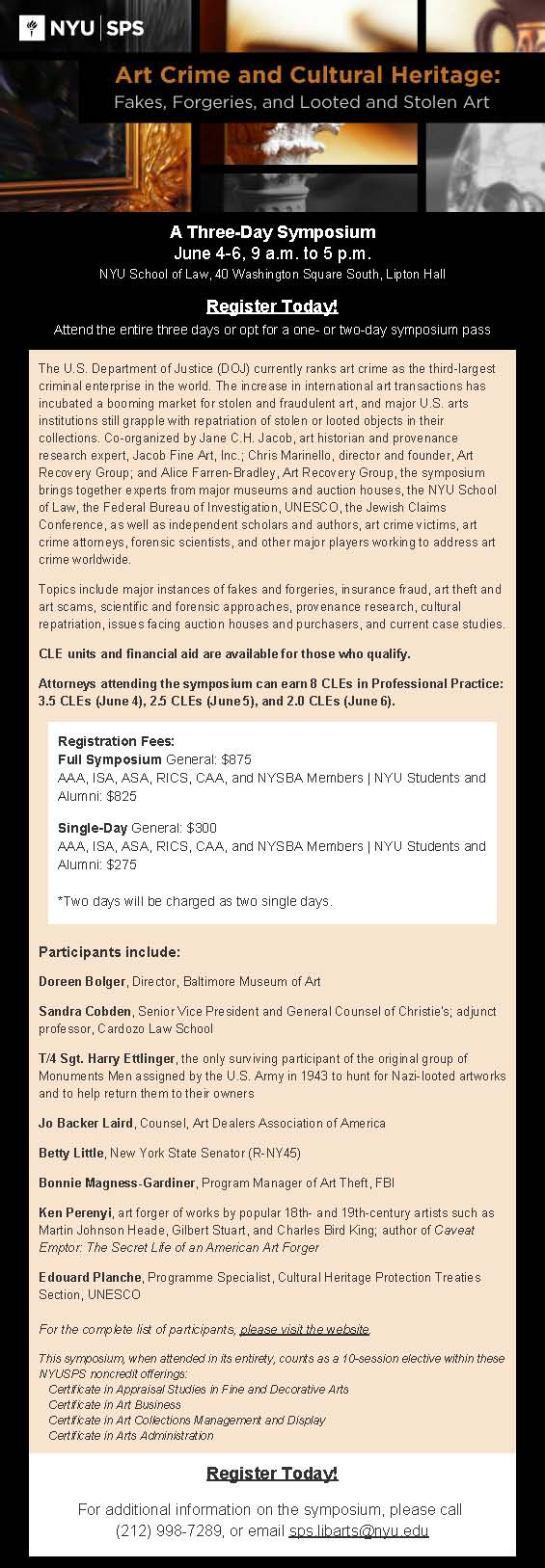
Art Crime and Cultural Heritage: Fakes, Forgeries, and Looted and Stolen Art
posted by CAA — May 05, 2015
Solo Exhibitions by Artist Members
posted by CAA — April 22, 2015
See when and where CAA members are exhibiting their art, and view images of their work.
Solo Exhibitions by Artist Members is published every two months: in February, April, June, August, October, and December. To learn more about submitting a listing, please follow the instructions on the main Member News page.
April 2015
Mid-Atlantic

Matthew Conboy. Silver Eye Center for Photography, Pittsburgh, Pennsylvania, January 16–March 21, 2015. Photography.

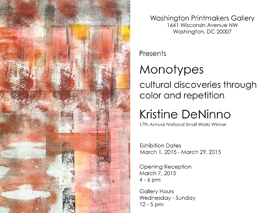 Invitation card for Kristine DeNinno’s exhibition at Washington Printmakers Gallery
Kristine DeNinno. Washington Printmakers Gallery, Washington, DC, March 1–29, 2015. Monotypes – Cultural Discoveries through Color and Repetition. Monotypes.
Christopher Meerdo. Silver Eye Center for Photography, Pittsburgh, Pennsylvania, January 16–March 21, 2015. Objects in mirror are closer than they appear. Photography.
Kameelah Rasheed. Vox Populi, Philadelphia, Pennsylvania, February 6–March 1, 2015. No Instructions for Assembly, IV. Installation of self-authored texts, original photographs, and found texts, objects, and photographs.
Midwest
Les Barta. Performing Arts Center Gallery, Illinois Central College, Peoria, Illinois, March 18–April 15, 2015. Flowers and Phenomena. Photoconstructions.
Northeast
Lorna Ritz. Oxbow Gallery, Northampton, Massachusetts, April 2–26, 2015. Painting and Drawings: Lorna Ritz. Painting and drawing.
West
Les Barta. Cace Gallery, Morgan Community College, Morgan, Colorado, April 22–June 5, 2015. Flowers and Phenomena. Photoconstructions.
Ken Gonzales-Day. Luis De Jesus Los Angeles, Los Angeles, California, April 4–May 9, 2015. Run Up. Photography and film.
Hazel Antaramian Hofman. Fig Tree Gallery, Fresno, California, March 5–29, 2015. /‘ôltər/ pieces II. Painting.
People in the News
posted by CAA — April 17, 2015
People in the News lists new hires, positions, and promotions in three sections: Academe, Museums and Galleries, and Organizations and Publications.
The section is published every two months: in February, April, June, August, October, and December. To learn more about submitting a listing, please follow the instructions on the main Member News page.
April 2015
Academe

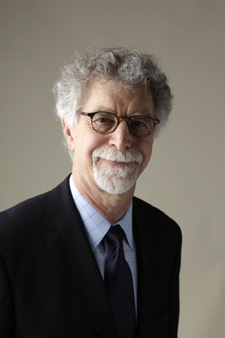 Raymond Allen
Raymond Allen, a painter, professor, and longtime vice president of academic affairs and provost at Maryland Institute College of Art in Baltimore, will retire in June 2015.
Leslie Bellavance, currently dean, director of graduate programs, and professor in the School of Art and Design at Alfred University’s New York State College of Ceramics, has been named president of Kendall College of Art and Design at Ferris State University in Big Rapids, Michigan. Her appointment begins on July 1, 2015.
Susan Best has become convenor of fine art and art theory in the Queensland College of Art at Griffith University in South Brisbane, Australia.
David Bogen, currently vice president academic and provost at Emily Carr University of Art and Design in Vancouver, British Columbia, has been appointed provost and vice president of academic affairs at Maryland Institute College of Art in Baltimore, effective August 2015.

 Tanya Sheehan
Tanya Sheehan, associate professor of art at Colby College in Waterville, Maine, has earned tenure at her school.
Museums and Galleries
Margaret C. Conrads, formerly deputy director of art and research at the Amon Carter Museum of American Art in Fort Worth, Texas, has been appointed director of curatorial affairs at the Crystal Bridges Museum of American Art in Bentonville, Arkansas.
Anne Hawley, director of the Isabella Stewart Gardner Museum in Boston, Massachussetts, has announced her retirement after twenty-five years of service. She will step down at the end of 2015.
Katherine Jentleson, a doctoral candidate in art history at Duke University in Durham, North Carolina, has been appointed the inaugural Merrie and Dan Boone Curator of Folk and Self-Taught Art at the High Museum of Art in Atlanta, Georgia.
David Joselit, distinguished professor of art history at the Graduate Center, City University of New York, has joined the board of directors of Artists Space in Manhattan.

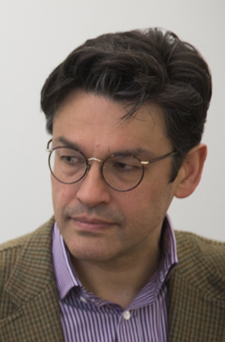 Narayan Khandekar (photograph provided by Harvard Art Museums
Narayan Khandekar, senior conservation scientist in the Harvard Art Museums’ Straus Center for Conservation and Technical Studies in Cambridge, Massachusetts, has become the center’s director.

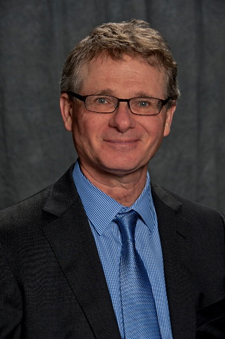 Thomas Kren
Thomas Kren, associate director for collections at the J. Paul Getty Museum in Los Angeles, California, will retire from his position in October 2015.
Kate Kunau, a doctoral candidate in the School of Art and Art History at the University of Iowa in Iowa City, has become associate curator at the Cedar Rapids Museum of Art in Cedar Rapids, Iowa.
Jeongho Park, formerly Anne L. Poulet Curatorial Fellow at the Frick Collection in New York, has become curatorial research associate for the Department of Prints and Drawings at the Blanton Museum of Art, part of the University of Texas at Austin.
Lowery Stokes Sims, chief curator of the Museum of Arts and Design in New York, has retired from the museum.
David Stark, previously director of administration for museum education at the Art Institute of Chicago in Illinois, has been appointed chief curator of the Columbus Museum of Art in Ohio.
Michael Taylor has left his position as director of Dartmouth University’s Hood Museum of Art in Hanover, New Hampshire.
Daniel H. Weiss, an art historian and president of Haverford College in Haverford, Pennsylvania, has been named president of the board of trustees at the Metropolitan Museum of Art in New York.
Chris Yates, formerly director of CORE Studio and associate professor of art at the Columbus College of Art and Design in Ohio, has become assistant director of Gund Gallery at Kenyon College in Gambier, Ohio.
Organizations and Publications
Michael Conforti, director of the Sterling and Francine Clark Art Institute in Williamstown, Massachusetts, has announced his retirement. He will leave the institute in summer 2015.
Joni Doherty, formerly director of the New England Center for Civic Life at Franklin Pierce University in Rindge, New Hampshire, has accepted a position as program officer for the Kettering Foundation in Dayton, Ohio.