CAA News Today
Affiliated Society News for September 2012
posted by CAA — September 09, 2012
Art Libraries Society of North America

Windows on the War: Soviet Tass Posters at Home and Abroad, 1941–1945, edited by Peter Kort Zegers and Douglas W. Druick, won the 2011 George Wittenborn Memorial Book Award
The 2012 George Wittenborn Memorial Book Award Committee of the Art Libraries Society of North America (ARLIS/NA) welcomes submissions of notable art books published in North America during 2012. This prestigious award is presented annually to publications demonstrating excellence in art publishing. Established by ARLIS/NA in 1980, the award honors the memory of George Wittenborn (1905–1974), a premier New York art-book dealer and publisher who was a strong supporter of ARLIS/NA in its formative years. Each year, eligible titles are evaluated for excellence in standards of content, documentation, layout, and format. From these titles, one exemplary publication will be chosen to receive the George Wittenborn Memorial Book Award. Titles eligible for consideration include books (print and electronic), exhibition catalogues, and new periodical titles in any language, published in 2012 and originating from a North American publisher. Publications submitted by foreign publishers with North American offices must have been authored or edited in North America. The book-selection guidelines, entry form, and application address can all be found online. The deadline for consideration is December 31, 2012; the presentation of the awards will take place in April 2013 during the ARLIS/NA forty-first annual conference in Pasadena, California.
Association for Modern and Contemporary Art of the Arab World, Iran, and Turkey
The Association for Modern and Contemporary Art of the Arab World, Iran, and Turkey (AMCA) held its second annual conference, “The Longevity of Rupture: 1967 in Art and Its Histories,” at the American University in Beirut. Lebanon, on June 1–2, 2012.
AMCA is currently accepting submissions for the Rhonda A. Saad Prize for Best Graduate Paper in Modern Arab Art, 2012. In its second year, the award aims to recognize and promote excellence in the field of modern and contemporary Arab art. The prize is offered to a graduate student working in any discipline whose paper is judged to provide the most significant contribution to Middle Eastern studies and art history. Submissions must have been produced between June 2011 and September 2012, must not exceed thirty-five pages (excluding notes and bibliography), and must not have been previously published or be currently under consideration for publication. Submissions are due by September 30, 2012, and should be emailed to info@amcainternational.org. The winner will be announced during the AMCA members meeting, held at the Middle East Studies Association annual meeting in Denver, Colorado, in November 2012.
Association of Historians of American Art
Join the Association of Historians of American Art (AHAA) on October 11 to 13, 2012, for its second symposium, “American Art: The Academy, Museums, and the Market,” in Boston, Massachusetts. The keynote speaker is Holland Cotter, art critic for the New York Times. The Boston Athenaeum and Boston University will host the sessions; additional events include a special viewing of the newly installed Art of the Americas wing at the Museum of Fine Arts, Boston, and a reception at the Boston University Art Gallery. The full symposium schedule of speakers and registration information can be found at the conference website. Hurry! Registration is only open until September 15, 2012, and there are a limited number of spaces available. For more information, please contact the symposium cochairs, David Dearinger and Melissa Renn.
Historians of British Art
The Historians of British Art (HBA) has moved up the application deadline of its annual travel grant in order to give the successful applicant more lead-up time to plan his or her travel in calendar year 2013. This grant of $750 is intended to help offset travel costs incurred by a graduate-student member of HBA who will be presenting a paper on British visual culture at an academic conference. To apply, please send a letter of request, a copy of the letter of acceptance from the organizer of the conference session, an abstract of the paper to be presented, a budget of estimated expenses (noting what items may be covered by other resources), and a CV to Renate Dohmen, grant committee chair. The deadline for the 2013 application is September 15, 2012, with notification to the winner by October 15, 2012. An annual student membership in HBA is only $15; consider joining today.
Historians of Netherlandish Art
The next formal deadline for submitting manuscripts to the Journal of Historians of Netherlandish Art, the peer-reviewed, open-access ejournal published by the Historians of Netherlandish Art (HNA), is March 1, 2013. In addition to longer articles, the journal now welcomes shorter notes on archival discoveries, iconographical issues, technical studies, and rediscovered works. Please review the submission guidelines or contact the journal’s editor-in-chief, Alison Kettering, for more information.
Historians of Islamic Art Association

The Historians of Islamic Art Association (HIAA) would like to remind fellow CAA affiliates and members that registration for our third biennial symposium, “Looking Widely, Looking Closely,” hosted by the Metropolitan Museum of Art in New York, October 18–20, 2012, remains open. HIAA is pleased to offer a reduced rate for student members ($35). For more information about the symposium program, and about travel accommodations in New York, please visit the HIAA website.
International Sculpture Center
The International Sculpture Center (ISC) is accepting nominations for the 2013 Outstanding Educator Award, which recognizes individual artist-educators who have excelled at teaching sculpture in institutions of higher learning. Candidates for this award are master sculptors who have devoted their careers to the education of the next generation and to the advancement of the sculpture field as a whole. Nominations for the award will be accepted from September 3 through October 26, 2012. Anyone can nominate a qualified educator: submissions are not limited to United States participants, and international submissions are welcomed and encouraged. Award recipients receive benefits such as a featured article in Sculpture, a lifetime ISC professional-level membership, and an award ceremony to be held at their academic institution. Educational institutions of awardees also receive benefits, including recognition in Sculpture and a one-year ISC university-level membership.
Leonardo Education and Art Forum
The Leonardo Education and Art Forum (LEAF) has welcomed David Familian as its new chair-elect. Familian, an artist and educator, has served as the artistic director of the Beall Center for Art and Technology at the University of California, Irvine, since 2005. He has curated one-person exhibitions of Shih Chieh Huang, Golan Levin, Rafael Lozano-Hemmer, Chico MacMurtrie, Jennifer and Kevin McCoy, Nam June Paik, and Victoria Vesna.
LEAF seeks contributions to a scholarly project that examines interdisciplinary curricula that span the art, science, and humanities fields. Interested participants should send examples of courses and curricula in areas such art and biology, music and mathematics, art and chemistry, dance and environmental sciences, and similar pairings. The project, a relaunch of a similar call issued in 2009, is spearheaded by Roger Malina, Leonardo executive editor, and Kathryn Evans, a doctoral student at the University of Texas at Dallas. Please address all questions and syllabi or curricula information to Kathryn Evans.
Jill Scott of Z-Node and Ellen K. Levy, former chair of LEAF and an advisor for the Institute for Doctoral Studies in the Visual Arts, are cochairs of a panel for the eighteenth International Symposium on Electronic Art (ISEA), taking place September 19–24, 2012, in Albuquerque, New Mexico. Their panel, “Synaptic Scenarios for Ecological Environments,” will addresses cognitive issues in relation to ecology with the goal of gaining a greater embodied sense of place within the ecological environment. Another ISEA panel is “Eco-Art + the Evolving Landscape of Social and Situated Practices,” moderated by Patricia Olynyk, an artist and LEAF chair. The panel will focus on education and the complex triad of ecoart, situated practices, and project-based public work that embrace various democratic processes and inspire progressive social, cultural, and environmental change. “Breaking Tradition: Rethinking the Economy of Learning,” an education workshop for ISEA 2012 convened by Nina Czegledy, former chair of LEAF, will discuss the latest developments of educational policy investigations and evaluate the role of educational research and existing educational business strategies, financial modeling, and risk management. Olynyk and Adrienne Klein, incoming LEAF cochair, will moderate the panel “Art and Medicine: Reciprocal Influence” at the 2013 CAA Annual Conference in New York, taking place February 13–16, 2013. Their panel will explore the impact of medicine on artistic practice, of creative process on medical research, and of the idea of the artist’s body as subject matter. Joseph Lewis III of the University of California, Irvine, will moderate a second panel at the CAA conference, called “Re/Search: Art, Science, and Information Technology (ASIT): What Would Leonardo da Vinci Have Thought?”.
Mid-America College Art Association
Save the date for the Mid-America College Art Association (MACAA) biannual conference, taking place October 3–6, 2012, in Detroit, Michigan. The James Pearson Duffy Department of Art and Art History at Wayne State University will host the conference in downtown Detroit. Programming will include three featured speakers; panel presentations in art, design, art history, and visual resources; and studio workshops, MACAA member exhibitions, and museum visits. The conference will have two content areas, “Meaning and Making” and “Community and Collaboration.” Visit the conference website to learn more about the event, to check travel and hotel information, and to become an MACAA member.
National Council of Arts Administrators

From November 7 to 10, 2012, Ohio State University and Columbus College of Art and Design in Ohio will host “Granting Permission“ the fortieth annual conference of the National Council of Arts Administrators (NCAA). The event will focus on a reexamination of the importance of arts and art education as professionals face “occasions piled high with difficulty.” The conference will also spotlight current trends in arts administration; offer forums, speakers, and workshops; and create opportunities to network within a diverse community of higher-education arts professionals. You can expect top-notch speakers, timely and forward-looking sessions, an engaging administrator’s workshop, and much more. NCAA enthusiastically welcomes new members and any interested parties to its events.
Northern California Art Historians

The Northern California Art Historians (NCAH) has inaugurated an annual travel award for promising emerging scholars. Cheyanne Cortez, a master’s degree candidate at San José State University in California, received the award in recognition of her paper, “The Ladies’ American Girl: Delineating an Age through the Ladies Home Journal,” presented at the Women in Magazines conference held at Kingston University in London, June 22–23, 2012. The NCAH gives its sincere thanks to the anonymous donor who generously contributed $300 for this year’s award.
Public Art Dialogue
Public Art Dialogue (PAD) has announced Penny Balkin Bach as the 2013 recipient of the PAD award in recognition of her longstanding and continuing contributions to the field of public art. Join the dialogue with PAD’s newest awardee at the 2013 CAA Annual Conference in New York. More information will be available soon.
Public Art Dialogue is now accepting submissions for its upcoming special issue, “Memorials: The Culture of Remembrance.” This issue seeks to explore memorials in regard to their range of subjects, various formal and conceptual strategies, and critical issues pertaining to their study. PAD welcomes submissions that address related topics (except war or peace, covered in the previous issue) from any time period or place. Please see the journal website for guidelines. The submission deadline is September 15, 2012.
Society for Photographic Education
The Society for Photographic Education (SPE) seeks curators, professors, gallerists, art historians, and scholars to review student and/or professional member portfolios at SPE’s fiftieth annual conference, taking place March 7–10, 2013, in Chicago, Illinois. Portfolio reviewers receive a discounted admission to the four-day event in exchange for their participation. For more information on the conference offerings and to express interest in serving as a portfolio reviewer, please contact SPE. The deadline for portfolio review is November 15, 2012; the deadline for conference registration is February 22, 2013.
Society of North American Goldsmiths

The Society of North American Goldsmiths (SNAG) will hold their forty-second annual conference on May 15–18, 2013, in Toronto, Canada. Titled “Meta-Mosaic,” the event will celebrate the multiple industries within jewelry and metal-smithing in the twenty-first century. Toronto is a mosaic of peoples and cultures as well as the center of Canada’s jewelry industry. This conference will examine a fluid identity within art, craft, and design and inspire attendees to embrace our collective mosaic. Join SNAG for presentations and panels featuring industry luminaries from across the globe, rapid-fire presentations by international designers and artists, and over twenty exhibitions.
Southeastern College Art Conference
The sixty-eighth annual meeting of the Southeastern College Art Conference (SECAC), hosted by Meredith College, will be held in historic Durham, North Carolina, from October 17 to 20, 2012. SECAC membership is required to attend and to participate in the conference; registration opened on August 1, 2012. Please visit the website for registration fees, travel and accommodation details, and local information on Durham. Questions? Please contact Beth Mulvaney, conference chair for SECAC 2012.
Women’s Caucus for Art
The Women’s Caucus for Art (WCA) will present “Honoring Women’s Rights,” a conference and exhibition in celebration of WCA’s fortieth anniversary, taking place September 7–9, 2012, at the National Steinbeck Center in Salinas, California. The conference will feature a celebrated roster of speakers and panelists, including Malissa Feruzzi Shriver, California Arts Council chair, as well as Louise Bernikow, Sandra Fluke, Judy Baca, Flo Oy Wong, Kim Abeles, Ani Zonneveld, Emelia Fuentes Grant, Enid Blader, Geri Montano, Jane Schonberger, Laurie Frank, Linda Bynoe, Marta Donayre, Martha Richards, Melanie Cervantes, Pia Guerrero, and Thea Iberall. The speakers will cover a wide range of topics related to art, activism, and women’s rights. Works of art were juried by Ruth Weisberg, Joyce Aiken, and Patricia Rodriguez and will remain on view through November 25, 2012.
Solo Exhibitions by Artist Members
posted by CAA — August 22, 2012
See when and where CAA members are exhibiting their art, and view images of their work.
Solo Exhibitions by Artist Members is published every two months: in February, April, June, August, October, and December. To learn more about submitting a listing, please follow the instructions on the main Member News page.
August 2012
Abroad

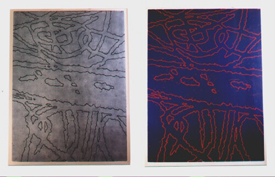 Two podographs by Mark Staff Brandl, 2012 (artwork © Mark Staff Brandl)
Mark Staff Brandl. Saint Mangen Church and Exhibition Space, Saint Gallen, Switzerland, May 25–August 17, 2012. Podographs in Church. Monoprints.

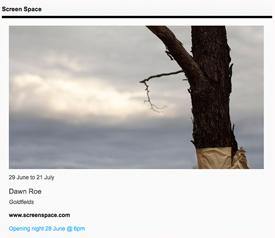 Exhibition announcement in Art Guide Australia reproducing Dawn Roe, Goldfields, 2012, video still, three-channel HD video installation, 5:29 min (artwork © Dawn Roe)
Dawn Roe. Screen Space, Melbourne, Victoria, Australia, June 29–July 21, 2012. Goldfields. Video installation.
Mid-Atlantic

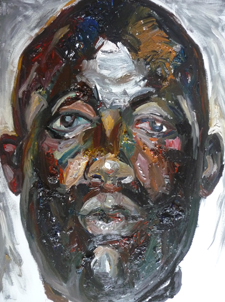 Elise Dodeles, San Francisco Area Fighter 956, 2012, oil on linen, 30 x 40 in. (artwork © Elise Dodeles)
Elise Dodeles. Quiet Life Gallery, Lambertville, NJ, August 10–September 30, 2012. Fearless: Fighters’ Portraits by Elise Dodeles. Painting.

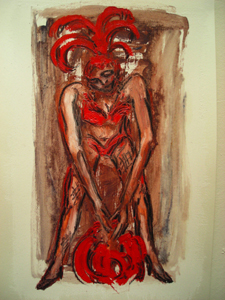 Jan Wurm, Showgirls, 2012, mixed media on paper, approximately 18 x 14 in. (artwork © Jan Wurm)
Jan Wurm. Christine Fréchard Gallery, Pittsburgh, Pennsylvania, August 18–September 21, 2012. Jan Wurm: Serious Play. Painting.
Midwest

Adriane Herman. Western Exhibitions, Chicago, Illinois, May 25–June 30, 2012. Adriane Herman. Mixed media.
Northeast
Francis Cape. ICA at MECA, Porteous Building, Maine College of Art, Portland, Maine, June 13-August 5, 2012. Utopian Benches. Sculpture.

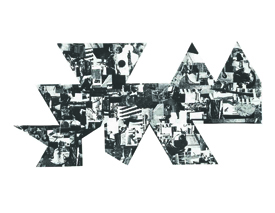 Thomas Lail, Untitled (Map II), 2011, cut paper on paper, 30 x 40 in. (artwork © Thomas Lail)
Thomas Lail. Architecture Omni, Omi International Arts Center, Ghent, New York, July 7–late 2012. Thomas Lail: Notes for the Future. Xerography painting, works on paper, and outdoor sculpture.
South
Reni Gower. Sawhill Gallery, James Madison University, Harrisonburg, Virginia, August 27–October 13, 2012. Strange Loops: Thirty Years of Painting. Painting.

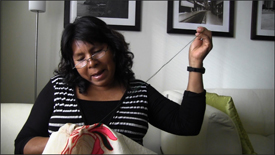 Maria Lino, still from Drawn Stitches, 2012, color video with sound (artwork © Maria Lino)
Maria Lino. Patricia and Philip Frost Art Museum, Florida International University, Miami, Florida, July 18–September 30, 2012. Shared Threads: Maria Lino’s Portrait of a Shipibo Healer. Video.

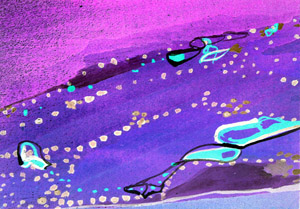 Jennifer Laura Palmer, Untitled I from the A Little World All to Myself series, 2012, mixed media on poplar, 3½ x 4¼ in. (artwork © Jennifer Laura Palmer)
Jennifer Palmer. Westbrook Gallery, Ferst Center for the Arts, Georgia Institute of Technology, Atlanta, Georgia, July 2–August 31, 2012. Lost in the Sea. Painting and drawing.
West

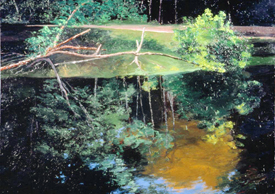 Diane Burko, Petit Creuse, Wissahickon, 1995, oil on canvas, 65 x 92 in. (artwork © Diane Burko)
Diane Burko. LewAllen Gallery, Santa Fe, New Mexico, June 8–July 15, 2012. Diane Burko: Water Matters. Painting.

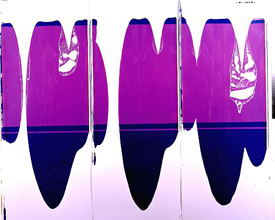 Ellen Carey, Pulls with Filigrees and Pod Mixes, 2005, three Polaroid 20 x 24 color positive prints, 80 x 22 each or 80 x 66 total (artwork © Ellen Carey)
Ellen Carey. Joseph Bellows Gallery, La Jolla, California, June 2–July 14, 2012. Ellen Carey: Photography Degree Zero. Polaroid lens-based art.
People in the News
posted by CAA — August 17, 2012
People in the News lists new hires, positions, and promotions in three sections: Academe, Museums and Galleries, and Organizations and Publications.
The section is published every two months: in February, April, June, August, October, and December. To learn more about submitting a listing, please follow the instructions on the main Member News page.
August 2012
Academe

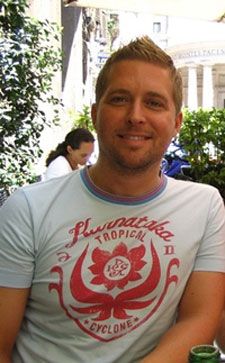 Sinclair Bell
Sinclair Bell, assistant professor of art history at Northern Illinois University in Dekalb, has been granted tenure and promoted to the rank of associate professor. Bell is a specialist in ancient Roman and Etruscan art.

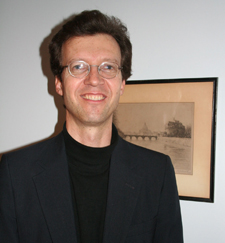 Charles S. Buchanan
Charles S. Buchanan, associate professor of art and architectural history at Ohio University in Athens, has been named interim director of the School of Interdisciplinary Arts, a doctoral program within the university.

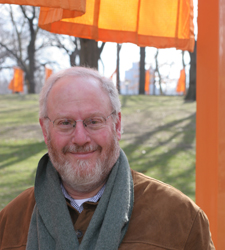 Jonathan Fineberg
Jonathan Fineberg, the Gutgsell Professor of Art History Emeritus at the University of Illinois in Urbana-Champaign, has been appointed the Visiting Presidential Professor at the University of Nebraska in Lincoln for academic year 2012–13. Fineberg will deliver four lectures that address modern art, neuroscience, and the “origin of the image.”

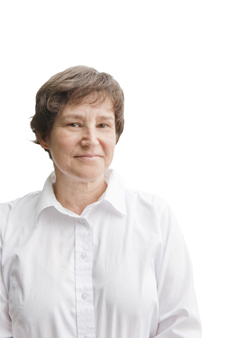 Amy Hauft
Amy Hauft, an artist and chair of the Sculpture Department at Virginia Commonwealth University in Richmond, has joined the University of Texas at Austin as the Leslie Waggener Professor of Art in the College of Fine Arts.
Kriszta Kotsis, an assistant professor of ancient and medieval art, has been granted tenure by the University of Puget Sound in Tacoma, Washington.
Sara M. Picard has accepted a position as assistant professor of art history at Rhode Island College in Providence.

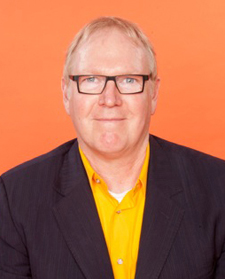 Jack Risley
Jack Risley, an artist and associate dean of academic affairs at Virginia Commonwealth University in Richmond, has been hired by the University of Texas at Austin to be Ruth Head Centennial Professor and chair of the school’s Department of Art and Art History.

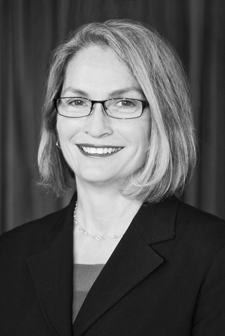 Karen M. Wirth (photograph by Rik Sferra)
Karen M. Wirth, an artist, professor, and former chair of the Fine Arts Department at the Minneapolis College of Art and Design in Minnesota, has been appointed vice president of academic affairs at her school.
Museums and Galleries
Lisa Hostetler, curator of photographs at the Milwaukee Art Museum in Wisconsin, will join the Smithsonian American Art Museum in Washington, DC, as its new curator of photography. In her seven years at the Milwaukee Art Museum, Hostetler was responsible for many critically acclaimed exhibitions, including the first major survey of the photographer Taryn Simon.
Barbara Buhler Lynes, curator at the Georgia O’Keeffe Museum in Santa Fe, New Mexico, has resigned her position at the museum. Lynes was the museum’s first curator as well as its Emily Fisher Landau Director of the museum’s research center.

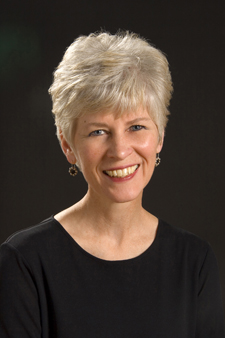 Patricia McDonnell
Patricia McDonnell, director of the Ulrich Museum of Art at Wichita State University in Kansas, has accepted a position as the executive director of the Wichita Art Museum. A member of the CAA Board of Directors, McDonnell succeeds Charles K. Steiner, who stepped down as executive director at the end of 2011 after twelve years of service.

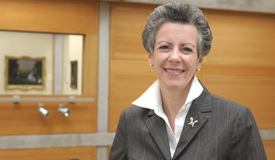 Amy Meyers
Amy Meyers, director of the Yale Center for British Art in New Haven, Connecticut, has been reappointed for a third five-year term as director.

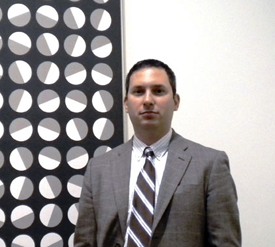 Matthew Palczynski
Matthew Palczynski, staff lecturer for Western art at the Philadelphia Museum of Art in Pennsylvania, has been appointed curator of the Woodmere Art Museum, also in Philadelphia.
Daniel H. Weiss, a scholar of medieval art and the president of Lafayette College in Easton, Pennsylvania, has been chosed to lead Haverford College in Haverford, Pennsylvania, as president, He begins the new position in July 2013.

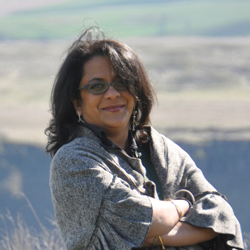 Namita Gupta Wiggers
Namita Gupta Wiggers, a curator at the Museum of Contemporary Craft, in partnership with Pacific Northwest College of Art in Portland, Oregon, has been named the director and chief curator of the museum.
Organizations and Publications
Thomas W. Lollar, a ceramicist and scholar of fine-art prints, has left his position as director of the Brodsky Center for Innovative Editions at Rutgers University in New Brunswick, New Jersey. He will join Paul Limperopulos as codirector of the Benefit Print Project in New York.
Dena Muller has been appointed to the newly established position of director of new initiatives at the New York Foundation for the Arts, based in Brooklyn. Previously, Muller was the executive director at ArtTable in New York, an organization that promotes women in the arts through outreach programs and mentorship.
Institutional News
posted by CAA — August 17, 2012
Read about the latest news from institutional members.
Institutional News is published every two months: in February, April, June, August, October, and December. To learn more about submitting a listing, please follow the instructions on the main Member News page.
August 2012
The Amon Carter Museum of American Art in Fort Worth, Texas, has received a $75,000 grant from the National Endowment for the Humanities to support an online cataloguing project of eight American photographers of the twentieth century: Carlotta Corpron, Nell Dorr, Laura Gilpin, Eliot Porter, Helen Post, Clara Sipprell, Erwin E. Smith, and Karl Struss.

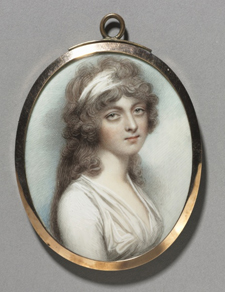 Andrew Plimer, Portrait of Anna Walmesley, 1795, watercolor on ivory, 2½ x 3 3/16 in. (artwork in the public domain)
The Cleveland Museum of Art in Ohio is creating an online catalogue of fifty-four British portrait miniatures from the museum’s collection of miniature painting from the seventeenth, eighteenth, and nineteenth centuries. The catalogue will allow the paintings to be viewed at actual size and in great detail; an essay by Cory Korkow, a curatorial fellow at the museum, will accompany the work.
The Indianapolis Museum of Art in Indiana has received a $190,000 grant from the National Endowment for the Humanities to digitize and catalogue primary materials about Miller House and Garden, a modernist home designed by Eero Saarinen that was registered as a national historic landmark in 2000 and is owned and cared for by the museum. The collection includes blueprints, correspondence, textile samples, sketches, and photographs related to the house.
The University of the Arts in Philadelphia, Pennsylvania, is the recipient of a $500,000 gift from a university trustee, Irvin J. Borowsky, and his wife, Laurie Wagman, to establish the annual Irvin Borowsky Prize in Glass Art. The donation will also fund the Irvin Borowsky Center for Glass Arts, a 3,700-square-foot studio and exhibition space.
The Wadsworth Atheneum Museum of Art in Hartford, Connecticut, has been awarded a $2 million grant from the Connecticut State Bond Commission and an additional $2.5 million from foundations and individuals to support an extensive renovation due to be completed in 2014. Affecting 70,000 square feet, the project will focus on creating additional gallery space, energy conservation, and improving storage facilities.
Grants, Awards, and Honors
posted by CAA — August 15, 2012
CAA recognizes its members for their professional achievements, be it a grant, fellowship, residency, book prize, honorary degree, or related award.
Grants, Awards, and Honors is published every two months: in February, April, June, August, October, and December. To learn more about submitting a listing, please follow the instructions on the main Member News page.
August 2012
Hartmut Austen, a painter, has been appointed Grant Wood Fellow in Painting and Drawing at the School of Art and Art History at the University of Iowa in Iowa City for academic year 2012–13. The fellowship comes with the faculty rank of visiting assistant professor; studio space is provided for independent work.


Lacey Baradel, a doctoral candidate in art history at the University of Pennsylvania in Philadelphia, has been awarded a Henry Luce Foundation/American Council of Learned Societies Dissertation Fellowship in American Art. Baradel’s dissertation is titled “Mobile Americans: Locomotion and Identity in US Visual Culture, ca. 1860–1915.”

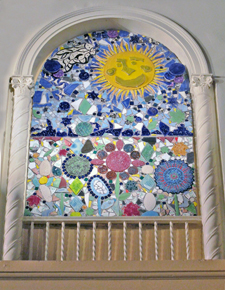 Julia Whitney Barnes, in collaboration with members of the Sirovich Senior Center, view of one section of Refracted Nature, 2012, mixed-media mosaic (artwork © Julia Whitney Barnes)
Julia Whitney Barnes, an artist based in Brooklyn, New York, received a commission to design and install a permanent public mosaic at the Sirovich Senior Center in Manhattan’s East Village, where she had been an artist in residence. With support from the Lower Manhattan Cultural Council and the New York City Department of Cultural Affairs, Barnes unveiled the mosaic in June 2012.
Phillip Bloom, a PhD candidate in the Department of History of Art and Architecture at Harvard University in Cambridge, Massachusetts, had been granted a Mellon Foundation/American Council of Learned Societies Dissertation Completion Fellowship for “Descent of the Deities: Early Icons of the Water-Land Ritual and the Transformation of the Visual Culture of Song (960–1279) Religion.”

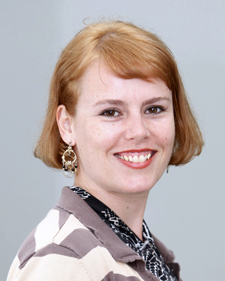 Caetlynn Booth (photograph by J Somers Photography, LLC)
Caetlynn Booth, an American artist living and working in Berlin, Germany, has been awarded a DAAD Fellowship for 2012–13 and a grant from the John Hanson Kittredge Fund for her current painting and research project, “The Work of Adam Elsheimer and the Spiritual Power of Painting,” which she began as a Fulbright fellow in 2011.
Katherine Colin, a painter and an MFA student at the University of Dallas in Texas, has won a 2012 Arch and Anne Giles Kimbrough Fund Award from the Dallas Museum of Art. Open to residents of Texas under the age of thirty, the Kimbrough fund was established in 1980 to recognize exceptional talent and potential in young visual artists who show a commitment to continuing their artistic endeavors.
Jess Riva Cooper, a sculptor from Toronto, Canada, has been awarded a scholarship for a summer residency at the Archie Bray Foundation in Helena, Montana. Cooper’s residency will be funded by a Windgate Scholarship, which provides a $700 grant for each recipient.
Andrew Eschelbacher, a doctoral candidate in art history in the Department of Art History and Archaeology at the University of Maryland in College Park, has received a Mellon Foundation/American Council of Learned Societies Dissertation Completion Fellowship for his dissertation, “Labor in the Cauldron of Progress: Jules Dalou, the Inconstant Worker, and Paris’s Memorial Landscape.”
Andrew Gilliatt, a ceramicist, has received the Speyer Fellowship from the Archie Bray Foundation in Helena, Montana. The fellowship comprises a $5,000 award and a one-year residency at the foundation to pursue independent work.

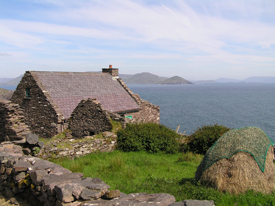 View of Cill Rialaig Artist’s Village in Ireland
Heather Ryan Kelley, professor of art at McNeese State University in Lake Charles, Louisiana, has been awarded a residency at the Cill Rialaig Project in County Kerry, Ireland. She will work on a series of prints, artist books, and collages based on James Joyce’s Finnegans Wake.
Miriam Kienle, a doctoral candidate in art history in the School of Art and Design at the University of Illinois in Urbana-Champaign, has received a Henry Luce Foundation/American Council of Learned Societies Dissertation Fellowship in American Art. Kienle’s dissertation is titled “Community at a Distance: The Networked Art of Ray Johnson.”
Debbie Kupinsky, a ceramicist and sculptor from Appleton, Wisconsin, has been awarded a Windgate Scholarship of $700 to attend a summer residency at the Archie Bray Foundation in Helena, Montana.
Matthew Levy, a PhD candidate at the Institute of Fine Arts, New York University, has accepted a Henry Luce Foundation/American Council of Learned Societies Dissertation Fellowship in American Art. Levy is working on a dissertation, “Abstract Painting after the Minimalist Critiques: Robert Mangold, David Novros, Jo Baer,” that examines the practice of three painters.
Emily Liebert, a doctoral candidate in the Department of Art History and Archeology at Columbia University in New York, has been awarded a Henry Luce Foundation/American Council of Learned Societies Dissertation Fellowship in American Art for “Roles Recast: Eleanor Antin and the 1970s.”
Joseph Madura, a doctoral student in the Art History Department at Emory University in Atlanta, Georgia, has earned a Henry Luce Foundation/American Council of Learned Societies Dissertation Fellowship in American Art for his research project, “Minimal Art in the AIDS Crises: 1984–1998.”
Christopher Oliver, a PhD candidate in the McIntire Department of Art at the University of Virginia in Charlottesville, has earned a Henry Luce Foundation/American Council of Learned Societies Dissertation Fellowship in American Art. Oliver’s dissertation is titled “Civic Visions: The Panorama and Popular Amusement in American Art and Society, 1845–1870.”
Mike Osbourne, an artist based in Austin, Texas, whose work examines the intersection of technology, urbanism, and the landscape, has earned a 2012 Otis and Velma Dozier Travel Grant from the Dallas Museum of Art. Osborne will travel to the Brazil and Peru to conduct research for a photography and video project that will address how the mythologized Amazonian landscape collides with the forces of modernity.
Julie Anne Plax, professor of art history at the University of Tucson in Arizona, has earned a 2012–13 John H. Daniels Fellowship from the National Sporting Library and Museum, based in Middleburg, Virginia. During her scholar in residence, Plax will work on a book project called “J. B. Oudry’s Tapestry Series Les Chasses Royales, the Chasse à Courre, and Royal Identity.”
Lisa Pon, associate professor of art history at Southern Methodist University in Dallas, Texas, has received an American Council of Learned Societies Fellowship for her project, “Venice and the Early Modern Plague.”
Austin Porter, a doctoral candidate in the Department of History of Art and Architecture at Boston University in Massachusetts, has been awarded a Henry Luce Foundation/American Council of Learned Societies Dissertation Fellowship in American Art for his research project, “Paper Bullets: The Visual Culture of American World War II Print Propaganda.”
Britt Ragsdale, an artist based in Houston, Texas, has been awarded an Individual Artist Grant from the Houston Arts Alliance. The competitive grant program supports local artists working in a range of media and promotes the city as a magnet for cultural tourism.
Alice Y. Tseng, an associate professor of art history and chair of the Department of History of Art and Architecture at Boston University in Massachusetts, has been granted an American Council of Learned Societies Fellowship for her project, titled “Conspicuous Construction: New Monuments to Imperial Lineage in Modern Kyoto.”
Murtaza Vali, a freelance art critic and curator, has been named guest curator of the fifth edition of the Abraaj Capitol Art Prize. Vali joins the committee that will select the five winning artists; he will also assist the artists in completing their projects, to be exhibited at Art Dubai in March 2013.
Sandra Zalman, an assistant professor of art history at the University of Houston in Texas, has been granted an American Council of Learned Societies Fellowship for her project, “Surrealism and its Afterlife in American Art 1936–1986,” which examines the far-reaching influence Surrealism had on mass culture in the United States.
Exhibitions Curated by CAA Members
posted by CAA — August 15, 2012
Check out details on recent shows organized by CAA members who are also curators.
Exhibitions Curated by CAA Members is published every two months: in February, April, June, August, October, and December. To learn more about submitting a listing, please follow the instructions on the main Member News page.
August 2012

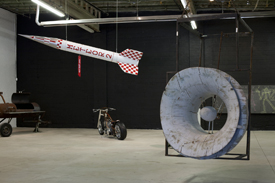 Installation view of Post-Industrial Complex (photograph by Corine Vermeulen)
Katie Grace McGowan and Jon Brumit. Post-Industrial Complex. Museum of Contemporary Art Detroit, Detroit, Michigan, May 11–July 29, 2012.
Matthew Palczynski. Haunting Narratives: Detours from Philadelphia Realism, 1935 to the Present. Woodmere Art Museum, Philadelphia, Pennsylvania, May 12–July 15, 2012.
Matthew Palczynski. Salvatore Pinto: A Retrospective Celebrating the Barnes Legacy. Woodmere Art Museum, Philadelphia, Pennsylvania, May 12–July 15, 2012.

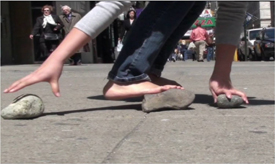 Kyoung eun Kang, video still from Islands, 2009 (artwork © Kyoung eun Kang)
Jennifer Wilkinson. Bivalence: Working Space 12. Cuchifritos, Essex Street Market, New York, July 12–August 12, 2012.
Books Published by CAA Members
posted by CAA — August 15, 2012
Publishing a book is a major milestone for artists and scholars—browse a list of recent titles below.
Books Published by CAA Members appears every two months: in February, April, June, August, October, and December. To learn more about submitting a listing, please follow the instructions on the main Member News page.
August 2012

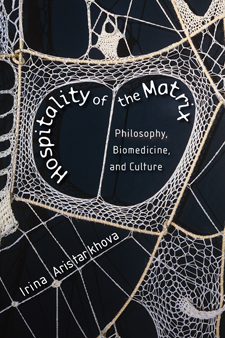
Irina Aristarkhova. Hospitality of the Matrix: Philosophy, Biomedicine, and Culture (New York: Columbia University Press, 2012).


Helene Aylon. Whatever Is Contained Must Be Released: My Jewish Orthodox Girlhood, My Life as a Feminist Artist (New York: Feminist Press, 2012).

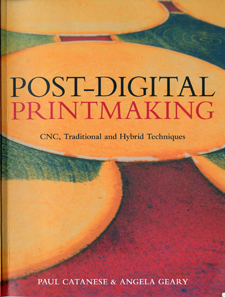
Paul Catanese and Angela Geary. Post-Digital Printmaking: CNC, Traditional, and Hybrid Processes (London: A&C Black, 2012).

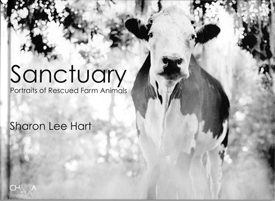
Sharon Lee Hart. Sanctuary: Portraits of Rescued Farm Animals (Milan, Italy: Charta, 2012).

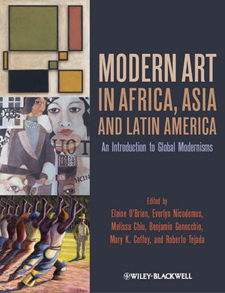
Elaine O’Brien, Everlyn Nicodemus, Melissa Chiu, Benjamin Genocchio, Roberto Tejada, and Mary C. Coffey, eds. Modern Art in Africa, Asia, and Latin America: An Introduction to Global Modernisms (Oxford, UK: Wiley-Blackwell, 2012).

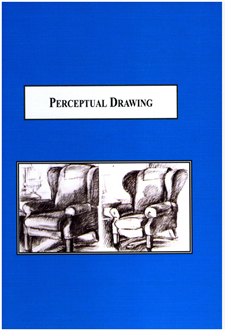
Conrad Ross. Perceptual Drawing: A Handbook for the Practitioner (Lewiston, NY: Edwin Mellen Press, 2011).

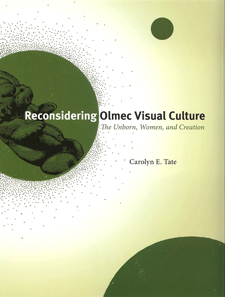
Carolyn E. Tate. Reconsidering Olmec Visual Culture: The Unborn, Women, and Creation (Austin: University of Texas Press, 2012).
Eugene F. Farrell: In Memoriam
posted by CAA — August 14, 2012
Francesca G. Bewer is research curator at the Straus Center for Conservation and Technical Studies, Harvard Art Museums.

Eugene Farrell, ca. late 1970s, in the analytical laboratory at the Center for Conservation and Technical Studies (photograph provided by the Straus Center for Conservation and Technical Studies, Harvard Art Museums)
It is with sadness that I inform you of the death of Eugene F. Farrell, former senior conservation scientist at the Harvard Art Museums’ Straus Center for Conservation and Technical Studies. Gene passed away in his sleep on March 19, 2012, in Cambridge, Massachusetts. He was 78 years old. Farrell will be remembered by generations of conservators as a generous colleague and a dedicated teacher. He was knowledgeable, calm, and open minded—qualities for which he was greatly appreciated, especially during discussions and at meetings.
Born in New Haven, Connecticut, in 1933, Farrell came to the conservation field with a background in geology. He received a BA cum laude and an MA in geology from Boston University, which he supplemented with courses in X-radiography, physics, mathematics, geochemistry, and petrology. In 1956, the same year he married Lynne Breda, he became a member of the Scientific Research Society, Sigma Xi, which “honors excellence in scientific investigation and encourages a sense of companionship and cooperation among researchers in all fields of science and engineering.” Farrell was a teaching fellow the following year at Boston University and spent the summer of 1958 studying ice cores in Thule, Greenland, as a crystallographer for Permafrost Ice Studies at the Snow, Ice, and Permafrost Research Establishment (then based in Wilmette, Illinois, and now in Hanover, New Hampshire). That led to a job as a research staff member in the Crystal Physics Laboratory of the Massachusetts Institute of Technology (1960–77), during which time he published numerous papers in the American Mineralogist, Materials Research Bulletin, and American Ceramics Society Bulletin,among others. He also collaborated on a patent for a “Cathode Ray Tube Whose Image Screen Is Both Cathodochromic and Fluorescent and the Material for the Screen.”
Farrell began his museum career in 1977 after he answered a small “help wanted” ad in the Boston Globe for analytical work at Harvard University’s Fogg Museum in the Center for Conservation and Technical Studies (CCTS). Like Rutherford John Gettens, the museum’s illustrious first staff chemist from 1928 to 1950, Farrell had no prior museum experience but quickly learned to apply his skills and knowledge to the materials of art. He started as assistant conservation scientist under the museum’s science associate, Leon Studolski, and helped to integrate petrography, Fourier transform infrared spectroscopy (FTIR), and X-ray diffraction (XRD) in the laboratory work. He was soon promoted to conservation scientist. Shortly thereafter, in 1980, he became the senior conservation scientist of the CCTS, which is now called the Straus Center for Conservation and Technical Studies. It was a position he held until his retirement in 2004.
Farrell greatly enjoyed the collaboration among scientists, curators, conservators, and students. His quiet demeanor belied his great productivity; the quality and quantity of analyses he carried out is attested by the cabinets filled with report files and by his numerous publications. Among the broad range of topics and materials he investigated were: the painting materials of Vincent van Gogh and Winslow Homer; the composition of pigments from ancient Persia and from sixteenth- to eighteenth-century house paint; and pasteprints. His research on illuminated Renaissance manuscripts found in the Historical Library of the University of Valencia in Spain, while he was a visiting professor at the Polytechnic University of Valencia in 1990 culminated in the bilingual book he coauthored with Salvador Muñoz Viñas, published in 1999. The materials of stone in Indian and Gothic art and in Chinese scholar’s rocks fascinated Farrell, as did the substance of Chinese ceramics and Baroque terracotta sculpture. He contributed to an eighteen-month project on the analysis of Gothic stone sculpture from New England collections, funded by the National Endowment for the Humanities. He also trained his analytical skills on the origins of turbidity in acrylic paints and on the metal composition of Renaissance bronze medals.
Farrell was a lecturer in history of art and architecture at Harvard University from 1984 onward, teaching courses on the “Technical Examination of Works of Art” and “The Materials of Art” and in the Harvard freshmen seminar program. His many students will remember him for his patience and courteousness: regardless of their level of scientific knowledge, they knew that they could depend on him for any help they needed. He also genuinely took pleasure in helping the Straus Center’s graduate conservation interns and fellows with their research projects and worked with them enthusiastically. Some of the projects that he oversaw were of great interest to the museum community at large. For instance, in 1984–85, under the guidance of Farrell and the center’s director Arthur Beale, Pamela Hatchfield and Jane Carpenter undertook the first major investigation of the potential effects of formaldehyde and formic acid on museum collections.
Farrell, along with Beale and a fellow conservation scientist, Richard Newman, publicized the effects of acid rain on outdoor cultural properties. He was also involved in the important two-day seminar on “The Role of Conservation and Technical Examination in the Art Museum” that was hosted in 1985 by the CCTS in conjunction with the New England Museum Association; more than a hundred participants attended the seminar. Also, in collaboration with colleagues at Harvard’s Peabody Museum, Farrell developed ways of applying atomic absorption spectroscopy instrumentation to the analysis of cultural artifacts.
At the beginning of the 1990s he oversaw the major upgrading of the Straus Center’s analytical facilities and, together with his colleagues, began creating libraries of FTIR and X-ray fluorescence (XRF) spectra using the Forbes Pigment Collection and the Gettens Collection of Binding Media and Varnishes. He also oversaw a new internship in conservation science and, more recently, the first Andrew W. Mellon postdoctoral fellowship in conservation science at the center—a program initiated in 2002.
After a brief break from museum work following his retirement, Farrell worked on a part-time basis on a range of analytical projects at the Museum of Fine Arts, Boston, collaborating anew with his former colleague Newman, who is now head of the MFA’s Scientific Research Department.
Farrell always had a dual interest in science and art. Throughout much of his adult life he took courses in art history, languages, and history. He played the guitar and studied instrument making at the Museum of Fine Art’s antique instruments collection, building several guitars and a lute. Farrell also obtained a certificate in the art of hand-wrought ironwork, of which he was very proud. His interests ranged beyond science and art—particularly to all matters Gaelic. The Farrell ancestors had come from the Dingle Peninsula in Ireland before they settled in what is now West Virginia. He took numerous trips back to the old homeland starting in 1968, both with his family and with study groups, and he also studied Gaelic assiduously at the Harvard Extension School. It is in Ireland that he and his family made the acquaintance of—and fell in love with—Irish wolfhounds. They adopted their first one from a shelter in 1982. Farrell was an indefatigable student to the end: in addition to other courses, he was giving himself a self-tutorial on quantum physics in the period before he died.
Gene Farrell is survived by his wife Lynne Breda Farrell, his son Eugene Thoralf, and his dog Owen (Gaelic for Eugene)—the latest in a long line of rescued Irish hounds. Gene will be greatly missed and remembered by all who had the very good fortune to spend time with him.
Committee on Women in the Arts Picks for August 2012
posted by CAA — August 10, 2012
Each month, CAA’s Committee on Women in the Arts selects the best in feminist art and scholarship. The following exhibitions and events should not be missed. Check the archive of CWA Picks at the bottom of the page, as several museum and gallery shows listed in previous months may still be on view or touring.
August 2012

Rineke Dijkstra, Self Portrait, Marnixbad, Amsterdam, Netherlands, June 19, 1991, 1991, chromogenic print, 35 x 28 cm (artwork © Rineke Dijkstra; photograph provided by the artist, Marian Goodman Gallery, New York and Paris, and the Solomon R. Guggenheim Museum)
Rineke Dijkstra: A Retrospective
Solomon R. Guggenheim Museum
1071 Fifth Avenue, New York, NY 10128
June 29–October 8, 2012
It has been a great year for female photographers exhibiting in New York museums: Cindy Sherman at the Museum of Modern Art, Francesca Woodman at the Guggenheim, and now the Dutch photographer Rineke Dijkstra, who has a midcareer survey at the Guggenheim. Active since the early 1990s, Dijkstra works in video and large-format color photography, addressing a diverse range of subjects, from adolescents in Poland, Ukraine, and the United States to new recruits to the Israeli army, juxtaposed in their civilian dress and soldier gear.
Feminist Genealogies in Spanish Art: 1960–2010
MUSAC: Museo de Arte Contemporáneo de Castilla y León
Avenida de los Reyes Leoneses 24, León, Spain 24008
June 23, 2012–January 6, 2013
Curated by Juan Vicente Aliaga and Patricia Mayayo, this exhibition investigates the underrecognized role that feminist activism and theory has played in Spanish art since the 1960s. Showcasing the work of seventy-seven artists (individuals and artist collectives) and representing several generations, Feminist Genealogies in Spanish Art: 1960–2010 strives to restore what the museum justifiably refers to as “the erased memory of feminist knowledge, practices, and genealogies” from Spanish art history—from the waning years of Francisco Franco’s dictatorship to the current rise of the Indignados (“Indignant”) protest movement.
Ulrike Müller: Raw/Cooked
Brooklyn Museum
200 Eastern Parkway, Brooklyn, NY 11238
June 29–September 9, 2012
In the fifth installment of the Brooklyn Museum’s Raw/Cooked series, Ulrike Müller asked queer and feminist artists to create drawings based on slogans from historical feminist t-shirts found in the Lesbian Herstory Archives in Park Slope, Brooklyn. The resulting one hundred drawings are both a valentine to the work of queer and feminist activists of the past and a testament to the ongoing struggle faced by the contributing artists. In addition, Müller also culled the museum’s permanent collection to find objects that spoke to her project, displaying these alongside the drawings.
Joana Vasconcelos Versailles
Palace, Museum, and National Estate of Versailles
Versailles, France 78646
June 16–September 30, 2012
The Portuguese artist Joana Vasconcelos’s installation of large-scale sculptures in the Palace of Versailles addresses history and politics with a child’s sense of wonder and a master craftsman’s feel for material and form. Starting from the idea that the “world is an opera and Versailles embodies the operatic and aesthetic ideal,” Vasconcelos has installed her work, made from everyday objects and materials, in primary locations throughout the palace and its gardens. Mary Poppins (2010), a colorful creature composed of handmade and industrial fabric, hovers expectantly above a grand staircase. A pair of giant-sized high-heel shoes, made entirely from stainless-steel pots and pans, occupies the Hall of Mirrors, adding an Alice in Wonderland element to the ornate surrounding.

Sharon Hayes, Beyond, 2012, research/ production still (photograph © Sharon Hayes and photograph provided by the artist and provided by the artist, Tanya Leighton Gallery, Berlin, and the Whitney Museum of American Art)
Sharon Hayes: There’s So Much I Want to Say to You
Whitney Museum of American Art
945 Madison Avenue, New York, NY 10021
June 21–September 9, 2012
Sharon Hayes uses photography, film, video, sound, and performance to investigate the critical relationships among politics, history, speech, and desire. In her largest museum installation to date, Hayes worked with a collaborator, Andrea Geyer, to build an environment on the Whitney Museum’s third floor for staging a collection of the artist’s “speech acts,” which date from 2000 to today. The radical conceit of the installation calls to mind moments in the 2012 Whitney Biennial, such as Dawn Kasper’s studio residency, while also evoking the contemporary protest culture that the biennial displaced outside the museum.
Burnt Breakfast and Other Works by Su Richardson
Constance Howard Gallery and Women’s Art Library
Goldsmiths, University of London, New Cross, London, SE14 6NW, United Kingdom
July 6–September 9, 2012
Curated by Alexandra Kokoli for the Constance Howard Gallery and Women’s Art Library at Goldsmiths, Burnt Breakfast and Other Works by Su Richardson is the latest in a string of exhibits and symposia around London that have been dubbed the “Feminist Art Spring.” Richardson’s crocheted plate of a typical English breakfast of sausage, egg, bacon, and tomato was created in 1975 as a transatlantic exchange with other women artists. It has since become an iconic work and been reclaimed as a precursor of the contemporary use of crafts in fine art by artists working in the United Kingdom.
Niki de Saint Phalle on Park Avenue
Park Avenue between 52nd and 60th Street, New York, NY
July 12–November 15, 2012
Ten years after Niki de Saint Phalle’s death and forty-four years since her art was exhibited in Central Park’s Conservatory Garden, residents of and visitors to New York can once again commune with her sculptures of mosaic-bejeweled figures, installed in the traffic islands that line Park Avenue from 52nd to 60th Street. The parade of nine sculptures includes signature de Saint Phalle pieces, such as her everywoman “Nana” figures, as well as work from a series that celebrate African American jazz musicians and athletes. This outdoor exhibition is sponsored by Nohra Haime Gallery.
Exhibitor and Advertiser Prospectus for the 2013 Annual Conference
posted by CAA — August 10, 2012
 The Exhibitor and Advertiser Prospectus for the 2013 Annual Conference in New York is now available for download. Featuring essential details for participation in the Book and Trade Fair, the booklet also contains options for sponsorship opportunities and advertisements in conference publications and on the conference website.
The Exhibitor and Advertiser Prospectus will help you reach a core audience of artists, art historians, educators, students, and administrators, who will converge in New York for CAA’s 101st Annual Conference, taking place February 13–16, 2013. With three days of exhibit time, the Book and Trade Fair will be centrally located at the Hilton New York, where most programs sessions and special events take place. CAA offers several options for booths and tables that can help you to connect with conference attendees in person.
In addition, sponsorship packages will allow you to maintain a high profile throughout the conference. Companies, organizations, and publishers may choose one of four visibility packages, sponsor specific areas and events such as the Student and Emerging Professionals Lounge, or work with CAA staff to design a custom package. Advertising possibilities include the Conference Program, distributed to over six thousand registrants, and the conference website, seen by thousands more.
The priority deadline for Book and Trade Fair applications has been extended to Friday, November 16, 2012; the final deadline for all applications and full payments, and for sponsorships and advertisements in the Conference Program, is Friday, December 7, 2012.
Questions about the 2013 Book and Trade Fair? Please contact Paul Skiff, CAA assistant director for Annual Conference, at 212-392-4412. For sponsorship and advertising queries, speak to Helen Bayer, CAA marketing and communications associate, at 212-392-4426.