
CAA News Today
Committee on Women in the Arts Picks for February 2014
posted by CAA — February 10, 2014
Each month, CAA’s Committee on Women in the Arts selects the best in feminist art and scholarship. The following exhibitions and events should not be missed. Check the archive of CWA Picks at the bottom of the page, as several museum and gallery shows listed in previous months may still be on view or touring.
February 2014
The CWA Picks for February 2014 are dedicated to the memory of Wanda D. Ewing (January 4, 1970–December 8, 2013), an artist and educator who lived and worked in Omaha, Nebraska, by her friends and fellow members of the Committee on Women in the Arts.
Jillian Mayer: Salt 9
Utah Museum of Fine Arts
University of Utah, Marcia and John Price Museum Building, Salt Lake City, UT 84112
January 17–August 17, 2014
The Utah Museum of Fine Arts presents the first museum exhibition of Jillian Mayer (American, b. 1984). Engaging the ubiquitous self, duping Google Image, or subverting facial-recognition software, Mayer’s newest body of work tosses aside the physical body to investigate modern identity formation. Identity, online and IRL, is a fluid performance of multiple selves in constant construction, but online there is no place, need, or value for the real body.
The mind, untethered by physical limits, can be free in its construction of identity. While presenting tools to maintain online identities, Mayer exposes moments when the virtual world defines the physical world, creating an alternate reality. In salt 9 she sets up scenarios, often using her own image, that call attention to how Web 2.0’s architecture of participation is changing perceptions of truth, privacy, authorship, and authenticity. By accepting the web’s uncontrollable context and by being open to malleable meaning, Mayer enlists an ever-expanding audience of collaborators and challenges the traditional relationship between artist and viewer, in which the latter becomes a participant, a collaborator, and even an active creator of content and meaning.
Doris Salcedo
Museum of Contemporary Art, Chicago
220 East Chicago Avenue, Chicago, IL 60611
February 21–May 31, 2015
The Museum of Contemporary Art, Chicago, presents the first survey of the work of the renowned sculptor Doris Salcedo (Colombian, b. 1958). Salcedo, who lives and works in Bogotá, gained prominence in the 1990s for her fusion of Postminimalist forms with sociopolitical concerns. The exhibition features all major bodies of work from the artist’s twenty-five-year career—most of which have never been shown together before—as well as the American debut of her recent major work Plegaria Muda (Silent prayer) (2008–10) and a site-specific public project.
Salcedo’s work is deeply rooted in her country’s social and political landscape, including its long history of civil wars, yet her sculptures and installations subtly address these fraught circumstances with elegance and a poetic sensibility that balances the gravitas of her subjects. She grounds her art in intense research and fieldwork, which involves extensive interviews with people who have experienced loss and trauma in their everyday lives due to political violence. In more recent years, Salcedo has become increasingly interested in the universal nature of these experiences and continues to pursue research in different locations, including Turkey, Italy, Great Britain, and the United States. Rather than making literal representations of violence or trauma, however, her artworks convey the idea of corporeal fragility and evoke a collective sense of loss. The resulting pieces engage with multiple dualities at once—strength and fragility, ephemeral and enduring—and bear elements of healing and reparation in the careful, laborious process of their making.
Güler Ates: Whispers of Colour
Kubik Gallery
Rua da Restauração, 2, 4050-499 Porto, Portugal
January 25–March 1, 2014
The central themes of gender, identity, and cultural hybridity are driving forces in Güler Ates’s practice, which examines how various settings can challenge and disrupt a person’s assumptions on these topics. The lone veiled woman is the central motif of her work, an ambiguous figure whose identity is consistently kept from the viewer.
While the veiled female figure is a recurring motif, it is the setting that informs her practice. Each series is site-specific in that Ates’s captures through photography the ways in which her figure interacts with each environment. Thus, by responding to her surroundings, her work explores the nuanced ways in which locale and context affect our interpretation of figures. This aspect works in tandem with the concept of performativity. An essential element to Ates’s work, this theme stems form Judith Butler’s seminal theory that such supposedly fixed concepts, such as gender, ethnicity, or nationality, are in no way fixed but are rather merely roles that we perform. Thus, while the repetition of our actions reinforces the identity to which those actions are associated, when the cultural context in which this performance takes place changes, so too does the identity. In her use of a veil, Ates interrogates what it means for a woman to be covered. She reclaims the female body by respecting the autonomy of the figure. In doing so, the artist is able to reclaim not simply the female body but also Orientalist imagery, thus creating highly charged images that are alluring yet defiant.
Carrie Mae Weems: Three Decades of Photography and Video
Solomon R. Guggenheim Museum
1071 Fifth Avenue, New York, NY 10128
January 24–May 14, 2014
Organized by Frist Center for Visual Arts in Nashville, Tennessee, where it first opened in 2012, Carrie Mae Weems: Three Decades of Photography and Video—the first major museum retrospective of the work of Carrie Mae Weems—finally comes to New York. Featuring more than 120 works—primarily photographs but also texts, videos, and an audio recording—and a range of related educational programs, the exhibition thoroughly traces the evolution of the artist’s career over the last thirty years, from her early documentary and autobiographical photographic series to later conceptual and philosophically complex works of global concerns. As such Carrie Mae Weems offers a great opportunity to explore the breadth of her practice and marvel at the visual poetics of her politics.
Having opened influential paths for younger generations of photographers with sociopolitical and gender concerns over the past forty years, Weems has sharply, movingly and beautifully contemplated issues surrounding race, gender, and class inequality. It is by positioning herself “as history’s ghost,” as put by Nancy Princenthal, that her work brings to light the ignored or erased experiences of marginalized people, even though the artist strives to propose a multidimensional picture of history and humanity, intended to raise greater cultural awareness and compassion. While Weems’s subjects are often African American, “Her work speaks to human experience and of the multiple aspects of individual identity, arriving at a deeper understanding of humanity,” as said by Mary Jane Jacobs.
Organized in a loose chronology throughout two of the museum’s Annex Levels, Carrie Mae Weems begins with the breakthrough series Family Pictures and Stories (1978–84) and brings together most landmark series of the artist’s photographic work. Also included, of course, is the celebrated Kitchen Table Series (1990), which employs text and photography and explores the range of women’s roles within a community, pointedly situating the photographs’ subject within a domestic setting and foregrounding the artist’s gendered concerns. The exhibition also looks at the role of video as a natural extension of Weems’s narrative photographic practice and as an opportunity to include music in her work. Along with a selection of videos such as Italian Dreams (2006), Afro Chic (2009), and Constructing History: A Requiem to Mark the Moment (2008) placed near related photographic series, Weems’s first major endeavor in film, Coming Up for Air (2003–4), a work comprised of series of poetic vignettes, will be screened in the New Media Theater in the Guggenheim’s Sackler Center for Arts Education.
Theresa Bernstein: A Century in Art
Phillips Museum of Art
Franklin and Marshall College, Colonel J. Hall Steinman College Center, College Avenue, Lancaster, PA
17603
February 7–April 12, 2014
This exhibition features work from the American artist Theresa Bernstein (1890–2002), one of the few—if not the only—artist to display work in every decade of the twentieth century. Although Bernstein found great success early in her career as an art student, she struggled with fluctuations in popularity as various art movements came and went, resulting in her work falling into obscurity for most historians and art critics. Despite this neglect, Bernstein has recently begun to receive recognition, and her work is being touted as noteworthy, even in comparison to her contemporaries such as Edward Hopper, Stuart Davis, and John Sloan. Through her realist technique, Bernstein captured many iconic American themes from the twentieth century, such as women’s suffrage, World War I, the struggles of immigrants, jazz, and even Hassidic life. Therefore her work is not only skilled and aesthetic, but it also offers another perspective on American history. Theresa Bernstein: A Century in Art was curated by Gail Levin, Distinguished Professor of Art History, American Studies, and Women’s Studies at Baruch College and the Graduate Center, City University of New York.
Ileana Sonnabend: Ambassador for the New
Museum of Modern Art
11 West 53rd Street, New York, NY 10019
December 21, 2013–April 21, 2014
Ileana Sonnabend: Ambassador for the New is an homage to one of the most foresighted art dealers of the late twentieth century. Organized by Ann Temkin with the assistance of Claire Lehmann, the exhibition is accompanied by an extensive publication with the same title and celebrates the donation of Robert Rauschenberg’s combine Canyon (1959) to the Museum of Modern Art by Ileana Sonnabend’s Estate. Bringing together works of over forty major artists—from Jasper Johns and Andy Warhol to Mario Merz and Vito Acconci—who either debuted at her gallery in Paris (1959–1968) or New York (1968– ) or entered into her personal collection early, the exhibition captures Sonnabend’s instrumental role in introducing American Pop and Minimalism to Europe and Arte Povera to the United States, while exploring her legendary eye and championship of new artists.
Despite frustrating limitations, including the politics of the exhibition, the donation of Canyon, and an unsurprising selection of masterpieces that self-congratulatorily reinforces mainstream narratives of American and European art of the late twentieth century housed in modern art temples such as MoMA (as justly implied by Holland Cotter in his New York Times review), Ileana Sonnabend: Ambassador for the New is a great reminder that the often-catalytic contribution of several female agents’ of postwar art in shaping its course in North America and Europe remains unexplored, if not unsung. Instead of just marveling at iconic landmarks of postwar, especially American, art as known, this exhibition should trigger further interest in Sonnabend’s story and raise questions that will pressure the histories of postwar art as we know them by illuminating the impact of the stories Sonnabend fashioned from the art of her time with her choices or the difference of her staging of her finds in Europe and in the United States.
CAA Seeks Proposals and Comments on the Draft 2015–2020 Strategic Plan
posted by CAA — February 10, 2014
The Task Force on the Strategic Plan seeks member comments on the draft Strategic Plan and invites your participation at the Annual Members’ Business Meeting at the 2014 Annual Conference in Chicago on Friday, February 14, at 5:30 PM.
CAA Comment on George Bellows Painting Sold by Randolph College
posted by CAA — February 10, 2014
The College Art Association endorses the deaccessioning policies of the American Association of Museums and Association of Art Museum Directors. These mandate that once a museum approves the serious step of a sale of works from its holdings, those proceeds be put toward the collection and not toward institutional operating costs. The recent sale of the George Bellows painting Men of the Docks from the Maier Museum at Randolph College violates these principles. CAA supports the AAMD censure of the Maier Museum at Randolph College and expresses its regret that Randolph College has compromised the educational and cultural mission of the museum by treating its collection as a fungible asset rather than as a vital part of the institution’s artistic heritage, held in trust for its students and the community.
Committee on Diversity Practices highlights for February 2014
posted by CAA — February 09, 2014
Each month, CAA’s Committee on Diversity Practices highlights a number of exhibitions, events, and activities that support the development of global perspectives on art and visual culture and deepen our appreciation of political and cultural heterogeneity as educational and professional values.
February 2014
As Cosmopolitans & Strangers: Mexican Art of the Jewish Diaspora from the Permanent Collection
National Museum of Mexican Art
1852 W. 19th Street, Chicago, IL 60608
January 16–August 3, 2014
This NMMA Permanent Collection exhibition explores the notion of both “insiders and outsiders” and the struggle between preservation and integration among the Jewish communities in Mexico. Furthermore, the exhibition provides a unique opportunity to challenge established notions of Mexicanidad (Mexicaness), as these artists of Jewish heritage have been integral to the evolution of a modern Mexican visual culture. The diverse experiences that have cultivated Mexican identity now raise questions of citizenship and immigration.
Ink Art: Past as Present in Contemporary China
Metropolitan Museum of Art
1000 Fifth Avenue, New York, NY 10028
December 11, 2013–April 6, 2014
The first major exhibition of Chinese contemporary art ever mounted by the Metropolitan, Ink Art explores how contemporary works from a non-Western culture may be displayed in an encyclopedic art museum. Presented in the Museum’s permanent galleries for Chinese art, the exhibition features artworks that may best be understood as part of the continuum of China’s traditional culture. These works may also be appreciated from the perspective of global art, but by examining them through the lens of Chinese historical artistic paradigms, layers of meaning and cultural significance that might otherwise go unnoticed are revealed. Ultimately, both points of view contribute to a more enriched understanding of these artists’ creative processes.
For more than two millennia, ink has been the principal medium of painting and calligraphy in China. Since the early twentieth century, however, the primacy of the “ink art” tradition has increasingly been challenged by new media and practices introduced from the West. Ink Art examines the creative output of a selection of Chinese artists from the 1980s to the present who have fundamentally altered inherited Chinese tradition while maintaining an underlying identification with the expressive language of the culture’s past.
Featuring some seventy works by thirty-five artists in various media—paintings, calligraphy, photographs, woodblock prints, video, and sculpture—created during the past three decades, the exhibition is organized thematically into four parts: The Written Word, New Landscapes, Abstraction, and Beyond the Brush. Although all of the artists have challenged, subverted, or otherwise transformed their sources through new modes of expression, Ink Art seeks to demonstrate that China’s ancient pattern of seeking cultural renewal through the reinterpretation of past models remains a viable creative path.
Fútbol: The Beautiful Game
Los Angeles County Museum of Art
5905 Wilshire Blvd, Los Angeles, CA 90036
February 2–July 20, 2014
The exhibition examines football—nicknamed “the beautiful game” by one sports commentator—and its significance in societies around the world. As a subject, football touches on issues of nationalism and identity, globalism and mass spectacle, as well as the common human experience shared by spectators from many cultures. Celebrating the sport on the eve of the 2014 World Cup in Brazil, the exhibition includes approximately thirty artists from around the world who work in video, photography, painting and sculpture. Two room-sized video installations—Zidane: A 21st Century Portrait, by the artists Philippe Parreno and Douglas Gordon, and Volta by Stephen Dean—anchor the exhibition. Other works by artists including Miguel Calderon (whose 2004 video Mexico v. Brasil represents a 17-0 victory for Mexico), Robin Rhode, Kehinde Wiley, and Andy Warhol provide a sense of the miraculous possibilities of the sport as universal conversation piece.
Wix.com Webinar on Creating a Strong Online Presence
posted by CAA — February 03, 2014
Creating a strong online presence is the key to a successful career. During this special workshop for CAA, to be held on Wednesday, February 5, 2014, 3:00–4:00 PM EST, representatives from Wix.com will go over the fundamentals for creating a personal online brand. They will also explain how to choose the best social channels, visual branding, and website creation with Wix.com, a no-code, visual drag-and-drop editor that uses the latest HTML5 technology to help you build the best website possible. With Wix you can have a beautiful, free website in just a few hours.
Join a Live Video Chat and Q&A about CAA’s Annual Conference
posted by CAA — January 23, 2014
Join CAA this Monday for a live video chat and Q&A about the upcoming Annual Conference in Chicago.
WHEN: Monday, January 27, 2014, 3:00 PM (EST)
WHERE: RSVP and watch online here
Want to learn the ins and outs of CAA’s 102nd Annual Conference in advance so you can make the most of the four-day event? Join us online this Monday for a live, interactive Google+ Hangout to get practical tips and advice, as well as answers to all your questions! Whether you’re a job seeker, a first-time attendee, or still trying to decide whether to attend, this event will be a valuable resource for anyone hoping to learn more about the Chicago conference.
In addition to covering the basics of how to register and navigate the conference, this Hangout will cover many frequently asked questions, including:
- How do I choose among the hundreds of great sessions and events?
- What resources are available for students and emerging professionals?
- What’s the best way to make new professional contacts?
- What is the dress code? What do I need to bring with me?
- What are this year’s “can’t miss” events and sessions?
- How can the free mobile app and social media enhance my experience?
Submit your questions in advance to conferenceqs@collegeart.org or on Twitter with the hashtag #CAAConferenceQ.
The presenters will be:
- Emmanuel Lemakis, Director of Programs, CAA
- Lauren Stark, Manager of Programs and Archivist, CAA
- Paul B. Jaskot, Professor, Art History, DePaul University; Past President, CAA
- Jacqueline Francis, Professor, Visual and Critical Studies, Painting and Drawing, California College of the Arts; Vice President for Annual Conference, CAA
- Sabina Ott, Professor, Fine Art, Columbia College Chicago; Board of Directors, CAA
- Laurel O. Peterson, Doctoral Candidate, History of Art, Yale University
Not free on Monday? Don’t worry! The conversation will be archived on CAA’s YouTube page, where you can also watch our last Hangout on CAA’s publishing grant program.
Joseph Anthony “Joe” Gatto: In Memoriam
posted by CAA — January 17, 2014
Joseph Anthony “Joe” Gatto, a noted jewelry artist and the founding visual-art dean of the Los Angeles County High School for the Arts, died on November 13, 2013. He was 78 years old.
Born on December 22, 1934, in Pueblo, Colorado, Gatto was the son of immigrants. His father was a shoveler in the steel industry, and his mother was a garment worker. The family moved west, and Gatto attended Fairfax High School in Los Angeles, California, where he aspired to attend college. He worked bagging groceries, studied, and lettered in four sports. After military service at Fort Lewis, Washington, he attended California State University, Los Angeles, and Pepperdine University in Malibu, where he earned a bachelor’s and master’s degrees in art and education. Gatto was the first in his family to graduate from college and earn advanced degrees.
An award-winning jewelry artist, painter, photographer, and author of several books on teaching art, Gatto cofounded the Los Angeles County High School for the Arts (LACHSA), where he was visual-arts dean from 1985 to 2002. He was a recipient of the California “Bravo” Teacher of the Year Award and was honored at the White House by both Presidents Ronald Reagan and George W. Bush. Always active in his church and community, Gatto supported the parish and school at Our Mother of Good Counsel Church and participated in local politics. In 2004 he fulfilled a lifelong dream, serving as delegate to the Democratic National Convention.

Joe Gatto, Nesting Bird 3, gold, coral, pearl, and found objects (artwork © Joe Gatto)
After retiring from LACHSA, Gatto continued to teach figure drawing and art-education courses at Art Center College of Design in Pasadena, California. He exhibited and gained national acclaim for his finely crafted art jewelry shown under his brand Wear Art Now. A dedicated father and grandfather, avid gardener, collector, and world traveler, Gatto lived life to its fullest while he nurtured the creative lives of others.
Gatto is survived by brothers Don and Frank, his daughter Nicole and her husband Mark, his son Mike and his wife Danielle, his daughter Mariann and her fiancé Eric, his grandchildren Damian, Elliana, and Evangelina, and his former wife Isolde, plus countless cousins, admiring students, and loving friends.
Memorial services were held on November 22, 2013, in Los Angeles, with hundreds in attendance. The Los Angeles Police Department is continuing its investigation into Gatto’s untimely death. Donations in his memory can be made to one of his favorite charities: (1) Historic Italian Hall Foundation, 125 Paseo De la Plaza, Suite 400, Los Angeles, CA 90012; (2) Los Angeles Community Garden Council, 4470 West Sunset Boulevard, No. 381, Los Angeles, CA 90027; or (3) Tuition Magician, Joe Gatto Arts Scholarship, 4470 West Sunset Boulevard, PMB 378, Los Angeles, CA 90027.
Donald F. McCallum: In Memoriam
posted by CAA — January 17, 2014
Sherry Fowler is associate professor of Japanese art history at the University of Kansas. She earned her doctorate from the University of California, Los Angeles, in 1994.

Donald F. McCallum
Donald F. McCallum, a celebrated art historian and treasured teacher, passed away peacefully in his home on October 23, 2013, after battling sudden metastatic prostate cancer. He was 74 years old.
McCallum had a long distinguished career as a scholar of Japanese art history, over seven years of which were spent doing research and fieldwork in Japan. In June 2013, he retired from his position as professor in the Department of Art History at the University of California, Los Angeles (UCLA). He was a beloved teacher known for his serious commitment to education alongside a sharp sense of humor. Born in Vancouver, British Columbia, on May 23, 1939, McCallum earned his PhD at the Institute of Fine Arts, New York University, and his AB at University of California, Berkeley.
He began teaching at UCLA in 1969 and served as chair of its Department of Art History, interim director for the UCLA Center for Japanese Studies, director of the University of California Tokyo Study Center, Toyota Visiting Professor at the University of Michigan, Franklin D. Murphy Lecturer at the University of Kansas, and Hooker Distinguished Visiting Professor at McMaster University. His numerous awards include fellowships from the International Research Center for Japanese Studies in Kyoto, the Metropolitan Center for Far Eastern Art, the Japanese Society for the Promotion of Science, the Korean Cultural Service, the Japan Foundation, and the John D. Rockefeller III Fund.
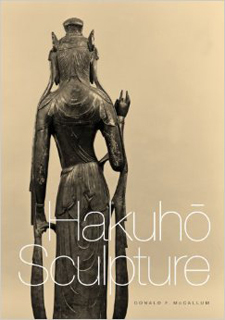
Donald F. McCallum, Hakuhō Sculpture (2012)
McCallum’s research on Japanese art had a wide breadth, but his main area was Japanese Buddhist art in which he published three books: Hakuhō Sculpture (Seattle: University of Washington Press, 2012); The Four Great Temples: Buddhist Archaeology, Architecture, and Icons of Seventh-Century Japan (Honolulu: University of Hawai‘i Press, 2009); and Zenkoji and Its Icon: A Study in Medieval Japanese Religious Art (Princeton: Princeton University Press, 1994). His interests expanded to Korean art, modern Japanese art, and even tattoos, as exemplified in his articles “Korean Influence on Early Japanese Buddhist Sculpture,” in Korean Culture (1982); “Three Taisho Artists: Yorozu Tetsugoro, Koide Narashige, and Kishida Ryusei,” in Paris in Japan: The Japanese Encounter with European Painting (1987); and “Historical and Cultural Dimensions of the Tattoo in Japan,” in Marks of Civilization: Artistic Transformations of the Human Body (1988). In addition to his books, McCallum’s published articles and book reviews that number over seventy will continue to have a significant impact on the field for years to come.
As a dedicated teacher at UCLA for forty-four years, McCallum shared his passion and knowledge with thousands of students and patiently served as dissertation advisor to eleven graduate students. His rigorous training style and strong, personal commitment toward his students, even after they started their own professional careers, was instrumental toward enabling some to become leaders in Japanese art history. Among them are tenured faculty members at Yale University, Portland State University, the University of Kansas, the University of Regina, Taiwan National Central University, California State Polytechnic University in Pomona, and the University of Maryland. Aside from helping his own graduate students, McCallum enthusiastically and generously supported nearly the entire next generation of younger scholars in Japanese art history with great encouragement and by writing thoroughly researched letters of support for tenure and promotion.
McCallum will be dearly missed by many, both in and outside academia. He is survived by his wife Toshiko, his son Kenneth and his daughter-in-law Takayo, his daughter Sumako and his son-in-law James Turner, and his grandchildren Ella Sachiko and Jackson James Turner. Anyone who has ever talked with him or heard him lecture knows how devoted he was to his family and was more than likely treated to many humorous tales about his cherished grandchildren.
The Donald F. McCallum Memorial Fund has been established to support the Department of Art History and the UCLA Terasaki Center for Japanese Studies. Memorial gifts to support the fund can be made out to the UCLA Foundation and sent to: Alexa Almazán, UCLA College Development, Division of Humanities, 1309 Murphy Hall, Box 951413, Los Angeles, CA 90095-1413.
NHA Memo to Members
posted by CAA — January 16, 2014
Stephen Kidd, executive director of the National Humanities Alliance (NHA), sent the following email on January 15, 2014.
NHA Memo to Members
Dear NHA Member Representatives,
Please click here for a new Memo to Members. This edition features:
- Capitol Hill news, including an overview of humanities funding in the proposed omnibus spending bill
- National Endowment for the Humanities news
- Studies, reports, and initiatives
- A compendium of humanities news articles and essays
- Federal grant opportunities
We encourage you to share this memo with your colleagues. If you have information to suggest for a future edition, please contact Erin Mosley at emosley@nhalliance.org.
Arts Victory in Congress!
posted by CAA — January 15, 2014
Nina Ozlu Tunceli, executive director of Americans for the Arts, sent the following email on January 14, 2014.
Arts Victory in Congress!
Victory – your voice was heard on Capitol Hill.
Late last night, Congress released the details of its massive FY 2014 Omnibus spending bill. I am pleased to share that the online petition that you and 40,000 other arts advocates signed this fall helped lead the way to the National Endowment for the Arts (NEA) being allocated $146 million for the year. We cannot thank you enough for taking the time to sign and share our petition.
Because of members like you, arts advocates successfully prevented a proposed 49% budget cut from taking place!
In fact, this new funding level is, in effect, an increase over last year’s since Congress is suspending the automatic sequester cuts that began last year. NEA will now have the full spending power of $146 million to invest in community-based arts programs across the country.
Together, we provided a strong voice for the arts. We now need your support to continue this momentum with the 2014 midterm elections right around the corner. With so many Members of Congress retiring, please consider contributing today to help us educate the next generation of elected leaders.