CAA News Today
Meet the Meiss Fund Recipients for Spring 2020
posted by CAA — July 08, 2020

MEET THE GRANTEES
Twice a year, CAA awards grants through the Millard Meiss Publication Fund to support book-length scholarly manuscripts in the history of art, visual studies, and related subjects that have been accepted by a publisher on their merits, but cannot be published in the most desirable form without a subsidy.
Thanks to the generous bequest of the late Prof. Millard Meiss, CAA began awarding these publishing grants in 1975.
The Millard Meiss Publication Fund grantees for Spring 2020 are:
- Sarah Betzer, Animating the Antique: Sculptural Encounter in the Age of Aesthetic Theory, Penn State University Press
- Peter Chametzky, Turks, Jews, and Other Germans in Contemporary Art, The MIT Press
- Pamela Corey, The City in Time: Contemporary Art and Urban Form in Vietnam and Cambodia, University of Washington Press
- Christina Crawford, Spatial Revolution: Architecture and Planning in the Early Soviet Union, Cornell University Press
- Frank Feltens, Ogata Kōrin: Art in Early Modern Japan, Yale University Press
- Andrew Finegold, Vital Voids: Cavities and Holes in Mesoamerican Material Culture, The University of Texas Press
- Marika Knowles, Realism and Role-Play: The Human Figure in French Art from Callot to the Brothers Le Nain, University of Delaware Press
- Ginger Nolan, Savage Mind to Savage Machine: Racial Science and Twentieth-Century Design, University of Minnesota Press
- Joanna Pawlik, Remade in America: Surrealist Art, Activism, and Politics 1940–1978, University of California Press
Read a list of all recipients of the Millard Meiss Publication Fund from 1975 to the present. The list is alphabetized by author’s last name and includes book titles and publishers.
BACKGROUND
Books eligible for a Meiss grant must currently be under contract with a publisher and be on a subject in the arts or art history. The deadlines for the receipt of applications are March 15 and September 15 of each year. Please review the Application Guidelines and the Application Process, Schedule, and Checklist for complete instructions.
CONTACT
Questions? Please contact Cali Buckley, Grants and Special Programs Manager, at cbuckley@collegeart.org.
Affiliated Society News for Summer 2020
posted by CAA — July 06, 2020
Affiliated Society News shares the new and exciting things CAA’s affiliated organizations are working on including activities, awards, publications, conferences, and exhibitions.
Interested in becoming an Affiliated Society? Learn more here.
Art Libraries Society of North America (ARLIS/NA)
ARLIS/NA will be holding its 2021 Annual Conference in Montréal, Québec, Canada from May 9 through May 15 at the Hotel Bonaventure, Montreal. For update information please see https://www.arlisna.org/news/conferences/1405-2021-49th-annual-conference.
On June 8, 2020 ARLIS/NA issued its Statement Against Anti-Black Racism and Violence which can be accessed here: https://www.arlisna.org/news/news-events/2057-arlis-na-advocacy-statement-against-anti-black-racism-and-violence
Nominations are open for the following Executive Board positions: Vice President/President Elect, Secretary, Advancement Liaison, and Chapters Liaison; nominations must be received by July 13, 2020 for terms beginning at the Montreal Conference in May 2021. For more information please see the official announcement here: https://www.arlisna.org/news/news-events/2056-call-for-interest-nominations-for-2021-executive-board
BSA (Bibliographical Society of America)
- Applications due September 8 for BSA’s 2021 New Scholars Program: The Bibliographical Society of America’s New Scholars Program seeks to promote the work of scholars who are new to the field of bibliography, broadly defined. The New Scholars selection committee welcomes new methods and new approaches, including applications from candidates applying bibliographical theory and principles to diverse materials and media. In addition, the committee welcomes scholarly submissions that embrace diverse, multicultural perspectives. The committee particularly encourages applications from those who have not previously published, lectured, or taught on bibliographical subjects.International applicants are welcome to apply. New: Joint applications will be accepted in 2021. For more information, see https://bibsocamer.org/awards/new-scholars-program/.
- Applications due November 1 for BSA Fellowships: To foster the study of books and other textual artifacts in traditional and emerging formats, and in keeping with the value which the Society places on the field of bibliography as a critical interpretive framework for understanding such artifacts, the BSA funds a number of fellowships designed to promote bibliographical inquiry and research. For more information see https://bibsocamer.org/awards/fellowships/.
- Community Subtitling Project: The BSA records many events to offer free, virtual programming to a broader public. These videos are accessible through the BSA’s YouTube channel. To improve accessibility, as of Spring 2020 we are working to provide edited English and other language subtitles, with a focus on Spanish. We need English speakers to edit automated transcriptions, and speakers of other languages to translate them in YouTube. We are pleased to offer free one year memberships to all who submit complete translations of edited English transcripts of individual videos. We created a guide to editing English subtitles and to adding foreign language translations that you can view on our website, here.
La guía también está disponible en español, aquí.
- June 2020 (vol 114:2) issue, The Papers of the Bibliographical Society of America:
Articles
Sonia Hazard, “The American Tract Society and the Refinement of the Evangelical Book, 1825–1861”
David Atkinson, “Distribution of Street Literature in the Later Eighteenth Century: Some Imprint Evidence from the West of England”
MacDonald P. Jackson, “Two Variants in Poems by Keats: Textual and Literary Evidence”
Book Reviews
Jung, Sandro. The Publishing and Marketing of Illustrated Literature in Scotland, 1760–1825
Reviewed by Kristin Bluemel
Stephens, Walter, and Earle A. Havens, eds. Literary Forgeries in Early Modern Europe 1450–1800
Reviewed by Linda Isaac
Duncan, Sara Jeanette. A Social Departure: How Orthodocia and I Went Round the World by Ourselves. Ed. Linda Quirk, with Cheryl Cundell
Reviewed by Kathryn James
Lallier, Monique. Monique Lallier: A Retrospective
Reviewed by Kevin M. O’Sullivan
Association for Modern and Contemporary Art of the Arab World, Iran, and Turkey
CFP: Modern Art in the Arabian Peninsula: A collection of essays to be published in collaboration with Barjeel Art
Foundation and the Association for Modern and Contemporary Art of the Arab World, Iran, and Turkey (AMCA)
Over the last two decades, the Arabian Peninsula has been the subject of critical attention regarding the rapid development of art initiatives and institutions, notably blockbuster transnational partnerships and attendant labor inequities. Less attention, however, has been given to the longer history of modern art in the region and the Peninsula’s artistic practices in comparative perspective. This publication brings together scholarly voices from across disciplines to consider the various movements, schools, collectives, manifestos, and debates that emerged in the countries of the Arabian Peninsula: Bahrain, Kuwait, Oman, Qatar, Saudi Arabia, United Arab Emirates, and Yemen throughout the 20th century. Contributions might address the following subjects: artists’ monographs, aesthetic debates in the press, artists’ collectives, exhibition histories, role of public sculpture, and the contextualization of art movements within regional histories. Themes may also consider the international scope of exhibitions and events that have molded the Arabian Peninsula into a global art capital. This call for essays welcomes scholarly explorations centered on the exchange of art and ideas between Gulf countries and their neighbors (e.g, Iran, South Asia, East Africa, and other Arab States) and how those dialogues have informed modern art in the Arabian Peninsula. We encourage submissions that consider the ways in which studies of modern art in the Arabian Peninsula might challenge conventional regional studies of modern Arab art or serve as a catalyst for broader disciplinary concerns with decolonizing art history.
We welcome abstracts for proposals addressing but not limited to the topics listed. Please submit a 500-word abstract along with a brief, one-page CV by September 15, 2020. Up to three accompanying images may be included in the body of the word document (optional). Abstracts should be submitted in MS office format (any recent version). Proposals in both English and Arabic will be accepted. Send your abstract to: MAAP@barjeel.com
The book will be edited by Nada Shabout, Sarah Rogers and Suheyla Takesh. Accepted contributions due on June 1, 2021. All essays will undergo a double-blind, peer-review process before final acceptance. Papers will be accepted in either English or Arabic and may include up to 7 images.
Association of Art Museum Curators Foundation
2020 Mentorship Program Applications Open June 30
Due July 14 at 12PM ET
Up to 10 Mentees with a required minimum of at least 3-5 years of curatorial experience in the field will be selected through a competitive application process for a career advancement experience. The program’s goal is to advance the skills, experience and knowledge needed to succeed in a curatorial career.
The program incorporates three main pillars:
- An immersive Virtual Learning Residency creating a peer to peer cohort held online;
- Digital engagement with a Mentor establishing one on one connections for feedback and guidance; and
- Attendance at the 2021 Art Curators Conference furthering expansion of the Mentee’s network (pending confirmation in early 2021 due to COVID-19).
Past program participants and additional program details and benefits are outlined in detail here.
All applicants must:
- Be art curators at nonprofit organizations in any country around the globe, with direct responsibility for works of art. In addition, independent curators and others that work a minimum of 50% of the time for/with nonprofit organizations will be considered.
- Have a minimum of 3-5 years of direct working curatorial experience in the field, excluding internships.
- Commit to all program requirements at the time of application, including all deadlines (non-negotiable), timelines, and travel. All Mentees are provided funding to accommodate travel, which will be disbursed in early 2021.
Applications open June 30 and are due by noon ET on July 14.
Questions/Concerns? Email programs@artcurators.org.
This program is made possible through the generosity of Barbara Futter, Catherine Futter, and the Emily Hall Tremaine Foundation.
Society for the History of Collecting
The Society for the History of Collecting is pleased to announce a series of lectures that will take place online via Zoom. The inaugural lecture will be delivered by Charles Sebag Montefiore on Jewish British Art Collectors. It will take place on Thursday, July 2 at 1:30pm (EDT) (see below for further details).
Stacey Pierson of the School of Oriental and African Studies, University of London, will deliver a lecture Art in China/Chinese art in Europe: a comparative study of approaches to collecting in China and Europe, 1500-1900 the following week (Thursday, July 9 at 1:30pm (EDT))
This illustrated lecture will explore almost 250 years of Jewish collecting in Britain, from the opening of Bevis Marks Synagogue in 1701 to the start of World War II. It will explore the role of prominent individuals, such as Sampson Gideon, Ralph Bernal, Ludwig Mond, the Rothschilds, Sir Philip Sassoon and Sir Percival David. The talk will cover a wide range of works of art from Old Master paintings and drawings to Classical sculpture and bronzes, as well as silver, Delftware, Hebraica and oriental ceramics. It will conclude by seeking to answer whether or not differences of religious background have any bearing on the way that people collected.
Charles Sebag-Montefiore is a Trustee of the National Gallery. He has served for many years as Treasurer of the Friends of the National Libraries, the National Manuscripts Conservation Trust and The Walpole Society, and is a former trustee of the Samuel Courtauld Trust and the Art Fund. He is joint author of The British as Art Collectors: From the Tudors to the Present (2012) and of A Dynasty of Dealers: John Smith and Successors 1801-1924 (2013).
To Join the lecture Please follow the zoom instructions below
Join Zoom Meeting
https://us02web.zoom.us/j/86005302560?pwd=Ylp6eitSN3RJbFpLMXlrZWp4WGdZdz09
Meeting ID: 860 0530 2560
Password: 774341
Renaissance Society of America
RSA 2021 Dublin
The Renaissance Society of America warmly invites submissions for its 67th Annual Meeting, to be held in Dublin, Ireland on 7-10 April 2021. The Convention Centre Dublin will serve as the site of our conference headquarters, with sessions also held at premier cultural and scholarly institutions such as the Chester Beatty , Marsh’s Library , and the Royal Irish Academy . We are delighted to announce that the Dublin conference has been expanded to four days instead of three, to accommodate more presenters and allow plenty of time for special events and visits to the city’s museums and archives. Submissions are due 15 August 2020. For more information about RSA 2021 Dublin and details on how to submit CfPs and sessions for the conference, please click here.
New Media Caucus
In response to worldwide protests mobilizing for Black Lives, the New Media Caucus, in collaboration with the Queer Caucus for Art, has created a sale of Digital Artifacts. 100% of all sales go to the Movement for Black Lives. Please visit https://www.defunddefend.newmediacaucus.org/
The New Media Caucus recently launched the Header/Footer Gallery, a digital exhibition space curated by NMC members. Flesh Spaces, opening in July, examines the challenges that cyberfeminists in the 1990s posed against a male-dominant technoculture. Via Net.art, installations and DIY publications, these artists interjected their bodies into cyberspace to celebrate physical presence, gender, and sexuality, challenging the dominate notion of cyber as disembodied and transcendent. However, despite the group’s efforts for coalition, cyberfeminism remained predominantly white and cisgender. 30 years later, H/F Gallery’s exhibition, curated by Constanza Salazar, champions work by WOC and members of the LGBTQ+ community – work that interrogates recent issues surrounding online spaces and digital technologies. https://www.newmediacaucus.org/hfgallery/#content
NMC continues to feature member spotlight on our website including a recent interview with Shawné Michaelain Holloway. A new media artist and poet, Holloway creates critical software, video installations, and real-time performances to initiate conversations about power and control. Her work re-shapes the rhetorics of technology and sexuality by critically engaging the technical language of instruction, specifically from queer feminist BDSM communities, to direct viewers to read, play, or listen their way through narratives that guide them in and out of visceral memories. Her work leverages both tech and poetic mechanisms to navigate through and/or away from abuses of power. This choreography of viewership is constructed through a decidedly black, queer, feminist discipline, forefronting agency and consent within the experience. Read KT Duffy’s interview with Holloway: https://www.newmediacaucus.org/member-spotlight-shawne-michaelain-holloway/
NMC’s journal Media-N is seeking proposals for a special issue – No Template: Art and the Technicity of Race. Updated deadline for abstracts: July 31, 2020. A decade ago, Beth Coleman and Wendy Hui Kyong Chun introduced the concept of race and/as technology.* Turning to Heidegger’s notion of techne as prosthesis or skill, Coleman and Chun imagine race itself as a technology that can be leveraged, a tool for navigating systems of power. This distances race from its mythological status as biological fact, creating a critical framework that returns historical agency to the individual and helps us understand how race and ethnicity function in the visual–and technological–world. Recently, the concept has received renewed attention as the intersections between race and ethnicity and the technological have come to the fore in popular discourse, raised by issues ranging from representation in film to bias in facial recognition. Critical work by scholars such as Simone Browne and Lisa Nakamura and the Precarity Lab has also continued to interrogate the technicity of race and its relationship to other technologies, both historical and contemporary. Artistic research and practice on the subject, however, has often been either neglected or instrumentalized as illustrative of a larger debate. This special issue of Media-N responds to the urgent need to examine the state of dialogue on race and/as technology in art practice, history, and criticism. It will feature a ten years on reflection on the concept by Beth Coleman, opening discussion onto the way this framework has shaped, and has been shaped by, art of the past and present. The guest editor for this issue is Megan Driscoll. For more information and guidelines: https://www.newmediacaucus.org/media-n-cfp-no-template-art-and-the-technicity-of-race/
*See Beth Coleman, “Race as Technology,” Camera Obscura: Feminism, Culture, and Media Studies 24, no. 1 (70) (May 1, 2009): 176-207; and Wendy Hui Kyong Chun, “Race and/as Technology, or How to Do Things to Race,” in Race After the Internet, eds. Lisa Nakamura, Peter Chow-White, and Alondra Nelson (New York: Routledge, 2012), 38-60.
NCHA
The NCHA announces that the quadrennial CIHA congress scheduled this year for Sao Paulo, Brazil, has been postponed one year until August 2021. We hope to see many of our CAA colleagues there! In addition, NCHA has elected new officers who begin their terms July 1, 2020: Paul Jaskot (President-Elect, beginning his term officially at the August 2021 CIHA), Anne Collins Goodyear (Vice President), Jesús Escobar (Treasurer), and Suzanne Blier (Secretary). Finally, NCHA is pleased to inform CAA members that the last CIHA colloquium, organized by the Japanese committee at the National Museum of Tokyo (March 2019, has published its papers which are available for download. The title of the conference was Toward the Future: Museums and Art History in East Asia. We are grateful to the Otsuka Museum of Art’s for making the publication available for free download on its Home Page at the following address :
http://srv0001.heteml.net/is/museums/ .
Design Incubation
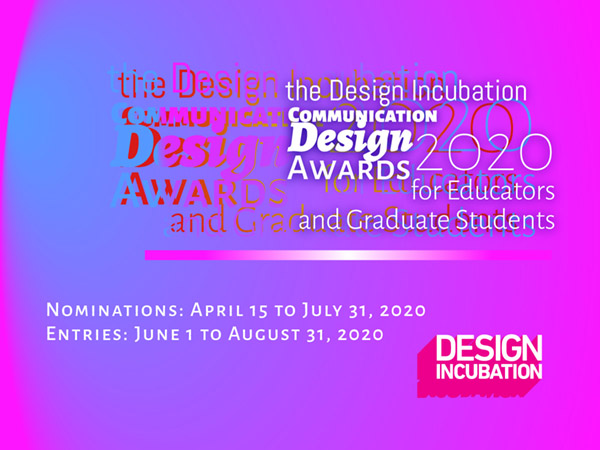
CFP: the 2020 Design Incubation Communication Design Awards
Call for Nominations and Entries for the 2020 Design Incubation Communication Design Awards for Educators and Graduate Students
2020 Jury
- Gail Anderson, School of Visual Arts, United States
- Audrey G. Bennett (Chair), University of Michigan, United States
- Fatima Cassim, University of Pretoria, South Africa
- Denise Gonzales Crisp, North Carolina State University, United States
- Paul Nini, Ohio State University, United States
- Maria Rogal, University of Florida, United States
- Teal Triggs, Royal College of Art, United Kingdom
Design Incubation announces a call for nominations and entries for the 2020 awards for communication design educators and graduate students in the areas of scholarship, teaching, service. The aim of the awards program is to discover and recognize new scholarship (creative work and publications), teaching, and service in our broad and varied discipline. We hope to expand the design record, promote excellence and share knowledge within the field.
This year, the jury also will be considering commendations for work covering the area of diversity, equity, access, and inclusion in communication design. We encourage submissions of work that relate to these areas for consideration.
Nominations
We kindly ask colleagues and mentors to identify outstanding creative work, publications, teaching, and service being done by design educators and graduate students in our field and to nominate these individuals for an award. Nominations will be accepted from April 15 to July 31, 2020.
Entry Guidelines
Entries will be accepted from June 1–August 31, 2020. Complete the online entry form with the following:
- Title: Description of project and outcomes (not to exceed 500 words)
- Supporting Materials (limited to 5-page medium resolution pdf of artwork; web links to websites, videos, other online resources; published documents or visual documents)
- Bio of applicant/s (150 words per applicant)
- Curriculum vitae of applicant/s
New Initiative for the 2020 Design Incubation Awards: Graduate Student Work
Beginning this year, Design Incubation is accepting entries in a new juried area of Graduate Student Work. The future of communication design education begins with the work of future faculty and researchers in the field of Communication Design. Recognition of graduate student work will be grouped and reviewed in the categories of scholarship, creative projects, and service. Graduate students currently enrolled in graduate design programs are invited to submit scholarship, creative projects, and service projects they completed during graduate study or up to one year after graduation.
ICMA
The International Center of Medieval Art (ICMA) has been awarded a grant from the NEH CARES: Cultural Organizations funding program. These NEH grants were distributed as part of the Coronavirus Aid, Relief, and Economic Security (CARES) Act, and roughly 14% of applicants were funded. A press release offers full information. The ICMA will use the award to support a Coordinator for Digital Engagement who will develop and oversee online offerings that serve the needs of scholars, instructors, museum professionals, and other enthusiasts and specialists in medieval art history at a time when we cannot gather in person.
Due 31 August 2020: ICMA-Kress Exhibition Development Grant (https://www.medievalart.org/exhibition-grant) and the ICMA-Kress Research and Publication Grant (https://www.medievalart.org/kress-research-grant).
Visual Resources Association News
The VRA invites proposals for papers, sessions, special interest/user groups, and workshops for the 2021 Conference program. The VRA’s 2021 Annual Conference will be held in Chicago, IL, from Tuesday, March 23th through Friday, March 26th, 2021 at the Westin, Michigan Avenue. Hybrid (in-person and online) conference options are being explored, so please consider ways to present materials to both physical and virtual audiences.
Presenting at the VRA Conference provides opportunities to see how your ideas, research, work, and passion connect to those of other dedicated professionals while building networks and friendships in an open, collaborative environment.
Presentation Types:
- Individual Paper- A paper is an individual idea submission, which will be reviewed for possible grouping into a session. Your ideas, whether they come to us alone or in a group, are equally valued in the Board’s proposal and selection process.
- Session – A session is typically a 60-minute moderated panel with 3 presenters, speaking for 15 to 18 minutes, followed by a brief facilitated question and answer period. If you feel your session topic requires more time, consider dividing it into two sessions, consisting of a Part I and a Part II.
- SIG/SUG- A special interest/user group is a 60-minute informal, community -driven, facilitated group discussion on topics related to a specific segment of the VRA membership.
- Workshop- A workshop is a 2, 4, or 8-hour workshop to develop skills and experience in the field of visual resources with hands-on activities.
All proposals are welcome, and if you have other conference ideas or suggestions that do not fit the conference proposal form, please reach out to the Vice President for Conference Program, Sara Schumacher at vpcp@vraweb.org.
To Apply:
The deadline for submissions is Monday, July 27, 2020. Program submissions received after this date will not be considered for the 2021 conference.
Preview the Paper, Sessions, Special Interest/User Groups Submission Form. Preview the Workshop Submission Form.
Submit your proposal here: https://www.surveymonkey.com/r/cfpvra2021.
All speakers/presenters must register for the conference and may register under the Conference Speaker rate for the full conference (same as member rate) or under the one-day rate. Speakers/Presenters may apply for Travel Awards through the VRA Travel Awards Committee or through select VRA Chapters.
Suggested topics:
- Challenges and Lessons Learned from Remote Work
- The Workplace, Institutional Transitions, Personnel Issues
- Copyright & IP in Education and Beyond
- Teaching & Research Needs, Visual Literacy
- Equity, Ethics, Privacy, Advocacy
- Metadata
- Best Practices and Standards (VRA Core 4, CCO, etc.)
- Critical Cataloging, Alt-Text, Rights Statements, Geolocation Data
- Crowdsourcing
- Managing Collections
- Digital Asset Management, Digital and Institutional Repositories
- Preservation, Planning for Collections Growth
- Outreach and Instruction
- Instruction using Materials, Special, and Digital Visual Collections
- Accessibility, Universal Design, Open Educational Resources, Online Exhibitions, Social Media
- Emerging Technologies and Applications
- 3D Photography Imaging and Digitization, Audio and Video Editing
- Coding, GIS, IIF, Omeka S, Story Maps
- Digital Humanities/Scholarship Tools, Projects, Research Processes
The Visual Resources Association is a multidisciplinary organization, founded in 1982, dedicated to furthering research and education in the field of image management within the educational, cultural heritage, and commercial environments. Since its foundation and even earlier, VRA has been affiliated with or had committee ties to CAA http://vraweb.org/. For more information about the important work and professional development activities sponsored by the Visual Resources Association or the VRA Foundation, please contact Maureen Burns, VRA’s CAA Affiliate Representative at moaburns@gmail.com or 310-489-3792.
SECAC
SECAC 2020. Following a survey of members and a subsequent affirmative vote of the full Board, SECAC 2020 will be moving online, hosted by Virginia Commonwealth University with Carly Phinizy, Assistant Chair and Assistant Professor of Art History, as Conference Director. To volunteer to assist in this endeavor and to thank the VCU team for the immense work that they have done so far – and that lies ahead – in order to sustain professional development opportunities for so many members this year, Carly can be reached at secac2020@vcu.edu.
Equity and Inclusion. The recent killings of countless unarmed Black people have brought renewed attention to systemic racial inequity in the United States. With support from the Executive Committee, members of the Board are conducting a review of SECAC practices from the perspective of racial justice, equity, and inclusion. The intent is to gain an empirical view of SECAC’s record as a baseline for identifying areas for improvement and an action plan, which will be developed collaboratively with our members. As a preliminary step, SECAC will waive institutional membership dues for HBCUs.
SECAC Member Opportunities Deadline: August 31, 2020
- Submission for the William R. Levin Awards for Research in the History of Art (minimum amount of $5000 each). https://secacart.org/page/LevinAwards
- Submission for the SECAC Artist’s Fellowship ($5000) and Artist’s Fellowship Honorable Mention ($1000). https://secacart.org/page/ArtistsFellowship
- Nominations for the SECAC Awards. https://secacart.org/page/Awards
- Outstanding Artistic Achievement
- Outstanding Professional Achievement in Graphic Design
- Outstanding Exhibition and Catalogue of Contemporary Materials
- Outstanding Exhibition and Catalogue of Historical Materials
- Excellence in Teaching
- Excellence in Scholarly Research and Publication
- Nominations for SECAC Board seats in Georgia, Virginia, South Carolina, West Virginia, and At-Large #2. Submit nominations, with nominee’s CV, to lawrence.jenken@umassd.edu.
Please consider nominating colleagues and peers for SECAC Awards and Board Seats, particularly those individuals who have been underrepresented historically.
Association of Print Scholars
The Association of Print Scholars (APS) has awarded the 2020 Schulman and Bullard Article Prize to Dr. Elizabeth Savage, Senior Lecturer in Book History and Communications, Institute of English Studies, School of Advanced Study, University of London. Now in its sixth year, the award is given to an article published by an early-career scholar that features compelling and innovative research on prints or printmaking. Dr. Savage’s article, “Identifying Hans Baldung Grien’s Colour Printer, c. 1511-12” was published in Burlington Magazine, Volume 161 (October 2019): 830-839.
Additionally, Honorable Mentions have been awarded to Tomasz Grusiecki, Assistant Professor of Art History, Department of Art, Design & Visual Studies, Boise State University, and Erin Sullivan Maynes, Assistant Curator, Rifkind Center for German Expressionist Studies, Los Angeles County Museum of Art, for their articles, “Michal Boym, the Sum Xu, and the Reappearing Image” in Journal of Early Modern History, Volume 23, issue 2-3 (May 2019): 296-324 and “Making Money: Notgelt and the Material Experience of Inflation in Weimar Germany” in Art History, volume 42, number 4 (September 2019): 678-701, respectively. APS is now accepting submissions until January 31, 2021 for the 2021 Schulman and Bullard Article Prize, which carries a $2,000 prize and is generously sponsored by Susan Schulman and Carolyn Bullard, both private print dealers. Further submission information can be found on the APS website.
The Association of Print Scholars is pleased to announce that it has been awarded a major grant in the amount of $120,000 from the Getty Foundation to fund a series of two hands-on intensive printmaking workshops for emerging scholars and curators in the field. The grant is funded through The Paper Project, an initiative focused on training and professional development for early- to mid-career curators of prints and drawings. This grant will go toward two intensive four- and five-day long workshops in 2021 and 2022, respectively, that will invite participants to learn about a specific technical area from talented printmakers, master printers, and curators from around the country. The first workshop is dedicated to intaglio techniques (etching, engraving, and drypoint) and will be hosted at the esteemed Highpoint Center for Printmaking and the Minneapolis Institute of Art in Minneapolis, Minnesota from June 21-26, 2021. The second workshop, dedicated to lithography and monotype, will be hosted at the renowned Tamarind Institute and the University of New Mexico Art Museum in Albuquerque, and 10 Grand Press in Santa Fe, New Mexico in May 2022. A formal call for applications for the first workshop will be sent out in Fall 2020.
Women’s Caucus for Art
Board members of the Women’s Caucus for Art gathered in early June via videoconference. Their work included welcoming Laura Morrison as incoming President of the WCA. Past President Margo Hobbs is now in the process of forming an Art Writers Committee as part of the WCA. Anyone interested in joining should contact Margo at margohobbs@muhlenberg.edu.
Association for Latin American Art (ALAA)
ALAA COVID Relief Fund
The Association for Latin American Art (ALAA) is pleased to announce that over the course of this summer we will be launching an emergency relief grant program in support of our colleagues who are suffering financial hardships as a result of the COVID-19 crisis. There is no doubt that the current public health crisis has rippled and negatively impacted those of us working in museums and higher education. Many of our colleagues are facing furloughs, non-renewed/terminated contracts, decreased pay, or the dire consequences of hiring freezes.
ALAA plans to offer micro-grants of up to $500 to contingent professionals, graduate students, and independent scholars of Latin American and/or Latinx art who are most vulnerable to economic precarity.
Given our organization’s very modest budget, we will need to finance this program through voluntary donations. For more information please visit our website: https://associationlatinamericanart.org/alaa-covid-19-relief-fund/. Also, you can direct any inquiries to our Secretary-Treasurer, Lesley Wolff at Lesley.Wolff@ttu.edu
IAWIS
The next IAWIS conference in Luxembourg, due to take place in early July has been postponed due to the corona virus pandemic.
The conference will now take place from the 12th to the 16th of July 2021.
Here is the link to the new website https://waterandsea2021.uni.lu/
Catalogue Raisonné Scholars Association (CRSA)
https://www.catalogueraisonne.org/
CRSA is embarking on a new initiative to strengthen its connections with other Affiliated Societies. We hope to increase the visibility and value of catalogues raisonnés to educators, art historians, and artists by engaging in conversations with our CAA colleagues about how catalogues raisonnés can respond and contribute to evolving methodologies of art history research and analysis that can be applied to broad cultural studies as well as monographic subjects. We look forward to reaching out directly to our fellow Affiliated Societies–and welcome inquiries–as we work to develop future programs that encourage greater exchange among our membership and the larger CAA community.
The CRSA website is also hosting a new online feature that offers reflections from the community of scholars on the inevitable gaps in documentation faced within the field of art research as well as the common experience of pause during the pandemic: “The Catalogue Raisonné and the Ellipsis” https://www.catalogueraisonne.org/ellipsis
New in caa.reviews
posted by CAA — July 03, 2020
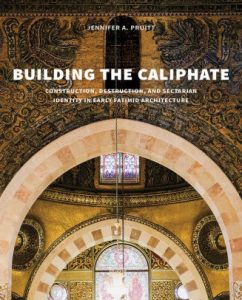
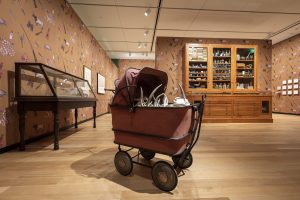
Valerie Gonzalez reviews Building the Caliphate: Construction, Destruction, and Sectarian Identity in Early Fatimid Architecture by Jennifer A. Pruitt. Read the full review at caa.reviews.
Francesca Balboni virtually explores the Amon Carter Museum exhibition The Perilous Texas Adventures of Mark Dion. Read the full review at caa.reviews.
News from the Art and Academic Worlds
posted by CAA — July 01, 2020
|
Want articles like these in your inbox? Sign up for our weekly newsletter:
RAAMP Coffee Gathering: Gender Equity in the Museum (and Arts) Workplace
posted by CAA — June 30, 2020
Coffee Gathering: Gender Equity in the Museum (and Arts) Workplace
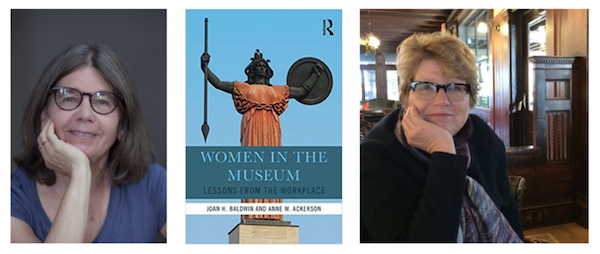
On Thursday, July 2 at 2:00 PM (EST) we will speak with Anne Ackerson and Joan Baldwin on gender equity in museums and workplaces.
To RSVP to this Coffee Gathering, please fill out this form.
A former museum director, Joan H. Baldwin is the Curator of Special Collections at The Hotchkiss School. She is the principal writer for the Leadership Matters blog which had 55,000 views in 2018. Her work has also appeared in The Museum Blog Book, “History News,” and “Museum” Magazine, Museopunks, and “The Guardian.” She is a co-founder of the Gender Equity in Museums Movement, and teaches in the Johns Hopkins University museum studies program. With Anne Ackerson, she is the co-author of Leadership Matters (2013) and Women in the Museum: Lessons from the Field (2017). She and Ackerson published a revision of Leadership Matters: Leading Museums in an Age of Discord in August 2019.
Anne W. Ackerson is a former history museum director, director of the Museum Association of New York, and director of the national Council of State Archivists. She is currently an independent consultant to cultural and educational nonprofits, specializing in leadership, governance, and management issues. With Joan H. Baldwin, she is the co-author of Leadership Matters, a book examining history museum leadership for the 21st century, and Women in the Museum: Lessons from the Workplace. She is a co-founder of the Gender Equity in Museums Movement (GEMM), which is focusing its recent efforts on education, advocacy, and policy development around pay equity, salary transparency, and sexual harassment in the museum workplace. In 2018, she and Baldwin spearheaded research, revealing that 62% of the museum workforce are affected by some form of gender discrimination. In addition to research and writing about gender inequity, she and Baldwin have presented their findings to the Texas and Pennsylvania Associations of Museums as conference keynoters and via their blog, Leadership Matters.
RAAMP Coffee Gatherings are monthly virtual chats aimed at giving participants an opportunity to informally discuss a topic that relates to their work as academic art museum professionals. Learn more here.
Submit to RAAMP
RAAMP (Resources for Academic Art Museum Professionals) aims to strengthen the educational mission of academic art museums by providing a publicly accessible repository of resources, online forums, and relevant news and information. Visit RAAMP to discover the newest resources and contribute.
RAAMP is a project of CAA with support from the Andrew W. Mellon Foundation and the Samuel H. Kress Foundation.
New in caa.reviews
posted by CAA — June 26, 2020
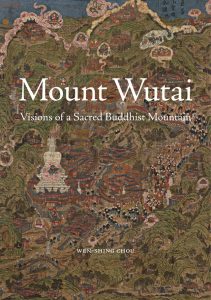
Lihong Liu writes about Mount Wutai: Visions of a Sacred Buddhist Mountain by Wen-shing Chou. Read the full review at caa.reviews.
Alexander Nagel considers the Metropolitan Museum of Art exhibition The World between Empires: Art and Identity in the Ancient Middle East. Read the full review at caa.reviews.
The Getty Foundation to Fund the CAA-Getty International Program for a Tenth Year
posted by CAA — June 25, 2020
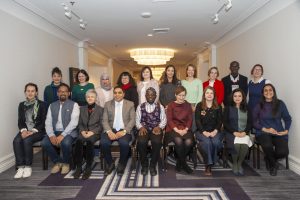
CAA-Getty Scholars at the 2020 Annual Conference in Chicago. Photo: Stacey Rupolo
The Getty Foundation has awarded CAA a grant to fund the CAA-Getty International Program for a tenth consecutive year. Unlike previous years, the 2021 program will take place virtually, due to the COVID-19 pandemic and the challenges of bringing international scholars to New York to attend the 2021 Annual Conference. CAA is especially grateful to the Getty Foundation for sustaining its support during these uncertain times, when maintaining contact with our international colleagues is more important than ever. Turning this crisis into an opportunity, the twenty participants in next year’s program will spend the time between now and February exploring the advantages of online technology for enriching scholarly research and building global bonds. Meme Omogbai, CAA’s new executive director, stated “We appreciate not only the Getty Foundation’s ongoing support, but also its faith in the CAA-Getty program to pursue scholarly excellence and innovation in an acutely challenging time. We believe the participants in this program will help lead the way for CAA’s future growth in international programs and membership.”
Over the coming months, the participants—all alumni of the program—will work in small online groups to workshop their conference papers, originally planned to be presented in person at the 2021 Annual Conference. What can be gained by geographically-distanced scholars collaborating regularly over the next six months, discussing and critiquing each other’s work? How will ideas evolve and change from early conversations to completed presentations?
The 2021 CAA-Getty program participants will also explore opportunities provided by online exchanges to produce resource materials for other scholars. Using recordings of the online discussions and the conference presentations, the group will initiate a virtual archive containing video and text documentation of the year’s work, including podcasts, bibliographies, and references related to the themes of the conference sessions. Although this virtual program breaks with the patterns established by the first nine years of the program, its forward-looking experiment in online scholarship is a fitting way to celebrate the tenth anniversary of a program that promises new models for robust scholarship in the post-COVID world.
“We applaud CAA for a taking a bold step to reimagine the international program online,” says Joan Weinstein, director of the Getty Foundation. “This thoughtful approach to digital engagement will teach us all a great deal about how to maintain international perspectives and connections in this new post-pandemic reality.”
The CAA-Getty International Program was established in 2011-12 to increase international participation in CAA and the CAA Annual Conference. The program fosters collaborations between North American art historians and curators and their international colleagues and introduces visual arts professionals to the unique environments and contexts of practices in different countries. Since the CAA-Getty International Program began, it has brought 135 first-time attendees from 49 countries to CAA’s Annual Conference. Historically, the majority of international registrants at the conference have come from Canada, the United Kingdom, and Western European countries. The CAA-Getty International Program has greatly diversified attendance, adding scholars from Central and Eastern Europe, Russia, Africa, Asia, Southeast Asia, the Caribbean, and South America. The majority of the participants teach art history, visual studies, art theory, or architectural history at the university level; others are museum curators and researchers.
About the Getty Foundation
The Getty Foundation fulfills the philanthropic mission of the Getty Trust by supporting individuals and institutions committed to advancing the greater understanding and preservation of the visual arts in Los Angeles and throughout the world. Through strategic grant initiatives, it strengthens art history as a global discipline, promotes the interdisciplinary practice of conservation, increases access to museum and archival collections, and develops current and future leaders in the visual arts. It carries out its work in collaboration with the other Getty Programs to ensure that they individually and collectively achieve maximum effect.
2021 CAA-Getty International Program Participants
Danielle Becker, Stellenbosch University, South Africa
Federico Freschi, Otago Polytechnic, New Zealand
Georgina Gluzman, University of Buenos Aires, Argentina
Richard Gregor, Trnava University, Slovenia
Alison Kearney, University of the Witwatersrand, South Africa
Sandra Krizic Roban, Institute of Art History, Croatia
Peju Layiwola, University of Lagos, Nigeria
Daniela Lucena, University of Buenos Aires, Argentina
Priya Maholay-Jaradi, National University of Singapore
Ana Mannarino, Federal University of Rio De Janeiro, Brazil
Parul Mukherji, Jawaharlal Nehru University, India
Cristian Nae, George Enescu National University of Arts, Romania
Marton Orosz, Museum of Fine Arts, Hungary
Ceren Ozpinar, University of Brighton, United Kingdom
Dasha Panaiotti, Hermitage Museum, Russia
Valeria Paz Moscoso, Universidad Católica Boliviana San Pablo, Bolivia
Judy Peter, University of Johannesburg, South Africa
Horacio Ramos Cerna, City University of New York
Nora Veszpremi, University of Birmingham, United Kingdom
Giuliana Vidarte, Pontifical Catholic University, Peru
Serve on a CAA Jury and Provide Support to the Field
posted by CAA — June 24, 2020
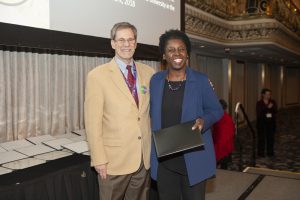
Former CAA Interim Director David Raizman and Denise Murrell, who received the Alfred H. Barr Jr. Award for Smaller Museums, Libraries, Collections, and Exhibitions for her catalog Posing Modernity: The Black Model From Manet and Matisse to Today, at the 2020 Annual Conference in Chicago. Photo: Stacey Rupolo
CAA invites nominations and self-nominations for individuals to serve on our Awards for Distinction, Publication Grant, Fellowship, and Travel Grant juries. Terms begin August 2020.
Candidates must possess expertise appropriate to the jury’s work and be current CAA members. They should not hold a position on a CAA committee or editorial board beyond May 31, 2020. CAA’s president and vice president for committees appoint jury members for service.
Awards for Distinction Juries
CAA has vacancies in ten of the fourteen juries for the annual Awards for Distinction for three years (2020–23). Terms begin in August 2020; award years are 2021–23.
- Alfred H. Barr Jr. Award for museum scholarship in the history of art/Alfred H. Barr Jr. Award for Smaller Museums, Libraries, Collections, and Exhibitions for museum scholarship in the history of art published by smaller institutions: two vacancies
- Frank Jewett Mather Award for art criticism: two vacancies
- Charles Rufus Morey Book Award for non-catalogue books in the history of art: one vacancy
- Arthur Kingsley Porter Prize for articles written by younger scholars in The Art Bulletin: one vacancy
- Artist Award for Distinguished Body of Work: two vacancies
- Distinguished Artist Award for Lifetime Achievement: one vacancy
- Distinguished Feminist Awards for Scholars and Artists: one vacancy
- Distinguished Teaching of Art History Award: one vacancy
- Excellence in Diversity Award: four vacancies
Publication Grant Juries
CAA has vacancies on our Millard Meiss Publication Fund grant jury for four years (2020–24) and the Terra Foundation for American Art Publication Grant jury for one year (2020-21).
- Millard Meiss Publication Fund: three vacancies
- Terra Foundation for American Art Publication Grant: one vacancy
Professional Development Fellowship Juries
CAA has vacancies on our Professional Development Fellowship juries for three years (2020–23). Terms begin August 2020.
- Professional Development Fellowship in Visual Arts: three vacancies
- Professional Development Fellowship in Art History: two vacancies
Travel Grant Juries
CAA has vacancies on our Art History Fund for Travel to Special Exhibitions jury for three years (2020–23). Terms begin August 2020.
- Art History Fund for Travel to Special Exhibitions: two vacancies
HOW TO APPLY
Nominations and self-nominations should include a brief statement (no more than 150 words) outlining the individual’s qualifications and experience and a CV (an abbreviated CV no more than two pages may be submitted). Please send all materials by email to Cali Buckley (cbuckley@collegeart.org), CAA grants and special programs manager; submissions must be sent as Microsoft Word or Adobe PDF attachments.
For questions about jury service and responsibilities, contact Tiffany Dugan (tdugan@collegeart.org), CAA director of programs and publications.
Deadline: July 31, 2020
New in caa.reviews
posted by CAA — June 19, 2020
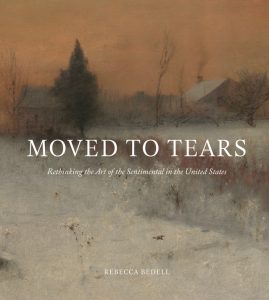
David M. Lubin discusses Moved to Tears: Rethinking the Art of the Sentimental in the United States by Rebecca Bedell. Read the full review at caa.reviews.
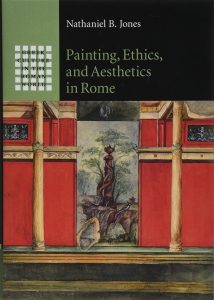
Shelley Hales considers Nathaniel B. Jones’s Painting, Ethics, and Aesthetics in Rome. Read the full review at caa.reviews.
In Memoriam: Cynthia Navaretta
posted by CAA — June 15, 2020
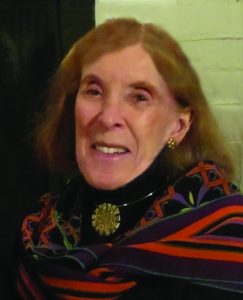
Cynthia Navaretta.
We were saddened to learn of the passing of critic, publisher, and longtime CAA member Cynthia Navaretta last month at the age of 97. An active member of the organization and a founding member of the Women’s Caucus for Art (WCA), Navaretta was founder of the feminist arts publisher Midmarch Arts Press and a tireless advocate for women artists.
A memorial in her honor will be hosted via on Sunday, September 13th, 2020, at 6pm (EST). Members interested in attending are invited to contact cyncelebration@gmail.com to receive information and a link closer to the event. Readers are also invited to post comments and pictures about her life on a newly created Facebook page, here.
Cynthia Navaretta, art critic, curator, publisher, art collector, architectural engineer died on May 18, 2020 at 97
In her mid-twenties Cynthia Navaretta was immersed in the New York art scene from the early days of the ‘New York School’ and the influential “8th Street Club” (one of only 6 female members!) before she married Emanuel Navaretta, artist, poet, critic, professor and roommate of Franz Kline in 1950. Cynthia’s friends and neighbors in New York and Long Island (Springs in the Hamptons) included Jackson Pollack, Harold Rosenberg, Lee Krasner, Milton Resnick, Milton Avery, Franz Kline, the De Kooning’s (Elaine and Willem) Ibram Lassaw, David Smith, Phillip Pavia, Judy Chicago, Agnes Martin, Pat Passlof, Hans Hofmann, June Wayne, Susan Schwalb and a long list of other art legends.
In 1974, she was a founding steering committee member of ‘Artists Talk On Art’, the art world’s longest running panel discussion series. With her knowledge of the New York art scene, along with her professional qualifications in engineering and building, Cynthia served as a mayoral appointee to the Artists Certification Committee of the NYC Department of Cultural Affairs and later served as the public voting member of the powerful Loft Board in Manhattan for 20 years, deciding who was a bona fide artist and deserving of live-work studio space in converted factories. She was a founding member of the Women’s Caucus for Art, the Coalition of Women’s Arts Organizations, and also Women in the Arts.
She represented the United States at the 1985 UN Conference on Women in Kenya and served in similar capacities on other boards and meetings around the world including the International Festival of Women Artists, Copenhagen in 1980. She befriended many well-known African-American women artists throughout the United States. In 1995, she published the first definitive compendium of American women artists of color – Gumbo Ya Ya: Anthology of Contemporary African – American Women Artists with an introduction by Leslie King Hammond, Midmarch Arts Press.
As the founder of Midmarch Arts Press, she published numerous memoirs, guides, histories and anthologies by and about American artists, male and female including: Guide to Women’s Arts Organizations, Women Artists of the World edited by Sylvia Moore, Cindy Lyle and Cynthia Navaretta, Mutiny in the Mainstream — Talk That Changed Art (with Judy Seigal), The Heart of the Question, The Writings and Paintings of Howardena Pindell, introduction by Lowery S. Sims, Voices of Women, by Lucy Lippard, Postmodern Heretics, by Eleanor Heartney, Out of the Picture: Milton Resnick and the New York School edited and with an Introduction by Goeffey Dorfman and The First Wife’s Tale: A Memoir by Louise Strauss – Ernst, to name only a few.

Cynthia Navaretta at the National Women’s Conference in Houston 1977. Credit: Judy Seigel, via The New York Times
Her sharp mind, mixed with her organizational skills and ability to span many spheres of knowledge and personalities made her the ideal art panel planner, moderator or guest speaker. She was a beloved panel participant at College Art Association and mentored many young female artists. She was an active member of the International Art Critics Association and often traveled on their numerous trips around the world. She was also the publisher, along with photographer Judy Siegel, of the well-known Women Artist News (1978 – 1991), the first publication sent out on a regular basis covering the doings and activities of women artists; thus, publishing the first constant and continuing dialogue for women artists in the United States. A prodigious publisher, author and critic of feminist art in the United States Cynthia was one of the few who acknowledged and attracted regional and southern feminist artists whose work would otherwise most probably never have seen the light of day. Through the vehicles of Women Artist News and Midmarch Press, Cynthia was determined to document and champion many obscure female artists, offering them an exclusive avenue to introduce themselves and their work to a wider audience in the art world.
In her later years, she organized and curated her archives which were accepted by the Smithsonian Institution’s Archives of American Art. This written legacy from one of the leading feminist voices on art- is sure to be preserved, shared, and seen as a unique transcript of the American art experience.
In her ‘other’ life, Cynthia earned a master’s degree in mechanical engineering the 1940s. Returning to NYC, she was hired by the construction company Alvord & Swift. Established in 1911, Alvord became a significant contractor in the emerging specialty of HVAC design and construction. She designed and built many of the HVAC systems with Alvord & Swift for well-known skyscrapers in New York, including the famous Solow building. She also designed many of the HVAC systems at the 1964 World’s Fair in New York. During her several year’s tenure there, she had the thankless job of training and preparing no fewer than three less talented male colleagues to assume the position and prestige of Vice President. This glass ceiling was the deciding factor in her eventual resignation. At that time, she was one of approximately 400 female mechanical engineers in the United States.
Throughout her engineering career, she held a variety of ambitious, supervisory positions. These included a managerial position for the ABC Television Network when the new Lincoln Center broadcast facility was being built. She also did a stint as an AMTRAK vice president, responsible for ‘new construction’ and ‘rights of way.’ She eventually retired to devote all her time to her publishing house and friends and family. But well into her nineties she could still be seen at art openings dressed to the ninths with her walker having arrived fashionably late by bus.
Remembrance by Susan Schwalb.