
CAA News Today
Spring Meiss Winners
posted by Christopher Howard — July 30, 2008
CAA has awarded five Millard Meiss Publication Grants for spring 2008. Thanks to the generous bequest of the late Prof. Millard Meiss, these grants are given twice annually to publishers to support the publication of scholarly books in art history and related fields.
The grantees are:
- Molly Aitken, The Intelligence of Tradition: Form and Meaning in Mewar Painting (Yale University Press)
- Elissa Auther, String, Felt, Thread, and the Hierarchy of Art and Craft in American Art, 1961–1979 (University of Minnesota Press)
- Marin F. Hanson and Patricia Cox Crews, eds., American Quilts in the Modern Age, 1870–1940: A Catalog from the International Quilt Study Center (University of Nebraska Press)
- Richard King, ed., Art and the Artist in Cultural Revolution China (University of British Columbia Press)
- Judith Ostrowitz, Interventions: Native American Art for Far-Flung Territories, (University of Washington Press)
Books eligible for a Meiss grant must already be under contract with a publisher on a subject in the arts or art history. Authors must be current CAA members. Application criteria and guidelines are available online or from nyoffice@collegeart.org. Deadlines: March 15 and October 1 of every year
July CAA News Now Online
posted by Christopher Howard — July 02, 2008
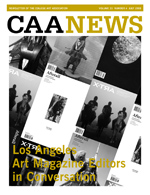 The July CAA News has been posted to the CAA website. You can download a 1.6-megabyte PDF of the issue by clicking on the cover at right.
In the issue, CAA News talks to the editors of two art magazines with roots in Los Angeles: X-TRA and Afterall. Also included are CAA’s new procedures for developing professional standards and guidelines; a report on the recent Board of Directors meeting in May; and information on registration rates for the upcoming Los Angeles conference and travel grants to attend it.
The deadline for submissions to the September issue is July 10, 2008. Please send yours to Christopher Howard, CAA News editor.
CAA News Back in Print in September
posted by Christopher Howard — July 01, 2008
Beginning with the September 2008 issue, CAA News will once again be printed and mailed to all individual and institutional members six times a year.
In July 2007, the newsletter transformed from printed publication to a PDF document distributed online primarily to balance the previous year’s budget. The decision, made by the CAA Board of Directors, was not a permanent one.
Going from 32–48 pages to 16–24 pages per issue, the new CAA News will focus largely on organizational business, providing updates on the Annual Conference; listing individual- and institutional-member achievements; publishing calls for participation for CAA committees, editorial boards, awards committees; and more.
At the same time, CAA plans to beef up its website, with more online-only content. Former newsletter sections such as the Advocacy Update and the Obituaries, for example, will be exclusive to the web as part of a larger initiative to revamp the CAA website. We want www.collegeart.org to become an indispensable resource for artists and scholars, curators and educators, and critics and other arts professionals throughout the year.
CAA News will continue to appear as a PDF document on the website; past issues go back to March 2002. Posted at the beginning of the month of publication, the newsletter can be read immediately—before the printed publication arrives in your mailbox.
If you wish to receive CAA News in electronic format only, please contact CAA Member Services.
Special House Hearing Highlights NEA and NEH Programs
posted by Christopher Howard — May 15, 2008
On May 8, 2008, a hearing was held by the Healthy Families and Communities Subcommittee in the House of Representatives to discuss the National Endowment for the Arts (NEA) and the National Endowment for the Humanities (NEH). While the subcommittee has jurisdiction over NEH and NEA authorization, this was an informational hearing only.
The following individuals provided testimony on the national impact of NEH and NEA programs: Ken Burns, documentary filmmaker; Bruce Cole, NEH chairman; Dana Gioia, NEA chairman; William Glacken, mayor of Freeport, New York; Jeanne Schmedlen, director of special projects and chief of protocol office for the speaker of the Pennsylvania House of Representatives; Katrine Watkins, librarian at Shaler Area Intermediate School in Glenshaw, Pennsylvania; and former US Army Captain Ryan Kelly, a participant in Operation Homecoming, an NEA-sponsored program.
The panelists emphasized the importance of NEH and NEA grants to their work and asked that Congress continue to support arts and humanities programming. Testimony focused on the agency’s special initiatives, including the NEH’s We the People Bookshelf and Picturing America programs, as well as the NEA’s Mayors Institute on Urban Design and Operation Homecoming. Chairwoman Carolyn McCarthy (D-NY) praised the NEA and NEH programs presented and identified them as essential to defining “what is America.” She also reiterated the importance of the arts and humanities to American society.
New National Project to Examine Impact of Arts Training
posted by Christopher Howard — May 15, 2008
Artists often don’t end up working in the exact fields in which they trained. Instead, they may work at the boundaries between disciplines. Artists frequently move between the nonprofit and commercial sectors; some hold multiple jobs. Moreover, there is a growing demand for arts training, both from students and the rising number of employers in the creative economy. Arts-training institutions and civic policy makers need good data to respond and plan effectively.
The Strategic National Arts Alumni Project (SNAAP) was launched this month to examine questions about the impact of arts training. The project will provide a first-ever in-depth look at factors that help or hinder the careers of graduates of arts high schools, arts colleges and conservatories, and arts schools and departments within colleges and universities.
Arts alumni who graduated five, ten, fifteen, and twenty years earlier will provide information about their formal arts training. They will report the nature of their current arts involvement, reflect on the relevance of arts training to their work and further education, and describe turning points, obstacles, and key relationships and opportunities that influenced their lives and careers.
The results of the annual online survey and data-analysis system will help schools to strengthen their programs of study by tracking what young artists need to advance in their fields. In addition, the information will allow institutions to compare their performance against other schools in order to identify areas where improvements are needed.
The Indiana University Center for Postsecondary Research will administer the annual survey in cooperation with the Curb Center for Art, Enterprise, and Public Policy at Vanderbilt University. Steven J. Tepper, Curb Center associate director, says “SNAAP is a milestone for cultural-policy research, because it will go beyond profiles of individual artists and provide a comprehensive look at the creative workforce in America and the critical role of training institutions in preparing artists and creative workers.” The project will be guided by a National Advisory Board comprised of leaders from all types and levels of arts-training institutions, visual and performing artists, and arts and community-development leaders from the nonprofit and commercial sectors.
Over time, SNAAP findings will allow institutions to learn more about the impact of their educational programs to better understand, for example, how students in different majors use their arts training in their careers and other aspects of their lives. Policy makers and community leaders will be able to use SNAAP findings to understand local, regional, and national arts workforce issues and market patterns. The results will also indicate how students who have trained intensively in the arts contribute to their communities and different areas of the economy.
According to George Kuh, Indiana University professor and SNAAP project director, the arts-alumni survey will be extensively field-tested in 2008 and 2009 with as many as one hundred institutions before its first national administration in 2010. “We’ll learn a lot about what matters in arts training from these early results and also be able to fine-tune the survey for future use,” Kuh said. The Curb Center will host a national conference in 2010 to explore the educational and cultural-policy implications of SNAAP findings.
After several years of studying the need for and feasibility of the project, the Surdna Foundation recently awarded a five-year $2,500,000 leadership grant to help launch the project. In addition, support from other funders is anticipated to support the testing phases of the project and insure widespread participation. SNAAP is expected to become self-sustaining through institutional participation fees by 2012.
Further project information is available on the SNAAP website.
Los Angeles Artist Settles VARA Lawsuit
posted by Christopher Howard — May 15, 2008
The Los Angeles Times reports that the artist Kent Twitchell will receive $1.1 million from the settlement of a lawsuit against the United States government and eleven other defendants for painting over his six-story mural. entitled Ed Ruscha Monument and painted on the side of a downtown building owned by the federal government.
The settlement, disclosed April 30, 2008, is believed to be the largest awarded under the federal Visual Artists Rights Act (VARA) or the California Art Preservation Act, both of which prohibit the desecration, alteration, or destruction of certain works of public art without giving ninety days’ notice to the artist to allow him or her the option of removing the artwork.

Copyright © 2008 College Art Association.
275 Seventh Avenue, 18th Floor, New York, NY 10001 | T: 212-691-1051 | F: 212-627-2381 | nyoffice@collegeart.org
The College Art Association supports all practitioners and interpreters of visual art and culture, including artists and scholars, who join together to cultivate the ongoing understanding of art as a fundamental form of human expression. Representing its members’ professional needs, CAA is committed to the highest professional and ethical standards of scholarship, creativity, connoisseurship, criticism, and teaching.
New National Project to Examine Impact of Arts Training
posted by Christopher Howard — May 15, 2008
Artists often don’t end up working in the exact fields in which they trained. Instead, they may work at the boundaries between disciplines. Artists frequently move between the nonprofit and commercial sectors; some hold multiple jobs. Moreover, there is a growing demand for arts training, both from students and the rising number of employers in the creative economy. Arts-training institutions and civic policy makers need good data to respond and plan effectively.
The Strategic National Arts Alumni Project (SNAAP) was launched this month to examine questions about the impact of arts training. The project will provide a first-ever in-depth look at factors that help or hinder the careers of graduates of arts high schools, arts colleges and conservatories, and arts schools and departments within colleges and universities.
Arts alumni who graduated five, ten, fifteen, and twenty years earlier will provide information about their formal arts training. They will report the nature of their current arts involvement, reflect on the relevance of arts training to their work and further education, and describe turning points, obstacles, and key relationships and opportunities that influenced their lives and careers.
The results of the annual online survey and data-analysis system will help schools to strengthen their programs of study by tracking what young artists need to advance in their fields. In addition, the information will allow institutions to compare their performance against other schools in order to identify areas where improvements are needed.
The Indiana University Center for Postsecondary Research will administer the annual survey in cooperation with the Curb Center for Art, Enterprise, and Public Policy at Vanderbilt University. Steven J. Tepper, Curb Center associate director, says “SNAAP is a milestone for cultural-policy research, because it will go beyond profiles of individual artists and provide a comprehensive look at the creative workforce in America and the critical role of training institutions in preparing artists and creative workers.” The project will be guided by a National Advisory Board comprised of leaders from all types and levels of arts-training institutions, visual and performing artists, and arts and community-development leaders from the nonprofit and commercial sectors.
Over time, SNAAP findings will allow institutions to learn more about the impact of their educational programs to better understand, for example, how students in different majors use their arts training in their careers and other aspects of their lives. Policy makers and community leaders will be able to use SNAAP findings to understand local, regional, and national arts workforce issues and market patterns. The results will also indicate how students who have trained intensively in the arts contribute to their communities and different areas of the economy.
According to George Kuh, Indiana University professor and SNAAP project director, the arts-alumni survey will be extensively field-tested in 2008 and 2009 with as many as one hundred institutions before its first national administration in 2010. “We’ll learn a lot about what matters in arts training from these early results and also be able to fine-tune the survey for future use,” Kuh said. The Curb Center will host a national conference in 2010 to explore the educational and cultural-policy implications of SNAAP findings.
After several years of studying the need for and feasibility of the project, the Surdna Foundation recently awarded a five-year $2,500,000 leadership grant to help launch the project. In addition, support from other funders is anticipated to support the testing phases of the project and insure widespread participation. SNAAP is expected to become self-sustaining through institutional participation fees by 2012.
Further project information is available on the SNAAP website.
CAA at Arts Advocacy Day
posted by Christopher Howard — May 01, 2008
Andrea Kirsh is an independent curator and scholar and an adjunct faculty member at the Winterthur/University of Delaware Program in Art Conservation. She is also a member of the CAA Board of Directors.
I don’t usually hang around with the likes of Robert Redford, John Legend, and Peter Yarrow, but last month I did. With Nia Page, CAA director of membership, development, and marketing, and Sara Hines, CAA marketing and development assistant, I joined these performers and other arts advocates at the House Office Building in Washington, DC, as part of Arts Advocacy Day. Held March 31-April 1, 2008, the event was the twenty-first year that Americans for the Arts has brought together grassroots advocates from across the country to lobby Congress for arts-friendly legislation. CAA has been a longtime cosponsor of these important days for American arts and culture.
More than five-hundred-plus individuals from institutions and locations all over the country descended on Capitol Hill to raise awareness about funding for the National Endowment for the Arts (NEA), the National Endowment for the Humanities (NEH), and the Department of Education, along with specific bills under consideration in the Senate and House of Representatives concerning tax laws, Federal Communications Commission regulations, and foreign exchange policy.
Redford, Legend, Yarrow, and the rest of us were among a coalition of representatives from the NEA and Americas for the Arts who addressed the House Subcommittee on Interior Appropriations in the first congressional hearing in over a decade dedicated to the importance of federal arts funding. We were outside the hearing room with an overflow crowd of more than two hundred that lined an entire third-floor hallway.
Some historical background: after the culture wars that followed the outcry against funding Robert Mapplethorpe, Andres Serrano, and others, the NEA’s budget was cut from $176 million in 1992 to $99.5 million the following year, with grants to individual artists completely eliminated and the endowment’s other grant programs sorely lacking support. During the past fifteen years, the agency has slowly been recovering, with an encouraging $20 million increase in 2007, bringing the current budget to $144.7 million. Still $30 million shy of the baseline goal to reach 1992 levels, the current presidential administration has now proposed a $16 million cut for 2009.
The United States is unusual among advanced democracies in having no federal department of culture; current arts legislation is spread over more than fourteen congressional committees, which also have responsibility for forest fires, homeland security, and the entire tax system. The current Congress is looking at funding for the NEA, NEH, Institute of Museum and Library Services, arts education, and State Department cultural exchanges; tax legislation allowing artists to take fair-market-value tax deductions for donations to museums; and the inclusion of arts education within No Child Left Behind legislation (as well as several issues affecting the performing arts).
I was among the thirty-four Pennsylvanians who met in Senator Arlen Spector’s office with his staff member, Mary Beth McGowan, to ask for support for arts-friendly bills and to tell stories of how federal funding has benefited the state. Spector is a member of the Senate Cultural Caucus and a long-time friend of the arts, but that doesn’t make such visits any less important. The group included fourteen students in Drexel University’s Arts Administration Program (who had raised their own funds for the trip) and Silagh White of ArtsLehigh, an initiative at Lehigh University to integrate arts throughout the curriculum and educate an enthusiastic audience; two Lehigh undergraduates joined her.
Page and Hines joined seventy-five New York art supporters who lobbied the offices of Representatives Charles Rangel, Carolyn Maloney, and Louise McIntosh Slaughter and Senators Charles Schumer and Hillary Clinton, to name a few, urging Congress to support increased funding for the NEA and NEH and to cosponsor the Artist-Museum Partnership Act. They also urged Congress to appropriate $53 million for the US Department of Education’s Arts in Education programs in the fiscal year 2009 Labor-HHS-Education Appropriations Bill.
During a training session on the first day, we were told, “If you don’t get involved, your opponents will.” I can’t overemphasize the importance of such lobbying. If you can’t make the trip to DC, you can still phone, write, or e-mail your senators and representatives about arts issues. They want to hear from their constituents, and the more personal your stories about the impact of arts policies and federal funding–which includes federal monies channeled through state and local arts councils–the better. Any time an individual or organization receives a federal grant, it is appropriate to thank both senators and congressman. If the grant benefits a number of people, such as funded research, which has an impact on teaching, mention it. You can keep up with current legislation at the Americans for the Arts website; if you sign up for its e-list, the organization can supply boiler letters and e-mails to you when action is needed. The website also holds a wealth of information on voting records and other means of gauging your representative’s stance on cultural policy. Get involved today!
Charges Against Steve Kurtz Dismissed
posted by Christopher Howard — April 15, 2008
On April 21, 2008, Federal Judge Richard J. Arcara ruled to dismiss the indictment against Steven Kurtz, an artist and professor of visual studies at the University at Buffalo, State University of New York.
In June 2004, Kurtz was charged with two counts of mail fraud and two counts of wire fraud stemming from an exchange of $256 worth of harmless bacteria with Robert Ferrell, professor of human genetics at the University of Pittsburgh’s Graduate School of Public Health. Kurtz had planned to use the bacteria in an educational art exhibit about biotechnology with his award-winning art and theater collective, the Critical Art Ensemble.
Kurtz’s lawyer, Paul Cambria, said that his client was “pleased and relieved that this ordeal may be coming to an end.” The prosecution has the right to appeal this dismissal. How the prosecution will proceed is unknown at this time. If an appeal were undertaken the case would move to the New York Second Circuit Court of Appeals in Manhattan.
Lucia Sommer, coordinator of the Critical Art Ensemble Defense Fund, which raises funds for Kurtz’s legal defense, said, “We are all grateful that after reviewing this case, Judge Arcara took appropriate action.” She added that “this decision is further testament to our original statements that Dr. Kurtz is completely innocent and never should have been charged in the first place.”
For more information about the case and to download a PDF of the ruling, visit the Critical Art Ensemble Defense Fund website.
Background on Kurtz and the Critical Art Ensemble
The Critical Art Ensemble, which Kurtz cofounded in 1987 with Steven Barnes, has won numerous awards for its bio art, including the prestigious 2007 Andy Warhol Foundation Wynn Kramarsky Freedom of Artistic Expression Grant, honoring more than two decades of distinguished work. The group has been commissioned to exhibit and perform in many of the world’s cultural institutions–including the Natural History Museum and the Institute of Contemporary Arts, both in London; the Whitney Museum of American Art and the New Museum of Contemporary Art, both in New York; the Corcoran Museum of Art in Washington, DC; Schirn Kunsthalle in Frankfurt; the Musée d’Art Moderne de la Ville de Paris; and many more.
Participate in the 2008 Global Candlelight Vigil
posted by Christopher Howard — March 15, 2008
Saving Antiquities for Everyone (SAFE) and Donny George, former director of the Iraq Museum and former president of the Iraq State Board of Antiquities, invite you to participate in the 2008 Global Candlelight Vigil to mark the fifth anniversary of the 2003 looting of the Iraq Museum in Baghdad.
In the five years since this terrible event, nearly half the missing works have been recovered. Yet thousands of Iraq Museum artifacts remain at large. Meanwhile, museums around the world are increasingly confronted by security challenges, and rampant looting at archaeological sites continues unabated around the world.
“Now is the time for people and museum professionals to gather together: to remember the events of 2003 and take steps to ensure that no museum in the world suffers a similar fate,” says George, who is now a visiting professor at Stony Brook University.
In a global call to action, George urges museum directors and staff, university faculty and students, and citizens around the world to use the fifth anniversary of the looting of the Iraq Museum as an opportunity to reenergize our efforts to protect the world’s cultural heritage.
Museums are encouraged to treat April 10-12, 2008, every year as a time to conduct security audits and update their internal risk management and due diligence practices. Likewise, universities are invited to use these three days every year for education and public awareness about the academic, ethical, and legal consequences of the destruction of cultural heritage with classroom projects, panel discussions, symposiums, or exhibitions.
The SAFE website offers suggestions for universities, museums, community groups, and others to plan an event of any size. SAFE Candlelight Vigil Kits offer a wealth of resources, including the DVD documentary Robbing the Cradle of Civilization: The Looting of Iraq’s Ancient Treasures (Canadian Broadcasting Company) or the documentary Thieves of Baghdad (Al Jazeera). Other relevant videos, such as a Charlie Rose interview with George from 2007, can be used, and SAFE also provides publicity tools.
Hosting a vigil in your community is easy:
• Choose a location and time on April 10, 11, or 12
• Schedule your event and post it to the Host a Vigil section of the SAFE website so that members of your community can learn of it and attend
• Use e-cards, customizable announcement flyers, buttons, posters, postcards, and the press-release template to help publicize your vigil
• Distribute the Candlelight Vigil brochure for distribution at your event. The brochure is being developed in conjunction with the exhibition Catastrophe! The Looting and Destruction of Iraq’s Past at the Oriental Institute at the University of Chicago
• Gather with friends, family, colleagues, professors, and students. Pause for a moment of silence and light a candle. Discuss the destruction of cultural heritage and looting of ancient sites around the world, fueled by the global trade in illicit antiquities
• Document your vigil with digital photographs or video and send them to SAFE. We will use them in a compilation Video Memorial that includes gatherings from around the world
• You may also choose to light a virtual candle and add your name to the list of other supporters
For more information about the 2008 Global Candlelight Vigil for the Iraq Museum, contact us. Also join our e-mail list to receive periodic newsletters about SAFE activities.
SAFE is a nonprofit organization that creates educational programs and media campaigns to raise public awareness about the importance of preserving cultural heritage worldwide. Having no political affiliations, SAFE is a coalition of professionals in communications, media, and advertising working alongside experts in the academic, legal, and law enforcement communities.