CAA News Today
CAA Joins Coalition Issuing Statement on Censorship in Response to Threats of Violence
posted by Christopher Howard — December 01, 2009
The College Art Association has joined the National Coalition Against Censorship, the American Association of University Professors, and other leading groups in academia, civil liberties, journalism, and free speech to issue a Statement of Principle and Call to Action urging governments, institutions, and private individuals to support freedom of expression and academic freedom, and to resist caving in to threats of violence.
This statement (see below) is a response to a number of incidents, specifically the decision by Yale University officials to remove all images of Mohammed from Jytte Klausen’s book, The Cartoons That Shook the World. This scholarly treatise examines the violent response in 2005 to twelve drawings by Danish cartoonists depicting the prophet Mohammed. While Yale officials cited “generic” fears of violence as the reason for excising all the images, there have been no actual threats of violence.
The statement, which follows a letter sent to Yale in September 2009 regarding the images in Klausen’s book, acknowledges that violence has been a common response to controversial words and images throughout human history and is now threatening the commitment to free speech, raising concerns about “fear-induced self-censorship.”
While the statement is immediately in response to the incident at Yale, religion is only one of a number of prominent issues known to incite violence. Recent examples of self-censorship in the visual arts include an exhibition at the San Francisco Art Institute in 2008 that was cancelled in response to violent threats from animal-rights activists, and an instance in 2006 in which the Whitechapel Gallery in London made the decision not to exhibit twelve works by Hans Bellmer, declaring that they were too dangerous to display because the sexual overtones would offend the Muslim population in the area.
Statement of Principle: Free Expression at Risk, at Yale and Elsewhere
A number of recent incidents suggest that our long-standing commitment to the free exchange of ideas is in peril of falling victim to a spreading fear of violence. Not only have exhibitions been closed and performances canceled in response to real threats, but the mere possibility that someone, somewhere, might respond with violence has been advanced to justify suppressing words and images, as in the recent decision of Yale University to remove all images of Mohammed from Jytte Klausen’s book, The Cartoons that Shook the World.
Violence against those who create and disseminate controversial words and images is a staple of human history. But in the recent past, at least in liberal democracies, commitment to free speech has usually trumped fears of violence. Indeed, as late as 1989, Salman Rushdie’s Satanic Verses continued to be published, sold, and read in the face of a fatwa against its author and in the face of the murder and attempted murder of its translators and publishers. In 1998, the Manhattan Theater Club received threats protesting the production of Terrence McNally’s play, Corpus Christi, on the ground that it was offensive to Catholics. After initially canceling the play, MTC reversed its decision in response to widespread concerns about free speech, and the play was performed without incident.
There are signs, however, that the commitment to free speech has become eroded by fears of violence. Historical events, especially the attacks of September 2001 and subsequent bombings in Madrid and London, have contributed to this process by bringing terrorist violence to the heart of liberal democracies. Other events, like the 2004 murder of Dutch film director Theo Van Gogh in apparent protest against his film “Submission,” and the threats against Ayaan Hirsi Ali, who wrote the script and provided the voice-over for the film, demonstrated how vulnerable artists and intellectuals can be just for voicing controversial ideas. Under such threats, the resolve to uphold freedom of speech has proved to be lamentably weak: in the same year as Van Gogh’s murder, Behzti, a play written by a British Sikh playwright, was canceled days after violence erupted among protesters in Birmingham, England on opening night.
In response to rising concerns about fear-induced self-censorship, in 2005 the Danish newspaper Jyllands-Posten published an article, “The face of Mohammed,” which included twelve cartoon images. The cartoons became the focus of a series of violent political rallies in the Middle East in February 2006 and a subject of worldwide debate pitting free speech against “cultural sensitivity.”
For all the prominence of religion in such debates, threats of violence against words and images are not the sole province of religious extremists. In 2005, a politically controversial professor’s scheduled speech at Hamilton College in Clinton, NY was canceled in response to threats of violence. In 2008, the San Francisco Art Institute closed a controversial video exhibition in response to threats of violence against faculty members by animal rights activists. Later that year, the University of Nebraska-Lincoln canceled a speech by former Weatherman and education theorist William Ayers citing security concerns.
The possibility of giving offense and provoking violence has entered the imagination of curators, publishers and the public at large, generating more and more incidents of preemptive self-censorship: in 2006, for instance, London’s Whitechapel gallery declared twelve works by Surrealist master Hans Bellmer too dangerous to exhibit because of fears that the sexual overtones would be offensive to the large Muslim population in the area; and publisher Random House canceled the 2008 publication of Sherry Jones’ The Jewel of Medina because “it could incite acts of violence.” The suppression of images in Jytte Klausen’s book is the latest, but not likely to be the last in the series of such incidents.
Words and images exist in complex socio-political contexts. Suppressing controversial expression cannot erase the underlying social tensions that create the conditions for violence to begin with, but it does create a climate that chills and eventually corrupts the fundamental values of liberal democracy.
A Call to Action
The incident at Yale provides an opportunity to re-examine our commitment to free expression. When an academic institution of such standing asserts the need to suppress scholarly work because of a theoretical possibility of violence “somewhere in the world,” it grants legitimacy to censorship and casts serious doubt on their, and our, commitment to freedom of expression in general, and academic freedom in particular.
The failure to stand up for free expression emboldens those who would attack and undermine it. It is time for colleges and universities in particular to exercise moral and intellectual leadership. It is incumbent on those responsible for the education of the next generation of leaders to stand up for certain basic principles: that the free exchange of ideas is essential to liberal democracy; that each person is entitled to hold and express his or her own views without fear of bodily harm; and that the suppression of ideas is a form of repression used by authoritarian regimes around the world to control and dehumanize their citizens and squelch opposition.
To paraphrase Ben Franklin, those who would give up essential liberty to purchase a little temporary safety, will get neither liberty nor safety.
Joan E. Bertin, Executive Director, National Coalition Against Censorship
Cary Nelson, President, American Association of University Professors
Endorsed by:
American Association of University Professors
American Civil Liberties Union
American Federation of Teachers
American Society of Journalists and Authors
Center for Democracy and Technology
Center for Inquiry
College Art Association
First Amendment Lawyers Association
First Amendment Project
Foundation for Individual Rights in Education
International Publishers Association
Modern Language Association
National Coalition Against Censorship
National Council of Teachers of English
National Education Association
People For the American Way Foundation
World Cultural Leaders Sign Salzburg Declaration on the Conservation and Preservation of Cultural Heritage
posted by Christopher Howard — November 24, 2009
On October 31, 2009, fifty-nine cultural heritage leaders from thirty-two countries, including representatives of Africa, the Middle East, South America, and Asia, unanimously passed the Salzburg Declaration on the Conservation and Preservation of Cultural Heritage. The declaration was the culmination of the Salzburg Global Seminar (SGS), entitled “Connecting to the World’s Collections: Making the Case for Conservation and Preservation of our Cultural Heritage” and held October 28–November 1, 2009, under the auspices of the Institute of Museum and Library Services (IMLS) and SGS. The declaration will be widely distributed to cultural ministries and other policy-making entities; it has already been translated into Arabic.
The seminar built on the findings of “Connecting to Collections: A Call to Action,” IMLS’s multiyear initiative on collections care, putting them into a global context. It combined presentations by leading experts in conservation and preservation throughout the world with small working groups tasked with making practical recommendations for future action on specific topics. Those guiding topics included emergency preparedness, education and training, public awareness, new preservation approaches, and assessment and planning. One evening was devoted to a fireside chat on “conservation in the developing world,” with a panel of participants representing Benin, Iraq, Mexico, Singapore, and Trinidad and Tobago.
At the opening session, Vinod Daniel, seminar coleader and head of Culture Heritage and Science Initiatives at the Australia Museum, noted that he had never attended a meeting “as diverse as this, with people from this many parts of the world, as cross-disciplinary as this.” A report summarizing the discussions and outlining the recommendations will be published later this year, sent to key stakeholders around the world, and made available online at www.imls.gov and www.SalzburgGlobal.org.
Additional support for the seminar was provided by the President’s Committee on the Arts and the Humanities. For more information about the program, please contact Nancy Rogers, IMLS senior project coordinator, or Susanna Seidl-Fox, SGS program director.
Daily seminar blog posts by Richard McCoy, associate conservator of objects at the Indianapolis Museum of Art, are available at www.iiconservation.org/wpress.
New Members Appointed to the President’s Committee on the Arts and Humanities
posted by Christopher Howard — November 03, 2009
Several artists, architects, filmmakers, and other supporters of the arts and humanities have recently been named to the President’s Committee on the Arts and Humanities. Among the new members to the committee are:
- Paula Hannaway Crown, an artist and member of the board of trustees for the Museum of Modern Art
- Christine Forester, an architect and board member for the Museum of Contemporary Art, San Diego, and the Museum of Photographic Arts
- Liz Manne, an independent film producer and consultant
- Thom Mayne, an architect whose projects include the Cooper Union academic building in New York and the San Francisco Federal Building
- Anna Wintour, the editor of Vogue, who was instrumental in fundraising efforts for the Metropolitan Museum of Art
Other well-known members newly appointed to the committee include actors Edward Norton and Sarah Jessica Parker and the musician Yo-Yo Ma. For the full list of members, please see the Chicago Tribune’s Cityscapes. (In the Los Angeles Times, Christopher Knight laments the lack of visual artists on the committee.)
The twenty-six-member committee works closely with the National Endowment for the Arts, the National Endowment for the Humanities, and the Institute of Museum and Library Services to promote the value of the arts and humanities in the United States through education, cultural diplomacy, and recognition of excellence in those fields.
The National Council on the Arts Will Hold a Public Session on Friday
posted by Christopher Howard — October 28, 2009
The National Council on the Arts, the advisory body of the National Endowment for the Arts (NEA), will meet in a public session on Friday, October 30, 2009, which will include a tribute to the late Merce Cunningham. The meeting will be held in Room M-09 of the Nancy Hanks Center, 1100 Pennsylvania Avenue NW, in Washington, DC. This is the first council meeting at which Rocco Landesman will participate as NEA chairman.
In addition to council business, the public session will feature a tribute to the late choreographer Merce Cunningham. Douglas Sonntag, NEA director of dance, will lead the presentation, which will also include remarks from the dance critic Suzanne Carbonneau, the choreographer Elizabeth Streb, and Trevor Carlson, executive director of the Cunningham Dance Company. These colleagues of Cunningham will discuss their experiences working with the choreographer and his major contributions to the contemporary dance field.
The complete meeting schedule is as follows:
- 9:00 AM: Chairman Rocco Landesman’s Opening Remarks
- 9:30 AM: White House/Congessional/Budget Updates
- 9:45 AM: Tribute to Choreographer Merce Cunningham
- 10:45 AM: Application and Guidelines Review/Voting
- 11:15 AM: General Discussion, Closing Remarks, and Adjournment
The National Council on the Arts is convened three times per year to vote on funding recommendations for grants and rejections; to advise the chairman on application guidelines, the budget, and policy and planning directions; and to recommend to the president nominees for the National Medal of Arts.
Including the chairman, there are fourteen members: James Ballinger, Miguel Campaneria, Ben Donenberg, JoAnn Falletta, Lee Greenwood, Joan Israelite, Charlotte Kessler, Bret Lott, Jerry Pinkney, Stephen Porter, Barbara Ernst Prey, Frank Price, Terry Teachout, and Karen Wolff. The council also has six ex-officio members from Congress: Robert Bennett (R-UT), Sheldon Whitehouse (D-RI), and Patrick J. Tiberi (R-OH); appointment by majority and minority leadership of the remaining members of Congress to the council is pending.
Free Public Program in New York on Orphan Works
posted by Christopher Howard — October 14, 2009
CAA invites members in the tristate area of New York, Connecticut, and New Jersey to attend an upcoming panel on orphan works, entitled “Lost and Found: A Practical Look at Orphan Works.” The program is free and open to the public, but registration is required.
Lost and Found: A Practical Look at Orphan Works
Tuesday, October 20, 2009
Meeting Hall, New York City Bar Association, 42 West 44th Street, New York
How should the law treat “orphan works”? Please join us as we discuss proposals that would enable copyrighted works to be used when their owners cannot be located to obtain necessary permissions. What should be the obligations of potential users with respect to searching for copyright owners? How should infringement claims be handled if a copyright owner emerges? Do different types of copyrighted works present unique issues? What roles might registries and recognition and detection technologies play? Our speakers will address these and related questions, focusing on orphan images.
June M. Besek, executive director of the Kernochan Center for Law, Media, and the Arts, is the panel moderator. Speakers are:
- Brendan M. Connell, Jr., Director and Counsel for Administration, Solomon R. Guggenheim Foundation
- Frederic Haber, Vice President and General Counsel, Copyright Clearance Center
- Eugene H. Mopsik, Executive Director, American Society of Media Photographers
- Maria Pallante, Associate Register for Policy and International Affairs, US Copyright Office
- Charles Wright, Vice President and Associate General Counsel, Legal and Business Affairs, A&E Television Networks
“Lost and Found” is sponsored by the Art Law Committee (chaired by Virginia Rutledge) and the Copyright and Literary Property Committee (chaired by Joel L. Hecker) of the New York City Bar Association, in conjunction with Columbia Law School’s Kernochan Center for Law, Media, and the Arts.
Inside Higher Ed Reports on the “Great Universities Have Great Museums” Movement
posted by Christopher Howard — October 01, 2009
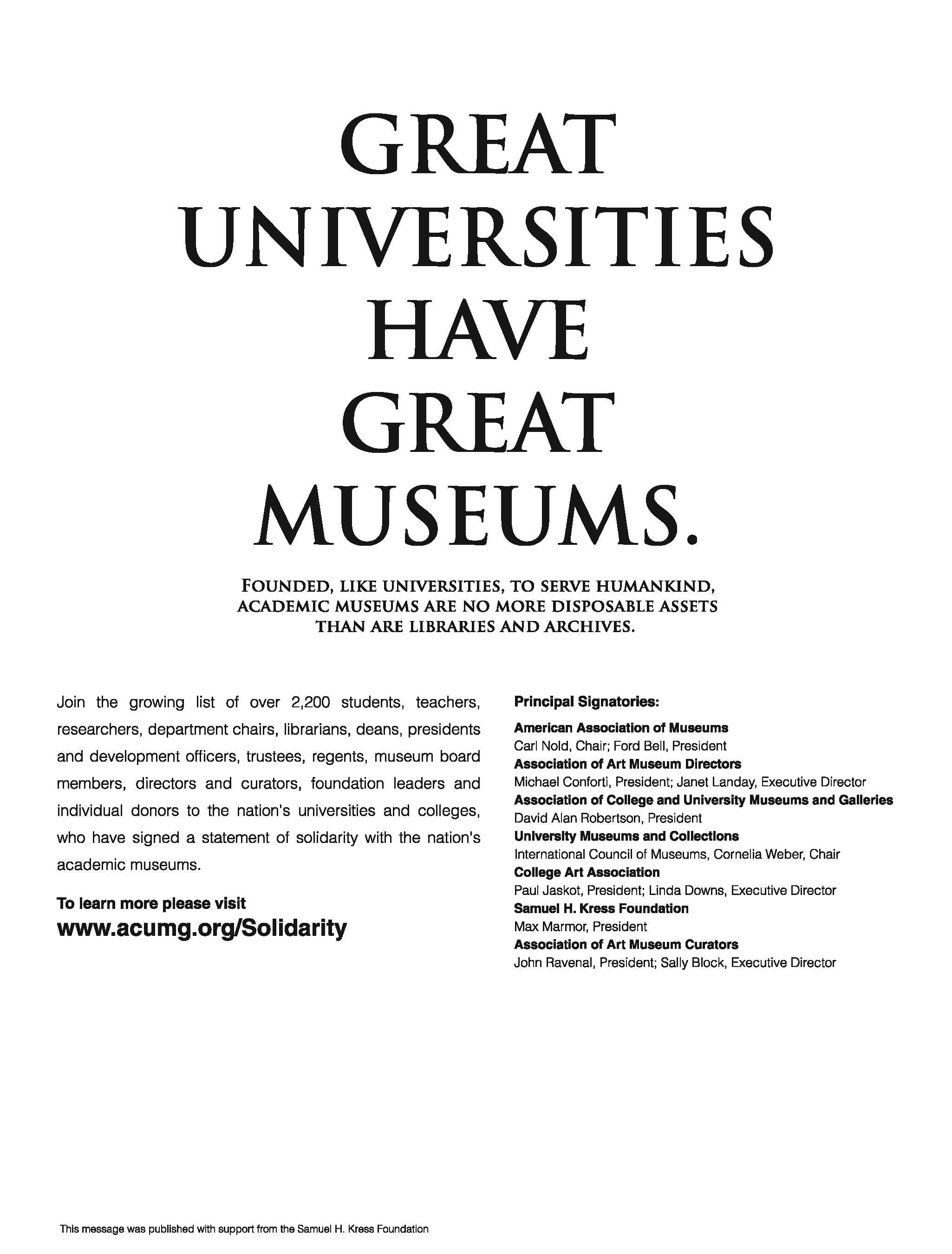 Today in Inside Higher Ed, Scott Jaschik reports on recent work of a task force, comprising representatives from seven national and international organizations, that is raising awareness of the value of university and college art museums and galleries in light of recent events involving attempts by schools to sell work from their collections.
In “Avoiding the Next Brandeis,” Jaschik talks to the task-force cochair David Alan Robertson, director of Northwestern University’s Mary and Leigh Block Museum of Art, who is “trying to impress upon [regional higher-education accrediting agencies] that museums shouldn’t be viewed as extras, but as ‘teaching institutions and research institutions.’” Jaschik continues, “Another strategy being discussed is encouraging colleges to define the financial exigency plans—or what they would do in a severe financial crisis—and to make the case that museums should not be the first institutions to be closed.”
Lyndel King, task-force cochair and director and chief curator of the Frederick R. Weisman Art Museum at the University of Minnesota, Twin Cities, tells the reporter that “we need to educate college administrators and governing boards that disposing of their collections can’t be a way to fill the coffers or seen as an easy way to bring in money.”
The task force comprises representatives from CAA, the American Association of Museums, the Association of Art Museum Directors, the Association of College and University Museums and Galleries, the International Council of Museums, the Samuel H. Kress Foundation, and the Association of Art Museum Curators. The next meeting of the task force will take place on January 9, 2010, in Sarasota, Florida, in conjunction with the midwinter gathering of the Association of Art Museum Directors.
You may read the petition, published by the task force in July 2009, and include your name and affiliation in the growing list of signatories. A prominent advertisement will appear in the Chronicle for Higher Education later this month; you can download a PDF of it or click and save the above image for use in blogs, press, and more. The task force had planned to include all signatories in the ad, but the list has exceeded 2,200 names and institutional affiliations—too many to include in print.
Inside Higher Ed Reports on the “Great Universities Have Great Museums” Movement
posted by Christopher Howard — October 01, 2009
Today in Inside Higher Ed, Scott Jaschik reports on recent work of a task force, comprising representatives from seven national and international organizations, that is raising awareness of the value of university and college art museums and galleries in light of recent events involving attempts by schools to sell work from their collections.
In “Avoiding the Next Brandeis,” Jaschik talks to the task-force cochair David Alan Robertson, director of Northwestern University’s Mary and Leigh Block Museum of Art, who is “trying to impress upon [regional higher-education accrediting agencies] that museums shouldn’t be viewed as extras, but as ‘teaching institutions and research institutions.’” Jaschik continues, “Another strategy being discussed is encouraging colleges to define the financial exigency plans—or what they would do in a severe financial crisis—and to make the case that museums should not be the first institutions to be closed.”
Lyndel King, task-force cochair and director and chief curator of the Frederick R. Weisman Art Museum at the University of Minnesota, Twin Cities, tells the reporter that “we need to educate college administrators and governing boards that disposing of their collections can’t be a way to fill the coffers or seen as an easy way to bring in money.”
The task force comprises representatives from CAA, the American Association of Museums, the Association of Art Museum Directors, the Association of College and University Museums and Galleries, the International Council of Museums, the Samuel H. Kress Foundation, and the Association of Art Museum Curators. The next meeting of the task force will take place on January 9, 2010, in Sarasota, Florida, in conjunction with the midwinter gathering of the Association of Art Museum Directors.
You may read the petition, published by the task force in July 2009, and include your name and affiliation in the growing list of signatories. A prominent advertisement will appear in the Chronicle for Higher Education later this month; you can download a PDF of it or click and save the above image for use in blogs, press, and more. The task force had planned to include all signatories in the ad, but the list has exceeded 2,200 names and institutional affiliations—too many to include in print.
Listen to Live Audio News Briefing on US v. Stevens on Thursday
posted by Christopher Howard — September 22, 2009
Media Coalition invites listeners to join an audio news briefing discussing the upcoming Supreme Court case US v. Stevens on Thursday, September 24, 2009, at 2:00 PM EDT. Speaking will be David Horowitz from Media Coalition; Laurie Lee Dovey of the Professional Outdoor Media Association; Joan Bertin of the National Coalition Against Censorship; and Chris Finan from the American Booksellers Foundation for Free Expression.
In 2004, Robert J. Stevens was convicted under a federal statute, passed in 1999, which made it illegal to distribute or own media depicting animal cruelty. Stevens, a writer and filmmaker from Virginia, had assembled footage of pit bulls fighting and hunting, mainly in international locations where dogfighting is legal. Last year, Stevens’s conviction was overturned, and the Supreme Court will hear arguments in this case on October 6, 2009. Read CAA’s description of the case and statement on this issue.
This summer, CAA signed an amicus curiae brief supporting the National Coalition Against Censorship’s claim that acts of expression, not actual involvement in illegal activities, are protected under the First Amendment and are not subject to criminal penalties. Media Coalition, a trade association that defends First Amendment rights of the mainstream media, filed its own amicus brief in late July.
To RSVP for the audio news briefing, please contact Kai-Ming Cha at 212-587-4025, ext. 12. To hear the briefing, call 1-888-387-8686 and enter access code 1066257.
Listen to Live Audio News Briefing on US v Stevens on Thursday
posted by Christopher Howard — September 22, 2009
Media Coalition invites listeners to join an audio news briefing discussing the upcoming Supreme Court case US v. Stevens on Thursday, September 24, 2009, at 2:00 PM EDT. Speaking will be David Horowitz from Media Coalition; Laurie Lee Dovey of the Professional Outdoor Media Association; Joan Bertin of the National Coalition Against Censorship; and Chris Finan from the American Booksellers Foundation for Free Expression.
In 2004, Robert J. Stevens was convicted under a federal statute, passed in 1999, which made it illegal to distribute or own media depicting animal cruelty. Stevens, a writer and filmmaker from Virginia, had assembled footage of pit bulls fighting and hunting, mainly in international locations where dogfighting is legal. Last year, Stevens’s conviction was overturned, and the Supreme Court will hear arguments in this case on October 6, 2009. Read CAA’s description of the case and statement on this issue.
This summer, CAA signed an amicus curiae brief supporting the National Coalition Against Censorship’s claim that acts of expression, not actual involvement in illegal activities, are protected under the First Amendment and are not subject to criminal penalties. Media Coalition, a trade association that defends First Amendment rights of the mainstream media, filed its own amicus brief in late July.
To RSVP for the audio news briefing, please contact Kai-Ming Cha at 212-587-4025, ext. 12. To hear the briefing, call 1-888-387-8686 and enter access code 1066257.