
CAA News Today
Designing a Better Future: A Participatory Platform for Exchange
posted by Christopher Howard — May 16, 2013
Jacki Apple and Mat Rappaport, the producers of a 2014 ARTspace session, seek your participation for “Designing a Better Future: A Participatory Platform for Exchange,” taking place at the 102nd CAA Annual Conference in Chicago on Saturday, February 15, 10:00 AM–2:00 PM. Deadline for proposals: June 1, 2013; notification of selection: June 20, 2013.
Designing a Better Future: A Participatory Platform for Exchange
Artists and designers operating as thinkers and communicators, visualizers and producers, can be leaders in changing how we think, live, and act in order to make a better world. Are we ready to discuss cultural production and the arts as viable and meaningful practices beyond the established system of commodity trading? What potential models of an effective creative practice can we envision and develop?
Artists, designers, media producers, photographers, filmmakers, architects, writers, theorists, educators, and cultural historians are invited to submit proposals for presentation and discussion that will inspire others to join them in imagining, inventing, and actualizing a more sustainable and enlightened possible future, whether it be local or global.
What would you do to effect change? What would that look like? Do aesthetics matter?
We seek provocative and challenging theoretical concepts and/or models for practical application. Encouraged are visionary, daring, and unconventional ideas and collaborations across fields in the arts, sciences, and humanities that conceive different ways to address social, economic, and environmental realities.
General topics and themes to consider may include:
- Climate change, the environment, and sustainable living: consumption, energy, waste, food, water, air, and economic and social consequences
- The culture of violence: all its social, political, cultural, and economic manifestations
- Technology and human rights: biological, political, intellectual, and spiritual
Presentation Format
The format for presentation will be an interactive forum of exchange between speakers and audience. There will be no podium. Speakers will be placed within the audience. Presentations may include visuals such as images, texts, charts, etc.
Each speaker will be given seven minutes to present his or her proposal. The audience will then have equal time—seven minutes—to respond and discuss. Time may be slightly less or more depending on the number of outstanding proposals selected.
Submission Instructions
Please send a description of your topic and the theoretical concepts and/or model that you intend to propose in approximately three hundred words, plus a brief biography or CV of no more than two pages. The written proposal must include a title, name(s) of author(s), address, email, and phone number. Please submit all proposal files as PDF documents to studio@meme01.com. Deadline for proposals: June 1, 2013; notification of selection: June 20, 2013.
CAA Awarded $20,000 NEA Grant for ARTspace
posted by Nia Page — April 23, 2013
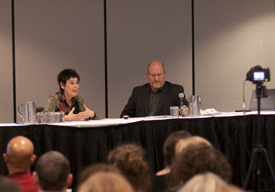 CAA has been awarded a $20,000 grant from the National Endowment for the Arts (NEA) to support the next ARTspace, taking place during the 2014 Annual Conference in Chicago. Initiated twelve years ago by CAA’s Services to Artists Committee, ARTspace is a forum for presenting programming designed by artists for artists that is free and open to the public. Held at each conference since 2001, ARTspace is intended to reflect the current state of the visual arts and arts education and is among the most vital and exciting aspects of the yearly meeting.
The grant, which is the NEA’s fifth consecutive award to CAA for ARTspace, will help fund ARTexchange, the popular open-portfolio event for artists, and [Meta] Mentors, which has recently addressed such topics as making a living as an artist with and without a dealer. ARTspace programming at the 2013 conference in New York also included several panels on the intersections of art and ethics, law, and social change.
Designed to engage CAA’s artist members as well as the general public, ARTspace offers program sessions free of charge and includes diverse activities such the Annual Artists’ Interviews (most recently with Mira Schor and Janine Antoni); screenings of film, video, and multimedia works; live performances; and papers and presentations that facilitate a conversational yet professional exchange of ideas and practices.
Image: the painter and writer Mira Schor (left) participated in CAA’s Annual Artists’ Interviews, hosted by ARTspace during the 2013 Annual Conference in New York. Schor was interviewed by Stuart Horodner, artistic director of the Atlanta Contemporary Art Center (photograph by Bradley Marks)
Propose a Paper or Presentation for the 2014 Annual Conference
posted by Lauren Stark — March 26, 2013
 The 2014 Call for Participation for the 102nd Annual Conference, taking place February 12–15, 2014, in Chicago, describes many of next year’s programs sessions. CAA and the session chairs invite your participation: please follow the instructions in the booklet to submit a proposal for a paper or presentation. This publication also includes a call for Poster Session proposals and describes the seven Open Forms sessions.
Listing more than 120 panels, the 2014 Call for Participation will soon mail to all individual and institutional members; you can also download a PDF of the twenty-seven-page document from the CAA website immediately.
The deadline for proposals of papers and presentations for the Chicago conference has been extended to Monday, May 13, 2013.
In addition to dozens of wide-ranging panels on art history, studio art, contemporary issues, and professional and educational practices, CAA conference attendees can expect participation from many area schools, museums, galleries, and other institutions. The Hilton Chicago on South Michigan Avenue (in the Loop) is the conference headquarters, holding most sessions, Career Services, the Book and Trade Fair, ARTspace, special events, and more. Deadline extended: May 13, 2013.
Contact
For more information about proposals of papers and presentations for the 2014 Annual Conference, please contact Lauren Stark, CAA manager of programs, at 212-392-4405.
My Trip to New York (Thanks to CAA and the Getty Foundation)
posted by Karen von Veh — March 22, 2013

Early last year, in my role as president of the South African Visual Arts Historians (SAVAH), I was asked by Professor Federico Freschi (at the University of Johannesburg) to send out a call for participants to apply for a travel grant to attend the CAA Annual Conference in New York in February 2013. After mailing the request to SAVAH members, I read through the requirements and found that it was an extraordinarily generous grant for which one only needed to be a full-time practicing art historian residing in a country not well represented in CAA membership. The grant, which was funded by the Getty Foundation, was aimed at encouraging dialogue between art historians from around the globe and included a year’s membership to CAA.
As a lucky recipient I was one of twenty people heading for the icy snow-laden New York in February and arrived on the first morning that JFK airport was opened again after being closed for two days due to blizzards. My first activity in New York was to head for Central Park and enjoy the novelty of walking in the deep snow.
The day before the CAA conference, travel-grant recipients had a preconference gathering where we met the other grantees and gave five-minute presentations to introduce ourselves. This allowed us to get to know each other and identify like minds and areas of collaboration, so from the first meeting there was already a networking frenzy taking place. The grantees reminded me of the League of Nations, with people from various African countries, South American countries, India, Pakistan, China, Haiti, Korea, Iceland, and several Eastern European countries (and I have probably missed a few). There was a lot of lively discussion every time we met, and we got on very well with each other as a group. It was wonderful to meet so many diverse people who shared a passion for the development and teaching of art history.
The CAA conference was huge and frenetic with many parallel sessions, so one had to choose the papers very carefully. I heard some wonderful presentations by Amelia Jones, Griselda Pollock, and Whitney Chadwick (among others) in a feminist session that was packed to the hilt, with people sitting on the floor and lining the walls. As part of conference attendance, everyone had free access to many galleries and museums in New York for the duration of the conference, so there was much rushing to see exhibitions between listening to papers.
 I was also lucky enough to be invited (with the other African delegates) to the opening of El Anatsui’s glorious exhibition, Gravity and Grace, at the Brooklyn Museum, where the artist made an appearance as well. For this and other wonderful visits (such as a private tour of the African collection at the Metropolitan Museum) I must thank Jean Borgatti, who was assigned as host to two of the African delegates but was kind enough to include all the visitors from Africa in her plans. At the end of the conference, we had a final “debriefing” session where we could state what worked and what didn’t. From my point of view, the entire event was splendidly arranged and I cannot fault anything, although on a purely personal note I would have enjoyed more time with the group as a whole.
After the conference we were invited by the Sterling and Francine Clark Art Institute to visit their museum and research center in Williamstown, Massachusetts. Most of the group were able to extend their visit for the extra three days required for this trip, and we were bussed off to Williamstown, where we stayed at the delightful Williams Inn. At the Clark we were given a tour of the library, the print archives, and the museum, and joined in discussions of possible future projects for the Clark’s Research and Academic Programs to pursue. We were also taken to one of the biggest art spaces I have ever seen: the Massachusetts Museum of Contemporary Art (or MASS MoCA), which had a room large enough (one football field long) to display Xu Bing’s enormous flying Phoenix.
 After returning to New York, most travel-grant recipients returned to their countries, while I and a few others were able to stay another few days (in my case until the weekend—two more days) to make the most of the city. I spent this time literally running from one gallery to another to try and fit them all in before leaving. New York is amazingly rich in terms of what it has to offer culturally, and I feel this trip was altogether an enriching experience—from the intellectual stimulation and visual excitement to the wonderful people I met. This affords great networking opportunities such as reciprocal arrangements between institutions (student or staff exchanges) and invitations to conferences or ongoing discussions about the state of art history on a global scale (via email, of course). As a direct result of this trip I have already been invited to speak at a global conference in Slovakia this September, and am making arrangements for exchange programs with other institutions.
First image: Me (the “Michelin Man”) in Central Park.
Second image: The “African Contingent” admiring El Anatsui at the Met.
Third image: Our group at the final “debriefing” in New York.
Twenty International Travel Grant Recipients Attend CAA’s Annual Conference
posted by Ann Albritton and Janet Landay — March 12, 2013
 Twenty recipients of CAA International Travel Grants, funded by the Getty Foundation, attended the Annual Conference in New York in February. For the second year, CAA’s International Committee, chaired by Ann Albritton, worked with Janet Landay, organizer of this project for CAA, to host a diverse group of art historians—scholars, teachers, and curators from nineteen countries around the world—in CAA’s endeavor to become more connected in our increasingly global art world.
CAA Executive Director, Linda Downs, explains the project in this way:
We developed the concept for a program that would:
- introduce individuals who have not had the means to participate in the annual conference to provide travel, hotel and stipends to attend;
- attempt to interest individuals who are teaching in relatively small or new art and art history departments to provide access to an international network of people in the visual arts;
- to do a good job of hosting them and connecting them to other members of similar sub disciplines and interests (be they US or international members) in order to provide the beginnings of networks that they can build on;
- to give them instruction on what is sought by the Annual Conference Committee for vetted session proposals so that they might propose sessions in the future in order to present their perspectives, critical concerns and resent research; and
- to start a dialogue with US art historians and artists on their methodology, research, networks and interests.
Each grantee was hosted by a colleague from CAA—members of the International Committee, Board members, or representatives of the National Committee on the History of Art (NCHA)—who introduced them to the conference and scholars in their fields, and also arranged meetings, museum visits and informal gatherings. This year, we were very grateful for a grant from NCHA to support the hosts’ activities.
 On February 12, the day before the Annual Conference began, the grant recipients and their hosts met for a half-day preconference about issues in global art history. Beginning with short presentations by the grantees about their research and experiences, the afternoon included a panel discussion on global art history, moderated by Marc Gotlieb, the president of NCHA and professor of art history at Williams College, with representatives from the Getty Foundation (Joan Weinstein), the Getty Research Institute (Gail Feigenbaum), the Clark Research and Academic Program (Michael Ann Holly), and the Center for Advanced Study in the Visual Arts (Elizabeth Cropper). Exciting exchanges prompted by the panel discussion as well as the research projects of the grant recipients produced energy that enlivened our discussions for the remainder of the conference. Here’s how one grantee summarized it:
The pre-conference was probably the most useful aspect of this visit as it allowed each of us to get to know each other and to immediately identify people with whom we could network and set up reciprocal projects or research exchanges between our institutions. I have made some wonderful contacts and we are already busy with plans for invitations to speak at conferences and plans to arrange student/staff visits to linked institutions.
—Karen von Veh, South Africa
 On Thursday, during a luncheon for the grantees and hosts, James Elkins, E.C. Chadbourne Chair of art history, theory, and criticism at the School of the Art Institute of Chicago, had lunch with the group and shared with them ideas and stories from his international study of the field. This, again, was a highlight for many. In fact, Elkins plans to visit some of them in the near future as he travels around the world.
A whole new range and scope of possibilities have entered my horizon. I think it will open up many opportunities for my students and colleagues as well. But on a personal and human level the conference was a great gathering for creating global understanding.
—Musarrat Hasan, Pakistan
Jean Borgatti, specialist in African Art, commented on her hosting activities for several of the grant recipients from African countries: Joseph Adande from Benin; Peju Layiwola of Lagos, Nigeria; Venny Nakazibwe of Uganda; Ohioma Pogoson of Nigeria, and Karen von Veh of South Africa (and also, at times, Marly Desir of Haiti). A week after the CAA conference, Jean flew to Africa for several months of study and wrote this:

I’m looking forward to actually visiting three of my five grantees in Lagos, Ibadan, and what I refer to as ‘the other’ Benin, since I am currently in Benin City, heart of the old kingdom. During CAA, we had three great outings together: on Monday, Yaelle Biro at the Metropolitan Museum graciously provided a tour of her exhibit on the reception of African art in New York in the 1930s, and then left us with the Met’s archivist who gave us an overview of the various media encompassed by the archive. On Wednesday, we were invited to a private reception for El Anatsui’s exhibition at the Brooklyn Museum and were stunned by the beauty of the objects and thrilled to meet with the artist himself. On Thursday, Susan Vogel, founding director of the Center for African Art, invited the group to her Soho loft for dinner, a nice way to unwind and extend our conversations about ongoing and upcoming projects. A good time was had by all.
In addition to the events Borgatti described, these recipients also attended several CAA sessions, exchanged ideas with other recipients, and met many other CAA members.
The International Committee is delighted with CAA’s travel grant program, not only for bringing international scholars to the Annual Conference, but for the opportunity for us to interact with them: to learn about each other’s research and discuss mutual interests and concerns. We are indeed grateful to the Getty Foundation and NCHA for making this program possible and hope the friends we made this year will come to future conferences to continue our conversations. As one of the grantees put it:
I will be an ambassador for the CAA henceforth and will advise art historians in my country and elsewhere to endeavor to attend their annual meetings.
—Ohioma Pogoson, Nigeria
First image: Parul Mukherji (India) and Ding Ning (China), two of this year’s recipients of CAA’s International Travel Grants.
Second image: Gail Feigenbaum, Elizabeth Cropper, Marc Gotlieb, Michael Ann Holly, and Joan Weinstein participated in a panel discussion on issues in global art history during the February 12 pre-conference for the International Travel Grant program.
Third image: James Elkins, professor at the School of the Art Institute of Chicago, met with the CAA International Travel Grant recipients during the conference. Pictured are Peju Layiwola, Ann Albritton, James Elkins, and Elaine O’Brien.
Fourth image: Jean Borgatti took five recipients of this year’s CAA International Travel Grant to the Metropolitan Museum of Art, where they received a tour from curator Yaelle Biro. Front row: Jean Borgatti, Venny Nakazibwe (Uganda) Back row: Ohioma Pogoson (Nigeria), Karen von Veh (South Africa), Yaelle Biro, Joseph Adande (Benin), Peju Layiwola (Nigeria).
Take the 2013 Annual Conference Survey
posted by Nia Page — March 11, 2013
In an effort to improve our services, we encourage you to complete the following survey about your experiences at the 101st Annual Conference in New York last month. This survey should take only a few minutes to complete. We appreciate your feedback and your support and hope to see you at the 102nd Annual Conference in Chicago, to be held February 12–15, 2014.
Survey link: http://www.surveymonkey.com/s/JXZPKTS
Please complete the survey by Friday, March 22, 2013. Thank you.
CAA’s Task Force on Fair Use Meets during Annual Conference
posted by Jeffrey Cunard, CAA Counsel — March 05, 2013
CAA is now moving ahead with its Fair Use project, which will culminate in developing and disseminating a code of best practices intended to guide visual arts scholars, artists, teachers and museum professionals when they may use the copyrighted works of others under fair use. The project is funded by a major grant from the Andrew W. Mellon Foundation. An announcement of the grant can be found here: https://www.collegeart.org/news/2013/01/14/caa-receives-major-mellon-grant/
Last year, CAA’s Board established a Task Force to guide the Fair Use project. The Task Force is co-chaired by Gretchen Wagner, former general counsel of ARTstor, and me. Its other members include CAA President Anne Goodyear, CAA Executive Director Linda Downs, Committee on Intellectual Property Chair as well as members of the Board, and CAA members at large. During this year’s Annual Conference, the Task Force held its first meeting and the Committee on Intellectual Property sponsored a session that described the background of the project, its goals, and the projected timeline.
CAA’s Fair Use project has four phases. First, a hundred visual arts professionals, representing the broad spectrum of CAA’s membership and the field as a whole, will be interviewed on the use of third-party copyrighted materials in scholarly and artistic works. We also will survey CAA’s membership, so, within the next week, members can expect to see an email with a survey about copyright and the visual arts. Please take the time to fill it out: your participation is critical to the success of the project. This research phase will culminate in an Issues Report, which will be reviewed by a Community Practices Advisory Committee and, prior to the next Annual Conference, will then be made public.
In the second phase, we will convene a series of discussion groups across the country to focus on the issues raised by the Issues Report. These, too, will represent a wide range of CAA members. In these discussions, CAA members will discuss the most common situations identified in the Issues Report, and how they understand fair use to be important to accomplishing the professional goals of CAA members. During the third phase, that consensus will be reflected in a draft code. The draft will be reviewed by a Legal Advisory Committee, to ensure that it is consistent with the current law on fair use, and will be presented to the CAA Board for its approval. In the fourth and final phase, CAA will disseminate the code by making presentations at visual arts conferences around the country and posting webinars on CAA’s website and those of related organizations.
Patricia Aufderheide, University Professor in the School of Communication at American University and co-director of its Center for Social Media, and Peter Jaszi, Professor of Law and faculty director of the Washington College of Law’s Glushko-Samuelson Intellectual Property Clinic, co-principal investigators on the project, are conducting the research. They have considerable experience in developing codes of best practice for a large number of communities, including documentary filmmakers, dance archivists, poets, research librarians, and journalists. Their methodology and experience is described in their book, Reclaiming Fair Use: How to Put Balance Back in Copyright, University of Chicago Press, 2011. We are also grateful for the expert input of project advisors Virginia Rutledge, an art advisor, art historian, and lawyer who practices in the areas of both copyright and art law, and Maureen Whalen, associate general counsel for the J. Paul Getty Trust.
Throughout CAA’s Fair Use project, we will post updates in CAA News. We hope you will follow our progress.
Please take time to complete the CAA Creativity and
Copyright Survey, arriving by email on Friday, March 8.
Reflections on the Annual Conference, the Year Past, and the Year to Come
posted by Anne Collins Goodyear — March 05, 2013
Anne Collins Goodyear is president of the CAA Board of Directors.
CAA’s Annual Conference was typically lively and rewarding. With nearly six thousand participants, representing all fifty states—and the District of Columbia—and fifty-three countries, CAA hosted well over two hundred sessions addressing a broad range of topics, including contemporary art practice, criticism, pedagogy, issues in museums, and the history of art. As participation in the conference by colleagues from around the world continues to grow, we were pleased to welcome twenty recipients of CAA International Travel Grants, generously supported by the Getty Foundation, and further discussed by Ann Albritton, Chair of CAA’s International Committee, in an article that will soon be published on the CAA website.
The conference took advantage of new technologies, providing, for the first time, wireless internet access free of charge to conference goers throughout the conference rooms, and making possible the broad spread use of Skype to involve panelists and respondents unable to be in New York. CAA also hosted its first ever THATCamp (The Humanities And Technology) on February 11 and 12, fully subscribed with seventy-five scholars, just before the official start of the conference. A follow up session held during the conference continued a stimulating discussion about the promise and current role of new technologies for art historians.
New technologies are shaping CAA’s publications, two of which celebrate major milestones this year. The Annual Conference enabled us to mark the centennial of The Art Bulletin and the fifteenth anniversary of caa.reviews—both of which were toasted with cake and champagne following our Annual Members’ Business Meeting. In connection with this, each publication, thanks to a $20,000 grant from the Alliance for Networking Visual Culture, has undertaken open-access online projects using the Scalar platform. Thelma Thomas, chair of the Art Bulletin Editorial Board, graciously demonstrated her online compilation “Publishing The Art Bulletin: Past, Present, and Future,” (http://scalar.usc.edu/anvc/the-art-bulletin/index) at the meeting. A forthcoming Scalar project by the caa.reviews editor-in chief, Sheryl Reiss, will address the exhibition Bernini: Sculpting in Clay at the Kimbell Art Museum.
As the terrain of scholarly publishing continues to evolve, the high cost of scholarly publications, due in large part to the necessity of obtaining copyright and other clearance permissions for reproductions, concerns all of us. CAA is thus deeply appreciative of a one-year Meiss/Mellon Author Grant for $69,698 to offer subventions to emerging scholars who are publishing monographs in art history and visual studies and to advertise the award. Applications for the first round of the Meiss/Mellon Author’s Book Award are now being accepted. The deadline for spring submissions is March 15, 2013. Fall applications are due October 1, 2013. For more information see: http://www.collegeart.org/meissmellon/.
The larger question of when copyrighted material may be used without licensing in accordance with the principles of fair use is at the heart of a major initiative by CAA to establish Fair Use Best Practice Guidelines, undertaken with the assistance of generous support from the Kress and Mellon Foundations. The project is addressed in greater depth in Jeffrey Cunard’s article, published today. See: https://www.collegeart.org/news/2013/03/05/caas-task-force-on-fair-use-meets-during-annual-conference/.
As the Strategic Plan for 2010–2015 draws to its conclusion (available at http://www.collegeart.org/about/plan), the Board of Directors has now embarked, having convened a task force for the purpose, on the development of a 2015–2020 Strategic Plan. We are eager for your input into the plan and to hear from you about what you feel is working well within the organization and where our services could be strengthened. A related survey will be distributed later this year, and key issues will be discussed with the CAA membership next February at the 2014 Annual Members’ Business Meeting.
As always, CAA welcomes input from its membership on any topic of interest to the field. Please feel free to consult directly with the staff and board and/or to take advantage of CAA’s Facebook page to share your views. See: https://www.facebook.com/collegeartassociation.
Final Report of the Task Force on Annual Conference Technologies
posted by CAA — March 05, 2013
Submitted by: Jacqueline Francis, Vice President for Annual Conference
February 17, 2013
This report is a revised and updated version of the preliminary report delivered to the Board of Directors at its October 28, 2012 meeting. It is offered in four parts:
A. The Task Force Origins and Goals
B. Relevant Task Force Discussions and Findings
C. Future Research and Considerations
D. The Task Force’s Accomplishments and Recommendations
The Task Force members:
Jacqueline Francis, California College of the Arts; Vice President for Annual Conference; Chair
Anne Collins Goodyear, National Portrait Gallery, Smithsonian Institution; CAA President and past-VP for Annual Conference
Randall Griffin, Southern Methodist University; CAA VP for Publications
Patricia McDonnell, Wichita Art Museum; CAA VP for External Affairs
Sabina Ott, Columbia College Chicago; CAA Board Member
Emmanuel Lemakis, CAA Director of Programs
Lauren Stark, CAA Manager of Programs and Archivist
Michael Goodman, CAA Director of Information Technology
Paul Jaskot, De Paul University; CAA Past-president
Bruce Robertson, University of California–Santa Barbara; CAA Past-VP for Annual Conference
Katherine Behar, Baruch College
Conrad Gleber, LaSalle University
Mark Tribe, Brown University
On behalf of CAA, I thank the Task Force members for their service to our organization.
A. The Task Force Origins and Goals
Discussion began in December 2011. The initial meeting was chaired by Anne Collins Goodyear, then Vice President for Annual Conference. At this early stage, Task Force members considered historical perspectives on the Conference, offered by Bruce Robertson, the first CAA Vice President for Annual Conference, and CAA’s Director of Programs, Emmanuel Lemakis. In this collegial and productive discussion, the possibility of providing new member benefits whether via live stream and interactive broadcasts or as a post-conference recorded archive (audio and/or video) arose right away. It was useful to be reminded by CAA Director of Information Technology, Michael Goodman, that our organization’s technology infrastructure is mostly used for communication. For this reason, video recording sessions would require CAA to find volunteers to undertake the task, hire new personnel to do so, or contract outside service providers. Starting in January 2012, the Task Force researched, reviewed, and reported on available information technology strategies. The Task Force considered current strategies in use by other learned societies and professional organizations that regularly host conferences and symposia, and by cultural institutions whose goals resonate, overlap, and are coeval with CAA’s.
B. Relevant Task Force Discussions and Findings
1. Distributing Annual Conference Sessions
Presently CAA members can purchase audio recordings of conference sessions whose participants agree to be recorded. Initially, the product was audiocassettes, and presently, CDs and MP3s (digital) are available. Other available technologies include podcasts in MP4 (Quick Time files), Flash Video format which delivers video on the Internet, Windows Media Video/WMV format for streaming (constant delivery provided to a user), and webcasts (media presentation streamed live or distributed on demand on the Internet). Live streaming and video sharing of conference sessions were at the center of many Task Force discussions.
The benefits of distributing session proceedings online during the conference and in its aftermath include:
- a. offering content to CAA members, including those who attended the sessions and simply want to revisit their subjects, and those who did not attend at all;
- b. attracting new members to CAA who may not ever attend a conference, such as those living outside of the U.S. and/or persons with limited resources;
- c.- generating revenue by making online content a membership benefit;
- d.- expanding and broadening its audience by providing some or all of our online content for free.
- e.- documenting conference proceedings and session participation, which, in the UK is regarded as active research that is assessed in academic promotion and tenure cases, and other performance reviews.
Of course, there are many challenges around recording and webcasting content:
- a. the costs of streaming and delivering high quality visual recordings and limited CAA resources for undertaking this expense at present. The hourly rate for professional videographers in New York is at least $500/hour.
- b. Fair Use limitations for broadcasting modern and contemporary art presented in Power Point, Keynote, Prezi, and other presentation formats. [Fair Use is a limitation and exception to federal copyright laws that allow one to use a text, image, recording, etc., without the permission of the copyright holder.]
There are companies that webcast conference and symposium presentations,c.amplifying (as one website proclaimed) these events. Among the prominent video hosting sites are Vimeo, Art Babble, and YouTube. Making use of these sites, the Institute of Fine Arts (New York University), the National Gallery of Art, the Getty Research Institute, and the Arts & Humanities Research Council (United Kingdom) presently offer streamed and/or recorded content online. All are committed to this kind of programming because it has increased their visibility.
The Getty’s strategy in developing policy that allows it to distribute its event online is exemplary. Advised by its attorneys, the Getty has scripted a release form that each guest speaker must sign; this document informs guest speakers that their presentations may be visually recorded and distributed on Getty sites, which included its YouTube channel, Facebook page, social media sites that might carry the Getty name, and the getty.edu website. In addition, the Getty posts signs in its auditorium, advising the audience members at events that they may appear in video, still photography, etc., and on Getty websites. The Getty’s approach to recording speaker presentations that include works of art is to shoot around such images.
Following the Getty’s model, CAA might visually record session participants (and not any of the presented images prepared by panelists) who agree to be recorded. Major public sessions at the conference—the convocation, the distinguished scholar session, artist interviews—could be streamed live with presented images relegated to the background or not shot at all. CAA Counsel Jeffrey P. Cunard has confirmed that there would be no issue in visually recording (1) session speakers who have signed release forms, (2) separate Power Points (text only) presented, and (3) the work of an artist who is speaking. The costs of live streaming and recording sessions will be considered, including the possibility of contracting with a company which could both visually record and host captured media on its own server. Investigating the costs of such undertakings remains to be done, and the decision regarding prioritization for future Annual Conference’s falls to the board, in consultation with the executive director.
C. Future Research and Considerations
1. Conference Technologies
- a. CAA could organize and sponsor another session using Skype (or another innovative presentation technology that allows distance participation).
- b. CAA might investigate the possibility of a conference “app” that might make the gathering easier to navigate for participants, re: finding sessions, making use of the conference space, etc.
- c. CAA might weigh the benefits of (a) launching the splash/landing page for the conference further in advance of the gathering, and (b) revising the page with the goal of highlighting certain events.
- d. CAA might consider holding electronic roundtables.
- e. CAA could encourage greater use of social networking services and platforms, e.g., Twitter, Tumblr, etc., at the conference and in the lead-up to it. CAA Board members might host blogs based on their particular interests and affiliations, and interest groups within CAA might take up blogging. To create a stream of comments generated and carried forth by a conference session, CAA might add a Twitter hashtag to each session, or to a limited number of sessions related to particular interest groups. (Notably, artists place great importance on facilitating relationships in sessions.) Hashtags might be published in the conference program or announced at the start of a session. Overall, tweeting, which is like taking notes, gives people a feeling of belonging to a social network, and would signal a change in CAA’s relationship with conference participants.
- f. CAA could consider a price for access to conference recordings. Access might be a benefit of conference registration, set as a charge for non-registrants, or granted following a pay-per-view price for a single recording or a package of recordings downloaded from a CAA-branded website. A disclaimer stating that the quality of the recorded media will vary might be necessary.
- g. Regarding streaming and recorded technology under consideration, CAA might have to accept some loss of control over them for it will not be possible to review all conference media slated for distribution. While CAA strives to provide and distribute high quality recordings to members, determining, assessing, and meeting that standard are responsibilities that our body might share with session participants, including session chairs.
- h. CAA could pursue the prospect of live streaming several sessions that will be distributed either on our website or on another server.
- i. CAA might consider a universal opt-in format for consent related to recording sessions and distributing them. That is, by agreeing to participate in the conference, all participants (presenters and audiences) would agree to be recorded, photographed, etc., and have their images used on CAA sites. Those who do not agree to any or all of these terms would have to submit forms stating their refusal by a set, pre-conference deadline.
2. Post-Conference Documentation of Conference Sessions
CAA’s identity is that of a member organization, and it can further capitalize on its capacity to facilitate relationships within our community. Specific to the visual recording of conference sessions, a Task Force member suggested this design for implementation:
- a. Session chairs could self-document (visual and audio recording, distribution of papers and presentations, setting up URL links, etc.) and post the media to a website they design and control.
- b. The CAA website could provide links to the session websites with abstracts and biographical information about the participants.
Some strategies for implementation:
- a. CAA requests, encourages or requires participation in such documentation.
- b. CAA starts small and works to support the initiative through outside funding.
- c. CAA make copyright issues the session chairs’ responsibility.
Participation in the visual recording of conference events for distribution may be low at first and may require CAA support to reach 100%. Without question, increasing the availability of the conference sessions will be a benefit to members. It also will influence creative, scholarly, and professional interest groups who exist outside of CAA and include individuals who have not or do not attend the Annual Conference. There is unlimited potential for CAA to facilitate the development of new networks and relationships.
3. Digital Communication and Distribution of Scholarship
Digital content is still being driven by individual members. CAA must continue to investigate the benefits and challenges of digital communication and distribution of scholarship using such technologies. The Modern Language Association (MLA) has recently established a new Office of Scholarly Communication with the goal of using digital platforms to promote member communication. MLA’s model of membership privileges openness, rather than the conventional closed dynamic of scholarly associations. A key benefit of membership is the opportunity to use MLA resources to find and communicate with likeminded scholars. Previously, a benefit of MLA membership was sharing one’s work with a relatively small number of people in attendance at an annual conference, or through publication in a journal (itself conceived as a benefit of membership). Now, MLA members will be able communicate with each other throughout the year, and publish digitally through MLA Commons, an open-source, blog-like platform that is being developing in partnership with the City University of New York Academic Commons (and with the support of the Andrew W. Mellon Foundation). MLA believes that the open practices and flexible network of MLA Commons will cultivate the best scholarship.
D. The Task Force’s Accomplishments and Recommendations
1. Accomplishments
- a. There will be a CAA Board-sponsored session at the 2013 conference on participatory art, curated by Task Force member Mark Tribe and led by Pablo Helguera. A New York based artist, Helguera is an author and multi-disciplinary artist working in unconventional formats, including experimental symposia, audio recordings, exhibition audio-guides, and nomadic museums.
- b. THATCamp CAA (in association with Columbia University and Smarthistory at Khan Academy) will be held on Monday, February 11, 2013 and Tuesday, February 12, 2013. This unconference will be an informal, discussion-based, collaborative meeting to be held at Macaulay Honors College (35 West 67th Street, NY). Attendance is free. THATCamp CAA focuses on digital art history scholarship and is open to those with an active interest in that area. Seventy-five participants were accepted on a first-come, first-served basis. A limited number of Kress Fellowships were made available for graduate students to help defray travel costs to THATCamp CAA. Lastly, there will be a CAA Board sponsored session at the 2013 Conference dedicated to the findings and outcomes of THATCamp CAA.
- c. There is wireless access at the 2013 Conference (NY) in all session rooms; our 2014 Conference (Chicago) also will offer this benefit for participants. CAA director of programs, Emmanuel Lemakis, deserves special recognition for negotiating with Hilton New York Hotel representatives for this perk.
- d. CAA is negotiating with a New York-area university to have student videographers record two to three sessions at the 2013 Conference. Session participants will permit video recording of themselves at the podium (but not their images as presented in Keynote, Power Point, Prezi, etc.). These videos will be made available after the conference. (See Task Force Recommendations section below.)
2. Recommendations
- a.. In 2013 CAA should undertake a pilot project to present two to three visual recordings of Conference sessions on Vimeo. Key CAA staff, the CAA President, and the VP for Annual Conference should review the recordings. High quality video should be uploaded to Vimeo by mid-March 2013 and promoted on CAA’s website.
- b.. Post-2013 conference, CAA should apply for a grant to fund a three-year initiative to research and present best practices of live streaming, audio and video recording, and archiving records of scholarly and professional presentations in which Fair Use is an issue. Grant requests could be made to the Kress Foundation and to the Andrew W. Mellon Foundation to position CAA as an organization well-suited to create a model for streaming online content. Our grant application should stress both the benefits to CAA and to the cultural sector in which we operate, especially in working out costs and other challenges to presenting images that are under copyright.
3. Budget items may include the following:
- (a) a temporary employee’s salary to professionally visually record a limited number of sessions, upload video to a media hosting site, and pursue image permissions used in a limited number of conference sessions, starting in 2014;
- (b) production costs related to streaming, visual recording, archiving, and posting conference videos for online distribution, live stream or on demand;
- (c) the costs of contracting with recording company that would visually record CAA sessions and host the recordings on its server;
- (d) research on permissions costs to session speakers to reproduce images at conference sessions/events starting in 2014 Conference and extending to 2017.
- e. CAA should identify a suite of conference sessions, presentations, and events suitable for live streaming and video recording, and secure participants’ permission to record, broadcast, and/or archive their discussions (and not their images), starting with the 2014 Conference. The cost of doing so should be recouped from conference fees.
- f. Four sessions at the 2014 Conference—selected in advance by CAA executive director, deputy director, director of programs, director of information technology, director of membership, development, marketing, CAA President, CAA Vice President for Annual Conference—should be streamed live during the conference and made freely available. Cost of doing so should be recouped from conference fees. The Task Force suggests streaming the conference’s keynote speaker’s address and the distinguished scholar session.
- g. The unconference format should be part of the 2014 Conference, and might be organized around the topic of contemporary artists’ use and engagement with emergent technologies. This unconference could be scheduled to run concurrently with the Annual Conference; limited to 60-75 participants in the THATCamp format, the unconference would not compete with the Annual Conference.
- h. CAA should encourage the growth of interest blogs and assign hashtags to our conference sessions. Task Force members recently attended conferences and symposia where social media enhanced the event for participants. The CAA director of programs will contact museum professionals and information management experts who have organized and/or used Twitter in conference settings, and the Annual Conference Committee will investigate the viability of the hashtag proposal.
- i. New technology is created regularly and must be continuously discussed and considered for adoption. A Board-sponsored session at the conference is an appropriate Fostering sustainable and ongoing review of conference In addition to harvesting ideas introduced or technologies tried in conference sessions soon after the forum for such discussion technologies should be the charge of the Annual Conference Committee, which would add some members with expertise in this area and comprise a subcommittee annual meeting’s conclusion, the subcommittee would evaluate older technologies to determine if modifications are necessary or if they have outlived their usefulness.
2013 Annual Conference Report
posted by Nia Page — February 27, 2013
CAA hosted its 101st Annual Conference from February 13 to 16, 2013, at the Hilton New York in midtown Manhattan. This year’s program included four days of presentations and panel discussions on art history and visual culture, Career Services for professionals at all stages of their professional lives, a Book and Trade Fair, and a host of special events throughout the region. Preceding the Annual Conference was CAA’s first THATCamp, an “unconference” on digital art history that took place at Macaulay Honors College, City University of New York.
Attendance
Close to six thousand people from throughout the United States and abroad—including artists, art historians, students, educators, curators, critics, collectors, and museum staff—attended the conference.
Sessions
Conference sessions featured presentations by artists, scholars, graduate students, and curators who addressed a range of topics in art history and the visual arts. In total, the conference offered over two hundred sessions, developed by CAA members, affiliated societies, and committees.
Career Services
Career Services included four days of mentoring and portfolio-review sessions, career-development workshops, and job interviews with colleges, universities, and other art institutions. Approximately 230 interviewees and forty mentors participated in Career Services.
Book and Trade Fair
This year’s Book and Trade Fair presented 110 exhibitors—including participants from the United States, the United Kingdom, Turkey, Belgium, Mexico, Hong Kong, Germany, Poland, Ukraine, and Canada—that displayed new publications, materials for artists, digital resources, and other innovative products of interest to artists and scholars. The Book and Trade Fair also featured book signings, lectures, and demonstrations, as well as three exhibitor-sponsored program sessions on art materials and publishing.
ARTspace and ARTexchange
ARTspace, a “conference within the conference” tailored to the needs and interests of practicing artists, presented programming free and open to the public, including this year’s Annual Artists’ Interviews with Mira Schor and Janine Antoni. Over three hundred people attended this extraordinary event.
ARTspace also featured four days of panel discussions devoted to visual-arts practice, opportunities for professional development, and screenings of video work curated and produced by graduate students from the New York region. Programmed by CAA’s Services to Artists Committee, ARTspace was made possible in part by a generous grant from the National Endowment for the Arts.
ARTexchange, an open-portfolio event in which CAA artist members displayed drawings, prints, photographs, small paintings, and works on laptop computers, took place on Friday, February 15. Nearly fifty artists participated in ARTexchange this year.
Convocation and Awards
More than five hundred people attended CAA’s Convocation and presentation of the annual Awards for Distinction, which honor the outstanding achievements and accomplishments of individual artists, art historians, authors, conservators, curators, and critics whose efforts transcend their individual disciplines and contribute to the profession as a whole and to the world at large. The recipients of the 2013 awards are:
- Ellsworth Kelly, Distinguished Artist Award for Lifetime Achievement
- Elaine Sturtevant, Artist Award for Distinguished Body of Work
- T. J. Clark, Distinguished Lifetime Achievement Award for Writing on Art
- Hal Foster and Claire Bishop, Frank Jewett Mather Award
- Harmony Hammond and Martha Rosler, Distinguished Feminist Award
- Mary K. Coffey, Charles Rufus Morey Book Award
- Philipp Kaiser and Miwon Kwon, Alfred H. Barr Jr. Award
- Joanne Pillsbury, Miriam Doutriaux, Reiko Ishihara-Brito, and Alexandre Tokovinine, Alfred H. Barr Jr. Award for Smaller Museums, Libraries, Collections, and Exhibitions
- Buzz Spector, Distinguished Teaching of Art Award
- June Hargrove, Distinguished Teaching of Art History Award
- Lance Mayer and Gay Myers, CAA/Heritage Preservation Award for Distinction in Scholarship and Conservation
- Yukio Lippit, Arthur Kingsley Porter Prize
- Julia Bryan-Wilson, Art Journal Award
Robert Storr of Yale University delivered the keynote address. His provocative address will be posted on CAA’s website in the coming weeks.
Special Events
Following Convocation, the Solomon R. Guggenheim Museum hosted CAA’s Opening Reception on Wednesday evening, February 13. Hundreds of attendees gathered to celebrate the conference while enjoying a preview of the exhibition Gutai: Splendid Playground.
CAA celebrated the one hundredth anniversary of The Art Bulletin and the fifteenth anniversary of caa.reviews after the Annual Members’ Business Meeting on Friday, February 15.
Thank You
Members of CAA’s Board of Directors and staff would like to extend their gratitude to all conference funders and sponsors, attendees, volunteers, and participants; the organization’s committees and award juries; the Hilton New York staff; NYC and Company; the museums and galleries that opened their doors to conference attendees free of charge; and everyone involved in helping to make the 101st Annual Conference such a tremendous success!
Save the Date
CAA’s 102nd Annual Conference will be held in Chicago, Illinois, February 12–15, 2014.
About CAA
The College Art Association is dedicated to providing professional services and resources for artists, art historians, and students in the visual arts. CAA serves as an advocate and a resource for individuals and institutions nationally and internationally by offering forums to discuss the latest developments in the visual arts and art history through its Annual Conference, publications, exhibitions, websites, and other events. CAA focuses on a wide range of issues, including education in the arts, freedom of expression, intellectual-property rights, cultural heritage and preservation, workforce topics in universities and museums, and access to networked information technologies. Representing its members’ professional needs since 1911, CAA is committed to the highest professional and ethical standards of scholarship, creativity, criticism, and teaching.