CAA News Today
New Publication Grants for Manuscripts on American Art
posted by Christopher Howard — September 03, 2014
 The Terra Foundation for American Art has awarded CAA a major, three-year grant to administer an annual grant program to support book-length scholarly manuscripts in the history of American art. The Terra Foundation for American Art International Publication Grant will award funds of up to $15,000 for books that examine American art in an international context, increase awareness of American art internationally through publication outside the United States, allow wider audiences to access important texts through translation, and/or result from international collaboration. The program is designed to offset image acquisition and translation costs, however other editing and production expenses will be considered.
The publication grants will support publications that make significant contributions to the field in three award categories: grants to US publishers for manuscripts that consider American art in an international context, grants to non-US publishers for books on topics in American art, and grants for the translation of books on topics in American art to or from English. In addition to the publication grants, the program will support the creation of an international network of American art scholars by providing two non-US authors whose books are funded through the grant program with travel stipends and complimentary registration to attend CAA’s Annual Conference.
Grant guidelines, detailed eligibility requirements, and application instructions are available on the CAA website. For this grant program, “American art” is defined as art (circa 1500–1980) of what is now the geographic United States. Letters of inquiry should be submitted to CAA no later than October 15, 2014. Applicants whose projects fall within the guidelines and successfully fulfill the mission of the grant program will be invited to submit full applications, due December 15, 2014. The first round of award winners will be announced in April 2015.
About CAA
CAA is dedicated to providing professional services and resources for artists, art historians, and students in the visual arts. CAA serves as an advocate and a resource for individuals and institutions nationally and internationally by offering forums to discuss the latest developments in the visual arts and art history through its Annual Conference, publications, exhibitions, website, and other programs, services, and events. CAA focuses on a wide range of advocacy issues, including education in the arts, freedom of expression, intellectual-property rights, cultural heritage and preservation, workforce topics in universities and museums, and access to networked information technologies. Representing its members’ professional needs since 1911, CAA is committed to the highest professional and ethical standards of scholarship, creativity, criticism, and teaching.
About the Terra Foundation
 The Terra Foundation for American Art is dedicated to fostering exploration, understanding, and enjoyment of the visual arts of the United States for national and international audiences. Recognizing the importance of experiencing original works of art, the foundation provides opportunities for interaction and study, beginning with the presentation and growth of its own art collection in Chicago. To further cross-cultural dialogue on American art, the foundation supports and collaborates on innovative exhibitions, research, and educational programs. Implicit in such activities is the belief that art has the potential both to distinguish cultures and to unite them.
Contact
For more information please contact Hillary Bliss, CAA development and marketing manager, at hbliss@collegeart.org or 212-392-4436. For more information on applying to the Terra Foundation for American Art International Publication Grant, please contact Betty Leigh Hutcheson, CAA director of publications, at bhutcheson@collegeart.org or 212-392-4417.
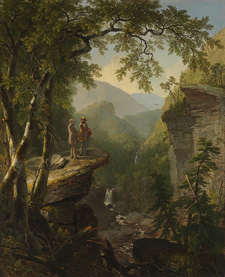
Image: Asher B. Durand, Kindred Spirits, 1849, oil on canvas, 44 x 36 in. (artwork in the public domain)
Provenance Research in American Institutions
posted by Linda Downs — August 28, 2014
Rowman & Littlefield is pleased to announce the release of Volume 10, Number 3 of Collections: A Journal for Museum and Archives Professionals, a focused issue dedicated to the subject of provenance research in American institutions. Guest-Edited by Jane C. Milosch, Lynn H. Nicholas, and Megan M. Fontanella, the issue draws attention to current research in the field by highlighting key resources and initiatives, case studies from collections throughout the United States, and perspectives on unprovenanced cultural property and Nazi-era claims.
\Bringing together the expertise of independent scholars and professionals who are affiliated with American institutions, this issue aims to foster dialogue among museums, archives, and research centers and to broaden the accessibility of information. The collection of articles opens with a Foreword by Megan M. Fontanella and an introduction by Lynn H. Nicholas. A closer look at resources and initiatives is offered in the following articles: “Provenance: Not the Problem (The Solution): Smithsonian Provenance Research Initiative” by Jane C. Milosch; “Princes, Dukes, and Counts: Pedigrees and Problems in the Kress Collection” by Nancy H. Yeide; “The ‘German Sales 1930–1945’ Database Project” by Christian Huemer; and Laurie A. Stein’s “’Everyone Brings a Piece to the Puzzle’: Conversations with Elaine Rosenberg and Reflections on Provenance Research among The Paul Rosenberg Archives.” Case studies include: “Navigating the Gray Area: Pechstein’s Girl Combing Her Hair, the Littmann Collection, and the Limits of Evidence” by Catherine Herbert; “Researching the Wertheim Collection at the Harvard Art Museums” by Elizabeth M. Rudy; “One Painting Concealed Behind Another: Picasso’s La Douleur (1903) and Guitar, Gas-Jet, and Bottle (1913)” by Christel Hollevoet-Force; “The Eugene Garbáty Collection of European Art” by Victoria Reed; and Dorota Chudzicka’s “’In Love at First Sight Completely, Hopelessly, and Forever with Chinese Art’: The Eugene and Agnes Meyer Collection of Chinese Art at the Freer Gallery of Art.” Perspectives on legal claims include Gary Vikan’s “Provenance Research and Unprovenanced Cultural Property” and Stephen W. Clark’s “Nazi-Era Claims and Art Museums: The American Perspective”.
This impressive group of articles is valuable to art historians, curators, and myriad others whose work addresses provenance. The collection showcases thoughtful, methodical and meticulous research related to individual owners and to individual works and collections of art. It serves as a touchstone for provenance research in American Institutions. Journal Editor Juilee Decker stated, “It is particularly exciting to see this issue of Collections appear in print. This focused issue takes the lead in proactive press regarding the continuous efforts of provenance research at American institutions. Building on the recent interest surrounding ‘The Monuments Men,’ this journal forms part of the epilogue to an unfinished story of provenance that both pre- and post-dates the Second World War, providing insight into the challenging, exciting and ongoing work of provenance researchers that continues to be integral to museums worldwide.”
“The value of this focused issue on provenance research in American institutions,” remarks guest editor and Director of the Smithsonian Provenance Research Initiative Jane C. Milosch, is that it “brings together scholars and researchers to share their incredible work and to initiate important discussions for the future. While the greatest focus and challenge of provenance research remains sifting through immense amounts of paper and digital archival materials, communication and collaboration are essential to effective provenance research and to sharing with and educating others on how specialized and time-consuming provenance research is with its often inconclusive results and on-going nature.”
Published by AltaMira Press (an imprint of Roman & Littlefield), Collections: A Journal for Museum and Archives Professionals is a multidisciplinary journal for all aspects of handling, preserving, researching, interpreting, and organizing collections. To purchase Volume 10, Number 3 (Summer 2014) focusing on “Provenance Research in American Institutions” call 1.800.273.2223 or send an email to: journals@rowman.com with “Issue 10.03” in the subject line. Further information about the journal may be obtained online: https://rowman.com/Page/Journals.
June 2014 Issue of The Art Bulletin
posted by Christopher Howard — July 18, 2014
 The June 2014 issue of The Art Bulletin, the leading publication of international art-historical scholarship, leads off with an essay by Parul Dave Mukherji, who explores the promise of postethnic art history in “Whither Art History in a Globalizing World.”
Also in the June issue, Hallie Franks investigates domestic mosaics in ancient Greece through travel metaphors associated with the symposium. In “Casts, Imprints, and the Deathliness of Things,” Marcia Pointon examines the materiality of death masks produced in eighteenth- and nineteenth-century Europe to excavate their meanings, past and present. Next, Sugata Ray analyzes the architecture of the 1887 Jaipur Economic and Industrial Museum as destabilizing the imperial aspirations of colonial museology. Finally, Joseph Siry considers how Frank Lloyd Wright’s Kalita Humphreys Theater in Dallas realized the architect’s ambition to rethink the ideal building form for drama.
In the Reviews section, Wei-Cheng Lin considers Megan E. O’Neil’s book Engaging Ancient Maya Sculpture at Piedras Negras, Guatemala, Paul Barolsky reviews Michael W. Cole’s study Ambitious Forms: Giambologna, Ammanati, and Danti in Florence, and Joanne Rappaport examines Daniela Bleichmar’s Visible Empire: Botanical Expeditions and Visual Culture in the Hispanic Enlightenment.
CAA sends The Art Bulletin to all institutional members and to those individuals who choose to receive the journal as a benefit of their membership. The digital version at Taylor & Francis Online is currently available to all CAA individual members.
The next issue of the quarterly publication, to appear in September 2014, will feature a third “Whither Art History?” piece, by Claudia Valladão de Mattos, and essays on the memorializing function of Jan van Eyck’s van der Paele Virgin, the moral and phenomenological implications of a monstrous visage in Hans Burgkmair’s Crucifixion, modern interiority in Watteau’s fêtes galantes, and several exhibitions associated with the Festival of India in the United States. The issue will also include reviews on painting in early modern Japan, photography in nineteenth-century India, and the politics and power of Mughal architecture.
Juror Sought for the Millard Meiss Publication Fund
posted by CAA — June 30, 2014
CAA seeks nominations and self-nominations from an architectural historian or an art historian with a specialization in Islamic, East Asian, or contemporary art to serve on the jury for the Millard Meiss Publication Fund for a four-year term, ending on June 30, 2018. Candidates must be actively publishing scholars with demonstrated seniority and achievement; institutional affiliation is not required.
The Meiss jury awards subsidies to support the publication of book-length scholarly manuscripts in the history of art and related subjects. Members review manuscripts and grant applications twice a year and meet in New York in the spring and fall to select the awardees. CAA reimburses jury members for travel and lodging expenses in accordance with its travel policy.
Candidates must be current CAA members and should not be serving on another CAA editorial board or committee. Jury members may not themselves apply for a grant in this program during their term of service. Nominators should ascertain their nominee’s willingness to serve before submitting a name; self-nominations are also welcome. Please send a letter describing your interest in and qualifications for appointment, a CV, and contact information to: Millard Meiss Publication Fund Jury, College Art Association, 50 Broadway, 21st Floor, New York, NY 10004; or send all materials as email attachments to Alex Gershuny, CAA editorial manager. Deadline: July 22, 2014.
New Appointments to CAA’s Editorial Boards
posted by Christopher Howard — June 24, 2014
The president of CAA’s Board of Directors, DeWitt Godfrey, has made appointments to the editorial boards of CAA’s three scholarly journals, in consultation with the editorial boards and the vice president for publications, Suzanne Preston Blier. The appointments take effect on July 1, 2014.
Art Journal
Two new members-at-large have joined the Art Journal Editorial Board. Tirza True Latimer is an associate professor at the California College of the Arts in San Francisco and chair of its graduate program in visual and critical studies. Janet Kraynak is an associate professor of contemporary art history at the New School in New York, with joint appointment at Parsons the New School for Design and Eugene Lang College. The terms for Latimer and Kraynak extend until June 30, 2018.
The Art Bulletin
The Art Bulletin has announced its next reviews editor: Nancy Um, associate professor in the Department of Art History at Binghamton University, State University of New York, and a scholar of Islamic art and visual culture. For the past year, Um has been a scholar in residence at the Getty Research Institute in Los Angeles. From 2011 to 2014, she served as the inaugural reviews editor of the International Journal of Islamic Architecture. Um is the author of The Merchant Houses of Mocha: Trade and Architecture in an Indian Ocean Port (University of Washington Press, 2009), as well as many essays and book chapters. Um will succeed Rachael DeLue of Princeton University, beginning a three-year-term as reviews editor on July 1, 2015, with the preceding year as reviews editor designate.
caa.reviews
The caa.reviews Editorial Board welcomes two new members-at-large: Meredith Cohen and Suzanne Hudson. Cohen is a historian of the art, architecture, and urbanism of medieval Europe and an assistant professor of art history at the University of California, Los Angeles. Hudson is an assistant professor of art history and fine arts at the University of Southern California in Los Angeles and currently serves as the caa.reviews field editor for exhibitions of modern and contemporary art on the West Coast. Both Cohen and Hudson will serve four-year terms on the editorial board, from July 1, 2014, to June 30, 2018.
The caa.reviews Council of Field Editors has four new members. Phillip Bloom, an assistant professor of art history at the University of Indiana in Bloomington and a visiting researcher at the Institute for Advanced Studies on Asia at the University of Tokyo for 2013–14, will commission reviews of books on Chinese art. Edward A. Vazquez, assistant professor of history of art and architecture at Middlebury College in Vermont, will be the field editor for exhibitions of modern and contemporary art in the northeastern United States. Megan Cifarelli, an associate professor at Manhattanville College in Purchase, New York, and chair of her school’s program in art history, will assign reviews of books on ancient Egyptian and Near Eastern art for the journal. Finally, Pamela M. Fletcher, a professor of art history and codirector of the Digital and Computational Studies Initiative at Bowdoin College in Brunswick, Maine, joins caa.reviews to oversee reviews of digital projects in the visual arts.
Two Meiss/Mellon Author’s Book Awards for Spring 2014
posted by Christopher Howard — June 17, 2014
CAA is pleased to announce the two recipients of the Meiss/Mellon Author’s Book Award for spring 2014. Thanks to a grant from the Andrew W. Mellon Foundation, CAA is supporting the work of emerging authors who are publishing monographs on the history of art and related subjects.
The spring 2014 grant recipients are:
- Sonal Khullar, Worldly Affiliations: Artistic Practice, National Identity, and Modernism in India, 1930–1990, University of California Press
- Pepper Stetler, Stop Reading! Look! Modern Vision and the Weimar Photographic Book, University of Michigan Press
The purpose of the Meiss/Mellon subventions is to reduce the financial burden that authors carry when acquiring images for publication, including licensing and reproduction fees for both print and online publications. Authors must be current CAA members. Please review the application guidelines for more information. Deadline for the fall 2014 grant cycle: September 15, 2014.
Spring 2014 Grants from the Millard Meiss Publication Fund
posted by Christopher Howard — June 16, 2014
This spring, CAA awarded grants to the publishers of eight books in art history and visual culture through the Millard Meiss Publication Fund. Thanks to the generous bequest of the late Prof. Millard Meiss, CAA gives these grants to support the publication of scholarly books in art history and related fields.
The grantees for spring 2014 are:
- Una Roman D’Elia, Raphael’s Ostrich, Pennsylvania State University Press
- Sonal Khullar, Worldly Affiliations: Artistic Practice, National Identity, and Modernism in India, 1930–1990, University of California Press
- Elizabeth Kindall, Geo-Narratives of a Filial Son: The Paintings and Travel Diaries of Huang Xiangjian (1609–1673), Harvard University Asia Center
- Vered Maimon, The Photographic Imagination: Talbot and the Conception of Photography in the Early 19th Century, University of Minnesota Press
- Pepper Stetler, Stop Reading! Look! Modern Vision and the Weimar Photographic Book, University of Michigan Press
- Erik Thunø, The Apse Mosaic in Early Medieval Rome, Cambridge University Press
- Jason Weems, Barnstorming the Prairies: Aerial Vision and Modernity in Rural America, 1920–1940, University of Minnesota Press
- Marnin Young, Later Realism and the Politics of Time, Yale University Press
Books eligible for Meiss grants must already be under contract with a publisher and on a subject in the visual arts or art history. Authors must be current CAA members. Please review the application guidelines for more information. Deadline for the fall 2014 grant cycle: September 15, 2014.
caa.reviews Seeks Field Editors in Korean and African Diaspora Art
posted by Betty Leigh Hutcheson — May 19, 2014
caa.reviews invites nominations and self-nominations for two individuals to join its Council of Field Editors, which commissions reviews within an area of expertise or geographic region, for a three-year term: July 1, 2014–June 30, 2017. An online journal, caa.reviews is devoted to the peer review of new books, museum exhibitions, and projects relevant to art history, visual studies, and the arts.
The journal seeks two field editors for books in two areas: Korean art and African diaspora art. Candidates may be artists, art historians, critics, curators, or other professionals in the visual arts; institutional affiliation is not required.
Working with the caa.reviews editor-in-chief, the caa.reviews Editorial Board, and CAA’s staff editor, each field editor selects content to be reviewed, commissions reviewers, and reviews manuscripts for publication. Field editors for books are expected to keep abreast of newly published and important books and related media in his or her field of expertise. The Council of Field Editors meets annually at the CAA Annual Conference. Field editors must pay travel and lodging expenses to attend the conference.
Candidates must be current CAA members and should not be serving on the editorial board of a competitive journal or on another CAA editorial board or committee. Nominators should ascertain their nominee’s willingness to serve before submitting a name; self-nominations are also welcome. Please send a statement describing your interest in and qualifications for appointment, a CV, and your contact information to: caa.reviews Editorial Board, College Art Association, 50 Broadway, 21st Floor, New York, NY 10004; or email the documents to Mallory Roark, CAA publications department assistant. Deadline: June 15, 2014.
CAA Publishes the March 2014 Issue of The Art Bulletin
posted by Christopher Howard — May 07, 2014
 The March 2014 issue of The Art Bulletin, the leading publication of international art-historical scholarship, is the first in the editorship of Kirk Ambrose and the first copublished with Taylor & Francis. The issue opens with a new recurring feature, “Whither Art History?” The inaugural essay by Griselda Pollock critically engages interpretive and institutional trends within the discipline.
In the long-form essays that follow, Mary D. Garrard explores the effect of love on Michelangelo’s creativity by analyzing the Renaissance artist’s cryptic drawing Children’s Bacchanal (1532–33) in her essay, “Michelangelo in Love.” For his contribution, titled “Map as Tapestry,” Jesús Escobar argues that Pedro Teixera’s monumental 1656 map of Madrid is not only a remarkable scientific achievement but also a sophisticated art object. Next, in “The Fragrance of the Divine,” Nina Ergin considers the olfactory traditions underlying Ottoman incense burners and discusses their complex meanings. Finally, Edith Wolfe demonstrates in her essay, called “Paris as Periphery,” how the art of Vicente do Rego Monteiro reflects a specifically Brazilian cosmopolitanism at the core of a counternarrative of modernity in the 1920s.
In the Reviews section, an Art Bulletin Centennial review essay by Mariët Westermann assesses the two volumes of De Hollandsche schilderkunst in de zeventiende eeuw, which examine the work of Frans Hals and Rembrandt van Rijn. Tanya Sheehan reviews two books on interdisciplinary subjects: Knowing Nature: Art and Science in Philadelphia, 1740–1840, edited by Amy R. W. Myer, and The Premise of Fidelity: Science, Visuality, and Representing the Real in Nineteenth-Century Japan, written by Maki Fukuoka. Three recent books on Mexican art—Mary K. Coffey’s How a Revolutionary Art Became Official Culture, Adriana Zavala’s Becoming Modern, Becoming Tradition, and Shelley E. Garrigan’s Collecting Mexico—are assessed by Rick López. Josh Ellenbogen ruminates on two books on art and technology, Illusions in Motion: Media Archaeology of the Moving Panorama and Related Spectacle by Erkki Huhtamo and Enfoldment and Infinity: An Islamic Genealogy of New Media Art by Laura U. Marks.
CAA sends The Art Bulletin to all institutional members and to those individuals who choose to receive the print journal as a benefit of their membership. In addition, online versions of the articles in each issue are available to CAA members who log into the CAA members’ portal. The next issue of the quarterly publication, to appear in June 2014, will feature the next “Whither Art History?” essay, by Parul Dave Mukherji, and essays on Greek domestic mosaics, death masks produced in eighteenth- and nineteenth-century Europe, the architecture of the Jaipur Economic and Industrial Museum, and Frank Lloyd Wright’s Kalita Humphreys Theater.
New Study on the Changing Research Practices of Art Historians
posted by Christopher Howard — April 30, 2014
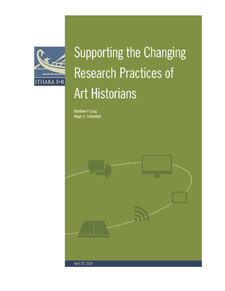 The following announcement was originally published by Ithaka S+R on April 30, 2014.
Supporting the Changing Research Practices of Art Historians
A study funded by the Getty Foundation and the Samuel H. Kress Foundation, called Supporting the Changing Research Practices of Art Historians, looks at how art historians’ research practices are evolving in the digital age. Intended primarily for the museums, libraries, academic departments, and visual-resources centers that support research in art history within the United States, this project focused on five key areas:
1. The emergence of “digital art history,” and how it is diverging from the broader understanding of the digital humanities.
2. The interconnected scholarly communities that support art history, including museums, libraries, and visual-resources centers, both within and beyond an art historian’s home institution.
3. The changes that digitization and online search portals have brought to the process of searching for primary sources and the limitations of the current discovery environment.
4. The practices art historians employ for managing their large personal collections of digital images.
5. The state of graduate students’ professional training.
Within these five areas, the report makes clear that the needs of art historians can be successfully met only through the collaborative work of many support organizations. Our findings suggest several opportunities for these organizations to develop new funding, services, tools, and initiatives that will have far-reaching impact on the discipline.
This is the third project to be completed as part of Ithaka S+R’s Research Support Services Program. A report for the project in history was released in December 2012, and a report for the project in chemistry was released in February 2013.