CAA News Today
NEA Releases Report on How Americans Use Electronic Media to Participate in the Arts
posted by Christopher Howard — July 06, 2010
 According to a new report published by the National Endowment for the Arts (NEA), Americans who participate in the arts through the internet, television, radio, computers, and handheld devices are almost three times more likely to attend live arts events than nonmedia participants (59 percent versus 21 percent). Users of technology and electronic media also attend, on average, twice as many live arts events—six versus three in a single year—and see a wider variety of genres.
The report, called Audience 2.0: How Technology Influences Arts Participation, looks at who is participating in the arts through electronic media, what factors affect their participation, and the relationships among media-based arts activities, live attendance, and personal arts creation. Audience 2.0 has determined that media-based arts participation appears to encourage—rather than replace—attendance at live arts events. Among the conclusions:
- Education continues to be the best predictor of arts participation among adults, both for live attendance and through electronic media. Survey respondents with at least some college education were more likely than respondents with a grade-school education to have used electronic media to participate in the arts
- For many Americans—primarily older Americans, lower-income earners, and racial/ethnic minority groups—electronic media is the only way they participate in arts events
- The 15.4 percent of US adults who use media only to engage with the arts are equally likely to be urban or rural
- Twenty-one percent (47 million) of all US adults reported using the internet to view music, theater, or dance performances in the last twelve months. Twenty-four percent (55 million) obtained information about the arts online
Audience 2.0 expands on the research published in the NEA’s 2008 Survey of Public Participation in the Arts (SPPA). This survey, conducted in partnership with the US Census Bureau and released last year, is the nation’s largest, most representative study of arts participation among American adults. Since 1982, SPPA has measured American adult participation in activities such as visits to art museums or galleries and attendance at jazz and classical music concerts, opera and ballet performances, and musical and nonmusical plays. SPPA categorizes these as “benchmark” activities, providing a standard group of arts activities for more than two decades of consistent trend analysis. Audience 2.0 takes a closer look at how audiences use electronic media to engage in these benchmark activities.
In an agency first, the new report is being released only in an electronic format that includes multimedia features. Chairman Rocco Landesman’s video greeting is accompanied by a video commentary on the report from Sunil Iyengar, NEA director of research and analysis. Additionally, each chapter will open with videos from arts organizations that represent each of the benchmark disciplines tracked by the report. Arts organizations can use findings from Audience 2.0 to better understand their audiences’ uses of technology and electronic media.
As part of its ongoing analysis of SPPA data, the NEA is making raw data and detailed statistical tables available to researchers and the public. The tables highlight demographic factors affecting adult participation in a variety of art forms.
May Issue of CAA News Published and Online
posted by Christopher Howard — May 14, 2010
 The May issue of CAA News—which requests your participation in the two upcoming Centennial Conferences in New York (2011) and Los Angeles (2012)—has just been published. You may download a PDF of it immediately.
Although the deadline for papers for the New York conference has passed, ARTspace seeks participation from members for two events. First, CAA invites artists to submit video documentation of performance work for the ARTspace Media Lounge, on continuous view during the conference. Second, the organizers of a panel on health and safety in the artist’s studio seek presenters from diverse points of view. (See pp. 17–18 for information on both.) For Los Angeles, CAA will begin accepting your session proposals through an online process starting June 28; see pages 9–11 for full details.
Introduced by Barbara Nesin, the new president of the CAA Board of Directors, the May newsletter brings you up to date on all CAA programs and services, including a profile of Karen Lang, the incoming editor-in-chief of The Art Bulletin, and an announcement that CAA is reinstating its fellowships for MFA students and restoring the Millard Meiss Publication Fund.
The CAA News managing editor welcomes your submissions to the Endnotes section of the July issue. Please send listings for recent solo exhibitions, books published, and exhibitions curated, as well as news about your new position or your grant or fellowship, to Christopher Howard. Deadline extended: June 7, 2010.
Interested in advertising in CAA News? Please contact Bradford Nordeen, CAA marketing and membership assistant, at 212-691-1051, ext. 252.
CAA Board of Directors Restores Suspended Programs
posted by Christopher Howard — May 12, 2010
At its meeting on May 2, 2010, the CAA Board of Directors voted to restore several important programs for the next fiscal year, beginning July 1. After a year of conservative budgeting in response to the economic downturn, the board eased financial constraints on the following programs that benefit CAA members.
Professional Development Fellowships
Later this fall, CAA will award five Professional Development Fellowships in the Visual Arts of $5,000 each to outstanding students who will receive MFA degrees in calendar year 2011. Eligibility requirements and application guidelines will be available on the CAA website by June 1, 2010; the deadline for applications will be October 1, 2010.
The number of artists applying for support has always been consistently high. Given this significant interest by artists—as well as the emphasis in CAA’s 2010–2015 Strategic Plan on strengthening programs and support for artist members—the board agreed that renewing artists’ fellowship is an important first step toward full restoration of the fellowship program.
Although the operating budget is lean, CAA hopes that Professional Development Fellowships in Art History can again be awarded to doctoral candidates in 2011.
The Art Bulletin and Art Journal
CAA’s two scholarly print publications, The Art Bulletin and Art Journal, will return to regular quarterly publication in 2011, with four issues appearing next year. In 2010, each journal is producing just three issues in response to the financial constraints of the previous fiscal year. The Art Bulletin combined its March and June 2010 issues, and Art Journal produced a joint Spring–Summer 2010 issue.
Millard Meiss Publication Fund
The CAA Publications Department will once again make grants to publishers from the Millard Meiss Publication Fund beginning this fall. The Meiss fund, founded in 1975, awards grants to support book-length scholarly manuscripts in the history of art and related subjects that have been accepted by publishers on their merits, but cannot be published in the most desirable form without subsidy.
The grant program had been suspended for two cycles, in fall 2009 and spring 2010. Awards will also be made in spring 2011, pending later approval.
Artists’ Projects Launch New Editor’s First Issue of Art Journal
posted by Christopher Howard — May 11, 2010
 The Spring–Summer 2010 issue of Art Journal marks the first issue produced by the art historian and critic Katy Siegel, who began work as editor-in-chief in July 2009. Special artists’ projects by Sharon Lockhart and Kerry James Marshall are highlights of this issue, and the magazine also features never-before-published photographs of a project by the cult artist Jack Smith and his collaborator, the renowned avant-garde actress Kate Manheim. Completing the mix are feature essays by Hannah Higgins, Cary Levine, and Martin Patrick, and an interview with the London-based artist Goshka Macuga by Achim Borchardt-Hume.
Katy Siegel, a professor of art history at Hunter College in New York, a contributing editor to Artforum, and author of the forthcoming “Since ’45”: America and the Making of Contemporary Art (Reaktion, 2010), will serve as editor-in-chief of Art Journal for three years. She says of this first issue, “While preserving its integrity as an academic journal, I want to make sure that every issue of Art Journal also represents the vitality and vicissitudes of the real life of art and artists.”
Readers immediately encounter four pages of Kerry James Marshall’s comic Dailies: On the Stroll, placed in the inside front and back covers. Marshall’s bold black-and-white graphics weave together racial politics in the larger society with those of the art world in the first episode of a frankly polemical serial.
Sharon Lockhart’s Lunch Break Times previews a publication the artist will launch later this year. Working with blue-collar workers throughout the state of Maine, Lockhart conveys the visual aspects of the industrial workplace by means of intriguing objects she has found there: antique postcards and photos, a coffee-cart sign emblazoned on a state map, a labor activist’s painting hanging in the union hall, and more.
Kate Manheim is best known for several decades of performances as the lead actor in Richard Foreman’s Ontological-Hysteric Theater. Jack Smith (1932–1989) blazed through the underground art and film scenes in lower Manhattan in the 1960s, 1970s, and 1980s, creating films and performances with his coterie of Flaming Creatures. Smith and Manheim collaborated on a project exploring marriage, melodrama, and the Hollywood star Maria Montez. A selection of their atmospheric and amusing photographs is published for the first time ever in the pages of Art Journal, introduced by a beautiful personal essay by the film historian P. Adams Sitney.
The art historian Hannah Higgins has contributed a clear-eyed and moving account of the intertwined careers of her parents, the Fluxus artists Alison Knowles and Dick Higgins, and her relationship to them as both daughter and historian. Martin Patrick considers the present-day implications of the work of another important Fluxus artist, Robert Filliou. Cary Levine reflects on a somewhat sinister body of work by the West Coast artist Mike Kelley, which draws on the themes and techniques of do-it-yourself crafts. And the curator of London’s Whitechapel Gallery, Achim Borchardt-Hume, interviews Goshka Macuga about her yearlong installation at Whitechapel that was based on Picasso’s tapestry version of Guernica, presented here with documentation of the artist’s project. This is the first installation of a new feature, “Before and After,” which will expand Art Journal’s engagement with the making of art as well as its social afterlife.
The quarterly Art Journal, published since 1929, is available by subscription to CAA members. Single copies may be purchased by calling 212-691-1051, ext. 204, or by writing to nyoffice@collegeart.org. Art Journal is made possible by a generous grant from the Andy Warhol Foundation for the Visual Arts, CAA membership support, and contributions from individuals and institutions. To make a contribution, please contact Sara Hines at 212-691-1051, ext. 216; or visit www.collegeart.org/support.
March–June 2010 Issue of The Art Bulletin Published
posted by Christopher Howard — May 05, 2010
 The combined March–June 2010 issue of The Art Bulletin, the leading publication of international art-historical scholarship, has just been published. It will be mailed to all individual CAA members who elect to receive the journal, and to all institutional members.
The central scene of Diego Velázquez’s Las Meninas graces the cover and introduces the issue’s Interventions essay series. Byron Ellsworth Hamann applies postcolonial and materialist strategies in “The Mirrors of Las Meninas: Cochineal, Silver, and Clay” to consider the artist’s masterpiece within a transatlantic visual archive. A group of six scholars from such diverse disciplines as Precolumbian studies, Romance studies and literature, art history, and Aztec and Spanish colonial art respond to Hamann’s article with texts of their own.
The issue features two other major essays. In “Family Space: Buddhist Materiality and Ancestral Fashioning in Mogao Cave 231,” Winston Kyan considers the diverse integration of family references into the visual program of ninth-century Buddhist Mogao caves at Dunhuang, which marked a turning point in the construction of religious space in medieval China. For “Portrait of Luca Pacioli and Disciple: A New, Mathematical Look,” Renzo Baldasso examines the famous painting as a statement about the achievements of mathematical humanists as well as the subject of mathematics as a mode of thinking, as court activity, and as a form of education.
In the reviews section, Rebecca Zorach evaluates Margaret D. Carroll’s Painting and Politics in Northern Europe: Van Eyck, Bruegel, Rubens, and Their Contemporaries, and Jonathan Unglaub examines Maria H. Loh’s Titian Remade: Repetition and the Transformation of Early Modern Italian Art. In addition, Joel Smith reviews the history and evolution of the notion of objectivity as presented in Lorraine Daston and Peter Galison’s book Objectivity.
Please read the full table of contents for more details. The next two Art Bulletins for 2010 will appear in September and December.
New Online Journal Published by an International Group of Art-History Research Institutes
posted by Christopher Howard — April 19, 2010
This month the International Association of Research Institutes in the History of Art, known as RIHA, has launched a new online publication, RIHA Journal. This peer-reviewed, open-access e-journal provides a unique publishing platform for international research articles in the history of art.
Open to the entire range of art-historical topics and approaches, RIHA Journal will feature articles in English, French, German, Italian, and Spanish. Three essays have already published so far: read Michèle Hannoosh on Eugène Delacroix’s Journal (in French), Maria Poprzęcka’s ruminations on the experience of viewing paintings under reflective glass (in English), and Manuel Weinberger on a cartography collection at the Austrian National Library (in German). Contributions can be subscribed to via an RSS feed.
The not-for-profit RIHA Journal makes all articles available free of charge. Manuscripts undergo a double-blind peer-review process and are published within a few weeks of submission. A joint project of twenty-seven institutes in eighteen countries, RIHA Journal has an editing processes that is locally organized, with each RIHA institute being responsible for acquiring submissions, organizing reviews, and copy editing. In the United States, these are the Getty Research Institute, the Center for Advanced Study in the Visual Arts, and the Sterling and Francine Clark Art Institute.
The Zentralinstitut für Kunstgeschichte in Munich is responsible for developing and organizing the journal. Funding is provided by the German Federal Government Commissioner for Culture and the Media (Beauftragter der Bundesregierung für Kultur und Medien).
Editorial-Board Member Sought for Art Journal
posted by Joe Hannan — April 02, 2010
CAA invites nominations and self-nominations for one individual to serve on the Art Journal Editorial Board for a four-year term, July 1, 2010–June 30, 2014. Published quarterly by CAA, Art Journal is devoted to twentieth- and twenty-first-century art and visual culture.
Candidates are individuals with a broad knowledge of modern and contemporary art; institutional affiliation is not required. Applicants who are artists, museum-based scholars, or scholars interested in pedagogical issues are especially invited to apply.
The editorial board advises the editor-in-chief and assists him or her to seek authors, articles, artist’s projects, and other content for the journal; guides its editorial program and may propose new initiatives for it; performs peer reviews and recommends peer reviewers; and may support fundraising efforts on the journal’s behalf. Members also assist the editor-in-chief to keep abreast of trends and issues in the field by attending and reporting on sessions at the CAA Annual Conference and other academic conferences, symposia, and events.
The editorial board meets three times a year, including once at the CAA Annual Conference. Members pay travel and lodging expenses to attend the conference.
Candidates must be current CAA members and should not be serving on the editorial board of a competitive journal or on another CAA editorial board or committee. Members may not publish their own work in the journal during the term of service. Nominators should ascertain their nominee’s willingness to serve before submitting a name. Please send a letter describing your interest in and qualifications for appointment, a CV, and contact information to: Chair, Art Journal Editorial Board, CAA, 275 Seventh Ave., 18th Floor, New York, NY 10001. Deadline: April 15, 2010.
caa.reviews Seeks Editor-in-Chief and Editorial-Board Members
posted by Betty Leigh Hutcheson — March 31, 2010
An online journal, caa.reviews is devoted to the peer review of new books, museum exhibitions, and projects relevant to the fields of art history, visual studies, and the arts.
caa.reviews Seeks Editor-in-Chief
The caa.reviews Editorial Board invites nominations and self-nominations for the position of editor-in-chief for a three-year, nonrenewable term, July 1, 2011–June 30, 2014. This term is preceded by one year of service on the editorial board as editor designate, July 1, 2010–June 30, 2011, and followed immediately by one year of service as past editor.
Working with the editorial board, the editor-in-chief is responsible for the content and character of the journal. He or she supervises the journal’s Council of Field Editors, assisting them to identify and solicit reviewers, articles, and other content for the journal; develops projects; makes final decisions regarding content; and may support fundraising efforts on the journal’s behalf.
The editor-in-chief attends the three annual meetings of the caa.reviews Editorial Board—held in the spring and fall and in February at the Annual Conference—and submits an annual report to CAA’s Publications Committee. He or she pays travel and lodging expenses to attend the conference. The editor-in-chief also works closely with CAA’s New York staff and receives an annual honorarium of $2,000.
Candidates must be current CAA members. Nominators should ascertain their nominee’s willingness to serve before submitting a name. A statement of interest in the position, a CV, and at least one letter of recommendation must accompany each nomination. Please mail to: Codirector of Publications, caa.reviews Editor-in-Chief Search, CAA, 275 Seventh Ave., 18th Floor, New York, NY 10001. Deadline: April 15, 2010. Finalist candidates will be interviewed in May 2010.
caa.reviews Seeks Editorial-Board Members
CAA invites nominations and self-nominations for two individuals to serve on the caa.reviews Editorial Board for a four-year term, July 1, 2010–June 30, 2014.
Candidates may be artists, art historians, art critics, art educators, curators, or other art professionals with stature in the field and experience in writing or editing book and/or exhibition reviews; institutional affiliation is not required. The journal seeks candidates with a strong record of scholarship and at least one published book or the equivalent who are committed to the imaginative development of caa.reviews.
The editorial board advises the editor-in-chief and Council of Field Editors and helps them to identify books and exhibitions for review and to solicit reviewers, articles, and other content for the journal; guides its editorial program and may propose new initiatives for it; and may support fundraising efforts on the journal’s behalf. Members also assist the editor-in-chief to keep abreast of trends and issues in the field by attending and reporting on sessions at the CAA Annual Conference and other academic conferences, symposia, and events.
The editorial board meets three times a year, including once at the CAA Annual Conference. Members pay travel and lodging expenses to attend the conference.
Candidates must be current CAA members and should not be serving on the editorial board of a competitive journal or on another CAA editorial board or committee. Nominators should ascertain their nominee’s willingness to serve before submitting a name. Please send a letter describing your interest in and qualifications for appointment, a CV, and contact information to: Chair, caa.reviews Editorial Board, CAA, 275 Seventh Ave., 18th Floor, New York, NY 10001. Deadline: April 15, 2010.
NEA Announces Research on Informal Arts Participation in Rural and Urban Areas
posted by Christopher Howard — March 26, 2010
Any serious reckoning of how Americans participate in arts and cultural activities must account for demographic and geographic diversity. Prior National Endowment for the Arts (NEA) publications, including the 2008 Survey of Public Participation in the Arts, already have examined the age, race and ethnicity, gender, and education and income status of arts-goers.
Another way to understand arts participation is by asking where it takes place. Come as You Are: Informal Arts Participation in Urban and Rural Communities is the NEA’s first research publication in several years to examine the “informal arts”—such as playing a musical instrument, attending an art event at a place of worship, or visiting a craft fair. This finding is part of new research from the NEA, announced earlier this during a visit by NEA Chairman Rocco Landesman to Chelsea, Michigan, as part of the NEA’s Art Works Tour. The publication provides an analysis of arts participation in rural and urban areas.
Come as You Are: Informal Arts Participation in Urban and Rural Communities is available in print and pdf on the NEA website.
March Issue of CAA News Published
posted by Christopher Howard — March 19, 2010
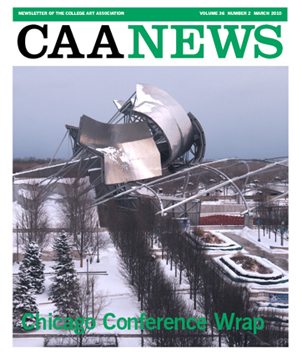 The March CAA News—which presents a wrap-up of the wildly successful 2010 Annual Conference in Chicago—has just been published. You may download a PDF of it immediately.
This issue offers conference summaries from multiple perspectives by key players, including CAA’s conference director Emmanuel Lemakis, Services to Artists Committee members Brian Bishop and Sabina Ott, and more. Dawoud Bey’s keynote address at Convocation is reprinted in full, and a report from the Board of Directors meeting is also included. And don’t miss the wide selection of full-color photographs from the many conference events.
If you missed the web article on the Coalition on the Academic Workforce’s statement on part-time faculty, or the calls for editorial-board members of CAA’s journals, you can catch up with the March newsletter.
The CAA News editor is still accepting submissions for the Endnotes section for the May issue. Please send your listings for recent solo exhibitions, books published, and exhibitions curated, as well as news about your new position or your grant or fellowship, to Christopher Howard.
Interested in advertising in CAA News? Please contact Bradford Nordeen at 212-691-1051, ext. 252.