CAA News Today
New Issue of Visual Resources Published
posted by Christopher Howard — January 13, 2010
 “Digital Crossroads: New Directions in 3D Architectural Modeling in the Humanities” is the title of the December 2009 issue of Visual Resources: An International Journal of Documentation (published by Taylor & Francis/Routledge). This special issue, guest edited by Arne R. Flaten and Alyson A. Gill, includes essays covering a broad range of approaches, periods, regions, and projects that utilize 3D digital models to examine architectural forms.
After the editors’ brief overview of the papers, Gill presents synopses of various innovative programs nationally and worldwide employing digital modeling. Next, David Johnson’s article evaluates the methods of critically assessing the accuracy of computer reconstructions and proposes criteria for such appraisals. An article by Flaten follows with his description of the Ashes2Art program in which 3D models of ancient Delphi are built by undergraduates.
Sheila Bonde and Clark Maines examine movement and uncertainty in digital models and online paradigms through the virtual medieval monastery of Saint-Jean-des-Vignes. Paula Lupkin’s analysis of her reconstructed New York YMCA building raises questions about the diverse role(s) assumed by digital modelers. Finally, Christopher Johanson explores multiple realities and ontologies, and the problems and opportunities presented by geo-referenced models of Republican Rome.
Visual Resources is published in print and electronically. CAA members are eligible for the special reduced subscription rate for individuals.
December 2009 Issue of The Art Bulletin Published
posted by Christopher Howard — December 15, 2009
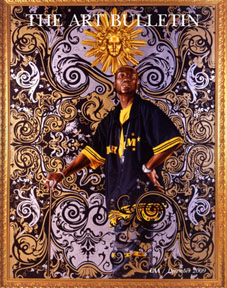 The December 2009 issue of The Art Bulletin, the leading publication of art-historical scholarship, has just been published. It will be mailed to those CAA members who elect to receive it, and to all institutional members.
For the first time, a work of twenty-first-century art graces the cover of the esteemed journal—Kehinde Wiley’s Portrait of Andries Stilte (2005). The painting accompanies an essay by Krista Thompson exploring how contemporary artists such as Wiley and Luis Gispert combine the visual language of hip-hop with late Renaissance and Baroque painting techniques.
Four essays precede Thompson’s. Leading off is Michael Schreffler, who analyzes how sixteenth- and seventeenth-century Spaniards described the practice of Aztec painting by looking through the lens of European art theory. Next, Emma Barker contends that Jean-Baptiste Greuze evokes both the innocence and vulnerability of children in his A Child Playing with a Dog, while implicating the viewer in the child’s fate.
Matthew Rampley’s essay expresses an opposing view of the Vienna school of art history, not as progressive and aesthetically liberal, but as a proponent of an imperialist outlook, related to the cultural politics of Austria-Hungary in the early-twentieth-century. The next contributor is Roberta Wue, who investigates the ways late-nineteenth-century Chinese artists positioned themselves in the marketplace through the classifieds in the Shanghai newspaper Shenbao. She also examines the changing relationship between artists and urban audiences in the late Qing era.
The December issue of The Art Bulletin also contains six reviews of books about tapestries at the Tudor court, engravings of Native American Indians, the gardens of Versailles and panoramic landscape painting, Buckminster Fuller, Tony Conrad, and issues on museum ownership of antiquities. Please read the full table of contents for more details.
Executive Summary of the New CAA Strategic Plan
posted by Christopher Howard — December 10, 2009
 The executive summary for CAA’s Strategic Plan 2010–2015 is now available for download from the CAA website. During the strategic-planning process, a task force comprising members of the Board of Directors, CAA staff and committees, and more reviewed the mission, needs, and long-term goals of CAA. The 2010–2015 plan contains new mission, vision, and values statements and identifies seven important goals of the organization that are intended to meet the needs of all members in the visual arts.
The seven goals outlined in the plan focus on promoting the visual arts and meeting the needs of CAA’s membership, while expanding the programs, publications, and finances in order to do so. Some important strategies for accomplishing these goals include strengthening CAA’s ability to represent the visual arts, improving communication with national and international members, and establishing and identifying new sources of earned revenue. In his letter prefacing the summary, Paul B. Jaskot, CAA president, states, “With the plan in place, CAA will be able to advocate for the visual arts nationally and internationally and create new opportunities for dialogue among our members.”
For more details, see Jaskot’s letter, download the executive summary, and read the new mission, vision, and values statements.
New CAA Member Benefit: Humanities E-Book
posted by Nia Page — December 04, 2009
 Humanities E-Book, a project of the American Council of Learned Societies (ACLS), offers unlimited access to its collection of nearly three thousand cross-searchable, full-text titles across the humanities and related social sciences. Titles, which include fifty-six CAA Monographs on the Fine Arts, have been selected and peer reviewed by ACLS constituent learned societies for their continued importance and value in teaching and researching. The collection, which grows by about five hundred books a year, includes both in- and out-of-print titles published from the 1880s to the present. Humanities E-Book titles also link to publishers’ websites and to online reviews in JSTOR, Project MUSE, and other sites.
Individual Subscriptions
As a special benefit of CAA membership, individual members can acquire a twelve-month, renewable subscription to Humanities E-Book for $35, which helps sustain the resource for the entire scholarly community.
Individual subscriptions are an attractive option for those whose institutions do not already subscribe to Humanities E-Book, or for CAA members who might not be affiliated with a subscribing institution. Please check this list to see if your institution subscribes.
When completing the Humanities E-Book’s online purchase module, choose the College Art Association from the Society Affiliation pull-down menu and enter your CAA member number. Be sure to review the terms of service before subscribing. For inquiries, please write to subscriptions@hebook.org or call 212-697-1505.
Institutional Subscriptions
Humanities E-Book offers a special 10 percent discount on subscriptions to institutional CAA members. Subscriptions range from $450 to $3,125, depending on the size of your institution.
Institutional subscription information, including pricing, is available on the Humanities E-Book website. For a free trial, a subscription for your school, museum, or organization, or further information, please write to info@hebook.org and mention that you are an institutional CAA member.
CAA Announces 2009 Wyeth Publication Grant Recipients
posted by Christopher Howard — December 02, 2009
CAA is pleased to announce four recipients of the Wyeth Foundation for American Art Publication Grant for 2009:
- Hiroko Ikegami, The Great Migrator: Robert Rauschenberg and the Global Rise of American Art, MIT Press
- Kevin D. Murphy, Jonathan Fisher of Blue Hill, Maine: Commerce, Culture, and Community on the Eastern Frontier, University of Massachusetts Press
- David Raskin, Donald Judd’s Local Orders: Art, Principles, and Activism, Yale University Press
- Alison Syme, A Touch of Blossom: John Singer Sargent and the Queer Flora of Fin-de-Siècle Art, Pennsylvania State University Press
Since 2005, Wyeth grants have annually supported one or more book-length scholarly manuscripts in the history of American art, visual studies, and related subjects that have been accepted by a publisher on their merits but cannot be published in the most desirable form without a subsidy.
For purposes of this grant program, “American art” is defined as art created in the United States, Canada, and Mexico prior to 1970.
Application criteria and guidelines for the Wyeth Grant are available at www.collegeart.org/wyeth or from nyoffice@collegeart.org. Deadline: October 1, 2010.
Google Books Settlement
posted by Christopher Howard — November 09, 2009
Today is the deadline for a revised settlement agreement to be filed in response to a lawsuit by the Authors Guild and the Association of American Publishers, who are protesting the unauthorized copying of in-copyright books by Google.
CAA has prepared a summary article on the Google Library Book Project to better inform you about the issues at stake; included are a brief description of aspects of the settlement and links to articles and editorials from authors and reporters supporting or criticizing the settlement.
CAA’s constituency includes both creators and users of books. The Committee on Intellectual Property has taken up the matter for consideration and is currently considering what position, if any, to recommend.
November CAA News Published
posted by Christopher Howard — November 06, 2009
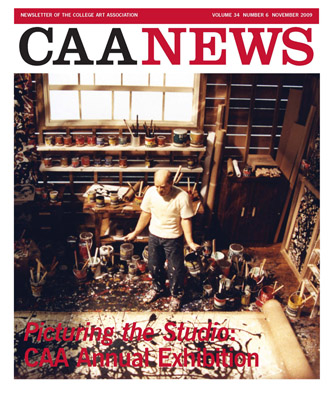 The November issue of CAA News, your critical guide to life in the worlds of art and academia, has just been published. You may download a PDF of the issue immediately.
On the cover is not a long-lost Hans Namuth photograph of Jackson Pollock at work—it’s a detail of a sculpture by Joe Fig that’s part of the CAA Annual Exhibition, Picturing the Studio. Read an excerpt from the catalogue essay for this important group show, which opens next month in Chicago and will be on view during the CAA Annual Conference.
The newsletter also contains an interview with the creators of Smarthistory, a multimedia art-history website with innovative ideas for supplementing the Western survey class, as well as an article about this fall’s hot intellectual-property topic, the Google Books settlement. You can also check out the latest details about the upcoming conference, browse listings of recent solo exhibitions and books published by CAA members, and much more.
For submissions to the January issue, please review the CAA News guidelines. Questions? Contact Christopher Howard, CAA managing editor.
New Industry Report by NAMTA on Artists and Art Materials
posted by Christopher Howard — November 03, 2009
 A recent study on artists and their materials has been published by the International Art Materials Trade Association (known as NAMTA) and American Artist magazine, in conjunction with Hart Business Research. Based on a spring 2009 survey of artists, students, and the retailers and suppliers of art materials, “Artists & Art Materials USA 2009” is the first report published in over a decade that analyzes industry size and trends, business practices, and artist needs.
The most groundbreaking finds published in this report include an increased use of mixed media and digital media, the importance of arts education for both children and practicing artists, and the continued use of magazines and books as a primary source of learning. The results of the survey show that artists are purchasing larger amounts of “nontraditional” art materials such as fabrics, glass, and beads, using more digital products, and incorporating scavenged materials. In 2008, the percentage of artists spending for nontraditional art supplies was almost equal to that for paints.
Unsurprisingly, the study found that artists are increasingly using computers either to create digital art or to assist them in producing nondigital art. However, many artists favor printed materials such as art magazines to their website counterparts as a source for education. Eighty-seven percent of survey participants said they read art-related magazines, making these publications the top source for learning, followed closely by books. Early exposure to art is crucial: well over half of the professional artists who participated in the survey responded that art was a major part of their lives by age 12. The report urges for the support of elementary school art teachers in order to expose children to art at a young age.
The 4.4 million active artists in the United States—professionals, students, and hobbyists—are spending over $4 billion per year on art materials and services. While 28 percent of artists buy their supplies online, almost twice as much shopping (54 percent) occurs at brick-and-mortar businesses. Also, while stores are meeting artists’ need for drawing and painting supplies, an increasing number of practitioners are spending more for classes and workshops, an area underserved by retailers and suppliers.
A free download of the eight-page executive summary is available from NAMTA.
Fall 2009 Art Journal Published
posted by Christopher Howard — October 21, 2009
 In her editor’s introduction to the Fall 2009 issue of Art Journal, Judith Rodenbeck discusses a text by Erwin Panofsky that she relates to the current interest in reenactment. Making a further connection to the four essays and the roundtable discussion in the current issue, she suggests that “Panofsky’s insistence on the detailed and intertwined study of form, content, and context here bears reconsideration, albeit under the revised skies of our own time.”
In “Imperious Griffonage,” Hajime Nakatani explores the role of the Chinese written character in the work of the artist Xu Bing and several of his contemporaries, finding that both the standard script characters and Xu’s inventive pseudocharacters show curious signs of a life of their own. In an essay that contextualizes Jo Baer’s paintings and writing of the late 1960s, Patricia Kelly accentuates the artist’s innovative exhibition strategies, intended to engage the viewer in a participatory manner.
Jane McFadden writes about the art of Walter de Maria in “Earthquakes, Photoworks, and Oz,” focusing first on his photoworks of the 1960s and then on his best-known work, The Lighting Field, and its mediation through photography. In her essay on the reception of Louise Bourgeois’s 1964 Stable Gallery exhibition, Elyse Speaks examines the consistency of the artist’s treatment of themes of the body and the home.
Art Journal assembled an expert panel of scholars for a critical discussion of the promises and pitfalls of transcultural exchange in The Third Mind: American Artists Contemplate Asia, 1860–1989, a 2009 exhibition at the Guggenheim Museum. Alexandra Munroe, the chief curator of the exhibition, responds.
In the Reviews section of this issue, Clark Buckner considers three recent books on curatorial and exhibition practice, Marc James Léger examines two books about art and activism, and Soraya Murray evaluates two books on new-media art.
New Report Compares Virtual-Gallery Software
posted by Christopher Howard — October 20, 2009
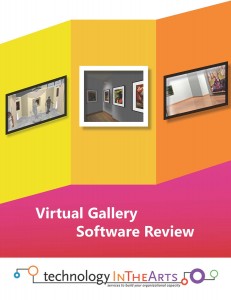 Technology in the Arts has published a free report, entitled Virtual Gallery Software Review, that reviews and compares three software applications—Virtual Galleries, Image Armada, and SceneCaster/3D Scenes—designed to help artists, curators, and art organizations create three-dimensional virtual exhibitions. This type of technology can provide not only a useful alternative experience for audiences that cannot physically attend a live exhibition, but it can also potentially help students and professionals learn about exhibition planning and installation.
The task of building virtual galleries or exhibitions can often be daunting and costly. Despite software that facilitates the development of virtual environments for conferences, commercial expos, and education, solutions for creating virtual art exhibitions have been scarce. For these reasons, two important criteria for the study were ease of use and user-friendly design. The primacy of these criteria also prompted the researchers to exclude Second Life because of its steep learning curve for environment creation.
Researchers looked for five features desirable in an application used by artists and arts professionals: ease of creating an exhibition; quality of images; flexibility of creating an exhibition; ease of navigation in the three-dimensional space; and ease of publishing or distributing the gallery. The report contains individual descriptions of the three applications, as well as comparisons of their features, such as Mac and PC compatibility, hardware requirements, internet-based viewing, and image and lighting manipulation.
Technology in the Arts, an organization that explores the intersection of arts management and technology, offers services such as consulting, professional-development training, webinars, an online resource directory, monthly podcasts, and a discussion-based blog. It is part of the Center for Arts Management and Technology, an applied research center at Carnegie Mellon University exploring ways in which arts managers can employ online technologies to meet their organizational goals and engage audiences more effectively.