
CAA News Today
NEA REPORT ON UNEMPLOYMENT RATES FOR ARTISTS
posted by Christopher Howard — March 09, 2009
Unemployment rates are up among working artists and the artist workforce has contracted, according to new research from the National Endowment for the Arts (NEA). Artists in a Year of Recession: Impact on Jobs in 2008 examines how the economic slowdown has affected the nation’s working artists. The study looks at artist employment patterns during two spikes in the current recession—the fourth quarters of 2007 and 2008. Not unexpectedly, this downturn reflects larger economic declines across the nation: a Commerce Department report from late February noted a 6.2 percent decrease in the gross domestic product in the last quarter of 2008. The ten-page publication can be downloaded as a PDF.
Among the findings:
- Artists are unemployed at twice the rate of professional workers, a category in which artists are grouped because of their high levels of education. The artist unemployment rate grew to 6 percent in the fourth quarter of 2008, compared with 3 percent for all professionals. A total of 129,000 artists were unemployed in the fourth quarter of 2008, an increase of 50,000 (63 percent) from one year earlier. The unemployment rate for artists is comparable to that for the overall workforce (6.1 percent)
- Unemployment rates for artists have risen more rapidly than for US workers as a whole. The unemployment rate for artists climbed 2.4 percentage points between the fourth quarters of 2007 and 2008, compared to a one-point increase for professional workers as a whole, and a 1.9 point increase for the overall workforce
- Artist unemployment rates would be even higher if not for the large number of artists leaving the workforce. The US labor force grew by 800,000 people from the fourth quarter of 2007 to the fourth quarter of 2008. In contrast, the artist workforce shrank by 74,000 workers. Some of this decline may be attributed to artists’ discouragement over job prospects
- Unemployment rose for most types of artist occupations. Artist jobs with higher unemployment rates are performing artists (8.4 percent), fine artists, art directors, and animators (7.1 percent), writers and authors (6.6 percent), and photographers (6.0 percent)
- The job market for artists is unlikely to improve until long after the US economy starts to recover. Unemployment is generally a lagging economic indicator, or a measure of how an economy has performed in the past few months. During the prior recession (2001), artist unemployment did not reach its peak of 6.1 percent until 2003—two years after economic recovery began nationwide.
As an example of how arts jobs intersect with the larger economy, consider the construction industry. Industry-wide declines, which began in 2006, have contributed to the shrinking job market for architects. While this group usually has the lowest unemployment rates among all artist occupations and all professionals, architect unemployment rates doubled, from 1.8 percent in fourth quarter 2007, to 3.8 percent in the fourth quarter of 2008. Unemployment in the designer category also doubled, from 2.3 percent to 4.7 percent. This broad category includes interior, commercial, and industrial designers whose work is closely associated with the construction industry. Eighty-three thousand designers left the artist labor market during that time period.
The contraction of the arts workforce has implications for the overall economy. A May 2008 NEA study revealed there are two million full-time artists representing 1.4 percent of the US labor force, only slightly smaller than the number of active-duty and reserve personnel in the military (2.2 million). More recently, a National Governors Association report recognized that the arts directly benefit states and communities through job creation, tax revenues, attracting investments, invigorating local economies, and enhancing quality of life. There are 100,000 nonprofit arts organizations that support 5.7 million jobs and return nearly $30 billion in government revenue every year, according to a study by Americans for the Arts.
The NEA Office of Research and Analysis produced Artists in a Year of Recession: Impact on Jobs in 2008 using published and unpublished data from the Department of Labor’s Bureau of Labor Statistics. The research note measures unemployment rates among workers who self-reported an artist job as occupying their greatest number of working hours per week, whether the employment was full-time or part-time.
2010 Call for Participation Published
posted by Lauren Stark — February 23, 2009
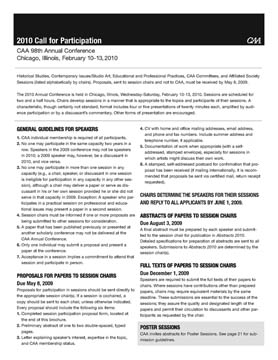 The 98th Annual Conference will take place February 10–13, 2010, in Chicago, Illinois, the first time since 2001. Listing more than 120 sessions, the 2010 Call for Participation, which you can download now as a PDF, will arrive in the mailboxes of all individual and institutional CAA members in March 2009.
This twenty-four-page publication describes many of next year’s panels and presentations. CAA and session chairs invite your participation: please follow the instructions in the booklet to submit a proposal for a paper or presentation. This publication also includes a call for Poster Session proposals and describes the Open Forms sessions.
In addition to attending and participating in the wide-ranging panels on art history, studio art, contemporary issues, and professional and educational practices, CAA expects participation from many area schools, museums, galleries, and other art institutions. The Hyatt Regency Chicago is the conference hotel, holding most sessions and panels, Career Services and the Book and Trade Fair, receptions and special events, and more. Deadline: May 8, 2009.
March CAA News Published
posted by Christopher Howard — February 20, 2009
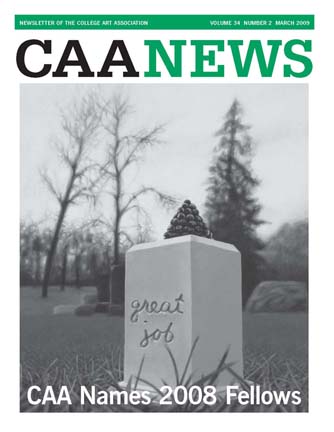 The March 2009 CAA News has been posted to the CAA website as a PDF download. Printed copies for individual and institutional members will be mailed next week, with your copy arriving in early March.
Highlighted in the issue are the four 2008 recipients of CAA’s Professional Development Fellowship Program for graduate students: Mary Reid Kelley, Yale University; Justin Shull, Rutgers University; Nichole N. Bridges, University of Wisconsin, Madison; and Wendy Ikemoto, Harvard University. Six honorable mentions are also named.
In the Publications section, CAA announces the appointment of Katy Siegel as the next Art Journal editor-in-chief. In addition, the editorial boards of our three journals—The Art Bulletin, Art Journal, and caa.reviews—and the Millard Meiss Publication Fund Jury all seek new members. Read the calls for nominations and self-nominations inside.
The deadline for submissions to the May 2009 CAA News is March 10. Please read the newsletter submission guidelines or write to Christopher Howard, CAA managing editor.
Conference Book and Trade Fair Exhibitors
posted by Christopher Howard — February 17, 2009
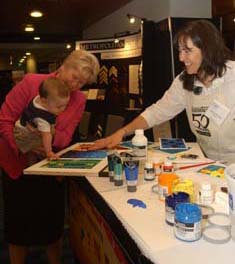 CAA has announced the list of exhibitors who will be present in Los Angeles for this year’s Book and Trade Fair. Taking place at the Los Angeles Convention Center during the 97th Annual Conference, the Book and Trade Fair hosts more than one hundred major college and university publishers, leading trade publishers, and trend-setting independent presses.
The largest national and international art-materials manufacturers and distributors, as well as highly specialized companies with unique products for studio artists, will show their products and wares. Also on hand are a handful of contemporary art journals.
The fair continues to attract a wide array of diverse organizations providing professional services to the visual arts, including programs of advanced study, specialized associations, advanced-degree programs, and independent exhibition services.
At the CAA booth, you can purchase copies of the highly anticipated directories of graduate programs in the arts: Graduate Programs in Art History and Graduate Programs in the Visual Arts. Stop by to browse these publications, talk with CAA staff members, and learn more about CAA’s programs and services.
The Book and Trade Fair in Los Angeles is open for three days: Thursday, February 26, and Friday, February 27, 9:00 AM–6:00 PM, and Saturday, February 28, 9:00 AM–2:30 PM. The 2009 sponsors are ARTstor, Blick Artist Materials, Prestel Publishing, Saskia Ltd./Scholars Resource, the School of Visual Arts, and SlideRoom.
Winter 2008 Art Journal Published
posted by Christopher Howard — February 02, 2009
 The Winter 2008 issue of Art Journal has just been published. The table of contents is posted on the CAA website, and your printed copy will arrive in the mail this month.
In the Forum, Suzanne Hudson and Anne Byrd collected papers first presented at their cochaired CAA session from the 2008 Annual Conference in Dallas–Fort Worth. Entitled “I’ll Be Your Mirror, or Why and How Do We Work on Living Artists,” the section presents essays and responses from Hudson, Byrd, Ágnes Berecz, Huey Copeland, Phyllis Tuchman, and Johanna Burton. Richard Meyer’s essay here “ ‘Artists sometimes have feelings,’ ” won CAA’s 2009 Art Journal Award, to be awarded at the upcoming conference in Los Angeles.
Features include “Toward an Aesthetic Marine Biology,” a deep-sea investigation by J. Malcolm Shick, a professor of zoology and oceanography, of underwater imagery in historical and contemporary art and its use in his classroom. Two other texts on pedagogy round out the section: Julia Morrisroe and Craig Roland consider “A Collaborative Approach to Preparing MFA Art Students to Teach at the University Level,” and Harrell Fletcher leads a conversation with his students on the MFA in social practice that he developed at Portland State University.
In Reviews, Lisa Frye Ashe examines the exhibition Morris Louis Now: An American Master and its catalogue, published to accompany a show that originated at the High Museum of Art in Atlanta, Georgia, in 2006 and traveled to San Diego and Washington, DC. In related art-historical areas, Harry Cooper reviews Mark Godfrey’s book Abstraction and the Holocaust, and Gail Levin looks at the exhibitions Action Painting (on view in Basel, Switzerland in 2008) and Action/Abstraction: Pollock, de Kooning, and American Art, 1940–1976 (opening on February 13 at the Albright-Knox Art Gallery in Buffalo, New York, after stops in New York and St. Louis), while also reviewing their catalogues.
CAA Publishes Its Directories of Graduate Programs in the Arts
posted by Christopher Howard — January 26, 2009
 New editions of CAA’s two Directories of Graduate Programs in the Arts are now available for purchase. Listing more than six hundred programs in the United States, Canada, the United Kingdom, Australia, New Zealand, and elsewhere worldwide, the guides are the most comprehensive resources available for prospective graduate students in the visual arts. Colleges, universities, and independent art schools are all included.
The first volume, Graduate Programs in Art History: The CAA Directory, includes over 260 programs that offer a master’s, doctoral, or related degrees in art and architectural history, visual studies, museum and curatorial studies, arts administration, library science, and more.
The second book, Graduate Programs in the Visual Arts: The CAA Directory, describes 350-plus programs that offer a master’s or other advanced degree in in studio art, graphic and web design, art education, film production, conservation, heritage preservation, and more.
Compiled in 2008 and conveniently divided into two separate volumes, these easy-to-use directories present detailed information on: descriptions of special courses; numbers, names, and specializations of faculty; facilities such as libraries, studios, and labs; student opportunities for research and work; information on financial aid, fellowships, and assistantships; and details on housing, health insurance, and other practical matters.
 An index lists schools alphabetically and by state and country for quick reference. An introductory essay presents a detailed description of the elements of a program entry, including explanations of the various kinds of programs and degrees offered, placing the search and selection process in context.
Although these invaluable books are designed primarily for students who are considering graduate study in the arts, they also provide a wealth of data for academic departments and programs, researchers, publishers, and funders.
Each directory is available for $39.95 for members and $49.95 for nonmembers, plus shipping and handling. Please visit CAA’s online store to get your copies of the directories today!
Please note: If you are ordering on behalf of an institution of department within a university, please use this special order form (or request one from Anitra Haendel, CAA office services and purchasing coordinator) and submit it via fax or post. At this time, online purchases can only be processed for individuals.
Editorial-Board Member and Field Editors Needed for caa.reviews
posted by Betty Leigh Hutcheson — January 23, 2009
caa.reviews is an online journal devoted to the peer review of new books, museum exhibitions, and projects relevant to the fields of art history, visual studies, and the arts.
caa.reviews Seeks Editorial-Board Member
CAA invites nominations and self-nominations for one individual to serve on the caa.reviews Editorial Board for a four-year term, July 1, 2009–June 30, 2013.
Candidates may be artists, art historians, art critics, art educators, curators, or other art professionals with stature in the field, a strong record of scholarship, and experience in writing or editing book and/or exhibition reviews; institutional affiliation is not required.
The editorial board advises the editor-in-chief and field editors and helps them to identify books and exhibitions for review and to solicit reviewers, articles, and other content for the journal; guides its editorial program and may propose new initiatives for it; and may support fundraising efforts on the journal’s behalf. Members also assist the editor-in-chief to keep abreast of trends and issues in the field by attending and reporting on sessions at the CAA Annual Conference and other academic conferences, symposia, and events in their fields.
Each year the editorial board meets twice in New York and once at the CAA Annual Conference. CAA reimburses members for travel and lodging expenses for the spring and fall New York meetings in accordance with its travel policy, but members pay these expenses to attend the conference.
Candidates must be current CAA members and should not be serving on the editorial board of a competitive journal or on another CAA editorial board or committee. Nominators should ascertain their nominee’s willingness to serve before submitting a name. Please send a letter describing your interest in and qualifications for appointment, CV, and contact information to: Chair, caa.reviews Editorial Board, CAA, 275 Seventh Ave., 18th Floor, New York, NY 10001. Deadline: April 15, 2009.
caa.reviews Seeks Field Editors for Books on Photography and South Asian Art
CAA invites nominations and self-nominations for field-editor positions for book reviews in caa.reviews for three-year terms, July 1, 2009–June 30, 2012.
Candidates may be artists, art historians, art critics, art educators, curators, or other art professionals; institutional affiliation is not required. Candidates with expertise in photography and in South Asian art are needed now.
Each field editor commissions reviews of books in their subject area or exhibitions in their geographic area, determines the appropriate character of the reviews, and works with reviewers to develop manuscripts for publication. These field editors work with the caa.reviews Editorial Board as well as the caa.reviews editor-in-chief and CAA’s staff editor.
The Council of Field Editors meets with the caa.reviews Editorial Board once a year at the CAA Annual Conference. Editors must pay travel and lodging expenses to attend the conference.
Candidates must be current CAA members and should not be serving on the editorial board of a competitive journal or on another CAA editorial board or committee. Nominators should ascertain their nominee’s willingness to serve before submitting a name. Please send a letter describing your interest in and qualifications for appointment, CV, and contact information to: Chair, caa.reviews Editorial Board, CAA, 275 Seventh Ave., 18th Floor, New York, NY 10001. Deadline: April 15, 2009.
Art Journal Seeks Reviews Editor and Editorial-Board Members
posted by Joe Hannan — January 22, 2009
Art Journal, published quarterly by CAA, is devoted to twentieth- and twenty-first-century art and visual culture.
Art Journal Seeks Reviews Editor
The Art Journal Editorial Board invites nominations and self-nominations for the position of reviews editor of Art Journal, for a three-year term, July 1, 2010–June 30, 2013 (preceded by half a year as reviews editor designate, from January 1 to June 30, 2010).
Working with the editorial board, the reviews editor is responsible for the commissioning of all book and exhibition reviews in Art Journal. He or she selects books and exhibitions to be reviewed, commissions reviewers, and determines the appropriate length and character of reviews. The reviews editor also works with authors and CAA’s manuscript editor in the development and preparation of review manuscripts for publication and is expected to keep abreast of newly published and/or important books and recent exhibitions in the fields of twentieth-century and contemporary art, criticism, theory, and visual culture. This is a three-year term, which includes membership on the Art Journal Editorial Board.
The reviews editor attends the three annual meetings of the Art Journal Editorial Board—held in the spring and fall in New York and once at the CAA Annual Conference—and submits an annual report to CAA’s Publications Committee. CAA reimburses the reviews editor for travel and lodging expenses for the spring and fall meetings in accordance with its travel policy, but the reviews editor pays these expenses to attend the Annual Conference.
Candidates must be current CAA members and should not be serving on the editorial board of a competitive journal or on another CAA editorial board or committee. Members may not publish their own work in the journal during the term of service. Nominators should ascertain their nominee’s willingness to serve before submitting a name. Please send a letter describing your interest in and qualifications for appointment, CV, and contact information to: Chair, Art Journal Editorial Board, CAA, 275 Seventh Ave., 18th Floor, New York, NY 10001. Deadline: April 15, 2009.
Art Journal Seeks Editorial-Board Members
CAA invites nominations and self-nominations for two individuals to serve on the Art Journal Editorial Board for a four-year term, July 1, 2009–June 30, 2013.
Candidates are individuals with a broad knowledge of modern and contemporary art; institutional affiliation is not required. Applicants who are artists, museum-based scholars, or scholars interested in pedagogical issues are especially invited to apply.
The editorial board advises the editor-in-chief and assists him or her to seek authors, articles, artist’s projects, and other content for the journal; guides its editorial program and may propose new initiatives for it; performs peer reviews and recommends peer reviewers; and may support fundraising efforts on the journal’s behalf. Members also assist the editor-in-chief to keep abreast of trends and issues in the field by attending and reporting on sessions at the CAA Annual Conference and other academic conferences, symposia, and events in their fields.
Each year the editorial board meets twice in New York and once at the CAA Annual Conference. CAA reimburses members for travel and lodging expenses for the spring and fall New York meetings in accordance with its travel policy, but members pay these expenses to attend the conference.
Candidates must be current CAA members and should not be serving on the editorial board of a competitive journal or on another CAA editorial board or committee. Members may not publish their own work in the journal during the term of service. Nominators should ascertain their nominee’s willingness to serve before submitting a name. Please send a letter describing your interest in and qualifications for appointment, CV, and contact information to: Chair, Art Journal Editorial Board, CAA, 275 Seventh Ave., 18th Floor, New York, NY 10001. Deadline: April 15, 2009.
The Art Bulletin Seeks Editor-in-Chief and Editorial-Board Members
posted by CAA — January 21, 2009
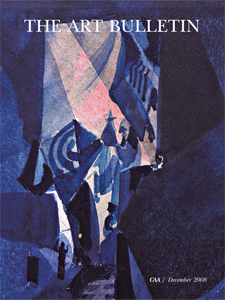 The Art Bulletin publishes leading scholarship in the English language in all aspects of art history as practiced in the academy, museums, and other institutions. From its founding in 1913, the quarterly journal has published, through rigorous peer review, scholarly articles and critical reviews of the highest quality in all areas and periods of the history of art.
The Art Bulletin Seeks Editor-in-Chief
The Art Bulletin Editorial Board invites nominations and self-nominations for the position of editor-in-chief of The Art Bulletin, for a three-year term, July 1, 2010–June 30, 2013 (preceded by a year as editor designate, from July 1, 2009 to June 30, 2010).
The Art Bulletin comprises scholarly essays and documentation on the history of visual art of all periods and places. The editor-in-chief is responsible for the content and character of the journal. Each issue has approximately 150 editorial pages (135,000 words), not including book and exhibition reviews, which are the responsibility of the reviews editor. The editor-in-chief reads all submitted manuscripts, refers them to appropriate expert referees for scholarly review, provides guidance to authors concerning the form and content of submissions, and makes final decisions regarding acceptance or rejection of articles for publication.
In addition to working with authors, the editor-in-chief attends the three annual meetings of the Art Bulletin Editorial Board—held in the spring and fall in New York and once at the CAA Annual Conference—and submits an annual report to the CAA Board of Directors and editorial board. CAA reimburses the editor-in-chief for travel and lodging expenses for the spring and fall meetings in accordance with its travel policy, but the editor-in-chief pays these expenses to attend the Annual Conference. The editor-in-chief also works closely with the CAA staff in New York, where production for the publication is organized. This is a half-time position. CAA provides financial compensation to the editor’s institution, usually in the form of course release or the equivalent, for three years. The editor is not usually compensated directly.
Candidates must be current CAA members and should not be serving on the editorial board of a competitive journal or on another CAA editorial board or committee. Members may not publish their own work in the journal during the term of service. Nominators should ascertain their nominee’s willingness to serve before submitting a name. Please send a letter describing your interest in and qualifications for appointment, CV, and contact information to: Chair, Art Bulletin Editorial Board, CAA, 275 Seventh Ave., 18th Floor, New York, NY 10001. Deadline: April 15, 2009.
The Art Bulletin Seeks Editorial-Board Members
CAA invites nominations and self-nominations for two individuals to serve on the Art Bulletin Editorial Board for a four-year term, July 1, 2009–June 30, 2013.
The ideal candidate has published substantially in the field and may be an academic, museum-based, or independent scholar; institutional affiliation is not required. Applicants who have specializations in East or South Asian, Renaissance, or early modern European art are especially invited to apply.
The editorial board advises the editor-in-chief and assists him or her to seek authors, articles, and other content for the journal; guides its editorial program and may propose new initiatives for it; performs peer reviews and recommends peer reviewers; and may support fundraising efforts on the journal’s behalf. Members also assist the editor-in-chief to keep abreast of trends and issues in the field by attending and reporting on sessions at the CAA Annual Conference and other academic conferences, symposia, and events in their fields.
Each year the editorial board meets twice in New York and once at the CAA Annual Conference. CAA reimburses members for travel and lodging expenses for the spring and fall New York meetings in accordance with its travel policy, but members pay these expenses to attend the conference.
Candidates must be current CAA members and should not be serving on the editorial board of a competitive journal or on another CAA editorial board or committee. Members may not publish their own work in the journal during the term of service. Nominators should ascertain their nominee’s willingness to serve before submitting a name. Please send a letter describing your interest in and qualifications for appointment, CV, and contact information to: Chair, Art Bulletin Editorial Board, CAA, 275 Seventh Ave., 18th Floor, New York, NY 10001. Deadline: April 15, 2009.
Meiss Grant Seeks Jury Member
posted by CAA — January 20, 2009
CAA seeks nominations and self-nominations for an individual to serve on the Millard Meiss Publication Fund Jury for a four-year term, July 1, 2009–June 30, 2013. Applicants with expertise in East Asian art, African, or twentieth-century art, or in the history of photography, are especially invited to apply.
The jury awards grants that subsidize the publication of book-length scholarly manuscripts in the history of art and related subjects. It reviews manuscripts and grant applications twice a year and meets in New York in the spring and fall to select awardees. CAA reimburses committee members for travel and lodging expenses in accordance with its travel policy. For more information about the Meiss grant, please see www.collegeart.org/meiss.
Candidates must be current CAA members and should not be serving on another CAA editorial board or committee. Jury members may not themselves apply for a grant in this program during their term of service. Nominators should ascertain their nominee’s willingness to serve before submitting a name. Please send a letter describing your interest in and qualifications for appointment, CV, and contact information to: Millard Meiss Publication Fund Jury, CAA, 275 Seventh Ave., 18th Floor, New York, NY 10001. Deadline: April 15, 2009.