CAA News Today
caa.reviews Seeks Eight Field Editors
posted by CAA — January 27, 2020
CAA invites nominations and self-nominations for EIGHT individuals to join the caa.reviews Council of Field Editors for a three-year term July 1, 2020–June 30, 2023. An online journal, caa.reviews is devoted to the peer review of new books, museum exhibitions, and projects relevant to art history, visual studies, and the arts.
The journal seeks eight field editors in the following areas:
- African Art
- African Diaspora/African American Art
- Architecture and Urban Planning
- Asian Art
- Contemporary Art
- Exhibitions: East Coast
- Exhibitions: Midwest
- Exhibitions: West Coast
Working with the caa.reviews editor-in-chief, the caa.reviews Editorial Board, and CAA’s staff editor, each field editor selects content to be reviewed, commissions reviewers, and considers manuscripts for publication. Field editors for books are expected to keep abreast of newly published and important books and related media in their fields of expertise, and those for exhibitions should be aware of current and upcoming exhibitions (and other related projects) in their geographic regions.
The Council of Field Editors meets yearly at the CAA Annual Conference. Field editors must pay travel and lodging expenses to attend the conference. Members of all CAA committees and editorial boards volunteer their services without compensation.
Candidates must be current CAA members and should not be serving on the editorial board of a competitive journal or on another CAA editorial board or committee. Nominators should ascertain their nominee’s willingness to serve before submitting a name; self-nominations are also welcome. Please email a statement describing your interest in and qualifications for appointment, a CV, and your contact information to managing editor Joan Strasbaugh, jstrasbaugh@collegeart.org. In the subject line please include Council of Field Editors [and the subject area you are applying for].
Deadline: April 15, 2020
The Art Bulletin Seeks Reviews Editor or Coeditor Team
posted by CAA — January 27, 2020
The Art Bulletin Editorial Board invites nominations and self-nominations for the position of reviews editor for a three-year term July 1, 2021–June 30, 2024 (with service as incoming reviews editor designate July 1, 2020–June 30, 2021). The Art Bulletin, published quarterly by CAA, features leading scholarship in the English language in all aspects of art history as practiced in the academy, museums, and other institutions.
Candidates should be art scholars with stature in the field and experience in editing book and/or exhibition reviews; institutional affiliation is not required. Candidates should be published authors of at least one book.
The reviews editor is responsible for commissioning all book and exhibition reviews in The Art Bulletin. He or she selects books and exhibitions for review, commissions reviewers, and determines the appropriate length and character of reviews. The reviews editor also works with authors and CAA’s editorial director in the development and preparation of review manuscripts for publication. He or she is expected to keep abreast of newly published and important books and recent exhibitions in the fields of art history, criticism, theory, visual studies, and museum publishing. This is a three-year term, which includes membership on the Art Bulletin Editorial Board.
The reviews editor attends the three annual meetings of the Art Bulletin Editorial Board held three times a year: in the spring and fall plus one at the CAA Annual Conference in February. The fall and spring meetings are currently held by teleconference. Members are expected to pay travel and lodging expenses to attend the conference in February. Members of all editorial boards volunteer their services to CAA without compensation. The reviews editor submits an annual report to CAA’s Board of Directors.
Candidates must be current CAA members in good standing and should not be simultaneously serving on the editorial board of a competitive journal or on another CAA editorial board or committee. The Art Bulletin also encourages nominations from two-person editorial teams representing divergent and/or complementary fields and approaches. CAA seeks applications from colleagues who will contribute to the diversity of perspectives on the Art Bulletin Editorial Board and who will engage actively with conversations about the discipline’s engagements with differences of culture, religion, nationality, race, gender, sexuality, and access. Nominators should ascertain their nominee’s willingness to serve before submitting a name; self-nominations are also welcome. Please email a letter describing your or your nominee’s interest in and qualifications for appointment, a CV, and your contact information to Joan Strasbaugh, Managing Editor, at JStrasbaugh@collegeart.org.
Deadline: April 15, 2020
Finalists will be interviewed on the afternoon of Friday, May 1, in New York.
The Art Bulletin Seeks Editorial Board Member
posted by CAA — January 27, 2020
CAA invites nominations and self-nominations for one individual to serve on the The Art Bulletin Editorial Board for a four-year term, July 1, 2020–June 30, 2024. The ideal candidate has published substantially in the field and may be an academic, museum-based, or independent scholar; institutional affiliation is not required. The Art Bulletin features leading scholarship in the English language in all aspects of art history as practiced in the academy, museums, and other institutions.
The editorial board advises The Art Bulletin editor-in-chief and assists by seeking authors, articles, and other content for the journal; performs peer review and recommends peer reviewers; may propose new initiatives for the journal; and may support fundraising efforts on the journal’s behalf. Members also assist the editor-in-chief to keep abreast of trends and issues in the field by attending and reporting on sessions at the CAA Annual Conference and other academic conferences, symposia, and events in their fields.
The Art Bulletin Editorial Board meets three times a year, with meetings in the spring and fall plus one at the CAA Annual Conference in February. The spring and fall meetings are held by teleconference. Members pay travel and lodging expenses to attend the conference in February. Members of all editorial boards volunteer their services to CAA without compensation.
Candidates must be current CAA members in good standing and should not be serving on the editorial board of a competitive journal. Members may not publish their own work in the journal during the term of service. CAA encourages applications from colleagues who will contribute to the diversity of perspectives on The Art Bulletin Editorial Board and who will engage actively with conversations about the discipline’s engagements with differences of culture, religion, nationality, race, gender, sexuality, and access. Nominators should ascertain their nominee’s willingness to serve before submitting a name; self-nominations are also welcome. Please email a letter describing your interest in and qualifications for appointment, a CV, and your contact information to managing editor Joan Strasbaugh, at jstrasbaugh@collegeart.org.
Deadline: April 15, 2020
Deadline extended: CAA Seeks Two Publications Committee Members
posted by CAA — January 27, 2020
CAA invites nominations and self-nominations for two members-at-large to serve on the Publications Committee for a three-year term, from July 1, 2020, to June 30, 2023.
The Publications Committee is a consultative body that meets three times a year: in the spring, in the fall, and again at the CAA Annual Conference in February. Through its chair, the CAA vice president for publications, the committee advises the CAA Publications staff and the CAA Board of Directors on publications projects and meets with chairs of the editorial boards of The Art Bulletin, Art Journal/AJO, and caa.reviews. The committee chooses candidates to serve on CAA’s book-grant juries; sponsors a practicum session at the Annual Conference; and, with the CAA vice president for publications, serves as liaison to the board, membership, editorial boards, book-grant juries, and other CAA committees.
Committee members pay their travel and lodging expenses to attend the meeting at the Annual Conference. Meetings in the spring and fall are held by teleconference. Members of all committees volunteer their services to CAA without compensation.
We encourage applications from individuals who have served as members of CAA editorial boards in the past, and/or have considerable writing, editorial, or publishing experience. Candidates must be current CAA members and may not serve concurrently on other CAA committees or editorial boards. Applicants may not be individuals who have served as members of a CAA editorial board within the past five years. The Publications Committee is committed to upholding CAA’s values statement on diversity and inclusion.
Please address in your application how your experience would contribute to the Publications Committee. Nominators should ascertain their nominee’s willingness to serve before submitting a name; self-nominations are also welcome. Appointments are made by the CAA president in consultation with the CAA vice president for publications.
Please email a letter of interest, a CV, and your contact information to managing editor Joan Strasbaugh at jstrasbaugh@collegeart.org. Please include “Publications Committee” in the subject line.
Deadline (extended): June 1, 2020
Art Journal / Art Journal Open (AJO) Editorial Board Seeks Three New Members
posted by CAA — January 27, 2020
CAA invites nominations and self-nominations for three individuals to serve on the Art Journal / AJO Editorial Board for a four-year term: July 1, 2020–June 30, 2024. Candidates may be artists, art historians, art critics, art educators, curators, or other art professionals; institutional affiliation is not required. Art Journal, published quarterly by CAA, is devoted to twentieth- and twenty-first-century art and visual culture. AJO is an online forum for the visual arts that presents artists’ projects, conversations and interviews, scholarly essays, and other forms of original content. Committed to fostering new intellectual exchanges in the fields of modern and contemporary art, AJO prioritizes material that makes meaningful use of the web and publishes on a rolling basis.
The editorial board advises the Art Journal and AJO editors-in-chief and assists them in seeking authors, articles, artists’ projects, and other content for the journal; performs peer review and recommends peer reviewers; guides the journals’ editorial programs and may propose new initiatives for them; promotes and advocates for both journals; and may support fundraising efforts on their behalf. Members also assist the editors-in-chief to keep abreast of trends and issues in the field by attending and reporting on sessions at the CAA Annual Conference and other academic conferences, symposia, exhibitions, and events.
The Art Journal / AJO Editorial Board meets three times a year, with meetings in the spring and fall plus one at the CAA Annual Conference in February. The fall and spring meetings are currently held by teleconference. Members are expected to pay travel and lodging expenses to attend the conference in February. Members of all editorial boards volunteer their services to CAA without compensation.
Candidates must be current CAA members in good standing and should not be serving on the editorial board of a competitive journal or on another CAA editorial board or committee. Members may not publish their own work in the journals during the term of service. CAA encourages applications from colleagues who will contribute to the diversity of perspectives on the Art Journal / AJO Editorial Board and who will engage actively with conversations about the discipline’s engagements with differences of culture, religion, nationality, race, gender, sexuality, and access. Nominators should ascertain their nominee’s willingness to serve before submitting a name; self-nominations are also welcome. Please email a letter describing your or your nominee’s interest in and qualifications for appointment, a CV, and your contact information to Joan Strasbaugh, Managing Editor, at JStrasbaugh@collegeart.org.
Deadline: April 15, 2020
Art Journal / Art Journal Open (AJO) Editorial Board Seeks New Members
posted by CAA — November 11, 2019
CAA invites nominations and self-nominations for two individuals to serve on the Art Journal / AJO Editorial Board for a three-and-one-half-year term: January 1, 2020–June 30, 2023 Candidates may be artists, art historians, art critics, art educators, curators, or other art professionals; institutional affiliation is not required. Art Journal, published quarterly by CAA, is devoted to twentieth- and twenty-first-century art and visual culture. AJO is an online forum for the visual arts that presents artists’ projects, conversations and interviews, scholarly essays, and other forms of original content. Committed to fostering new intellectual exchanges in the fields of modern and contemporary art, AJO prioritizes material that makes meaningful use of the web and publishes on a rolling basis.
The editorial board advises the Art Journal and AJO editors-in-chief and assists them in seeking authors, articles, artists’ projects, and other content for the journal; performs peer review and recommends peer reviewers; guides the journals’ editorial programs and may propose new initiatives for them; promotes and advocates for both journals; and may support fundraising efforts on their behalf. Members also assist the editors-in-chief to keep abreast of trends and issues in the field by attending and reporting on sessions at the CAA Annual Conference and other academic conferences, symposia, exhibitions, and events.
The Art Journal / AJO Editorial Board meets three times a year, with meetings in the spring and fall plus one at the CAA Annual Conference in February. The fall and spring meetings are currently held by teleconference. Members are expected to pay travel and lodging expenses to attend the conference in February. Members of all editorial boards volunteer their services to CAA without compensation.
Candidates must be current CAA members in good standing and should not be serving on the editorial board of a competitive journal or on another CAA editorial board or committee. Members may not publish their own work in the journals during the term of service. CAA encourages applications from colleagues who will contribute to the diversity of perspectives on the Art Journal / AJO Editorial Board and who will engage actively with conversations about the discipline’s engagements with differences of culture, religion, nationality, race, gender, sexuality, and access. Nominators should ascertain their nominee’s willingness to serve before submitting a name; self-nominations are also welcome. Please send a letter describing your or your nominee’s interest in and qualifications for appointment, a CV, and your contact information to Joan Strasbaugh, Managing Editor, at JStrasbaugh@collegeart.org or c/o CAA, 50 Broadway, 21st floor, New York, NY 10004.
Deadline: Sunday, December 8, 2019
Marking Indigenous Peoples’ Day with Art Journal
posted by CAA — October 14, 2019
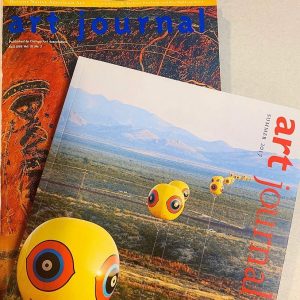
In celebration of Indigenous Peoples’ Day we have brought out from behind the paywall two issues of Art Journal in their entirety: our Summer 2017 issue on Indigenous Futures, (featuring Postcommodity’s Repellent Fence on the cover) and our Fall 1992 issue on Recent Native American Art. Articles from each will be open access until the end of October.
Announcing the Recipients of the 2019 Spring Millard Meiss Publication Fund Awards
posted by CAA — June 13, 2019
The Millard Meiss Publication Fund is made possible by a generous bequest of the late Prof. Millard Meiss. Two times each year, CAA awards grants to publishers in art history and visual culture to support presses in the publication of projects of the highest scholarly and intellectual merit that may not generate adequate financial return.
The Meiss grantees for spring 2019 are:
Bajorek, Jennifer, Unfixed: Photography and Decolonial Imagination in West Africa, Duke University Press, 2019.
Busbea, Larry, The Responsive Environment: Design, Aesthetics, and the Human in the 1970s, University of Minnesota Press, 2019.
Fozi, Shirin, Romanesque Tomb Effigies: Death and Redemption in Medieval Europe, 1000-1200, Penn State University Press, 2020.
Guinness, Katherine, Schizogenesis: The Art of Rosemarie Trockel, University of Minnesota Press, 2019.
Naoi, Nozomi, Beyond the Modern Beauty: Takehisa Yumeji and the New Mediascape of Early Twentieth-Century Japan, University of Washington Press, 2019.
Newbury, Susanna, Speculations: Art, Real Estate, and the Making of Global Los Angeles, University of Minnesota Press, 2020.
Overton, Keelan, Iran and the Deccan: Persianate Art, Culture, and Talent in Circulation, 1400-1700, Indiana University Press, 2020.
Schwartz, Vanessa R., Jet Age Aesthetic: The Glamour of Media in Motion, Yale University Press, 2020.
Sichel, Kim, Making Strange: The Modernist Photobook in France, Yale University Press, 2020.
Silberstein, Rachel, Embroidered Figures: Fashion and Commerce in Nineteenth-Century China, University of Washington Press, 2020.
VanDiver, Rebecca, Negotiating Traditions: Loïs Mailou Jones and the Composite Aesthetics of Blackness, Penn State University Press, 2020.
Zinman, Gregory Austen, Making Images Move: Handmade Cinema and the Other Arts, University of California Press, 2020.
Celebrate Pride with CAA’s LGBTQ+ Article Collection
posted by CAA — June 13, 2019
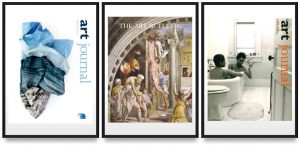
In commemoration of the 50th anniversary of the Stonewall Riots and in celebration of Pride Month, we’ve made a collection of articles from Art Journal and The Art Bulletin focused on LGBTQ+ histories and perspectives free to read and explore online.
These articles will remain open access on Taylor & Francis through August 31, 2019.
We wish to thank Edward Rossa, CAA Summer 2018 intern, for his research on this archive.
Learn more about Art Journal and The Art Bulletin.
An Interview with Jordana Moore Saggese, Editor-in-Chief of Art Journal
posted by CAA — May 21, 2019
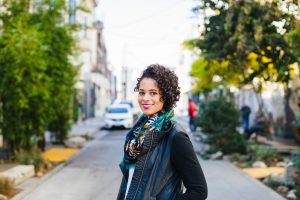
Photo by Sarah Deragon, Portraits to the People
Jordana Moore Saggese is an Associate Professor of American Art at the University of Maryland, College Park and the current Editor-in-Chief of Art Journal, CAA’s publication focused on twentieth- and twenty-first-century art history. Trained as an art historian, Saggese’s work focuses on modern and contemporary art with an emphasis on the expressions and theorizations of blackness. She was previously Associate Professor of Contemporary Art & Theory at California College of the Arts.
Joelle Te Paske, CAA Media and Content Manager, corresponded with her this month to learn about how she came to do the work she does, and her aspirations for the journal and the field beyond.
Joelle Te Paske: Thanks for taking the time for our interview, Jordana. So to begin, where are you from originally? What pathways led you to the work you’re doing now?
Jordana Moore Saggese: I am originally from Nashville, Tennessee. I attended Vanderbilt University, as a first-generation college student, for my undergraduate degree, and fell into an art history major at the very last moment. In fact, the summer before my senior year I suddenly realized that every opportunity I had to take an elective unit during my time at Vanderbilt I had chosen an art history class. The art history classes I took with my mentor Leonard Folgarait were truly inspiring. He encouraged his students (even those like me, who had very little knowledge of art history) to consider the work of artists as a response to the values and ideas of society, which in turn are determined by historical conditions. I can still remember his lecture on Dada, which was really the turning point for me. It was at that moment that I realized art was not something meant only for the elite; art could also be a form of rebellion. Although I had never been inside an art museum before my time as an undergraduate, Dr. Folgarait, and other faculty there, encouraged me and asked me to think deeply about the stakes of representation and introduced me to a range of objects across multiple continents and chronologies. With their encouragement, I decided to declare a major in art history and apply for graduate school my senior year.
This meant that I had to take the two-semester survey course as a senior, which fundamentally shifted the way I think about teaching those courses.
I can still remember my shock, sitting in a huge lecture hall, listening to someone drone on about a mostly white, male, heterosexist art history. I was wholly unprepared to memorize a seemingly endless stream of images. I finished the courses but this was not the art history that I was used to. That experience, of coming in almost backwards to the discipline, highlighted two main issues that still impact my teaching and research today.
First, how can we give students the very best introduction to the discipline—one that reflects the deep inquiry and the collaboration that was so intrinsic to my experience in the upper-division courses?
And second, whose art history are we teaching? That is, to what extent has a colonialist logic pervaded much of modern art history and what can I do—in my teaching and research—to undo that logic? I have been acutely aware of the ways in which art history has tended to exclude diverse perspectives and histories and much of my own work involves complicating those dominant narratives.
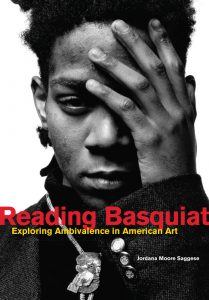
Saggese’s first book, Reading Basquiat: Exploring Ambivalence in American Art, was published by UC Press in 2014.
JTP: I love these questions as a fundamental starting point—not supplement—to the question of teaching art history. You were previously on the faculty at the California College of the Arts, and are now at University of Maryland, College Park. How has the transition been?
JMS: Teaching at an art school for the first ten years of my career was a wonderful experience in that it gave me direct and constant access to working artists. Thanks to my colleagues I was able to stay current in the field—a challenge for any historian of contemporary art—and my students constantly challenged me to make the history of art come into real time and space. CCA was also a site of experimentation, where students and faculty were willing to challenge one another, to wrestle openly with difficulty, and to fail. I have tried to bring those values to my teaching at Maryland as well. I have found the students and faculty at College Park to be deeply invested in their individual fields of interest but also in the discipline as a whole. There has also been tremendous support for my research practice, which has been a great benefit to making this transition.
JTP: As a Basquiat scholar, what is something you wish more people know about the artist?
JMS: I wish that more people considered the extent to which Basquiat’s celebrity status has threatened to eclipse his critical significance. My main project has been, and continues to be, writing this artist into the history of American art. I would also add that working on Basquiat presents extreme challenges for a researcher. There is no public archive of his work and approximately 85-90% of the paintings and drawings are in private collections (and I might mention, constantly being sold). This means that in order to see the works, one must shake a lot of hands, charm a lot of people, and knock on lots of doors. Working on Basquiat requires a thick skin, as I am often embroiled in territorial battles or even ignored. I also spend a lot of money traveling to see exhibitions so that I might glimpse the works in person. So, it’s not your typical research project!
JTP: I can only imagine the challenges that presents in pushing research forward—it’s far from a straightforward dive into the archives. What are you working on currently?
JMS: My second book, The Basquiat Reader: A Critical Anthology will be published by the University of California Press in 2020. The Basquiat Reader is a comprehensive sourcebook on Basquiat for both general audiences and advanced readers. Through a combination of interviews with the artist, criticism from the artist’s lifetime and immediately after, previously unpublished research by me, and a selection of the most important critical essays on the artist’s work, The Basquiat Reader provides a full picture of the artist’s views on art and culture, his working process, as well as the critical significance of his work both then and now. It is my hope that by giving more people access to the primary sources, we will see more scholarship on this artist.
My new book project considers representations of black male athletes as a point of entry to thinking about how black men have historically been presented to (and positioned by) the white mainstream public as a fear/fantasy. More specifically, I examine the ways in which black masculinity is constructed in the visual realm, and how the black athletic body can shape the moral, physical, and social position of African American men more broadly. Over five chapters I analyze key moments in the history of the sport, prominent black athletes and their representation in the American popular press and visual art.
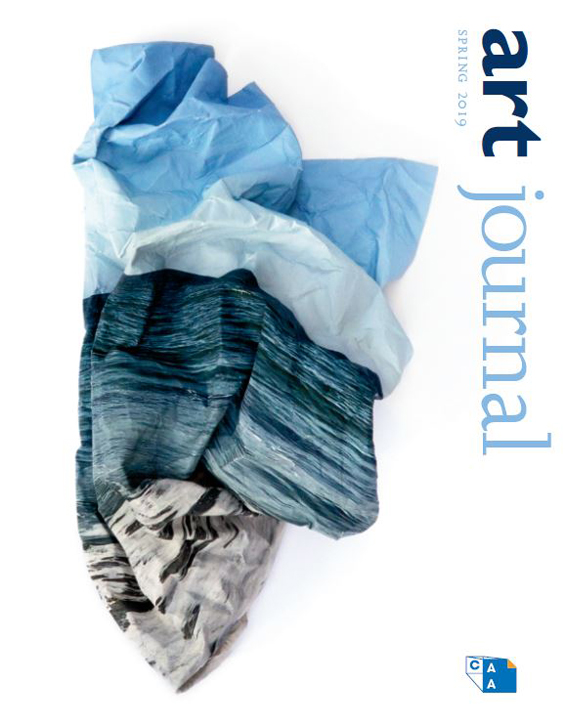
Art Journal, Spring 2019
JTP: That is such important work, especially as those constructions persist and accelerate in contemporary visual culture. What are your hopes for Art Journal during your tenure?
JMS: During my tenure I would like to continue to build on the global reach of the publication—in terms of both content and readership. I mean global here as something more than a keyword to signal “diversity.” I use global to signal an interconnected conversation between Europe, Asia, Africa, Latin America, South America, the Pacific—rather than a series of isolated references to an “other.” I want to think of how the perspective of modern and contemporary art from Mumbai or even Beijing connects to as well as lives separate from the touch-points of America and Europe. This is something that I began to explore in my edited forum, “Diversity and Difference,” published in Art Journal in 2016—that is, how can we think beyond the paradigm of margins and center?
I am also hoping to increase a direct engagement of artist members via the introduction of new features, such as “Object Lessons,” which will first appear in Fall 2019. This is an opportunity for artists to consider a specific object of visual culture that has directly impacted or influenced their own practice. I am also increasing the diversity of artists that we publish in Art Journal. For example, every artist project for issues published in 2019 was developed by a woman of color.
Finally, I want to highlight the role of the journal as a forum for professional conversations. Readers can expect to see short essays on fair use, censorship, and the white supremacist logic of art history—topics that typically are buried in whispers. I see Art Journal as a place where these difficult conversations and issues come to light. Many readers of Art Journal are also teachers, and I hope to bring more focus to issues of pedagogy over the coming years of my tenure as Editor-in-Chief.
JTP: It’s exciting to see the direction you are bringing to it. What are some of your other arts-related recommendations at the moment?
JMS: I have really enjoyed seeing the conversation around #POCarthistory (started by Ananda Cohen-Aponte [who recently took over CAA’s Instagram]) develop on Twitter over the last months. As someone interested in our current moment I am constantly reading Hyperallergic and I have found the resources on the website of the Association for Critical Race Art History very important to my own pedagogical development. I am currently reading The Painter’s Touch by Ewa Lajer-Burcharth.
JTP: Do you have a favorite exhibition you’ve seen recently?
JMS: This year I really enjoyed the shows by Jack Whitten (Met Breuer) and Nari Ward (New Museum), but I am still reeling from the show of new paintings by Lynette Yiadom-Boakye (Under-Song for a Cipher), which I saw at the New Museum two years ago. That show left me speechless.
The Spring 2019 issue of Art Journal is now online.
Not a CAA member? Join today and begin exploring immediately.