
CAA News Today
People in the News
posted by CAA — April 17, 2014
People in the News lists new hires, positions, and promotions in three sections: Academe, Museums and Galleries, and Organizations and Publications.
The section is published every two months: in February, April, June, August, October, and December. To learn more about submitting a listing, please follow the instructions on the main Member News page.
April 2014
Academe

Christine Hahn has earned tenure in the Department of Art and Art History at Kalamazoo College in Kalamazoo, Michigan.
David Joselit has left Yale University in New Haven, Connecticut, for a new post as Distinguished Professor of Art History at the Graduate Center, City University of New York.
Museums and Galleries
Darby English, director of research and academic programming at the Sterling and Francine Clark Art Institute in Williamstown, Massachusetts, has been appointed consulting curator in the Department of Painting and Sculpture at the Museum of Modern Art in New York. He will retain his position at the Clark.
Sandra Q. Firmin, curator of the UB Art Galleries at the University at Buffalo, State University of New York, has accepted the directorship of the CU Art Museum at the University of Colorado in Boulder.
David Rubin has left his curatorial position at the San Antonio Museum of Art in San Antonio, Texas.
Organizations and Publications
Jill Deupi has joined the board of directors of the Association of Art Museums and Galleries as its New England representative.
Jessi DiTillio has been appointed interim administrative director of the Association of Art Museums and Galleries.
Reni Gower of Virginia Commonwealth University in Richmond has been reelected to the Southeastern College Art Conference’s board of directors for a three-year term.
Sandra Reed of the Savannah College of Art and Design in Savannah, Georgia, has been reelected to the Southeastern College Art Conference’s board of directors for a three-year term.
Institutional News
posted by CAA — April 17, 2014
Read about the latest news from institutional members.
Institutional News is published every two months: in February, April, June, August, October, and December. To learn more about submitting a listing, please follow the instructions on the main Member News page.
April 2014
The Arkansas Arts Center in Little Rock has received a spectacular gift of 290 watercolors and drawings by the American artist John Marin (1870–1953) from Norma B. Marin, the widow of the artist’s son.

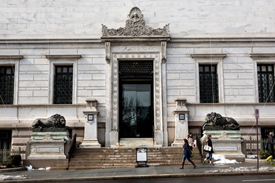 The Corcoran Gallery of Art and Corcoran College of Art and Design (photograph by William Atkins/George Washington University and © George Washington University Photography)
The Corcoran Gallery of Art and Corcoran College of Art and Design, both in Washington, DC, have announced a merger with the National Gallery of Art and George Washington University, also located in the nation’s capital.
The Courtauld Institute of Art in London, England, and the Iran Heritage Foundation have announced funding for a postgraduate and research-assistant post with a focus on Persian arts.
The Frick Art Reference Library and the William Randolph Hearst Archive at Long Island University (LIU) Post have completed a collaborative digitization project, Gilding the Gilded Age: Interior Decoration Tastes and Trends in New York City. With funding from the New York State Regional Bibliographic Databases Program, this project brings together a group of late-nineteenth and early-twentieth-century auction catalogues held by the library and the archive.
The Los Angeles County Museum of Art in California is one of five major American museums to have received funding for the Andrew W. Mellon Undergraduate Curatorial Fellowship Program, which provides specialized training in the curatorial field for students across the United States with diverse backgrounds.
The Metropolitan Museum of Art in New York has received a gift from Daniel Brodsky, the museum’s chairman, and his wife Estrellita B. Brodsky, an art historian, to endow two new curatorial positions in the museum’s Department of Modern and Contemporary Art. The two positions will be called the Estrellita B. Brodsky Curator of Latin American Art and the Daniel Brodsky Associate Curator of Architecture and Design.
The Museum of Fine Arts, Houston, is one of five major American museums to have received funding for the Andrew W. Mellon Undergraduate Curatorial Fellowship Program, which provides specialized training in the curatorial field for students across the United States with diverse backgrounds.

 Ann Hamilton
Ohio State University in Columbus has initiated the Ann Hamilton Project Archive, which contains more than one thousand downloadable, high-resolution images from thirty-five installation by Hamilton, an internationally acclaimed artist and Distinguished University Professor in the university’s Department of Art.
The Yale Center for British Art in New Haven, Connecticut, has reopened its Study Room after completing the first phase of a major building-conservation project.
The Yale School of Art in New Haven, Connecticut, has accepted a $5 million contribution from the Stavros Niarchos Foundation to create a permanent, unrestricted endowment to support the core priorities of the school, while naming in perpetuity the Stavros Niarchos Foundation Dean. A second gift of $900,000 will supplement three existing endowments, created by the foundation in 2010, to establish an artist’s residency, scholarships for international students, and a dean’s resource fund.


Yale University Press in New Haven, Connecticut, has accepted the 2013 Design Book of the Year Award by the editors of Designers & Books for Phyllis Lambert’s volume Building Seagram (2013). The press also received an honorable mention for another book, The Houses of Louis Kahn (2013) by George H. Marcus and William Whitaker.
Grants, Awards, and Honors
posted by CAA — April 15, 2014
CAA recognizes its members for their professional achievements, be it a grant, fellowship, residency, book prize, honorary degree, or related award.
Grants, Awards, and Honors is published every two months: in February, April, June, August, October, and December. To learn more about submitting a listing, please follow the instructions on the main Member News page.
April 2014
Molly Emma Aitken, associate professor of art at City College, City University of New York, has accepted a Collaborative Research Grant from the American Council of Learned Societies for her project with Allison Renée Busch, called “Aesthetic Worlds of the Indian Heroine.”
Elizabeth Athens, an independent scholar based in Providence, Rhode Island, was named a Clark Graduate Summer Fellow for July–August 2013 by the Sterling and Francine Clark Art Institute in Williamstown, Massachusetts.

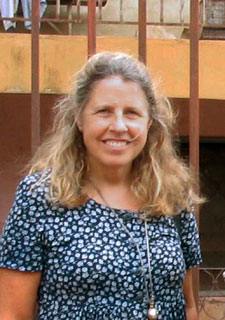 Suzanne Preston Blier
Suzanne Preston Blier, Allen Whitehill Clowes Professor of Fine Arts and of African and African American Studies in Cambridge, Massachusetts, received a Beinecke Fellowship from the Sterling and Francine Clark Art Institute in Williamstown, Massachusetts, for September–December 2013.
William L. Coleman, a PhD candidate in history of art at the University of California, Berkeley, has been awarded the 2014 Dora Wiebenson Prize by the Historians of Eighteenth-Century Art and Architecture. The paper honored as the best of the year by a graduate student was “‘Both instructive and pleasant’: The Country House Garden in Vitruvius Britannicus,” given at CAA Chicago.
Romy Golan, professor of art history at and Lehman College and the Graduate Center, City University of New York, won a fellowship from the Sterling and Francine Clark Art Institute in Williamstown, Massachusetts, for September–December 2013.
Michael Ann Holly, Starr director emeritus of research and academic programs at the Sterling and Francine Clark Art Institute in Williamstown, Massachusetts, has been awarded a fellowship from her institution for February–June 2014.
Simon Leung, an artist and professor of art for the University of California, Irvine, has earned a fellowship from the Sterling and Francine Clark Art Institute in Williamstown, Massachusetts, for February–June 2014.
Judith Rodenbeck, professor of modern and contemporary art at Sarah Lawrence College in Bronxville, New York, was named a fellow by the Sterling and Francine Clark Art Institute in Williamstown, Massachusetts, for September–December 2013.

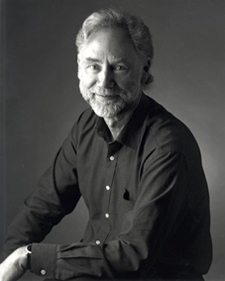 Terry Smith (photograph by John Williams)
Terence Smith, Andrew W. Mellon Professor of Contemporary Art History and Theory in the Department of the History of Art and Architecture at the University of Pittsburgh in Pennsylvania, has received a fellowship for February–June 2014 from the Sterling and Francine Clark Art Institute in Williamstown, Massachusetts.
Roberto Tejada, professor of art history in the Meadows School of the Arts at Southern Methodist University in Dallas, Texas, was named Clark/Oakley Humanities Fellow and Clark Mellon Curatorial Fellow by the Sterling and Francine Clark Art Institute in Williamstown, Massachusetts, for September–December 2013.
Exhibitions Curated by CAA Members
posted by CAA — April 15, 2014
Check out details on recent shows organized by CAA members who are also curators.
Exhibitions Curated by CAA Members is published every two months: in February, April, June, August, October, and December. To learn more about submitting a listing, please follow the instructions on the main Member News page.
April 2014

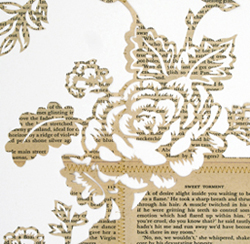 Lauren Scanlon, Sweet Torment (Sorrel II), 2010, hand-cut book pages from romance novels and gold thread on paper, 17½ x 15¼ in. (artwork © Lauren Scanlon)
Reni Gower. Papercuts: The Art of Contemporary Papercutting. Muskegon Museum of Art, Muskegon, Michigan, January 9–March 16, 2014.

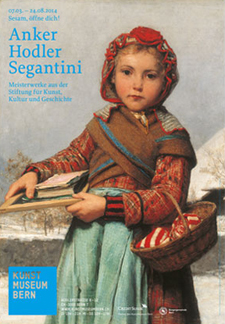 Poster for Open Sesame! Anker, Hodler, Segantini
Valentina Locatelli. Open Sesame! Anker, Hodler, Segantini; Masterpieces from the Foundation for Art, Culture, and History. Kunstmuseum Bern, Bern, Switzerland, March 7–August 24, 2014.
Melissa Potter and Jessica Cochran. Social Paper: Hand Papermaking in the Context of Socially Engaged Art. Center for Book and Paper Arts, Columbia College Chicago, Chicago, Illinois, February 10–April 15, 2014.

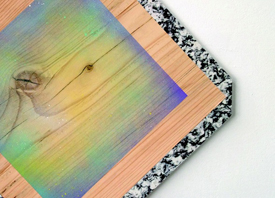 Detail of Parsley Steinweiss, Untitled, 2013, spray paint on digital C-print mounted on Plexiglas and Sintra, 23½ x 22½ in. (artwork © Parsley Steinweiss)
Sarah G. Sharp. Offline. Radiator Gallery, RadiatorArts, Long Island City, New York, February 7–March 15, 2014.
Books Published by CAA Members
posted by CAA — April 15, 2014
Publishing a book is a major milestone for artists and scholars—browse a list of recent titles below.
Books Published by CAA Members appears every two months: in February, April, June, August, October, and December. To learn more about submitting a listing, please follow the instructions on the main Member News page.
April 2014


Katharine P. Burnett. Dimensions of Originality: Essays on Seventeenth-Century Chinese Art Theory and Criticism (Hong Kong: Chinese University Press, 2013).

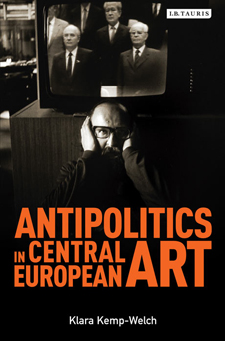
Klara Kemp-Welch. Antipolitics in Central European Art: Reticence as Dissidence under Post-Totalitarian Rule 1956–1989 (London: I. B. Tauris, 2013).


Andreas Marks. Kunisada’s Tōkaidō: Riddles in Japanese Woodblock Prints (Leiden, the Netherlands: Brill, 2013).

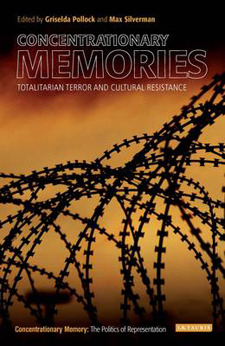
Griselda Pollock and Max Silvermann, eds. Concentrationary Memories: Totalitarian Terror and Cultural Resistance (London: I. B. Tauris, 2013).

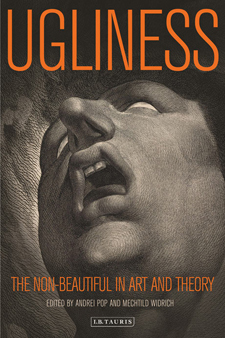
Andrei Pop and Mechtild Widrich, eds. Ugliness: The Non-Beautiful in Art and Theory (London: I. B. Tauris, 2013).

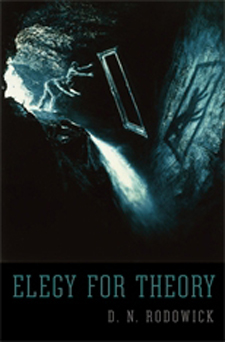
D. N. Rodowick. Elegy for Theory (Cambridge, MA: Harvard University Press, 2014).

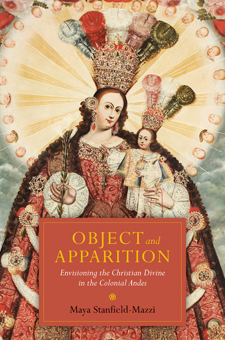
Maya Stanfield-Mazzi. Object and Apparition: Envisioning the Christian Divine in the Colonial Andes (Tucson: University of Arizona Press, 2013).
Committee on Women in the Arts Picks for April 2014
posted by CAA — April 10, 2014
Each month, CAA’s Committee on Women in the Arts selects the best in feminist art and scholarship. The following exhibitions and events should not be missed. Check the archive of CWA Picks at the bottom of the page, as several museum and gallery shows listed in previous months may still be on view or touring.
April 2014
Claudia DeMonte: La Forza del Destino
June Kelly Gallery
166 Mercer Street, New York, NY 10012
April 10–May 13, 2014
Claudia DeMonte: La Forza del Destino presents a new series of paintings and sculptures focused on symbols of good and bad luck from around the world. For decades, Claudia DeMonte has been involved in collaborative research and art production with women artists across the globe. As curator, DeMonte is the artifice of WOMEN OF THE WORLD: A Global Collection of Art. This traveling exhibition, with accompanying comprehensive publication, includes the works and statements of women artists from 177 countries portraying their image of what means being a woman in their cultural environment. In her later project, Real Beauty, DeMonte commissioned handmade fabric dolls from artists and crafters to express local concepts of female beauty, standards that are being lost due to plastic reproductions and globalization.
From Bhutan, Laos, and Saudi Arabia to Senegal and Tibet, DeMonte has traveled the globe observing cultures, customs, and idiosyncrasies from women perspectives and often working collaboratively with local women workshops. In one of the works presented in La Forza del Destino, DeMonte uses a female form sculpted from wood and laden with pictographic configurations suggesting lucky charms of protection. Her new works make evident, once again, her continued interest in women’s multifaceted roles and impact as storytellers, historians, and mythological controllers of destiny. In DeMonte’s own words, La Forza del Destino examines from a women’s perspective the icons that represent luck, superstition, and protection from the evils of the world.
Ane Mette Hol: In the Collection
Trondheim Kunstmuseum
Bispegata 7 B, 7013 Trondheim, Norway
February 8–May 18, 2014
Trondheim Kunstmuseum presents In the Collection, a solo exhibition by the Oslo-based artist Ane Mette Hol (b. Bodø, 1979), who uses drawing as a research method that investigates the relationships between originals and reproductions. The “accurate copies” of objects and phenomena are the result of a painstaking work, questioning the very medium of drawing. By using paper and drawing tools, Hol copies things with precision down to the finest detail. She has made copies of brown paper, rolls of drawing paper, music sheets, drawing pads, and book covers, as well as printouts from the internet and botched photocopies. Through her completed works, she challenges the relationship between original and copy with an almost Borgesian approach. Furthermore, through this relationship, Hol’s works comment on our continuous recycling of what already exists and on our common knowledge about art history and theory. In this, she questions the nature of art; its premises in terms of content, politics, and institution through remarkable technical skill and through innovative frames of reference and conceptual discourse.
In the exhibition at Trondheim Kunstmuseum, Hol has based her work on a drawing of a photocopy from Charles Wood’s book How to Draw Portraits (1943). The drawing shows the book’s list of contents, and the exhibition is based on the different sections of the book. As the exhibition title suggested, the show features works from the museum’s collections and from Hol’s drawings, animations, and sound installations.
Maria Lassnig
MoMA PS1
22-25 Jackson Avenue, Long Island City, NY 11101
March 9–May 25, 2014
Maria Lassnig (Austrian, b. 1919) is one of the most important contemporary women painters. Through what she called “body awareness,” her paintings mean an exploration of the inner world. She focused on representing the way her body feels to her from the inside, rather than attempting to depict it from outside. Lassnig’s remarkable career has spanned more than seventy years. Throughout the decades she has continued to create work that vulnerably explores the way she comes into contact with the world, emphasizing often the disjunctions between her own self-image, challenging the way she may be seen by others as a woman, as a painter, and as a person who has lived through the dramatic technological and cultural shifts that have marked the century of her lifetime. In her paintings, Lassnig exposes personal traumas, fantasies, and nightmares, offering instruction for courageous living in a time of social interaction.
From all creative periods of her career, spanning her early involvement with graphic abstraction in Paris and Art Informel, to her later shift to figural representation, Lassnig’s exhibition at PS1 is the most significant survey of the artists’ work ever presented in the United States. The show, focusing in her self-portraits, features approximately fifty paintings drawn from public and private holdings and from the artist’s own collection. A selection of watercolors and filmic works, many of which have never been previously seen in the United States, also make an appearance in the exhibition.
Mimi Smith: Constructing Art about Life
Harold B. Lemmerman Gallery
New Jersey City University Galleries, Hepburn Hall, 2039 Kennedy Boulevard, Room 323, Jersey City, NJ 07305
March 20–April 24, 2014
Mimi Smith: Constructing Art about Life is a concise survey of Mimi Smith’s work over the past five decades, curated by Midori Yoshimoto. A New York–based artist and a graduate of Rutgers University, Smith is best known for the clothing sculptures she begun in the mid-1960s, the most prominent being Steel Wool Peignoir (1966), a see-through dressing gown embellished with lace and steel wool that has become an icon of early feminist art. Combining banal consumer or domestic objects—such as the wrapping plastics of various consumer goods in Recycle Coat (1965), the bath mats in Girdle (1966), or the pieced-together plastics in Maternity Dress (1966)—Smith radically intervened in Pop art, producing feminist sartorial sculptures that addressed the role of fashion in women’s individual and social identities, while unmasking the complicated relationship of the public and the private in women’s lives.
In the early 1970s Smith challenged the Conceptual art of her time from the homebound perspective of a female artist and a mother, then raising her children in Ohio, with a series of works that merit further evaluation for their contribution to postwar art and their diverse politics. These include series of large-scale drawings done with measuring tape and knotted thread that replicates the rooms and furniture of her home, as well as multimedia installations that allude to the pervasiveness of new technologies and the increasing invasiveness of the news media, and also to the environment and nuclear threats.
Sculptural cloth making and clothing itself continue to play a great role in Smith’s contemporary investigation of gendered identity and politics, as seen in her recent ruminations on women’s aging through drawn representations of underwear.
Lee Bontecou: Drawn Worlds
Menil Collection
1533 Sul Ross Street, Houston, TX 77006
January 31–May 11, 2014
Curated by Michelle White under the auspices of the Menil Drawing Institute, Lee Bontecou: Drawn Worlds is the first museum survey to focus on Lee Bontecou’s works on paper. It brings together over seventy works from various collections, including that of the Menil, that sample her drawing practice from 1958 to 2012. The show is accompanied by a fully illustrated catalogue with essays by White, Dore Ashton, and Joan Banach.
Advancing the understanding of the work of this incredible artist, Drawn Worlds explores Bontecou’s experimentation in materials and techniques, such as her early use of a welding torch to deposit velvet layers of black soot on paper, muslin, and canvas. The exhibition also contextualizes the artist’s distinctive iconography, especially her penchant for circles and voids, within the political and environmental concerns of the time of their making. Above all it provides a unique opportunity to witness the “unsettling realms of human folly and the frailty of the natural world” in which Bontecou’s “drawn words” take the viewer, while studying the forms that characterize them, whether as origins of her sculptures or independent transmutations of her haunting vocabulary.
Betye Saar: Redtime Est
Michael Rosenfeld Gallery
100 Eleventh Avenue, New York, NY 10001
March 15–May 3, 2014
Betye Saar is widely known for multimedia collages, box assemblages, altars, and installations consisting of found materials that, as put by the artist, “reach across the barriers of art and life to bridge cultural diversity and forge new understandings,” in effect voicing various political, racial, spiritual and gender concerns. Redtime Est (2011), a variation of the eponymous installation for Pacific Standard Time in Los Angeles three years ago, offers a unique opportunity to indulge the affective sensibility of her highly political objects.
Redtime Est consists of red, or chameleonlike red, works that are curated by the artist in and around a room whose walls are painted red, “the color of anger, danger, violence, heat, passion, blood and fire.” A caged mannequin with a crow as head and dressed with shackles guards the entrance to Redtime Est, setting its tone, while Red Ascension, a painted red ladder, hangs diagonally across the wall that faces the viewer upon his or her entrance, cinematically commemorates the slaves’ trip from Africa to America with various symbolic objects featured in each frame, ranging from an African mask to handcrafted ships to red-painted chains and padlocks.
Unlike the miniretrospective character of the Redtime Est, this one is a mega-assemblage of recent works, the earliest dating from the early 1990s, whose subject matter, as in Justice (2011) features Aunt Jemima, is manifested with signature tropes of the feminist and antiracist underpinnings of the artist’s assemblage practice since the 1960s. Focusing on the most political aspects of her work, the artist brings together objects for Redtime Est that, while sampling the various modes of her practice from painting to assemblage and the sheer repurposing of found objects, illustrate the way in which she used “derogatory” stereotypes of blackness and recycled objects of poignant history and function, such as washboards, to make powerful and empowering critical statements about race and gender with an idiosyncratic marriage of past and present, her homage to her ancestors and her radical legacy to future.
Alexandra Bachzetzis and Claire Hooper
Bonner Kunstverein
Hochstadenring 22,
D-53119 Bonn, Germany
February 22–May 25, 2014
Bonner Kunstverein juxtaposes the deconstructive and seductive ways in which pop culture is respectively employed in the work of the performer and choreographer Alexandra Bachzetsis and the filmmaker Claire Hooper, putting in dialogue the exploration of the distinct significance given by social media in the staging of personality and life today as well as the ways in which their practice challenges the exhibition format. While Bachzetsis performed with Anne Pajunen for A Piece Danced Alone (2011) during the opening, her work is mostly represented through video documentations of her choreographies. Hooper’s videos are exhibited as part of structures that function as projection surfaces and architectural ornamentation, creating links between the exhibition space, the illusionistic space of the film, and its documentary function in a manner typical of Hooper, as, for instance, by recreating a Berlin subway environment.
Bachzetsis’s works depict the controlled movements of bodies following a clear sequence in evocative situations that condense reflections of the contemporary media culture into studies of motion by means of mirroring and repetition. By isolating gestures and body language from the flow of the familiar as signs of cultural codes she deconstructs the sequence of events, while also variously analyzing the mechanics of TV soaps and hip hop video clips, classical ballet, modern dance, and performance art.
Hooper’s films, in which the British tradition of documentaries encounters Greek mythology, focus on figures in precarious social circumstances and their entanglement in restrictive systems that are converted into collective social areas through parablelike, mythological enhancement. Interchangeable elements from everyday life in documentary fashion oscillate kaleidoscopically with theatrically charged passages. While pop culture plays an equally important part in the staging of her figures, Hooper depicts the body in seemingly surreal dance performances that enable her to portray the irrational and also the compulsive forces that continue to drive our society. A dialogue about the body and its representation in the media, as well as its physical and social limitations, develops between their works. Both artists depict the body and the figure as shimmering, constantly changing projection surfaces.
Committee on Women in the Arts Picks for March 2014
posted by CAA — March 10, 2014
Each month, CAA’s Committee on Women in the Arts selects the best in feminist art and scholarship. The following exhibitions and events should not be missed. Check the archive of CWA Picks at the bottom of the page, as several museum and gallery shows listed in previous months may still be on view or touring.
March 2014

Anna Maria Maiolino, still from Y, 1974, 8mm film transferred to DVD, black and white with sound, 2:28 mins. (artwork © Anna Maria Maiolino; photograph by Max Nauenberg)
Anna Maria Maiolino: MATRIX 252
Berkeley Art Museum and Pacific Film Archive
University of California, Woo Hon Fai Hall, 2625 Durant Avenue, No. 2250, Berkeley, CA 94720
January 17–March 30, 2014
MATRIX 252 offers a selection of videos by the São Paulo–based artist Anna Maria Maiolino. For over five decades, Maiolino’s multidisciplinary practice comprised drawing, engraving, painting, sculpture, installation, and Super 8 films that led to the use of audio and video in her work. Through fragmentation and abstraction she has explored the “viscerality of embodied experience.” MATRIX 252 features a group of four videos, originally shot on Super 8 between 1973 and 1982.
Born in Italy in 1942, Maiolino emigrated with her family to Venezuela in 1954 before moving to Brazil in 1960. Previous to settling in São Paulo, she lived in Rio de Janeiro, where she took part of the exhibition Nova Objetividade Brasileira (New Brazilian Objectivity) alongside Lygia Clark, Antonio Dias, Rubens Gerchman, Hélio Oiticica, and Lygia Pape. The brutality of the Brazilian military dictatorship (1964–85) became a subject for Maiolino’s work. Based on Oswald de Andrade’s “Manifesto Antropófago” (“Cannibal Manifesto”) of 1928, In-Out (Antropofagia) (1973) shows a close-up of a male and a female mouth attempting to communicate while obstructed by various objects, such as a tape, an egg, and a string. Further close-up shots of faces appear in two works, X and Y (both 1974): eyes are imperiled by snapping scissors in X, while in Y they are blindfolded while the mouth emits a cry. Through these videos, the artist exposes a human body that struggles to find a mode of expression as a metaphor for living under political repression and censorship.
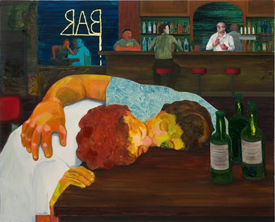
Nicole Eisenman, Sloppy Bar Room Kiss, 2011, oil on canvas, 39 x 48 in. (artwork © Nicole Eisenman)
Dear Nemesis: Nicole Eisenman, 1993–2013
Contemporary Art Museum Saint Louis
3750 Washington Boulevard, Saint Louis, MO 63108
January 24–April 13, 2014
Dear Nemesis, the largest midcareer survey of the work of the American artist Nicole Eisenman (b. France, 1965) to date, includes more than 120 paintings, prints, and drawings created between 1993 to 2013. The work of Eisenman bridges the absurd and abject with the introspective and irreverent, drawing on sources as varied as the iconography of classical myths and popular culture in general. Over the past two decades, she has developed a creative and versatile vision that combines high and low culture with virtuosic skill. Being her core concerns the depictions of community, identity, and sexuality, Eisenman demonstrates an uncanny capacity for capturing the joy, pain, embarrassment, and ecstasy of being human. Fusing images that fluctuate between the depiction of a world rooted in the visual language of art history and a critical and comedic meditation on contemporary life, she depicts settings and themes as varied as bar scenes, motherhood, and the dilemma of the artist. Through a recurrent representation of women, both as “butch” and “femme,” and female love, Eisenman infuses the practice of figurative painting with an audaciously queer bent that also re-presents art history in a feminist light. Through her wit and the uneasiness caused by her playful images, she is able to communicate with a critical—and yet visually breathtaking—absurdity the multifaceted depth of the human condition.

Alice Aycock, Hoodo (Laura) from the Series “How to Catch and Manufacture Ghosts” Vertical & Horizontal Cross-section of the Ether Wind (1981), 1990/2012, watercolor and ink on paper, 27½ x 39¼ in. Collection of the artist (artwork © Alice Aycock)
Alice Aycock Drawings: Some Stories Are Worth Repeating
Santa Barbara Museum of Art
1130 State Street, Santa Barbara, CA 93101
January 26–April 20, 2014
Alice Aycock Drawings: Some Stories Are Worth Repeating
Art, Design, and Architecture Museum
University of California, Santa Barbara, CA 93106
January 26–April 20, 2014
Including over one hundred works, Some Stories Are Worth Repeating is the first comprehensive exploration of Alice Aycock’s creative process. For this major retrospective, the Santa Barbara Museum of Art partnered the Art, Design, and Architecture (AD&A) Museum at the University of California, Santa Barbara, to present an exhibition that traces the artist’s career from 1971 to date. The display at the AD&A Museum focuses on Aycock’s work from 1971 to 1984 and includes detailed architectural drawings, sculptural maquettes, and photo documentation for both realized and imagined architectural projects. The Santa Barbara Museum of Art covers Aycock’s work from 1984 to present, a period in which she developed an increasingly elaborate visual vocabulary, drawing upon a multitude of sources that were partially informed by the use of computer programs.
This double-venue exhibition highlights the major themes that have governed Aycock’s artistic practice. While she is best known for her large-scale installations and outdoor sculptures, her drawings capture the full range of her ideas and sources, mirroring her conceptual clarity and formal depth. Her drawings and built projects achieved new complexity with the advent of computer-graphics programs in the 1990s. New technologies have enable Aycock to develop a digitally informed visual language that includes the generation of forms from multiple perspectives, mathematically perfect curve, and a precise construction drawings, while imagining points of view that are extraordinarily accurate.
A fully illustrated exhibition catalogue, published by the Parrish Art Museum and distributed by Yale University Press, features an interpretive essay by Jonathan Fineberg and an introduction by Terrie Sultan, director of the Parrish Art Museum. This book is the first scholarly exploration of the pivotal, enormously productive role that drawing has played in Aycock’s career over the course of her forty years as professional artist.
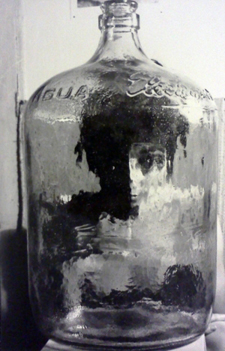
Kati Horna, Bottle, 1962, gelatin-silver print, 9 5/16 x 6½ in. (artwork © Kati Horna)
Kati Horna
Museo Amparo
2 Sur 708, Centro Histórico, Puebla, Pue., Mexico
December 7, 2013–April 28, 2014
Museo Amparo, in collaboration with Jeu de Paume in Paris (where the show will travel later this spring), presents the first major survey of the work of the photographer Kati Horna (Szilas-Balhas, Hungary, 1912–Mexico City, 2000). Horna turned to photography in the early 1930s in Hungary and, though still understudied, became one of the greatest documentary and surrealist photographers of Mexico. Seeking to define her contribution to photojournalism—and the photo-essay in particular—the exhibition brings together over 150 mostly unpublished or rarely seen works and contextualizes Horna’s career with personal photos and the European and Mexican journals with which she collaborated. It is chronologically organized along three axes that distinguish the changing geographic, cultural, and political contexts of her production.
The first part focuses on early work, conducted in Hungary, Berlin (where she relocated at age eighteen), and Paris, her early collages and photomontages illuminating the formation of her aesthetics in the context of the European avant-gardes of the 1930s (Bauhaus, Surrealism, and Neue Sachlichkeit). The second part focuses on Horna’s documentation of the Spanish Civil War, characterized by her compassionate look at civilians, an approach that radically complemented the perspective of her then partner, the war photographer Robert Capa, whom she followed to Spain. The last part of the exhibition examines her work as a chronicler of life in Mexico. Horna moved there on the eve of the Second World War with her husband Jose Jorna, joining various circles of the local intelligentsia, such as the movimiento pánico (Alejandro Jodorowsky) and the artistic, literary, and architectural avant-garde in Mexico (Mathias Goeritz, Germán Cueto, Pedro Friedeberg, Salvador Elizondo, Alfonso Reyes, and Ricardo Legorreta), while forming a close relationship with Leonora Carrington and Remedios Varo. The last twenty years of Horna’s life were dedicated—in addition to her creative work—to teaching photography at the Universidad Iberoamericana and the Academia de San Carlos (Univesidad Nacional Autónoma de México), where she influenced a new generation of contemporary photographers.

Posters (ca. 1991–present) from Riot Grrrl–related shows, conventions, and meetings internationally, solicited from institutional and personal archives through open calls, word of mouth, and invitations
Alien She
Vox Populi
319 North 11th Street, Philadelphia, PA 19107
March 7–April 27, 2014
Organized by two former Riot Grrrls, Astria Suparak and Ceci Moss, Alien She is the first exhibition to examine the lasting impact of the highly influential feminist punk movement from the 1990s on contemporary artists and cultural producers. Formed in reaction to the pervasive and violent sexism, racism, and homophobia in the punk-music scene and in culture at large, Riot Grrrl fomented a new generation of active feminists, inspiring them to create their own culture and communities in defiance of mainstream conventions. The movement also popularized the academic discourse of identity politics. Emphasizing female and youth empowerment, collaborative organization, creative resistance, and DIY ethics, Riot Grrrl had a pivotal influence, inspiring many around the world to pursue socially and politically progressive careers as artists, activists, authors, and educators.
Alien She focuses on seven artists—Ginger Brooks Takahashi (Pittsburgh), Tammy Rae Carland (Oakland), Miranda July (Los Angeles), Faythe Levine (Milwaukee), Allyson Mitchell (Toronto), L. J. Roberts (Brooklyn), and Stephanie Syjuco (San Francisco)—working in different media whose practices reflect the impact of Riot Grrrl; the exhibition also includes an open-ended historical section that reflects the multiplicity that was integral part of the original movement and its continuity, in the spirit of the Riot Grrrl’s principles. Each artist is represented by several projects from the last twenty years, including new and rarely seen works, providing an insight into the development of their creative practices and individual trajectories. The movement’s vast creative output is captured by hundreds of self-published zines and hand-designed posters (solicited from institutional and personal archives through open calls, word-of-mouth, and invitations, similar to the way Riot Grrrl expanded), different music playlists from Riot Grrrl scenes across the United States, Canada, South America, and Europe, while interviews and an ongoing, online Riot Grrrl Census provide an expanded oral history.
The exhibition’s title, Alien She, refers to a Bikini Kill song of the same name. The lyrics are about the negotiation of normalized gender roles, the uneasy line between feminist critique and collectivity, and the process of coming to a feminist consciousness, with the repeated refrain, “She is me, I am her.”

Installation view of Leonor Fini: Pourquoi pas? (artworks © Leonor Fini; photograph by Polly Yassin/Bildmuseet)
Leonor Fini: Pourquoi pas?
Bildmuseet
Umeå University, S-901 87 Umeå, Sweden
January 31–May 11, 2014
Leonor Fini: Pourquoi pas? is the first survey of the work of the Buenos Aires–born, Italian-French artist Leonor Fini (1907–1996) in the Nordic countries. Fini’s work challenged conventional ideas through questioning the frontiers between female and male, myth, and reality, the conscious and unconscious; it also expressed female desire, interfering in Surrealism from a transgressive female point of view. Though posthumously reduced to a footnote of art history, including feminist art history, Fini became a “queen of the Paris art world,” where she moved circa 1931 to become an artist, constantly featured in the news and celebrated for her paintings, illustrations, and theater designs, and above all for her flamboyant bohemian lifestyle, marked by her masquerades and ménages à trois. Fini was largely self-taught, having nurtured her prodigious talent and passion for portraiture by studying Flemish masters and Italian Mannerists; she also claimed dreams as the source of the irrational of her imagery. She was featured in major Surrealist exhibitions, including the 1936 International Exhibition of Surrealism in London, where she scandalized the critics with her erotic females. She also participated in Parisian Surrealist circles yet distanced herself from André Breton’s misogynistic circle.
The exhibition, which includes paintings, drawings, book illustrations, objects, text, film, and costume sketches for theater and opera, is accompanied by a richly illustrated bilingual catalogue (in English and Swedish) with previously unpublished texts by the artist alongside new essays by the poet and author Lasse Söderberg, the art historian Anna Rådström, and the curators Cecilia Andersson and Brita Täljedal.
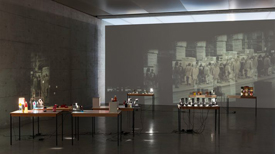
Installation view of Were I made of matter, I would color (photograph by Stephan Wyckoff)
Ulrike Grossarth: Were I made of matter, I would color
Generali Foundation
Wiedner Hauptstrasse 15, 1040 Vienna, Austria
January 24–June 29, 2014
Ulrike Grossarth (b. 1952) is a Berlin-based multimedia conceptual artist and professor of expanded concepts of art and mixed media art at the Academy of Fine Arts in Dresden since 1998. She is the founder of the Essen branch of Free International University initiated by Joseph Beuys and the recipient of the 2009 Kathe Kollwitz Prize. Though Grossarth began her career as a dancer, she became known since the late 1980s for sculptural milieus that variously manifest her interest in the corporeality of matter and create “radical and vivid spaces for thinking, spaces people can actually experience and use,” rather than artworks, as the artist puts it.
Curated by Sabine Folie and Ilse Lafer, Were I made of matter, I would color is a comprehensive retrospective that traces the evolution of Grossarth’s art, drawing connections from her early years as a dancer in the 1970s and 1980s, her sculptural settings and actions, and her most recent work, which interlaces an interest in history with the history of ideas.
The exhibition’s centerpiece, BAU I (1989–2000), is an experimental ensemble comprised of the “unmoved object-bodies” that Grossarth created over a decade and presented in a wide variety of constellations. Visualizing changed spaces of thought and action, the show bridges Grossarth’s early work, which is informed by Fluxus and punk and the attempt to come to terms with the postwar era, and her later art, with its focus on Eastern Europe. More recent works in the exhibition, such as the so-called Lublin projects (since 2006) and SYMBOL gotowe/Subject Aggregates, showcase the ways in which Grossarth seeks to reanimate lost cultural traditions, and her challenging of Occidental thought with her engagement with Jewish mysticism and the motif of the Shekhinah.
Solo Exhibitions by Artist Members
posted by CAA — February 22, 2014
See when and where CAA members are exhibiting their art, and view images of their work.
Solo Exhibitions by Artist Members is published every two months: in February, April, June, August, October, and December. To learn more about submitting a listing, please follow the instructions on the main Member News page.
February 2014
Mid-Atlantic

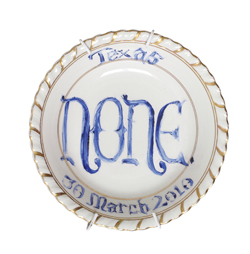 Julie Green, Texas 30 March 2010, from The Last Supper series (2000–ongoing), cobalt blue pigment painted on porcelain, kiln-fired ceramic, 6 x 6 x 1 in. (artwork © Julie Green)
Julie Green. Lore Degenstein Gallery, Susquehanna University Selinsgrove, Pennsylvania, January 18–March 1, 2014. The Last Supper: Final Meals of U.S. Death Row Inmates. 550 painted, kiln-fired ceramic plates.
Midwest

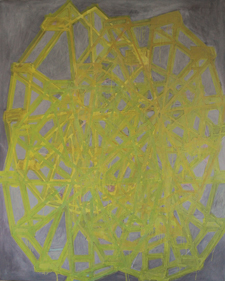 Hartmut Austen, Ferris, 2013, oil on canvas, 75 x 60 in. (artwork © Hartmut Austen)
Hartmut Austen. The Butcher’s Daughter, Detroit, Michigan, January 18–February 23, 2014. Approximate Territory. Painting.

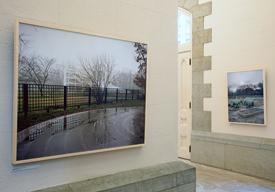 Regina Mamou, Chartres Cathedral (left), 2012, C-print, 40 x 50 in.; and Lustgarten (right), 2012, C-print, 40 x 32 in. (artworks © Regina Mamou)
Regina Mamou. City Gallery in the Historic Water Tower, Chicago, Illinois, October 11, 2013–January 19, 2014. Unfortunately, It Was Paradise. Photography.
Christopher Troutman. Mallin Gallery, Kansas City Artists Coalition, Kansas City, Missouri, December 13, 2013–January 17, 2014. Charcoal and ink drawing.
South

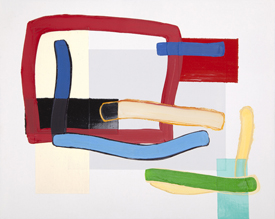 Sharon Louden, Community, 2013, oil and enamel on stretched paper mounted on panel, 11 x 14 x 1½ in. (artwork © Sharon Louden)
Sharon Louden. Beta Pictoris Gallery, Maus Contemporary Art, Birmingham, Alabama, January 7–February 16, 2014. The Dancing Line: New Paintings, New Drawings. Painting and drawing.
West

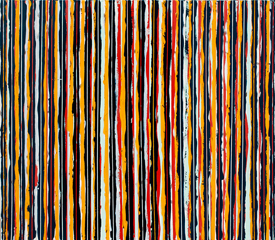 Jeffrey Glossip, Arrival (New Big), 2012, oil on canvas, 72 x 80 in. (artwork © Jeffrey Glossip)
Jeffrey Glossip. Lynnwood Convention Center, Lynnwood, Washington, January 8–July 31, 2014. Big Paint. Large-scale nonrepresentational painting.
People in the News
posted by CAA — February 17, 2014
People in the News lists new hires, positions, and promotions in three sections: Academe, Museums and Galleries, and Organizations and Publications.
The section is published every two months: in February, April, June, August, October, and December. To learn more about submitting a listing, please follow the instructions on the main Member News page.
February 2014
Museums and Galleries

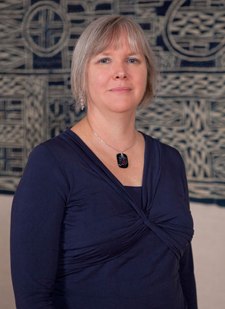 Kathleen Bickford Berzock
Kathleen Bickford Berzock, previously curator of African art at the Art Institute of Chicago, has been appointed associate director of curatorial affairs for the Mary and Leigh Block Museum of Art at Northwestern University in Evanston, Illinois.
Michael Brown, a researcher, lecturer, and formerly Mayer Curatorial Fellow for Spanish Colonial Art at the Denver Art Museum in Colorado, has become an associate curator of European art at the San Diego Museum of Art in California.

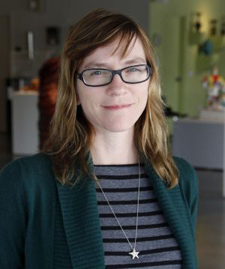 Elizabeth Kozlowski
Elizabeth Kozlowski, formerly Windgate Curatorial Fellow at the Arizona State University Museum in Tempe, has become a new curator for the Houston Center for Contemporary Craft in Texas.
Institutional News
posted by CAA — February 17, 2014
Read about the latest news from institutional members.
Institutional News is published every two months: in February, April, June, August, October, and December. To learn more about submitting a listing, please follow the instructions on the main Member News page.
February 2014
The Brooklyn Museum, the Museum of Modern Art, and the Frick Collection, whose institutional libraries formed the New York Art Resources Consortium (NYARC), have been awarded a $340,000 grant from the Andrew W. Mellon Foundation to initiate a program of web archiving for specialist art-historical resources. The two-year program will follow a 2012 pilot study, Reframing Collections for the Digital Age, also funded by the Mellon Foundation.
The Fralin Museum of Art at the University of Virginia in Charlottesville has accepted a $20,000 grant from the National Endowment for the Arts to support an upcoming exhibition, Joseph Cornell and Surrealism, organized by the museum and the Musee des Beaux-Arts in Lyon, France.
The J. Paul Getty Trust, based in Los Angeles, California, and the British Museum in London, England, have announce a three-year collaboration with the National Cultural Fund and the Archaeological Survey of India (ASI), under the aegis of the Indian government’s Ministry of Culture, to build the capacities of ASI’s site-museum and site-management professionals. Nearly one hundred ASI professionals—among them archaeologists, site-museum professionals, site managers, directors, and caretakers—will participate in workshops, trainings, conferences, and working-group meetings in India, Los Angeles, London, and other Asian sites to help reimagine Indian site-museums with enhanced narratives, better collection management, and conservation.
The Herron School of Art and Design, part of Indiana University–Purdue University Indianapolis, has received a $2 million gift from Cindy Simon Skjodt, a philanthropist and advocate for mental health, to endow a chair for the school’s program in art therapy.
The Philadelphia Museum of Art in Pennsylvania has met the goal of a major five-year initiative, the Lenfest Challenge, having raised a total of $54 million to endow twenty-nine staff positions in its curatorial, conservation, library, archive, education, publishing, and digital-technology departments. H. F. (Gerry) Lenfest, chairman emeritus of the museum’s board of trustees, and his wife, Marguerite, offered a $27 million grant in September 2008, challenging donors to match this gift on a one-to-one basis to endow and name these positions.
The University of Southern California (USC) in Los Angeles and the Pacific Asia Museum of Pasadena, one of the few American museums dedicated to the arts and culture of Asia and the Pacific Islands, have announced a new partnership that will preserve the museum’s 1924 Chinese Qing Dynasty–inspired mansion in downtown Pasadena as an art museum. The partnership will also enhance the scholarship of the creative faculty and students at USC’s six arts schools and those in the departments of art history, East Asian language and cultures, religion, and archaeology. In addition, the alliance will provide a foundation for a renewed museum-studies and curatorial-training program at USC.
The University of Texas at Dallas has announced the new home for the Arts and Technology (ATEC) program: the Edith O’Donnell Arts and Technology Building. This new 155,000-square-foot facility will host programs and promote advancements in visual art, emerging media technology, and multimedia communications.
The Wadsworth Atheneum Museum of Art in Hartford, Connecticut, has received a $9.6 million bequest from the estate of Charles H. Schwartz to establish an endowment to expand and enhance the museum’s collection of English and European works of art from the eighteenth century.