CAA News Today
Solo Exhibitions by Artist Members
posted by CAA — June 22, 2014
See when and where CAA members are exhibiting their art, and view images of their work.
Solo Exhibitions by Artist Members is published every two months: in February, April, June, August, October, and December. To learn more about submitting a listing, please follow the instructions on the main Member News page.
June 2014
Mid-Atlantic

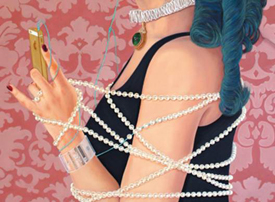
Lisa Ficarelli-Halpern. Visual Arts Center of New Jersey, Mitzi and Warren Eisenberg Gallery, Summit, New Jersey, May 9–June 29, 2014. #BaroqueTechStyle: Portraits by Lisa Ficarelli-Halpern. Oil painting and digital printmaking.

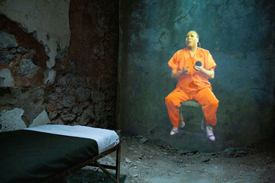
Michelle Handelman. Eastern State Penitentiary, Philadelphia, Pennsylvania, May 9–November 16, 2014. Beware the Lily Law. Installation.
Midwest

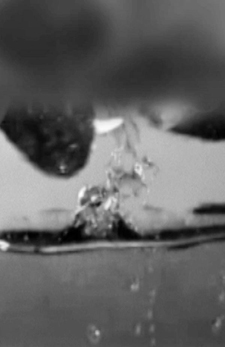
Victoria Fu. Document, Chicago, Illinois, January 31–March 8, 2014. Crossbar Radical-Tick Scoop Star. Installation, video, projection, and photography.
Northeast


Victoria Fu. Simon Preston Gallery, New York, May 4–June 7, 2014. Belle Captive. Installation, video, projection, and photography.

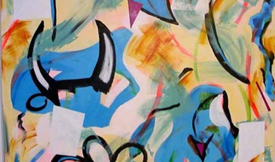
Sue Karnet. BBLA Gallery, Bohemian Benevolent and Literary Association, New York, April 2–29, 2014. Perceptions. Painting.

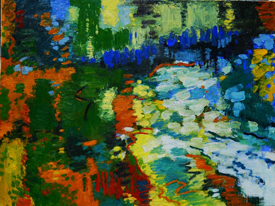
Lorna Ritz. French Cultural Center, Boston, Massachusetts, March 1–31, 2014. A Travelogue in Color. Painting.


Jo Sandman. Gallery Kayafas, Boston, Massachusetts, April 18–May 24, 2014. Transmissions. Transparent images.

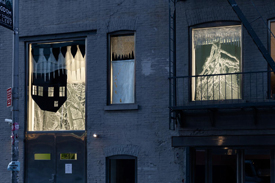
Leigh Tarentino. Mixed Greens Gallery, New York, March 20–May 23, 2014. The Night Hours. Window installation.
West

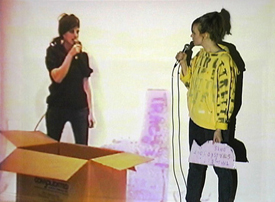
Wynne Greenwood. Henry Art Gallery, University of Washington, Seattle, Washington, April 5–June 15, 2014. Wynne Greenwood: Notes on Tracy + the Plastics. Video archive.
People in the News
posted by CAA — June 17, 2014
People in the News lists new hires, positions, and promotions in three sections: Academe, Museums and Galleries, and Organizations and Publications.
The section is published every two months: in February, April, June, August, October, and December. To learn more about submitting a listing, please follow the instructions on the main Member News page.
June 2014
Academe

Shiben Banerji has joined the Department of Art History, Theory, and Criticism at the School of the Art Institute of Chicago in Illinois as assistant professor of history of architecture.
Emine Fetvaci, an associate professor of Islamic art, has earned tenure in the Department of History of Art and Architecture at Boston University in Massachusetts.
Patrick Hajovsky, an assistant professor of art history who specializes in Precolumbian and colonial Latin American art, has earned tenure in the Art and Art History Department at Southwestern University in Georgetown, Texas.
Seth Kim-Cohen has been appointed assistant professor of contemporary art history in the Department of Art History, Theory, and Criticism at the School of the Art Institute of Chicago in Illinois.
Elena FitzPatrick Sifford has accepted the position of assistant professor of Renaissance and Baroque art at Louisiana State University in Baton Rouge.
Mechtild Widrich has joined the Department of Art History, Theory, and Criticism at the School of the Art Institute of Chicago in Illinois as assistant professor of contemporary art history.
Gregory Williams, associate professor of contemporary art at Boston University in Massachusetts, has received tenure in his school’s Department of History of Art and Architecture.
Museums and Galleries
Paul R. Davis, previously Andrew W. Mellon Postdoctoral Fellow at the Centre for the Creative Arts of Africa at the University of the Witwatersrand in Johannesburg, South Africa, has been appointed curator of collections at the Menil Collection in Houston, Texas.
Douglas Dreishpoon has become the first chief curator emeritus at the Albright-Knox Art Gallery in Buffalo, New York, where he has worked since 1998.

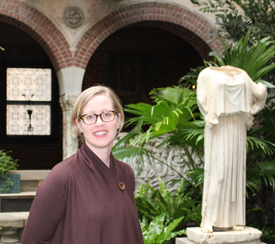 Christine Neilsen
Christine Neilsen, formerly assistant curator of late antique and Byzantine art for the Art Institute of Chicago in Illinois, has been named William and Lia Poorvu Curator of the Collection and Director of Program Planning at the Isabella Stewart Gardner Museum in Boston, Massachusetts.
David Odo has left his position as Bradley Assistant Curator of Academic Affairsat the Yale University Art Gallery in New Haven, Connecticut. He is now director of student programs and research curator of university collections initiatives at the Harvard Art Museums in Cambridge, Massachusetts.

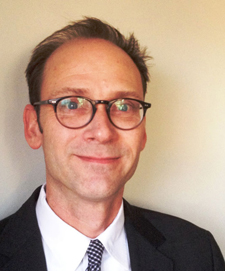 Brandon Ruud
Brandon Ruud, previously curator of American art for the Sheldon Museum of Art at the University of Nebraska in Lincoln, has been named the new Constance and Dudley J. Godfrey Jr. Curator of American Art and Decorative Arts at the Milwaukee Art Museum in Wisconsin.

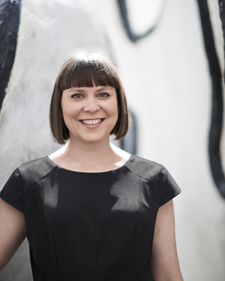 Jill Shaw
Jill Shaw, a research associate at the Art Institute of Chicago in Illinois, has accepted the position of senior curator of collections at Colgate University’s Picker Art Gallery in Hamilton, New York.
Organizations and Publications
Parme Giuntini, professor of art history and assistant chair of liberal arts and sciences at Otis College of Art and Design in Los Angeles, California, has become a contributing editor to the website Art History Teaching Resources.
Kimberly James Overdevest, assistant professor of visual arts at Grand Rapids Community College in Michigan, has joined the website Art History Teaching Resources as a contributing editor.
Virginia Spivey, an independent art historian based in Washington, DC, has become a contributing editor to the website Art History Teaching Resources.
Institutional News
posted by CAA — June 17, 2014
Read about the latest news from institutional members.
Institutional News is published every two months: in February, April, June, August, October, and December. To learn more about submitting a listing, please follow the instructions on the main Member News page.
June 2014
The Baltimore Museum of Art in Maryland has received a $2,500 award from the International Fine Print Dealers Association to fund a curatorial internship in museum print collections.
The Delaware Art Museum in Wilmington has launched a collections website, created with the web-based platform eMuseum. Visitors to the online resource can browse the museum’s collections, search for specific objects, view images, and create their own saved collections of work. To date, over 1,000 works of art have been photographed, catalogued, and added to the website. The museum’s entire 12,500-work collection, including the largest collection of British Pre-Raphaelite art outside the United Kingdom, will be available online by 2018.


The Getty Research Institute in Los Angeles, California, has acquired the archive documenting the first three decades of the Kitchen, a leading alternative space devoted to performance art, dance, music, and video. The large, well-preserved archive includes thousands of videotapes, audiotapes, photographs, posters, and other archival materials documenting the exhibitions, performances, and events presented by the Kitchen between 1971 and 1999.

The Harvard Art Museums—composed of the Fogg Museum, the Busch-Reisinger Museum, and the Arthur M. Sackler Museum—will open their new Renzo Piano–designed facility to the public on November 16, 2014. The renovation and expansion of the museums’ landmark building at 32 Quincy Street in Cambridge, Massachusetts, will bring the three museums and their collections together under one roof for the first time, inviting students, faculty, scholars, and the public into one of the world’s great institutions for arts scholarship and research.

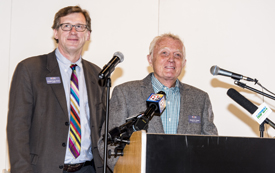 Don Tuski, president of the Maine College of Art (left) with Dan Crewe, brother of Bob Crewe and a college trustee since 2011
The Maine College of Art in Portland has accepted a $3 million gift from the Bob Crewe Foundation to develop a new program that focuses on the study of contemporary music and its relation to visual art. This transformational gift will support an innovative field of study in honor of the internationally known musician, artist, and entrepreneur, Bob Crewe, while supporting students from a wide range of backgrounds wishing to pursue a career in music, art, or both.
The Metropolitan Museum of Art in New York has launched MetCollects, a new series on the museum’s website that offers first looks at recently acquired works of art. MetCollects will feature one work each month, selected from the hundreds that the Metropolitan Museum acquires through gifts and purchases annually. The series will also pair spectacular photography with curatorial commentary, often including video for further contextualization of the works.
Michigan State University in East Lansing has received a $5 million gift from the art collectors Eli and Edythe Broad to increase the endowment for and to help fund exhibitions at the Eli and Edythe Broad Art Museum for the next five years.
The Moore College of Art and Design in Philadelphia, Pennsylvania, and the City of Philadelphia Mural Arts Program have formed a unique partnership to provide innovative, collaborative-style teaching across two new graduate programs at the college: an MA in art and social engagement and an MFA in community practice. The new graduate programs are expected to launch in 2015 and will help Moore establish itself as the region’s educational center for community arts practice.
The Museum of Fine Arts, Houston, in Texas has received a $2,500 award from the International Fine Print Dealers Association to fund a curatorial internship in museum print collections.
The RISD Museum at the Rhode Island School of Design in Providence has accepted a $2,500 award from the International Fine Print Dealers Association to fund a curatorial internship in museum print collections.
The University of Iowa Museum of Art in Iowa City has been given a $2,500 award from the International Fine Print Dealers Association to fund a curatorial internship in museum print collections.
Virginia Commonwealth University in Richmond has announced that it will break ground on a new Institute of Contemporary Art, an exhibition and performance space, laboratory, and incubator for the presentation of visual art, theater, music, dance, and film by nationally and internationally recognized artists, in June 2014.


Yale University Press, based in New Haven, Connecticut, has accepted the thirty-fifth George Wittenborn Memorial Book Award from the Art Librarians Society of North America for Interaction of Color by Josef Albers (App for iPad), published in 2013.
Grants, Awards, and Honors
posted by CAA — June 15, 2014
CAA recognizes its members for their professional achievements, be it a grant, fellowship, residency, book prize, honorary degree, or related award.
Grants, Awards, and Honors is published every two months: in February, April, June, August, October, and December. To learn more about submitting a listing, please follow the instructions on the main Member News page.
June 2014

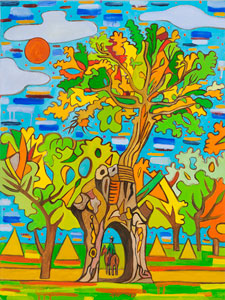 Susan Bee, Autumn Fantasy, 2011, oil on linen, 18 x 14 in. Collection of Leslee Smoke (artwork © Susan Bee)
Susan Bee, a painter and writer based in New York, has received a 2014 fellowship in fine arts from the John Simon Guggenheim Memorial Foundation.


Doris Chon, a lecturer in the Department of Art at the University of California, Los Angeles, has been named Harald Szeemann Research Project Postdoctoral Fellow by the Getty Research Institute in Los Angeles. From September 2014 to June 2016 she will work on “Museum Mythologies: Harald Szeemann’s Museums by Artists, the Museum of Obsessions, and the Legacy of Institutional Critique.”
Denise Rae Costanzo, assistant professor in the H. Campbell and Eleanor R. Stuckeman
School of Architecture and Landscape Architecture at Pennsylvania State University in University Park, has been awarded the 2014–15 Marian and Andrew Heiskell Postdoctoral Rome Prize in modern Italian studies.
Michelle H. Craig, an independent scholar of African and Islamic art who is based in Mansfield Center, Connecticut, has received a National Endowment for the Humanities Fellowship via the Getty Research Institute in Los Angeles, California. From September 2014 to July 2015, she will work on “Across Desert Sands: Trans-Saharan Visual Culture.”
Nathan S. Dennis, a PhD candidate in the history of art at Johns Hopkins University in Baltimore, Maryland, has won the 2014–15 Paul Mellon/Samuel H. Kress Foundation Predoctoral Rome Prize in ancient studies.
Yvonne Elet, an assistant professor of art history at Vassar College in Poughkeepsie, New York, has earned a 2013–14 fellowship from the American Council of Learned Societies for her project, “Materiality and Metamorphosis: Stucco in the Architecture and Decoration of Early Modern Europe.”

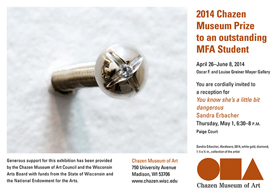
Sandra Erbacher, an MFA student at the University of Wisconsin, Madison, has accepted the 2014 Chazen Museum Prize, offered annually by the Chazen Museum of Art in collaboration with the University of Wisconsin’s Art Department.
Wayne Franits, professor of art history at Syracuse University in Syracuse, New York, has received a grant from the American Philosophical Society that will enable him to conduct research in London for his current project concerning Godfried Schalcken’s English period.
John Craig Freeman has been awarded an Art +Technology grant from the Los Angeles County Museum of Art in California. Freeman will draw on crowdsourcing, augmented reality, and electroencephalography (EEG) technology for a project titled Things We Have Lost.

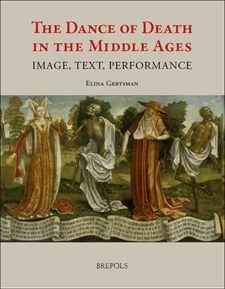
Elina Gertsman has won the 2014 John Nicholas Brown Prize from the Medieval Academy of America for her book, The Dance of Death in the Middle Ages: Image, Text, Performance (Turnhout, Belgium: Brepols, 2010). Established in 1978, the prize is awarded annually for a first book or monograph on a medieval subject judged by the selection committee to be of outstanding quality.
Christopher H. Hallett, professor and chair of the Department of History of Art at the University of California, Berkeley, has been selected as a 2014–15 Getty Scholar at the Getty Research Institute in Los Angeles, California. He will be in residence at the Getty Villa in Malibu from September to December 2014 to work on “The ‘Archaic Revival’ of Augustan Rome: Primitivism in the Art and Monuments of Rome, 30–20 BCE.”
Gregory Halpern, a photographer and assistant professor at the Rochester Institute of Technology in Rochester, New York, has earned a 2014 fellowship in photography from the John Simon Guggenheim Memorial Foundation.
Taro Hattori, an artist and lecturer based in San Francisco, California, has been awarded a 2014 residency from Omi International Arts Center, based in Ghent, New York.
Pablo Helguera, an artist and director of adult and academic education at the Museum of Modern Art in New York, has been named a 2014 ABOG Fellow for Socially Engaged Art by the Manhattan-based organization A Blade of Grass.

 Jessica L. Horton
Jessica L. Horton has been recognized as a 2014–15 National Endowment for the Humanities Postdoctoral Fellow by the Getty Research Institute in Los Angeles, California. She will be in residence at the Smithsonian American Art Museum and the National Museum of the American Indian, both in Washington, DC, to work on “Global Histories of Native American Art” from September 2014 to July 2015.
Jeanette Kohl, associate professor of art history at the University of California, Riverside, has become a 2014–15 Getty Scholar. While at the Getty Research Institute in Los Angeles from September to December 2014, she will work on “Global Faces: Heteronomies and the Afterlife of Renaissance Portraiture.”
Jason Lazarus, an artist, curator, writer, and educator based in Chicago, Illinois, has received a 2014 grant from the Samuel I. Newhouse Foundation. As part of the award, he participated in the Wynn Newhouse Awards Exhibition this past spring.
Sean Villareal Leatherbury, a specialist in Roman, late antique, and Byzantine art and archaeology who earned a PhD from the University of Oxford in Oxford, England, has accepted a 2014–15 Postdoctoral Fellowship from the Getty Research Institute in Los Angeles, California. He will work on “The Arts of Votive Dedication from Rome to Byzantium” at the Getty Villa in Malibu from September 2014 to June 2015.
Julia Orell from the Section for East Asian Art History in the Department of Art History at the University of Zurich in Switzerland, has been named a 2014–15 Postdoctoral Fellow by the Getty Research Institute, based in Los Angeles, California. Her project, “Shifting the Boundaries of Art History: East Asian Art History in Germany, Austria, and Switzerland ca. 1840–1940,” will be worked on from September 2014 to June 2015.
John K. Papadopoulos, professor and chair of the Interdepartmental Archaeology Program at the University of California, Los Angeles, has been selected to be a 2014–15 Guest Scholar and Consortium Professor at the Getty Research Institute in Los Angeles, California, from January to June 2015. His research, currently taking the form of a project titled “The Archaeological Context of Value,” focuses on Aegean prehistory and Greek and Italian archaeology, as well as the history and culture of the Classical and later periods.

 David Raskin
David Raskin, chair of Department of Sculpture and professor in the Department of Art History, Theory, and Criticism at the School of the Art Institute of Chicago in Illinois, has been appointed a fellow in the United States Study Centre at the University of Sydney in Australia for spring 2015.
Kristin E. Romberg, assistant professor in the Department of Art History at the University of Illinois, Urbana-Champaign, has been selected for a 2014–15 Postdoctoral Fellowship at the Getty Research Institute in Los Angeles, California. She will work on “Radical Constructivism: Aleksei Gan’s Grass-Roots Modernism” from September 2014 to June 2015.
Susan Sidlauskas, professor of art history at Rutgers University in New Brunswick, New Jersey, has been named a 2014 fellow in fine arts research by the John Simon Guggenheim Memorial Foundation.
Larry A. Silver, Farquhar Professor of Art History in the Department of the History of Art at the University of Pennsylvania in Philadelphia, has been appointed a 2014–15 Guest Scholar by the Getty Research Institute in Los Angeles, California. From January to June 2015, Silver will work on “Jewish Art as Marked.”
Joanna S. Smith, associate professional specialist in the Department of Art and Archaeology at Princeton University in Princeton, New Jersey, has become a 2014–15 Getty Scholar, thanks to the Getty Research Institute in Los Angeles, California. She will work on her project, “Seal Stratigraphies from Enkomi, Cyprus,” at the Getty Villa in Malibu from April to June 2015.
Jenni Sorkin, assistant professor of history of art and architecture at the University of California, Santa Barbara, has received a 2013–14 fellowship from the American Council of Learned Societies for her project, “Live Form: Women, Ceramics, and Community, 1945–1975.”
Allison Nicole Stielau, a PhD candidate in the Department of History of Art at Yale University in New Haven, Connecticut, has accepted a 2014–15 Predoctoral Fellowship from the Getty Research Institute in Los Angeles, California. She will research “The Unmaking of Metalwork in Early Modern Europe” while at the Getty from September 2014 to June 2015.
Kathleen Tahk, a graduate student in art history at Northwestern University in Evanston, Illinois, has earned a Mellon Fellowship for Dissertation Research in Original Sources from the Council on Library and Information Resources. Tahk’s project is called “A Revolution beyond Borders: The Soviet Art of the Latvian Rifleman, 1917–1938.”
Exhibitions Curated by CAA Members
posted by CAA — June 15, 2014
Check out details on recent shows organized by CAA members who are also curators.
Exhibitions Curated by CAA Members is published every two months: in February, April, June, August, October, and December. To learn more about submitting a listing, please follow the instructions on the main Member News page.
June 2014
Mary Forbes. This Is the Life. Art Car Museum, Houston, Texas, March 15–June 8, 2014.

 Peter Demos, Untitled, 2014, acrylic on dyed canvas, 60 x 30 in. (artwork © Peter Demos)
Katarina Lanfranco. Elusive Abstraction. Rhombus Space, Brooklyn, New York, May 2–25, 2014.

 Don Fritz, Ground Zero, mixed media on paper, 36 x 24 in. (artwork © Don Fritz)
Katarina Lanfranco. Thought Bubbles. Rhombus Space, Brooklyn, New York, March 28–April 27, 2014.

 Future Buddha Maitreya Flanked by the Eighth Dalai Lama and His Tutor, Tibet, 1793–94. Norton Simon Art Foundation (artwork in the public domain)
Melody Rod-ari. In the Land of Snow: Buddhist Art of the Himalayas. Norton Simon Museum, Pasadena, California, March 28–August 25, 2014.
Books Published by CAA Members
posted by CAA — June 15, 2014
Publishing a book is a major milestone for artists and scholars—browse a list of recent titles below.
Books Published by CAA Members appears every two months: in February, April, June, August, October, and December. To learn more about submitting a listing, please follow the instructions on the main Member News page.
June 2014

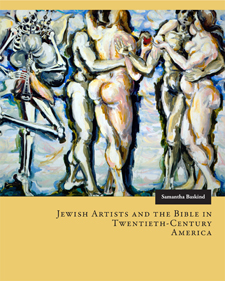
Samantha Baskind. Jewish Artists and the Bible in Twentieth-Century America (University Park: Pennsylvania State University Press, 2014).

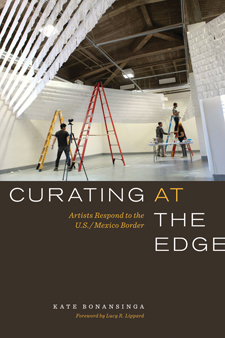
Kate Bonansinga. Curating at the Edge: Artists Respond to the U.S./Mexico Border (Austin: University of Texas Press, 2014).

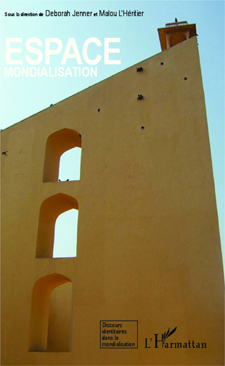
Deborah Jenner and Malou L’Héritier, eds. Espace mondialisation (Paris: l’Harmattan, 2013).

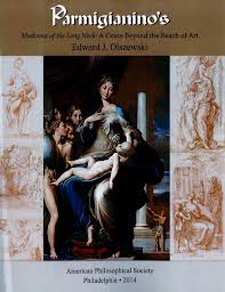
Edward J. Olszewski. Parmigiano’s “Madonna of the Long Neck”: A Grace beyond the Reach of Art (Philadelphia: American Philosophical Society, 2014).

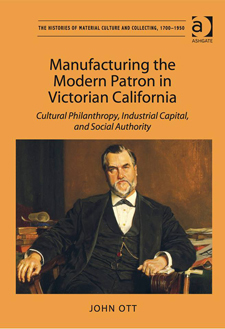
John Ott. Manufacturing the Modern Patron in Victorian California: Cultural Philanthropy, Industrial Capital, and Social Authority (Burlington, VT: Ashgate, 2014).

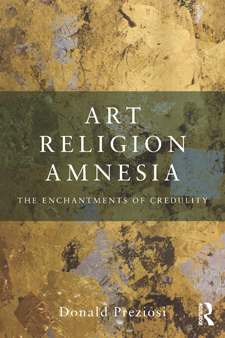
Donald Preziosi. Art, Religion, Amnesia: The Enchantments of Credulity (New York: Routledge, 2013).

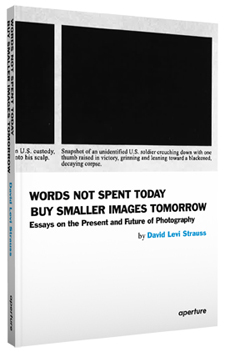
David Levi Strauss. Words Not Spent Today Buy Smaller Images Tomorrow: Essays on the Present and Future of Photography (New York: Aperture, 2014).
Committee on Women in the Arts Picks for June 2014
posted by CAA — June 10, 2014
Each month, CAA’s Committee on Women in the Arts selects the best in feminist art and scholarship. The following exhibitions and events should not be missed. Check the archive of CWA Picks at the bottom of the page, as several museum and gallery shows listed in previous months may still be on view or touring.
June 2014
Swoon: Submerged Motherlands
Brooklyn Museum
Iris and B. Gerald Cantor Gallery, Fifth Floor, 200 Eastern Parkway, Brooklyn, NY 11238
April 11–August 24, 2014
Submerged Motherlands, a solo exhibition by the Brooklyn-based artist Swoon, is a collaborative inhabitable shelter that explores social and environmental issues. Born in Florida in 1977 as Caledonia Dance Curry, Swoon is best known for her large, intricate linocut prints that are wheat pasted onto industrial buildings in Brooklyn and Manhattan. In this occasion Swoon leaves the streets to appropriate the Brooklyn Museum as a temporary home for transforming the rotunda gallery into a “submerged motherland,” an inhabitable installation that includes previous traveling boats and rafts, figurative prints, drawings, and painting, dyed fabrics, and cut-paper foliage that grew around a monumental sculptural tree.
Swoon’s practice is rooted in collaboration, community, experimentation, and discovery. From conceptualization through production, her practice means an immersive, provocative, and transformative experience for both participants and visitors. She has translated her projects to both galleries and museums, but also to socially rooted arts activism in places such as Konbit Shelter Project in Haiti and Transformazium in Braddock, Pennsylvania, among others.
A meditation on humanity, climate change, and the artist’s own mother passing away during the ideation stage for the installation, Submerged Motherlands reflects on the notion of home—and the loss of it. In the artists’ words, the creative process of this inhabitable installation follows an “impulse to build a safe space in the world for herself and her community; some place to be a little bit different from the norm.” Swoon’s fantastic installation transformed the Iris and B. Gerald Cantor Rotunda Gallery in a temporary and yet memorable shelter for many.
Judith Shea
Kent Fine Art
210 Eleventh Avenue, Second Floor, New York, NY 10001
May 9–June 28, 2014
Judith Shea’s solo exhibition is a sculptural homage to the role of women in the arts. For decades, Shea studied the representation of the human figure through a constant observation of people and the exploration of materials. In absence or presence of the body, from her late 1970s clothes-based series to the present sculptures that honors the role of women in the arts, powerful human emotions are evident in Shea’s work.
Shea reflects on the origin of her sculptural approach to the human form to different and yet meaningful experiences of her educational upbringing. Being raised as a Catholic, she was a constant witness of the representation of religious statues in church. While being trained as a ballet dancer as a child, she grew connected with her own body.
Graduated with a fashion-design degree from Parsons in 1969, Shea continues pursuing her interests in visual art, earning her BFA at Parsons in 1975. Based on “her own style”—as titled the successful exhibition she curated on women self-portraits at National Academy Museum in 2012—“the artist who makes clothes” was invited to collaborate with Trisha Brown and the Eye and Ear Theater Company—working with artists such as Red Grooms and Elizabeth Murray.
At Kent Fine Arts, Shea presents seven new sculptures that pay tribute to the role of women in the arts. Through these sculptural portraits, Shea demonstrates her unique sense of observation and virtuosity with materials. A fully illustrated monograph documenting Shea’s work from 1976 to the present accompanies the exhibition.
Nalini Malani: Transgressions
Asia Society and Museum
725 Park Avenue, New York, NY 10021
February 19–August 3, 2014
Transgressions is a solo exhibition by Nalini Malani. Born in Karachi in 1946, Malani is considered one of the foremost artists from India today. Her work is influenced by her experiences as a refugee of the Partition of India in 1947. Trained as a painter at the Sir Jamsetjee Jeejebhoy School of Art in Mumbai, Malani has created work gradually evolved toward new media and international collaboration, expanding the pictorial surface into the surrounding environment, such as ephemeral wall drawing, installation, shadow play, and theater. In the 1980s, she became a pioneer in India for her attention to feminist issues. In the early 1990s, her innovative theater, installations, and multimedia projects featured recurring themes on gender, memory, race, and transnational politics, especially in reference to India’s postcolonial history after independence and partition.
Her current exhibition at the Asia Society and Museum includes Trangressions II (2009), a video that draws from the museum’s collection, exploring the nuances of Western postcolonial dominance in India, integrating the folk sensibility of traditional shadow plays with new technology. Using projections through transparent Lexan cylinders, painted by the artist in a fashion that references the nineteenth- and early-twentieth-century Bengal Kalighat style and inspired by the genre of reverse glass painting, brought to the subcontinent in the eighteenth century by the Chinese, Malani examines the power dynamics of transnational commerce in our increasingly globalized world. Through a mesmerizing projection of colors and imagery inspired by Edward Said’s book Orientalism, an ever-shifting tableau including wrathful female deity, boxers, and animals is accompanied by a recording of a poem written by the artist. The exhibition includes a selection of artist’s books that highlight the relevance of drawing and painting in Malani’s practice.
Zilia Sánchez: Heróicas Eróticas en Nueva York
Galerie Lelong
528 West 26th Street, New York, NY 10001
May 3–June 21, 2014
Heróicas Eróticas en Nueva York, Zilia Sánchez’s first solo exhibition at Galerie Lelong, offers a delightful opportunity to experience masterpieces of sensuous and haptic minimalism, while timely questioning the canonic premises of Minimalism as being reconstituted at the Jewish Museum. Spanning fifty years of her production, including recent works such as the monumental diptych Conversation (from the Eros and Communication series), the exhibition brings together “paintings” rarely seen outside Puerto Rico, made in the artist’s signature technique of stretching canvas over hand-molded wooden armatures—often in modular configurations or reworked as parts of ongoing series—that was developed during the period she lived in New York (1964–72). Heroically erotic, Sánchez’s curvy and soft minimalist hybrid objects “queer” hard-edge minimalism differently evoking the body in a manner that does not adhere to fixed categories of gender.
Born in Cuba in 1926, Sánchez studied at the Escuela Nacional de Bellas Artes San Alejandro and became associated with the group Sociedad Cultural Nuestro Tiempo. Under the influence of Victor Manuel, she developed her own modernist approach to formal abstraction through paintings and drawings, while also designing furniture and theater sets (especially for the anti-Batista guerilla theater group Los Yesistas). Several grants allowed her to travel in Europe, and in 1964 she settled in New York, where she first begun experimenting with shaped canvases. In 1972, Sánchez moved to Puerto Rico, where she became inspirational through her teaching at the Escuela de Artes Plásticas de Puerto Rico. From 1972 to 1975 she designed the influential experimental literary journal Zona de Carga y Descarga, while in the 1980s she renewed her signature style by including line drawing or drawing transfer of semaphores and sign language on her canvases.
Sharon Lockhart: Milena, Milena
Bonniers Konsthall
Torsgatan 19
SE-11390, Stockholm, Sweden
April 16–June 29, 2014
Bonniers Konsthall hosts the second iteration of the exhibition trilogy Sharon Lockhart: Milena Milena that begun in Warsaw in 2013 at the Center for Contemporary Art and will be concluded in Switzerland in 2015 at the Kunstmuseum Luzern. This exhibition is the first large-scale survey of the work of the renowned American photographer and filmmaker in Scandinavia, where Lockhart has been particularly influential. Drawing inspiration from filmmaking and documentary photography, as well as from ethnography and anthropology, she has distinguished herself since the 1990s for her fascinating portrayals of individuals and communities, and a minimalist attention to the everyday, the subjective, and the human.
As a cross-sectional presentation of both her photographic and filmic work in the past twenty years, the exhibition explores the middle ground between the filmic and the photographic that is inhabited by her meticulously staged photographs and almost still films, emphasizing the relationship they both maintain to time and space, while also claiming the biographical dimension of her work. As such, the exhibition opens with the cinematic Double Tide (2009)—filmed in Maine, where Lockhart spent her childhood—and concludes with the rarely exhibited series Untitled Studies (1993–ongoing), Lockhart’s photographic diary, composed of rephotographed snapshots found in her own family album.
At the center of the exhibition’s narrative is Milena, an enigmatic figure who remains disquietly absent, distilling different threads of identification in her very nonpresence. Lockhart first met Milena when nine years old in 2009 in Łódź, Poland, while filming Podwórka, also a centerpiece of the exhibition. Literally translated as “courtyard” from Polish, Podwórka displays six different courtyards in Łódź and the children that live and play there. Lockhart and Milena developed a friendship through the act of play. Upon the rekindling of their friendship when staging the show for Warsaw, Lockhart discovered Milena’s desire to write an autobiography about her life, which provided the impetus through which the two have explored artistic expression together. The exhibition at Bonniers Konsthall features a specially commissioned, monumental stained-glass portrait of the Polish master glass painter Piotr Ostrowski as a personal and culturally specific tribute.
Kalliopi Lemos: I Am I Between Worlds and Between Shadows
Ioakimion School for Girls
Fener, Istanbul
September 11, 2013–December 14, 2014
Curated by Beral Madra as a parallel event of the thirteenth Istanbul Biennale but now extended to December 2014, I Am I Between Worlds and Between Shadows is a major site-specific installation of new work by the London-based Greek artist Kalliopi Lemos. A painter, sculptor, and installation artist, Lemos has become internationally known for a series of public installations that make poignant commentaries about the hopes and tragedies that underpin illegal migration by using the abandoned relics of successful or failed illegal migration typical of the Aegean coasts—small wooden boats (such as Crossing, Eleusis, Greece [2006/9]; Round Voyage, Istanbul [2007]; At Crossroads, Brandenburg Gate, Berlin [2009]; and Pledges for a Safe Passage, Canakkale, Turkey [2012]). Complementing Lemos’s concern with the dispossessed from a transnational feminist perspective that links the injustices against the racial, classed, and religious underdogs of global capital—best represented by the illegal migrant—with those against the gendered others of patriarchal societies—women—I Am I Between Worlds and Between Shadows tackles the issue of violence against women in a poetic, multidisciplinary, and site-specific way.
I Am I Between Worlds and Between Shadows consists of a series of seven sculptures depicting variously violated hybrid creatures, a sound installation, and a constantly renewed archive of women’s abuse, comprised of world news print outs, all evocatively installed in the abandoned yet intact rooms of the Ioakimion Greek High School for Girls. A gem of the once booming Greek Orthodox minority in Fener, the latter was founded in nineteenth century but closed in the 1980s when its attendance dropped to six students. The sound collage of joyful schoolchildren playing and singing affectively evokes the lively atmosphere of the past of the school as a breeding ground of dreams for the girls who attended it. Yet the injustices awaiting women, even in Western societies, are hinted by the evocations of gendered violation and sacrifice embedded in the Greek folk songs and international fairy tales narrated by children (also part of the sound installation), echoing the monstrosity of contemporary actuality that marks the news’ readings of the absent schoolgirls with transcultural staples of patriarchal myth. Hung from a butcher’s hook, on crutches or on gigantic prosthetic devices or confined by rails—and more often than not mutilated, amputated, and violently dismembered—these sculptural bodies most poignantly hint at various kinds of bodily, psychic, and gendered abuse, both through their imaginative bodily articulations and their manner of installation. Masterfully cast in stonelike steel with embedded resin, these half-animal, half-human creatures evoke familiar mythological and Surrealist creatures that suggestively cut across a wide spectrum of cultural and artistic references. Melancholically posed in the place of the teacher, the beheaded mermaid, the multibreasted hung rabbit, and the decapitated hen with the splayed vulva hovering on crutches, for instance, become protagonists of a tale from a children’s book that keeps going wrong in the world of the adults, raising awareness of all kinds of abuse that, whether explicitly or implicitly, threatens not only the egalitarian realization of women in various societies, but also their unencumbered expression of difference, and above all their human dignity. A two-faced chicken, clumsily balancing on two bases—itself a metaphor of unstable youth, according to the artist—looms also as an evocative stand-in for liminal creatures of exile. With its gaze fixed here and there, it aids the artist by bringing in full circle her concerns by perhaps planting a metaphor for the modern transnational, subject—forced migrant or cosmopolitan—and its vulnerability in the heart of a charged site of convoluted transcultural and imperial histories—an abandoned stronghold of Greek and Christian culture in Istanbul in the era of globalization and yet renewed and bloody nationalisms and religious fundamentalisms that, like all kinds of violence, make children and women their primary victims.
Kara Walker: A Subtlety
Domino Sugar Factory
316 Kent Avenue, Brooklyn, NY 11249
May 10–July 6, 2014
Commissioned by Creative Time as a public-art farewell to a loaded site—the Domino Sugar Factory—where American industrial capitalism, consumerism, and racism have variously intersected and will be perhaps redefined through its upcoming neoliberal gentrification, Kara Walker’s A Subtlety is a both moving and canning, sugar-coated, monumental memorial to chief confectioners of the American Dream, black slaves and laborers, as well as the artist’s first large scale sculptural public work. The subtitle of the work tellingly summarizes its poignant agenda: Marvelous Sugar Baby, an Homage to the unpaid and overworked Artisans who have refined our Sweet tastes from the cane fields to the Kitchens of the New World on the Occasion of the demolition of the Domino Sugar Refining Plan.
A Subtlety comprises a gigantic sphinx whose hybrid body combines cliché apparitions of the black woman as domestic slave and sex object and a series of black boys cast in molasses. The latter are cast after contemporary giftware made in China but reference the original “subtleties”: sugar-made, edible sculptures and dinner emblems of power and wealth that decorated the tables of Middle Eastern sultans and European nobility.
“In Greek mythology the sphinx is a guardian of the city, a devourer of heroes and the possessor of a riddle that maybe can’t be answered,” says the artist, explaining its conception: “the factory is a modern-day ruin, and I think the sphinx contains the various readings of history that the place represents.” Exchanging her signature black for the site-specific whiteness of sugar, a material central to the slave trade and in effect of the American way, Walker has thus unsubtly “refined” the black body of her mighty benign monster, mixing references to the labor of sugar production and trade and white’s classical and sanctifying purity, in effect both honoring black bodies’ unsung contribution to Western pleasures while foregrounding the lasting whiteness of power in America. Moreover half a century after Niki de Saint Phalle’s Hon in the Moderna Museet in Stockholm, the temporary gigantic Nana that exorcised the riddles surrounding the female body, Sugar Baby toys with them yet also from the radical, even though controversial, perspective of a woman of color: “she’s a woman, a bootylicious figure with something paradoxical about her pose. She’s both a supplicant and an emblem of power. From the front, she seems to hold her ground. But what you see from behind is what happens when a nude woman bends over, raising a question of whether it’s a gesture of sexual passivity or not.”
As put by the project’s curator, Nato Thompson, A Subtlety speaks “of power, race, bodies, women, sexuality, slavery, sugar refining, sugar consumption, wealth inequity, and industrial might that uses the human body to get what it needs no matter the cost to life and limb. Looming over a plant whose entire history was one of sweetening tastes and aggregating wealth, of refining sweetness from dark to white, she stands mute, a riddle so wrapped up in the history of power and its sensual appeal that one can only stare stupefied, unable to answer.”
AN INTERVIEW WITH DEWITT GODFREY
posted by Christopher Howard — May 14, 2014
CAA caught up with DeWitt Godfrey, the new president of the CAA Board of Directors, via email shortly after the board’s spring meeting, which was held on May 4, 2014, to talk about the organization’s direction.
Godfrey, professor of sculpture in the Department of Art and Art History at Colgate University in Hamilton, New York, recently began his two-year term. A board member since 2009, he has served on the Executive Committee as secretary (2010–12) and vice president for committees (2012–14). Godfrey succeeds Anne Collins Goodyear, codirector of the Bowdoin College Museum of Art in Bowdoin, Maine, who has led the board since May 2012.
You reorganized the Professional Practices Committee to bring many of the guidelines and standards up to date. What progress has been made over the past few years?
During my term as chair, the Professional Practices Committee created a set of procedures and practices that would ensure that each standard and guideline would be reviewed—and updated as needed—on a regular schedule. Over the past few years, using these “guidelines for guidelines,” the committee has updated dozens of our standards, some of which had languished for decades. The Standards and Guidelines section is one the most visited on our website, and the CAA staff members field inquiries concerning best practices in the field on almost a daily basis. This section is one of the most important services we provide for membership, institutions, and the field more broadly.
The 2015–2020 Strategic Plan addresses advocacy for part-time faculty, instituting leadership ladders at CAA, building membership, and social networking. How would you like CAA to respond to these four issues during your term as president?
I can think of no issue of greater importance to CAA and our membership than the rapidly changing academic workforce and the plight of part-time and contingent faculty. CAA has been premised on the assumption that the basic needs of our academic members—economic stability, benefits, support for scholarship—would be met by their home institutions. With the increasing reliance on part-time and adjunct faculty, those assumptions are eroding, sometimes with alarming consequences. CAA must respond to these challenges through expanded advocacy at the governmental and institutional level (we are already members of the Coalition on the Academic Workforce) and moving to understand and meet the professional needs of this growing segment of our constituents.
A strong organization requires strong leadership. We are striving to cultivate leaders among the members of our standing Professional Interests, Practices, and Standards Committees and our awards and publishing-grant juries. We are also working to persuade CAA members of the benefits of committee service who can help us meet the organization’s challenges both now and in the future. We often reach out to members and even beyond CAA for specific expertise to augment the work of committees and task forces. We volunteer our time and talents, committed to the vision of CAA as the preeminent international leadership organization in the visual arts. We also recognize how CAA has supported our own teaching, practice, and service in myriad ways and want to provide the same benefits for our colleagues at all stages of their careers.
As CAA begins its second century, we face many of the same issues confronting other membership organizations in a digital world in which access to rich troves of information and services are decentralized and diffuse. The arts are where a diversity of disciplines come together. Over time, the needs and interests of our membership have undergone dramatic transformation; we want to continue to provide programs, publications, services, and opportunities that reflect the changing needs in the field and to deliver critical support to individual members over the course of their careers. We need to ask what benefits CAA membership provides. What can CAA do for it members that other learned societies cannot? How can we advocate the visual arts more broadly? How can we cultivate a membership with a diversity of practices and practitioners?
DeWitt Godfrey, Layman, 2012, corten steel and bolts, 23 x 7 x 8 ft. Currently installed at Lehman College Art Gallery, Lehman College, Bronx, New York (artwork © DeWitt Godfrey)
How has teaching art changed over the last fifteen years?
Over the last fifteen years the disciplinary model of studio teaching has come under pressure, mirroring the shifting, overlapping boundaries of artistic practices. The challenge is to provide an equivalent depth and rigor of a particular disciplinary practice in an art world and context in which disciplinary distinctions have lost much of their meaning and value. More dramatically, the reach of digital tools into every area of art practice is creating a wholesale revolution, a fundamental disruption of how and what we make, how and what we teach, and how we understand the role of art and design in the twenty-first century.
How have your travels and study in other countries—Japan, England, and Scotland—affected how you teach art
Work and travel in other countries provides both rich new worlds and materials and new vantage points from which to examine on your own history and experience. As Buckaroo Banzai put it, “wherever you go there you are.” Different cultures and people understand the world in different ways. I draw upon my international experiences that bring alternative perspectives to my process and practice—often from outside an art context—which helps me to reimagine familiar materials, ideas, and histories.
The Cambridge Arts Council in Massachusetts recently commissioned a public-art project called Waverly. What’s the progress like?
We are currently working the engineers on the location and design of the foundation elements, ahead of the road and bike path improvements that my project will be part of. My piece will span a bike path in a converted railway right of way, along the edge of MIT housing. The path also provides access for fire and safety vehicles, so my sculpture must meet strict width and height requirements. Right now we are projecting a completion sometime in 2015.
Committee on Women in the Arts Picks for May 2014
posted by CAA — May 10, 2014
Each month, CAA’s Committee on Women in the Arts selects the best in feminist art and scholarship. The following exhibitions and events should not be missed. Check the archive of CWA Picks at the bottom of the page, as several museum and gallery shows listed in previous months may still be on view or touring.
May 2014
Regina José Galindo: Estoy Viva
Pac/Padiglione d’Arte Contemporanea
Via Palestro, 14, Milan, Italy
March 25–June 8, 2014
Curated by Diego Sileo and Eugenio Viola, this is the first survey of the work of the acclaimed Guatemalan performance artist and poet Regina Jose Galindo (b. 1974). Galindo became first known for political performances in Guatemala in the late 1990s, including her bloody walk from the Congress of Guatemala building to the National Palace in protest against the presidential candidacy of Guatemala’s former dictator, Jose Efrain Rios Montt. In 2005 she received the Golden Lion award at the Venice Biennale, in the category of “artists under 30,” for her video Himenoplastia, a controversial feminist work featuring the artist undergoing surgical reconstruction of her hymen. Although Galindo has organized performances in which she does not take part, her work is distinguished for the political use of her own body in order to tackle a variety of social issues, including cultural traumas, and to denounce the ethical implications of social and cultural injustices, discriminations of race and sex, and, more in general, all kinds of abuses stemming from power. A postidentarian turning of her body into a symbolic evocation of the “social body differentiates the use of her self as the tool of her critique from the autobiographic one of several of her performance art progenitors.”
The exhibition Estoy Viva is divided in five sections that, conceived as permeable categories, illustrate the focus of her critique and poetics: politics, woman, violence, organic, and death. It is titled after the eponymous performance conceived and performed for the opening of the exhibition and featuring the artist naked in a white chilly room on a sort of tombstone, her life proved only by her invisible breath’s imprint on a mirror held by each visitor in front of her nose. The exhibition is accompanied by a film by Cosimo Alemà, a cinematographic reading of her work produced in collaboration with the artist as an emotional key to her work.
Sara VanDerBeek
Museum of Contemporary Art Cleveland
11400 Euclid Avenue, Cleveland, OH
March 7–June 8, 2014
The New York–based photographer Sara VanDerBeek (b. Baltimore, 1976) is known for her formally striking employment of photography, sculpture, and performative gestures that contemplate the construction of images, their relation to objects, and the passage of time. For her solo exhibition at MOCA Cleveland, organized by David Norr, VanDerBeek responded to the city of Cleveland in line with her recent work. She began by testing the relation of photograph to object by photographing architectural objects made in her studio that were in turn turned into photographic objects, but her most recent work explores photographically cities central to American history, such as Baltimore, New Orleans, and Detroit, their personal, historical, and political connotations, as well as their distinct urban features. Engaging the city as a physical site and a system undergoing continuous change, the displayed photographs are combined results of VanDerBeek’s experience of Cleveland’s landscape and cultural monuments within a range of material and cultural shifts.
Hito Steyerl: Junktime
Home Workspace Program
Ashkal Alwan, Building 110, First Floor, Jisr al Wati, Street 90, Beirut 2066-8421 Lebanon
April 16–May 31, 2014
Ashkal Alwan Home Workspace Program 2013–14 presents Hito Steyerl: Junktime, a series of video installations, screenings, and conversations as part of Creating and Dispersing Universes That Work without Working, led by the resident professors Jalal Toufic and Anton Vidokle. The screening series includes twelve films and video installations developed by Steyerl between 2004 and 2014. Between them is presented How Not to be Seen: A Fucking Didactic Educational .MOV File, launched in the Venice Biennale exhibition Il Palazzo Enciclopedico in 2013.
Born in Munich in 1966, Steyerl has produced a variety of work as a filmmaker and an author in the field of essayist documentary video. With the global circulation of images as her principal topic of interest, she focuses on the intersection of media technology, political violence, and desire. Departing from the digital image and using humor and charm as political means of expression, her films and essays envision a world in which war, genocide, capital flows, class conflicts, and digital detritus seem to take place only partially within images, thus reminding us we are no longer dealing with the virtual but with a “confusing concreteness.”
Eva Koťátková
Art en Valise
April 3–June 28, 2014
In collaboration with the scrap metal gallery in Dublin and the Unit E in Toronto, Art en Valise presents, as its inaugural project, the first solo exhibition of the multimedia Czech artist Eva Koťátková in Canada. Born in Prague (in 1982), where she lives and works today, Koťátková studied at the Academy of Fine Arts and the Academy of Applied Arts in Prague, as well as at the San Francisco Art Institute and the Akademie der Bildenden Künste in Vienna. The youngest-ever winner of the prestigious Jindrich Chalupecky Award for Czech artists, she has widely exhibited internationally, both in solo and group exhibitions, and her work was distinguished as one of the highlights of the exhibition The Encyclopedic Palace in the fifty-fifth Venice Biennale (2013).
Underpinned by her generation’s trauma—the contrast of her freedom to do what she wants as opposed to the suppression that haunted the dreams and desires of her parents generation—Koťátková creates work in various media, including collage, film collage, and “mad” sculptures, that seem to explore the often-failed attempts of people to both conform to and break free of the rules and codes of contemporary societal institutions, including family and school. Kotátková undermines and recontextualizes the values and mechanisms used to regulate our perception of the world, and, in turn, the way we perceive ourselves.
Bringing together drawing, collage, installation, sculpture, and performance, the exhibition investigates Kotátková’s process of deconstructing traditional behavioral systems to produce fragmented models that invite alternative ways of communication, while offering a unique opportunity to explore the idiosyncratic surrealist sensibility that underpins her multimedia practice, signature themes such as the cage, and her use of the body.
Dorothy Iannone: This Sweetness Outside of Time; Paintings, Objects, Books 1959–2014
Berlinische Galerie
Alte Jakobstraße 124–128, 10969 Berlin, Germany
February 20–June 2, 2014
The Berlinische Galerie presents This Sweetness Outside of Time, a major solo exhibition of the Berlin-based American artist Dorothy Iannone. This will be the first extensive retrospective to address the humorous and erotic oeuvre of one of the most unusual women artists of the twentieth and twenty-first century. This Sweetness Outside of Time includes paintings, objects, and books created by the self-taught artist between 1959 and 2014. The aim of this retrospective is to illustrate the radical subjectivity of this unique artist to a wider audience.
A pioneering spirit against censorship and for free love and autonomous female sexuality, Iannone (b. Boston, 1933) occupies a distinct place as an artist in the second half of the twentieth century. Her oeuvre spans more than fifty years and includes painting and visual narrative, autobiographical texts and films. Since the 1960s Iannone continues to go her own way without compromise, artistically and conceptually. She is a pioneer of women’s sexual and intellectual emancipation that draws uncompromisingly on her own life.
Iannone’s art frequently depicts the sexual union between man and woman with an unmistakably mystical dimension rooted in the spiritual and physical union of opposites. Through graphic paintings, object, and books, her visual universe portrays partly clothed and naked figures on bright psychedelic backgrounds of flora, mandalas, and biomorphic patterns in which male and female sexuality celebrate the joy of intimate relationships while subverting traditional gender stereotypes of control an dominance. This Sweetness Outside of Time presents a personal narrative of a passionate pursuit of “ecstatic unity” through transcendence and spirituality.
Tauba Auerbach: The New Ambidextrous Universe
Institute of Contemporary Arts
The Mall, London
SW1Y 5AH, United Kingdom
April 16–June 15, 2014
The Institute of Contemporary Art, London, presents The New Ambidextrous Universe, the first solo exhibition in the United Kingdom of Tauba Auerbach (b. San Francisco, 1981), a New York–based artist who works in sculpture, photography, painting, weaving, prints, artist’s books, and performance. In her early career she created graphic sign paintings, producing abstract renderings of calligraphy and typography. In recent work she has developed a signature practice of ironing creases into her canvases and using industrial paint guns or hand-painted Ben Day dots to create the illusion of three-dimensional folded fabric that Auerbach describes as “Fold” paintings that occupy “a liminal state between two and three dimensions.” The artist plays with perceptions of space, taking a highly innovative approach to mechanical processes and color. For The New Ambidextrous Universe, Auerbach presents newly created sculptures and photographs that translate the scientific principles of symmetry and reflection in pallid plywood as a means “to hint at an alternate, mirror universe.”
Open Engagement Conference 2014
Queens Museum of Art
New York City Building, Flushing Meadows, Corona Park, Queens, NY 11368
May 16–18, 2014
Open Engagement is a free international conference that sets out to explore various perspectives on art and social practice with the aim to expand the dialogue around socially engaged art making. The conference will examine how economic and social conditions connect to life values and philosophies, situating the everyday in relation to a larger political and social issues that includes labor, economics, food production, ways of being, and education.
Directed and founded by Jen Delos Reyes, the 2014 Open Engagement Conference is copresented by the Queens Museum of Art and A Blade of Grass and takes place in the Hall of Science, the Queens Theater, Immigrant Movement International, and various locations throughout New York. As in previous conferences, Open Engagement will include a partnership with graduate programs featuring art and social engagement. This year this partnership will include a number of New York–based programs led by Social Practice Queens at Queens College, City University of New York. The event also features two keynote presenters, Mierle Laderman Ukeles and J. Morgan Puett, and focuses on the theme of “life/work.” The legacies of these two seminal figures have through their practices defined and redefined how life and work can be the foundation for artistic exploration.
Solo Exhibitions by Artist Members
posted by CAA — April 22, 2014
See when and where CAA members are exhibiting their art, and view images of their work.
Solo Exhibitions by Artist Members is published every two months: in February, April, June, August, October, and December. To learn more about submitting a listing, please follow the instructions on the main Member News page.
April 2014
Mid-Atlantic

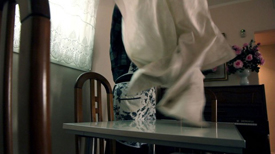 Ira Eduardovna, Mother, 2013, single-channel HD video (artwork © Ira Eduardovna)
Ira Eduardovna. Vox Populi, Philadelphia, Pennsylvania, January 3–26, 2014. Mother. Video.
Midwest
Stacy Leeman. Sharon Weiss Gallery, Columbus, Ohio, March 2–30, 2014. Hidden Presences. Painting.
Northeast
Blane De St. Croix. Fredericks and Freiser, New York, May 1–June 14, 2014. Dead Ice. Sculpture.

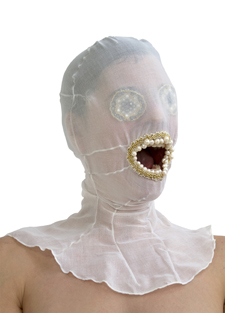 Laura Kalman, Hood (5), 2014, inkjet print, 20 x 28 in. (artwork © Laura Kalman)
Lauren Kalman. Sienna Patti Contemporary, Lenox, Massachusetts, February 8–April 6, 2014. But if the Crime is Beautiful … Part 1, Composition with Ornament and Object. Fine art and contemporary craft.
South

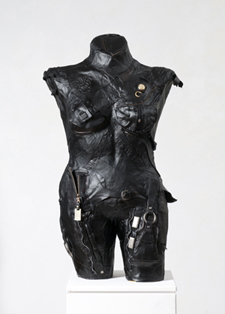 Linda Stein, Defender 696, 2010, leather, metal, and mixed media, 38 x 22 x 14 in. (artwork © Linda Stein)
Linda Stein. Rebecca Randall Bryan Art Gallery, Coastal Carolina University, Conway, South Carolina, January 15–February 28, 2014. The Fluidity of Gender: Sculpture by Linda Stein. Sculpture.
West
Kent Hayward. 7 Dudley Cinema, Beyond Baroque Arts Center, Venice, California, April 27, 2014. Retrospective of Filmmaker Kent Hayward’s Work. Experimental and documentary film.

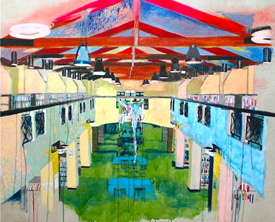 Katie Herzog, painting from Altered State Library (artwork © Katie Herzog)
 Katie Herzog. Monte Vista Projects, Los Angeles, California, February 15–March 9, 2014. Altered State Library. Painting.