
CAA News Today
People in the News
posted by CAA — June 17, 2011
People in the News lists new hires, positions, and promotions in three sections: Academe, Museums and Galleries, and Organizations and Publications.
The section is published every two months: in February, April, June, August, October, and December. To learn more about submitting a listing, please follow the instructions on the main Member News page.
June 2011
Academe

Michaël J. Amy has been promoted to professor of the history of art in the College of Imaging Arts and Sciences at Rochester Institute of Technology in Rochester, New York.

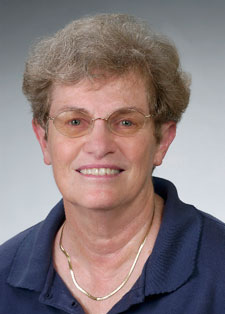 Mary D. Garrard
Mary D. Garrard, professor emerita of American University in Washington, DC, was the William Fleming Distinguished Visiting Professor at Syracuse University in Syracuse, New York, in April 2011.

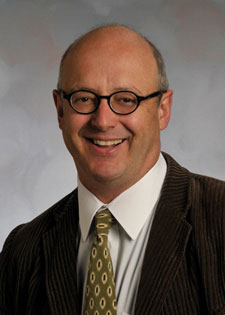 Beauvais Lyons
Beauvais Lyons, James R. Cox Professor of Art at the University of Tennessee in Knoxville, has been appointed a Chancellor Professor at his school. The honor comes with a $20,000 research stipend.
Museums and Galleries
Amy Brandt, formerly assistant curator at American Federation of Arts in New York, has been named McKinnon Curator of Modern and Contemporary Art at the Chrysler Museum of Art in Norfolk, Virginia.
Cosmin Costinas will join Para/Site, a contemporary art space in Hong Kong, China, as executive director and curator in September 2011. He was previously curator at Basis voor actuele kunst in Utrecht, the Netherlands.
Olivier Meslay, curator of European and American art at the Dallas Museum of Art in Texas, has been appointed interim director of his institution, following the resignation of Bonnie Pitman.
Joel Smith, curator of photography at the Princeton University Art Museum in Princeton, New Jersey, has been named Peter C. Bunnell Curator of Photography, a newly endowed position.
John R. Stomberg, currently deputy director and chief curator of the Williams College Museum of Art in Williamstown, Massachusetts, has been chosen to lead the Mount Holyoke College Art Museum in South Hadley, Massachusetts, as director. He begins the new job on August 1, 2011.
Michael Taylor, curator of modern art and department head of modern and contemporary art at the Philadelphia Museum of Art in Pennsylvania, has become director of the Hood Museum of Art in Hanover, New Hampshire.
Organizations and Publications
Heath Fox, assistant dean of arts and humanities at the University of California, San Diego, since 2006, has been appointed deputy director of operations at the Broad Museum in Los Angeles, California.

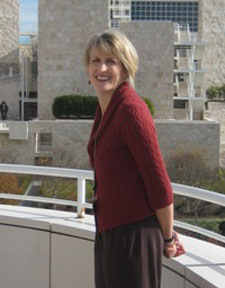 Anne Helmreich
Anne Helmreich, formerly director of the Baker-Nord Center for the Humanities and associate professor of art history at Case Western Reserve University in Cleveland, Ohio, has been appointed senior program officer at the Getty Foundation in Los Angeles, California.
Institutional News
posted by CAA — June 17, 2011
Read about the latest news from institutional members.
Institutional News is published every two months: in February, April, June, August, October, and December. To learn more about submitting a listing, please follow the instructions on the main Member News page.
June 2011
The Archives of American Art at the Smithsonian Institution, based in New York and Washington, DC, has received a $3 million grant from the Terra Foundation for American Art to support another five years of the archives’ digitization project and to fund a new position that will create and oversee related online scholarly and educational outreach initiatives. This second grant brings the Terra’s total gift to the archives to $6.6 million over a ten-year period.
The Currier Museum of Art in Manchester, New Hampshire, has received a grant from the National Endowment for the Arts to support the exhibition Jon Brooks: Bringing Art and Nature to Children and Families. A comprehensive selection of educational and community outreach activities will accompany the retrospective exhibition of works by Brooks, a New Hampshire artist who is a leading member of the American studio furniture movement.
The Honolulu Academy of Arts and the Contemporary Museum, both in Hawai‘i, have announced that the two institutions will merge, effective July 1, 2011. Under the agreement, the latter museum will gift its collection and assets to the former one.
The Philadelphia Museum of Art in Pennsylvania has been approved for reaccreditation by the Accreditation Commission of the Association of American Museums, a nonprofit organization based in Washington, DC.
Rutgers University’s Visual Arts Department has received a $3.4 million gift from Marlene A. and David A. Tepper to endow a faculty chair position at the Mason Gross School of the Arts and to fund scholarships in the painting program.
The Virginia Museum of Fine Arts in Richmond has received reaccreditation from the Accreditation Commission of the American Association of Museum, based in Washington, DC.
The Whitney Museum of American Art in New York has been reaccredited by the Accreditation Commission of the Washington, DC–based Association of American Museums.
Grants, Awards, and Honors
posted by CAA — June 15, 2011
Grants, Awards, and Honors
CAA recognizes its members for their professional achievements, be it a grant, fellowship, residency, book prize, honorary degree, or related award.
Grants, Awards, and Honors is published every two months: in February, April, June, August, October, and December. To learn more about submitting a listing, please follow the instructions on the main Member News page.
June 2011

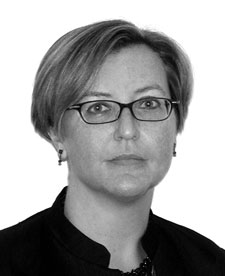 Elizabeth Bolman
Elizabeth Bolman, associate professor of art history in the Tyler School of Art at Temple University in Philadelphia, Pennsylvania, has received a 2011 John Simon Guggenheim Memorial Foundation Fellowship in fine-arts research. She will study magnificence and asceticism in Upper Egypt via the Red Monastery Church.
Michele Brody, an artist based in New York, has been awarded a summer residency at Quimby Colony in Portland, Maine, where she will focus on her Drawing Roots series.
Carissa Carman, an MFA student in fibers at Concordia University in Montreal, Quebec, has received a $2,000 Textile Society of America Travel Grant to attend and participate in the International Symposium and Exhibition on Natural Dyes, which took place April 24–30, 2011, in La Rochelle, France.
Mary D. Garrard, professor emerita of American University in Washington, DC, has received a Lifetime Achievement Award from the Mississippi Institute of Arts and Letters.
Charles Goldman, an artist based in Brooklyn, New York, has been award a 2011 John Simon Guggenheim Memorial Foundation Fellowship in fine arts.

 Michelle Handelman, still from Dorian, 2009, 4-channel HD video, 63 min. (artwork © Michelle Handelman)
Michelle Handelman has been awarded a 2011 John Simon Guggenheim Memorial Foundation Fellowship in film and video. She will spend the fellowship period working on her new project, Irma Vep, the last breath, a three-channel video installation based on the life of the actress and film director Musidora, and the silent-film character she was best known for, Irma Vep, from Les Vampires (1915, directed by Louis Feuillade).

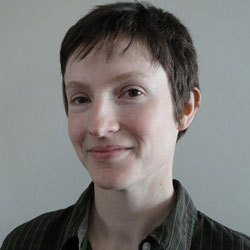 Jen P. Harris
Jen P. Harris, a New York–based artist, has been awarded a $2,500 grant from the Astraea Visual Arts Fund, which promotes the work of contemporary lesbian visual artists.
Anne D. Hedeman, professor of art and medieval studies at the University of Illinois, Urbana-Champaign, has received a 2011 John Simon Guggenheim Memorial Foundation Fellowship in medieval history.
Corin Hewitt, an artist and assistant professor of sculpture and extended media at Virginia Commonwealth University in Richmond, has been awarded a 2011 John Simon Guggenheim Memorial Foundation Fellowship in fine arts.
Alison Luchs has been tapped by the Italian Art Society to deliver the 2011 Italian Art Society–Kress Foundation Lecture in Florence, Italy, taking place on June 8, 2011.
Billie Grace Lynn has received the 2011 West Grand Prize. A $25,000 award will assist her project, called Mad Cow Motorcycle, in which she will develop a biodiesel motorcycle to raise awareness for greenhouses gases coming from commercial cattle farms.

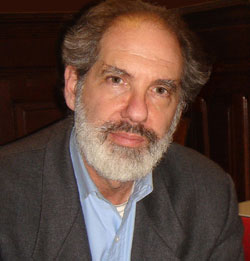 Richard Minsky (photograph by Richard Grosbard)
Richard Minsky has received the 2011 Worldwide Books Award for Publications for The Art of American Book Covers, 1875–1930 (New York: George Braziller, 2010). The Art Libraries Society of North America awarded him a certificate and a $1,000 prize for his book at its recent annual conference, held jointly with the Visual Resources Association.
Linda Nochlin, Lila Acheson Wallace Professor of Modern Art at the Institute of Fine Arts, New York University, has received a 2011 Icon Award in the Arts from the Bruce Museum in Greenwich, Connecticut.
Jennifer Ellen Robertson, professor of anthropology at the University of Michigan, Ann Arbor, has received a 2011 John Simon Guggenheim Memorial Foundation Fellowship in East Asian studies.
Allison Smith, a sculptor based in Oakland, California, has been awarded a $50,000 USA Fellowship for artistic excellence from United States Artists.
Susan Webster, Jane Williams Mahoney Professor of Art History and American Studies at the College of William and Mary in Williamsburg, Virginia, has received a 2011 John Simon Guggenheim Memorial Foundation Fellowship in fine-arts research. She will study European architecture and Andean masters in colonial Quito, Ecuador.

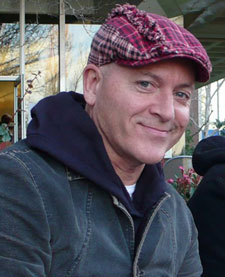 Bradley Wester
Bradley Wester, an artist based in New York, has been awarded two residencies. From September to November 2011, he will be a resident artist at AIR Antwerpen in Belgium. In February 2012, he will take part in the Hermitage Artist Retreat, based in Englewood, Florida, and comprised of writers, painters, composers, playwrights, poets, choreographers, performance artists, sculptors, and other artists whose work defies categorization. (He was also a resident there in March 2011).

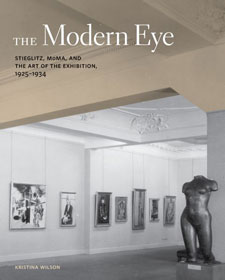
Kristina Wilson, associate professor of art history at Clark University in Worcester, Massachusetts, has received the twenty-third Charles C. Eldredge Prize for Distinguished Scholarship in American Art, awarded by the Smithsonian American Art Museum in Washington, DC, for her book, The Modern Eye: Stieglitz, MoMA, and the Art of the Exhibition, 1925–1934 (New Haven: Yale University Press, 2009).
Exhibitions Curated by CAA Members
posted by CAA — June 15, 2011
Exhibitions Curated by CAA Members
Check out details on recent shows organized by CAA members who are also curators.
Exhibitions Curated by CAA Members is published every two months: in February, April, June, August, October, and December. To learn more about submitting a listing, please follow the instructions on the main Member News page.
June 2011
John Chaich. Mixed Messages: A(I)DS, Art + Words. La MaMa La Galleria, New York, June 2–July 3, 2011.

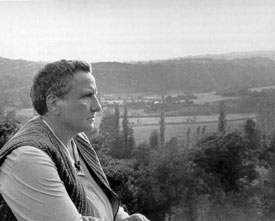 George Platt Lynes, Gertrude Stein, Bilignin, 1931, toned gelatin-silver print. Baltimore Museum of Art, Cone Collection, Gift of Adelyn D. Breeskin, BMA 1985.3 (artwork © Estate of George Platt Lynes)
Wanda M. Corn and Tirza True Latimer. Seeing Gertrude Stein: Five Stories. Contemporary Jewish Museum, San Francisco, California, May 12–September 6, 2011.

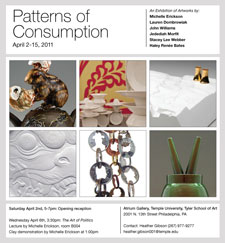 Promotional image for Patterns of Consumption
Heather Gibson. Patterns of Consumption. Atrium Gallery, Tyler School of Art, Temple University, Philadelphia, Pennsylvania, April 2–15, 2011.
Elizabeth Keithline. A Tool Is a Mirror. Danforth Museum of Art, Framingham, Massachusetts, May 4–June 5, 2011.

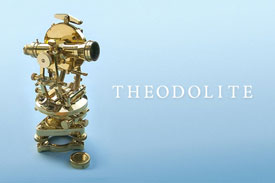 Promotional image for Theodolite
John Silvis and Brett Dickinson. Theodolite. New York Center for Art and Media Studies, New York, April 6–21, 2011.
Robert Storr and Francesca Pietropaolo. North by New York: New Nordic Art. Third Floor Galleries, Scandinavia House, Nordic Center in America, American-Scandinavian Foundation, New York, April 14–August 19, 2011.
Virginia-Lee Webb. Ancestors of the Lake: Art of Lake Sentani and Humboldt Bay, New Guinea. Menil Collection, Houston, Texas, May 6–August 28, 2011.
Books Published by CAA Members
posted by CAA — June 15, 2011
Publishing a book is a major milestone for artists and scholars—browse a list of recent titles below.
Books Published by CAA Members appears every two months: in February, April, June, August, October, and December. To learn more about submitting a listing, please follow the instructions on the main Member News page.
June 2011

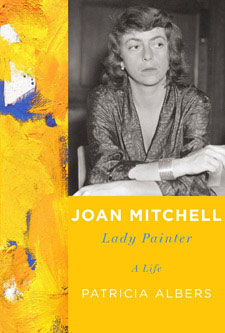
Patricia Albers. Joan Mitchell, Lady Painter: A Life (New York: Alfred A. Knopf, 2011).

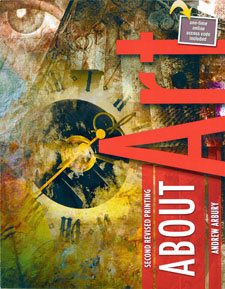
Andrew Arbury. About Art (Dubuque, IA: Kendall Hunt, 2011).

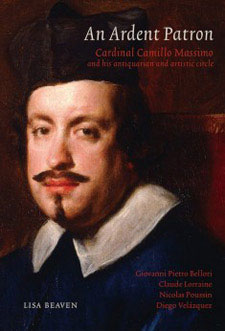
Lisa Beaven. An Ardent Patron: Cardinal Camillo Massimo and His Antiquarian and Artistic Circle (London: Paul Holbertson, in association with Centro de Estudios Europa Hispánica, 2010).

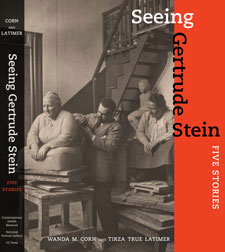
Wanda M. Corn and Tirza True Latimer. Seeing Gertrude Stein: Five Stories. (Berkeley: University of California Press; San Francisco: Contemporary Jewish Museum; Washington, DC, National Portrait Gallery, 2011).

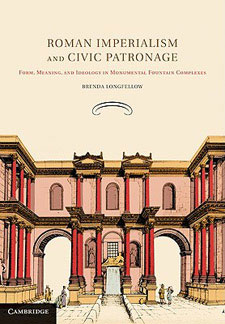
Brenda Longfellow. Roman Imperialism and Civic Patronage: Form, Meaning, and Ideology in Monumental Fountain Complexes (New York: Cambridge University Press, 2010).


Andreas Marks, ed. Fukami: Purity of Form (Hanford, CA: Clark Center for Japanese Art and Culture, 2011).

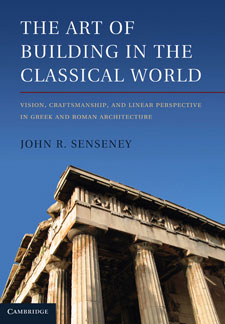
John R. Senseney. The Art of Building in the Classical World: Vision, Craftsmanship, and Linear Perspective in Greek and Roman Architecture (New York: Cambridge University Press, 2011).
Report from the May 2011 Board of Directors Meeting
posted by Linda Downs — June 14, 2011
The CAA Board of Directors held its second meeting of the year in New York on Sunday, May 1, 2011 at the offices of the law firm Debevoise & Plimpton LLC in Manhattan. President Barbara Nesin welcomed the four newly elected board members—Leslie Bellavance, Denise Mullen, Saul Ostrow, and Georgia Strange—who were attending their first meeting. Nesin also recognized Anne-Imelda Radice, who recently joined the board as an appointed director. In addition, new officers began their one-year appointmentat the May meeting (see the board list for all names, titles, and affiliations).
The board reviewed a three-year budget projection for CAA for fiscal years 2012–14 and approved the fiscal year 2012 budget. This is the first time that CAA staff has developed a multiyear budget projection in order to better plan and effect positive changes for the future. The 2012 budget includes: an increase in staff for publications, membership, and information technology; a professional analysis of the journals to determine the feasibility of transitioning to electronic formats for The Art Bulletin and Art Journal and to prepare a business plan for practical publications; and increased funds for Professional-Development Fellowships for artists and art historians.
Linda Downs, CAA executive director, presented an overview of recent advocacy initiatives and recommendations for greater board and member participation. Andrea Kirsh, former vice president for external affairs, is assisting the organization on advocacy issues by researching and preparing public statements in cooperation with the executive director and legal counsel. The board agreed to clarify CAA’s position in support of the proposed legislation on orphan works and to publicly post a statement that can also be sent to art schools and art departments.
The board approved a resolution to use online voting in the annual election of directors to the board, eliminating paper ballots. (CAA had employed both formats for several years.) Concerned about the low number of members who vote in elections, the group considered strategies to address the issue. Surveys of members indicate that the primary reason they do not vote is because they do not know the candidates. CAA currently provides short videos from the candidates as well as written statements and biographies that describe their backgrounds and their interests in serving on the board. CAA also reminds members to vote through email messages. The board welcomes suggestions on how to increase voter participation (see below for contact information).
Patricia McDonnell, who led the Task Force on Practical Publications, presented a resolution to develop a business plan to launch practical publications. The board approved the resolution , and the business plan will become part of the professional analysis of the journals to be carried out in the next two years.
Anne Collins Goodyear, who led the Task Force on Editorial Safeguards and Procedures, presented a resolution to revise CAA’s statement on conflict of interest. The amendment specifically addressed procedures for editors and added language about the importance of confidentiality. The new Statement on Conflict of Interest and Confidentiality, published last month, will be read and signed annually by board members, journal editors, committee members, and award jurors.
The board welcomes conversations on any question or issue related to the association and invites members to submit agenda items to the board and to the Annual Members’ Business Meeting. Send your ideas and suggestions to Vanessa Jalet, CAA executive assistant. Upcoming board meetings are scheduled for: Sunday, October 23, 2011, in New York; and Sunday, February 26, 2012, in Los Angeles, a day after the Annual Conference. The business meeting will be held on Friday, February 24, 2012, during the Los Angeles conference.
You may also read about two previous board meetings, held in October 2010 and February 2011.
Committee on Women in the Arts Picks for June 2011
posted by CAA — June 10, 2011
Each month, CAA’s Committee on Women in the Arts selects the best in feminist art and scholarship. The following exhibitions and events should not be missed. Check the archive of CWA Picks at the bottom of the page, as several museum and gallery shows listed in previous months may still be on view or touring.
June 2011
“Women and the Arts: Dialogues in Female Creativity in the U.S. and Beyond”
June 15–17, 2011
University of Lisbon Centre for English Studies
Centro de Saúde de Sete Rios, Lisbon, Portugal 1600-214
This three-day international gathering, organized by the American Studies Group of the University of Lisbon Centre for English Studies, will promote a reflection on women’s artistic production, contrasting the US context with other cultures. Featured sessions address such topics as “Dreaming, Doing, Being, & Seeing: The Woman Artist as Seen, Invisible, Witnessed and Observer”; “Women and the Crafts”; “Performance Arts”; “Art and Gender Politics”; “Portraits of the Artist as Woman”; “Women in Contemporary Art in the U.S. and Beyond”; and “Boundaries and Crossings in Theory and Art.”

!Women Art Revolution
Various locations across the United States
This eight-three-minute documentary film, directed by Lynn Hershman Leeson (and a CWA Pick in January 2011), relates the feminist art movement to the 1960s antiwar and civil rights causes and explains how historical events sparked feminist actions against major cultural institutions. Detailing major developments in women’s art of the 1970s, the film looks at early feminist art-education programs, political organizations and protests, and alternative art spaces such as A.I.R. Gallery and Franklin Furnace in New York and the Women’s Building in Los Angeles. Leeson also turns her attention to publications such as Chrysalis and Heresies and to landmark exhibitions, performances, and installations of public art that changed the direction of contemporary art.
In June, the following theaters and cultural institutions will screen the film:
- June 1–8: IFC Center, 323 Avenue of the Americas, New York, NY 10014
- June 2: Manhasset Cinemas, Gold Coast International Film Festival, 430 Plandome Road, Manhasset, NY 11030
- June 2–9: West End Cinema, 1 M Street NW, Washington, DC
- June 3: New Hyde Park Cinemas, Gold Coast International Film Festival, 3324 Hillside Avenue, New Hyde Park, NY 11040
- June 10: Institute of Contemporary Art, 100 Northern Avenue, Boston, MA 02210
- June 10: The Screen, Santa Fe University of Art and Design, 100 Saint Michaels Drive, Santa Fe, NM 87505
- June 14: Billy Wilder Theater, Hammer Museum, 10899 Wilshire Boulevard, Los Angeles, CA 90024
- June 15–19: Museum of Fine Arts, 100 Huntington Avenue, Boston, MA 02116
- June 17–23: Laemmle’s Music Hall 3, 9036 Wilshire Boulevard, Beverly Hills, CA 90211
- June 17–23: Northwest Film Forum, 1515 Twelfth Avenue, Seattle, WA 98122
- June 23–26: Noble Theater, Oklahoma City Museum of Art, 415 Couch Drive, Oklahoma City, OK 73102
- June 24–27: Northwest Film Center, 1119 Southwest Park Avenue, Portland, OR 97205
- June 24–30: Denver FilmCenter, Denver Film Society, 2601 Blake Street, Denver, CO 80205
- June 24–30: Real Art Ways, 56 Arbor Street, Hartford, CT 67401
- June 24–30: Salina Art Center, 150 South Santa Fe, Salina, KS 67401
Talks by the director and guest speakers—such as Howardena Pindell and Carey Lovelace in New York, Carrie Brownstein in Portland—and other special events will accompany selected screenings.

Guerrilla Girls, Untitled, from the series Guerrilla Girls Talk Back: The First Five Years, 1985–1990, 1986, color photolithograph on paper, 17 x 22 in. National Museum of Women in the Arts, Gift of Steven Scott, Baltimore, in honor of Wilhelmina Cole Holladay (artwork © Guerrilla Girls; photograph provided by the National Museum of Women in the Arts)
The Guerrilla Girls Talk Back
June 17–October 2, 2011
National Museum of Women in the Arts
1250 New York Avenue NW, Washington DC 20005
The Guerrilla Girls—anonymous females who take the names of dead women artists and appear in public wearing gorilla masks—use humor to expose sexism and racism in the art world, film, politics, and culture at large. This exhibition presents posters and ephemera from the group, including works from two portfolios, Guerrilla Girls Talk Back: The First Five Years, 1985–1990 and Guerrilla Girls Talk Back: Portfolio 2.
Tracey Emin: Love Is What You Want
May 18–August 29, 2011
Hayward Gallery
Southbank Centre, Belvedere Road, London SE1 8XX, England
The first major survey in London of Tracey Emin’s work occupies both floors and two outdoor sculpture terraces at the Southbank Centre. Works from every period of her career and in diverse media—painting, textiles, work on paper, photography, neon, film, and sculpture—will accompany a new series of outdoor sculptures made especially for the Hayward Gallery installation.
Committee on Women in the Arts Picks for May 2011
posted by CAA — May 10, 2011
Each month, CAA’s Committee on Women in the Arts selects the best in feminist art and scholarship. The following exhibitions and events should not be missed. Check the archive of CWA Picks at the bottom of the page, as several museum and gallery shows listed in previous months may still be on view or touring.
May 2011

Poster for a Mahalia Jackson concert in Topeka, Kansas, 1962 (photograph provided by the Rock and Roll Hall of Fame and Museum)
Women Who Rock: Vision, Passion, Power
Rock and Roll Hall of Fame and Museum
1100 Rock and Roll Boulevard, Cleveland, OH 44114
May 13, 2011–February 26, 2012
The eight sections of Women Who Rock: Vision, Passion, Power will highlight how women have driven the engines of creation and change in popular music since the early twentieth century. Blues women from the 1920s such as Ma Rainey and Bessie Smith set the stage for those who followed: Brenda Lee, the Ronettes, Janis Joplin, Carol King, Donna Summer, Siouxsie Sioux, Madonna, Bikini Kill, Queen Latifah, and Lady Gaga. In addition to displays of artifacts and memorabilia, as well as videos and listening stations, the interactive exhibition will set up a recording booth where visitors can record a short story or moment of inspiration related to women in rock.
“From Portraits to Pinups: Women in Art and Popular Culture”
Iris and B. Gerald Cantor Auditorium
Brooklyn Museum
200 Eastern Parkway, Brooklyn, NY 11238
May 14, 2011
On Saturday, May 14, the Brooklyn Museum will hold a daylong symposium in conjunction with the exhibition Lorna Simpson: Gathered (a CWA Pick from February). Graduate students will present their research on topics such as the implications of women artists using images of women in their work, the connections between women’s history and contemporary art, and perceptions of race and gender. In addition, Wendy Steiner, an English professor and the founding director of the Penn Humanities Forum at the University of Pennsylvania, will speak about concepts of beauty, while a panel discussion will feature the comedian Erica Watson, the drag king Shelly Mars, and the illustrator Molly Crabapple.
Uta Barth
Art Institute of Chicago
111 South Michigan Avenue, Chicago, IL 60603
May 14–September 14, 2011
The photographer Uta Barth once intriguingly said that her contemplative images of domestic scenes devoid of action “are really not of anything in that sense, they register only that which is incidental and peripheral implied.” Curated by Elizabeth Siegel of the Art Institute of Chicago, this exhibition presents her latest series, called … and to draw a bright white line with light, alongside two earlier bodies of work: white blind (bright red) from 2002 and Sundial from 2007.

“Illustrated Lecture and Book Signing: Dr. Gail Levin”
Elizabeth A. Sackler Center for Feminist Art
Brooklyn Museum, 200 Eastern Parkway, Brooklyn, NY 11238
May 15, 2011
On Sunday, May 15, the art historian Gail Levin, who teaches at Baruch College and the Graduate Center in New York, will discuss her most recent book, Lee Krasner: A Biography (New York: William Morrow, 2011), which looks beyond Krasner’s relationship with her husband Jackson Pollock to detail her own brilliant career as a painter in New York. A book signing will follow the 2:00 PM talk.
Loïs Mailou Jones: A Life in Vibrant Color
Women’s Museum
3800 Parry Avenue, Dallas, TX 75226
May 21–July 23, 2011
This traveling exhibition surveys Loïs Mailou Jones’s seventy-five years as a painter, tracing the development of her work from her early career into her signature mixture of African, Caribbean, American, and African American iconography, design, and thematic elements. Comprised of over sixty paintings, drawings, and textile designs from public and private collections, Loïs Mailou Jones: A Life in Vibrant Color also includes, for the first time, major holdings from the late artist’s estate for public presentation. A CWA Pick in October 2010, the exhibition originated at the National Museum of Women in the Arts in Washington, DC.
FIELD REPORT
posted by Christopher Howard — May 03, 2011
Lucille A. Roussin is an attorney-at-law who earned a PhD in art history and archaeology from Columbia University. She is the founder and director of the Holocaust Restitution Claims Practicum at the Benjamin N. Cardozo School of Law in New York from which she earned her JD. Roussin introduced the conference and served as moderator of one panel, “Nazi Era Looted Art: Research and Restitution.”
A Conference Report on “Human Rights and Cultural Heritage”
Paul Cézanne, Madame Cézanne in the Conservatory, 1891, oil on canvas, 36¼ x 28¾ in. Metropolitan Museum of Art, New York (artwork in the public domain)
The Benjamin N. Cardozo School of Law at Yeshiva University in New York hosted an all-day conference, entitled “Human Rights and Cultural Heritage: From the Holocaust to the Haitian Earthquake,” on March 31, 2011. The program brought together experts in both human-rights law and Holocaust-era restitution law. Its organizers also invited specialists in the same areas who had not previously engaged this important topic.
The program commenced with opening remarks by Allan Gerson, chairman of AG International Law PLLC, a Washington, DC–based law firm specializing in complex issues of international law and politics. During his talk on “Civil Litigation to Secure Cultural Property as a Human Right,” he spoke of the continuing debate over the existence of a recognized human right to secure restitution of cultural property and, when a victim is deprived of actual possession, the right to just compensation. Gerson included news about his current litigation against the Metropolitan Museum of Art over Paul Cézanne’s Madame Cézanne in the Conservatory (1891) and Yale University over Vincent van Gogh’s The Night Café (1888). Both cases involve major issues in international law, including the Act of State Doctrine and the Foreign Sovereign Immunities Act.
The first morning panel, entitled “Natural Disasters: Haiti and Beyond,” comprised leaders in the law-related nonprofit world. A former officer of the United States Army, Corine Wegener has witnessed cultural-heritage catastrophes firsthand in Sarajevo, Iraq, and, most recently, Haiti. In 2006 she founded the US Committee of the Blue Shield—the “cultural equivalent of the Red Cross”—and serves as its president. Her illustrated presentation addressed what has been, and is being done, to preserve the many cultural monuments of Haiti since the devastating earthquake in January 2010. Wegener stressed that, because of current law, the US cannot provide aid to endangered nations on its own initiative: the country suffering the disaster must first request assistance. Her current efforts focus on training local communities to conduct preservation work themselves.
As executive vice president and chief operating officer of the New York–based World Monuments Fund, Lisa Ackerman helps lead an organization dedicated to protecting and preserving threatened ancient and historic sites around the globe. Using a wonderful PowerPoint presentation, she demonstrated the evolution of heritage-protection efforts in which she has been involved. Ackerman commented that when floods ravaged Venice in 1966, operations rallied around the city as a cultural icon and saved many important works of art. After Hurricane Katrina in 2005, however, community building took precedence over art and architecture. She drove home her point with images of the preservation efforts at the Greater Little Zion Baptist Church in the Ninth Ward, which is not just an architectural gem but the heart of a community. Her two-fold message was a powerful one. First, nonprofits so accustomed to operating on shoestring budgets should not be afraid to think big. Second, widespread public perception that cultural-heritage preservation during times of crisis occurs at the expense of helping humans is a false dilemma. The two-pronged effort in Haiti is an excellent example of how disaster relief led by medical and humanitarian organizations can work side by side with specialists in cultural heritage.
Lucas Cranach the Elder, Adam, ca. 1530, oil on panel, 75 x 27½ in. Norton Simon Art Foundation, Pasadena (artwork in the public domain)
Tess Davis, the executive director of the Lawyers Committee for Cultural Heritage Preservation who has significant preservation experience, particularly in Cambodia and Sri Lanka, summed up the panel. She observed that the public does not realize how important cultural heritage becomes until after the dust settles, floods recede, and immediate humanitarian needs are met. She also emphasized how cultural-heritage preservation should be an up-front part of postwar and disaster-management planning.
The second morning panel concerned “Nazi Era Looted Art: Research and Restitution.” Marc Masurovsky, a leading scholar in this field and the cofounder of the Holocaust Art Restitution Project, led with an historical overview of the restitution of artworks looted during the Holocaust. Inge van der Vlies, a member of the Dutch Restitution Committee in Amsterdam and a professor of constitutional law and of art and law at the University of Amsterdam, considered the workings of Dutch project, its processes, and recent successes. Lucian Simmons, vice president and head of the Restitution Department at the New York branch of Sotheby’s, informed us about the process used at his auction house to determine if a work of art has a questionable provenance. He then illustrated recent restitutions and settlements, discussing research efforts and the outcomes. Lawrence M. Kaye, partner and cochair of the Art Law Group at Herrick, Feinstein LLP, spoke of recent major recoveries to the heirs of the Amsterdam art dealer Jacques Goudstikker. Kaye also addressed the current lawsuit against the Norton Simon Museum for two notable pieces from the former Goudstikker collection, Lucas Cranach the Elder’s Adam and Eve (both ca. 1530), in which a petition for certiorari has been filed with the US Supreme Court. He then detailed other art cases that his firm had handled, most importantly the restitution of several paintings in the Stedelijk Museum in Amsterdam to the heirs of the Suprematist artist Kasimir Malevich.
One program highlight was the midday keynote address by Howard N. Spiegler, also cochair of the Art Law Group of Herrick, Feinstein LLP, who provided an overview of many aspects of and results in cases involving Holocaust-era looted art. He related several examples, including the recently settled case of United States v. Portrait of Wally, in which the firm represented the heirs of Lea Bondi Jaray, the rightful owner of the Egon Schiele painting, Portrait of Wally (1912). Spiegler referenced a haunting testimonial by Rabbi Israel Singer, who once related that: “Himmler said you have to kill all the Jews because if you don’t kill them, their grandchildren will ask for their property back.”
Moderating the first afternoon session, “Libraries and Archives: Restitution of Recorded Cultural Heritage,” was Lynn Wishart, Cardozo’s associate dean for library services and professor of legal research. Her three panelists examined the many difficult issues with the restitution not of art but of written documents. Jeff Spurr, secretary and board member of the Sabre Foundation (based in Cambridge, Massachusetts), deliberated contesting arguments for the restitution of the ancient Jewish books, papers, and manuscripts rescued from the looting and burning of the Iraq National Library and Archives after the American incursion in 2003. Library representatives contend that the holdings belong to their country’s history, but a Jewish community no longer exists in Iraq. With some support from the American government, former Iraqi Jews in Israel and the US argue that the documents should be given to a living Jewish community. Nathan Lewin, a partner at the Washington, DC–based firm Lewin & Lewin LLP, represented the successful plaintiff, Agudas Chasidei Chabad, against the Russian Federation, discussed the case from the viewpoint of international law, under which the Russian Federation is obligated to return books and documents to the Chabad in New York but has refused. Patricia Krimsted, senior research associate at the Harvard Ukrainian Research Institute in Massachusetts, provided a history of looting by the Einsatzstab Reichsleiter Rosenberg (ERR) in Western Europe. She noted that the three largest ERR concentrations of books contained works that came from both West and East—but far more originated in the West. Grimsted also highlighted how looted collections (an estimated 600,000 books) that came to rest in the Soviet sectors of postwar Berlin, taken as part of the Soviet trophy brigades. Prospects for restitution today largely hinge on whether the archives ended up in the Soviet or Allied sectors. Six years ago the Russians admitted for the first time that collections were taken to Minsk in November 1945; Grimsted had found scraps of evidence in card catalogues that matched ERR confiscation lists. She questioned how the Russians could view the cultural materials, taken from Jews and published in languages few people in Russia can read, to be compensation for their World War II–era losses and then demand their own compensation to return them.
The second afternoon panel on the Foreign Sovereign Immunities Act (FSIA) presented a lively discussion on the applicability of the law. Jennifer Anglim Kreder, a professor in the Salmon P. Chase College of Law at Northern Kentucky University, conducted a roundtable with four experts on FSIA litigation to explore the intersection of cultural property, human rights, and the War on Terror. The panelists, all based in Washington, DC, were Mark N. Bravin (partner, Winston & Strawn LLP); Lisa Grosh (deputy assistant legal adviser, US Department of State); Laina C. Lopez (attorney, Berliner, Corcoran & Rowe LLP); and Stuart H. Newberger (partner, Crowell & Moring LLP). Bravin has represented both plaintiffs and defendants in FSIA litigation, including McKesson v. Islamic Republic of Iran (plaintiff), ongoing for twenty-five years, and Orkin v. The Swiss Federation, concerning a van Gogh drawing allegedly sold by a Jew under Nazi duress to a Swiss collector in 1933 (defendant). Grosh, who spoke in her individual capacity, was heavily involved with litigation under the FSIA’s Terrorism Amendments, which expressly authorized litigation against nations identified as State Sponsors of Terrorism. Lopez’s firm represents Iran, included in the McKesson case and proceedings brought by plaintiffs who obtained default judgments against Iran under the Terrorism Amendments; the plaintiffs seek to seize and sell Persian antiquities currently held in US museums to partially execute their judgments. The panelists engaged in a fascinating discussion of the mechanics of FSIA litigation, exploring such questions as: Should forced seizure and possible auction of cultural objects be fair game to compensate victims of terrorism? Is litigation or mass-claims resolution a better course to secure justice for terrorism and genocide victims—and for public safety?
In conclusion, “Human Rights and Cultural Heritage,” which brought together new voices in cultural heritage and human rights, was dynamic, informative, and thought provoking.
FIELD REPORT
posted by Christopher Howard — April 26, 2011
Svetlana Mintcheva is director of programs at the National Coalition Against Censorship. She is also the editor, with Robert Atkins, of Censoring Culture: Contemporary Threats to Free Expression (New York: New Press, 2006) and the curator of Filth, Treason, Blasphemy? Museums and Censorship, shown at the McCormick Tribune Freedom Museum in Chicago, Illinois, in 2007.
Hide/Seek: Museums, Ethics, and the Press: A Symposium Report
Hide/Seek may be remembered as the censorship controversy that launched a hundred discussion panels. There were public statements and street protests, of course, letters to the Smithsonian Board of Regents and articles in the press, but most of all, there were the conferences. Starting with a gathering at the Jewish Community Center in Washington, DC, spreading to the West Coast, and featuring major public events at the Corcoran and the New Museum, these discussions responded to an apparently endless desire to analyze and assign blame, to blow off steam and extract lessons, and to place what happened within the history of Culture Wars in America.
An April 9 symposium, “Hide/Seek: Museum, Ethics, and the Press,” organized by the Institute of Museum Ethics at Seton Hall University and the Institute for Ethical Leadership at Rutgers Business School, had the goal of framing the issues surrounding the Hide/Seek controversy as ethical ones. Daniel Okrent, former chairman of the National Portrait Gallery (NPG), opened the event by posing several key questions: Is choosing to do a controversial show an ethical decision? Should a show ever be changed after opening? What happens after a controversy in terms of institutional definition and future planning? A diverse group of participants from such disciplines as art history, law, political science, and philosophy, as well as Smithsonian representatives and one journalist, attempted to grapple with these issues and more.
Mounting a show on a controversial topic was, indeed, a decision requiring courage and commitment to the concept of the museum as a space where important cultural conversations should happen. Over forty-five other arts institutions had rejected the idea of a canonical show of queer art before the NPG took it up. With the curators Jonathan Katz and David Ward, the museum went forward with Hide/Seek: Difference and Desire in American Portraiture even though it expected—and was prepared to respond to—controversy and homophobic reactions. Unfortunately the NPG was not as capable of resisting the internal hierarchy of Smithsonian decision-making.
The attacks on the show came a full month after its opening, just as the museum was ready to declare the Culture Wars over. Detractors latched onto a few seconds of video portraying a plastic crucifix, taking the position of the offended victim of hate speech, rather than that of the intolerant bully, which would have happened if they had focused on what really annoyed them: the queer content of the exhibition. The rest of the story is familiar: the NPG’s preparedness to face public complaints was never tested as Smithsonian Secretary G. Wayne Clough unilaterally—and within a single day—ordered the removal of David Wojnarowicz’s A Fire in My Belly, with its eleven seconds of ants crawling over a crucifix. Clough’s ill-conceived effort to appease Republicans in Congress backfired, and the censorship controversy hit the headlines.
Clough’s decision appears to have pitched the pragmatic, that is, protecting funding for the Smithsonian from congressional assault, against the ethical: protecting the integrity of the institution and free-speech principles against partisan pressure. As Abe Zakhem, a philosophy professor at Seton Hall, commented: when normative ethics and practical considerations are in conflict, the need for courage arises. Courage and, perhaps, some political sense: it is far from certain that oppositional bluster in Congress would have succeeded in cutting the budget for the venerable Smithsonian. Worse, it is almost guaranteed that the artwork’s removal will only encourage future interference with the Smithsonian’s curatorial independence.
Failing to demonstrate either courage or political sense, Clough comes out as the villain in the story. Even his supporters on the Smithsonian’s Board of Regents criticized his decision as rash. What about the other actors in this drama? Symposium panelists discussed the role of Penny Starr, whose outrageously titled article—“Smithsonian Christmas-Season Exhibit Features Ant-Covered Jesus, Naked Brothers Kissing, Genitalia, and Ellen DeGeneres Grabbing Her Breasts”—published on November 29, 2010, for the Cyber News Service (formerly the Conservative News Service) appears to have started it all.1 Starr was the first to isolate the eleven seconds of A Fire in My Belly; she also described and photographed other pieces from Hide/Seek and, in an email, goaded Republican Representatives Eric Cantor and John Boehner, among other congressional leaders, with questions about the offensiveness of these images.2
The panelists agreed that the press was indisputably the instigator of crisis in this case, as it has been in many others.3 No matter how detestable and biased one may find Starr’s cultural “intervention,” the press has the right, even the obligation, to direct the public’s attention to matters of importance, including the curatorial politics of the Smithsonian. As the cultural journalist and blogger Lee Rosenbaum noted, Starr was practicing “Journalism 101” when she contacted stakeholders to elicit a response in a potentially controversial case.
The actions of politicians who, alerted by Starr, threatened to cut funds to the Smithsonian remained virtually unquestioned—perhaps because Republican congressmen were so clearly in the wrong, or perhaps because such actions have become politics as usual. Nevertheless, if we have learned anything from the Hide/Seek controversy, it is that museum leaders do not make their ethical decisions in a vacuum but must negotiate a path spiked with the demands of politicians, the eyes of the press, and the campaigns of special-interest groups. Could things have gone differently? Should Martin Sullivan, director of the National Portrait Gallery (and symposium participant), have resigned in protest? Should the Smithsonian’s secretary have attempted to persuade the detractors in Congress—some of whom admitted they never even saw the show—to temper their threats? The possibilities are many, but none present a magic-bullet solution. The Smithsonian has bent under political and interest-group pressure before, and neither the resignation of a museum director nor attempts to appease critics by exhibition script revisions has won any victories.
There is reason to believe that something moderately positive may come from the situation. Sullivan welcomed the new policy adopted by the Smithsonian Board of Regents, which states “in the absence of actual error, changes to exhibitions should not be made once an exhibition opens without meaningful consultation with the curator, director, Secretary, and the leadership of the Board of Regents.” The regents have also decided that the director of the specific museum should make the call regarding the fate of an exhibition, not the Smithsonian secretary, whose decisions are heavily influenced by the risk-averse Office of Congressional Relations.
Another new Smithsonian policy is much more ambiguous, if not ominous. Criticized as “curating via crowdsourcing,” the policy requires solicitation of public input during the exhibition-planning process.4 In previous instances, including the Enola Gay exhibition at the Air and Space Museum (1995–98) and the show of photographs from the Arctic National Wildlife Refuge at the National Museum of Natural History (2003–4), preexhibition input has had dire consequences for curatorial freedom.5 One can easily imagine the effect of public input in which the Catholic League or a similar professional “offense hound” attacks a show in the vulnerable period of its gestation.
In his memoir about the attacks and subsequent cancellation of the Enola Gay exhibition, Martin Harwit, who resigned as director of the Air and Space Museum in protest, writes that “our nation has begun to settle important issues … not through substantive debate, but through partisan campaigns aimed at victory by any means.”6 Apparently little has changed since.
Nevertheless, it was encouraging to hear Rachelle V. Browne, associate general council at the Smithsonian, clearly state that the First Amendment protects museums from having to choose between government funds and self-censorship. She also formulated the most unequivocal ethical message of the day: that concerns about financial sustainability do not override the museum’s obligation to sustain integrity and free speech.
Notes
1. Penny Starr, “Smithsonian Christmas-Season Exhibit Features Ant-Covered Jesus, Naked Brothers Kissing, Genitalia, and Ellen DeGeneres Grabbing Her Breasts,” CNS News, November 29, 2010, http://www.cnsnews.com/news/article/smithsonian-christmas-season-exhibit-fea.
2. In an email obtained by Brian Beutler of Talking Points Memo, Starr wrote to House and Senate leaders from both parties asking for feedback on her story. The email reads: “The federally funded National Portrait Gallery, which is part of the Smithsonian, is running an exhibition through the Christmas season that features an ant-covered Jesus and what the Smithsonian itself calls ‘homoerotic’ art. Should this exhibition continue or be cancelled?” Boehner and Cantor responded by immediately asking that the exhibition be pulled. See Brian Beutler, “Ant Jesus: An Anatomy of the Latest War on Christmas Scandal,” On Capitol Hill (blog), Talking Points Memo, December 1, 2010, http://www.talkingpointsmemo.com/author_blogs/2010/12/ant-jesus-an-anatomy-of-the-latest-war-on-christmas-scandal.php.
3. Recent examples include the leadership role taken by the New York Daily News in the efforts to boot the Drawing Center from a proposed new space at Ground Zero in 2005 (which succeeded) and to close the Brooklyn Museum’s Sensation show in 1999 (which did not).
4. Bob Duggan, “Mob Rule: Curating via Crowdsourcing,” Picture This (blog), Big Think, April 7, 2011, http://bigthink.com/ideas/37784.
5. For a fascinating story of the workings of the Smithsonian’s politics, see Martin Harwit, An Exhibit Denied: Lobbying the History of “Enola Gay” (New York: Copernicus, 1996).
6. Harwit, vii.