
CAA News Today
2015 Annual Conference Highlights
posted Mar 03, 2015
CAA hosted its 103rd Annual Conference from February 11 to 14, 2015, at the New York Hilton Midtown in New York City. This year’s program included four days of presentations and panel discussions on art history and visual culture, Career Services for professionals at all stages of their careers, a Book and Trade Fair, and a host of special events throughout the region. Preceding the Annual Conference was CAA’s third THATCamp, an “unconference” on digital art and art history.
Attendance
Over 5,000 people from throughout the United States and abroad—including artists, art historians, students, educators, curators, critics, collectors, and museum staff—attended the conference. Visual-arts professionals from over 54 countries were represented.
Sessions
Conference sessions featured presentations by artists, scholars, graduate students, and curators who addressed a range of topics in art history and the visual arts. In total, the conference offered over 200 sessions, developed by CAA members, affiliated societies, and committees. Approximately 800 individuals presented their work.
Career Services
Career Services included four days of mentoring and portfolio-review sessions, professional-development workshops, and job interviews with colleges, universities, and other art institutions. Approximately 200 interviewees and 50 mentors participated in Career Services. During the week of the Annual Conference, there were over 150 active jobs posted on the Online Career Center and more than 50 employers participating onsite.
Book and Trade Fair
This year’s Book and Trade Fair presented 155 exhibitors—including participants from the United States, France, Turkey, China, Canada, Italy, Russia, and Ukraine—that displayed new publications, materials for artists, digital resources, and other innovative products of interest to artists, scholars, and arts enthusiasts. The Book and Trade Fair also featured book signings, lectures, and demonstrations, as well as three exhibitor-sponsored program sessions on art materials and publishing.
ARTspace
ARTspace, a “conference within the conference” tailored to the needs and interests of practicing artists, presented programming that was free and open to the public, including this year’s Annual Distinguished Artist Interviews with William Pope.L, who spoke to Jenny Schlenzka of MoMA PS1, and Ursula von Rydingsvard, who conversed with Mark Stevens. Over 200 people attended this lively event.
ARTspace also featured four days of panel discussions devoted to visual-arts practice, opportunities for professional development, and screenings of film and video.
ARTexchange, an open-portfolio event in which CAA artist members displayed drawings, prints, photographs, small paintings, and works on laptop computers, took place on Friday, February 13. Nearly 40 artists participated in ARTexchange this year.
The Media Lounge, a space for innovative new-media programming in conjunction with ARTspace, focused on the theme of “alternative economies.” These programs are considered models of social, cultural, and technological economies that transform changing conditions for critical discourse and art making. “Alternative economies” aimed to create a platform that brought together artists, art collectives, new-media practitioners, video artists, film curators, academics, creative thinkers, economists, writers, and activists, with the aspiration to create a space to reflect on intersections of art, culture, and new-media technologies.
Programmed by CAA’s Services to Artists Committee, ARTspace was made possible in part by a generous grant from the National Endowment for the Arts.
Student and Emerging Professionals Lounge
The Student and Emerging Professionals Lounge served as a hub for networking, information-sharing, collaboration, professional development, and much more. The Student and Emerging Professionals Committee hosted an incredibly informative session on “Teaching Professional Practices in the Arts” to a packed audience; five Brown Bag Sessions with attendance ranging from 25 to 80; a successful social night; and two days of Mock Interviews at full capacity.
Distinguished Scholar Session
Robert Farris Thompson, professor of the history of art at Yale University, was CAA’s 2015 Distinguished Scholar. Grey Gundaker of the College of William and Mary chaired the session, and five additional participants—Charles Daniel Dawson, Wyatt MacGaffey, Rowland Abiodun, Leslie King-Hammond, and Lowery Stokes Sims—joined her in exploring and celebrating Thompson’s many contributions.
Convocation and Awards
More than 500 people attended CAA’s Convocation and presentation of the annual Awards for Distinction, which honor the outstanding achievements and accomplishments of individual artists, art historians, authors, conservators, curators, and critics whose efforts transcend their individual disciplines and contribute to the profession as a whole and to the world at large. Tom Finkelpearl, commissioner of the New York City Department of Cultural Affairs, opened Convocation with a short talk, and Dave Hickey delivered the keynote address.
The recipients of the 2015 awards were:
Charles Rufus Morey Book Award
Megan Holmes
The Miraculous Image in Renaissance Florence
Yale University Press, 2013
Alfred H. Barr Jr. Award
Susan Weber, ed.
William Kent: Designing Georgian Britain
Bard Graduate Center and Yale University Press, 2013
Alfred H. Barr Jr. Award for Smaller Museums, Libraries, Collections, and Exhibitions
Lynn Boland, et al.
Cercle et Carré and the International Spirit of Abstract Art
Georgia Museum of Art, University of Georgia, 2013
Arthur Kingsley Porter Prize
Douglas Brine
“Jan van Eyck, Canon Joris van der Paele, and the Art of Commemoration”
The Art Bulletin, September 2014
Art Journal Award
Anna Chave
Art Journal, Winter 2014
Distinguished Feminist Award
Amelia Jones
University of Southern California
Distinguished Teaching of Art Award
Richard Brown
Massachusetts College of Art and Design
Distinguished Teaching of Art History Award
Petra Ten-Doesschate Chu
Seton Hall University
Artist Award for Distinguished Body of Work
Charles Gaines
Charles Gaines: Gridwork 1974–1989
Studio Museum in Harlem
Distinguished Artist Award for Lifetime Achievement
Keith Sonnier
CAA/Heritage Preservation Award for Distinction in Scholarship and Conservation
Melanie Gifford
National Gallery of Art
Distinguished Lifetime Achievement Award for Writing on Art
Lucy R. Lippard
Morey and Barr Award Finalists
CAA recognizes the 2015 finalists for the Charles Rufus Morey Book Award and the Alfred H. Barr Jr. Award for their distinctive achievements:
Charles Rufus Morey Book Award
Matthew C. Hunter, Wicked Intelligence: Visual Art and the Science of Experiment in Restoration London (Chicago: University of Chicago Press, 2013)
Karl Whittington, Body-Worlds: Opicinus de Canistris and the Medieval Cartographic Imagination (Toronto: Pontifical Institute of Medieval Studies, 2014)
Catherine Zuromskis, Snapshot Photography: The Lives of Images (Cambridge, MA: MIT Press, 2013)
Alfred H. Barr Jr. Award
Kimberly A. Jones, et al., Degas/Cassatt (Washington, DC: National Gallery of Art and DelMonico Books, 2014)
Special Events
Following Convocation, the Museum of Modern Art hosted CAA’s Opening Reception on Wednesday evening, February 11. Over 500 attendees gathered to celebrate the conference while enjoying a stroll through the museum’s permanent collections.
CAA Travel Grant in Memory of Archibald Cason Edwards, Senior, and Sarah Stanley Gordon Edwards
Established by Mary D. Edwards with the help of others, the CAA Travel Grant in Memory of Archibald Cason Edwards, Senior, and Sarah Stanley Gordon Edwards will support women who are emerging scholars at either an advanced stage of pursuing a doctoral degree (ABD) or who have received their PhD within the two years prior to the submission of the application. Julia Louise Langbein of Oxford University delivered her paper “Caricature and Comic Spectacle at the Paris Salon (1857–1880)” in the “Comic Modern” session. and Kristine Tanton of the University of California, Los Angeles, participated in a panel on “Biblical Archetypes in the Middle Ages,” presenting a talk called “Looking onto Galilee: The Narthex Tribune at Vézelay.”
CAA-Getty International Travel Grant Program
In an effort to promote greater interaction and exchange between American and international art historians, CAA brought 15 scholars from around the world to participate in the Annual Conference. This is the fourth year of the program, which has been generously funded by grants from the Getty Foundation since its inception.
The CAA-Getty International Program participants’ activities began with a one-day preconference colloquium on international issues in art history, during which they met with North American–based CAA members to discuss common interests and challenges. The participants were assisted throughout the conference by CAA member hosts, who recommended relevant panel sessions and introduced them to colleagues who share their interests. Members of CAA’s International Committee served as hosts, along with representatives from several CAA affiliated societies, including the American Council for Southern Asian Art, the Arts Council of the African Studies Association, the Association for Latin American Art, the Society of Contemporary Art Historians, and the Society of Historians of East European, Eurasia, and Russian Art and Architecture.
This program has increased international participation in CAA’s activities and expanded international networking and the exchange of ideas both during and after the conference.
The recipients were: Mokammal H. Bhuiyan, Dafne Cruz Porchini, Boureima Tiékoroni Diamitani, Ljerka Dulibić, Georgina Gluzman, Angelo Kakande, Nazar Kozak, Savita Kumari, Nomusa Makhubu, Ana Mannarino, Márton Orosz, Andrey Shabanov, Shao Yiyang, Lize van Robbroeck, and Nóra Veszprémi.
Other Exciting Highlights
CAA published the Code of Best Practices in Fair Use for the Visual Arts, a project funded by the Andrew W. Mellon Foundation with additional funding from the Samuel H. Kress Foundation. This Code of Best Practices provides visual-arts professionals with a set of principles addressing the fair use of copyrighted materials. It describes how fair use can be invoked and implemented when using copyrighted materials in scholarship, teaching, museums, and archives and in the creation of art. The Code’s authors, Patricia Aufderheide and Peter Jaszi of American University, presented the document to conference attendees as part of a panel discussion organized by CAA’s Committee on Intellectual Property.
Board of Directors Update
Results of the Board of Directors election were announced on February 13, 2015, during the Annual Members’ Business Meeting. The new directors are:
- Jawshing Arthur Liou, professor of digital art and the director of the Henry Radford Hope School of Fine Arts at Indiana University, Bloomington
- Chika Okeke-Agulu, associate professor of art history in the Department of Art and Archaeology and Center for African American Studies, Princeton University
- Rachel Weiss, professor of arts administration and policy at the School of the Art Institute of Chicago
- Andrés Mario Zervigón, associate professor of the history of photography and acting chair of the Art History Department at Rutgers, the State University of New Jersey
They will take office at the next board meeting in May 2015.
Jim Hopfensperger of Western Michigan University was voted onto the board for a one-year term.
The CAA board also approved:
- New guidelines developed by the Professional Practices Committee on Fine Art Print Publications for Artists
- A Task Force on Advocacy, which will be chaired by Jacqueline Francis, associate professor at California College of the Arts, to address part-time faculty, diversity, and the interaction of artists and art historians in the public sphere
- A Task Force on the Annual Conference, to be led by Suzanne Blier, Allen Whitehill Clowes Professor of Fine Art at Harvard University, to develop recommendations for changes that will adapt to the changing needs of the field
- The three-year reviews of the Services to Artists Committee, the International Committee, and the Committee on Women in the Arts
New board officers were elected:
- John Richardson, Vice President for External Affairs
- Charles Wright, Vice President for Committees
- Suzanne Blier, Vice President for Annual Conference
- Gail Feigenbaum, Vice President for Publications
- Doralynn Pines, Secretary
Affiliated Societies
CAA would like to welcome two new affiliated societies:
Thank You
Members of CAA’s Board of Directors and staff would like to extend their gratitude to all conference funders and sponsors, attendees, volunteers, and participants; the organization’s committees and award juries; the New York Hilton Midtown staff; the museums and galleries that opened their doors to conference attendees free of charge; and everyone else involved in helping to make the 103rd Annual Conference such a tremendous success!
A warm thanks to the following for their generous support of CAA:
- Alberta College of Art and Design
- Andrew W. Mellon Foundation
- Andy Warhol Foundation for the Visual Arts
- Art in America
- Artstor
- Blick Art Materials
- Bloomsbury
- Getty Foundation
- Institute for Doctoral Studies in Visual Arts
- Knoll
- Laurence King Publishing
- McVicker and Higginbotham
- Museum of Modern Art
- National Committee for the History of Art
- National Endowment for the Arts
- Pearson
- Prestel
- Richmond University
- Samuel H. Kress Foundation
- Terra Foundation for American Art
- Wyeth Foundation for American Art
- Yale University Press
Save the Date
CAA’s 104th Annual Conference will be held in Washington, DC, February 3–6, 2016.
About CAA
The College Art Association is dedicated to providing professional services and resources for artists, art historians, and students in the visual arts. CAA serves as an advocate and a resource for individuals and institutions nationally and internationally by offering forums to discuss the latest developments in the visual arts and art history through its Annual Conference, publications, exhibitions, websites, and other events. CAA focuses on a wide range of issues, including education in the arts, freedom of expression, intellectual-property rights, cultural heritage and preservation, workforce topics in universities and museums, and access to networked information technologies. Representing its members’ professional needs since 1911, CAA is committed to the highest professional and ethical standards of scholarship, creativity, criticism, and teaching.
CAA Seeks Nominations for 2016–20 Board Service
posted Mar 02, 2015
CAA seeks nominations and self-nominations from individuals interested in shaping the future of the organization by serving on the Board of Directors for the 2016–20 term. The board is responsible for all financial and policy matters related to the organization. It promotes excellence in scholarship and teaching in the history and criticism of the visual arts, and it encourages creativity and technical skill in the teaching and practice of art. CAA’s board is also charged with representing the membership on issues affecting the visual arts and the humanities.
Candidates must be current CAA members. Nominations and self-nominations should include a short statement of interest, a condensed résumé of no more than 3–4 pages, and the following information: the nominee’s name, affiliation, address, email address, and telephone number, as well as the name, affiliation, and email address of the nominator, if different from the nominee. Please send all information by mail or email to: Vanessa Jalet, Executive Liaison, College Art Association, 50 Broadway, 21st Floor, New York, NY 10004. Deadline: April 1, 2015.
Thanks to 2015 Career Services Mentors and Workshop Leaders
posted Mar 02, 2015
CAA wishes to thank the artists, scholars, curators, critics, educators, and other professionals in the visual arts who generously served as Career Services mentors—for the Artists’ Portfolio Review, Career Development Mentoring, the Mock Interviews, and the Professional Development Roundtables—during the 2015 Annual Conference in New York. CAA also appreciates the work of leaders of the Professional-Development Workshops and speakers at Orientation.
Orientation
Susan Altman, Middlesex County College; Michael Aurbach, Vanderbilt University; and Jo-Ann Morgan, Western Illinois University.
Artists’ Portfolio Review
Virginia Fabbri Butera, College of Saint Elizabeth; Michael Bzdak, Johnson & Johnson; Susan Canning, College of New Rochelle; Brian Curtis, University of Miami; Peter Kaniaris, Anderson University; Jason Lahr, University of Notre Dame; Matthew LaRose, Park University; Preston B. Lawing, Saint Mary’s University of Minnesota; Suzanne Lemakis; Sharon Lippman, Art Without Walls; Craig Lloyd, College of Mount St. Joseph; Judith Pratt, Judith Pratt Studio; Habibur Rahman, Claflin University; Steve Teczar, Maryville University of St. Louis; and David Voros, University of South Carolina.
Career Development Mentoring
Susan Altman, Middlesex County College; Frances Altvater, University of Hartford; Michael Aurbach, Vanderbilt University; Brian Bishop, Framingham State University; Colin Blakeley, Eastern Michigan University; Karen Carter, Kendall College of Art and Design, Ferris State University; Leda Cempellin, South Dakota State University; Jaia Chen, Shelton State Community College; Kevin Concannon, Virginia Polytechnic Institute and State University; Anne D’Alleva, University of Connecticut; Rebecca DeRoo, Rochester Institute of Technology; James Farmer, Virginia Commonwealth University; Joan Giroux, Columbia College Chicago; Reni Gower, Virginia Commonwealth University; Jim Hopfensperger, Western Michigan University; Dennis Ichiyama, Purdue University; Carol Krinsky, New York University; Elisabeth Leach; Heather McPherson, University of Alabama, Birmingham; Jo-Ann Morgan, Western Illinois University; Jeff Nathanson, Arts Council of Princeton; Niki Nolin, Columbia College Chicago; Mark O’Grady, Pratt Institute; Christopher Olszewski, Savannah College of Art and Design; Morgan Paine, Florida Gulf Coast University; Doralynn Pines, Metropolitan Museum of Art, retired; Judith Pratt, Judith Pratt Studio; David Raizman, Drexel University; Jack Risley, University of Texas at Austin; Dinah Ryan, the Principia; Paul Ryan, Mary Baldwin College; Gerald Silk, Tyler School of Art, Temple University; Andrew Jay Svedlow, University of Northern Colorado; Joe A. Thomas, Zuckerman Museum of Art, Kennesaw State University; Larry Thompson, Samford University; Ann Tsubota, Raritan Valley Community College; Philip Van Keuren, Southern Methodist University; and Barbara Yontz, St. Thomas Aquinas College.
Professional Development Roundtables
Michael Aurbach, Vanderbilt University; Brian Curtis, University of Miami; Dennis Ichiyama, Purdue University; Peter Kaniaris, Anderson University; and Leo Morrissey, Georgian Court University.
Mock Interview Sessions
Dina Bandel, Virginia Commonwealth University, Qatar; Colin Blakely, Eastern Michigan University; Maria Ann Conelli, Brooklyn College, City University of New York; Jacqueline Coutré, Queens University; Stephanie Dickey, Queens University; Adam Fung, Texas Christian University; Carol Garmon, University of Mary Washington; Joann Giroux, Columbia College Chicago; Bertha Gutman, Delware County Community College; Kim Hartswick, Brooklyn College, City University of New York; Rebecca Harvey, Ohio State University; Richard Heipp, University of Florida; Heidi Hogden, University of South Dakota; David Howarth, Zayed University; Eldred Hudson, University of North Carolina, Charlotte; Dennis Ichiyama, Purdue University; Matt King, Virginia Commonwealth University; Andrea Kirsch, Rutgers University; David LaPolambara, Ohio University; Brittany Lockard, Wichita State University; Carolyn Martin; Tamryn McDermott; Jo-Ann Morgan, Western Illinois University; Thomas Post, Kendall College of Art and Design; Lauren Puzier, Sotheby’s Institute of Art; David Yager, University of California, Santa Cruz; and Megan Koza Young, Prospect New Orleans.
Brown Bag Lunches/Sessions
Leda Campellin, South Dakota State University; Maria Ann Conelli, Brooklyn College, City University of New York; Jacqueline Coutré, Queens University; Lauren Grace Kilroy-Ewbank, Brooklyn College, City University of New York; Brittany Lockard, Wichita State University; Carolyn Martin; Tamryn McDermott; Lauren Puzier, Sotheby’s Institute of Art; Georgia Strange, University of Georgia; and Megan Koza Young, Prospect New Orleans.
Professional Development Workshops
Susan Altman, Middlesex County College; Michael Aurbach, Vanderbilt University; Barbara Bernstein, Virginia Center for the Creative Arts and University of Virginia; Steven Bleicher, Coastal Carolina University; Mika Cho, California State University, Los Angeles; Curtis Fletcher, University of Southern California; Amanda French, George Mason University; Gigi Rosenberg; and Blaise Tobia, Drexel University.
CAA Statement on Mosul Museum Destruction
posted Feb 26, 2015
CAA abhors the senseless destruction of ancient Assyrian sculpture that was publicized today. The Assyrians created sophisticated monumental sculpture that reflected their unique form of government, fostered urban development projects of palaces, temples and markets, built a prosperous economy and promoted reading and writing in cuneiform. The monumental works from this extraordinary ancient civilization had been preserved for over 2,500 years in one of the most important collections of Middle Eastern art, the Mosul Museum. CAA calls upon the Iraq and United States government as well as the ICOMOS, the World Monuments Fund and other international organizations to adhere to Hague Convention (1954), in concert with the public and the scholarly community, to develop and implement programs to protect ancient sites, monuments, antiquities, and cultural institutions in the case of war.
DeWitt Godfrey, CAA President
Linda Downs, Executive Director
Membership Categories and Conference Registration
posted Feb 26, 2015
This past spring CAA restructured its membership program in order to provide more options and better serve its members. CAA added new benefits such as online access to The Art Bulletin and Art Journal as well as discounted access to JPASS. CAA also added new, discounted membership categories for part-time faculty and independent artists and scholars. These changes were made in direct response to important feedback from CAA members.
The four income-based levels of membership that CAA used for many years were replaced by two general categories: Basic and Premium. The Basic level ($125 a year) provides a lower-cost option for members who aren’t planning to attend the Annual Conference. If they do attend, Basic members receive a 20 percent discount on registration. The Premium level ($195 a year) costs a bit more but offers a much greater value for conference attendees: a 55 percent registration discount.
CAA communicated this information through letters, eblasts, a presentation on CAA’s YouTube Channel, and an Individual Member Guide and member FAQs posted on the website. We have since learned from members, however, that some confusion has arisen over the new membership categories and their respective benefits related to conference discounts.
We are in the process of reviewing and updating the Membership section of the website, and we will aim to be clearer in member correspondence throughout the year. Please keep in mind that if you are renewing your membership and you know at that time that you will attend the Annual Conference, the Premium membership with its larger conference registration discount will provide you with the greatest overall value when combined with the conference cost.
If you ever have any questions about your membership, please do not hesitate to contact us at membership@collegeart.org. Thank you for your continued support of CAA.

John Richardson, CAA Vice President for External Affairs
Professor and Chair, Department of Art and Art History, Wayne State University
News from the Art and Academic Worlds
posted Feb 25, 2015
Each week CAA News publishes summaries of eight articles, published around the web, that CAA members may find interesting and useful in their professional and creative lives.
Why Is Art So Expensive?
I recently went to a gallery and saw pieces of broken glass selling for $1,000 per shard. Why? And why is art so expensive? (Read more from Slate.)
The Academy’s Dirty Secret
According to a new study that scrutinized more than 16,000 faculty members at 242 schools, just a quarter of all universities account for 71 to 86 percent of all tenure-track faculty in the US and Canada in business, computer science, and history. Just eighteen elite universities produce half of all computer-science professors, sixteen schools produce half of all business professors, and eight schools account for half of all history professors. (Read more from Slate.)
How to Start an Art School
There are plenty of examples out there, from fly-by-night, for-profit scoundrels to august, ivy-draped centuries-old institutions. Why not just join one of them rather than go through the trouble of starting something new? Unfortunately, the current model for art school is awful. Let us count the ways, easily summed in dollars. (Read more from Momus.)
Do Artist Branding and Hollywood Talent Agency Deals Kill an Artist’s Soul?
Many of us have seen the Andy Warhol Converse sneakers and the Uniqlo t-shirts adorned with famous artworks. We’ve seen the painted BMW cars and the branding of vodka bottles. If artists want to put their signature squiggles on a shoe or a bottle of booze, are they compromising their integrity in exchange for a bit of cash? (Read more from Artnet News.)
US Museums Capitalize on Baby Boomers’ Desire to Write Big Checks
Cultural giving among America’s top philanthropists fell slightly in 2014, according to the Chronicle of Philanthropy’s annual ranking of the fifty largest charitable donors. The news might come as a surprise to US museum directors, who have been swiftly and quietly raising eight-, nine-, and ten-figure donations from eager patrons. Their ambitious capital campaigns make the austerity measures of the recent recession feel like a distant memory. (Read more from the Art Newspaper.)
From the Journal Editor’s Vantage Point
We could spend a lot of time discussing why academic journals accept so few manuscripts at the outset. Having satirized the peer-review process myself, I would be the first to acknowledge that it’s far from perfect. But pragmatically speaking, it’s important to realize that if you receive a revise-and-resubmit and decide to cut your losses and move on to another journal, you’re likely to face exactly the same outcome. (Read more from Vitae.)
We Need More STEM Majors with Liberal Arts Training
Our culture has drawn an artificial line between art and science, one that did not exist for many innovators. Leonardo da Vinci’s curiosity and passion for painting, writing, engineering, and biology helped him triumph in both art and science. And Steve Jobs once declared: “It’s in Apple’s DNA that technology alone is not enough—it’s technology married with liberal arts, married with the humanities, that yields us the result that makes our heart sing.” (Read more from the Washington Post.)
Yale to Launch Lens Media Lab for Photograph Research and Conservation
The Lens Media Laboratory, a new research facility that will apply scientific principles to the characterization and conservation of photographs and other lens-based media, has been created as part of the Yale Institute for the Preservation of Cultural Heritage, a center dedicated to improving the science and practice of conservation globally. (Read more from Yale News.)
Millard Meiss Publication Fund Seeks Three Jury Members
posted Feb 24, 2015
 CAA seeks nominations and self-nominations to fill three positions on the jury for the Millard Meiss Publication Fund for a four-year term, July 1, 2015–June 30, 2019. Candidates must be actively publishing scholars with demonstrated seniority and achievement; institutional affiliation is not required.
The Meiss jury awards grants twice a year to support the publication of book-length scholarly manuscripts in the history of art, visual studies, and related subjects that have been accepted by a publisher on their merits but cannot be published in the most desirable form without a subsidy. CAA reimburses jury members for travel and lodging expenses in accordance with its travel policy.
Candidates must be current CAA members and should not be serving on another CAA editorial board or committee. Jury members may not themselves apply for a grant in this program during their term of service. Nominators should ascertain their nominee’s willingness to serve before submitting a name; self-nominations are also welcome. Please send a letter describing your interest in and qualifications for appointment, a CV, and contact information to: Millard Meiss Publication Fund Jury, College Art Association, 50 Broadway, 21st Floor, New York, NY 10004; or send all materials as email attachments to Sarah Zabrodski, CAA editorial manager. Deadline: May 1, 2015.
Teaching the History of Modern Design: The Canon and Beyond
posted Feb 23, 2015
Teaching the History of Modern Design: The Canon and Beyond
NEH Summer Institute
Drexel University, Philadelphia, Pennsylvania
July 6–July 31, 2015
“Teaching the History of Modern Design: The Canon and Beyond” is an exciting four-week NEH Summer Institute that will prepare twenty-five college faculty from diverse disciplinary backgrounds to meet the increasing demand for, as well as interest in, courses on modern design history. In-depth seminars will focus upon three interdependent thematic units: (1) taste and popular culture; (2) women as consumers and producers of design; and (3) political and global interpretations of design after World War II.
The director’s and visiting scholars’ complementary approaches to “The Canon and Beyond” will build upon and reinforce participants’ familiarity with standard material, while simultaneously introducing new material and critical perspectives. Field trips to regional museums and collections such as the Philadelphia Museum of Art and the Hagley Museum in Delaware will provide participants direct experience with objects and suggest ways to use local collections in their own teaching. Group presentations by our participants will take place during the final week of the institute.
Application deadline: March 2, 2015
Notification date: March 30, 2015
Stipend: $3,300
Visiting scholars: Regina Lee Blaszczyk, University of Leeds, England; Maria Elena Buszek, University of Colorado, Denver; Catharine Rossi, Kingston University, England; Sarah Teasley, Royal College of Art, London; and Vladimir Kulic, Florida Atlantic University.
Project faculty: Carma R. Gorman, University of Texas at Austin
Institute director: David Raizman, Drexel University
Solo Exhibitions by Artist Members
posted Feb 22, 2015
Solo Exhibitions by Artist Members
See when and where CAA members are exhibiting their art, and view images of their work.
Solo Exhibitions by Artist Members is published every two months: in February, April, June, August, October, and December. To learn more about submitting a listing, please follow the instructions on the main Member News page.
February 2015
Abroad

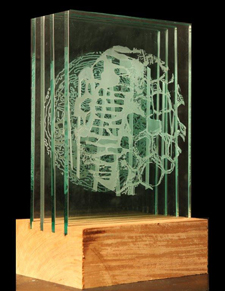 Lea Kannar-Lichtenberger, Glimpse Beyond, 2014, sandblasted glass panels in PNG Rosewood (artwork © Lea Kannar-Lichtenberger)
Lea Kannar-Lichtenberger. Community Gallery, Hazelhurst Regional Gallery and Arts Centre, Gymea, New South Wales, Australia, March 7–17, 2015. Colliding Worlds. Bio-art.
Mid-Atlantic

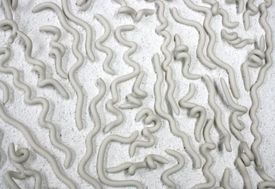 Lorrie Fredette, ceiling detail of Proper Limits, 2015, porcelain, 8 ft. 1 in. x 17 ft. 10½ in. x 18 ft. 3½ in. (artwork © Lorrie Fredette)
Lorrie Fredette. Visual Art Center of New Jersey, Summit, New Jersey, February 8–May 31, 2015. Proper Limits. Installation.
Midwest

Michael Aurbach. Main Galleries, Tarble Arts Center, Eastern Illinois University, Charleston, Illinois, January 16–February 18, 2015. Michael Aurbach Sculpture: Three Decades after Eastern. Sculpture.
Joan Marie Kelly. Richard D. Baron ’64 Art Gallery, Oberlin College, Oberlin, Ohio, November 21, 2014–January 2, 2015. Historical Indian Archetypes of Masculinity and Femininity: The Kotha and The Akhara.
Angela Piehl. North Gallery, Oklahoma State Capitol, Oklahoma City, Oklahoma, December 8, 2014–February 1, 2015. Stillwater. Drawing.

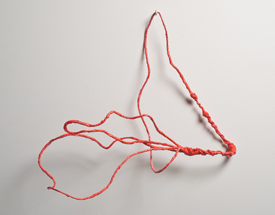 Robert Schatz, Lotus, 2014, jute twine, alphatic resin, kozo paper, and acrylic, 14 x 8 x 19½ in. (artwork © Robert Schatz)
Robert Schatz. Sheldon Museum of Art, University of Nebraska, Lincoln, Nebraska, January 16–April 26, 2015. A New Line of Thinking. Sculpture and work on paper.
Northeast

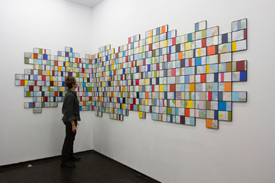 Nayda Collazo-Llorens, installation view of Geo Dis/connect, 2014, wall installation with found maps, 360 framed images (4 x 6 in. each), overall dimensions approximately 5 x 16 ft. (artwork © Nayda Collazo-Llorens)
Nayda Collazo-Llorens. LMAKprojects, New York, October 17–December 21, 2014. Dis/connect. Wall installation, drawing, and work on canvas.
Josette Urso. Main Window Project Space, One Main Street, Brooklyn, New York, February 5–March 29, 2015. High Five.

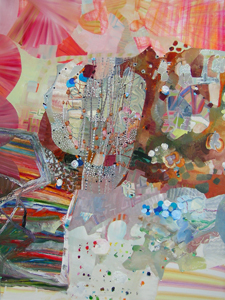 Josette Urso, Jujube, 2015, oil on canvas, 48 x 36 in. (artwork © Josette Urso)
Josette Urso. Market Fine Arts, New York, March 19–April 18, 2015. Treehouse. Painting.
West
Martin Gantman. Los Angeles Center for Digital Art, Los Angeles, California, January 8–February 28, 2015. Inconsequential Intersections.
Join CAA in Supporting Part-Time Faculty
posted Feb 20, 2015
On the occasion of the National Adjunct Walkout Day planned for February 25th CAA asks visual arts tenured faculty and faculty administrators to review, discuss with your colleagues, and implement the CAA Guidelines for Part-Time Professional Employment. These guidelines provide the consensus on best practices in the visual arts in hiring, contracting, providing resources, working space, information, professional development, equitable salaries, and opportunities to participate in institutional government. We particularly encourage full-time tenured faculty and administrators to revisit these guidelines and discuss them toward full implementation at your institution.
The CAA Strategic Plan, 2015–2020 has placed part-time faculty issues as a priority. At the February 15th Board of Directors meeting, a task force on advocacy has been formed to address part-time faculty issues along with diversity in the field, and the public face of art and art history. As part of this effort, we will be surveying visual-arts departments to determine where we stand on these issues and how best to move forward.
DeWitt Godfrey, CAA President
Professor of Art and Art History
Colgate University
Linda Downs
Executive Director and CEO