
CAA News Today
Recent Deaths in the Arts
posted Jun 18, 2013
In its regular roundup of obituaries, CAA recognizes the lives and achievements of the following artists, designers, scholars, professors, museum directors, and others whose work has significantly influenced the visual arts. Notable deaths this month include the former Guggenheim Museum director Thomas M. Messer and a dealer, curator, and publisher of Conceptual art, Seth Siegelaub.
- Cerna “Chickie” Alter, a corporate art consultant who established her Chicago-area business in the 1960s, died on May 10, 2013. She was 74
- Ralph Brown, a British sculptor of figurative works in clay, plaster, metal, and marble, died on April 3, 2013, at age 84
- Anne Bryan, an artist and a student of painting at the Pennsylvania Academy of the Fine Arts in Philadelphia, died on June 5, 2013. She was 24 years old
- William T. Cartwright, a documentary filmmaker and producer who bought and preserved the Watts Towers in Los Angeles, died on June 1, 2013. He was 92
- Roberto Chabet, a curator and the founding director of the Cultural Center of the Philippines who taught for more than thirty years in the College of Fine Arts at the University of the Philippines, died on April 30, 2013. Known as the father of conceptual art in his country, he was 76 years old
- Niels Diffrient, an industrial designer who worked on the Princess telephone, John Deere tractor seats, the Polaroid SX-70 camera, and American Airlines jet interiors, died on June 8, 2013, at age 84
- Bruce Evans, a curator and museum director who worked at the Dayton Art Institute from 1965 to 1991, died on May 14, 2013, at 72. He also led the Mint Museum of Art in Charlotte, North Carolina, and served as president of the Association of Art Museum Directors
- Dawn Glanz, a historian of American and European art who taught in the School of Art at Bowling Green State University for twenty-five years, passed away on May 9, 2013. She was 66
- Michael Harrison, head of fine art at Winchester School of Art and director of Kettle’s Yard, a contemporary-art center in Cambridge, England, from 1992 to 2011, died on April 25, 2013. He was 65
- Ray Harryhausen, an influential stop-motion animator for films such as Mighty Joe Young (1949), Jason and the Argonauts (1963), One Million Years BC (1966), and Clash of the Titans (1981), passed away on May 7, 2013. He was 92
- Jimmy Jalapeeno, a painter and photographer based in Texas who earned two fellowships from the National Endowment for the Arts, died on May 22, 2013. He was 66 years old
- Farideh Lashai, an Iranian painter of gestural abstractions and the author of a compelling autobiographical novel called Shal Bamu (2003), died on February 24, 2013, at age 68
- Lee Littlefield, a Houston-based artist known for his “Pop-Up” sculptural works alongside Interstate 10 in Texas, died on June 9, 2013. He was 77 years old
- Mollie Lyman, a professor of art who taught in the Art Department at Emory University for over thirty years as well as at the Atlanta College of Art, passed away on April 13, 2013. She was 87
- Kim Merker, a designer, typesetter, and printer of hand-pressed books of poetry, died on April 28, 2013, at age 81. He founded Stone Wall Press in 1957 and the Windhover Press at the University of Iowa ten years later
- Thomas M. Messer, a director of the Solomon R. Guggenheim Museum from 1961 to 1988 who oversaw the acquisition of the Thannhauser Collection and the Peggy Guggenheim Collection, died on May 15, 2013, at the age of 93
- Wayne F. Miller, a photographer who documented the Second World War for the US Navy and captured the experiences of black residents living on the South Side of Chicago, died on May 22, 2013. He was 94
- Otto Muehl, a controversial Austrian artist, died on May 26, 2013, at age 87. With several others, Muehl founded Viennese Actionism in the early 1960s
- Angela Paterakis, a professor of art education at the School of the Art Institute of Chicago for nearly fifty years, died on May 19, 2013. She was 80 years old
- William Plunkett, a British designer and manufacturer of modern furniture, died on May 5, 2013. He was 84
- Richard Rousseau, the founder and owner of Artist Hardware, a design and development firm, and a former product manager at Blick Art Materials, passed away on May 31, 2013. He was 46 years old
- Dale R. Roylance, a curator at Princeton University who organized more than one hundred exhibitions in the Harvey S. Firestone Memorial Library, died on May 19, 2013, age 88. Roylance also served as curator of the arts of the book at Yale University’s Sterling Memorial Library
- Betty Rogers Rubenstein, an art historian and a former art critic for the Tallahassee Democrat, passed away on May 19, 2013. She was 92
- Elizabeth Foster Schoyer, a former member of the Women’s Committee at the Carnegie Museum of Art and a longtime museum docent, died on June 10, 2013. She was 94
- Seth Siegelaub, an adventurous dealer of Conceptual art, a producer and publisher of artists’ projects, and an expert in textiles, died on June 15, 2013, at the age of 71
- Vollis Simpson, a self-taught artist based in North Carolina who created large sculptural works called whirligigs with materials from junkyards, passed away on May 31, 2013. He was 94
- Willi Sitte, an East German artist who worked in a Social Realist style, died on June 8, 2013, at age 92. Sitte served as president of his former country’s association of visual artists from 1974 to 1988
- Dorothea Wight, an artist, printmaker, and teacher who operated Studio Prints, an intaglio workshop in London, died on May 23, 2013. She was 68
Read all past obituaries in the arts in CAA News, which include special texts written for CAA. Please send links to published obituaries, or your completed texts, to Christopher Howard, CAA managing editor, for the next list.
People in the News
posted Jun 17, 2013
People in the News lists new hires, positions, and promotions in three sections: Academe, Museums and Galleries, and Organizations and Publications.
The section is published every two months: in February, April, June, August, October, and December. To learn more about submitting a listing, please follow the instructions on the main Member News page.
June 2013
Academe

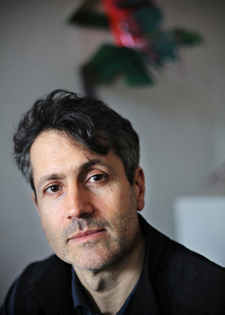 Luca Buvoli (photograph by Keke Keukelaar)
Luca Buvoli, an interdisciplinary artist, has been appointed director of the Mount Royal School of Art at Maryland Institute College of Art in Baltimore.

Muriel Hasbun, chair of photography at the Corcoran College of Art and Design in Washington, DC, has been promoted to professor at her school.

 Jean Robertson
Jean Robertson, an art historian and professor in the Herron School of Art and Design at Indiana University–Purdue University Indianapolis, has been named Chancellor’s Professor, the highest academic rank at the university.

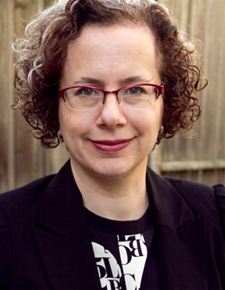 Rachel Schreiber
Rachel Schreiber, formerly director of humanities and sciences at California College of the Arts in Oakland and San Francisco, has become dean and vice president for academic affairs at the San Francisco Art Institute. She will assume her duties on July 1, 2013.
Tanya Sheehan has been promoted to associate professor in the Art History Department at Rutgers University in New Brunswick, New Jersey, where she has taught since 2008. In September 2013 she will take a new position, associate professor of American art, at Colby College in Waterville, Maine.
Museums and Galleries

 Peter Barnet
Peter Barnet, the Michel David-Weill Curator in Charge of the Metropolitan Museum of Art’s Department of Medieval Art and the Cloisters in New York, has been promoted to the newly created position of senior curator. His new position begins on September 1.
Connie Butler, chief curator of drawings at the Museum of Modern Art in New York, has been named chief curator of the Hammer Museum, part of the University of California, Los Angeles. Her new job begins in July.
C. Griffith Mann, deputy director and chief curator of the Cleveland Museum of Art in Ohio, has been appointed Michel David-Weill Curator in Charge of the Department of Medieval Art and the Cloisters at the Metropolitan Museum of Art in New York, succeeding Peter Barnet. He assumes his new position on September 1.

 Ugochukwu-Smooth Nzewi
Ugochukwu-Smooth Nzewi, a specialist in modern and contemporary African and African diaspora art, has been appointed the first curator of African art for the Hood Museum of Art at Dartmouth College in Hanover, New Hampshire.
Jonathan F. Walz, curator of the Cornell Fine Arts Museum at Rollins College in Winter Park, Florida, has resigned in order to devote more time to a national traveling exhibition that he is cocurating, This Is a Portrait If I Say So.
Institutional News
posted Jun 17, 2013
Read about the latest news from institutional members.
Institutional News is published every two months: in February, April, June, August, October, and December. To learn more about submitting a listing, please follow the instructions on the main Member News page.
June 2013

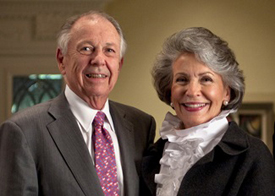 Linda and William Custard of Dallas, Texas
The Meadows Museum of Art at Southern Methodist University in Dallas, Texas, has received a $1 million gift from Linda and William Custard to establish and endow the position of Linda P. and William A. Custard Director of the Meadows Museum and Centennial Chair in the Meadows School of the Arts. The position will also receive an additional $1 million in funding to endow the position.
Travel Grants to Attend the 2014 Annual Conference in Chicago
posted Jun 17, 2013
 CAA offers Annual Conference Travel Grants to graduate students in art history and studio art and to international artists and scholars. In addition, the Getty Foundation has funded the second year of a program that enables twenty applicants from outside the United States to attend the 2014 Annual Conference in Chicago. Applicants may apply for more than one grant but can only receive a single award.
CAA Graduate Student Conference Travel Grant
CAA will award a limited number of $250 Graduate Student Conference Travel Grants to advanced PhD and MFA graduate students as partial reimbursement of travel expenses to attend the 102nd Annual Conference, taking place February 12–15, 2014, in Chicago. To qualify for the grant, students must be current CAA members. Successful applicants will also receive complimentary conference registration. Deadline: September 13, 2013.
CAA International Member Conference Travel Grant
CAA will award a limited number of $500 International Member Conference Travel Grants to artists and scholars from outside the United States as partial reimbursement of travel expenses to attend the 102nd Annual Conference, taking place February 12–15, 2014, in Chicago. To qualify for the grant, applicants must be current CAA members. Successful applicants will also receive complimentary conference registration. Deadline: September 13, 2013.
CAA International Travel Grant Program
The CAA International Travel Grant Program, generously supported by the Getty Foundation, provides funding to twenty art historians, museum curators, and artists who teach art history to attend the 102nd Annual Conference, taking place February 12–15, 2014, in Chicago. The grant covers travel expenses, hotel accommodations, per diems, conference registrations, and one-year CAA memberships. The program also includes a one-day preconference meeting to be held on February 11, providing grant recipients and their hosts with the opportunity to address their common professional interests and issues. Applicants do not need to be CAA members. Deadline extended: August 23, 2013.
Donate to the Annual Conference Travel Grants
CAA’s Annual Conference Travel Grants are funded solely by donations from CAA members—please contribute today. Charitable contributions are 100 percent tax deductible. CAA extends a warm thanks to those members who made voluntary contributions to this fund during the past twelve months.
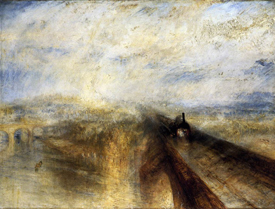
Image: Joseph Mallord William Turner, Rain, Steam and Speed—The Great Western Railway, 1844, oil on canvas, 35⅞ x 49 in. National Gallery, London (artwork in the public domain)
Grants, Awards, and Honors
posted Jun 15, 2013
CAA recognizes its members for their professional achievements, be it a grant, fellowship, residency, book prize, honorary degree, or related award.
Grants, Awards, and Honors is published every two months: in February, April, June, August, October, and December. To learn more about submitting a listing, please follow the instructions on the main Member News page.
June 2013

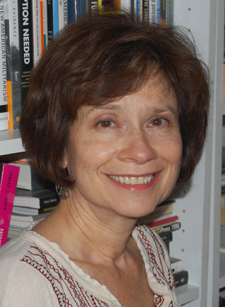 Dora Apel
Dora Apel has received a Marilyn Williamson Distinguished Faculty Fellowship for 2013–14, awarded by the Humanities Center at Wayne State University in Detroit, Michigan.
Sarah D. Beetham, a doctoral candidate in the Department of Art History at the University of Delaware in Newark, has received a 2013 Henry Luce Foundation/American Council of Learned Societies Dissertation Fellowship. Her research project is titled “Sculpting the Citizen Soldier: Reproduction and National Memory, 1865–1917.”
Leigh Behnke, an artist and lecturer at the School of Visual Arts in New York, has earned a 2013 fellowship in fine arts from the John Simon Guggenheim Memorial Foundation.
Jill E. Bugajski, a PhD student in the Department of Art History at Northwestern University in Evanston, Illinois, has accepted a 2013 Henry Luce Foundation/American Council of Learned Societies Dissertation Fellowship. She is researching “Totalitarian Aesthetics and the Democratic Imagination in American Art, 1933–1947.”
Mary Katherine Campbell, assistant professor of art history in the School of Art at the University of Tennessee, Knoxville, has earned a 2013 ACLS Fellowship from the American Council of Learned Societies. Her project is called “Mormon Porn: Charles Ellis Johnson’s Stereographic Sinners and Latter-Day Saints.”

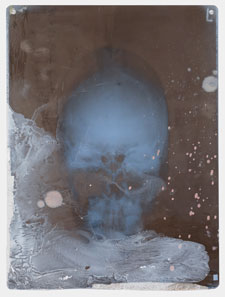 Cora Cohen, R 77, 2011, acrylic, Flashe, and tape on roentgenograph, 15⅝ x 11¾ in. (artwork © Cora Cohen)
Cora Cohen, an artist based in Long Island City, New York, has received a 2013 fellowship in fine arts from the John Simon Guggenheim Memorial Foundation.
Huey Copeland, associate professor of art history at Northwestern University in Evanston, Illinois, has been given a 2013 ACLS Fellowship from the American Council of Learned Societies. He will use the funds to work on his project, “In the Arms of the Negress: A Brief History of Modern Artistic Practice.”
Katelyn D. Crawford, a doctoral student in the McIntire Department of Art at the University of Virginia in Charlottesville, has accepted a 2013 Henry Luce Foundation/American Council of Learned Societies Dissertation Fellowship to continue work on “Transient Painters, Traveling Canvases: Portraiture and Mobility in the British Atlantic, 1750–1780.”

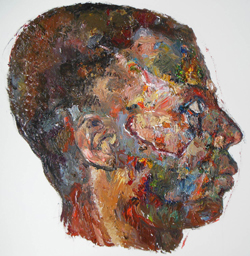 Elise Dodeles, San Francisco Area Fighter A885 in Profile, 2012 (artwork © Elise Dodeles)
Elise Dodeles has been awarded a 2013 New Jersey Individual Artist’s Fellowship for Painting from the New Jersey State Council on the Arts.
Klint Ericson, a doctoral student in the Art Department at the University of North Carolina, Chapel Hill, has earned a 2013 Henry Luce Foundation/American Council of Learned Societies Dissertation Fellowship. He will continue working on “Sumptuous and Beautiful, As They Were: Architectural Form, Everyday Life, and Cultural Encounter in a Seventeenth-Century New Mexico Mission.”
Coco Fusco, an artist based in Brooklyn, New York, has won a 2013 fellowship in film and video from the John Simon Guggenheim Memorial Foundation.

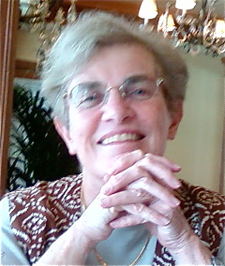 Mary D. Garrard
Mary D. Garrard, professor emerita of art history at American University in Washington, DC, visited the University of Miami in Coral Gables, Florida, as Stanford Distinguished Professor in the Humanities in February 2013. While in residence, Garrard delivered the keynote address for a conference celebrating the university’s Center for the Humanities as the new publication site for Early Modern Women: An Interdisciplinary Journal; she also gave another plenary session lecture for conferees.

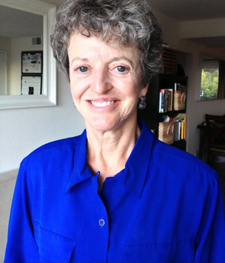 Ann Eden Gibson
Ann Eden Gibson, professor emerita of art history at the University of Delaware in Newark, has won the Georgia O’Keeffe Foundation’s Research Center Book Prize for Abstract Expressionism: Other Politics (1997). The triennial $5,000 prize honors the author of a significant book on some aspect of American modernism published from the mid-1980s to 2009.
Sharon Harper, an artist and associate professor of visual and environmental studies at Harvard University in Cambridge, Massachusetts, has received a 2013 fellowship in photography from the John Simon Guggenheim Memorial Foundation.
Guy Heedren, professor of art at Williams College in Williamstown, Massachusetts, has won a 2013 fellowship in fine-arts research from the John Simon Guggenheim Memorial Foundation.
Laura Turner Igoe, a graduate student in art history at Temple University’s Tyler School of Art in Philadelphia, Pennsylvania, has received a 2013 Henry Luce Foundation/American Council of Learned Societies Dissertation Fellowship. Her research project is called “The Opulent City and the Sylvan State: Art and Environmental Embodiment in Early National Philadelphia.”

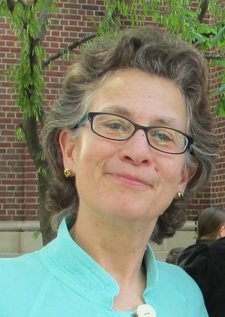 Sharon Irish
Sharon Irish, an art and architectural historian, has been awarded a Colston Research Fellowship from the Institute of Advanced Study at the University of Bristol in England for spring 2014, hosted by the Department of Drama: Theatre, Film, and Television, in conjunction with the Productive Margins program. As a Benjamin Meaker Visiting Professor, Irish will continue her research on the artists Stephen Willats and Suzanne Lacy, in collaboration with the Knowle West Media Centre in Bristol. Her project is entitled “In the Margins? Local Knowledge and Self-Organization.”
Susan N. Johnson-Roehr, who recently earned her PhD in architectural history from the University of Illinois, Urbana-Champaign, has been named a New Faculty Fellow by the American Council of Learned Societies. She will take up a two-year position at the University of Virginia in Charlottesville.

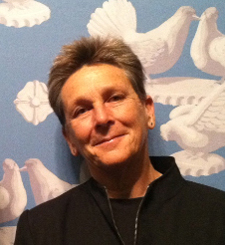 Tirza True Latimer
Tirza True Latimer, chair of the graduate program in Visual and Critical Studies at California College of the Arts in San Francisco, has received a National Endowment for the Humanities Summer Stipend to complete research for a book, provisionally titled Eccentric Modernisms: Making Differences in the History of American Art.
Megan R. Luke, assistant professor in the Department of Art History at the University of Southern California in Los Angeles, and Sarah B. H. Hamill, assistant professor of art at Oberlin College in Oberlin, Ohio, have received a Collaborative Research Fellowship from the American Council of Learned Societies. Their project is entitled “Sculpture and Photography: The Art Object in Reproduction.”
Lyle Massey, associate professor in the Art History Department at the University of California, Irvine, has been awarded a Frederick Burkhardt Residential Fellowship from the American Council of Learned Societies. She will be in residence at the Huntington Library, Art Collections, and Botanical Gardens in Pasadena to work on her project, “Woman Inside Out: Gender, Dissection, and Representation in Early Modern Europe.”

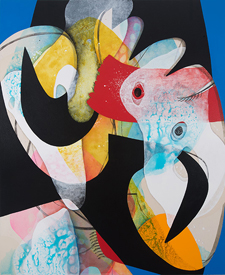 Carrie Moyer, Hook, Line & Sinker, 2012, acrylic, graphite, and glitter on canvas, 72 x 60 in. Collection of the artist (artwork © Carrie Moyer)
Carrie Moyer, an artist based in Brooklyn and associate professor of art and art history at Hunter College, City University of New York, has received a 2013 fellowship in fine arts from the John Simon Guggenheim Memorial Foundation.
Jennifer Anne Norman has completed a fall 2012 artist residency at the Sam and Adele Golden Foundation for the Arts, located in New Berlin, New York.
Erin K. Pauwels, a doctoral candidate in the history of art at Indiana University in Bloomington, has received a 2013 Henry Luce Foundation/American Council of Learned Societies Dissertation Fellowship. She continue working on her dissertation, “Sarony’s Living Pictures: Performance, Photography, and Gilded Age American Art.”
Naomi Ruth Pitamber, a doctoral student in art history at the University of California, Santa Barbara, has earned a Mellon/ACLS Dissertation Completion Fellowship from the American Council of Learned Societies. She will continue work on her research project, “Re-Placing Byzantium: Laskarid Urban Environments and the Landscape of Loss, 1204–1261.”
D. Jacob Rabinowitz, a PhD student in the Institute of Fine Arts at New York University, has been awarded a 2013 Henry Luce Foundation/American Council of Learned Societies Dissertation Fellowship to continue his project, “Public Construction: Christo and Jeanne-Claude’s Running Fence.”
Yael Rice, an art historian who teaches at Amherst College in Amherst, Massachusetts, has received a Rare Book School Mellon Fellowship in Critical Bibliography to attend the University of Virginia’s Rare Book School, a three-year program for early-career scholars that seeks to reinvigorate bibliographic studies in the humanities.
Conrad Rudolph, professor of medieval art history at the University of California, Riverside (UCR), has won a 2012–13 Digital Humanities Grant from the National Endowment for the Humanities for a project, “FACES: Faces, Art, and Computerized Evaluation Systems,” that he is researching with his UCR colleagues, Amit Roy-Chowdhury (electrical engineering) and Jeanette Kohl (art history).
D. Fairchild Ruggles, a professor of landscape architecture at the University of Illinois, Urbana-Champaign, has won a 2013 fellowship from the American Council of Learned Societies. The award, which supports individual scholars working in the humanities and related social sciences, will sustain her project, “Shajar al-Durr: The Extraordinary Architectural Patronage of a Thirteenth-Century Egyptian Slave-Queen.”
Gary Schneider, an artist based in Brookhaven, New York, and assistant professor of visual arts in the Mason Gross School of the Arts at Rutgers University in New Brunswick, New Jersey, has received a 2013 fellowship in photography from the John Simon Guggenheim Memorial Foundation.
William Tronzo of the University of California, San Diego, and an affiliate of Università degli Studi Roma Tre has been awarded a multiyear grant from the Getty Foundation for a project he has been working on with Kimberly Bowes of the University of Pennsylvania and Mellon Professor at the American Academy in Rome. Called “Framing the Medieval Mediterranean: Museums and Archaeology in National Discourse,” the project will bring together scholars and museum professionals from North Africa, the Middle East, Europe, and America to discuss their common and divergent aims, methodologies, approaches, and techniques regarding the collection and display of medieval material culture, as well as the influence of national narratives on shaping field- and institution-specific goals. The grant is part of the Getty Foundation’s Connecting Art Histories initiative, which aims to increase scholarly exchange among individuals in key international regions whose economic or political realities have prevented previous collaboration.
Edward Vazquez, assistant professor of the history of art and architecture at Middlebury College in Middlebury, Vermont, has earned a 2013 ACLS Fellowship from the American Council of Learned Societies for his research on “Aspects: Fred Sandback’s Sculpture.”

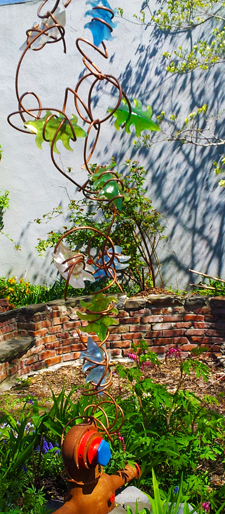 Fotini Vurgaropulou, Red Hook Mama, 2013, steel, paint, copper, and cast resin (artwork © Fotini Vurgaropulou)
Fotini Vurgaropulou, an artist based in Brooklyn, New York, has been commissioned by the Backyard Garden and New York’s GreenThumb program to install a 9-foot-tall mixed-media sculpture (steel, paint, copper, and cast resin) in a public garden in the neighborhood of Red Hook. The piece is on view from April 21 to August 4, 2013.

 Nancy L. Wicker
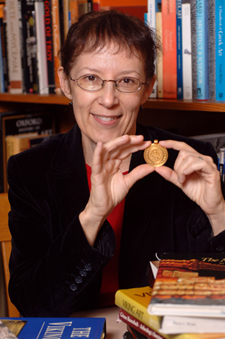
Nancy L. Wicker, professor of art history at the University of Mississippi in Oxford, has been named a recipient of a Digital Humanities Start-Up Grant by the National Endowment for the Humanities to initiate “Project Andvari: A Digital Portal to the Visual World of Early Medieval Northern Europe” with a codirector, Lilla Kopár of the Catholic University and the Institute for Advanced Technology in the Humanities at the University of Virginia.
Alice Pixley Young has accepted a fellowship for a summer residency at the Jentel Artist Residency Program. She will spend the month of July living and working in Banner, Wyoming.
Gregory A. Zinman, who recently earned a doctorate in cinema studies from New York University, has been appointed by the American Council of Learned Societies as a two-year New Faculty Fellow in film at Columbia University in New York.
Exhibitions Curated by CAA Members
posted Jun 15, 2013
Check out details on recent shows organized by CAA members who are also curators.
Exhibitions Curated by CAA Members is published every two months: in February, April, June, August, October, and December. To learn more about submitting a listing, please follow the instructions on the main Member News page.
June 2013
Patricia G. Berman and Pari Stave. MUNCH | WARHOL and the Multiple Image. Scandinavia House, Nordic Center in America, New York, April 27–July 27, 2013.
June Blum. A Celebration of Women’s Art. Cocoa Beach Library, Cocoa Beach, Florida, April 1–19, 2013.
Bruce Boucher. Corot to Cézanne: French Drawings from the Collection of Mr. and Mrs. Paul Mellon at the Virginia Museum of Fine Arts. Fralin Museum of Art, University of Virginia, Charlottesville, Virginia, January 25–June 2, 2013.
Rachel Epp Buller. Postpartum. Erman B. White Gallery of Art, Butler Community Collece, El Dorado, Kansas, March 1–April 5, 2013.
Rachel Epp Buller. Working on the Bias. Stiefel Watson Gallery, Stiefel Theater for the Performing Arts, Salina, Kansas, February 21–April 22, 2013.

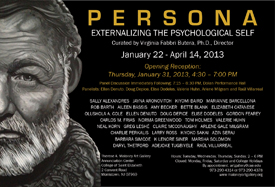
Virginia Fabbri Butera. Persona: Externalizing the Psychological Self. Therese A. Maloney Art Gallery, Annunciation Center, College of Saint Elizabeth, Morristown, New Jersey, January 22–April 14, 2013.

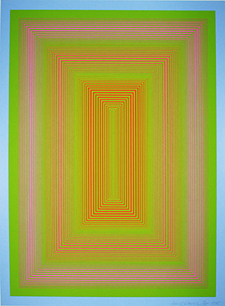 Richard Anuszkiewicz, New Glory, 1975, screen print, 26 x 19½ in. (artwork © Richard Anuszkiewicz)
Tyrus R. Clutter. Out of Abstraction: Divergent Directions in Late 20th Century Art. Appleton Museum of Art, Ocala, Florida, April 5–June 2, 2013.

 Suzanne McClelland, Soft Partition, 2012, ink and graphite on Yupo paper, 9 x 12 in. (artwork © Suzanne McClelland)
Jennifer Farrell. STrAY: Found Poems from a Lost Time. Fralin Museum of Art, University of Virginia, Charlottesville, Virginia, January 25–May 26, 2013.

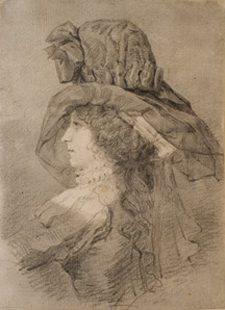 Jean-Baptiste Isabey, Jeanne Justine Laurice de Salienne (The Artist’s Wife), ca. 1789, pencil and grey wash, 7 x 5⅛ in. Fralin Museum of Art, University of Virginia, Charlottesville (artwork in the public domain)
Lawrence O. Goedde. Traces of the Hand: Master Drawings from the Collection of Frederick and Lucy S. Herman. Fralin Museum of Art, University of Virginia, Charlottesville, Virginia, January 25–May 26, 2013.
Reni Gower. Papercuts. Eleanor D. Wilson Museum, Hollins University, Roanoke, Virginia, May 31–September 14, 2013.
Reni Gower. Heated Exchange: Contemporary Encaustic. Elizabeth Stone Harper Gallery, Harper Center for the Arts, Presbyterian College, Clinton, South Carolina, January 17–February 23, 2013.

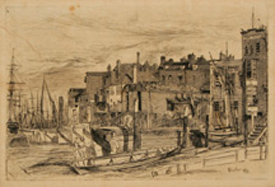 James McNeill Whistler, Nocturne, 1878, lithotint on blue laid chine collé, second state, 6¾ x 10⅛ in. Fralin Museum of Art, University of Virginia, Charlottesville (artwork in the public domain)
Emilie Johnson. Becoming the Butterfly: Landscapes of James McNeill Whistler. Fralin Museum of Art, University of Virginia, Charlottesville, Virginia, January 25–April 28, 2013.
Emilie Johnson. Becoming the Butterfly: Portraits of James McNeill Whistler. Fralin Museum of Art, University of Virginia, Charlottesville, Virginia, April 30–August 4, 2013.
Julian Kreimer. Part of the Story. Lower East Side Printshop, New York, March 20–May 12, 2013.

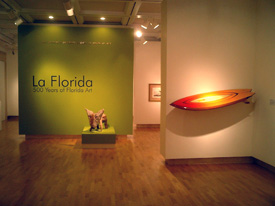 Installation view of La Florida: 500 Years of Florida Art
Preston Thayer. La Florida: 500 Years of Florida Art. Thomas H. Jacobsen Gallery of American Art, Cummer Museum of Art and Gardens, Jacksonville, Florida, January 15–October 6, 2013.
Books Published by CAA Members
posted Jun 15, 2013
Publishing a book is a major milestone for artists and scholars—browse a list of recent titles below.
Books Published by CAA Members appears every two months: in February, April, June, August, October, and December. To learn more about submitting a listing, please follow the instructions on the main Member News page.
June 2013

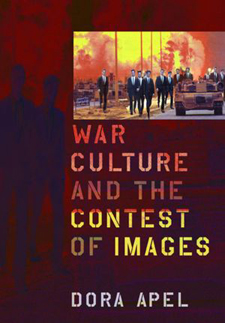
Dora Apel. War Culture and the Contest of Images (New Brunswick, NJ: Rutgers University Press, 2012).

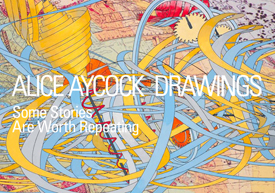
Jonathan Fineberg. Alice Aycock: Drawings; Some Stories Are Worth Repeating (Southampton, NY: Parrish Art Museum, 2013).

Wayne Franits. The Paintings of Dirck van Baburen, ca. 1592/93–1624: Catalogue Raisonné (Philadelphia: John Benjamins, 2013).

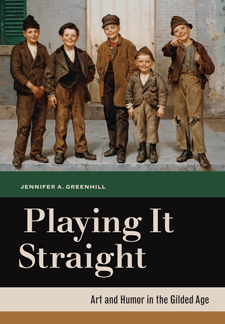
Jennifer A. Greenhill. Playing It Straight: Art and Humor in the Gilded Age (Berkeley: University of California Press, 2012).


Ellen G. Landau. Mexico and American Modernism (New Haven, CT: Yale University Press, 2013).

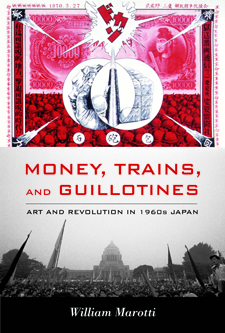
William Marotti. Money, Trains, and Guillotines: Art and Revolution in 1960s Japan (Durham, NC: Duke University Press, 2013).


Julie Wosk. Breaking Frame: Technology, Art, and Design in the Nineteenth Century (New York: An Authors Guild Backinprint.com Edition, 2013).

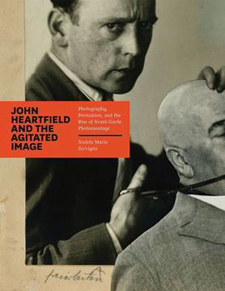
Andrés Mario Zervigón. John Heartfield and the Agitated Image: Photography, Persuasion, and the Rise of Avant-Garde Photomontage (Chicago: University of Chicago Press, 2012).
NEA Releases New Research Tool on Working Artists
posted Jun 13, 2013
What do we know about the 2.1 million artists in the United States’ labor force? To help answer that question, the National Endowment for the Arts (NEA) has released Equal Opportunity Data Mining: National Statistics about Working Artists. This new online research tool offers seventy searchable tables with figures on working artists by state and metropolitan area, by demographic information (including race and ethnicity, age, gender, and disability status), and by residence and workplace. The public is welcome to investigate the tables, a map of state-level rankings, and links to original sources.
“Artists represent just 1.4 percent of the labor force, but they have an outsized role as entrepreneurs and innovators who contribute to the vitality of the communities where they live and work,” said the NEA’s acting chairman, Joan Shigekawa. “These data add further detail and nuance to our understanding of the profile of American artists.”
This new research resource gives statistical profiles of Americans who reported an artist occupation as their primary job, whether full-time, part-time, or self-employed. The data set looks at artists in eleven distinct occupations: actors; announcers; architects; art directors, fine artists, and animators; dancers and choreographers; designers; entertainers and performers; musicians; photographers; producers and directors; and writers and authors. Some tables offer data on employed artists in particular, while other tables measure all artists in the workforce, both employed and looking for work.
The NEA created these data sets based on the US Census Bureau’s Equal Employment Opportunity (EEO) Tables. Every ten years, the Census Bureau produces EEO tables using data from its annual American Community Survey (ACS). This set of EEO tables is drawn from the ACS survey results for 2006–10, which were combined to obtain a large enough sample. The EEO tables are the federal standard for comparing the race, ethnicity, and gender composition of the labor market in specific geographic areas and job categories.
Equal Opportunity Data Mining is the first installment of a series of Arts Data Profile webpages that the NEA will release over the next several months. Future NEA Arts Data Profiles will introduce public data about arts participation and arts organizations, and additional data on artists in the workforce.
Some findings that emerge from the EEO tables include:
- One-fourth of all American architects are women. Yet in Maryland, Massachusetts, Montana, and Washington, the share is roughly one-third. By contrast, in Arkansas, West Virginia, and Wyoming, nearly all architects are men
- Nationally, 4 percent of all artists are disabled, compared with 6 percent of the labor force. At 7 percent, the share of dancers and musicians with a disability is somewhat higher. The percentage of working musicians with a disability is comparatively high in Alaska (25 percent), Alabama (14 percent), Kentucky (16 percent), and Wisconsin (13 percent)
- In Oregon, 40 percent of working actors are African American, Asian, Native American, Pacific Islander, or other, while these ethnic and racial groups make up only 20 percent of the total Oregon labor force
- Roughly one-quarter of musicians working in Nashville commute to the city from outside areas. For example, an estimated one hundred musicians commute thirteen miles from Hendersonville (Sumner County); twenty musicians commute from Franklin, and an additional sixty-five musicians commute to Nashville from other parts of Williamson County
The research tool also includes a video tutorial, links to additional resources (such as the US Census Bureau’s American Fact Finder page), and surveys and databases from the US Department of Labor’s Bureau of Labor Statistics.
For more than thirty years, the NEA has been the only federal agency to use US Census data to analyze artists in the workforce. The NEA seeks to extend the conversation on arts research through commissioned research, direct research grants, and research convenings to encourage more rigorous research on the impact of the arts in other domains of American life, such as education, health and well-being, community livability, and economic prosperity. Recent endeavors include a landmark partnership between the NEA and the US Bureau of Economic Analysis to develop an Arts and Cultural Production Satellite Account that will identify and calculate the arts and culture sector’s contributions to the Gross Domestic Product (GDP). The NEA has convened seventeen federal agencies in the NEA Interagency Task Force on the Arts and Human Development, to foster more research on the arts’ role in improving health and educational outcomes throughout the lifespan. Just published, Creative Communities from Brookings Institution Press is based on a first-ever convening between the NEA and the Brookings Institution on the arts and economic development.
About the National Endowment for the Arts
The National Endowment for the Arts was established by Congress in 1965 as an independent agency of the federal government. To date, the NEA has awarded more than $4 billion to support artistic excellence, creativity, and innovation for the benefit of individuals and communities. The NEA extends its work through partnerships with state arts agencies, local leaders, other federal agencies, and the philanthropic sector.
News from the Art and Academic Worlds
posted Jun 12, 2013
Each week CAA News publishes summaries of eight articles, published around the web, that CAA members may find interesting and useful in their professional and creative lives.
When Artworks Crash: Restorers Face Digital Test
Paintings fade; sculptures chip. Art restorers have long known how to repair those material flaws, so the experience of looking at a Vermeer or a Rodin remains basically unchanged over time. But when creativity is computerized, the art isn’t so easy to fix. For instance, when a web-based work becomes technologically obsolete, does updated software simply restore it? Or is the piece fundamentally changed? (Read more in the New York Times.)
Crowdfunding Academic Research
When a professor from a small liberal-arts college in central Pennsylvania decided to take on a massive research project two summers ago, he went through the usual, often futile, process of applying for federal and private grants. But when funds were short a year later, he went down a nontraditional route—turning to the public and the internet for help. In fifty days, Juniata College’s Chris Grant and his research partner, Gina Lamendella, raised $10,800 through a crowdfunding website called iAMscientist. (Read more in Insider Higher Ed.)
Self-Sabotage in the Academic Career
Pogo recognized long ago that we often are our own worst enemies. Sure, he was a cartoon character, but he had a point—especially in higher education, where self-sabotage seems to be a standard characteristic of academic careers. In my thirty years as a professor, five years as a dean, and three years as a provost, I have observed many academics harm their own careers, often without realizing it. Here are fifteen ways in which you can be most self-destructive. (Read more in the Chronicle of Higher Education.)
Help Desk: Curating Like a Fool
I’m an artist and art writer and would like to complete the trifecta by seriously trying to curate. However, since I’ve only been on the curated side of the table, I know embarrassingly little about the nitty-gritty of it. For example, when I have a proposal ready, do I inform the proposed artists of my intentions before or after I submit the proposal? Who arranges and pays for shipping work? I only know how I’ve personally been treated and not what is typical. I’m too afraid of looking like a fool to give it a shot. (Read more in Daily Serving.)
“Stuff Matters”: The Crucial Work of the AIC’s Collections Emergency Response Team
The Collections Emergency Response Team, says Eric Pourchot, institutional advancement director at the Foundation of the American Institute for Conservation, “came out of the experience we had after Hurricane Katrina, as many of our members from AIC had served on teams that went down to the New Orleans and Gulf Coast area to help cultural institutions recover as best they could from that disaster.” (Read more in Can You Dig It?.)
Are Video Games the Next Great Art Form?
In 2005, the late film critic Roger Ebert created a storm of controversy when he wrote that video games could never be art. While Ebert wasn’t the first person to address the subject, he was one of the first mainstream critics to do so, and his statement set off a rash of essays, blog posts, and talks arguing for (few) and against (many) his position. The subject has drifted in and out of popular culture ever since, with different scholars weighing in here and there. Recently, a number of museums, including the Smithsonian and MoMA, staged exhibitions featuring video games as art, throwing the topic into focus again. (Read more in Pacific Standard.)
Experimenting with Facebook in the College Classroom
While discussing the nuances of regression analysis, I saw some of my students smiling. It wasn’t a smile of understanding; it was a response to seeing a Facebook comment on their smart phone. I later learned that 99 percent of the students in the research method class were Facebook users, routinely checking for updates ten to twenty times a day. The next semester, I decided to embrace social media and created a Facebook page for the class, which was comprised of twenty-five students. It was actually fun and easy. In less than two hours, I had created a page with relevant material for the course. (Read more in Faculty Focus.)
The Deduction for Charitable Contributions: The Sacred Cow of the Tax Code?
In his most recent budget proposal, President Barack Obama seeks to impose a cap on itemized deductions in the personal income tax return—which includes the deduction for charitable contributions. This provision, part of the administration’s strategy to raise revenue to pay for government spending, has been a part of every White House budget proposal since 2009, and every year arts advocacy organizations join the rest of the nonprofit sector in opposing the changes. So far, the cap has been successfully warded off, but there’s growing concern that if Republicans and Democrats ever agree on sweeping tax reforms, the charitable deduction will be on the chopping block. (Read more in Createquity.)
June 2013 Issue of The Art Bulletin
posted Jun 11, 2013
 The June 2013 Art Bulletin, the leading publication of international art-historical scholarship, is the second issue of the journal’s centennial year. In “Regarding Art and Art History,” Cecelia F. Klein ponders Precolumbian art and the canon. “Notes from the Field” offers short essays on the subject of mimesis by Dexter Dalwood, Suzanne Preston Blier, Daniela Bohde, Helen C. Evans, Sarah E. Fraser, Thomas Habinek, Tom Huhn, Jeanette Kohl, Niklaus Largier, Peter Mack, and Alex Potts. The June interviewee is Timon Screech, who discusses fantasies and foreign contact in the art history of Japan with Yukio Lippit.
In their essay “An Émigré Art Historian and America: H. W. Janson,” Elizabeth Sears and Charlotte Schoell-Glass explore institutional art history in the mid-twentieth century through the lens of the American career of the German-born author of the classic survey text, History of Art. Emine Fetvaci’s “From Print to Trace” considers why the Ottoman creators of a 1579 book of imperial portraits may have consulted European models, raising questions about the understanding of the portrait as a visual document and the concepts that underpinned it.
Analyzing the intricate iconography of an illustrated thesis print on the system of natural philosophy by the seventeenth-century Franciscan professor Martin Meurisse, Susanna Berger demonstrates the complex uses of imagery in philosophy education in early modern France. Viccy Coltman studies a group of portraits of the Frasers of Reeling, a Scottish Highland family, by the late-eighteenth- and early-nineteenth-century Scottish artist Henry Raeburn to reveal an understanding of portrait likeness as present and prescient in the global British Empire. Finally, in “The Cultural Politics of the Brushstroke” Martin Powers examines the debates between and among European, American, and Chinese intellectuals over some four centuries in order to deconstruct the seductive rhetoric of the brushstroke as employed in both “East” and “West.”
In the Reviews section, Charles Palermo considers three books on fin-de-siècle culture in Europe: Dario Gamboni’s The Brush and the Pen: Odilon Redon and Literature, Linda Goddard’s Aesthetic Rivalries: Word and Image in France, 1880–1926, and Anna Sigrídur Arnar’s The Book as Instrument: Stéphane Mallarmé, the Artist’s Book, and the Transformation of Print Culture. Next, Bridget Alsdorf reviews Mary Jane Jacob and Michelle Grabner’s edited volume, The Studio Reader: On the Space of Artists, and Bolaji Campbell assesses David T. Doris’s Vigilant Things: On Thieves, Yoruba Anti-Aesthetics, and the Fates of Ordinary Objects in Nigeria.
CAA sends The Art Bulletin to all institutional members and to those individuals who choose to receive the journal as a benefit of their membership. The next issue of the quarterly publication, to appear in September 2013, will feature essays on, among other topics, Albrecht Dürer, Horace Walpole, Tanaka Atsuko, and public fountains in nineteenth-century Havana.