CAA News Today
New Members of CAA Committees
posted Feb 06, 2013
CAA’s nine Professional Interests, Practices, and Standards Committees welcome their newly appointed members, who will serve three-year terms (2013–16). In addition, five new chairs will take over committee leadership, and several members of the CAA Board of Directors assume liaison posts. New committee members, chairs, and board liaisons will begin their terms at the 101st Annual Conference, to be held February 13–16, 2013, in New York. CAA warmly thanks all outgoing committee members for their years of service to the organization.
A call for nominations for these committees appears annually from July to September in CAA News and on the CAA website. CAA’s president, vice president for committees, and executive director review all nominations in November and make appointments that take effect the following February. CAA’s vice president for committees, DeWitt Godfrey of Colgate University, is an ex officio member of all nine groups.
New Committee Members, Chairs, and Board Liaisons
Committee on Diversity Practices: Julie L. McGee, University of Delaware; and Staci Scheiwiller, California State University, Stanislaus. The new board liaison is Leslie Bellavance of Alfred University, and the new committee chair is Susan D. Zurbrigg from James Madison University, replacing Kevin Concannon of Virginia Polytechnic Institute and State University.
Committee on Intellectual Property: Kenneth Cavalier, University of British Columbia; Anne Norcross, Ferris State University; and Cynthia Underwood, United States Patent and Trademark Office. A new board liaison to the committee is Suzanne Preston Blier of Harvard University.
Committee on Women in the Arts: Rocío Aranda-Alvarado, El Museo del Barrio; Jonathan D. Katz, University at Buffalo, State University of New York; and Neysa Page-Lieberman, Columbia College Chicago. The new chair is Claudia Sbrissa of St. John’s University, taking over from Maria Elena Buszek of the University of Colorado in Denver.
Education Committee: Kirsten Ataoguz, Indiana University–Purdue University, Fort Wayne; Leda Cempellin, South Dakota State University; and Bertha Gutman, Delaware County Community College. After serving three years as committee chair, Rosanne Gibel of the Art Institute of Fort Lauderdale will be succeeded by Julia A. Sienkewicz of Duquesne University.
International Committee: Francesca Fiorani, University of Virginia; Federico Freschi, University of Johannesburg; Annelise Jarvis-Hansen, independent artist, Copenhagen; and Valérie Rousseau, American Folk Art Museum. Gail Feigenbaum of the Getty Research Institute joins the committee as board liaison.
Museum Committee: Jeffrey Abt, Wayne State University; Joseph Becherer, Frederik Meijer Gardens and Sculpture Park; Makeda Best, University of Vermont; and Tracy Fitzpatrick, Neuberger Museum of Art, Purchase College, State University of New York. The new committee chair is N. Elizabeth Schlatter of the University of Richmond Museums, who takes over from Karol A. Lawson of Sweet Briar College.
Professional Practices Committee: Thomas Berding, Michigan State University; Virginia Maksymowicz, Franklin and Marshall College; and Jonathan F. Walz, Rollins College.
Services to Artists Committee: Michelle Grabner, School of the Art Institute of Chicago; Jenny Marketou, independent artist, New York; Martha Schwendener, critic, Brooklyn; and Molly Zuckerman-Hartung, artist, Chicago.
Student and Emerging Professionals Committee: Jacquelyn N. Coutré, Adelphi University; Lauren Grace Kilroy, Brooklyn College, City University of New York; Carolyn Jean Martin, San Francisco Art Institute; and John Douglas Powers, University of Alabama, Birmingham. Megan Koza Mitchell-Young of the Dishman Art Museum at Lamar University succeeds Jennifer Stoneking-Stewart of the University of Tennessee, Knoxville, as chair.
News from the Art and Academic Worlds
posted Feb 06, 2013
Each week CAA News publishes summaries of eight articles, published around the web, that CAA members may find interesting and useful in their professional and creative lives.
Classroom Meets Gallery
At the Yale University Art Gallery, a sunny new fourth-floor gallery was filled recently with a collection of artworks highly unlikely ever to meet in such proximity again. What thread could possibly unite these works? Not a purely curatorial one, of course, but a thread that wends its way through the often wonderfully murky territory where art appreciation meets education. The room, the Levin Study Gallery, is given over to professors—from art history but also from African American studies, South Asian studies, and gender and sexuality studies, among others—who choose pieces from Yale’s vast collection to serve as teaching tools. (Read more in the New York Times.)
Draft Document on Open Review Practices and Possibilities
In April 2011, MediaCommons and New York University Press jointly received a grant from the Andrew W. Mellon Foundation to support a yearlong study of open review practices and possibilities. The document that follows is a draft of the white paper that will serve as the grant’s primary outcome. (Read more at MediaCommons Press.)
Publishers and Library Groups Spar in Appeal to Ruling on Electronic Course Reserves
Fair use and electronic course reserves are back in court. A keenly watched copyright case that pitted three academic publishers against Georgia State University has entered the appeals phase, with a flurry of filings and motions this week and more expected soon. One surprise motion came from the United States Department of Justice, which requested more time to consider filing an amicus brief either in support of the publishers or in support of neither party. (Read more in the Chronicle of Higher Education.)
An Art Installation Made of the Cable News Crawl
We’re constantly inundated with news. Just look at your Twitter feed. We hop from North Korea to Top Chef to productivity tips without a second’s thought. But it’s strange, if you really think about it, that we process the world’s news as indiscriminately as sticking our fingers into every dish on a buffet. And That’s the Way It Is explores this idea of media inundation. By Ben Rubin, it’s a media installation at the University of Texas that scans closed-captioned chirons during the nightly news and projects those hot topics onto a building. (Read more at Fast Company.)
Major Art Museum Group Bolsters Rules for Acquiring Ancient Art
The ethics for adding ancient works to American art museum collections became substantially more stringent five years ago when the Association of Art Museum Directors (AAMD) decided to set the bar higher—prompted by complaints from Italy, Greece, and other ancient lands that museums had long turned a blind eye to evidence that pieces they owned had been looted from archaeological sites. Last month, the group announced a few more subtle tweaks to those guidelines, including requiring a public explanation on the AAMD’s website if a museum decides to acquire a piece despite gaps in its ownership record going back to fall 1970. (Read more in the Los Angeles Times.)
A Bronx Post Office, Home to Ben Shahn Murals, Could Be Sold
A landmark post office in the Bronx that contains thirteen Depression-era murals by the famed New Jersey artist Ben Shahn could be put up for sale. The proposal to sell the Bronx General Post Office on the Grand Concourse was outlined in a letter from the postal service to the Bronx borough president, Ruben Diaz Jr. (Read more at NJ.com.)
A New Way Forward
While some American art museums receive some government support, most depend on three main sources of money: (1) earned income from admissions, retail, restaurants, and the like; (2) revenue drawn from their endowments; and (3) annual contributions, which too often provide the largest part. In lean times, those donations tend to drop or level off—forcing cuts in staff, programming, and other costs or, sometimes, an increase in debt—and if Washington ever caps the tax deductibility of charitable donations, as many politicians want, it will make matters worse. (Read more in the Wall Street Journal.)
Curator, Tear Down These Walls
A modest proposal for this country’s great repositories of pre–twentieth-century American art: why don’t you, as Diana Vreeland might have asked, mix folk art in with the more realistic, academically correct kind that has so dominated museums since the nineteenth century? Despite rising interest in and scholarship about folk art—and even after the wholesale rethinking of several major American wings on the East Coast—the isolation of folk from academic is still the norm. (Read more in the New York Times.)
Download the Conference Abstracts and Directory of Attendees
posted Feb 05, 2013
 Registrants for the 2013 Annual Conference in New York can now download the Abstracts and Directory of Attendees. These publications, available as PDFs, summarize the contents of hundreds of papers and talks that will be presented in program sessions and list the names and contact information for those attendees who registered by both the early and advance deadlines.
Reading the abstracts in advance can help you plan your daily schedule at the conference. Program sessions are alphabetized by the chair’s last name and appear in the contents pages (4–10). An index in the back of the publication names all the speakers. Alternatively, use your Adobe Reader to conduct a keyword search for terms relevant to your interests. Similarly, the Directory of Attendees helps with networking during and communication after the conference.
To download the two publications, registrants can log into their CAA account, click the “Conference Registrant Information” image, and then click the Abstracts and/or Directory of Attendees icon to download a PDF. The Abstracts and Directory of Attendees are part of the registration package; there is no added cost to paid or complimentary registrants for access to these publications.
Conference attendees who purchase single-time slot tickets, or those who want the Abstracts but are not coming to New York, may attain the document for a charge: $30 for CAA members and $35 for nonmembers. The Abstracts and Directory of Attendees will remain on the CAA website for download or sale through July 31, 2013.
Beginning with the 2010 conference in Chicago, CAA offers its Abstracts exclusively as a PDF download. Past issues of the printed publication from 1999 to 2009 are also available. The cost per copy is $30 for CAA members and $35 for nonmembers. For more information and to order, please contact Roberta Lawson, CAA office coordinator.
Bridging the Digital Divide and So Much More
posted Feb 05, 2013
Ray Kurzweil predicts in How to Create a Mind: The Secret of Human Thought Revealed (New York: Viking, 2012) that, by 2030, intelligent computer devices will be scaled down to the size of blood cells. Kurzweil is a leading inventor (the CCD flatbed scanner, omnifont optical character recognition, a print-top-screen reading machine for the blind, and the first text-to-speech synthesizer, which led to the development of Siri) and director of engineering at Google. He believes that computer technology will soon replicate and exceed the functions of the human neocortex to a point where the barriers between the brain and computer will be totally permeable.
Until that time art historians, artists, and curators continue to rely on their neocortices to carry out creative work and research but with the help of extraordinary tech tools. CAA’s conference next week provides introductions to new technologies in the visual arts.
- THATCamp (The Technology and Humanities Camp) is being held two days prior to the Annual Conference to bring art historians, curators, and artists who publish together to focus on new technologies and means of accessing them for group and individual projects
- For those who could not attend THATCamp, a summary will be held during the conference at a panel session on Thursday, February 13 at 9:00 AM
- There are sessions throughout the conference that address the history, future, and current use of digital resources (“OS.XXI: Art’s Digital Future” on Wednesday, February 13) and online teaching (“Issues Surrounding the Online Foundations Experience” on Thursday, February 14). See http://conference.collegeart.org
- The Art Bulletin’s one-hundredth anniversary project is taking the form of a digital review. Thelma Thomas, chair of the Art Bulletin editorial board and associate professor of art history at the Institute of Fine Arts, New York University, has developed a multimedia review of the journal in partnership with the Alliance for Networking Visual Culture. The preview of the project will be presented at the Annual Members’ Business Meeting on Friday, February 14
- ARTspace will be screening new digital work in the Media Lounge throughout the conference, in addition to hosting artists’ interviews and sessions
Keynote Address: Rob Storr, dean of the Yale School of Art, will address the state of the visual arts in the keynote address.
Fair Use: Come to the Committee on Intellectual Property session on Saturday, February 16 to hear about the progress of CAA’s fair-use project with Peter Jaszi, Pat Aufderheide, Jeffrey Cunard, and Chris Sundt.
Attention Artists: The American Institute for Conservation (AIC) will provide free conservation advice and assistance to artists whose work was damaged by Hurricane Sandy. Please visit the table across from registration on Thursday and Friday.
These are just a few of the highlights of CAA’s conference this year. There are over 120 sessions on a very broad range of topics in the visual arts. I look forward to seeing you there!
News from the Art and Academic Worlds
posted Jan 30, 2013
Each week CAA News publishes summaries of eight articles, published around the web, that CAA members may find interesting and useful in their professional and creative lives.
The Case for Naming a US Secretary of Culture
Along with adding the finishing touches to his inaugural address on Monday, President Barack Obama has plenty on his plate. He is consumed by the responsibilities of selecting new Cabinet members and preparing strategies to get them confirmed. He already had his fair share of critics, and the last thing he needs is a music critic telling him how to run the country. So I’m sorry to have to be the one to remind you, Mr. President, that you’ve left someone out: Secretary of Culture. (Read more in the Los Angeles Times.)
As Art Values Rise, So Do Concerns about Market’s Oversight
When some of the world’s richest people gather for the glittering New York auction season this spring, they will spend hundreds of millions of dollars in an art market that allows opaque transactions and has few outside monitors. At major auctions the first bids announced for a piece are typically fictional—numbers pulled from the air by the auctioneer to jump-start bidding. (Read more in the New York Times.)
Displaying Prices in Art Galleries
In the context of an article exploring the need for more regulation of the art market, with a list of examples of questionable practices in the current system, the New York Times reporters Robin Pogrebin and Kevin Flynn raise again the issue of galleries not posting prices of the work for sale in their spaces. I don’t see why this is really a newsworthy “problem.” In the ten-plus years I’ve been in the art business, I have never once heard anyone complain unprompted about the lack of prices being posted other than journalists. (Read more at Edward Winkleman.)
Secret Painting in Rembrandt Masterpiece Coming into View
Scientists may be one step closer to revealing a hidden portrait behind a 380-year-old Rembrandt painting, Old Man in Military Costume, which resides at the J. Paul Getty Museum in Los Angeles. Scientists had noticed the painting bears faint traces of another portrait beneath its surface. Researchers had previously probed the painting with infrared, neutron, and conventional X-ray methods but could not see the behind the top coat, largely because Rembrandt used the same paint (with the same chemical composition) for the underpainting and the final version. (Read more in LiveScience.)
Thirty-Hour Work Week Is a Critical Threshold for More Than Just Health Care
The way colleges count adjuncts’ workloads is important not only for determining whether they are eligible for health insurance under the new health-care law, but also for their participation in some other federal programs. A federal student-loan-forgiveness program uses the same thirty-hour benchmark as the health-care law for determining full-time employment, a key requirement for eligibility. (Read more in the Chronicle of Higher Education.)
Report Finds Fundamental Flaws in Many Nonprofits’ Fundraising
A new national survey of nonprofit executives suggests it isn’t just the uncertain economy that’s making it hard for charities—including arts and culture groups—to meet their fundraising goals. The research says there’s something fundamentally amiss with the way many of them go about courting donors. “This study reveals that many nonprofit organizations are stuck in a vicious cycle that threatens their ability to raise the resources they need to succeed,” begins the thirty-six-page report. (Read more in the Los Angeles Times.)
The Never Before Told Story of the World’s First Computer Art (It’s a Sexy Dame)
During a time when computing power was so scarce that it required a government defense budget to finance it, a young man used a $238 million military computer, the largest such machine ever built, to render an image of a curvy woman on a glowing cathode ray tube screen. The year was 1956, and the creation was a landmark moment in computer graphics and cultural history that has gone unnoticed until now. (Read more in the Atlantic.)
Will 3D-Printed Houses Stand Up as Architecture?
Three-dimensional printing may have been used for a long time in the world of architecture, allowing visionaries to conjure ever more elaborate and unbuildable forms from the ether. But the technology has never been used to build anything bigger than a prototype model. This could all be set to change, now that the Dutch architect Janjaap Ruijssenaars has unveiled designs for the world’s first 3D-printed house. (Read more in the Guardian.)
Free Wi-Fi at the Conference
posted Jan 29, 2013
 For the first time, CAA will offer free wireless internet at the Hilton New York to all 2013 Annual Conference attendees from Tuesday, February 12, to Sunday, February 17. Service will be available in all session rooms, the Interview Hall, the Book and Trade Fair, and Career Services, including the Student and Emerging Professionals Lounge.
Officially, coverage will encompass the entire Concourse Level, Second Floor, Third Floor, and the Americas Halls 1 and 2. The Hilton’s lobby, restaurants, and bar, however, may not be covered. To connect, use your laptop or mobile device to find the wireless network called CAA WiFi and enter the password “arts2013” (without quotes) into the WPA2 encryption key. The password is case sensitive and must be in lowercase.
Connecting to the internet at the conference is essential, whether you are searching for a job, contacting friends and colleagues in New York, or communicating with your school or institution back home. The following information below may be subject to change but should be reliable.
Hilton New York
The Hilton New York offers two tiers of wireless internet service in rooms to its guests and thus has two prices: $14.99 and $18.99 per twenty-four hours. The hotel, though, was not able to confirm the exact download speed for each. For full details in advance, please contact the Hilton, not CAA. While onsite, ask a hotel representative from the concierge or check-in desk for more information.
Sheraton New York
The Sheraton New York is generously offering free high-speed internet access in rooms to all guests who are attending the conference (a value of $14.95 per day). When you check in, tell the hotel representative that you are here for CAA and ask for the log-in information. The Sheraton also provides free Wi-Fi inside the hotel lobby to anyone—you need not be a guest. To gain access, simply request the password from the concierge or check-in desk, as you cannot automatically connect just by opening a browser. For more information in advance, please contact the Sheraton, not CAA. While onsite, ask a hotel representative for more information.
Park Central Hotel
The Park Central Hotel, the conference hotel for students, charges $14.10 for twenty-four-hour access to its wireless connection, which can be used by guests throughout the building. For full details in advance, please contact the Park Central, not CAA. While onsite, ask a hotel representative at the concierge or check-in desk for more information. A Starbucks with free Wi-Fi is located next door to the Park Central, and sometimes its internet bleeds into the hotel lobby.
Candidate Center
As part of the conference’s Career Services, the Candidate Center—located in Concourse A, Concourse Level, Hilton New York—houses a bank of computers that CAA members may use only for the Online Career Center. No other internet use is allowed on these computers. Hours are Wednesday, February 13–Friday, February 15, 9:00 AM–7:00 PM. You must have a CAA membership card to enter the Candidate Center.
Starbucks
Bottoms up, coffee drinkers! A smallish Starbucks—located directly across the street from the Hilton, at the northeast corner of Avenue of the Americas (Sixth Avenue) and West Fifty-Third Street—offers free wireless internet to its guests. No special password is needed—just connect when you open a browser. This location is usually open from 6:00 AM to 9:00 PM during the week, and from 9:00 AM to 7:00 PM on Saturday and Sunday, according to the company.
A handful of other Starbucks are within a few blocks of the conference. Use OpenWiFiSpots (below) or download the free Starbucks smart-phone app for Apple or Android devices for the locations.
Other Area Hot Spots
OpenWiFiSpots, which calls itself a comprehensive directory of free wireless hot spots, lists sixty-four free sources near the Hilton in midtown Manhattan, including hotels, cafés, and restaurants. This list, however, may not be completely up to date.
caa.reviews Seeks Editor-in-Chief
posted Jan 28, 2013
The caa.reviews Editorial Board invites nominations and self-nominations for the position of editor-in-chief for a three-year term, July 1, 2014–June 30, 2017. This term is preceded by one year of service on the editorial board as editor designate, July 1, 2013–June 30, 2014, and followed immediately by one year of service as past editor. Candidates should have published substantially in the field and may be academic, museum-based, or independent scholars; institutional affiliation is not required. An online journal, caa.reviews is devoted to the peer review of new books, museum exhibitions, and projects relevant to the fields of art history, visual studies, and the arts.
Working with the editorial board, the editor-in-chief is responsible for the content and character of the journal. He or she supervises the journal’s Council of Field Editors, assisting them to identify and solicit reviewers, articles, and other content for the journal; develops projects; and makes final decisions regarding content.
The editor-in-chief attends the caa.reviews Editorial Board’s three meetings each year—held twice in New York in the spring and fall and once at the Annual Conference in February—and submits an annual report to CAA’s Board of Directors. CAA reimburses the editor-in-chief for travel and lodging expenses for the two New York meetings in accordance with its travel policy, but he or she pays these expenses to attend the conference. The editor-in-chief also works closely with the CAA staff in New York and receives an annual honorarium of $4,000.
Candidates must be current CAA members and should not be serving on the editorial board of a competitive journal or on another CAA editorial board or committee. Nominators should ascertain their nominee’s willingness to serve before submitting a name; self-nominations are also welcome. Please send a statement describing your interest in and qualifications for appointment, a CV, at least one letter of recommendation, and your contact information to: Codirectors of Publications, caa.reviews Editor-in-Chief Search, College Art Association, 50 Broadway, 21st Floor, New York, NY, 10004; or email the documents to Betty Leigh Hutcheson, CAA codirector of publications. Deadline: April 15, 2013; finalists will be interviewed in early May.
Art Journal Editorial Board Seeks One Member
posted Jan 28, 2013
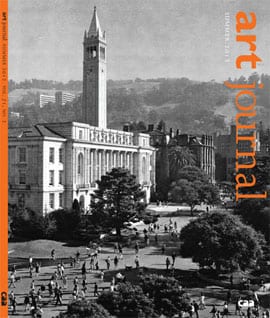 CAA invites nominations and self-nominations for one individual to serve on the Art Journal Editorial Board for a four-year term: July 1, 2013–June 30, 2017. Candidates may be artists, art historians, critics, curators, educators, or other professionals in the visual arts; institutional affiliation is not required. Art Journal, published quarterly by CAA, is devoted to twentieth- and twenty-first-century art and visual culture.
The editorial board advises the Art Journal editor-in-chief and assists him or her to seek authors, articles, artist’s projects, and other content for the journal; guides its editorial program and may propose new initiatives for it; performs peer review and recommends peer reviewers; and may support fundraising efforts on the journal’s behalf. Members also assist the editor-in-chief to keep abreast of trends and issues in the field by attending and reporting on sessions at the CAA Annual Conference and other academic conferences, symposia, and events in their fields.
The Art Journal Editorial Board meets three times a year: twice in New York in the spring and fall and once at the CAA Annual Conference in February. CAA reimburses members for travel and lodging expenses for the two New York meetings in accordance with its travel policy, but members pay these expenses to attend the conference. Members of all editorial boards volunteer their services to CAA without compensation.
Candidates must be current CAA members and should not be serving on the editorial board of a competitive journal or on another CAA editorial board or committee. Members may not publish their own work in the journal during the term of service. Nominators should ascertain their nominee’s willingness to serve before submitting a name; self-nominations are also welcome. Please send a statement describing your interest in and qualifications for appointment, a CV, and your contact information to: Chair, Art Journal Editorial Board, College Art Association, 50 Broadway, 21st Floor, New York, NY 10004; or email the documents to Alyssa Pavley, CAA editorial assistant. Deadline: April 15, 2013.
Art Bulletin Editorial Board Seeks Three Members
posted Jan 28, 2013
 CAA invites nominations and self-nominations for three individuals to serve on the Art Bulletin Editorial Board for a four-year term, July 1, 2013–June 30, 2017. The ideal candidate has published substantially in the field and may be an academic, museum-based, or independent scholar; institutional affiliation is not required. The Art Bulletin features leading scholarship in the English language in all aspects of art history as practiced in the academy, museums, and other institutions.
The editorial board advises the Art Bulletin editor-in-chief and assists him or her to seek authors, articles, and other content for the journal; guides its editorial program and may propose new initiatives for it; performs peer review and recommends peer reviewers; and may support fundraising efforts on the journal’s behalf. Members also assist the editor-in-chief to keep abreast of trends and issues in the field by attending and reporting on sessions at the CAA Annual Conference and other academic conferences, symposia, and events in their fields.
The Art Bulletin Editorial Board meets three times a year: twice in New York in the spring and fall and once at the CAA Annual Conference in February. CAA reimburses members for travel and lodging expenses for the two New York meetings in accordance with its travel policy, but members pay these expenses to attend the conference. Members of all editorial boards volunteer their services to CAA without compensation.
Candidates must be current CAA members and should not be serving on the editorial board of a competitive journal or on another CAA editorial board or committee. Members may not publish their own work in the journal during the term of service. Nominators should ascertain their nominee’s willingness to serve before submitting a name; self-nominations are also welcome. Please send a statement describing your interest in and qualifications for appointment, a CV, and your contact information to: Chair, Art Bulletin Editorial Board, College Art Association, 50 Broadway, 21st Floor, New York, NY 10004; or email the documents to Alyssa Pavley, CAA editorial assistant. Deadline: April 15, 2013.
caa.reviews Editorial Board Seeks One Member
posted Jan 28, 2013
CAA invites nominations and self-nominations for one individual to serve on the caa.reviews Editorial Board for a four-year term, July 1, 2013–June 30, 2017. Candidates may be artists, art historians, critics, curators, educators, or other professionals in the visual arts with stature in the field and experience in writing or editing book and/or exhibition reviews; institutional affiliation is not required. The journal also seeks candidates with a strong record of scholarship and at least one published book or the equivalent who are committed to the imaginative development of caa.reviews. An online journal, caa.reviews is devoted to the peer review of new books, museum exhibitions, and projects relevant to art history, visual studies, and the arts.
The editorial board advises the editor-in-chief of and field editors for caa.reviews and helps them to identify books and exhibitions for review and to solicit reviewers, articles, and other content for the journal; guides its editorial program and may propose new initiatives for it; and may support fundraising efforts on the journal’s behalf. Members also assist the editor-in-chief to keep abreast of trends and issues in the field by attending and reporting on sessions at the CAA Annual Conference and other academic conferences, symposia, and events in their fields.
The caa.reviews Editorial Board meets three times a year: twice in New York in the spring and fall and once at the CAA Annual Conference in February. CAA reimburses members for travel and lodging expenses for the two New York meetings in accordance with its travel policy, but members pay these expenses to attend the conference. Members of all editorial boards volunteer their services to CAA without compensation.
Candidates must be current CAA members and should not be serving on the editorial board of a competitive journal or on another CAA editorial board or committee. Nominators should ascertain their nominee’s willingness to serve before submitting a name; self-nominations are also welcome. Please send a statement describing your interest in and qualifications for appointment, a CV, and your contact information to: caa.reviews Editorial Board, College Art Association, 50 Broadway, 21st Floor, New York, NY 10004; or email the documents to Alyssa Pavley, CAA editorial assistant. Deadline: April 15, 2013.