
CAA News Today
2011 Advocacy Days in Washington for the Arts, the Humanities, and Museums
posted Nov 30, 2010
On November 30, G. Wayne Clough, secretary of the Smithsonian Institution, ordered the removal of David Wojnarowicz’s A Fire in My Belly (1987) from display at the National Portrait Gallery. In addition, incoming Republican leaders in Congress urged that the entire exhibition, Hide/Seek: Difference and Desire in American Portraiture, be closed. Thankfully this did not happen.
Our government clearly needs to hear from you. At this critical time of federal budget planning—when sufficient funding for the Smithsonian museums may be in doubt—it is crucial that you let Capitol Hill know about your support for the visual arts, humanities, and art museums. CAA encourages you register and take part in three upcoming events this winter and spring in Washington, DC: Museums Advocacy Day, Humanities Advocacy Day, and Arts Advocacy Day. At each, participants meet their senators and representatives in person to advocate for increased federal support of the National Endowment for the Arts, the National Endowment for the Humanities, and the Institute for Museum and Library Services.
Previous lobbying experience isn’t necessary. Training sessions and practice talks take place the day before the main events—that’s why, for example, Arts Advocacy Day is actually two days, not one. Participants are also prepped on the critical issues and the range of funding requested of Congress to support these federal agencies. It is at these training sessions where you meet—and network with—other advocates from your states. The main sponsoring organization for each event makes congressional appointments for you.
You may have mailed a letter or sent a prewritten email to your congressperson or senator before, but legislators have an algorithm of interest for pressing issues, in which a personal visit tops all other forms of communication. As citizen lobbyists, it’s also important to have a few specific examples about how arts funding has affected you: don’t be afraid to name-drop major cultural institutions—such as your city’s best-known museum or nonprofit art center—in your examples of why the visual arts matter in your state.
If you cannot attend the three advocacy days in person, please send an email or fax to your representatives expressing your concern about continued and increased funding for the visual arts. If you don’t know your representative or senators, you can look them up at www.congress.org.
Museums Advocacy Day
The American Association of Museums (AAM) leads Museums Advocacy Day, taking place February 28–March 1, 2011, with support from numerous other nonprofit organizations. AAM is developing the legislative agenda for this year’s event. Likely issues will include federal funding for museums, museums and federal education policy, and charitable giving issues affecting museums. The entire museum field is welcome to participate: staff, volunteers, trustees, students, and even museum enthusiasts. Museums Advocacy Day is the ideal chance for new and seasoned advocates to network with museum professionals from their state and meet with congressional offices. Register online now.
Humanities Advocacy Day
The National Humanities Alliance (NHA) sponsors Humanities Advocacy Day, to be held March 7–8, 2011, in conjunction with its annual meeting. Scholars, higher education and association leaders, and policy makers will convene first at George Washington University for the conference and then on Capitol Hill for congressional visits and a reception. The preliminary program includes NHA’s annual business meeting for voting members, commentary on the postelection landscape, discussion of humanities funding and other policy issues, a luncheon and keynote address, and presentations of current work in the humanities. Learn more about registration.
Arts Advocacy Day
To be held April 4–5, 2011, Arts Advocacy Day is the only national event that brings together America’s cultural and civic organizations with hundreds of grassroots advocates, all of whom will underscore the importance of developing strong public policies and appropriating increased public funding for the arts. Sponsored by Americans for the Arts, the event starts at the Omni Shoreham Hotel on the first day, before advocates head to Capitol Hill on the second. Registration is open now.
2011 Advocacy Days in Washington for the Arts, the Humanities, and Museums
posted Nov 30, 2010
On November 30, G. Wayne Clough, secretary of the Smithsonian Institution, ordered the removal of David Wojnarowicz’s A Fire in My Belly (1987) from display at the National Portrait Gallery. In addition, incoming Republican leaders in Congress urged that the entire exhibition, Hide/Seek: Difference and Desire in American Portraiture, be closed. Thankfully this did not happen.
Our government clearly needs to hear from you. At this critical time of federal budget planning—when sufficient funding for the Smithsonian museums may be in doubt—it is crucial that you let Capitol Hill know about your support for the visual arts, humanities, and art museums. CAA encourages you to register and take part in three upcoming events this winter and spring in Washington, DC: Museums Advocacy Day, Humanities Advocacy Day, and Arts Advocacy Day. At each, participants meet their senators and representatives in person to advocate for increased federal support of the National Endowment for the Arts, the National Endowment for the Humanities, and the Institute for Museum and Library Services.
Previous lobbying experience isn’t necessary. Training sessions and practice talks take place the day before the main events—that’s why, for example, Arts Advocacy Day is actually two days, not one. Participants are also prepped on the critical issues and the range of funding requested of Congress to support these federal agencies. It is at these training sessions where you meet—and network with—other advocates from your states. The main sponsoring organization for each event makes congressional appointments for you.
You may have mailed a letter or sent a prewritten email to your congressperson or senator before, but legislators have an algorithm of interest for pressing issues, in which a personal visit tops all other forms of communication. As citizen lobbyists, it’s also important to have a few specific examples about how arts funding has affected you: don’t be afraid to name-drop major cultural institutions—such as your city’s best-known museum or nonprofit art center—in your examples of why the visual arts matter in your state.
If you cannot attend the three advocacy days in person, please send an email or fax to your representatives expressing your concern about continued and increased funding for the visual arts. If you don’t know your representative or senators, you can look them up at www.congress.org.
Museums Advocacy Day
The American Association of Museums (AAM) leads Museums Advocacy Day, taking place February 28–March 1, 2011, with support from numerous other nonprofit organizations. AAM is developing the legislative agenda for this year’s event. Likely issues will include federal funding for museums, museums and federal education policy, and charitable giving issues affecting museums. The entire museum field is welcome to participate: staff, volunteers, trustees, students, and even museum enthusiasts. Museums Advocacy Day is the ideal chance for new and seasoned advocates to network with museum professionals from their state and to meet staff in congressional offices. Register online now.
Humanities Advocacy Day
The National Humanities Alliance (NHA) sponsors Humanities Advocacy Day, to be held March 7–8, 2011, in conjunction with its annual meeting. Scholars, higher education and association leaders, and policy makers will convene first at George Washington University for the conference and then on Capitol Hill for congressional visits and a reception. The preliminary program includes NHA’s annual business meeting for voting members, commentary on the postelection landscape, discussion of humanities funding and other policy issues, a luncheon and keynote address, and presentations of current work in the humanities. Learn more about registration.
Arts Advocacy Day
To be held April 4–5, 2011, Arts Advocacy Day is the only national event that brings together America’s cultural and civic organizations with hundreds of grassroots advocates, all of whom will underscore the importance of developing strong public policies and appropriating increased public funding for the arts. Sponsored by Americans for the Arts, the event starts at the Omni Shoreham Hotel on the first day, before advocates head to Capitol Hill on the second. Registration is open now.
Preorder Your Copy of The Eye, the Hand, the Mind: 100 Years of the College Art Association
posted Nov 30, 2010
 This offer from Rutgers University Press expired in late 2010.
Members receive a special 30 percent discount when preordering the forthcoming book on the history of CAA, The Eye, the Hand, the Mind: 100 Years of the College Art Association. Edited by Susan Ball, this 328-page hardcover book will be published in January 2011 by Rutgers University Press. It will also be available at the 99th Annual Conference and Centennial Kickoff in New York, where a special signing party will take place.
CAA members may preorder the book online for $20.97 (listed at $29.95). The special offer will end soon. Use code 02CAA10 on the Rutgers University Press website, after you “Add to Cart” and before you “Checkout.”
CAA was founded in 1911 with a single stated purpose: “to promote art interests in all divisions of American colleges and universities.” From this humble yet ambitious origin, Ball has organized her book thematically instead of chronologically, with sixteen “purposes” covered in twelve chapters, some written collaboratively. As such, it offers not a comprehensive history but rather a presentation of memorable highlights that tells the complex, contentious story of a venerated organization.
The Eye, the Hand, the Mind reviews familiar aspects of CAA. Craig Houser negotiates the history of CAA’s dynamic publications program, which began in 1913 with the first issue of The Art Bulletin, and Julia Sienkewicz chronicles the evolution of the Annual Conference. Less known is CAA’s traveling-exhibition program in the 1930s, uncovered by Cristin Tierney. More recently, Ellen Levy explores how CAA has similarly supported presentations of artwork by its members, both students and professionals. Other authors investigate myriad other topics: developments in pedagogy and curriculum; political involvements and advocacy work; visual resources, libraries, and issues of copyright; professional support and career development; partnerships with museums and their associations; relationships to other learned societies in the humanities; governance structure and diversity matters; and much more.
Ball, who served as CAA executive director from 1986 to 2006, is now director of programs at the New York Foundation for the Arts. In addition to organizing the book project, she contributed a chapter on the founding of CAA, administrative and financial matters, and the organization’s larger role in the visual arts.
2010 Recipients of the Meiss and Wyeth Publication Grants
posted Nov 29, 2010
CAA has awarded grants to the publishers of nine books in art history and visual culture through two programs: the Millard Meiss Publication Fund and the Wyeth Foundation for American Art Publication Grant.
Meiss Grants Winners
This fall, CAA has awarded four grants from the Millard Meiss Publication Fund. Thanks to the generous bequest of the late Prof. Millard Meiss, these grants are given to publishers to support the publication of scholarly books in art history and related fields. The 2010 grantees are:
- Cynthia Hahn, Strange Beauty: Issues in the Making and Meaning of Reliquaries 400–circa 1204 (Pennsylvania State University Press)
- Megan E. O’Neil, Engaging Ancient Maya Sculpture at Piedras Negras, Guatemala (University of Oklahoma Press)
- J. P. Park, Ensnaring the Public Eye: Painting Manuals of Late Ming China and the Negotiation of Taste (University of Washington Press)
- Stephen C. Pinson, Speculating Daguerre: Art and Enterprise in the Work of L. J. M. Daguerre (University of Chicago Press)
Books eligible for a Meiss grant must already be under contract with a publisher and be on a subject in the arts or art history. Authors must be current CAA members. Application criteria and guidelines for the Meiss grant are available online or from Alex Gershuny, CAA editorial associate.
Wyeth Grant Winners
CAA is pleased to announce five recipients of the annual Wyeth Foundation for American Art Publication Grant. Thanks to a second generous three-year grant from the Wyeth Foundation, these awards are given annually to publishers to support the publication of one or more book-length scholarly manuscripts in the history of American art, visual studies, and related subjects. Receiving 2010 grants are:
- Marianne Kinkel, Races of Mankind: The Sculptures of Malvina Hoffman (University of Illinois Press)
- Analisa Leppanen-Guerra, Children’s Stories and “Child-Time” in the Works of Joseph Cornell and the Trans-Atlantic Avant-Garde (Ashgate)
- Leo Mazow, Thomas Hart Benton and the American Sound (Pennsylvania State University Press)
- Maurie McInnis, Slaves Waiting for Sale: Visualizing the Southern Slave Trade (University of Chicago Press)
- Marian Wardle, ed., The Weir Family, 1820–1920: Expanding the Traditions of American Art (University Press of New England)
For the purpose of this program, “American art” is defined as art created in the United States, Canada, and Mexico prior to 1970. Books eligible for a Wyeth grant must already be under contract with a publisher. Authors must be current CAA members. Application criteria and guidelines for the Wyeth grant are available online or from Alex Gershuny, CAA editorial associate.
November Deaths in the Arts
posted Nov 23, 2010
CAA recognizes the lives and achievements of the following artists, designers, scholars, critics, and other men and women whose work has had a significant impact on the visual arts. Of special note is Jean Miller’s text on Todd DeVriese, written especially for CAA.
- Todd DeVriese, an artist, educator, and dean of the College of Fine Arts and Humanities at St. Cloud State University in Minnesota, died on November 15, 2010, while at a conference in India. He was 49
- Helen Escobedo, a Mexican sculptor who explored modern materials in site-specific, outdoor, and public locations, died on September 16, 2010, at the age of 76. She was also a curator and director for several university-based and national museums and galleries
- S. Neil Fujita, a graphic designer, illustrator, and painter who worked on numerous jazz album covers for Columbia Records in the 1950s and on book jackets with his own firm, died on October 23, 2010, at age 89. He also taught for many years at the Philadelphia Museum College of Art, Pratt Institute, and Parsons School of Design.
- Robert Goodnough, a painter from the second generation of Abstract Expressionists whose diverse body of work touched on many modernist styles, died on October 2, 2010, at age 92. He showed his work at Tibor de Nagy and André Emmerich galleries in New York
- Kathryn Hixson, an art critic, former editor of the New Art Examiner, and adjunct professor in various departments at the School of the Art Institute of Chicago, died on November 7, 2010, at the age of 55. She also curated several exhibitions in Texas and Illinois
- Eric Joisel, a French artist who created innovative, complex sculptures in origami, died on October 10, 2010, at the age of 53. His works can be found in the Louvre and in private collections worldwide
- Thomas Leavitt, founding director of the Herbert F. Johnson Museum of Art at Cornell University, died on October 14, 2010, at the age of 80. He also organized more than one hundred exhibitions, including Earth Art with Willoughby Sharp in 1969, and wrote numerous catalogue essays
- Jack Levine, an American painter of Social Realism whose works contained biting satire and caricature, died on November 8, 2010, at the age of 95. His works can be found in major museums nationwide, including the Metropolitan Museum of Art and the National Gallery of Art
- Bernd Lohaus, a German artist who created his sculptures with blocks of stone and rugged beams of Azobe wood, died on November 4, 2010. Born in 1940, he studied under Joseph Beuys and settled in Antwerp, Belgium, in 1966
- Nathan Oliveira, a Bay Area painter who emerged in the 1950s as an Abstract Expressionist but later embraced figuration and landscape, died on November 13, 2010, at age 81. He was a longtime professor of art at Stanford University
- Rozsika Parker, a pioneering British feminist, art historian, psychotherapist, and author of The Subversive Stitch: Embroidery and Making of the Feminine, died on November 5, 2010, at the age of 64. She collaborated with Griselda Pollock on two important books: Old Mistresses and Framing Women: Art and the Women’s Movement 1970–1985
- Chuck Ramirez, an artist and graphic designer based in San Antonio who worked in large-scale photography and site-specific sculptural installations, died on November 6, 2010. He was 48
- Sylvia Sleigh, a celebrated figurative painter and devoted feminist who helped found SOHO20 Gallery in 1973, died on October 24, 2010, at the age of 94. Born in Wales but based in New York since 1961, Sleigh received CAA’s Distinguished Artist Award for Lifetime Achievement in 2008
- Miriam Wosk, an illustrator who designed the first cover of Ms. magazine in 1971 but later concentrated on painting, drawing, and collage, died on November 5, 2010. She was 63
Read all past obituaries in the arts on the CAA website.
Todd DeVriese: In Memoriam
posted Nov 23, 2010
Jean M. K. Miller is associate dean of administrative affairs in the College of Visual Arts and Design at the University of North Texas in Denton. She is also a member of the CAA Board of Directors.

Todd DeVriese
Todd Joseph DeVriese, a gifted artist, a dedicated art administrator, and a respected colleague, died on November 15, 2010, in New Delhi, India. Born in Peoria, Illinois, on December 9, 1960, he was 49 years old.
With a group of academics from ten colleges and universities, DeVriese had traveled to India in his role as dean of the College of Fine Arts and Humanities at St. Cloud State University, located in St. Cloud, Minnesota. At last month’s International Council of Fine Arts Deans conference, he had shared his excitement about his upcoming trip and, using his gentle humor, urged many of us to become more involved in building strong relationships with international partners.
DeVriese had a strong history of international collaborations. From 2001 to 2006 he lived in the United Arab Emirates, working at Zayed University first as chair of the Department of Art and Design and then as interim dean of the College of Arts and Sciences. He arrived at Zayed—the first national university for women in the Emirates—with a mandate to create and develop a program for fine art and design. After successfully doing so, he returned to the United States and became, in 2007, director of the School of Art at Texas Tech University in Lubbock. Two years later, his career took him to St. Cloud State University, where he oversaw the undergraduate and graduate programs in more than twenty disciplines, including music, dance, theater, film studies, English, foreign languages and literature, philosophy, and mass communications. A native Midwesterner, DeVriese made his academic start as an associate professor at Ohio State University in Columbus, where he taught in the Department of Art from 1996 to 2001.

Todd DeVriese, New World Order: Policy, 2000, collage on paper, 34 x 46 in. (artwork © Todd DeVriese; photograph © Ohio Arts Council, 2003)
Ohio State is also where DeVriese received his MFA in printmaking in 1992. Before that he earned two degrees from Illinois State University in Normal—an MS in 1988 and a BFA in printmaking and painting in 1985—which provided a foundation for his creative work. DeVriese is perhaps best known for his collages using maps, which challenge prevailing notions of history, nationality, and the myths that surround them. During the past fifteen years his work evolved to engage digital media. He exhibited internationally in twenty-five solo exhibitions and over one hundred group shows; his work can also be found in numerous private and public collections. The recipient of numerous grants and fellowships, DeVriese had a residency at Anchor Graphics in Chicago, Illinois, and participated in the Ohio Arts Council International Program, traveling to Germany to work in the Dresden Graphic Workshop. As a curator, he organized a handful of exhibitions, including The Method and the Matrix: Contemporary Printmaking in Ohio with Bellamy Printz, which took place in 2003–4 at the Riffe Gallery in Columbus and at the Alice F. and Harris K. Weston Art Gallery in Cincinnati.
DeVriese was an active member of CAA, the National Council of Art Administrators, the International Council of Fine Arts Deans, the National Association of Schools of Art and Design, and EDUCAUSE. This year, CAA’s Nominating Committee had selected him as a candidate for the Board of Directors for the 2011–15 term. He often stated to his friends how deeply honored he was to be considered for the board.
Todd will be remembered as a man who spoke about his wife, Leila, and two-year old son, Johann, as his true pride and joy. He will also be remembered as an inspired and generous soul who loved the arts and was committed to family, friends, and making the world a better place for all.
A memorial gathering for DeVriese will be held on November 30, 2010, 3:00–5:00 PM in the Atwood Ballroom at his school. In lieu of flowers, contributions can be made to the Todd DeVriese Scholarship Fund for Arts and Humanities. For more information, please call the office of the St. Cloud State University Foundation at 320-308-3984.
Publications Committee and caa.reviews Welcome New Members
posted Nov 22, 2010
The Publications Committee, which oversees CAA’s scholarly journals and related projects, welcomes two new members who will serve through June 30, 2013. Anthony Elms is editor of WhiteWalls, a publisher of innovative books and a journal, and assistant director of Gallery 400 at the University of Illinois in Chicago. Cynthia Mills is executive editor of American Art, the scholarly journal of the Smithsonian American Art Museum in Washington, DC. She is also academic programs coordinator for the museum, where she supervises the fellowship program and publications prizes and organizes scholarly symposia.
caa.reviews, CAA’s online journal for reviews of books, exhibitions, and projects in art history and visual studies, has added Elizabeth Marlowe to its editorial board, to serve through June 30, 2014. Marlowe is visiting assistant professor of art and art history at Colgate University in Hamilton, New York. In addition, Janet Kraynak, assistant professor of art history at New School University, has become a field editor for the journal. She will commission reviews of exhibitions on modern and contemporary art in New York and internationally though June 30, 2013.
Over the summer, CAA made additional appointments for all three journals. Editors and members of editorial boards and committees are chosen from an open call for nominations and self-nominations, published on the CAA website from January to April each year and publicized through CAA News.
Solo Exhibitions by Artist Members
posted Nov 22, 2010
See when and where CAA members are exhibiting their art, and view images of their work.
To learn more about submitting a listing, please see the instructions on the main Member News page.
November 2010
Abroad

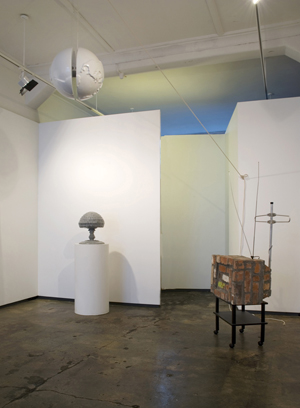 Installation view of works in Don’t Worry, Be Happy: Castle Bravo (top); Atomic Yo Yo Trick (left); and Bricked-in TV (right) (artworks © Brit Bunkley)
Brit Bunkley. Mary Newton Gallery, Wellington, New Zealand, August 18–September 11, 2010. Don’t Worry, Be Happy. Sculpture, digital C-type prints, and video.
Mid-Atlantic

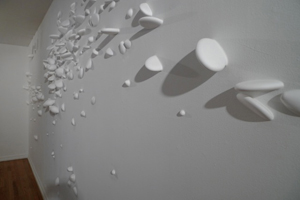 Patricia Villalobos Echeverría, Outbreak, 2010, EPS foam on wall, dimensions variable (artwork © Patricia Villalobos Echeverr’a)
Patricia Villalobos Echeverría. Pittsburgh Center for the Arts, Pittsburgh, Pennsylvania, September 10–November 7, 2010. Outbreak. Installation, sculpture, and video.
Midwest

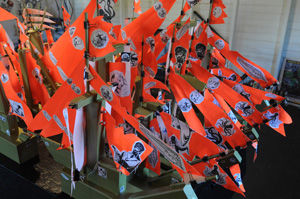 Pete Driessen, detail of Gorgonica Fleet (Orange/Metallic Green), 2010, mixed-media installation, dimensions variable (artwork © Pete Driessen)
Pete Driessen. They Won’t Find Us Here Gallery, Minneapolis, Minnesota, October 8–22, 2010. Nauticalia Tentacalus: YeOldeSe(a)menShoppe. Mixed-media installation.
Northeast

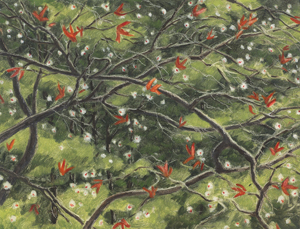 Robert Berlind, Red Leaves, 2007, oil on linen, 30 x 35 in. (artwork © Robert Berlind)
Robert Berlind. David Findlay Jr. Fine Art, New York, November 4–27, 2010. Recent Paintings. Oil on linen and board.

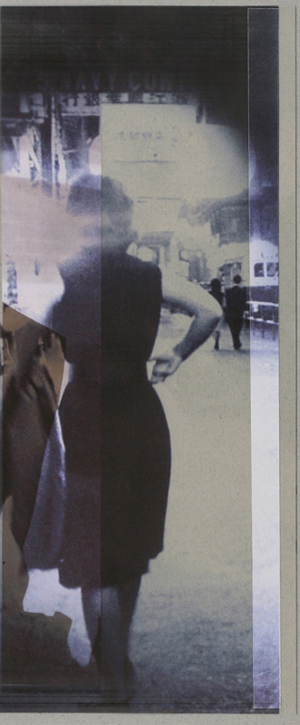 Adrienne Der Marderosian, Reverie, No. 2, 2010, collage, 9 x 3 3/4in. (artwork © Adrienne Der Marderosian)
Adrienne Der Marderosian. Belmont Public Library, Belmont, Massachusetts, October 1–30, 2010. New Works. Collage.

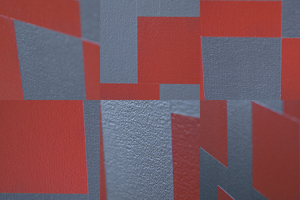 Daniel Hill, Red Gray Grid 1, 2009, archival pigment print, 22 x 33 in. (artwork © Daniel Hill)
Daniel Hill. Painting Center, New York, November 2–27, 2010. From Paint to Print. Acrylic painting and archival pigment prints.

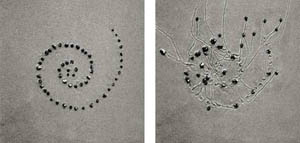 Daniel Ranalli, Spiral Start #9, from the series Snail Drawings, 1995/2009, photographic diptych of archival inkjet prints, 20 x 28 in. (artwork © Daniel Ranalli; photograph provided by Gallery Kayafas)
Daniel Ranalli. Provincetown Art Association and Museum, Provincetown, Massachusetts, October 15, 2010–January 16, 2011. Traces: Cape Work 1987–2007. Installation and documentation.
South

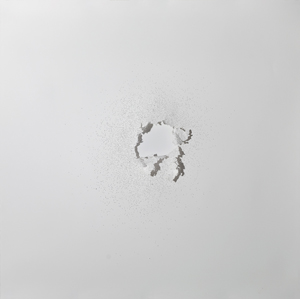 Christopher McNulty, 20,249 Days, 2007, dart holes in paper, 42 x 42 in. (artwork © Christopher McNulty)
Christopher McNulty. Blue Star Contemporary Art Center, San Antonio, Texas, September 30–October 30, 2010. Days. Work on paper.

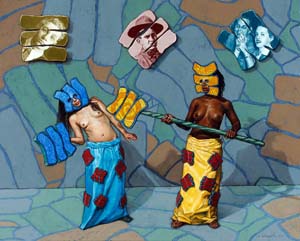 Jeff Whipple, Seizing the Day, 2009, oil on canvas, 40 x 60 in. (artwork © Jeff Whipple)
Jeff Whipple. Museum of Florida Art, DeLand, Florida, September 3–November 21, 2010. Seizing the Day. Painting, drawing, sculpture, photography, and video.
West

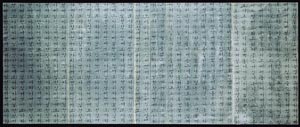 Kay Kang, Conversation with My Father, 1997, sumi ink on rice paper, with acrylic and mounted on canvas, 54 x 132 in. (artwork © Kay Kang)
Kay Kang. Alumni Hall Gallery, San Francisco State University, San Francisco, California, August 20–December 10, 2010. Conversation with My Father. Sumi ink on rice paper and acrylic mounted on canvas.

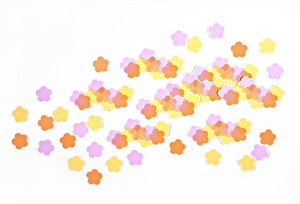 Janet Marcavage, Such Fancies, 2010, cut screen prints, approx. 30 x 48 in. (artwork © Janet Marcavage)
Janet Marcavage. University Gallery, Pacific Lutheran University, Tacoma, Washington, October 13–November 10, 2010. Such Fancies. Serial prints and cutout.
December 2010 Issue of The Art Bulletin Features Raphael, Rauschenberg, and Hōgai
posted Nov 19, 2010
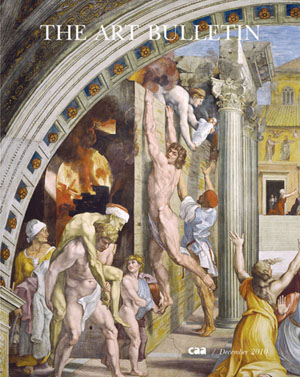 Insightful studies that reframe a Raphael fresco, Robert Rauschenberg’s Combines, and Kano Hōgai’s best-known work are among the six essays in the December 2010 issue of The Art Bulletin, the leading publication of international art-historical scholarship. The issue has been mailed to all individual CAA members who elect to receive the journal, and to all institutional members.
The final issue of the year comprises six essays, two of which delve into art from the Italian peninsula. In “Reflections of Imperialism,” Brenda Longfellow examines the Meta Sudans fountain in Rome, built during the Flavian dynasty, as a signifier of imperial legacy in both Rome and its provinces. For her contribution, Patricia Reilly contends that Raphael’s often-maligned Fire in the Borgo presents the artist’s argument for a new theory of painting. Looking across the Atlantic, Angélica Afandor-Pujol studies the illustrated manuscript known as the “Relación de Michoancán” and investigates issues of mimicry and the appropriation of European artistic traditions by indigenous artists in colonial Mexico.
Moving to the modern times, Chelsea Foxwell reconsiders the iconographic and historical significance of Hōgai’s Merciful Mother Kannon (1888), a masterpiece of Japanese painting, and Tom Folland argues that Rauschenberg’s Combines represent a queering of Abstract Expressionism and, by extension, the culture of postwar modernism. In “The State of Art History,” Terry Smith explores ideas of the contemporary within discourse on modern art and proposes a framework for globally considering the art of today.
In the Reviews section, Gabriela Siracusano assesses Veiled Brightness, a multiauthored book on the history of Maya color. Charles Darwin’s relationship to the visual arts is the focus of Rachael Delue four-book analysis, and Erika Naginski reviews The Blind Spot: An Essay on the Relations between Painting and Sculpture in the Modern Age.
Please read the full table of contents for more details. The next issue, to be published in March 2011, will feature essays on the Bocca della Verità in Rome; the “finger-bone” relics of a Buddha found in Shaanxi Province, China; and relationships between German painting and Czech Cubism.
FIELD REPORT
posted Nov 18, 2010
October SECAC/MACAA and Arts Education Conferences
Cover of the SECAC-MACAA conference program
It is a perennial pleasure to return to my native South for the Southeastern College Art Conference (SECAC). This year’s meeting, held in scenic Richmond, Virginia, was a joint venture with the Mid America College Art Association (MACAA), both CAA affiliated societies. Hosted by Virginia Commonwealth University (VCU), the conference took place October 20–23, 2010, in the beautiful Jefferson Hotel, a Beaux Arts masterpiece operating since 1895.
With his VCU colleagues, the artist, printmaking teacher, and freelance art critic Andrew Kozlowski cleverly branded the conference with the title “Curiouser: Where Cerebellum Meets Antebellum,” and planned some very sexy aesthetics and materials to go along. Sessions featured—if you can believe it—representations of the penis in modern and postmodern culture among familiar discussions on curriculum development and connections between memory and art.
On Thursday evening, after the first day of sessions from artists, historians, and curators, we were treated to the genius that is Pablo Helguera, who delivered the keynote address. Born in Mexico City, Helguera is a New York–based artist working with installation, sculpture, photography, drawing, and performance. His focus on a variety of topics such as history, pedagogy, sociolinguistics, ethnography, memory and the absurd takes the form of lecture, museum display, musical performance, and written fiction—tailored made for a memorable public speech. Helguera, who is also director of adult education programs at the Museum of Modern Art, sagely pointed out that he has spent many an evening sitting in the back of a darkened auditorium listening to people bloviate on all manner of topics. Through a performance that reflected on the act of performing that is any lecture, Helguera teased insight from the five elements of classical oration, culminating in a cacophonous delivery of a talk presented in alternating voices for four different hypothetical audiences: postmodernists and theorists (defined as people who read October), art-world insiders, arts administrators and educators, and the Facebook generation. His take was an incisive remonstrance of the expectations we carry to these types of events, and he exploded the notion that an art-history conference should be serious, dry, humorless, and devoid of careful calibration of character.
Following Helguera was a reception for the annual members’ juried exhibition held at 1708 Gallery. Founded in 1978, this artist-run alt space plays a leading role in connecting Richmond’s diverse community with the work of exceptional, innovative artists from Virginia and beyond. With fifty-six participants, the show was packed with work in every medium imaginable. Congratulations to these three CAA members for receiving top honors from Joe Seipel, the curator and juror: photographers Antonio Martinez of Southern Illinois University Carbondale and Allyson Klutenkamper of Shawnee State University, and the painter Matthew Kolodziej of the University of Akron.
Philip Reinagle, Portrait of an Extraordinary Musical Dog, 1805, oil on canvas, 18¼ by 36½ in. Virginia Museum of Fine Arts, Richmond (artwork in the public domain; photograph by Ron Jennings)
On Friday the Virginia Museum of Fine Arts hosted a reception for SECAC and MACAA. Newly reopened after a $150-million expansion that boosted gallery space nearly 50 percent, the museum is perhaps best known for its stunning collection of Art Nouveau masterpieces, where I found this bed that, to me, looked more like a set piece from Paul Thomas Anderson’s film Boogie Nights than a product of French modernism. Amongst wings of amazing Faberge cloisonné, French drawings, and superb holdings in modern and contemporary American art, I most enjoyed the rooms of British sporting art. Donated by Paul Mellon, who was also the establishing patron of the Yale Center for British Art, this profuse collection of painting and sculpture is the largest display of horses, dogs, pheasants, and guns that I’ve ever seen all in one place.
A street arts festival on Friday called “InLight Richmond,” organized by the folks at 1708 Gallery, was a really fun way to get us out-of-towners to Shockoe Bottom, a major nightlife and dining district. On my way back to the hotel, I walked past the Virginia State Capitol. An incredibly ghostly lighting design courtesy of a major restoration project rendered the building a spectral vision in white, glowing, nearly pulsing, with the principles of the Enlightenment. This was a particularly arresting, inspiring experience to have within a fortnight of an important midterm election.
But really, SECAC is such a wonderful affair each year. As a three time attendee, I’m not sure if it’s because Rachel Frew, the central nervous system of the conference, is so freaking awesome, or if it’s because the month of October in any Southeastern state is so beautiful, or if it’s because I can gorge myself on fried green tomatoes and Hoppin’ John. One thing I know for sure is that I am consistently amazed by the quality of scholarship and camaraderie of experience at this particular conference. Start planning now for the next one, “Text/Texture,” hosted by the Savannah College of Art and Design, November 9–12, 2011.
A couple of days later, back in New York, I attended the twenty-fourth annual National Conference on Liberal Arts and the Education of Artists, organized by the Humanities and Sciences Department of the School of Visual Arts. The event provides a forum for the exchange of ideas and information about the role of the liberal arts in the education of artists, and this year’s theme was “Green, Greener, Greenest: Romancing Nature Again.” Taking place October 27–29, 2010, the conference is truly impressive for its interdisciplinarity. The first session I attended, on the topic of “Nature Study and Interdisciplinary Learning,” included papers by a biologist, a mathematician, an art professor, and a director of student outcomes, and I ate lunch with a journalism professor who presented a body of research on the visualization of the “truly American” landscape vis-à-vis illustrated editorial spreads in early Life magazines. One panel asked if we can pique people’s moral and ethical responsibilities to the environment by heightening aesthetic appreciation through depiction in art. Another session explored the dual metaphor of nature as both sublime and accessible through literature, Hindu myth, and Gerhard Richter’s paintings based on photos.
“Green, Greener, Greenest” was an intimate gathering presided over by the dark-cherry interior of the Algonquin Hotel, and as such our conversations could have a personal, more lasting effect. Each year the organizers seek proposals on diverse topics relating to an annual theme and on other interdisciplinary issues. Check out the conference history or contact the conference director, Maryhelen Hendricks, for more information on presenting and attending.