CAA News Today
Conference Book and Trade Fair Exhibitors
posted Feb 17, 2009
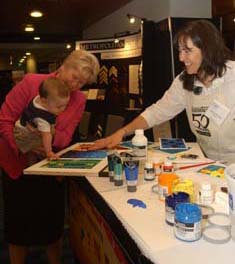 CAA has announced the list of exhibitors who will be present in Los Angeles for this year’s Book and Trade Fair. Taking place at the Los Angeles Convention Center during the 97th Annual Conference, the Book and Trade Fair hosts more than one hundred major college and university publishers, leading trade publishers, and trend-setting independent presses.
The largest national and international art-materials manufacturers and distributors, as well as highly specialized companies with unique products for studio artists, will show their products and wares. Also on hand are a handful of contemporary art journals.
The fair continues to attract a wide array of diverse organizations providing professional services to the visual arts, including programs of advanced study, specialized associations, advanced-degree programs, and independent exhibition services.
At the CAA booth, you can purchase copies of the highly anticipated directories of graduate programs in the arts: Graduate Programs in Art History and Graduate Programs in the Visual Arts. Stop by to browse these publications, talk with CAA staff members, and learn more about CAA’s programs and services.
The Book and Trade Fair in Los Angeles is open for three days: Thursday, February 26, and Friday, February 27, 9:00 AM–6:00 PM, and Saturday, February 28, 9:00 AM–2:30 PM. The 2009 sponsors are ARTstor, Blick Artist Materials, Prestel Publishing, Saskia Ltd./Scholars Resource, the School of Visual Arts, and SlideRoom.
Regional MFA Exhibition and Warhol Show at USC Galleries
posted Feb 12, 2009
The Roski School of Fine Arts at the University of Southern California (USC) is hosting the 2009 CAA Regional MFA Exhibition, which will showcase the unique, diverse community of young artists in the Southern California region. Held in the Helen Lindhurst Fine Arts Gallery and the Gayle and Ed Roski MFA Gallery, the exhibition will be on view February 24–28, 2009. The reception for the artists and CAA conference attendees takes place in Watt Hall 104 from 6:00 to 8:00 PM on Friday, February 27.
After the MFA opening reception, stick around USC for a celebration and special viewing of Looking into Andy Warhol’s Photographic Practice at the USC Fisher Museum of Art.
US Senate Passes Stimulus Bill without NEA Provision
posted Feb 11, 2009
 Yesterday the US Senate passed its version of an $838 billion stimulus bill, entitled the American Recovery and Reinvestment Act, with a 61 to 37 vote. The legislation included the Coburn Amendment, which eliminated a $50 million provision for the National Endowment for the Arts that was included in the House of Representatives’ bill. The amendment, voted on last week, passed 73 to 24.
The Senate legislation, as Eddy Ramírez reports for US News and World Report, “is stripped of, among other funds, $16 billion for school construction and $40 billion more for states to fund schools.”
The Washington Post lists how senators voted on the American Recovery and Reinvestment Act. CAA encourages you to show your approval or disapproval to your congressional representatives, using Americans for the Arts’ Capwiz feature to send a customized letter.
US SENATE PASSES STIMULUS BILL WITHOUT NEA PROVISION
posted Feb 11, 2009
Yesterday the US Senate passed its version of an $838 billion stimulus bill, entitled the American Recovery and Reinvestment Act, with a 61 to 37 vote. The legislation included the Coburn Amendment, which eliminated a $50 millionprovision for the National Endowment for the Arts that was included in the House of Representatives’ bill. The amendment, voted on last week, passed 73 to 24.
The Senate legislation, as Eddy Ramírez reports for US News and World Report, “is stripped of, among other funds, $16 billion for school construction and $40 billion more for states to fund schools.”
The Washington Post lists how senators voted on the American Recovery and Reinvestment Act. CAA encourages you to show your approval or disapproval to your congressional representatives, using Americans for the Arts’ Capwiz feature to send a customized letter.
Education Money Floats in and out of Stimulus Bills
posted Feb 10, 2009
Doug Lederman at Inside Higher Ed has been following the higher-education component of the current economic-stimulus bills in the US House of Representatives and Senate. The Senate version of the bill, which will be voted on today, has cut several earmarks for education that passed in the House legislation. Also, $50 million earmarked by the House for the National Endowment for the Arts was eliminated by the Senate. If the Senate passes its bill, Congress will work with the Obama administration to reconcile the two different stimulus packages. Read Lederman’s article from yesterday for more details and a breakdown of what’s included and excluded in both bills.
Meanwhile, the Los Angeles Times art critic Christopher Knight argued last week for economic stimulus for the nation’s arts nonprofit organizations: “I suspect every one of America’s nonprofits has at least one unfunded project that it would like to get going—‘shovel-ready,’ as it were, even if the job doesn’t involve bricks and mortar.” Chris Jones at the Chicago Tribune also makes a case for the importance of arts in economic-stimulus legislation.
CAA on Facebook
posted Feb 09, 2009
 CAA has created an official group page on Facebook, the popular social-networking website, to complement CAA’s growing digital initiatives. The Facebook group joins this frequently updated CAA News page and its RSS feed, Twitter accounts for both CAA and caa.reviews, and a conference blog for the upcoming Annual Conference in Los Angeles.
We look forward to using Facebook and these other online tools to promote CAA activities and programs not only to our members, but also to a larger audience. We also encourage your feedback. This month you can look forward to postings about special conference events, tips for the job search, information about our newly published directories of graduate schools, and much more.
This Week at the Rose Art Museum
posted Feb 06, 2009
News about the closing of the Rose Art Museum at Brandeis University and the selling of its collection slowed down this week, but not without several highlights. Brandeis President Jehuda Reinharz issued a formal apology—not for the decision to dismantle the museum’s collection but rather for his mishandling the announcement to do so. He also regretted leaving out the Brandeis community in the board of trustees’ deliberations.
Michael Rush, director of the Rose, posted his statement on the closing and sale directly to his museum’s website this week. The university’s Department of Fine Arts also joined the chorus of protest voices, issuing a statement to all university faculty, students, alumni, and friends of the department. Also, the New York Times condemned the Brandeis decision in an article by Roberta Smith and in an unsigned editorial.
Jeff Gilbride of the Daily News Tribune in Waltham, Massachusetts, was at the “funeral march” held this week by Brandeis students as an “emotional and rowdy counterpart” to last week’s sit-in at the museum. Relatedly, Jeff Weistein from Obit wonders, “Can a Museum Die?”
Greg Cook reviews the current exhibition at the Rose, Hans Hoffmann: Circa 1950, for the Boston Phoenix, and Daniel Grant considers donor responses and restrictions on gifts in his article “Is the University’s Museum Just a Rose to Be Plucked?” for the Wall Street Journal.
The Rose Art Museum website is chronicling the press on the closing and sale. Laurie Fendrich has been passionately following the story in the Chronicle Review, the blog of the Chronicle of Higher Education. And, of course, the Boston Globe has been leading the charge with daily reports.
THIS WEEK AT THE ROSE ART MUSEUM
posted Feb 06, 2009
News about the closing of the Rose Art Museum at Brandeis University and the selling of its collection slowed down this week, but not without several highlights. Brandeis President Jehuda Reinharz issued a formal apology—not for the decision to dismantle the museum’s collection but rather for his mishandling the announcement to do so. He also regretted leaving out the Brandeis community in the board of trustees’ deliberations.
Michael Rush, director of the Rose, posted his statement on the closing and sale directly to his museum’s website this week. The university’s Department of Fine Arts also joined the chorus of protest voices, issuing a statement to all university faculty, students, alumni, and friends of the department. Also, the New York Times condemned the Brandeis decision in an article by Roberta Smith and in an unsigned editorial.
Jeff Gilbride of the Daily News Tribune in Waltham, Massachusetts, was at the “funeral march” held this week by Brandeis students as an “emotional and rowdy counterpart” to last week’s sit-in at the museum. Relatedly, Jeff Weistein fromObit wonders, “Can a Museum Die?”
Greg Cook reviews the current exhibition at the Rose, Hans Hoffmann: Circa 1950, for the Boston Phoenix, and Daniel Grant considers donor responses and restrictions on gifts in his article “Is the University’s Museum Just a Rose to Be Plucked?” for the Wall Street Journal.
The Rose Art Museum website is chronicling the press on the closing and sale. Laurie Fendrich has been passionately following the story in the Chronicle Review, the blog of the Chronicle of Higher Education. And, of course, theBoston Globe has been leading the charge with daily reports.
Associated Press Claims Copyright Infringement in Obama Poster
posted Feb 05, 2009
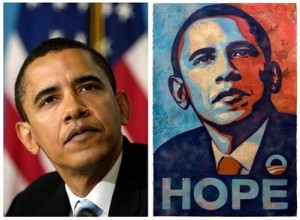 The Associated Press (AP) is claiming copyright in the image used by the street artist Shepard Fairey for his famous poster of Barack Obama. Fairey acknowledges that his image is based on a 2006 photograph taken by Manny Garcia while on an AP assignment at the National Press Club in Washington. “The AP says it owns the copyright, and wants credit and compensation,” writes Hillel Italie, a reporter for the news organization. Anthony Falzone, who is Fairey’s attorney, the executive director of the Fair Use Project at Stanford University, and a lecturer at the Stanford Law School, is arguing for fair use.
An exhibition of Fairey’s work opens tomorrow at the Institute of Contemporary Art in Boston, Massachusetts, on view through August 16, 2009.
In related copyright news, a lawsuit was filed in late December against the artist Richard Prince and Gagosian Gallery by the French photographer Patrick Cariou. Prince appropriated photographs from Cariou’s book Yes Rasta from 2000 in his recent exhibition of work; the work was also reproduced in a catalogue published by the gallery. Daniel Grant has the story for the Wall Street Journal.
Kress Foundation Survey for Current and Former Fellows
posted Feb 04, 2009
The Samuel H. Kress Foundation is assembling a contact database for all current and former Kress fellows in art history, art conservation, historic preservation, and related fields. The main purpose of this database is purely administrative, and the foundation’s intention is to keep all supplied contact information confidential.
Having said that, the Kress also understands that it would be helpful to the community of its fellows to communicate with each other for a variety of professional purposes, ranging from developing mentoring relationships to identifying colleagues with similar professional interests to simply comparing notes on fellowship experiences.
The foundation is therefore considering reserving a section of its new website for a password-restricted directory of current and former Kress fellows, to which only those fellows would have access.
The Kress invites all former and current fellows to complete a brief survey registering their willingness to supply contact information for a confidential directory, their interest in extending access for such a directory to other Kress fellows, and the value they would derive from having access to such a directory. The survey should take no more than five minutes to complete.
Questions? Please send an email to fellows@kressfoundation.org.