CAA News Today
caa.reviews Seeks Editor-in-Chief
posted by Betty Leigh Hutcheson — January 28, 2013
The caa.reviews Editorial Board invites nominations and self-nominations for the position of editor-in-chief for a three-year term, July 1, 2014–June 30, 2017. This term is preceded by one year of service on the editorial board as editor designate, July 1, 2013–June 30, 2014, and followed immediately by one year of service as past editor. Candidates should have published substantially in the field and may be academic, museum-based, or independent scholars; institutional affiliation is not required. An online journal, caa.reviews is devoted to the peer review of new books, museum exhibitions, and projects relevant to the fields of art history, visual studies, and the arts.
Working with the editorial board, the editor-in-chief is responsible for the content and character of the journal. He or she supervises the journal’s Council of Field Editors, assisting them to identify and solicit reviewers, articles, and other content for the journal; develops projects; and makes final decisions regarding content.
The editor-in-chief attends the caa.reviews Editorial Board’s three meetings each year—held twice in New York in the spring and fall and once at the Annual Conference in February—and submits an annual report to CAA’s Board of Directors. CAA reimburses the editor-in-chief for travel and lodging expenses for the two New York meetings in accordance with its travel policy, but he or she pays these expenses to attend the conference. The editor-in-chief also works closely with the CAA staff in New York and receives an annual honorarium of $4,000.
Candidates must be current CAA members and should not be serving on the editorial board of a competitive journal or on another CAA editorial board or committee. Nominators should ascertain their nominee’s willingness to serve before submitting a name; self-nominations are also welcome. Please send a statement describing your interest in and qualifications for appointment, a CV, at least one letter of recommendation, and your contact information to: Codirectors of Publications, caa.reviews Editor-in-Chief Search, College Art Association, 50 Broadway, 21st Floor, New York, NY, 10004; or email the documents to Betty Leigh Hutcheson, CAA codirector of publications. Deadline: April 15, 2013; finalists will be interviewed in early May.
Art Journal Editorial Board Seeks One Member
posted by Alyssa Pavley — January 28, 2013
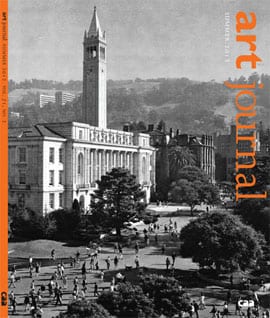 CAA invites nominations and self-nominations for one individual to serve on the Art Journal Editorial Board for a four-year term: July 1, 2013–June 30, 2017. Candidates may be artists, art historians, critics, curators, educators, or other professionals in the visual arts; institutional affiliation is not required. Art Journal, published quarterly by CAA, is devoted to twentieth- and twenty-first-century art and visual culture.
The editorial board advises the Art Journal editor-in-chief and assists him or her to seek authors, articles, artist’s projects, and other content for the journal; guides its editorial program and may propose new initiatives for it; performs peer review and recommends peer reviewers; and may support fundraising efforts on the journal’s behalf. Members also assist the editor-in-chief to keep abreast of trends and issues in the field by attending and reporting on sessions at the CAA Annual Conference and other academic conferences, symposia, and events in their fields.
The Art Journal Editorial Board meets three times a year: twice in New York in the spring and fall and once at the CAA Annual Conference in February. CAA reimburses members for travel and lodging expenses for the two New York meetings in accordance with its travel policy, but members pay these expenses to attend the conference. Members of all editorial boards volunteer their services to CAA without compensation.
Candidates must be current CAA members and should not be serving on the editorial board of a competitive journal or on another CAA editorial board or committee. Members may not publish their own work in the journal during the term of service. Nominators should ascertain their nominee’s willingness to serve before submitting a name; self-nominations are also welcome. Please send a statement describing your interest in and qualifications for appointment, a CV, and your contact information to: Chair, Art Journal Editorial Board, College Art Association, 50 Broadway, 21st Floor, New York, NY 10004; or email the documents to Alyssa Pavley, CAA editorial assistant. Deadline: April 15, 2013.
Art Bulletin Editorial Board Seeks Three Members
posted by Alyssa Pavley — January 28, 2013
 CAA invites nominations and self-nominations for three individuals to serve on the Art Bulletin Editorial Board for a four-year term, July 1, 2013–June 30, 2017. The ideal candidate has published substantially in the field and may be an academic, museum-based, or independent scholar; institutional affiliation is not required. The Art Bulletin features leading scholarship in the English language in all aspects of art history as practiced in the academy, museums, and other institutions.
The editorial board advises the Art Bulletin editor-in-chief and assists him or her to seek authors, articles, and other content for the journal; guides its editorial program and may propose new initiatives for it; performs peer review and recommends peer reviewers; and may support fundraising efforts on the journal’s behalf. Members also assist the editor-in-chief to keep abreast of trends and issues in the field by attending and reporting on sessions at the CAA Annual Conference and other academic conferences, symposia, and events in their fields.
The Art Bulletin Editorial Board meets three times a year: twice in New York in the spring and fall and once at the CAA Annual Conference in February. CAA reimburses members for travel and lodging expenses for the two New York meetings in accordance with its travel policy, but members pay these expenses to attend the conference. Members of all editorial boards volunteer their services to CAA without compensation.
Candidates must be current CAA members and should not be serving on the editorial board of a competitive journal or on another CAA editorial board or committee. Members may not publish their own work in the journal during the term of service. Nominators should ascertain their nominee’s willingness to serve before submitting a name; self-nominations are also welcome. Please send a statement describing your interest in and qualifications for appointment, a CV, and your contact information to: Chair, Art Bulletin Editorial Board, College Art Association, 50 Broadway, 21st Floor, New York, NY 10004; or email the documents to Alyssa Pavley, CAA editorial assistant. Deadline: April 15, 2013.
caa.reviews Editorial Board Seeks One Member
posted by Alyssa Pavley — January 28, 2013
CAA invites nominations and self-nominations for one individual to serve on the caa.reviews Editorial Board for a four-year term, July 1, 2013–June 30, 2017. Candidates may be artists, art historians, critics, curators, educators, or other professionals in the visual arts with stature in the field and experience in writing or editing book and/or exhibition reviews; institutional affiliation is not required. The journal also seeks candidates with a strong record of scholarship and at least one published book or the equivalent who are committed to the imaginative development of caa.reviews. An online journal, caa.reviews is devoted to the peer review of new books, museum exhibitions, and projects relevant to art history, visual studies, and the arts.
The editorial board advises the editor-in-chief of and field editors for caa.reviews and helps them to identify books and exhibitions for review and to solicit reviewers, articles, and other content for the journal; guides its editorial program and may propose new initiatives for it; and may support fundraising efforts on the journal’s behalf. Members also assist the editor-in-chief to keep abreast of trends and issues in the field by attending and reporting on sessions at the CAA Annual Conference and other academic conferences, symposia, and events in their fields.
The caa.reviews Editorial Board meets three times a year: twice in New York in the spring and fall and once at the CAA Annual Conference in February. CAA reimburses members for travel and lodging expenses for the two New York meetings in accordance with its travel policy, but members pay these expenses to attend the conference. Members of all editorial boards volunteer their services to CAA without compensation.
Candidates must be current CAA members and should not be serving on the editorial board of a competitive journal or on another CAA editorial board or committee. Nominators should ascertain their nominee’s willingness to serve before submitting a name; self-nominations are also welcome. Please send a statement describing your interest in and qualifications for appointment, a CV, and your contact information to: caa.reviews Editorial Board, College Art Association, 50 Broadway, 21st Floor, New York, NY 10004; or email the documents to Alyssa Pavley, CAA editorial assistant. Deadline: April 15, 2013.
caa.reviews Seeks Field Editors for Books and Exhibitions
posted by Alyssa Pavley — January 28, 2013
CAA invites nominations and self-nominations for six individuals to join the caa.reviews Council of Field Editors, which commissions reviews within an area of expertise or geographic region, for a three-year term: July 1, 2013–June 30, 2016. An online journal, caa.reviews is devoted to the peer review of new books, museum exhibitions, and projects relevant to art history, visual studies, and the arts.
The journal seeks four field editors for books in four areas: African art, theory and historiography, Egyptian and ancient Near Eastern art, and American art. In addition, two field editors are needed for exhibitions in two areas: on the West Coast covering art after 1800 and in New York and internationally, covering exhibitions of modern and contemporary art. Candidates may be artists, art historians, critics, curators, educators, or other professionals in the visual arts; institutional affiliation is not required.
Working with the caa.reviews editor-in-chief, the caa.reviews Editorial Board, and CAA’s staff editor, each field editor selects content to be reviewed, commissions reviewers, and reviews manuscripts for publication. Field editors for books are expected to keep abreast of newly published and important books and related media in his or her field of expertise, and those field editors for exhibitions should be aware of current and upcoming exhibitions (and other related projects) in their geographic regions.
The Council of Field Editors meets annually at the CAA Annual Conference. Field editors must pay travel and lodging expenses to attend the conference. Members of all CAA committees and editorial boards volunteer their services without compensation.
Candidates must be current CAA members and should not be serving on the editorial board of a competitive journal or on another CAA editorial board or committee. Nominators should ascertain their nominee’s willingness to serve before submitting a name; self-nominations are also welcome. Please send a statement describing your interest in and qualifications for appointment, a CV, and your contact information to: caa.reviews Editorial Board, College Art Association, 50 Broadway, 21st Floor, New York, NY 10004; or email the documents to Alyssa Pavley, CAA editorial assistant. Deadline: April 15, 2013.
CAA Seeks Publications Committee Member
posted by Alyssa Pavley — January 25, 2013
CAA invites nominations and self-nominations for one member at large to serve on its Publications Committee for a three-year term, July 1, 2013–June 30, 2016. Candidates, who must possess expertise appropriate to the committee’s work, may be artists, art historians, critics, curators, educators, or other professionals in the visual arts; institutional affiliation is not required.
Meeting three times a year, the Publications Committee is a consultative body that advises the CAA Publications Department staff and the CAA Board of Directors on publishing projects. It provides oversight for the editorial boards of The Art Bulletin, Art Journal, and caa.reviews, as well as the juries for CAA’s book grants; sponsors a practicum session at the Annual Conference; and, with the CAA vice president for publications, serves as liaison to the board, membership, editorial boards, book-grant juries, and other CAA committees.
The Publications Committee meets three times a year: twice in New York in the spring and fall and once at the CAA Annual Conference in February. CAA reimburses members for travel and lodging expenses for the two New York meetings in accordance with its travel policy, but members pay these expenses to attend the conference. Members of all CAA committees volunteer their services without compensation.
Candidates must be current CAA members and should not be serving on another CAA editorial board or committee. In addition, they may not be individuals who have served as members of a CAA editorial board within the past five years. Nominators should ascertain their nominee’s willingness to serve before submitting a name; self-nominations are also welcome. Appointments are made by the CAA president in consultation with the vice president for publications. Please send a statement describing your interest in and qualifications for appointment, a CV, and your contact information to: Publications Committee, College Art Association, 50 Broadway, 21st Floor, New York, NY 10004; or email the documents to Alyssa Pavley, CAA editorial assistant. Deadline: April 15, 2013.
Directory for Diversity Practices
posted by CAA — January 24, 2013
CAA’s Committee on Diversity Practices would like to introduce the Directory for Diversity Practices and to invite CAA members to submit syllabi and recommend additional material for it. The Directory for Diversity Practices has been developed to provide a range of updated documents, texts, and links related to ethnicity, race, gender, sexuality, disability, and aging for use in the classroom. It is accessible via the CAA website under the tab marked Resources.
The directory is divided into five user-friendly sections:
- Getting Started
- Classroom and Curricula
- Diversity in Academe
- Images and Documents of Art and Culture
- Syllabi
The Committee on Diversity Practices is dedicated to building a useful and evolving resource for teaching the visual arts and art history. CAA encourages you to visit the site and to let the committee know how it can add to the directory in order for it to be more useful. The committee regards this directory as a work in process and seeks comments and submissions (emails below) from the CAA community at large.
Submissions Guide
Suggestions for any of the five areas are welcome and will be added as appropriate. Material included in its entirety must be in the public domain, contributed by the authors or copyright owners who have given permission to publish it on the CAA website, and/or otherwise publicly available. Contributions should be relevant, applicable, and up to date. Older material will be selected on its continuing relevance.
The committee welcomes the submission of syllabi addressing issues and topics related to diversity and art. It hopes to significantly expand this section, which promises to be a valuable resource for anyone seeking current models for inclusive curricula. Kindly send your syllabus as a Word file. Please remove any references to the specific details of the class (dates, name of institution, office hours and location, etc.). Professors retain the copyright for their work.
Please visit the directory and send your comments and contributions to both Zoya Kocur, Middlesex University, and Yasmin Ramirez, Hunter College, City University of New York.
Mellon Foundation Helps CAA Initiate a Publishing Award for Emerging Scholars
posted by Christopher Howard — January 23, 2013
The Andrew W. Mellon Foundation has awarded the College Art Association (CAA) a one-year grant of $60,000 to administer the Meiss/Mellon Author’s Book Award. The award is a temporary measure to provide financial relief to early-career scholars in art history and visual studies who are responsible for paying for rights and permissions for images in their publications. The Meiss/Mellon Author’s Book Award will provide grants directly to emerging scholars to offset the high costs of image acquisition. Recipients will be selected on the basis of the quality and financial need of their project, and awards will be made twice during the year (in the spring and fall) in conjunction with CAA’s Millard Meiss Publication Fund awards to publishers. CAA anticipates awarding between eight and ten Meiss/Mellon Author’s Book Awards in 2013.
The Meiss/Mellon Author’s Book Award supports image rights and reproduction costs for books on topics in art history and visual studies. The Society of Architectural Historians (SAH) also received one year of funding from the Andrew Mellon Foundation and will award grants to emerging scholars who are publishing monographs on the built environment. Both the CAA and SAH awards will provide leading authors in the early stages of their careers with the financial resources to acquire images for scholarly publications. For information about the SAH award, visit www.sah.org or contact Beth Eifrig at info@sah.org.
Applications for the first round of the Meiss/Mellon Author’s Book Award are now being accepted. The deadline for submission is March 15, 2013, with a second round of applications due on September 15, 2013. CAA will administer the Meiss/Mellon Author’s Book Award according to guidelines developed for the Millard Meiss Publication Fund grant, an award established in 1975 by a generous bequest from the late Professor Millard Meiss. The jury for the award, comprising distinguished, mid-career or senior scholars whose specializations cover a broad range of art scholarship, has discretion over the number of and size of the awards. For further information about the award and to apply, please visit www.collegeart.org/meissmellon.
CAA seeks to alleviate high reproductions rights costs related to publishing in the arts. With funding from a separate grant from the Andrew W. Mellon Foundation, CAA recently initiated a project to explore the overall impact of copyright on the arts and how different understandings of copyright affect creative and scholarly choices in the visual arts. Over a four-year period, from 2013–2016, CAA will produce an issues report and a code of best practices for fair use in the creation and curation of artworks and scholarly publishing in the visual arts.
For further information please contact Virginia Reinhart, CAA marketing and communications associate, at vreinhart@collegeart.org or 212-392-4426. For information on applying to the Meiss/Mellon Author’s Book Award, please contact Alex Gershuny, CAA editorial associate, at agershuny@collegeart.org or 212-392-4424.
News from the Art and Academic Worlds
posted by Christopher Howard — January 23, 2013
Each week CAA News publishes summaries of eight articles, published around the web, that CAA members may find interesting and useful in their professional and creative lives.
Erwin Panofsky’s Newly Discovered Thesis on Michelangelo and Raphael Will Be Published
Next year De Gruyter will publish a previously unknown thesis by the influential art historian Erwin Panofsky, titled “The Creative Principles of Michelangelo, particularly in relation to those of Raphael.” The document was discovered in the archives of Munich’s Central Institute for Art History last June. (Read more at Blouin Artinfo).
Hundreds of Lost William Blake Etchings Discovered at a Manchester Library
Researchers at the University of Manchester’s John Rylands Library have stumbled upon a treasure trove of works by the poet and artist William Blake. After two years of work, a group students, overseen by the art historian Colin Trodd, found about 350 engraved plates designed by Blake in the collection. (Read more at the Independent).
How Art Can Bridge the Digital “Divide”
Like writers embracing digital platforms, musicians embracing digital music, or photographers embracing digital photography, art based on new media often just did—and still does—old things in new ways. The art critic Claire Bishop also made this observation on the “digital divide” in art, further noting that: “While many artists use digital technology, how many really confront the question of what it means to think, see, and filter affect through the digital? (Read more at Wired).
Brooklyn Museum Finds Some Problematic Gifts Can’t Be Returned
The Brooklyn Museum seemed to have garnered a bonanza in 1932 when it received a large bequest from the estate of Col. Michael Friedsam, president of the elegant retail emporium B. Altman. But eight decades later that cache of Dutch and Renaissance paintings, Chinese porcelains, jewelry, and furniture has become something of a burden. A quarter of the 926 works have turned out to be fakes, misattributions, or of poor quality, and the museum potentially faces a hefty bill to store the 229 pieces it no longer wants. (Read more at the New York Times).
From Palate to Palette: Can Food Be Art?
Last night, I cooked broccoli rabe with caramelized onions and vegan fennel sausage, along with a creamy parmesan polenta and a crusty whole wheat rosemary bread made from the Camaldoli sourdough culture that I feed flour to each day. Like many artists I know, I love to cook and often spend between one and two hours making dinner each night. I once felt guilty about this—worried that my time would be better spent in my studio drawing or printing or otherwise making art—but then I came to see that making food—combining textures, flavors, scents, and colors—is also creative. (Read more at Createquity).
Social Media Play Fresh Role in the Arts
The profound effect of social-media use on the arts community is becoming clear, with a recent study providing a first view of how arts organizations large and small are using online platforms. In the Sacramento region, some small organizations, such as the fledgling Classical Revolution, rely completely on social-media sites, while larger presenters, like the Mondavi Center, are using them as a tool to attract new and younger audiences. (Read more at the Sacramento Bee).
Copyright Suit Pits Fair Use against Unlicensed Distribution
Digital civil-rights groups asked a federal court in New York to reject what they call an attempt by the Associated Press to restrict fair use of content on the internet. “If adopted by this or any other court, this view would sharply curtail the essential role fair use plays in facilitating online innovation and expression, restricting the use and development of services that allow users to find, organize, and share public information, services that depend on making intermediate copies, and even personal consumer uses such as time-shifting,” argues an amicus brief filed by the Electronic Frontier Foundation, Public Knowledge, and the Stanford Law School Center for Internet and Society. (Read more at PC World).
Multinational MOOCs
The rapid expansion of massive open online courses (MOOCs) has left many in international higher education asking how they can compete. With elite American universities dominating the emerging market, will foreign institutions be left behind? (Read more at Inside Higher Ed).
Last Chance to Buy Advance Tickets to Guggenheim Reception
posted by Christopher Howard — January 22, 2013
 CAA is selling advance tickets to the opening reception of the 101st Annual Conference through Wednesday, January 23, 2013, at 5:00 PM EST. Admission to the event—which will take place at the Solomon R. Guggenheim Museum on Wednesday evening, February 13, 7:00–9:00 PM—is $40 for CAA members and $55 for nonmembers.
Please contact CAA’s Member Services at membership@collegeart.org or 212-691-1051, ext. 1, to purchase your ticket today. In New York, tickets will be sold at Registration at the Hilton New York but not at the museum. Avoid the rush for tickets at the Hilton by purchasing yours in advance.
At the museum, attendees may preview Gutai: Splendid Playground, the first North American exhibition devoted to Gutai, the influential artistic collective in postwar Japan and one of the most important avant-garde movements of the 1950s and 1960s.
The Guggenheim is located at 1071 Fifth Avenue in Manhattan. To get there from the conference hotels, take the 4, 5, or 6 train to 86th Street. Walk west on 86th Street, turn right at Fifth Avenue, and proceed north to 88th Street. To reach the museum by bus, take the uptown M1, M2, M3, or M4 bus on Madison Avenue.
Image: Murakami Saburō, Passing Through, 1956, performance view at the 2nd Gutai Art Exhibition, Ohara Kaikan, Tokyo, ca. October 11–17, 1956 (photograph © Makiko Murakami and the former members of the Gutai Art Association and provided by the Museum of Osaka University)