CAA News Today
News from the Art and Academic Worlds
posted by Christopher Howard — August 26, 2015
Each week CAA News publishes summaries of eight articles, published around the web, that CAA members may find interesting and useful in their professional and creative lives.
Black Arts: The $800 Million Family Selling Art Degrees and False Hopes
Behind the shiny façade at Academy of Art University in San Francisco is a less than lustrous business: luring starry-eyed art students into taking on massive amounts of debt based on the “revolutionary principle” that anyone can make a career as a professional artist. No observable talent is required to gain admission: the school will accept anyone who has a high school diploma and is willing to pay the $22,000 annual tuition (excluding room and board), no art portfolio required. (Read more from Forbes.)
Authors, Keep Your Copyrights. You Earned Them
Most trade publishers do not ask for an outright assignment of all exclusive rights under copyright; their contracts usually call for copyright to be in the author’s name. But it’s another story in the world of university presses. Most scholarly publishers routinely present their authors with the single most draconian, unfair clause we routinely encounter—taking all the exclusive rights to an author’s work as if the press itself authored the work. (Read more from the Authors Guild.)
How to Spot a Fake: Art Forgery’s Secrets Revealed
Can you tell if someone’s lying? There are scientifically proven traits that most people exhibit when they’re cooking up a lie. Sweaty palms. Dry throat. Tight collar. Fidgety movements. But can you tell if an object is lying? You sure can. Studying how forgers have successfully pulled the wool over our eyes offers some revealing clues as to how to avoid being fooled in the future. (Read more from Salon.)
Open Letter on Precariat Fees
A large and growing portion of the academy is unemployed or underemployed, and we all must consider how we can address the situation. We are writing to ask that you move to a graduated pay scale to provide steeply discounted rates for graduate students, unemployed, and non-tenure-track faculty for both membership in your organization and attendance at conferences that you sponsor. (Read more from Material Collective.)
Soaring Art Market Attracts a New Breed of Advisers for Collectors
For decades, art advisers were a small club of professionals who personally helped build collections for clients, using their scholarship and connoisseurship. Their role was to consult and offer expertise, rarely to make deals. But the rapidly changing art market—characterized by soaring prices, high fees, and a host of wealthy new buyers—has prompted scores of new players to jump into the pool, from young art-world arrivistes to former auction-house executives with an abundance of expertise and connections. (Read more from the New York Times.)
Inertia vs. Freedom in Faculty Life
It happens like clockwork each semester. Two weeks after a course begins, I brace myself for a wave of student complaints about the daily workload of questions, reading quizzes, and recurring tasks. I never cave to their demands, for I know just as surely that the flood of protests will begin to wither and, by the fourth week of the term, will have disappeared entirely. (Read more from the Chronicle of Higher Education.)
New Study Argues Mellon Program Has No Effect on Minority PhD Degrees
The Mellon Mays Undergraduate Fellowship program—an initiative of the Andrew W. Mellon Foundation that works to boost the diversity of faculty at US colleges and universities—has “no significant effect” on PhD completion rates, according to a study by the Cornell Higher Education Research Institute, published this month by the National Bureau of Economic Research. (Read more from Philanthropy News Digest.)
Italy’s Museums Honor Archaeologist Murdered by ISIL
Flags were flying at half-mast outside all museums and cultural institutions in Italy last week, and the archaeological museum of Milan, housed in a former Benedictine monastery, will change its name to commemorate Khaled Al-Asaad, the Syrian archaeologist murdered at Palmyra by ISIL on August 18. (Read more from the Art Newspaper.)
News from the Art and Academic Worlds
posted by Christopher Howard — August 19, 2015
Each week CAA News publishes summaries of eight articles, published around the web, that CAA members may find interesting and useful in their professional and creative lives.
Making the Most of the Syllabus
On the first day of class, after a brief introduction to the class topic and my related background, I pass out the syllabus in hard copy. We then read the document together out loud. I ask a student to read the first paragraph. Then the next student reads the next paragraph, and so on. In addition to ensuring that every student reads the entire syllabus, I help students get over possible anxieties about hearing themselves speak in front of their peers. (Read more from Inside Higher Ed.)
It’s the Little Things That Count in Teaching
Line up course readings. Plan the syllabus. Design lesson plans and homework assignments. Those are some of the big-picture elements that we all fret over as college instructors preparing for the fall semester. But as teachers of writing and rhetoric, we’ve come to realize the crucial role of the (often overlooked) “little” things. (Read more from the Chronicle of Higher Education.)
How Art Became Irrelevant
In terms of quantifiable data—prices spent on paintings and photographs and sculptures, visitors accommodated, funds raised, and square footage created at museums—the picture could hardly be rosier. Equally robust is the art market, to judge by a Christie’s auction on May 11 that set several records, including the highest price ever paid at auction for a work of art. But quantifiable data can only describe the fiscal health of the fine arts, not their cultural health. Here the picture is not so rosy. (Read more from Commentary.)
Why Is Stolen Art So Hard to Find?
Twenty-five years ago, two thieves dressed as police officers bluffed their way into Boston’s Isabella Stewart Gardner Museum and made away with $500 million of artwork by Rembrandt, Vermeer, Degas, and others. The thieves didn’t cover their faces and apparently didn’t know much about what they were stealing: they roughly cut the paintings from their frames and left more valuable works hanging on the walls. Despite the thieves’ apparent inexpertise and the ensuing media attention, no suspects were ever arrested and the art was never recovered. (Read more from Slate.)
Collectible after All: Christiane Paul on Net Art at the Whitney Museum
The Whitney Museum artport has been an important institutional presence in net art and new media since its launch in 2002. Created and curated by Christiane Paul, artport features online commissions as well as documentation of new-media artworks from the museum’s exhibitions and collections. This year, artport as a whole was made an official part of the Whitney Museum collection; to mark this occasion, the artist Marisa Olson interviewed Paul about the program’s history and evolution over thirteen years. (Read more from Rhizome.)
The Hell You Say
Half a century ago, the defense of free speech was closely identified with groups like the Free Speech Movement, a confederation of activists who came together at the University of California in Berkeley, after a student was arrested for setting up a table of civil-rights literature, in defiance of antisolicitation rules. But as the 1990s progressed, fights over obscenity subsided and fights over so-called political correctness intensified; “free speech” became a different kind of rallying cry, especially on college campuses. (Read more from the New Yorker.)
Thirteen Art History Emojis We Desperately Wish Were Real
This one goes out to all the art-savvy texters of the world, looking to add some of history’s finest manifestations of creative expression to their OMGs and LOLs. It’s been over two years since the glory days of #emojiarthistory, when the art world banded together to adapt art classics into emojis using the options available. What if, instead of using two dancing ballerinas to signify a Diane Arbus photo, there existed a whole realm of ready-made art emojis based on the canon of art history? (Read more from the Huffington Post.)
Late Again?
It’s 9:30 AM, and the upper-level course I teach on mass communication is about to begin. Ten of my twenty-seven students are missing. Twenty minutes later, that number dwindles to just two, as eight students arrive, one by one, during my lecture. Frustration kicks in as I try not to let the latecomers derail my train of thought. Does any of that sound familiar? (Read more from Vitae.)
New Appointments to CAA’s Journals
posted by Christopher Howard — August 14, 2015
The president of CAA’s Board of Directors, DeWitt Godfrey, has made appointments to the editorships and editorial boards of CAA’s three scholarly journals, in consultation with the editorial boards and the vice president for publications, Gail Feigenbaum. The appointments took effect on July 1, 2015.
The Art Bulletin
Nina Athanassoglou-Kallmyer, professor emerita in the Department of Art History at the University of Delaware in Newark, has been appointed the next editor-in-chief of The Art Bulletin. She is a specialist in French art from the eighteenth to the early twentieth centuries. In 2010 she published Théodore Géricault (Phaidon); other books have focused on Cézanne (University of Chicago Press, 2003) and Delacroix (Yale University Press, 1991). After a year as editor designate, Athanassoglou-Kallmyer will serve a three-year term, July 1, 2016–June 30, 2019. The March 2017 issue of The Art Bulletin will be her first issue. After her editorship, she will remain on the journal’s editorial board as past editor through June 30, 2020.
Two new at-large members have joined the Art Bulletin Editorial Board: Jonathan Reynolds is a scholar of modern Japanese art and architecture and a professor of art history at Barnard College and Columbia University in New York; Michael Schreffler, a specialist in early modern Latin American art, is an associate professor of art history at Virginia Commonwealth University in Richmond. Their terms run through June 30, 2019.
Art Journal
Kirsten Swenson, an assistant professor of art history, contemporary art, and aesthetics at the University of Massachusetts in Lowell, has been appointed reviews editor of Art Journal. Two books of her work will publish later this year: Irrational Judgments: Eva Hesse, Sol LeWitt, and 1960s New York (Yale University Press) and, coedited with Emily Eliza Scott, Critical Landscapes: Art, Space, Politics (University of California Press). Swenson is serving as reviews editor designate for one year before her three-year term begins on July 1, 2016. Her first commissioned reviews will appear in the Spring 2017 issue.
Talinn Grigor, an associate professor of fine arts at Brandeis University in Waltham, Massachusetts, is a new member of the Art Journal Editorial Board. Her area of expertise is modern and contemporary global art and architecture, with a focus on the art of Iran. Her term runs through June 30, 2019.
caa.reviews
The caa.reviews Editorial Board welcomes one new member-at-large, Ben Davis, an independent author and critic residing in New York. Davis is national art critic for Artnet News and the author of 9.5 Theses on Art and Class (Haymarket Books, 2013). He will serve on the editorial board for a four-year term, through June 30, 2019.
New field editors of book reviews for the journal are: Gwen Allen, associate professor of art history at San Francisco State University in California, as field editor for artists’ books and books for artists; Lisa Florman, professor and chair of the Department of History of Art at Ohio State University in Columbus, as field editor for twentieth-century art; Angela Vanhaelen, associate professor of art history at McGill University in Montreal, Quebec, as field editor for northern European art; and Helen Westgeest, assistant professor of modern and contemporary art history and of theory of photography at Leiden University in Leiden, the Netherlands, as field editor in photography.
New field editors for exhibition reviews are: Susan Best, professor of art history for the Queensland College of Art at Griffith University in South Bank, Australia, as field editor for modern and contemporary exhibitions in Australia and New Zealand; Natilee Harren, assistant professor of contemporary art history and critical studies in the School of Art at the University of Houston in Texas, as field editor for exhibitions in the Southwest; and Susan Richmond, associate professor of art history at Georgia State University in Atlanta, as field editor for exhibitions in the Southeast.
Carolee Schneemann Focus of Art Journal Issue
posted by Christopher Howard — August 13, 2015
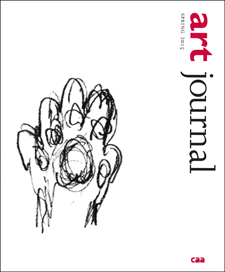 The most recent issue of Art Journal, published several weeks ago, takes a special look at the work of the pioneering artist Carolee Schneemann. Over a fifty-year career, she has consistently been at the forefront of experimental art—as a filmmaker, a performance artist, a creator of media installations, and a feminist artist. The centerpiece of the issue is “The Kitch Portfolio,” for which the artist compiled thirty pages of previously unpublished artworks, photographs, journal entries, letters, and other archival texts pertaining to a central presence in her work from the mid-1950s through 1976, the feline artist and performer Kitch. Two essays on Schneemann’s work are also featured: Thyrza Nichols Goodeve’s “‘The Cat Is My Medium’: Notes on the Writing and Art of Carolee Schneemann,” and Kenneth White’s “Meat System in Cologne.” The issue also includes an essay by Kerr Houston on Richard Serra’s 1966 renunciation of painting, as well as reviews of books by Sharon Kivland, Sharon Louden, Stephen Wright, and Todd Cronan.
News from the Art and Academic Worlds
posted by Christopher Howard — August 12, 2015
Each week CAA News publishes summaries of eight articles, published around the web, that CAA members may find interesting and useful in their professional and creative lives.
Art Museum Staff Demographic Survey
The results of the Art Museum Staff Demographic Survey lead to a range of conclusions, many of which are perhaps best addressed by museums on the local level, as local and regional demographics tend to differ considerably across the continent. The headline is unsurprising: utilizing the categories employed by the 2000 US Census, 72 percent of AAMD staff is Non-Hispanic White, and 28 percent belongs to historically underrepresented minorities. (Read more from the Andrew W. Mellon Foundation.)
Women Take the Lead in US Museum Jobs, but Minorities Are Still Underrepresented
American museums have made significant progress toward gender equality but little headway in building ethnically diverse staff, according to a report from the Andrew W. Mellon Foundation. The average museum’s curatorial, education, conservation, and top administrative staff members are 84 percent white. The report, based on a survey administered to 181 museums, was the first comprehensive study of the ethnic and gender makeup of US museum employees. (Read more from the Art Newspaper.)
The Guerrilla Girls, after Three Decades, Still Rattling Art World Cages
After three decades as masked crusaders for gender and racial equality in the art world—and increasingly, everywhere else—the Guerrilla Girls have lately been enjoying a victory lap. Last year, the Whitney Museum of American Art acquired the group’s portfolio of eighty-eight posters and ephemera from 1985 to 2012, documenting the number of women and minorities represented in galleries and institutions, including the Whitney itself. (Read more from the New York Times.)
A Sobering Look at How AIDS Changed Art in America
In the most literal way, AIDS left its mark on the art world. Keith Haring, Robert Mapplethorpe, and Felix Gonzalez-Torres are just a few of the well-known artists who died from illnesses related to the virus. And as a result, some of the art from the late 1980s and 1990s reflected the fear, mourning, and misunderstandings surrounding the epidemic. Art AIDS America, an exhibition that’s temporarily up in West Hollywood and opening in full at the Tacoma Art Museum in October, looks at how AIDS inserted itself into the art world’s conversation. (Read more from Wired.)
What’s at Stake in the Artist’s Resale Right Debate?
During the Scull auction of 1973, in which the collector Robert C. Scull sold some fifty iconic works of Pop and Minimalist art for $2.2 million, Robert Rauschenberg, whose work was represented prominently among the lots but who earned nothing from their sale, showed up to heckle the collector. Footage from the Scull auction was played to a packed house at Artists Space in New York, which hosted a panel of arts professionals that addressed resale rights for artists. (Read more from Artsy.)
Is the Copyright Office Inflating the Need for Orphan Works Legislation?
The issues and concerns surrounding orphan works emerged from the Copyright Act of 1976 when copyright protection became automatic and registration became optional. The Copyright Office has noted in its most recent report, Orphan Works and Mass Digitization, that the inability to locate the owners of these copyrighted but not registered works is “perhaps the single greatest impediment to creating new works.” But is it? (Read more from Clancco.)
Facing Facts: Artists Need an Entrepreneurial Mindset, Part 2
The attention generated by my first essay on artist entrepreneurship made me elated and depressed simultaneously. It was obviously hitting a nerve of many in the live arts whose training gave them no foundation for how to actually make a living. Although many college and university faculty members came forward in the comment section to demonstrate that there are, in fact, programs that prepare students for the marketplace, there is still a disconnect for most artists between their creative practice and the pragmatic skill set necessary to make a go of it in the real world. (Read more from HowlRound.)
Instagram Takes on Growing Role in the Art Market
Anyone in the art market who was not already paying attention to the social-media platform Instagram had to sit up and take notice in late April after the actor Pierce Brosnan visited the showroom of Phillips auction house in London. Brosnan snapped a selfie in front of a work he admired: the Lockheed Lounge, a space-age aluminum chaise longue by the industrial designer Marc Newson. Then he added the words “let the bidding commence” and posted it to the 164,000 followers of his Instagram feed. (Read more from the New York Times.)
CAA Members Go to Havana
posted by CAA — August 11, 2015
Last May CAA offered a trip to Cuba to visit the Havana Biennial. In an essay, Katherine Jánszky Michaelsen, a professor of art history at the Fashion Institute of Technology, State University of New York, and a CAA member, describes her experiences in this Caribbean capital city, newly reopened to American citizens.
Outside the airport terminal we’re hit by blinding sunlight and a riot of tropical color—a golden-shower tree, and a row of the famed vintage Cadillacs and Buicks painted in Day-Glo shades of fuchsia, turquoise, and green. All week long sunshine, blue skies, lush vegetation, and vivid colors provide the backdrop of our Havana sojourn; and then there’s the music; on every other street corner someone is making music—not to mention that this is the home of the ever-popular Buena Vista Social Club band.
Timed to coincide with the XII Bienal de la Habana, the CAA trip also overlapped with the onset of the normalization of diplomatic relations between the United States and Cuba. Although Europeans have been traveling to Cuba all along, this was the first year that large numbers of Americans were able to attend the biennial. Celebration was in the air. But testing the climate for change was Tania Bruguera, the dissident Cuban artist and free-speech advocate, who was arrested—not for the first time—at a live reading she held of Hannah Arendt’s 1951 book, The Origins of Totalitarianism. Two members of our group were present at the mêlée.
As tourists we were fortunate to enjoy the expertise and connections of the Cuban-born organizer of the trip, Adolfo Nodal, a former director of the Department of Cultural Affairs in Los Angeles and author of the pioneering book on Cuban art, who has been leading trips to Cuba for a number of years. Thanks to Al, who was one of the producers, we were able to attend the world premiere of the opera Cubanacán: A Revolution in Forms; and we were invited to savor roast pork in the garden of his friend, the artist Kadir López Nieves, with whom he is working on the restoration of Havana’s vintage neon signs. In addition to our spirited and fluently English-speaking guide, Gretell Sintes, another bonus was the considerable experience of CAA member and Xavier University associate professor of art history Alison Fraunhar, also a Cuban art specialist who, for example, arranged a special lecture by Nelson Herrera Ysla, one of the original founders of the Havana biennial in 1984. Finally, traveling with CAA top brass Linda Downs and DeWitt Godfrey, and a busload of like-minded, art-savvy colleagues, ensured the exchange of useful tips, stimulating conversation, and beautiful photographs by Sherman Clarke, among others.
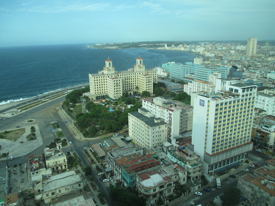 Every morning after partaking of the breakfast buffet that always included heaps of sliced mangoes, papayas, and melons, we assembled in the grand hall of the venerable oceanfront Hotel Nacional, built by McKim, Mead & White in 1930. In the evenings, after a full day of sightseeing, we’d lounge in the palm-tree-lined veranda sipping mojitos to the sound of a female salsa band. As the biennial venues were scattered around the city, it was possible to view historic tourist attractions—like the Plaza de la Revolución, or San Cristóbal cathedral, and at the same time take in a Tino Sehgal performance at the Centro de Arte Contemporáneo Wifredo Lam—or browse and buy prints at the Taller Experimental de Gráfica. Sales transactions can be made entirely on trust: you chose the work, take it with you, and send the check in the agreed amount to the Miami address of a relative or friend of the artist.
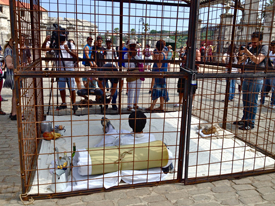 One day in the historic district we stumbled upon a large cage with a man wearing lace tights and stack heels locked inside. We later found out that this was a work by the Indian performance artist Nikhil Chopra, who after three days painting what he saw from behind the bars, hacksawed himself out and walked off to the delight of the cheering crowd that followed him. One particularly hot afternoon, we squeezed like eager sardines into the Church of San Francisco de Paula to watch 82-year-old artist Michelangelo Pistoletto smash large mirrors with a mallet.
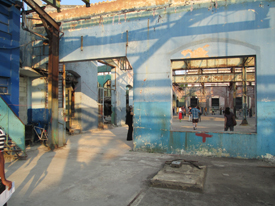
The Malecón seawall was another venue where art and life mixed seamlessly. To make up for the fact that there is no beach, Arlés del Rio created a fake one complete with sand and thatch-roofed cabañas. All along the five-mile promenade tourists and locals mingled amiably among the assorted works of art; children clambered on sculptures as if they were jungle gyms; and occasionally a wave crashing against the wall would douse us with a welcome cool spray. We were not cautioned, nor evidently did we need to be—public safety was not an issue. We saw no beggars, and apart from traffic cops there was no visible police presence. But evidence of poverty was everywhere. Unlike the spiffy, lovingly restored vintage models lined up in front of our hotel, if you hailed a cab in the street, you were likely to get a Soviet-era Lada with missing window and door-handles, springs poking through the seat, and a rattling engine spewing black fumes.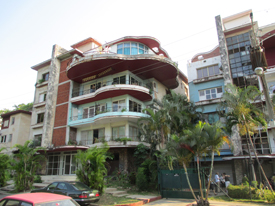 Whole neighborhoods are crumbling and derelict; former single-family houses in residential areas have been chopped up into numerous smaller units; elegant mansions are in ruins; and iconic modernist buildings from the 1950s have peeling paint. Architectural preservationists describe this neglect as “preservation by poverty,” meaning that paradoxically poverty has left extant what urban renewal would have inevitably destroyed. Designers in Havana (and elsewhere) have opportunistically embraced the romantic aesthetic of ruins. For example, Guarida, one of the top restaurants in Havana, is located in a ruined building where laundry hangs on a line in the entrance hall. Likewise, an international group show, Montañas con una esquina rota (Mountains with a Broken Corner), curated by artist Wilfredo Prieto, was staged in the roofless ruin of a former bicycle factory.
 Always at the ready, our tour bus comfortably transported us to outlying sites like Morro Cabaña, the historic colonial fortress on a hill that commands a breathtaking view of the city. A warren of small rooms connected by low barrel-vaulted corridors served as galleries that housed Zona Franca, an exhibition of about one hundred solo and group shows of both acclaimed and emerging Cuban artists. One afternoon we were taken to the Romerillo neighborhood where a year ago Alexis Leyva Machado, the artist known as Kcho, inaugurated (with a rare, surprise public appearance by Fidel Castro) an experimental community project, the Estudio Romerillo. For the biennial he organized an exhibition that took over the entire neighborhood and included artists from all over the world. There is a strong tradition of community service and sharing in Cuba, and established artists who enjoy special privileges are often moved to engage in activities to serve the common good. Carlos Garaicoa, a Cuban artist with an international reputation, is another example. In his spacious studio in a modernist building, he staged a group exhibition to launch Artista x Artista, an international exchange program that will include artist residencies and is based on the Open Studio program he started in Madrid in 2007. Yet another initiative created over the course of a decade for the benefit of the fishing village of Jaimanitas is an extensive and festive work of public art, Fusterlandia. Throughout the neighborhood, starting with his own house, the artist José Rodríguez Fuster painted murals and decorated the walls of dozens of houses with colorful ceramic shards in the manner of Antoni Gaudí.
Havana’s Museo Nacional de Bellas Artes (MNBA) comprises two separate buildings. The first, a majestic structure built in 1913 devoted to “arte universal,” was the venue for an exhibition titled Wild Noise—a collaboration with the Bronx Museum of the Arts that included an international roster of artists and explored a series of contemporary themes like identity, style, architecture, and community that are relevant to both the Bronx and Havana. Overseen by Bronx Museum director Holly Block, who has been engaged with Cuban art for two decades and is the author of Art Cuba: The New Generation, the exhibition was hailed as the most extensive cultural exchange between the US and Cuba in over fifty years; it will be followed in 2016 by an exhibition at the Bronx Museum organized by the Havana MNBA. A few blocks away, a modernist building from the 1950s that was fully restored and enlarged in the late 1990s showcases Cuban art from colonial times to the present. Except for the conspicuous absence of the obligatory museum book and gift shop, both the building and installation could easily hold their own anywhere in the world.
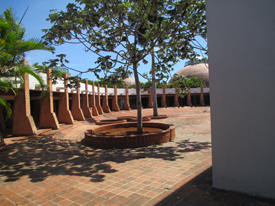 The highlight of the trip for many of us was the campus of the National Art Schools, now known as ISA (Instituto Superior de Arte). It is the subject of a book by John Loomis, Revolution of Forms: Cuba’s Forgotten Art Schools, and a poignant 2011 documentary, Unfinished Spaces, by Alysa Nahmias and Benjamin Murray. Both works tell the story that is also the subject of the opera Cubanacán: A Revolution of Forms that we attended. In 1961, while playing golf at the Havana Country Club in Cubanacán, Fidel Castro and Che Guevara had the idea that the verdant grounds of this symbol of wealth and privilege would be an ideal setting for a complex of tuition-free art schools. Architect Ricardo Porro, charged to build “the most beautiful city of the arts,” enlisted the help of two Italian colleagues Roberto Gottardi and Vittorio Garatti. Of the five proposed schools three (music, ballet, and theater arts) were sadly left unfinished in 1965 when, due to Cuba’s rapprochement with the Soviet Union, the political climate changed drastically. These buildings are now in a state of ruin and overgrown with vegetation. But the schools of modern dance and plastic arts by Porro were completed, recently restored, and continue to be in use.
The three wide arches of the entranceway of the brick-domed school of plastic arts provided the ideal backdrop for the outdoor performance of Cubanacán by the Cuban composer Roberto Valera and the American librettist Charles Koppelman. This worthy effort, previewed favorably in the New York Times, is an intriguing work in progress that deserves to be developed further, not only because it serves to publicize this unique architectural undertaking.
 It was in the daylight the following day that the building came fully to life. Low-lying, hugging the ground, the stupalike domes of red brick and contrasting white plaster are surrounded by tropical green foliage—it is as strange and unfamiliar-looking as the remains of some unknown, ancient civilization. The inside of the building is bathed in natural light from the oculi in the Catalan-vaulted domes and, due to skillful positioning of corridors and interior spaces, is ventilated and comfortable even in the midday sun. The experience of the building was made even more memorable because art students were present throughout. In keeping with the biennial’s theme of the fusion of art and life, mixed in with official exhibits were working art studios open to the public, where you could engage with the art students. When I asked a young woman whether the building was an inspiration for her, she smiled, and her eyes shining brightly, vigorously nodded her head.
Captions
Photo 1: View from the Edificio FOCSA with Hotel Nacional and gardens (rear) (photograph by Sherman Clarke)
Photo 2: Nikhil Chopra, performance The Black Pearl, Plaza de Armas, Havana (photograph by Katherine J. Michaelsen)
Photo 3: Modernist buildings in disrepair, Miramar, Havana (photograph by Sherman Clarke)
Photo 4: Group exhibition, curated by artist Wilfredo Prieto in former bicycle factory, Vedado, Havana (photograph by Sherman Clarke)
Photo 5: Inner courtyard, School of Plastic Arts, ISA, Cubanacán, Havana (photograph by Sherman Clarke)
Photo 6: CAA group on steps of Club Habana, Playa, Havana (photograph by Gretell Sintes)
Committee on Women in the Arts Picks for June 2015
posted by CAA — August 10, 2015
Each month, CAA’s Committee on Women in the Arts selects the best in feminist art and scholarship. The following exhibitions and events should not be missed. Check the archive of CWA Picks at the bottom of the page, as several museum and gallery shows listed in previous months may still be on view or touring.
August 2015
Beverly Semmes: Feminist Responsibility Project (FRP)
Weatherspoon Art Museum
Bob and Lissa Shelley McDowell Gallery, University of North Carolina, 500 Tate Street, Greensboro, NC 27413
May 24–September 6, 2015
The Weatherspoon Art Museum at the University of North Carolina in Greensboro presents the Feminist Responsibility Project (FRP) by the New York artist Beverly Semmes. The exhibition features drawings, ceramics, suspended and illuminated glass sculpture, and video work.
“The metaphors and imagery of Beverly Semmes’s art typically flow in this direction: from the female body and out into the landscape,” Ingrid Schaffner wrote in the 2011 exhibition catalogue from Rowan University Art Gallery. This is noticeably experienced through the large fabric sculpture, Buried Treasure, on view at the Weatherspoon. Buried Treasure, made of black crushed velvet, has one arm of the dress snaking its way off the wall and across the floor of the gallery, enveloping the active space. Continuing to connect mediums in space, her video, Kick, depicts Semmes kicking a reddish-pink potato across icy terrain, the color reflective of the pot sculptures dotting the gallery landscape.
“Her totemic and abstract works create alternative lenses from which to see the body in relationship to domestic or natural landscapes,” says the Weatherspoon exhibition description. In her works on paper, Semmes manipulates photographs in vintage “gentlemen” magazines, as she calls them, covering various parts of the depicted female bodies in ink to perform “a personal act of feminist censorship, blotting out the literal to leave behind abstract, nuanced images that speak in a different voice.”
Semmes will be at the Weatherspoon on Thursday, September 3, 2015, at 6:00 PM for an artist’s talk.

Linda Nochlin: Women Artists: The Linda Nochlin Reader
Edited by Maura Reilly
Recent book release
In addition to two new essays in this recently released volume, Women Artists: The Linda Nochlin Reader, readers are treated to twenty-nine of Nochlin’s essays over her career, including “Women Artists after the French Revolution” and “Starting from Scratch: The Beginnings of Feminist Art History.”
The new anthology includes the provocative essay, “Why Have There Been No Great Women Artists?”—a continuing relevant question. In May of this year, ARTnews revisited Nochlin’s groundbreaking 1971 essay (originally published in ARTnews), exploring women in the arts today, and including eight contemporary artists replies to Nochlin’s essay. In the New York Times Sunday Book Review, the journalist Chris Kraus acclaims, “Nochlin writes with a dazzling mix of erudition and candor, but what’s most remarkable about her work is that it’s driven by an exhaustive investigation as to why and how certain artworks have been meaningful to her.”
Presenting artist monographs alongside the essays, the volume collects Nochlin’s writings on artists such as Mary Cassatt, Louise Bourgeois, Cecily Brown, Kiki Smith, Miwa Yanagi, and Sophie Calle, written in a voice that feels as contemporary as when they first appeared. Women Artists: The Linda Nochlin Reader is published by Thames and Hudson and edited by Maura Reilly, founding curator of the Elizabeth Sackler Center for Feminist Art at the Brooklyn Museum in New York.
A. L. Steiner: Come & Go
Blum and Poe
2727 South La Cienega Boulevard, Los Angeles, CA 90034
July 2–August 22, 2015
The press release from Blum and Poe presents the new exhibition Come & Go by the artist A. L. Steiner in dramatic fashion: “Between the interlude of state-sanctioned exploitation and violence, the Amerikkkin project of mass incarceration and slavery, the uncertain future of California’s viability, and planetary implosion, A. L. Steiner presents an overview of her photo archive from 1995–2015.”
Despite the chance of planetary implosion, the exhibition by Steiner is a constructed “relaxing space” dedicated to the viewing of print work. Sparsely covered white walls are adorned only with a limited number of photographs and collages, while attention in the gallery is focused on a wooden desk and file system. Through the installation, and with an archivist on hand daily, the audience is encouraged to explore twenty years of Steiner’s work.
“A. L. Steiner utilizes constructions of photography, video, installation, collage, collaboration, performance, writing and curatorial work as seductive tropes channeled through the sensibility of a skeptical queer eco-feminist androgyne,” her website bio states.
In addition to the exhibition, Steiner has collaborated with a “revolving cast of subversives and interlocutors,” including a collaboration with Shinichiro Okuda/WAKA WAKA and additional live performances by Brave Accepter, Jibade-Khalil Huffman on August 15, and YACHT on August 22; and an archivist to guide viewers daily, 10:00 AM–1:00 PM and 2:00–6:00 PM.

Women Make Movies: 2015 Catalogue
Online and Print Resource
This thirty-two-page special-edition catalogue is the first in ten years released by Women Make Movies. Focused on their collection, the catalogue includes briefs and data on classics that focus on feminism and gender studies as well as films from diverse regions from across the globe. Highlighted are Academy Award winners such as Saving Face, “a harshly realistic view of violence against women in South Asia,” and new releases, Regarding Susan Sontag and Alice Walker: Beauty in Truth—illuminating portraits of the literary giants.
The catalogue is meant to facilitate rental or purchasing access to the Women Make Movies holdings. Established in 1972, Women Make Movies is a “multicultural, multiracial, non-profit media arts organization, which facilitates the production, promotion, distribution and exhibition of independent films and videotapes by and about women.” They provide distribution services and production assistance programs, while facilitating feminist media, including a special emphasis to support work by women of color.
Yoko Ono: One Woman Show, 1960–1971
Museum of Modern Art
11 West 53 Street, New York, NY 10019-5497
May 17–September 7, 2015
The Museum of Modern Art presents the first One Woman exhibition dedicated to the work of Yoko Ono. This retrospective is a survey of the decisive decade that led up to Ono’s unauthorized exhibition (One Woman Show, Museum of Modern [F] art, 1971), revalorizing one of the most misunderstood artists of the last sixty years.
Featuring Ono’s most celebrated pieces between 1960 and 1971, the exhibition brings together approximately 125 of Ono’s early objects, works on paper, installations, performances, audio recordings, and films, alongside rarely seen archival materials. During these years, Ono (born in Tokyo, 1933) moved between New York, Tokyo, and London. A pioneer in the international development of Conceptual art, experimental film, and performance art, Ono was then creating artworks that could exist as mere instructions, meant to be executed once, multiple times, or none. Since her early projects are often based on verbal or written instructions, the exhibited pieces focus in the participation on viewers, where the artist generously opens up to their diverse responses to “complete” her pieces, or perhaps towards a sense beyond a One-Woman proposal, but rather an invitation to a collaborative creativity.
Among the exhibited pieces to be highlighted are Grapefruit (1964), Ono’s influential book of instructions; the typescript for which is displayed here page by page—consisted of nothing but terse, open-ended instructions for readers to follow—and Half-A-Room (1967), an installation of bisected, incomplete, white-painted domestic objects. The film Cut Piece (1964), documentation of one of Ono’s seminal performances, is also on view. Here, Ono confronted issues of gender, class, and cultural identity by asking viewers to cut away pieces of her clothing as she sat quietly on stage. Cut Piece remains one of the most disturbing works of performance art of the 1960s, that stands as a foundation of feminist and body-centered art.
A Feminist Fiber Art Exhibition
Traveling Exhibition and Call for participation
First venue opens August 14, 2015
Organized by Iris Nectar Studio, this DIY feminist art exhibition will feature female artists from around the world whose practice focus on fiber art. The project will take the form of an art crawl throughout the Boston area, with an opening on August 14. The project was inspired by the “Guerrilla Girls’ statistics” of women underrepresented in the art world. Originally envisioned as a little exhibit to take place in a single venue for a few weeks, the initiative was transformed into a traveling exhibition using alternative art spaces all across the greater Boston area because of overwhelming response and support. The exhibition will evolve slightly, with a different lineup of artists in each new space.
The Feminist Fiber Art Exhibition will feature artwork created by artists that identify as female. The constantly growing collection include the witty—knitting from the Icelandic artist Ýrúrarí, the historic and esoterically influenced—as well as work with strong female characters embroided by Alaina Varrone (New Haven, Connecticut), “pubism” pieces by Sally Hewitt (England), and “retex” (recycled textile) sculptures from the London-based German artist Jess de Wahls. The project online also features a zine, a blog, and a call for participation.
Michelle Stuart: Topographies: Drawings & Photographic Works 1968–2015
Marc Selwyn Fine Art
9953 South Santa Monica Boulevard, Beverly Hills, CA 90212
July 18–September 5, 2015
Marc Selwyn Fine Art is pleased to announce Topographies: Drawings & Photographic Works 1968–2015, an exhibition by the New York–based artist Michelle Stuart. Stuart (b. Los Angeles, 1933) is a multidisciplinary artist best known for a rich and diverse practice, including site-specific earth works, intimate drawings, multimedia installations, paintings, sculpture, and photographs, all centered on a lifelong interest in the natural world and the cosmos. Her work questions conventional notions of drawing as it merges performative rubbing and frottage gestures with elements of the landscape itself. Stuart brings forth imagery by both adding natural materials and revealing the texture of the earth, combining the fundamentals of both drawing and photography.
Each work is a unique meditation on the nature of memory, digitally printed on sheets of archival paper. The individual panels feature untouched and altered elements, including appropriated vintage images and her own photographs, combined in a filmic manner. These dreamlike recollections of her past not only continue her life-long artistic engagement with specific locations, but also affirm the significance of place as a unique source of memory.
The exhibition highlights include #9 Zen, an iconic scroll that will be accompanied by a selection of works on paper, ranging from early collages such as Traces to more recent indexical works in which earth and seeds are pressed and merged onto her paper supports. The second gallery features a selection of her cinematic photographs, including the walk-about narratives of The Beginning, Islas Encantadas,and Past Shadows, Orkney.
caa.reviews Seeks Field Editors for Books and Exhibitions
posted by Betty Leigh Hutcheson — August 10, 2015
caa.reviews invites nominations and self-nominations for ten individuals to join its Council of Field Editors, which commissions reviews within an area of expertise or geographic region, for a three-year term, through June 30, 2018. An online journal, caa.reviews is devoted to the peer review of new books, museum exhibitions, and projects relevant to art history, visual studies, and the arts.
The journal seeks field editors for books in the following subject areas: Medieval Art, Early Modern Iberian and Colonial Latin American Art, Contemporary Art, South/Southeast Asian Art, Pre-Columbian Art, Islamic Art, and Museum Studies and Practice. The journal also seeks three field editors to commission reviews of exhibitions on the West Coast pre-1800, in Europe pre-1900, and in New York and the Northeast. Candidates may be artists, art historians, critics, curators, or other professionals in the visual arts; institutional affiliation is not required.
Working with the caa.reviews editor-in-chief, the editorial board, and CAA’s staff editor, each field editor selects content to be reviewed, commissions reviewers, and reviews manuscripts for publication. Field editors for books are expected to keep abreast of newly published and important books and related media in their fields of expertise, and field editors for exhibitions should be aware of current and upcoming exhibitions (and other related projects) in their geographic regions. The Council of Field Editors meets annually at the CAA Annual Conference. Field editors must pay travel and lodging expenses to attend the conference.
Candidates must be current CAA members and should not currently serve on the editorial board of a competitive journal or on another CAA editorial board or committee. Nominators should ascertain their nominee’s willingness to serve before submitting a name; self-nominations are also welcome. Please send a statement describing your interest in and qualifications for appointment, a CV, and your contact information to: caa.reviews Editorial Board, College Art Association, 50 Broadway, 21st Floor, New York, NY 10004; or email the documents to Deidre Thompson, CAA publications assistant. Deadline: September 16, 2015.
News from the Art and Academic Worlds
posted by Christopher Howard — August 05, 2015
Each week CAA News publishes summaries of eight articles, published around the web, that CAA members may find interesting and useful in their professional and creative lives.
Six Dos and Don’ts for Gallery Representation
The road to getting into a gallery can seem impossibly rocky with obstacles at every turn. How do you know if you’re choosing the right path and using the right approach? We chatted with a veteran gallery owner and turned to the experts for six important dos and don’ts to achieving gallery representation. (Read more from Artwork Archive.)
Why Do So Many Galleries Lose Money?
Management of Art Galleries, a slim, Day-Glo orange book, caused a furor when it was published in Germany last year. Written by a 31-year-old German entrepreneur, professor, and art adviser named Magnus Resch, the book argues that most galleries are undercapitalized and inefficient, but, with McKinseylike business strategies, the entire art market could be turned into a profit-generating machine. (Read more from Bloomberg.)
Leading Art Publications in the US Join Forces
ARTnews and Art in America, two of the largest and most widely read art magazines in the US, are merging. Artnews SA—which operates ARTnews, the Polish magazine Art and Business, and the online art market research outlet Skate’s—has acquired Brant Publications’ entire art publishing portfolio, including Art in America. In exchange, Brant Publications, owned by the collector and newsprint magnate Peter Brant, has become the majority shareholder of Artnews SA. (Read more from the Art Newspaper.)
Uncle Sam Wants YOU to Read “Popular” Scholarly Books
If all goes as planned, there’s a fascinating book about Diderot in your future—and one about the history of photographic detection and another one about the economics of addiction. The Public Scholar program, a major new initiative from the NEH, is designed to promote the publication of scholarly nonfiction books for a general audience, and the first round of grants has just been announced: a total of $1.7 million to 36 writers across a broad collection of disciplines. (Read more from the Washington Post.)
Libraries Are the Future of Manufacturing in the United States
Public libraries are becoming a one-stop shop for manufacturing in the digital age. Because libraries are investing in machines like 3D printers, someday soon everyone with access to a public library could become an inventor or create something. (Read more from Pacific Standard.)
Looking at How Performers Are Paid for Performance Art
On the heels of protesters descending upon the Guggenheim Museum in May, calling for improved conditions for the workers who will build a future branch of the museum in Abu Dhabi, the artists Gerard and Kelly have partnered with the Guggenheim to hammer out fair labor standards for themselves and the other performers in Timelining, part of Storylines: Contemporary Art at the Guggenheim. (Read more from the New York Times.)
That “Useless” Liberal Arts Degree Has Become Tech’s Hottest Ticket
Stewart Butterfield, Slack Technologies’ cofounder and CEO, proudly holds an undergraduate degree in philosophy from Canada’s University of Victoria and a master’s degree from Cambridge in philosophy and the history of science. “Studying philosophy taught me two things,” says Butterfield. “I learned how to write really clearly. I learned how to follow an argument all the way down, which is invaluable in running meetings.” (Read more from Forbes.)
An Ignored Conflict of Interest
Conflicts of interest are inherent in faculty control over curriculum. When not addressed, these conflicts can result in faculty behavior that is neither in the best interest of their students nor of their colleges and universities. Our proposed approach for mitigating such conflicts involves shared governance, with faculty and administrators facing, and mitigating, potential conflicts together. (Read more from Inside Higher Ed.)
Call for Applicants to PIPS Committees
posted by Vanessa Jalet — August 04, 2015
The Professional Interests, Practices and Standards (PIPS) committees address critical concerns of CAA’s members set out in the goals of CAA’s Strategic Plan. CAA invites members to apply for service on one of these PIPS working groups.
Committee on Diversity Practices
http://www.collegeart.org/committees/diversity
The Committee on Diversity Practices supports the development of global perspectives on art and visual culture. The committee promotes artistic, curatorial, scholarly and institutional practices that deepen appreciation of political and cultural heterogeneity, as educational and professional values. To that end, the committee assesses and evaluates the development and implementation of curricular innovation, new research methods, curatorial and pedagogical strategies, and hiring practices that contribute to the realization of these goals.
Committee on Intellectual Property
http://www.collegeart.org/committees/ip
The Committee on Intellectual Property monitors and interprets copyright legislation for the benefit of CAA’s various constituencies. In so doing, it seeks to offer educational programs and opportunities for discussion and debate in response to copyright legislation that affects educators, scholars, museum professionals, and artists.
Committee on Women in the Arts
http://www.collegeart.org/committees/women
The Committee on Women in the Arts (CWA) promotes the scholarly study and recognition of women’s contributions to the visual arts and to critical and art-historical studies; advocates for feminist scholarship and activism in art; develops partnerships with organizations with compatible missions; monitors the status of women in the visual-arts professions; provides historical and current resources on feminist issues; and supports emerging artists and scholars in their careers.
Education Committee
http://www.collegeart.org/committees/education
The Education Committee promotes the visual arts as essential human activity; as a creative Endeavor and subject of cultural and historical inquiry and critical appreciative activity, and encourages excellence in teaching at all levels. Its focus is on pedagogy at the higher education level in art history, visual culture, studio, aesthetics, and art criticism, and on the interface between arts teaching and learning research and practice.
International Committee
http://www.collegeart.org/committees/international
The International Committee seeks to foster an international community of artists, scholars and critics within CAA; to provide forums in which to exchange ideas and make connections; to encourage engagement with the international student community; to develop relationships between CAA and organizations outside the United States with comparable goals and activities; and to assist the CAA Board of Directors by identifying and recommending advocacy issues that involve CAA and cross national borders.
Museum Committee
http://www.collegeart.org/committees/museum
The Museum Committee provides a bridge between scholars and arts professionals in the academic and museum fields. It offers a forum for the discussion of issues of mutual interest and promotes museum advocacy issues within CAA. The committee lends support and mentorship for both seasoned and emerging professionals to protect and interpret the arts within museums.
Professional Practices Committee
http://www.collegeart.org/committees/professional
The Professional Practices Committee responds to specific concerns of the membership in relation to areas such as job placement and recruitment, tenure and promotion procedures, scholarly standards and ethics, studio health and safety, and artists’ practices. The Professional Practices Committee also oversees CAA’s Standards and Guidelines.
Services to Artists Committee
http://www.collegeart.org/committees/services
The Services to Artists Committee (SAC) was formed by the CAA Board of Directors to seek broader participation by artists and designers in the organization and the Annual Conference. SAC identifies and addresses concerns facing artists and designers; creates and implements programs and events at the conference and beyond; explores ways to encourage greater participation and leadership in CAA; and identifies ways to establish closer ties with other arts professionals and institutions. To this end, committee members are responsible for the programming of ARTspace and its related events.
Student and Emerging Professionals Committee
http://www.collegeart.org/committees/student
Established in February 1998, the Student and Emerging Professionals Committee is comprised of CAA members who are students, recent graduates, and experienced arts professionals with the intention of better representing students and emerging professionals within the larger CAA and academic framework.
In the past year the Committee on Diversity has addressed how CAA as an association can positively address diversity awareness, training and implementation and developed a site for resources on diversity practices: http://www.collegeart.org/diversity/; the Committee on Intellectual Property has organized conference sessions on the new Fair Use Code and maintains a resource cite on intellectual property: http://www.collegeart.org/ip/; the Committee on Women in the Arts provides CWA Picks: http://www.collegeart.org/committees/picks and supports scholarship on women in the arts; the Education Committee has organized conference panels on issues in education; the International Committee promotes interactions between scholars on a global basis and has supported the CAA/Getty International Travel program that brings international scholars to the annual conference; the Museum Committee focuses on the history and theory of art museums and academia and has initiated a new project—Resources for Academic Art Museum Professionals that has support from the Andrew W. Mellon Foundation; the Professional Practices Committee updates and develops guidelines for the profession; Services to Artists Committee plans and organizes ArtSpace at the annual conference that presents prominent artists and designers, discussions on artist/designer concerns from safety in the workplace to professional development; the Student and Emerging Professionals Committee organizes panels related to emerging professionals and holds mentoring and mock job interviews at the conference. All committees are seeking new members with expertise in these areas.
This year the Board of Directors has established a Task Force on Committees to strengthen and streamline the important work of CAA’s nine Professional Interest, Practices and Standards committees. The nine PIPS committees are working with the Task Force to determine the future focus and structure of the committees with the goal of better serving the visual arts field.
At the Annual Conference in February each committee presents one or two sessions on a subject related to their committee charge.
Committee members serve three-year terms (2016–2019), with at least one new member rotating onto a committee each year. Candidates must be current CAA members and possess expertise appropriate to the committee’s work. Members of all committees volunteer their services without compensation. Committee work is not for the faint of heart; it is expected that once appointed to a committee, a member will involve himself or herself in an active and serious way.
The following vacancies are open for terms beginning in February 2016:
- Committee on Diversity Practices: 2–3 members
- Committee on Intellectual Property: 4 members
- Committee on Women in the Arts: 3 members
- Education Committee: 6 members
- International Committee: 5 members
- Museum Committee: 0 members
- Professional Practices Committee: 3 members
- Services to Artists Committee: 5 members
- Student and Emerging Professionals Committee: 2–3 members
CAA’s president, vice president for committees, and executive director review all candidates in the fall and make appointments in December, prior to the Annual Conference. New members are introduced to their committees during their respective business meetings at the conference.
Nominations and self-nominations should include a brief statement (no more than 150 words) describing your qualifications and experience and an abbreviated CV (no more than 2–3 pages). Please send all materials to Vanessa Jalet, CAA executive liaison at vjalet@collegeart.org. Deadline: October 16, 2015.). Kindly enter subject line in email: 2016 PIPS Applicant.