
CAA News Today
Art Journal Open Seeks Submissions
posted by CAA — April 11, 2016
Art Journal Open, an open-access, independently edited website, seeks Artists’ Projects and Bookshelf submissions. An agile counterpart to the quarterly Art Journal, the website presents artwork, scholarly essays, conversations and interviews, artifacts of materials and process, and news items. The site serves as a provisional, suggestive, and projective archive for contemporary art. Gloria Sutton of Northeastern University serves as web editor for Art Journal Open, which publishes content on a rolling basis.
Artists’ Projects: We welcome submissions from all artists, ranging from those who work in more traditional mediums to those who have a digital and web-based focus. All formats and projects will be considered. Examples of published artist projects can be viewed on our website. Please send a short proposal describing your project, your website URL or images of your recent work, and your contact information to Gloria Sutton at art.journal.website@collegeart.org.
Bookshelf: Launched last year, Art Journal Open Bookshelf asks a simple question: “What are you reading?” Each answer provides a glimpse into the contributor’s personal reading list, from academic publications and artist monographs to novels, memoirs, and travel guides. Contributors to the series have included academics, artists, curators, and librarians. To submit your own Bookshelf to Art Journal Open, send a brief description of what you’re reading and why, a list of the titles (including author, publisher, and year of publication), and a photograph of your books or reading site to art.journal.website@collegeart.org.
“William Kentridge’s Project for the City of Rome”
posted by Jennifer Griffiths — April 07, 2016
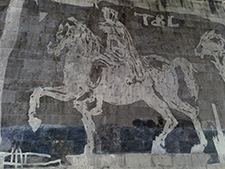
Emperor Marcus Aurelius
Rome’s Tiber embankments have been receiving an eye-catching mural makeover in the past few weeks, as a series of large-scale figures, up to ten meters in height, take shape as a century of pollution and biological patina is slowly power washed from the travertine walls. When William Kentridge’s 550-meter long mural, Triumphs and Laments: A Project for the City of Rome (2016), is complete and inaugurated on April 21, the mythical anniversary of the founding of Rome, it will constitute the South African artist’s largest public work to date.
Occupying the straightest stretch of urban riverfront between Ponte Sisto and Ponte Mazzini, the frieze will decorate a much-neglected space at the heart of the Eternal City. In fact, this reverse graffiti project is part of ongoing cultural programming by the organization Tevereterno, whose goal is to “revitalize Rome’s urban waterfront through the establishment and stewardship of Piazza Tevere, the first public space for contemporary art in Rome.” This international nonprofit initiative and multidisciplinary cultural project partners with the River//Cities Platform to create dialogue with other cities across Europe, America, and Asia about initiatives to develop rivers or waterfronts as cultural spaces. Speaking to a group of volunteers last month, Teverterno’s founder and artistic director Kristin Jones explained, “Everyone comes to Rome to take inspiration from the past, but who is caring for the present?” It was Jones who courted and convinced Kentridge to take on the Rome project.
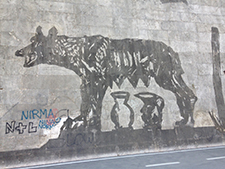
La Lupa Romana sans Romulus and Remus
Since its founding in 2004, Tevereterno has orchestrated a series of artistic happenings along the riverfront, including pieces by Jenny Holzer and Barnaby Evans. Holzer’s Words of Love and War (2007) was a projection of texts by international poets and writers in English and Italian onto a series of Roman monuments, including the Piazza Tevere. WaterFire Roma (2012) by Evans featured thirty bonfires floating on the surface of the river as a conceptual reflection on the struggle between light and dark. As with many of the other events, WaterFire Roma was fashioned after a gesamtkunstwerk, combining visual spectacle with original music by Stag of Marco Guazzone and choreography by Linda Foster.
Kentridge’s drawings of the historical symbols and figures for Triumphs and Laments were first shown at the Italian Pavilion of the Venice Biennale in 2015. Ten workers have been laboring to stencil the eighty silhouettes onto the embankments over the course of the past month. The images evoke both the city’s two thousand-year history and a more universal story of our collective successes and failures as human beings. Even as the name and subject suggest the history of an ancient Roman triumph, or a celebration of victory against Carthage, Britannia, or Parthia along the Sacred Way, Kentridge’s parade of images critically conjures up the specters of conquest and the contradictions of civilization. Just as one nation’s victory demands another’s defeat, one person’s rise often hinges on another’s fall.
Kentridge’s works consistently address issues of social justice by making the personal political and visualizing states of mind, and, in this respect, Triumphs and Laments does not disappoint. Kentridge often returns to themes of estrangement, exile, and transience, all of which are explored in the Rome frieze. Working in a wide range of media, from prints and drawings to theater, tapestry, and sculpture, he is perhaps best known for creating animated films with a palimpsestic process of sketch and erasure. In 9 Drawings for Projection (1989–2003), short films that narrate changing lives in apartheid South Africa, the artist used images of human processions and running water as metaphors for the passage of time. While there are meanings inherent to each individual silhouette along the river, the larger elements of process and iconography resonate with the artist’s other works and add another layer of meaning to his “projection” onto the Tiber walls.
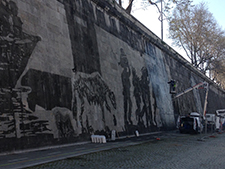
At work along the Tiber embankments
The fate of Kentridge’s frieze is to fade, like all things, under the patina of time, as the Tiber tides rise and fall year by year. This work, like the artist’s films, echoes the palimpsest that has been built, unbuilt, and rebuilt on the banks of the river over the centuries. Yet while the name and image of Rome resound through layers of history, this waterfront spectacle draws attention to the city’s cosmopolitan and contemporary art scene. What is truly lamentable is how the municipal administration of Rome frustrated and delayed such an innovative, creative contribution to the cityscape for so long; it took three years simply to obtain the necessary authorization.
In the run-up to the inauguration, Kentridge is in the city, hosted by the American Academy in Rome, inspecting the riverside work underway and giving a number of talks. He will be in conversation with Carolyn Christov-Bakargiev at the British School at Rome on April 15. Triumphs and Laments will play out as a kind of total work of art at the opening, which will premiere a theatrical program created in collaboration with the composer Philip Miller, and feature live shadow play and two processional brass bands.
News from the Art and Academic Worlds
posted by Christopher Howard — April 06, 2016
Each week CAA News publishes summaries of eight articles, published around the web, that CAA members may find interesting and useful in their professional and creative lives.
The Resurgence of Women-Only Art Shows
While some artists are ambivalent about being viewed through the lens of gender, the all-women’s group exhibition, which fell out of favor in the 1980s and 1990s, is flourishing again. At least a dozen galleries and museums across the United States are featuring women-themed surveys, a surge curators and dealers say is shining a light on neglected artists, resuscitating some careers, and raising the commercial potential of others. (Read more from the New York Times.)
Help Desk: Why Your Show Wasn’t Reviewed
None of my shows has ever been reviewed, even though I’ve exhibited my work in solo and group shows for almost six years. Press releases, personal emails, and newsletters have been sent from me and from the galleries. The galleries aren’t blue-chip, but they’re decent, and there’s an audience. Why can’t I get a review? (Read more from Daily Serving.)
How Critical Thinking Sabotages Painting
Critical thinking benefits disciplines based in words, and I use it myself when teaching modern art history and humanities seminars. But it’s a disaster when used to teach painting, whether to college art majors who want to become painters, to students who want to go into neighboring fields like graphic design or photography, or to biology students who decide to give painting a try. (Read more from Two Coats of Paint.)
We Need Ethnographic Museums Today—Whatever You Think of Their History
Since the 1970s ethnographic museums, perceived as warehouses of colonial loot, were charged with divesting non-Western works of the significance they once carried, in the heat and dust of ceremony, in the movement of dance or oratory, on the bodies of their former owners, in the flow of life. Among commentators and curators, there was much argument regarding approaches to display. (Read more from Apollo.)
Grade Inflation, Higher and Higher
The first major update in seven years of a database on grade inflation has found that grades continue to rise and that A is the most common grade earned at all kinds of colleges. Since the last significant release of the survey, faculty members at Princeton University and Wellesley College, among other institutions, have debated ways to limit grade inflation, despite criticism from some students who welcome the high averages. (Read more from Inside Higher Ed.)
Revising the Terrible, Horrible, No Good, Very Bad Dissertation
Like many graduate students, I wrote a terrible, horrible, no good, very bad dissertation, so revising it into a book has been something of a challenge. I’ve worked through it in two different ways. First, I’ve changed my writing and editing habits for what feels like the hundredth time. Second, I’ve adopted a strategy of recasting my chapters as journal articles. (Read more from the Chronicle of Higher Education.)
How Readers Discover Content in Scholarly Publications
Some survey findings make good sense and deserve attention on their own merits. Perhaps the most significant of these—which is a theme explored across the report—is that discovery patterns and practices vary across different sectors such as academic, corporate, and medical; different countries and levels of national income; and different fields and disciplines. (Read more from the Scholarly Kitchen.)
Getting Down to Brass Taxes: An Interview with Tax Expert Rus Garofolo
Tax day is fast approaching—what’s a freelance artist or burgeoning arts organization to do? In anticipation of the IRS’s upcoming deadline, Amanda Keating sat down with Rus Garofolo, founder of Brass Taxes, to discuss some key questions that arts organizations might want to consider in their tax prep. (Read more from Fractured Atlas.)
Suzanne Preston Blier Is the New CAA President
posted by Christopher Howard — April 04, 2016
Suzanne Preston Blier, a historian of African art and architecture at Harvard University, has been elected president of CAA for a two-year term, beginning in May 2016. A member of the board since 2012, Blier has served as vice president for publications (2013–15) and vice president of Annual Conference (2015–16), and has served on task forces related to the development of CAA’s Code of Best Practices in Fair Use for the Visual Arts and Guidelines for the Evaluation of Digital Scholarship in Art and Art History. She will succeed DeWitt Godfrey, professor of art and art history at Colgate University.
In her statement for candidacy, Blier wrote, “My priorities as president will focus on increasing membership in part through changes to the Annual Conference and enhancing CAA’s place in the community of discourse nationally and internationally through more effective social media engagement and the use of digital technologies. I hope also to broaden our engagement not only at the local and national levels but also internationally.”
Blier earned a BA from the University of Vermont in 1973 and completed a PhD in art history from Columbia University. Blier taught at Northwestern University for two years (1981–83) and returned to Columbia (1983–93) before landing at Harvard, where she is currently Allen Whitehill Clowes Professor of Fine Arts and Professor of African and African American Studies.
In 2008, Blier helped found an on-line GIS-enhanced database and mapping project supported by the Center for Geographic Analysis at her school that in 2011 was relaunched as Worldmap.
Blier’s involvement in CAA spans several decades. She originally served on the board from 1989 to 1994. She was a member of the Art Bulletin Editorial Board from 2003 to 2007, serving one year as chair, and participated on the juries for CAA’s Distinguished Lifetime Achievement Award for Writing on Art (2004–6) and Charles Rufus Morey Book Award (2009–11). Blier also helped to shape CAA’s Strategic Plan 2015–2020 and, in her role as vice president, chaired both the Annual Conference Committee and the 2016 task force that brought significant changes to the Annual Conference organization and structure.
“In my own academic work,” Blier continued in her statement, “I have come to understand firsthand the importance of engaging broad and diverse communities of participants; my work initiating an open source website focused on an array of mapping projects, has offered me opportunities to see the imprint that new technologies can have in the lives of both faculty and students.”
 Blier’s most recent book is Art and Risk in Ancient Yoruba: Ife History, Power, and Identity, c. 1300 (New York: Cambridge University Press, 2015), which won the 2016 PROSE Award for Art History and Criticism. She also wrote several other books of note: African Royal Art: The Majesty of Form (London: Calmann and King, 1998); African Vodun: Art, Psychology, and Power (Chicago: University of Chicago Press, 1995), which received CAA’s Morey Book Award in 1997; and The Anatomy of Architecture: Ontology and Metaphor in Batammaliba Architectural Expression (Cambridge, MA: Harvard University Press, 1987), which won the inaugural Arnold Rubin Outstanding Publication Award from the Arts Council of the African Studies Association. The production of both African Vodun and The Anatomy of Architecture were supported by grants from CAA’s Millard Meiss Publication Fund. Blier’s books have been translated into Spanish, Italian, Chinese, and Korean. A publication edited with David Bindman, called The Image of the Black in African and Asian Art, is forthcoming from Harvard University Press.
Her scholarship has appeared in numerous magazines and journals, including African Arts, Journal of African History, American Journal of Semiotics, Anthropology and Art, and Journal of the Society of Architectural Historians. A short essay “Art, Mimesis, and Tigritude” can be found in the June 2013 issue of The Art Bulletin as part of the series Notes from the Field: Mimesis. Other essays in CAA’s flagship journal are “Kings, Crowns, and Rights of Succession: Obalufon Arts at Ife and Other Yoruba Centers” (September 1985) and “Imaging Otherness in Ivory: African Portrayals of the Portuguese ca. 1492” (September 1993). Both articles were selected by members of the Art Bulletin Editorial Board for the Centennial Anthology of the Art Bulletin’s “greatest hits,” designating important articles and reviews since the journal’s 1913 founding to mark CAA¹s Centennial in 2011.
CAA at the 2016 National Art Education Association Conference
posted by CAA — March 31, 2016
 Staff members from CAA flew to the windy city to exhibit and meet the attendees at the 2016 National Art Education Association (NAEA) Convention from March 17-19. The NAEA, a CAA Affiliated Society, is the leading professional membership organization exclusively for visual arts educators. Similar to CAA’s own Annual Conference, the NAEA Convention provides professional development services including sessions, workshops, events, and activities aimed at improving visual arts instruction in American schools.
The NAEA Convention was held at the McCormick Place Convention Center and the Hilton Chicago Hotel, where CAA will hold its 108th Annual Conference in February of 2020. In the Exhibit Hall, CAA’s booth was visited by hundreds of NAEA members working and practicing across all areas of arts education. CAA staff Tiffany Dugan, director of programs, and Vivian Woo, marketing and development manager, talked with attendees and provided CAA information including institutional and individual membership brochures; the Code of Best Practices in Fair Use for the Visual Arts and Use Fair Use buttons; and information about the 2017 CAA Annual Conference in New York. Examples of Art Journal and The Art Bulletin were also on hand.
CAA looks forward to reconnecting with NAEA attendees next year in New York. For a limited time only, all NAEA members can receive a $10 discount off membership with CAA. For more information please contact the CAA Membership Department at 212-691-1051, ext. 1.
News from the Art and Academic Worlds
posted by Christopher Howard — March 30, 2016
Each week CAA News publishes summaries of eight articles, published around the web, that CAA members may find interesting and useful in their professional and creative lives.
How to Be an Unprofessional Artist
No one likes being called an amateur, a dilettante, a dabbler. “Unprofessional” is an easy insult. The professional always makes the right moves, knows the right thing to say, the right name to check. Controlled and measured, the professional never sleeps with the wrong person or drinks too much at the party. (Read more from Momus.)
The Complicated Relationship between Animals and Art
At this year’s CAA Annual Conference, I organized a session on “The Art of Animal Activism” with Keri Cronin of Brock University. The session explored art since the nineteenth century that has taken nonhuman animals seriously as subjects with sentience and agency—not just as decorative ornaments or symbols. I was pleased, and somewhat surprised, that the session was so well received. (Read more from National Public Radio.)
Volume, Weight, and Pigment to Oil Ratios
Oil painters concerned with fat over lean will often turn to information about the oil absorption values for particular pigments as a way to compare how oily or lean certain colors might be. This has led to many misconceptions and outright wrong conclusions that seem to persist in various forums and articles. (Read more from Just Paint.)
Can an Art Critic Fairly Review an Artist Friend’s Work?
There’s no upside for an artist to be friends with an art critic. The personal connection means the critic must pass on reviewing the artist’s work, and while the loss of critical wisdom may be negligible, the loss of exposure is a nuisance for the artist. I have wanted to write about Maggie Michael’s work for years now but can’t without first offering the reader a huge caveat. (Read more from the Washington Post.)
Hundreds of Looted Ancient Artifacts Are Returned to Italy
Hundreds of looted archaeological artifacts that officials say were handled by the London dealer Robin Symes and destined for markets in the United States, Japan, and Britain have been returned to Italy. The artifacts—dating from the seventh century BC to the second century AD—were found two years ago in a storage unit at the Geneva Freeport that investigators traced to Symes. (Read more from the New York Times.)
Business Looms Larger in Art Classes
The new art expert is not necessarily an expert in art. Art-history students used to tackle questions of symbolism, social context, and style in art. Now, many young scholars are at least as focused on prices as they are on the art itself. (Read more from the Wall Street Journal.)
What You Teach Is What You Earn
A new assistant professor of computer science at a public four-year college or university in 2015–16 earns, on average, a little more than $85,000. A full professor of history—likely with twenty-plus more years of teaching experience—earns on average a little less than $90,000 and will likely have his or her salary passed by the new computer-science professor in a few years. (Read more from Inside Higher Ed.)
University Press Redux: Preserving Heritage, Charting the Future
University presses in the United Kingdom are enjoying something of a renaissance. Over the past few years, established presses such as Cambridge, Edinburgh, Liverpool, Manchester, Oxford, and Wales have been joined by a raft of new publishers. (Read more from the Scholarly Kitchen.)
Going Back
posted by Georgina Gluzman, post-doctoral fellow, Universidad de San Andrés (Argentina), and 2015 Participant in the CAA-Getty International Program — March 29, 2016
In 2014, while I was literally printing my dissertation, I received an email saying I had been awarded a travel grant to attend the upcoming CAA Annual Conference. I had applied to the grant without any real expectations. I was so happy, yet so busy, so I replied to the email without even looking at the dates. I was in the middle of a lot of excitement—years of work were becoming printed words.
The conference had a lot of meaning to me. My tutor, Laura Malosetti Costa, had spoken about it several times, and nothing says “important academic event” than something your beloved tutor recommends. There was something mystical about receiving the grant at that specific moment in time!
I could say many things about my participation in the conference and the preconference colloquium in 2015, but I want to write about the experience of returning to the conference in 2016. I attended, along with three other former CAA-Getty grantees, and had the opportunity to present a paper.
I spoke on the Emerging Scholars in Latin American Art panel. Sounds like a big deal, right? I was so incredibly nervous. The other speakers were also excited, happy, and shaking. I delivered the paper, without collapsing, during the longest twenty minutes I have ever experienced at an academic event. Fortunately, I liked my paper and thought it was well-constructed, so I knew I was speaking with true passion—and commitment—about my topic.
The waiting was the hardest part. After I had finished, I lifted my eyes from the printed sheets in front of me and stared at the audience. I thought no one would ask me any questions and was prepared for that outcome, so I was surprised by the many questions I was asked. I have never received so many questions after delivering a paper. These were not your everyday pro-forma questions. The people expressed sincere interest, and their questions were all remarkably interesting. I answered. Some people asked follow-up questions. I stopped shaking. I talked.
When everything was over, I sat down and took notes of the questions and comments. I still keep those notes as a memento of speaking at a CAA conference. If I had not been lucky enough to be invited to the conference in 2015, I would not have been ready to present my work there a year later. And for that, I feel thankful.
CAA at Arts Advocacy Day and Humanities Advocacy Day
posted by CAA — March 24, 2016
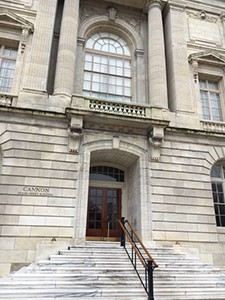
Cannon House, offices of the House of Representatives
CAA had the opportunity this year to attend Arts Advocacy Day, hosted by Americans for the Arts, and Humanities Advocacy Day, hosted by the National Humanities Alliance. One week apart from each other, both events filled Washington, DC with advocates of all ages ready to speak up for the arts and humanities and who were armed with data and statistics.
Arts Advocacy Day, which took place on March 7-8, was headquartered at the OMNI Shoreham Hotel in Washington, DC, just a stone’s throw from the Washington Marriott Wardman Park, where CAA held its 104th Annual Conference in February of this year. The first day of Arts Advocacy Day, now in its 29th year, was jam packed with presentations. Americans for the Arts staff members presented sessions on arts education legislation, such as the recent bipartisan passing of the Every Child Succeeds Act (ESSA), and they presented attendees with dense tables and statistical charts on the economic impact of the arts across the United States. For example, the non-profits arts industry supports 4.13 million jobs in the United States, and the industry contributes a whopping $698 billion annually to the economy. This and many other figures came from the 2016 Congressional Arts Handbook: Facts & Figures at Your Fingertips, which every attendee received. The first day served as foundational preparation for the visits with our local and state representatives the following day.
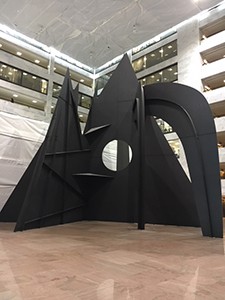
Alexander Calder looming in the Hart Senate Building
March 14-15 marked Humanities Advocacy Day, organized by the National Humanities Alliance. Humanities Advocacy Day, like Arts Advocacy Day, consisted of one day of talks and preparation and one day of Congressional and Senatorial office visits. William Adams, Chairman of the National Endowment for the Humanities, gave a talk on the first day on the NEH’s look toward the future as it shifts its grantmaking structure and adapts to global and domestic changes. The NEH will take on the challenges facing humanities enrollment in higher education and the reduction in humanities and arts programs offered in secondary schools. The NEH will also continue to support work in digital humanities and publishing through a partnership with the Andrew W. Mellon Foundation. Of continued interest to the NEH is increasing access to the humanities through its The Common Good: The Humanities in the Public Square, a program that establishes pathways and means for scholars, educators, and organizations to bring their work into the public sphere.
At lunch, attendees were treated to a presentation by Max Kenner, Executive Director and Founder of the Bard Prison Initiative. BPI offers currently incarcerated individuals the opportunity to obtain a liberal arts college degree from Bard. Since its founding in 1999, the program has grown to become one of the most academically rigorous and successful of its kind.
The National Humanities Alliance scheduled over 200 meetings with Congressman and Congresswomen and Senators for the second day. The New York City delegation, comprised of CAA Director of Programs, Tiffany Dugan, and CAA Director of Communications, Nick Obourn, met with the offices of Congressman Lee Zeldin, Senator Chuck Schumer, and Congresswoman Carolyn Maloney.
News from the Art and Academic Worlds
posted by Christopher Howard — March 23, 2016
Each week CAA News publishes summaries of eight articles, published around the web, that CAA members may find interesting and useful in their professional and creative lives.
The Cost of Being Decent to Adjuncts
Even if the adjunct movement for better working conditions succeeds, most adjuncts will lose. That’s one bold claim of a recent paper on the costs associated with a number of the movement’s goals, such as better pay and benefits. While activists and scholars have criticized what they call the paper’s inherently flawed logic, the study’s authors say it is a first step toward a more critical dialogue. (Read more from Inside Higher Ed.)
Abstraction Isn’t Neutral: Sondra Perry on the NCAA, Subjecthood, and Her Upcoming Projects
Earlier this month Ella Coon spoke with the video artist Sondra Perry to talk about recent projects, her upcoming exhibitions, and her thoughts on a variety of other subjects, including the role of generosity in her life and work. (Read more from ARTnews.)
Halting Academic Incivility (That’s the Nice Word for It)
A report published last year in the Journal of Applied Psychology confirms what many might say is obvious: “Incivility … defined as insensitive behavior that displays a lack of regard for others, is rampant and on the rise.” This will not be news for academics. Consider the regular calls for an end to faculty incivility—the rudeness, abusive language, bullying, and general meanness that seem to characterize many of our interactions. (Read more from the Chronicle of Higher Education.)
European Museums Adapt to the American Way of Giving
Museums in the United States, helped by favorable tax laws, are sustained by a culture of giving by private donors and a universe of trained development officials. That culture isn’t common in other parts of the world, where governments often support museums. That is changing. (Read more from the New York Times.)
Managing an MOOC
Several years ago I wrote a MOOC, “The Modern Genius: Art and Culture in the 19th Century,” which initially ran through the Canvas network, and then Kadenze. I had never assigned the MOOC course to any of my students, but that changed this January, when my honors modern art students enrolled in the MOOC, and we experimented with a completely flipped classroom. (Read more from Art History Teaching Resources.)
Whither the Digital Humanities?
The digital humanities can be viewed in two ways: as emerging and as emergent. The tension between them is a central force animating the field today. There are two areas—writing and the university—in which this tension is especially apparent, as digital technologies are upending, questioning, or reframing traditional or cherished assumptions. (Read more from Digital Pedagogy Lab.)
Pirating Papers
Peer-to-peer research sharing looks a lot like sharing of other forms of media, a new study suggests. While some researchers are personally opposed to copyright, others pirate research simply for the sake of convenience. (Read more from Inside Higher Ed.)
Asia Week Raids: New Details on the Christie’s Seizures
Last week, a series of five federal raids during New York’s Asia Week led to the seizure of at least eight looted antiquities and the arrest of at least one dealer. This is the first of several posts that will discuss the alleged smuggling networks disrupted by those raids. (Read more from Chasing Aphrodite.)
caa.reviews Seeks Field Editors
posted by CAA — March 18, 2016
 caa.reviews invites nominations and self-nominations for individuals to join its Council of Field Editors, which commissions reviews within an area of expertise or geographic region, for a term ending June 30, 2019. An online journal, caa.reviews is devoted to reviewing books, museum exhibitions, and projects relevant to art history, visual studies, and the arts.
The journal seeks field editors for books in the following subject areas: early modern Iberian and Latin American art; design history; American art; architecture and urbanism, pre-1800; eighteenth-century art; and Japanese art. The journal also seeks field editors for exhibitions in the following areas: modern and contemporary art; New York and international; and west coast pre-1900. Candidates may be artists, art or design historians, critics, curators, or other professionals in the visual arts; institutional affiliation is not required.
Working with the caa.reviews editor-in-chief, the editorial board, and CAA’s staff editor, each field editor selects content to be reviewed, commissions reviewers, and reviews manuscripts for publication. Field editors for books are expected to keep abreast of newly published and important books and related media in their fields of expertise, and field editors for exhibitions should be aware of current and upcoming exhibitions (and other related projects) in their geographic regions. The Council of Field Editors meets annually at the CAA Annual Conference. Field editors must pay travel and lodging expenses to attend the conference.
Candidates must be current CAA members and should not currently serve on the editorial board of a competitive journal or on another CAA editorial board or committee. Nominators should ascertain their nominee’s willingness to serve before submitting a name; self-nominations are also welcome. Please send a statement describing your interest in and qualifications for appointment, a CV, and your contact information to: caa.reviews Editorial Board, College Art Association, 50 Broadway, 21st Floor, New York, NY 10004; or email the documents to Deidre Thompson, CAA publications assistant. Deadline: April 15, 2016.