CAA News Today
New in caa.reviews
posted by CAA — March 17, 2017
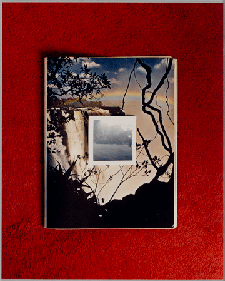 Vanessa Rocco visits Photo-Poetics: An Anthology at the Solomon R. Guggenheim Museum. The “exhibition of ten contemporary photographers” is grounded in the “passionate advocacy of investing time in looking closely at photographs.” As a whole, the works on display were “striking,” though “some individuals and groups were more compelling than others.” Read the full review at caa.reviews.
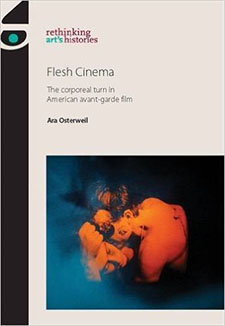 Nicholas C. Morgan reviews the book Flesh Cinema: The Corporeal Turn in American Avant-Garde Film by Ara Osterweil. In “one of the most compelling studies of the body’s relation to avant-garde art and film,” the author “articulate[s] ‘flesh cinema’ as a coherent, if shifting, category of postwar film” and insists “on the impossibility of divorcing ‘flesh cinema’ from the flesh of the world.” Read the full review at caa.reviews.
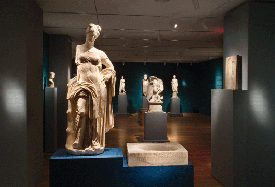 Anne Hrychuck Kontokosta discusses Gods and Mortals at Olympus: Ancient Dion, City of Zeus at the Onassis Cultural Center. The exhibition “delighted viewers with a carefully curated collection” of objects” and “focused on archeological research,” facilitating “a comprehensive and contextualized understanding of the ancient city of Dion.” Read the full review at caa.reviews.
 Gülru Çakmak reads Gustave Moreau: History Painting, Spirituality, and Symbolism by Peter Cooke. The author traces the artist’s “lifelong endeavor to revitalize le grand art in France … and to combat the endemic materialism of the age,” showing how “the antinaturalist and antidemocratic aesthetic” of Moreau’s work “countered the dominant naturalist paradigm in French art.” Read the full review at caa.reviews.
Statement on the US President’s FY2018 Budget Proposal
posted by CAA — March 16, 2017
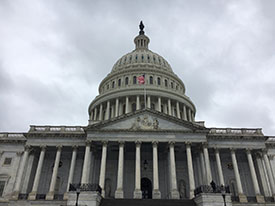 Today the US President released his proposal for 2018 federal budget – it envisions transferring additional billions of dollars to the Department of Defense, Veterans Affairs, and Homeland Security from many important domestic programs such as the Environmental Protection Agency, education, and legal services. As expected, the budget also calls for the complete elimination of the Corporation for Public Broadcasting, National Endowment for the Arts, National Endowment for the Humanities, and 16 other federal agencies. CAA was one of the first national organizations to speak against these cuts.
Read the statement against these cuts that CAA released on January 23, 2017.
As educators, art historians, artists, curators, museum directors, designers, scholars, and other members of the visual arts community we must act to defend the role of arts and humanities in our society. The budget process is long and ultimately controlled by the US House and Senate. Earlier this week, CAA traveled to Washington for Humanities Advocacy Day to meet with many congressional offices to discuss the importance of continued NEA and NEH funding. We will return again next week to do the same for Arts Advocacy Day.
In addition, CAA assembled an Arts and Humanities Advocacy Toolkit with information on how to contact your representatives in Congress to voice your support for the NEA and NEH and the many quality programs they fund. Call their offices. Email them. Attend Town Halls. You can learn how these agencies support activities in your area here: funded by the NEA and funded by the NEH. Be sure to let your representatives know of the impact of the arts and humanities in your districts. Spread the word to your colleagues and friends.
Despite the White House’s opposition to continued funding for the NEA and NEH, there is sufficient reason to believe that many members of the US House and Senate will support a budget that includes continued funding for these agencies. I ask our members to join in the effort to make sure all members of Congress knows the importance of the work done by these agencies.
Hunter O’Hanian
Executive Director
Chief Executive Officer
Thanks to 2017 Career Services Mentors and Workshop Leaders
posted by CAA — March 14, 2017
CAA extends a warm thank-you to all of the artists, scholars, curators, critics, educators, and other visual-arts professionals who served as Career Services mentors during the 2017 Annual Conference. Your knowledge and expertise helped to enrich the Artists’ Portfolio Review, Career Development Mentoring, and Mock Interviews. We also appreciate the efforts of the members who created and led Professional Development Workshops and Brown Bag Sessions based on members’ needs.
Artist’s Portfolio Review
Susan Canning, Sculpture; Jill Conner, Artists Studios; Carrie Ida Edinger, Independent Artist; Nancy Hart, Artist/263 Gallery; Richard Heipp, University of Florida; David Howarth, Zayed University; Paul Hunter, Artist/Painter; Jason Lahr, University of Notre Dame; Suzanne Lemakis, Citibank, retired; Sharon Lippman, Art Without Walls; Craig Lloyd, Mount St. Joseph University; Yelena McLane, Florida State University; Dinah Ryan, Principia College; Paul Bernard Ryan, Mary Baldwin University, Emeritus; and Greg Shelnutt, Clemson University.
Career Development Mentoring
Susan Altman, Middlesex County College; Michael Aurbach, Vanderbilt University, Emeritus; Roann Barris, Radford University; Colin Blakely, University of Arizona; Leda Cempellin, South Dakota State University; Crista Cloutier, The Working Artist; Rebecca J. DeRoo, Rochester Institute of Technology; James Farmer, Virginia Commonwealth University; Reni Gower, Virginia Commonwealth University; Antoniette (Toni) Guglielmo, Getty Leadership Institute; Dennis Ichiyama, Purdue University; Zach Kaiser, Michigan State University; Ann B. Kim, University East; Carol Herselle Krinsky, New York University; Emmanuel Lemakis, CAA, retired; Jeffery Cote de Luna, Dominican University; Heather McPherson, University of Alabama, Birmingham; Liliana Milkova, Oberlin College; Mark O’Grady, Pratt Institute; Doralynn Pines, CAA; Thomas Post, Ferris State University; Heather Snyder Quinn, DePaul University; Jack Risley, University of Texas at Austin; Andrew Svedlow, University of Northern Colorado; Joe A. Thomas, Kennesaw State University; Ann Tsubota, Raritan Valley Community College; and Barbara Yontz, St. Thomas Aquinas College.
Mock Interview Sessions
Megan Koza Mitchell (Student and Emerging Professionals Committee Chair), Prospect New Orleans; Amanda Wainwright (Student and Emerging Professionals Committee), University of South Carolina; Tamryn Mcdermott, Temple University; Annie Storr, Brandeis University; Lauren Puzier, Sotheby’s; Abbey Hepner, University of Colorado; Rachel Kreiter, Spelman College; Nathan Manuel (Student and Emerging Professionals Committee); Lauren O’Neal, Lamont Gallery, Phillips Exeter Academy; DeWitt Godfrey, Colgate University; Dennis Ichiyama, Purdue University; Rachel Stephens, University of Alabama; Matt King, VCU School of the Arts; Carol Garmon, University of Mary, Washington; Craig Lloyd, Mount St. Joseph University; Maile S. Hutterer, University of Oregon; Mark O’Grady, Pratt Institute; Thomas Post, Kendall College of Art and Design; Greg Shelnutt, Clemson University; Maria Ann Conelli, Brooklyn College, City University of New York; Rebekah Beaulieu, Bowdoin College Museum of Art ; David LaPalombara, Ohio University; Arthur Blake Pierce, Valdosta State University; Michael Lobel, Hunter College; Susan Altman, Middlesex County College; David Howarth, Zayed University; and Colin Blakely, University of Arizona.
Brown Bag Lunches and Sessions
Megan Koza Mitchell (Student and Emerging Professionals Committee Chair), Prospect New Orleans; Amanda Wainwright (Student and Emerging Professionals Committee), University of South Carolina; Tamryn Mcdermott, Temple University; Annie Storr, Brandeis University; Lauren Puzier, Sotheby’s; Abbey Hepner, University of Colorado; Rachel Kreiter, Spelman College; Nathan Manuel, SEPC; Andrea Kirsch, Rutgers University; and Mattie M. Schloetzer, National Gallery of Art.
Professional Development Workshops
Maria Michails, Rensselaer Polytechnic Institute; Susana Sevilla Aho, Modern Language Association; Susan Altman, Middlesex County College; Michael Aurbach, Vanderbilt University, Emeritus; Emily Pugh, Getty Research Institute; Elizabeth Buhe, Institute of Fine Arts, New York University; Petra ten–Doesschate Chu, Seton Hall University; Kate Kramer, University of Pennsylvania; Shannon Connelly, Lebanese American University; Craig Dietrich, The Claremont Colleges; Jon Ippolito, University of Maine; John Bell, Dartmouth College; Molly Fox, Indiana University; Rebekah Beaulieu, Bowdoin College Museum of Art; Deborah Lutz, Pamela Lawton, Annie Leist, and Emilie Gossiaux, all from the Metropolitan Museum of Art; Alexa Sand, Utah State University; Sara Orel, Truman State University; Jenn Karson, University of Vermont FabLab; Martha Schwendener, New York Times/New York University; Jack Henrie Fisher, University of Illinois, Chicago; and Alan Smart, University of Illinois, Chicago.
Meiss Call for Jurors 2017
posted by CAA — March 13, 2017
CAA seeks nominations and self-nominations for one individual to serve on the Millard Meiss Publication Fund Jury for a four-year term, July 1, 2017–June 30, 2021. Candidates must be actively publishing scholars with demonstrated seniority and achievement; institutional affiliation is not required.
The Meiss jury awards subsidies to support the publication of book-length scholarly manuscripts in the history of art and related subjects. Members review manuscripts and grant applications twice a year and meet in New York in the spring and fall to select the awardees. CAA reimburses jury members for travel and lodging expenses in accordance with its travel policy. Members volunteer their services to CAA without compensation.
Candidates must be CAA members and should not currently serve on another CAA editorial board or committee. Jury members may not themselves apply for a grant in this program during their term of service. Nominators should ascertain their nominee’s willingness to serve before submitting a name; self-nominations are also welcome. Please send a letter describing your interest in and qualifications for appointment, a CV, and contact information to: Millard Meiss Publication Fund Jury, College Art Association, 50 Broadway, 21st Floor, New York, NY 10004; or send all materials as email attachments to Deidre Thompson, CAA publications assistant, dthompson@collgeart.org. Deadline: April 21, 2016.
Affiliated Society News for March 2017
posted by CAA — March 10, 2017
Association of Academic Museums and Galleries (AAMG)
Registration and program information for the 2017 AAMG Annual Conference in Eugene, OR is now available. Please click here to access the schedule of presentations, workshops, receptions, and much more.
Online registration, as well as hotel and travel information, is also now online. Please note: AAMG institutional and individual members will need to login with their username and password to be eligible for the $250 early bird rate. The special member rate is available through April 15. If you have difficulty with logging in to your account, click here to reset your password or contact membership@aamg-us.org.
We hope to see you in Eugene this summer for what will be our biggest and best AAMG Annual Conference to date!
Association of Historians of American Art (AHAA)
The Association of Historians of American Art (AHAA) was happy to see many members at CAA for its Annual Meeting and its sponsored session, “The Gustatory Turn in American Art.” February 2017 also marked a changing of the guard of sorts, as we welcome several new board members to our ranks. We wish to express our gratitude to outgoing Board members Anna Marley (Chair Emerita), Monica Jovanovich-Kelley (Treasurer), Jillian Russo (Secretary), Melissa Renn (Membership Coordinator), and Annelise Madsen (Web Coordinator). We are grateful for their years of service to the organization!
We welcome the following incoming board members: Miguel de Baca (Co-Chair), Diana Seave Greenwald (Treasurer), Naomi Slipp (Secretary), Jonathan Walz (Membership Coordinator), and Jeff Richmond-Moll and Andrea Truitt (Web Co-Coordinators). Additionally, the Executive Editors of our online journal Panorama will be joining the board, and so we are pleased to work even more closely with Betsy Boone, Sarah Burns, and Jennifer Jane Marshall.
AHAA is also delighted to announce the venue for our October 2018 Symposium: Minneapolis, Minnesota! We look forward to sharing more information in the coming months as our colleagues at the University of Minnesota, the Minneapolis Institute of Art, and the Minnesota Museum of American Art develop their plans.
As always, we welcome hearing your news and views. You can learn more about AHAA or share your news by visiting our website at ahaaonline.org or emailing info@ahaaonline.org. We also welcome submissions, pitches, and proposals for our online journal; please visit journalpanorama.org.
Community College Professors of Art and Art History
CCPAAH wants to thank all of the presenters and participants at our Affiliated Society session at the 2017 CAA Annual Conference in New York. The panel Reinventing the Familiar: Updated Approaches in Art History and the Studio, was chaired by Susan Altman, Middlesex County College and included the following presentations: Taking Art History Beyond the Classroom by Maya Jiménez, Borough of Manhattan Community College, CUNY and Cheryl Hogue Smith, Kingsborough Community College, CUNY; Crowd-sourcing Global Art: Wikis and the Non-Western Canon by Jill Foltz, Collin College; Gaming the Critique: Providing Framework and Fun to the Group Critique by Tyrus Clutter, College of Central Florida; and Waging Art: When Fine Arts meets Workplace Development by Kathleen M. Dlugos, Westmoreland College. The successful Project Share at our early morning business meeting gave everyone lots of new ideas to bring back to our studio and art history classrooms.
CCPAAH will be sponsoring a session: Draw and Repeat: Reconsidering the Sketchbook at this year’s FATE Conference in Kansas City in April. Interested in presenting? The call for papers for next year’s CCPAAH Affiliated Session at the 2018 CAA Annual Conference will be posted is open through April 15, 2017. Submission site here.
Please follow us on Facebook: Community College Professors of Art and Art History and Instagram: @ccpaah. Interested in getting more involved? Contact Susan Altman at: ccpaah@gmail.com
FATE (Foundations in Art: Theory and Education)
Thank you to all who came to the FATE Affiliate Society session, “Using the F-word for Good, Not Evil: Fail, Fail Again, Fail Better,” at CAA this year. We had an excellent turn out!
Coming up, KCAI’s Foundation Department will host To the Core and Beyond, FATE’s 16th Biennial Conference from April 6th – 8th, 2017 at the Intercontinental at the Plaza in Kansas City. There, FATE members will gather as leading voices in fundamental art and design instruction and examine place, geography, introspective and reflexive actions, pedagogical values, and the potency of origins across the world. Influences from inside and outside the studio drive the development of Foundation programs and their students. In response to the conference theme, a broad spectrum of artists and academics will examine our reach as educators, and question how we instill world values through Foundation instruction and diverse programmatic structures. Enrique Martínez Celaya will be the 2017 FATE Conference Keynote Speaker.
More information about FATE’s 2017 conference.
In other news, FATE’s Positive Space: Episode 6 podcast is now live. In Episode 6, Jessica Burke (JB), Georgia Southern University & Emily Sullivan Smith, University of Dayton thoughtfully discuss the role of a Foundations Coordinator, balancing administrative roles with teaching & the pros/cons of a unified foundations curriculum.
More info? Please contact: Naomi J. Falk, naomijfalk@gmail.com
International Sculpture Center
Call for Panels now open for 27th International Sculpture Conference: Intersections + Identities. The ISC is seeking a diverse and comprehensive program, covering topics relevant to sculpture today. Apply online now! The call is open through March 13, 2017.
2017 Outstanding Student Achievement in Contemporary Sculpture Awards. Faculty, nominate your sculpture students today! Rules and details. Deadline: March 29, 2017. Email: studentawards@sculpture.org Phone: 609-689-1051 ext. 312
Japan Art History Forum (JAHF)
In recent elections, JAHF members elected: Julie Nelson Davis (University of Pennsylvania) to a 3-year term as President, Namiko Kunimoto (Ohio State University) to a 3-year term as Vice President, and Holly Rubalcava (University of Wisconsin-Madison) to a 2-year term as Graduate Representative.
The winner of the 2016 Chino Kaori Memorial Essay Prize for outstanding scholarship by a graduate student was Elizabeth Self, a PhD candidate in the Dept. of the History of Art and Architecture, University of Pittsburgh, for her paper titled “A Mausoleum Fit for a Shogun’s Wife: The Two Seventeenth-Century Mausolea for Sūgen-In.” The Chino Kaori Memorial Essay Competition is generously supported by the Japanese Art Society of America (JASA) and by University of Hawai’i Press. More information on the Chino Kaori Memorial Essay Prize.
The 2016 Clark Center Graduate Travel Grant was awarded to Ja Won Lee of the University of California, Los Angeles, who will be visiting the Museum of Fine Arts, Boston, to examine Japanese artworks from the collection in the context of her research on the collecting of Chinese antiques and its impact on visual and material culture in 19th and early twentieth-century Japan and Korea. More information on the Clark Center Graduate Travel Grant.
SECAC
SECAC was represented at CAA 2017 on the following session panels and with the following speakers: “In the Studio,” chaired by Elizabeth Heuer, University of North Florida; “Shared Space: The Home-Studio of Thomas Moran & Mary Nimmo Moran,” with Shannon Vittoria, The Metropolitan Museum of Art; “Dueling Studios: The Public and Private Images of Chaim Gross. Dueling Studios: The Public and Private Images of Chaim Gross,” with Sasha Davis, The Renee and Chaim Gross Foundation; “Free Markets, Free People: Discourse and Behavior in Lynda Benglis’ Lost Studio Tapes,” with Katie Anania, The University of Texas at Austin; and “The Studio as Model: From André Breton’s Wall to Fischli & Weiss’s Polyurethane Object Installations and Piero Giolio’s Studio,” with Susan Power, Los Angeles County Museum of Art.
SECAC 2017 Call for Papers deadline is April 20, 2017, midnight, EDT. Membership in SECAC is due at the time of paper acceptance, and registration fees are required of all. Columbus College of Art & Design (CCAD) looks forward to hosting “Microscopes and Megaphones,” the 73rd annual SECAC Conference, October 25-28, 2017. Eleanor Fuchs, Associate Provost at CCAD, will serve as conference director. Find more information here.
Society of Architectural Historians (SAH)
The Society of Architectural Historians (SAH) will host its 70th Annual International Conference in Glasgow, Scotland, from June 7–11, 2017. This is the first time that SAH has met outside North America in over 40 years! Meeting in Scotland’s largest city, world renowned for its outstanding architectural heritage, reflects the increasingly international scope of the Society and its conference. Architectural historians, art historians, architects, museum professionals and preservationists from around the world will convene to share new research on the history of the built environment. The Glasgow conference will include 36 paper sessions, eight roundtables, an introductory address and plenary talk, architecture tours, the SAH Glasgow Seminar, and more. Early registration ends March 14, 2017. Tours-only registration opens to the public on March 15, 2017.
The call for papers for the SAH 2018 Annual International Conference in St. Paul, MN, will open on March 31, 2017.
SAH is seeking educators to produce K-12 lesson plans for SAH Archipedia, an authoritative online encyclopedia of the built world published jointly by the Society of Architectural Historians and the University of Virginia Press. Interested educators should submit a proposal that includes a 500-word abstract outlining the topic of the lesson plan and include a preliminary list of the SAH Archipedia content the project would incorporate. Read the submission instructions here. Proposals are due by March 31, 2017.
SAH is accepting applications for the SAH/Mellon Author Awards through June 1, 2017. These awards are designed to provide financial relief to scholars who are publishing their first monograph on the history of the built environment, and who are responsible for paying for rights and permissions for images or for commissioning maps, charts or line drawings in their publications.
New in caa.reviews
posted by CAA — March 10, 2017
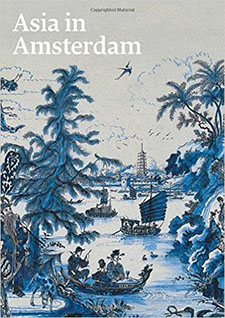 Dawn Odell discusses Asia in Amsterdam: The Culture of Luxury in the Golden Age, an exhibition catalogue produced by the Peabody Essex Museum and Rijksmuseum. “The marvel of this publication is its breadth,” as it “draws together a collection of stunning objects” and focuses “on the important role the Dutch played in facilitating and celebrating the material results of cross-cultural trade.” Read the full review at caa.reviews
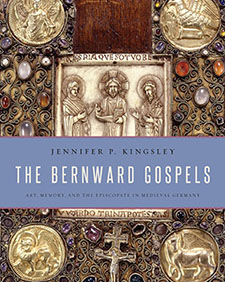 Karen Blough reads The Bernward Gospels: Art, Memory, and the Episcopate in Medieval Germany by Jennifer P. Kingsley. “Focusing minutely on a single patron and the visual program of one commission,” the author “brilliantly addresses a multitude of issues in Ottonian theology, history, and art” and makes “a valuable contribution to English-language scholarship on Ottonian art history.” Read the full review at caa.reviews
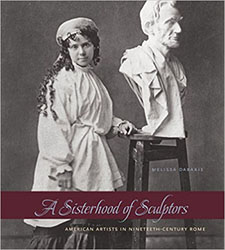 Emily C. Burns reviews Melissa A. Dabakis’s A Sisterhood of Sculptors: American Artists in Nineteenth-Century Rome. The author puts “sculptural production in dialogue with literature, visual culture, and the political and social histories of Rome and the United States,” tracing the city “as a welcoming site for feminine creativity” and “a complex site for gender politics and constructions of American culture.” Read the full review at caa.reviews
Committee on Women in the Arts Picks for March 2017
posted by CAA — March 10, 2017
Each month, CAA’s Committee on Women in the Arts selects the best in feminist art and scholarship. The following exhibitions and events should not be missed. Check the archive of CWA Picks at the bottom of the page, as several museum and gallery shows listed in previous months may still be on view or touring.
March 2017
From the Collection: Sister(s) In the Struggle: Angela Davis and Kathleen Cleaver
Ryerson Image Centre
33 Gould Street, Toronto, Ontario, Canada
Photographs of Angela Davis on view: January 18–March 5, 2017
Photographs of Kathleen Cleaver on view: March 7–April 9, 2017
Curated by Julie Crooks, Sister(s) In the Struggle: Angela Davis and Kathleen Cleaver features photographs of two leading female figures of the Black Panther Party taken from the Black Star Collection at the Ryerson Image Centre. “They were photographed excessively,” Crooks said in an interview with Flare, “and their images were ubiquitous. They were in newspapers, they were in journals, they were on posters and their representations, or likenesses, were all over the place and that created this kind of cult presence…. At times the photographs could be detrimental to one’s image, especially someone like Angela Davis, but I think they also fed into this kind of iconic status.”
In choosing to pull photographs from the Black Star Collection from the civil rights area, Crooks explained that she wanted to humanize the representation of Davis and Cleaver, selecting images that offered a previously unexplored way of looking at them. The exhibition creates comparisons to many other women behind the scenes—those who are not remembered. “I wanted to highlight these photographs because the Black Power statement was, ‘black is beautiful’ and that was kind of a relentless message: that we are beautiful, despite hundreds of years of representation that told us otherwise, Crooks told Flare.
This exhibition is part of a collaboration between the Ryerson Image Centre and Black Artists’ Networks Dialogue, called Power to the People: Photography and Video of Repression and Black Protest, which will run until April 9.
Amy Jorgensen: Something Old, Something New, Something Borrowed, Something Blue
Elizabeth Houston Gallery
190 Orchard Street, New York, NY
February 8–March 12, 2017
Something Old, Something New, Something Borrowed, Something Blue by Amy Jorgensen is a series of delicate handkerchiefs emblazoned with historic images of suffragettes. In fact, displayed on each piece of linen is the surveillance images of eighteen women taken from the 1913 Criminal Records Office of Scotland Yard.
“Recognizing in this episode a peculiar confluence of gazes, Jorgensen re-contextualizes and re-situates these images into the wider question of how women’s identities are constructed, and how they are obstructed…. The gift of the handkerchief is a matrimonial tradition passed from mother to daughter, woman to woman. This work investigates the search for, or the making of, identity that draws upon the plurality and fraction of the self, and the span of influence that is made from generation to generation.”
These discrete portraits of women suffragettes were taken and cataloged by Scotland Yard after a series of acts of civil disobedience, including arson, window breaking, and other public disturbances, which in turn created a national scandal. Jorgensen, who transferred the photographs to the handkerchief using cyanotype, an early-nineteenth-century photographic process pioneered by a woman, first discovered the images while researching Edna Berg, her great aunt and an impassioned suffragette from New York.
“The juxtaposition of these two histories—that of the matrimonial ceremony and that of the women of the suffragette movement—provides a jarring collision point for the examination of patriarchal structures both in history and contemporary culture.”
Jennifer Brea: Unrest
Film
SXSW, Austin, Texas
March 10–19, 2017
After making its debut at the 2017 Sundance Film Festival, Unrest by the director Jennifer Brea travels to SXSW in Austin, Texas, this March. The film focuses on the life of Brea, who was diagnosed with Myalgic Encephalomyelitis, commonly referred to as chronic fatigue syndrome. Brea, a PhD student at Harvard University, found that she could not sign a check at a restaurant, becoming progressively worse in the months before her wedding. When doctors told her it was “all in her head,” Brea turned her camera on herself, filming from the confines of her bed.
Myalgic Encephalomyelitis (ME) is a systemic neuroimmune condition characterized by post-exertional malaise—a severe worsening of symptoms after even minimal exertion. The root causes and physical effects are not fully understood, especially in women. As Brea described in a TED Talk, her neurologist diagnosed her with conversion disorder and said her physical symptoms were the result of some distance emotional trauma. “It is a perfect custom prison,” Brea observed. “How can a disease this devastating be forgotten by medicine?”
“As I got sick, I found myself as part of cohort of women in their late 20s whose bodies were falling apart,” Brea explained, “and how hard it was to be taken seriously.” Her film explores her own diagnosis but also seeks to address the millions of others with the same condition.
As SXSW nears, screening days and times for Unrest will be posted on the schedule page. The full TED Talk with Brea can be found online.
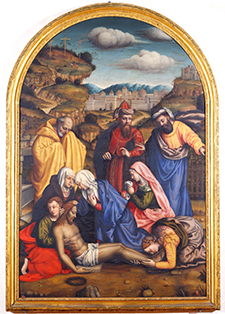
Suor Plautilla Nelli, Lamentation with Saints (1550)
The Art of Suor Plautilla Nelli
Uffizi Gallery
Piazzale degli Uffizi, 6, Florence, Italy
March 8–April 30, 2017
In the first of an open-ended, annual series of exhibitions dedicated to women artists—what the Italian press is calling “pink exhibitions”—the Uffizi Gallery will showcase the work of Suor Plautilla Nelli (1523–1587), an artist nun who was Florence’s first known female Renaissance artist. Works culled from her Domenican convent, as well as from churches and museums across central Italy, will go on display on March 8 to coincide with International Women’s Day; they will remain on view until April 30. The Florence-based organization Advancing Women Artists Foundation, which has been instrumental in facilitating the restoration of Nelli’s works, published the exhibition catalogue. Eike Schmidt, the Uffizi’s current director, was motivated to pursue this initiative after a conversation with the Guerrilla Girls.
Leila Alaoui: No Pasara
Musée des Beaux-Arts
1380, rue Sherbrooke O, Montreal, Canada
Through April 30, 2017
On January 18, 2016, a young French-Moroccan photographer named Leila Alaoui was killed in an attack in Burkina Faso. Alaoui, who had been in the West African nation on assignment for a report on women’s rights for Amnesty International, used her photography to highlight issues related to migration, displacement, and cultural identity. The twenty-four images of No Pasara, which means “no entry,” depict young Moroccans who dream of a better life on the other side of the Mediterranean. The series was commissioned by the European Union in 2008.
In a review of her work last year, a critic for the Economist wrote: “Alaoui’s photojournalism drove the reasons for the movement of humans—before and beyond today’s crises—home, by turning a lens on those who have been and continue to remain unseen between world crises. Economic migrants in the regions she captured, including young Moroccans, Lebanese and Sub-Saharan Africans willing to make perilous crossings for a life in Europe were the consistent thread through her projects.” Alaoui’s hauntingly beautiful images offer a trenchant and poignant vantage point from which to consider the global immigration crisis.
Walled Garden in an Insane Eden
Sara Zanin Gallery
Via della Vetrina, 2, Rome, Italy
February 9–March 25, 2017
“Is it only the external landscape which is altering? How often recently most of us have had the feeling of déjà vu, of having seen all this before, in fact of remembering these swamps and lagoons all too well. However selective the conscious mind may be, most biological memories are unpleasant ones, echoes of danger and terror. Nothing endures for so long as fear.”
—J. G. Ballard from The Drowned World (1962)
Borrowing its title from J. G. Ballard’s science-fiction novel and one of its dystopic tales, this exhibition brings together a contingency of London-based artists whose work engages with the political uncertainties introduced into the European landscape in 2016. Their responses, which include drawings, paintings, sculptures, textiles, and performance, range from skeptical to hopeful. Organized by Marcelle Joseph, the exhibition features mostly women artists, including Rebecca Ackroyd, Gabriella Boyd, Kira Freije, Marie Jacotey, Florence Peake, and Zadie Xa.
CAA Seeks Ad Sales Rep
posted by CAA — March 08, 2017
Part-time and commission based
The College Art Association (CAA), a membership and advocacy organization for those working in the visual arts, seeks a part-time advertising sales rep with media sales experience in both print and digital platforms. The ideal candidate should have established contacts in the arts and culture publishing landscape and in the wider culture field. She/he will have the mindset to strategically target prospective clients to build relationships that support CAA’s prestigious publications and events with a strong ad sales program.
The advertising sales rep would work primarily on CAA’s two flagship print journals, The Art Bulletin and Art Journal, with some work on CAA’s digital reviews platform, caa.reviews. Additional work would include selling ads for the graduate program directories and the CAA Annual Conference. Candidates for the position should have experience in billing clients, advertising proposal creation, and proper tracking of invoices and payments.
This is a part-time, commissioned-based position. The position reports to the Director of Communications and Marketing.
DUTIES AND RESPONSIBILITIES
- Manage relationships with current advertising clients and develop strategy for new client growth
- Work closely with staff across all departments to create client strategy aligned with journals, website content, and programs
- Produce client contracts for ad sales
- Oversee invoicing and record keeping for ad sales on journals and relevant websites
- Report and present on ad sales program and results to staff members and constituents
- Work with publications department staff and in-house graphic designer on ad placement and design as needed
- Other duties as assigned or requested
QUALIFICATIONS
- At least 2 years of ad sales or comparable experience
- A warm and welcoming personality that encourages relationship building
- Established relationships with advertisers and companies in the arts and culture field
- Proven track record of closing new business and maintaining current business
- Exceptional written/verbal communication skills
- Ability to work independently, organize multiple concurrent tasks, work efficiently, and follow through on details
- Experience with spreadsheets, systems, and database management and generally accepted programs and office equipment required
- BS/BA degree or equivalent preferred
Send resume and cover letter to nobourn@collegeart.org with the subject line “CAA Ad Sales Rep.”
This job description is intended as a summary of the primary responsibilities of and qualifications for this position. The job description is not intended as inclusive of all duties an individual in this position might be asked to perform or of all qualifications that may be required either now or in the future.
The College Art Association is an equal opportunity employer and considers all candidates for employment regardless of race, color, sex, age, national origin, creed, disability, marital status, sexual orientation, gender expression, or political affiliation.
Committee on Women in the Arts Picks for February 2017
posted by CAA — February 16, 2017
Each month, CAA’s Committee on Women in the Arts selects the best in feminist art and scholarship. The following exhibitions and events should not be missed. Check the archive of CWA Picks at the bottom of the page, as several museum and gallery shows listed in previous months may still be on view or touring.
February 2017
Susan Hiller: Lost and Found
Pérez Art Museum, Miami
1103 Biscayne Blvd., Miami, FL
October 14, 2016–June 4, 2017
Commissioned by the Pérez Art Museum and making its debut, Lost and Found, by the London-based artist Susan Hiller, features an audio collage of voices speaking in twenty-three different languages, including Aramaic, Comanche, Livonian, and other extinct or endangered idioms. A pioneer in video installations, Hiller creates immersive, psychologically charged environments. In Lost and Found a translation appears as subtitles to the anecdotes, songs, arguments, memories, and conversations. Oftentimes the themes revolve around language itself.
“A constantly shifting oscilloscopic line gives visual form to the work’s soundtrack, suggesting the poignant idea that individuals separated by time, geography, and worldview remain linked by the physical experience of sound as it resonates through the human body during verbal communication.”
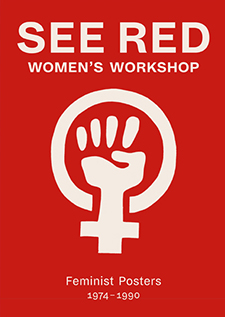
See Red Women’s Workshop Feminist Posters 1974–1990
Published by Four Corners Books
ISBN 978-1-909-82907-7
Released in September 2016, See Red Women’s Workshop Feminist Posters 1974–1990 collects sixteen years of posters, calendars, silkscreens, and more from the See Red Women’s Workshop. Founded in 1974, the group “grew out of a shared desire to combat sexist images of women and to create positive and challenging alternatives. With humor and bold graphics, they expressed the personal experiences of women as well as their role in wider struggles for change.” The 184-page book is written by See Red members and features the history of the group, including all of their original screenprints and posters commissioned for radical groups and campaigns.
“Ambitiously, See Red were not about selling a product or even getting over a party political message,” writes the British socialist feminist Sheila Rowbotham in the book’s foreword. “They were up to something far more complex and far more difficult. They aimed to convey ideas about a transformed society in which relations of gender, race and class would no longer be marked by inequality and subordination.”
Ambreen Butt: I Need a Hero
Isabella Stewart Gardner Museum
25 Evans Way, Boston, Massachusetts 02115
January 11–June 26, 2017
Ambreen Butt is the ninth artist in residence at the Isabella Stewart Gardner Museum, invited to create a temporary site-specific work for the museum’s façade. Throughout this project, Butt explores the ways in which women struggle to find and make use of their own power. Paying tribute to a fellow young Pakistani woman, I Need a Hero is inspired by the story of Mukhtar Mai, who was brutally raped in 2002 by order of her village tribal council as punishment for speaking out against archaic codes of justice. Refusing to be silenced, Mai not only became a spokesperson for women’s rights in Pakistan, but she also created two schools for girls and a crisis center for abused women.
In the Gardner façade piece, the heroine fights a dragon and a monkeylike creature (her inner and outer demons?). The wrestle is set against the background of a dollar bill as a reminder of today’s global economy, while other young women look at her from below and above, expectant on the results of the battle and a possible emergence of their hero(ine).
Butt was born in 1969, in Lahore, Pakistan, where she trained as a miniature painter. As a storyteller, the artist makes use of dramatic imagery from this traditional art form to comment on contemporary issues.
Tschabalala Self
Parasol unit foundation for contemporary art
14 Wharf Road,London N1 7RW
January 17–March 12, 2017
Parasol unit foundation for contemporary art presents the first solo exhibition in the United Kingdom by the New Haven–based artist Tschabalala Self. Curated by Ziba Ardalan, the exhibition brings together paintings, prints, collage, and sculptures drawn from the first five years of Self’s artistic career. The young artist (born New York, 1990) is concerned with the study of the black female body within contemporary culture. Self examines the confluence of race, gender, and sexuality through a variety of forms and narratives, in which each of her “characters,” as she calls them, explores the emotional, physical, and psychological impact of the black female body as icon.
Self’s paintings play boldly with figuration, deconstructing and reconstructing the black female body, sewing together pieces of African or African-inspired cloth, given to her by her mother, with fragments of unresolved pieces of work. Self’s fractured figure seems to assert its own self-defined identity, while mixed media allows her to explore how the black female body functions as a social and political symbol.
In addition to painting, collage, and sculpture, Self presents at Parasol unit her most recent animation work, My Black Ass (2016). Through a series of GIF portraits of abstractly drawn black female figures in a motion that suggests they are twerking, the black female character comes to life, displaying her buttocks and genitals in an energetic dance. Although based on a particular ethnicity, Self’s innovative works nonetheless speak universally of all humanity and its collective concerns.
Elena Dorfman: Syria’s Lost Generation
Mills College Art Museum
5000 MacArthur Blvd., Oakland, CA 94613
January 18–March 12, 2017
The Mills College Art Museum presents the Los Angeles–based artist Elena Dorfman’s Syria’s Lost Generation, a humanistic perspective to the ongoing Syrian conflict that has claimed more than 470,000 lives and forced the displacement of 6.5 million people.
Dorfman (born Boston, 1965) was on assignment with the United Nations High Commissioner for Refugees in 2013. While documenting exiled Syrians in Egypt, Jordan, Turkey, and Lebanon, she was drawn most strongly to Syrian teenagers, a small fraction of a population that has been disproportionately affected by the war. As Dorfman explains, “They seemed particularly shell-shocked and bereft…. [T]hey spoke to me of powerful longing and frustration.”
Dorfman has specialized in documenting extreme circumstances and unusual subjects. Syria’s Lost Generation builds on her previous work as a documentarian—in particular, The C-Word (1998), a series of photographs of teenagers living with cancer. Through visual and audio portraiture, Dorfman brings into exposure their voices, the physical and psychological ills suffered, their uncertain futures, and the fearful of retaliation. Displaced teenagers spoke about the powerful longing and frustration, where the dispossession seems absolute, and the future, lost.
Solo Exhibitions by Artist Members
posted by CAA — February 15, 2017
See when and where CAA members are exhibiting their art, and view images of their work.
Solo Exhibitions by Artist Members is published every two months: in February, April, June, August, October, and December. To learn more about submitting a listing, please follow the instructions on the main Member News page.
February 2017
Midwest

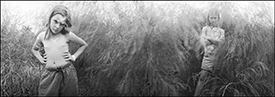 Jane Alden Stevens, Asparagus Patch, 1998, archival pigment print, 7 x 21 in. (artwork © Jane Alden Stevens)
Jane Alden Stevens. Alice F. and Harris K. Weston Art Gallery, Cincinnati, Ohio, February 10–April 2, 2017. The Thread in the River. Photography.
West

Alfred J. Quiroz. University of Arizona Museum of Art, Tucson, Arizona, October 22, 2016–January 22, 2017. The Presidential Series. Painting.