CAA News Today
March–June 2010 Issue of The Art Bulletin Published
posted by Christopher Howard — May 05, 2010
 The combined March–June 2010 issue of The Art Bulletin, the leading publication of international art-historical scholarship, has just been published. It will be mailed to all individual CAA members who elect to receive the journal, and to all institutional members.
The central scene of Diego Velázquez’s Las Meninas graces the cover and introduces the issue’s Interventions essay series. Byron Ellsworth Hamann applies postcolonial and materialist strategies in “The Mirrors of Las Meninas: Cochineal, Silver, and Clay” to consider the artist’s masterpiece within a transatlantic visual archive. A group of six scholars from such diverse disciplines as Precolumbian studies, Romance studies and literature, art history, and Aztec and Spanish colonial art respond to Hamann’s article with texts of their own.
The issue features two other major essays. In “Family Space: Buddhist Materiality and Ancestral Fashioning in Mogao Cave 231,” Winston Kyan considers the diverse integration of family references into the visual program of ninth-century Buddhist Mogao caves at Dunhuang, which marked a turning point in the construction of religious space in medieval China. For “Portrait of Luca Pacioli and Disciple: A New, Mathematical Look,” Renzo Baldasso examines the famous painting as a statement about the achievements of mathematical humanists as well as the subject of mathematics as a mode of thinking, as court activity, and as a form of education.
In the reviews section, Rebecca Zorach evaluates Margaret D. Carroll’s Painting and Politics in Northern Europe: Van Eyck, Bruegel, Rubens, and Their Contemporaries, and Jonathan Unglaub examines Maria H. Loh’s Titian Remade: Repetition and the Transformation of Early Modern Italian Art. In addition, Joel Smith reviews the history and evolution of the notion of objectivity as presented in Lorraine Daston and Peter Galison’s book Objectivity.
Please read the full table of contents for more details. The next two Art Bulletins for 2010 will appear in September and December.
December 2009 Issue of The Art Bulletin Published
posted by Christopher Howard — December 15, 2009
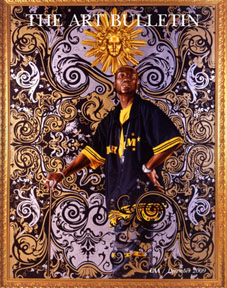 The December 2009 issue of The Art Bulletin, the leading publication of art-historical scholarship, has just been published. It will be mailed to those CAA members who elect to receive it, and to all institutional members.
For the first time, a work of twenty-first-century art graces the cover of the esteemed journal—Kehinde Wiley’s Portrait of Andries Stilte (2005). The painting accompanies an essay by Krista Thompson exploring how contemporary artists such as Wiley and Luis Gispert combine the visual language of hip-hop with late Renaissance and Baroque painting techniques.
Four essays precede Thompson’s. Leading off is Michael Schreffler, who analyzes how sixteenth- and seventeenth-century Spaniards described the practice of Aztec painting by looking through the lens of European art theory. Next, Emma Barker contends that Jean-Baptiste Greuze evokes both the innocence and vulnerability of children in his A Child Playing with a Dog, while implicating the viewer in the child’s fate.
Matthew Rampley’s essay expresses an opposing view of the Vienna school of art history, not as progressive and aesthetically liberal, but as a proponent of an imperialist outlook, related to the cultural politics of Austria-Hungary in the early-twentieth-century. The next contributor is Roberta Wue, who investigates the ways late-nineteenth-century Chinese artists positioned themselves in the marketplace through the classifieds in the Shanghai newspaper Shenbao. She also examines the changing relationship between artists and urban audiences in the late Qing era.
The December issue of The Art Bulletin also contains six reviews of books about tapestries at the Tudor court, engravings of Native American Indians, the gardens of Versailles and panoramic landscape painting, Buckminster Fuller, Tony Conrad, and issues on museum ownership of antiquities. Please read the full table of contents for more details.
September 2009 Issue of The Art Bulletin Published
posted by Christopher Howard — September 02, 2009
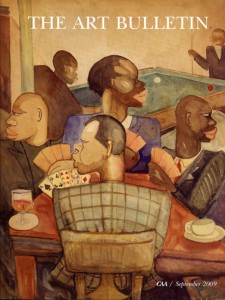 The September 2009 issue of The Art Bulletin, the leading publication of art-historical scholarship, has just been published. It will be mailed to those CAA members who elect to receive it, and to all institutional members.
Five articles make up the issue. Leading off is Rachel Kousser’s “Destruction and Memory on the Athenian Acropolis,” which argues that in the way it was commemorated, the Persians’ sack of the Acropolis in 480 BCE took on paradigmatic significance as an example of “Oriental violence.” Next is a text by Elena Boeck, who in “Simulating the Hippodrome: The Performance of Power in Kiev’s St. Sophia” analyzes strategies of display, appropriation, and simulation of Byzantine imperial symbols by Prince Iaroslav “the Wise” in the paintings of the hippodrome in Kiev’s St. Sophia.
In “Rubens and the Northern Past: The Michielsen Triptych and the Thresholds of Modernity,” Lynn F. Jacobs interrogates the miraculous thresholds of this work by Peter Paul Rubens, which negotiate relations between the donors and God and between the meanings inherent in the life and theology of Christ. Her essay is followed by “Nature and the Ideal in Khnopff’s Avec Verhaeren: Un Ange and Art, or the Caresses,” in which Brendan Cole examines the work of Fernand Khnopff from an iconographic perspective to reveal how the central concerns for all Symbolist artists—of duality and the reconciliation of opposites—are encoded in his paintings.
Last, Phoebe Wolfskill’s “Caricature and the New Negro in the Work of Archibald Motley Jr. and Palmer Hayden” evaluates the perplexing appearance of racial caricature in compositions by these two “New Negro” Renaissance painters and considers how pervasive stereotypes might inform self-perception. Hayden’s Nous quatre à Paris from ca. 1930 is the cover image for this issue.
Also included are seven reviews of books on Romanesque Partheny, Castilian culture, Inigo Jones, Utamaro, science in art, and more. Please read the full table of contents for more details.
2009 Member Survey Results
posted by Michael Fahlund — July 16, 2009
As part of information-gathering pursuant to the preparation of CAA’s 2010–2015 Strategic Plan, a 2009 member survey was developed, coordinated, and carried out by a team under the leadership of Elizabeth Knapp, vice president in the Research Division of the marketing firm Leo Burnett Worldwide, to determine member preferences, awareness of CAA publications and programs, and motivations for joining and renewing membership.
In total, 1,451 CAA members responded to the online survey, a response rate of 11 percent (which is within an acceptable range for statistical analysis). The final sample was then weighted to accurately reflect the total CAA membership based on membership type. The results are an enlightening view into CAA members’ views and opinions, revealing important strengths but also giving direction to how the organization can use the next strategic plan to improve its programs and services.
Demographically speaking, CAA members are more likely to be female (70 percent), within the age range of 35–49 (34 percent), Caucasian (87 percent), and in academic settings (73 percent), and to have ten years or more of professional experience (48 percent).
The top three reasons individuals gave for joining CAA and renewing their memberships were for job postings (69 percent), networking (54 percent), and debate in the visual arts (50 percent).
CAA is perceived as most relevant to art historians (78 percent agree). From artist members, enthusiasm for ARTspace at the Annual Conference was one of the higher-ranking areas of interest (61 percent). CAA is viewed as a well-known organization among peers (75 percent agree) and a well-run organization (51 percent agree). Members who responded to the question about CAA’s roles believe the most important are advocacy for artists, art historians, and university art museums (24 percent), a conference provider (21 percent), and a leader of creative and intellectual discourse (17 percent). The most common contact points between members and CAA are through publications and emails. The Art Bulletin has the strongest reputation among members (64 percent). The most used features of the CAA website are membership renewal (76 percent), conference registration (70 percent), and CAA News (60 percent). At least half the members also visit the CAA website regularly. A near majority of members (45 percent) have interest in social networking through CAA.
The CAA Annual Conference is perceived as important for networking (68 percent) and career development (62 percent), an opportunity for intellectual exchange about the visual arts (58 percent), and relevant to professional development (53 percent). At the conference, members mostly likely attend sessions (76 percent), the Book and Trade Fair (65 percent), and, as noted above, ARTspace (61 percent). The most popular conference topics are criticism and theory (33 percent) and contemporary art history (31 percent).
The most popular publication topics for the future are curriculum development for teaching studio and art-history courses; legal and copyright issues in publishing; career-development strategies; and standards and guidelines in the visual arts in academia. Members agree that digital publications are valuable because they can be searched online (76 percent), are environmentally friendly (71 percent), can expand readership and distribution (59 percent), and can include dynamic content (56 percent). Members are undecided on the future of digital publications, but 49 percent of respondents do not favor online, non–peer reviewed publications.
CAA continues to advocate on issues of importance to members and to the visual arts. Among these, members feel that full-time vs. adjunct status is most important (50 percent), followed by intellectual-property issues (38 percent) and salary equity (39 percent).
In efforts to increase its visibility and recognition for the programs and services it provides, CAA is eager to know how members react to or view its name. While some members felt that the name “College Art Association” or “CAA” is not descriptive of what the organization does, or that it does not fit the mission, 65 percent believe that the name is understood in the field of visual arts. Name recognition and identity will be assessed as part of CAA’s communications activities in the strategic plan.
Other directions gathered from this survey that will be addressed in the strategic plan are to: 1) increase programming and publications for artists; 2) attract more young professionals; 3) increase the diversity of members; 4) increase career-development sessions at the conference; 5) increase interactive communications; 6) develop practical peer-reviewed publications; and 7) continue working on advocacy issues, particularly related to adjunct faculty.
CAA thanks its members for participating in this recent survey. Comments and responses have been extremely helpful and are being used to guide changes and improvements in the organization’s services.
New Faces for CAA Journals
posted by Christopher Howard — July 10, 2009
Paul Jaskot, president of the CAA Board of Directors, has made new appointments to CAA’s three scholarly journals.
Karen Lang, associate professor of art history at the University of Southern California, has been appointed the next editor-in-chief of The Art Bulletin, succeeding Richard J. Powell of Duke University. Lang begins her three-year term on July 1, 2010, with the preceding year as editor designate.
Michael Cole is the new reviews editor for The Art Bulletin, succeeding David J. Roxburgh of Harvard University, who served the journal for three years. Cole became reviews editor designate in February and took over from Roxburgh this month.
Joining the Art Bulletin Editorial Board for four-year terms beginning July 1, 2009, are: Linda Komaroff, Los Angeles County Museum of Art; Thelma K. Thomas, Institute of Fine Arts, New York University; and Eugene Wang, Harvard University. The newly selected editorial-board chair is Natalie Kampen of Barnard College, who will serve for two years.
At Art Journal, Howard Singerman of the University of Virginia has been appointed the new reviews editor; he will take over from Liz Kotz of the University of California, Riverside, and serve from July 1, 2010, to June 30, 2013, with a year as reviews editor designate starting this month.
Also at Art Journal, Rachel Weiss of the School of the Art Institute of Chicago and Constance DeJong of Hunter College, City University of New York, have joined the Art Journal Editorial Board for the next four years.
Now on the caa.reviews Editorial Board is Michael Ann Holly of the Sterling and Francine Clark Art Institute, who will serve for four years. In addition, seven new field editors for books and related media have been chosen:
- Molly Emma Aitken, City College, City University of New York, South and Southeast Asian art
- Darby English, University of Chicago, contemporary art
- Jonathan Massey, Syracuse University, architecture and urbanism, 1800–present
- Adelheid Mers, School of the Art Institute of Chicago, arts administration and museum studies (a new field-editor position)
- Tanya Sheehan, Rutgers University, photography
- Janis Tomlinson, University Museums at the University of Delaware, Spanish art
- Tony White, Indiana University, Bloomington, artist’s books and books for artists (a new field-editor position)
Field editors work with the journal for three years, starting on July 1, 2009.
All editors and editorial-board members are chosen from an open call for nominations and self-nominations, published in at least two issues of CAA News (usually January and March) and on the CAA website.
June 2009 Issue of The Art Bulletin Published
posted by Christopher Howard — June 02, 2009
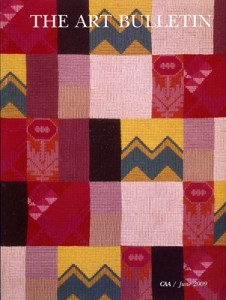 The June 2009 issue of The Art Bulletin, the leading publication of art-historical scholarship, has just been published. It will be mailed to those CAA members who elect to receive it, and to all institutional members.
On the cover is a detail of a pillowcase designed ca. 1916 by the Swiss artist Sophie Taeuber, which accompanies an essay by Bibiana Obler that considers the difference between Taeuber’s and Hans Arp’s public and private identities through a set of collaborative and closely related works and why they kept their most “advanced” work to themselves.
For her contribution, Stephanie Leitch investigates Hans Burgkmair’s images of non-Western communities in the woodcut frieze The Peoples of Africa and India (1508), which neither played into iconographic presets nor invented new stereotypes. Two more essays round out the issue: Norma Broude explores the political dynamics of gender informing the intentions, subjects, production, and reception of Giambattista Tiepolo’s frescoes for the palazzina of the Villa Valmarana, and Laura Morowitz examines the extraordinary popularity and religious undercurrents of the Hungarian artist Mihály Munkácsy’s paintings Christ before Pilate and Christ on Golgotha in late-nineteenth-century America.
The June issue of The Art Bulletin also contains reviews of books on Chinese epigraphy, Giovanni Bellini, Lucas Cranach the Elder, and Marcel Duchamp. Please read the full table of contents for more details.
CAA 2009–10 Operating Budget Reductions
posted by Linda Downs — May 11, 2009
Updated May 14, 2009.
Like most universities, art museums, and learned societies, CAA has been significantly affected by the global economic downturn. The Board of Directors made difficult decisions at its May 2009 meeting that nevertheless will allow CAA to maintain the high quality of member services and programming. Strategic reductions and other measures have been instituted throughout the association to balance the budget and keep core programs, publications, and services in operation. With this careful financial planning, CAA remains dedicated to supporting members and the visual-arts community at large through our advocacy, career services, publications, and conference.
Annual Conference
The 2010 Annual Conference in Chicago will commence on Wednesday evening, February 10, with Convocation and the Gala Reception. All 120 planned sessions will be presented over the following three days, Thursday, February 11 to Saturday, February 13, with the addition of extended evening hours. No sessions will take place on Wednesday.
Publications
Newsletter: Beginning July 2009, CAA News will only be distributed online in a new reader-friendly design. This allows us to save printing and mailing costs and help to preserve coverage of core programs and publications. CAA’s website, www.collegeart.org, will become the primary hub of up-to-date information on the organization.
Journals: CAA’s longtime support of the journals is absolutely central to the mission, and the association is fully committed to maintaining them now and in the future. The Art Bulletin and Art Journal will continue to be published. Illustrations, however, will be limited to black and white for 2009–10, except where editorial and budget decisions may allow the insertion of color. caa.reviews will be unchanged, with new book reviews, exhibition reviews, and conference and symposia reports published regularly. While the CAA Board of Directors has determined the budget restrictions necessary for this part of the association, the editors-in-chief will work closely with staff and editorial boards to make sure that any further reductions are implemented with a strict attention to quality consistent with the identity and mission of the journals.
Grants and Fellowships
Two programs in CAA’s grant-making arm will be suspended for 2009–10: the Professional Development Fellowship Program for graduate students and the Millard Meiss Publication Fund. However, the Annual Conference Travel Grants and the Wyeth Foundation for American Art Publication Grant will both continue, and the CAA Annual Exhibitions, also funded by a grant, will take place at the Chicago and New York conferences.
March 2009 Issue of The Art Bulletin Published
posted by Christopher Howard — March 20, 2009
 The March 2009 issue of The Art Bulletin, the leading publication of international art-historical scholarship, has been published and was mailed to CAA members earlier this month.
Special to this issue is the publication of Picasso’s Closet, a play by the Chilean American writer and Duke University professor Ariel Dorfman, which examines Pablo Picasso’s thorny politics and raises questions about the role of an artist during wartime. The art historians Pepe Karmel and Patricia Leighton and the theorist Mieke Bal respond.
Two essays examine on art and culture in eighteenth- and nineteenth-century France. Judy Sund reads Antoine Watteau’s Les charmes de la vie as a commentary on the ways that nature was domesticated and aestheticized for wealthy Parisians, with the artist standing as mediator between the realms of culture and nature. Meanwhile, Jennifer Olmsted considers how Eugène Delacroix’s The Sultan of Morocco and His Entourage was at odds with the triumphalist paintings of French domination over North Africa that were also on view at the Salon of 1845 in Paris.
This issue of The Art Bulletin also contains four book reviews on Roman visuality, the Buddhist afterlife in art, the Psalter of Saint Louis, and African architecture. Please read the full table of contents for more details.
The Art Bulletin Seeks Editor-in-Chief and Editorial-Board Members
posted by CAA — January 21, 2009
 The Art Bulletin publishes leading scholarship in the English language in all aspects of art history as practiced in the academy, museums, and other institutions. From its founding in 1913, the quarterly journal has published, through rigorous peer review, scholarly articles and critical reviews of the highest quality in all areas and periods of the history of art.
The Art Bulletin Seeks Editor-in-Chief
The Art Bulletin Editorial Board invites nominations and self-nominations for the position of editor-in-chief of The Art Bulletin, for a three-year term, July 1, 2010–June 30, 2013 (preceded by a year as editor designate, from July 1, 2009 to June 30, 2010).
The Art Bulletin comprises scholarly essays and documentation on the history of visual art of all periods and places. The editor-in-chief is responsible for the content and character of the journal. Each issue has approximately 150 editorial pages (135,000 words), not including book and exhibition reviews, which are the responsibility of the reviews editor. The editor-in-chief reads all submitted manuscripts, refers them to appropriate expert referees for scholarly review, provides guidance to authors concerning the form and content of submissions, and makes final decisions regarding acceptance or rejection of articles for publication.
In addition to working with authors, the editor-in-chief attends the three annual meetings of the Art Bulletin Editorial Board—held in the spring and fall in New York and once at the CAA Annual Conference—and submits an annual report to the CAA Board of Directors and editorial board. CAA reimburses the editor-in-chief for travel and lodging expenses for the spring and fall meetings in accordance with its travel policy, but the editor-in-chief pays these expenses to attend the Annual Conference. The editor-in-chief also works closely with the CAA staff in New York, where production for the publication is organized. This is a half-time position. CAA provides financial compensation to the editor’s institution, usually in the form of course release or the equivalent, for three years. The editor is not usually compensated directly.
Candidates must be current CAA members and should not be serving on the editorial board of a competitive journal or on another CAA editorial board or committee. Members may not publish their own work in the journal during the term of service. Nominators should ascertain their nominee’s willingness to serve before submitting a name. Please send a letter describing your interest in and qualifications for appointment, CV, and contact information to: Chair, Art Bulletin Editorial Board, CAA, 275 Seventh Ave., 18th Floor, New York, NY 10001. Deadline: April 15, 2009.
The Art Bulletin Seeks Editorial-Board Members
CAA invites nominations and self-nominations for two individuals to serve on the Art Bulletin Editorial Board for a four-year term, July 1, 2009–June 30, 2013.
The ideal candidate has published substantially in the field and may be an academic, museum-based, or independent scholar; institutional affiliation is not required. Applicants who have specializations in East or South Asian, Renaissance, or early modern European art are especially invited to apply.
The editorial board advises the editor-in-chief and assists him or her to seek authors, articles, and other content for the journal; guides its editorial program and may propose new initiatives for it; performs peer reviews and recommends peer reviewers; and may support fundraising efforts on the journal’s behalf. Members also assist the editor-in-chief to keep abreast of trends and issues in the field by attending and reporting on sessions at the CAA Annual Conference and other academic conferences, symposia, and events in their fields.
Each year the editorial board meets twice in New York and once at the CAA Annual Conference. CAA reimburses members for travel and lodging expenses for the spring and fall New York meetings in accordance with its travel policy, but members pay these expenses to attend the conference.
Candidates must be current CAA members and should not be serving on the editorial board of a competitive journal or on another CAA editorial board or committee. Members may not publish their own work in the journal during the term of service. Nominators should ascertain their nominee’s willingness to serve before submitting a name. Please send a letter describing your interest in and qualifications for appointment, CV, and contact information to: Chair, Art Bulletin Editorial Board, CAA, 275 Seventh Ave., 18th Floor, New York, NY 10001. Deadline: April 15, 2009.
Meet the Editors of CAA’s Journals
posted by CAA — December 30, 2008
Attendees of the CAA Annual Conference in Los Angeles are invited to meet the editors-in-chief of The Art Bulletin, Art Journal, and caa.reviews at the CAA booth in the Book and Trade Fair. Discuss the journals, present your ideas, learn how to submit material for consideration, and ask questions. Richard Powell of The Art Bulletin, Judith Rodenbeck of Art Journal, and Lucy Oakley of caa.reviews will be at the booth on Friday, February 27, 2008, 10:30–11:30 AM.