
CAA News Today
Contribute to the Art Bulletin Publication Fund
posted by Christopher Howard — June 25, 2013
 As you may already know, 2013 marks the one hundredth anniversary of The Art Bulletin, CAA’s first print publication and a preeminent scholarly journal for the history of art and visual studies. The Art Bulletin covers the full range of art history in essays by some of the world’s most acclaimed scholars of art. Essays from The Art Bulletin have been staples in art-history courses at colleges and universities for decades, and the journal continues to support exemplary scholarship in all areas of art history.
In honor of this important anniversary, CAA invites you to make a contribution to the Art Bulletin Publication Fund. Contributions of $50 or more made before July 1, 2013, will be acknowledged with a special thank you in the September issue, and contributions of $250 or more will be acknowledged in four consecutive issues and on the CAA website for twelve months.
Please join CAA in celebrating The Art Bulletin’s longstanding excellence as a leader in art-historical scholarship. We look forward to many years to come.
June 2013 Issue of The Art Bulletin
posted by Christopher Howard — June 11, 2013
The June 2013 Art Bulletin, the leading publication of international art-historical scholarship, is the second issue of the journal’s centennial year. In “Regarding Art and Art History,” Cecelia F. Klein ponders Precolumbian art and the canon. “Notes from the Field” offers short essays on the subject of mimesis by Dexter Dalwood, Suzanne Preston Blier, Daniela Bohde, Helen C. Evans, Sarah E. Fraser, Thomas Habinek, Tom Huhn, Jeanette Kohl, Niklaus Largier, Peter Mack, and Alex Potts. The June interviewee is Timon Screech, who discusses fantasies and foreign contact in the art history of Japan with Yukio Lippit.
In their essay “An Émigré Art Historian and America: H. W. Janson,” Elizabeth Sears and Charlotte Schoell-Glass explore institutional art history in the mid-twentieth century through the lens of the American career of the German-born author of the classic survey text, History of Art. Emine Fetvaci’s “From Print to Trace” considers why the Ottoman creators of a 1579 book of imperial portraits may have consulted European models, raising questions about the understanding of the portrait as a visual document and the concepts that underpinned it.
Analyzing the intricate iconography of an illustrated thesis print on the system of natural philosophy by the seventeenth-century Franciscan professor Martin Meurisse, Susanna Berger demonstrates the complex uses of imagery in philosophy education in early modern France. Viccy Coltman studies a group of portraits of the Frasers of Reeling, a Scottish Highland family, by the late-eighteenth- and early-nineteenth-century Scottish artist Henry Raeburn to reveal an understanding of portrait likeness as present and prescient in the global British Empire. Finally, in “The Cultural Politics of the Brushstroke” Martin Powers examines the debates between and among European, American, and Chinese intellectuals over some four centuries in order to deconstruct the seductive rhetoric of the brushstroke as employed in both “East” and “West.”
In the Reviews section, Charles Palermo considers three books on fin-de-siècle culture in Europe: Dario Gamboni’s The Brush and the Pen: Odilon Redon and Literature, Linda Goddard’s Aesthetic Rivalries: Word and Image in France, 1880–1926, and Anna Sigrídur Arnar’s The Book as Instrument: Stéphane Mallarmé, the Artist’s Book, and the Transformation of Print Culture. Next, Bridget Alsdorf reviews Mary Jane Jacob and Michelle Grabner’s edited volume, The Studio Reader: On the Space of Artists, and Bolaji Campbell assesses David T. Doris’s Vigilant Things: On Thieves, Yoruba Anti-Aesthetics, and the Fates of Ordinary Objects in Nigeria.
CAA sends The Art Bulletin to all institutional members and to those individuals who choose to receive the journal as a benefit of their membership. The next issue of the quarterly publication, to appear in September 2013, will feature essays on, among other topics, Albrecht Dürer, Horace Walpole, Tanaka Atsuko, and public fountains in nineteenth-century Havana.
March 2013 Issue of The Art Bulletin Published
posted by Christopher Howard — April 04, 2013
 The March 2013 issue of The Art Bulletin, the leading publication of international art-historical scholarship, launches the celebration of its centennial year. Gracing the cover is a photograph by the artist Martha Rosler that depicts the installation of her traveling library at the Institut National d’Histoire de l’Art in Paris in 2007. Karen Lang, the journal’s editor-in-chief, writes of this image: “These days … it remains unclear whether a ‘library user’ would hunker down with a book or nestle in for a session on a laptop…. Rosler invites us to consider how we interact with books. Her artwork makes us conscious of this activity and of the status of the book itself.”
In a brief essay, Craig Clunas ponders the conditions of seeing and description in “Regarding Art and Art History.” This issue’s “Notes from the Field” features short essays on the topic of materiality by Rosler, Caroline Walker Bynum, Natasha Eaton, Michael Ann Holly, Amelia Jones, Michael Kelly, Robin Kelsey, Alisa LaGamma, Monika Wagner, Oliver Watson, and Tristan Weddigen. The March interview brings Svetlana Alpers, professor emerita of history of art at the University of California, Berkeley, into conversation with her fellow scholar Stephen Melville.
In the opening essay, “Meaningful Spectacles: Gothic Ivories Staging the Divine,” Sarah M. Guérin uncovers the strategic use of microarchitectural frames in sacred ivory carvings of thirteenth-century Western Europe. Next, in the evocatively titled “Ingres’s Shadows,” Sarah Betzer demonstrates how the nineteenth-century French artist’s depictions of ancient sculpture for the publication Museé français relate to philosophical considerations of sensory experience, revealing the distinctly modern terms of its allure for the artist.
Paul Smith examines the perspectival distortions in Paul Cézanne’s paintings and the political implications of his repudiation of perspective, that is, the rejection of spectacle as the normative form of visual experience in modern life. Yi Gu’s essay “What’s in a Name?” studies the appellations of photography that circulated in China between 1840 and 1911 to trace the emergence of a new understanding of visual truth in Chinese art. Finally, Leora Maltz-Leca explores relations between William Kentridge’s ambulatory animation process and local imagery of striding figures as allegories of political regime change in South Africa.
The books under review in this issue represent a broad cross-section of art-historical scholarship. Robert H. Sharf examines Secrets of the Sacred: Empowering Buddhist Images in Clear, in Code, and in Cache, a collection of lectures delivered by the late scholar Helmut Brinker at the Spencer Museum of Art. An-Yi Pan assesses The Night Banquet: A Chinese Scroll through Time by De-nin D. Lee, the first book-length study on a well-known handscroll, and Leo G. Mazow evaluates Elizabeth Hutchinson’s The Indian Craze: Primitivism, Modernism, and Transculturalism in American Art, 1890–1915. John Ott’s review considers three recent books on race and art: Kirsten Pai Buick’s Child of the Fire: Mary Edmonia Lewis and the Problem of Art History’s Black and Indian Subject; Renée Ater’s Remaking Race and History: The Sculpture of Meta Warrick Fuller; and Jacqueline Francis’s Making Race: Modernism and “Racial Art” in America.
CAA sends The Art Bulletin to all institutional members and to those individuals who choose to receive the journal as a benefit of their membership. The next issue of the quarterly publication, to appear in June 2013, will feature essays on, among other topics, institutional art history in the mid-twentieth century through the lens of H. W. Janson’s classic survey text History of Art.
“Publishing The Art Bulletin” Launches
posted by Christopher Howard — February 13, 2013
 This year marks the one hundredth anniversary of the first issue of The Art Bulletin, CAA’s flagship journal of art-historical scholarship. “Publishing The Art Bulletin: Past, Present, and Future,” an ambitious online project, has just launched to celebrate the occasion. The project employs a deep exploration of the journal’s hundred-year archive to stimulate thinking about the forms that a future Art Bulletin might take.
Three outstanding essays—by Ananda K. Coomaraswamy (1939), Mehmet Aga-Oglu (1945), and Suzanne Preston Blier (1993)—stand at the heart of the project, which also features an array of features possible only in a digital format. Thelma K. Thomas, an associate professor in the Institute of Fine Arts at New York University and chair of the Art Bulletin Editorial Board, created the website in collaboration with the Scalar project of the Alliance for the Networking of Visual Culture and the University of Southern California, which helped fund the project.
Art Bulletin Editorial Board Seeks Three Members
posted by Alyssa Pavley — January 28, 2013
 CAA invites nominations and self-nominations for three individuals to serve on the Art Bulletin Editorial Board for a four-year term, July 1, 2013–June 30, 2017. The ideal candidate has published substantially in the field and may be an academic, museum-based, or independent scholar; institutional affiliation is not required. The Art Bulletin features leading scholarship in the English language in all aspects of art history as practiced in the academy, museums, and other institutions.
The editorial board advises the Art Bulletin editor-in-chief and assists him or her to seek authors, articles, and other content for the journal; guides its editorial program and may propose new initiatives for it; performs peer review and recommends peer reviewers; and may support fundraising efforts on the journal’s behalf. Members also assist the editor-in-chief to keep abreast of trends and issues in the field by attending and reporting on sessions at the CAA Annual Conference and other academic conferences, symposia, and events in their fields.
The Art Bulletin Editorial Board meets three times a year: twice in New York in the spring and fall and once at the CAA Annual Conference in February. CAA reimburses members for travel and lodging expenses for the two New York meetings in accordance with its travel policy, but members pay these expenses to attend the conference. Members of all editorial boards volunteer their services to CAA without compensation.
Candidates must be current CAA members and should not be serving on the editorial board of a competitive journal or on another CAA editorial board or committee. Members may not publish their own work in the journal during the term of service. Nominators should ascertain their nominee’s willingness to serve before submitting a name; self-nominations are also welcome. Please send a statement describing your interest in and qualifications for appointment, a CV, and your contact information to: Chair, Art Bulletin Editorial Board, College Art Association, 50 Broadway, 21st Floor, New York, NY 10004; or email the documents to Alyssa Pavley, CAA editorial assistant. Deadline: April 15, 2013.
December 2012 Issue of The Art Bulletin
posted by Christopher Howard — December 12, 2012
The December 2012 issue of The Art Bulletin, the leading publication of international art-historical scholarship, presents the fourth installment of a feature series that will continue through at least 2013. In Regarding Art and Art History, Rebecca Zorach reflects on politics and teaching. The subject of this issue’s Notes from the Field is detail, with twelve texts by artists, scholars, professors, conservators, and archaeologists: Susan Hiller, Spike Bucklow, Johannes Endres, Carlo Ginzburg, Joan Kee, Spyros Papapetros, Adrian Rifkin, Joanna Roche, Nina Rowe, Alain Schnapp, Blake Stimson, and Robert Williams. The Interview presents the German art historian Horst Bredekamp in conversation with the American scholar Christopher Wood. An installation view of Hiller’s Witness (2002), as seen as Tate London, appears on the cover.
The opening three long-form essays address the art of Italy. The first, by J. Keith Doherty, offers a new interpretation of the Judgment of Paris myth as it is depicted in Roman wall paintings. Robert Glass’s contribution, “Filarete’s Hilaritas: Claiming Authorship and Status on the Doors of St. Peter’s,” is a close reading of the Italian Renaissance sculptor’s bronze relief on the doors of St. Peter’s Basilica in the Vatican. David M. Stone’s article, “Signature Killer: Caravaggio and the Poetics of Blood,” considers the artist’s signature in his Beheading of Saint John the Baptist from 1608. Luisa Elena Alcalá’s “‘A Call to Action’: Visual Persuasion in a Spanish American Painting” analyzes a Central American painting from the mid-1680s sent to Madrid from Mexico as a tactic to lobby for continued royal support. Finally, Philip Cottrell explores the unpublished papers of the nineteenth-century English connoisseur George Scharf, who organized the celebrated exhibition Art Treasures of the United Kingdom in Manchester in 1857.
The Reviews section leads off with David J. Roxburgh’s take on the new galleries for the Art of the Arab Lands, Turkey, Iran, Central Asia, and Later South Asia at the Metropolitan Museum of Art in New York. Next, Elizabeth Hill Boone considers Carolyn Dean’s A Culture of Stone: Inka Perspectives on Rock, and Jesús Escobar looks at Gauvin Alexander Bailey’s The Andean Hybrid Baroque: Convergent Cultures in the Churches of Colonial Peru. Nicola Suthor’s book Bravura: Virtuosität und Mutwilligkeit in der Malerei der Frühen Neuzeit is appraised by Andreas Beyer, and Molly Emma Aitken’s study The Intelligence of Tradition in Rajput Court Painting, is evaluated by Pika Ghosh. The section concludes with Michael Leja’s assessment of the Crystal Bridges Museum of American Art in Bentonville, Arkansas.
CAA sends The Art Bulletin to all institutional members and to those individuals who choose to receive the journal as a benefit of their membership. The next issue of the quarterly publication, to appear in March 2013, will feature essays on the strategic use of microarchitecture in Christian ivory carvings of the thirteenth century, perspectival “distortions” in Paul Cézanne’s paintings and the political implications of his repudiation of perspective, and appellations of photography that circulated in China between 1840 and 1911, which trace the emergence of a new understanding of visual truth in Chinese art.
Support CAA’s Journals through the Publications Fund
posted by CAA — December 05, 2012
As 2012 comes to a close and CAA looks toward the year to come, it is time for us to consider the future of our publications. CAA’s long-standing, highly regarded print journals, The Art Bulletin and Art Journal, deliver much of the world’s leading scholarship in art history and visual studies. CAA member support of the Publications Fund helps maintain each publication’s preeminent position. I encourage you to join our growing list of donors this year.
The Art Bulletin, which covers the full range of art history in essays by some of the world’s most acclaimed art scholars, marks its centennial in 2013, celebrating one hundred years of exemplary scholarship and leadership in the field. Art Journal, in print since 1929, is an ever-evolving forum for topics in modern and contemporary art. Next spring will see the first issue of its new editor-in-chief, Lane Relyea. The youngest CAA publication, the born-digital caa.reviews, annually presents hundreds of reviews of books, exhibitions, publications, projects, conferences, and symposia as the sole art journal devoted exclusively to reviews. Founded in 1998, it celebrates its fifteenth anniversary this year with an Annual Conference panel discussion about its origin, evolution, and future. Together, these three journals promote new scholarship and practices in the visual arts to an international audience.
At a time when academic publishing offers fewer venues for discussion and debate, the visibility and vitality of The Art Bulletin, Art Journal, and caa.reviews continue to broaden. The journals reach tens of thousands of readers annually and remain essential resources—none of which would be possible without the support of donors.
Contributors who give at a level of $250 or higher are prominently acknowledged in the publication they support for four consecutive issues, as well as on the publication’s website for one year. On behalf of the artists, scholars, writers, and reviewers who publish in the journals, I hope CAA can count on your support this year.
Thank you for your consideration of this request. Your ongoing commitment is essential to our success—and very much appreciated.
With best regards,

Anne Collins Goodyear
CAA Board President
September 2012 Issue of The Art Bulletin
posted by Christopher Howard — September 10, 2012
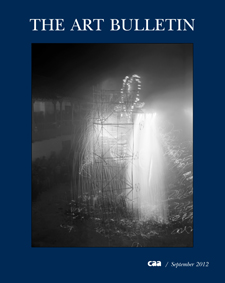 The September 2012 issue of The Art Bulletin, the leading publication of international art-historical scholarship, presents the third installment of its new feature series that will continue for two more volume years. In Regarding Art and Art History, Richard Shiff analyzes the role of interpretation in writing about art through the prism of Meyer Schapiro and Clement Greenberg’s different approaches to the topic. The subject of this issue’s Notes from the Field is contingency, with texts by eleven artists, scholars, professors, and philosophers: Linda Connor, Giovanna Borradori, Marcia Brennan, Mary Ann Doane, Angus Fletcher, Peter Geimer, Gloria Kury, Mark Ledbury, C. Brian Rose, Frances Spalding, and Chris Spring. A photograph based on Connor’s 2010 film Fireworks for the Virgin, shot in Peru, appears on the cover.
In the issue’s Interview, James Ackerman converses with Cammy Brothers about how recent trips to Turkey, Egypt, and India have affected his outlook on teaching architectural history. Ackerman, editor of The Art Bulletin from 1956 to 1959, also describes his formative years as a student at Yale University and his teaching career at Harvard University.
The September issue also features four essays that cover a wide range of art-historical topics and time periods. Jaś Elsner explores a transformative moment in the eighth century, when the icon was considered entirely as representation, and analyzes the debates that precipitated this moment among Christians, Jews, Muslims, and pagans. In her essay “Francesco Rosselli’s Lost View of Rome: An Urban Icon and Its Progeny,” Jessica Maier reconstructs Rosselli’s monumental engraving of Rome and analyzes the work as a marker of high innovation in Renaissance print culture. Elizabeth Kindall discusses how the seventeenth-century Chinese artist Huang Xiangjian moved to an experiential reading of the handscroll format and how this shift from a traditional, linear reading culminated in a panoramic “grand view.” In his essay “Architecture and Crime: Adolf Loos and the Culture of the ‘Case,’” Frederic J. Schwartz takes a close look at two widely publicized trials involving the modern Viennese architect Adolf Loos, demonstrating the implications of these encounters with criminality for Loos’s architecture practice and theory and their importance in the wider public sphere.
The books under review in this issue represent a broad cross-section of art-historical scholarship. Philippe Morel assesses Alessandro Nova’s The Book of the Wind: The Representation of the Invisible, and Carl Brandon Strehlke reviews eight books published within the last seven years on the Italian Renaissance painter Giotto. Ariella Azoulay looks at Martin A. Berger’s Seeing through Race: A Reinterpretation of Civil Rights Photography. Finally, Matthew Simms reviews two new volumes on Willem de Kooning, Richard Shiff’s Between Sense and de Kooning and the catalogue for the Museum of Modern Art’s 2011 retrospective of the artist, edited by John Elderfield, the exhibition’s curator.
CAA sends The Art Bulletin to all institutional members and to those individuals who choose to receive the journal as a benefit of their membership. The next issue of The Art Bulletin, to be published in December 2012, will feature Rebecca Zorach’s reflections on politics and teaching in Regarding Art and Art History, the texts collected in Notes from the Field will be on the topic of detail, and the Interview will feature a conversation between the German art historian Horst Bredekamp and Christopher Wood. The long-form essays include a new interpretation of the Judgment of Paris myth as it is depicted in Roman wall paintings; a close reading of the Italian Renaissance sculptor Filarete’s Hilaritas, a bronze relief on the doors of Saint Peter’s Basilica in the Vatican; a consideration of Caravaggio’s signature in Beheading of Saint John the Baptist; an analysis of a Central American painting from the mid-1680s; and an exploration of the unpublished papers of the nineteenth-century English connoisseur George Scharf. The Reviews section will include analyses of books on Islamic museum installation, Inka stonework, Andean architecture, European painterly virtuosity, Rajput painting, and a new American museum.
New Leaders for CAA’s Publications
posted by Christopher Howard — July 10, 2012
The president of the CAA Board of Directors, Anne Collins Goodyear, has confirmed new appointments to the editorial boards of CAA’s three scholarly journals and to the Publications Committee, in consultation with the vice president for publications, Randall C. Griffin. The appointments took effect on July 1, 2012.
The Art Bulletin
The Art Bulletin has announced its next editor-in-chief: Kirk Ambrose, associate professor and chair of the Department of Art and Art History at the University of Colorado in Boulder. In addition to numerous essays and book chapters, he is the author of The Nave Sculpture of Vézelay: The Art of Monastic Viewing (Toronto: Pontifical Institute of Mediaeval Studies, 2006) and the coeditor, with Robert A. Maxwell, of Current Directions in Eleventh- and Twelfth-Century Romanesque Sculpture Studies (Turnhout, Belgium: Brepols, 2010). His book Monsters in Twelfth-Century European Sculpture is forthcoming from Boydell and Brewer. Other future projects include a volume on Portuguese Romanesque sculpture and an exhibition at the University of Colorado Art Museum, tentatively entitled Aby Warburg and the Beginning of Cultural Studies in the American Southwest and scheduled for 2014. Ambrose will succeed Karen Lang of the University of Warwick in England, beginning his three-year term as editor-in-chief on July 1, 2013, with the preceding year as editor designate.
David J. Getsy, the Goldabelle McComb Finn Distinguished Professor of Art History, Theory, and Criticism at the School of the Art Institute of Chicago, has joined the Art Bulletin Editorial Board for a four-year term. His work focuses on modern and contemporary art in Europe and America from the 1870s to the present day. Among his books are Body Doubles: Sculpture in Britain, 1877–1905 (New Haven: Paul Mellon Centre for Studies in British Art and Yale University Press, 2004) and Rodin: Sex and the Making of Modern Sculpture (New Haven: Yale University Press, 2010). Getsy is currently editing the critical writings of the American postminimalist artist Scott Burton, for publication later this year by Soberscove Press.
Rachael DeLue, associate professor of art history at Princeton University in Princeton, New Jersey, has begun a three-year term as the reviews editor of The Art Bulletin, succeeding Michael Cole of Columbia University in New York. Her first section will appear in the March 2013 issue. Thelma K. Thomas, associate professor of fine arts at the Institute of Fine Arts, New York University, has now entered the second year of her two-year service as the chair of the editorial board of the journal.
Art Journal
Michael Corris, professor of art and chair of the Division of Art in the Meadows School of the Arts at Southern Methodist University in Dallas, Texas, was appointed Art Journal reviews editor. He will serve one year as reviews editor designate, taking over from Howard Singerman of the University of Virginia in July 2013. Corris is both an artist and an author of many works on postwar and contemporary art and theory. The Peacock Gallery in London and the Reading Room in Dallas hosted his most recent solo shows; he has also exhibited widely as a member of the collaborative group Art & Language. Among Corris’s many publications are monographs on Ad Reinhardt (London: Reaktion Books, 2008) and David Diao (Beijing: Timezone 8, 2005). Two books forthcoming in 2013 are The Artist Out of Work: Selected Writings on Art (Les Presses du réel and JRP | Ringier) and What Do Artists Know? The Response to Deskilling in Art (Reaktion Books). Corris is a cofounder and editor of Transmission Annual, a collaborative project of Sheffield Hallam University in England and the Meadows School of the Arts.
Joining the Art Journal Editorial Board for four-year terms are Catherine Lord and Hilary Robinson. Lord is a writer, artist, and curator whose work addresses issues of feminism, cultural politics, and colonialism. She is a professor of studio art and women’s studies at the University of California, Irvine. Recent solo exhibitions were held at ONE National Gay and Lesbian Archives and Jancar Gallery, both in Los Angeles. Lord is the author of the text-image experimental narrative The Summer of Her Baldness: A Cancer Improvisation (Austin: University of Texas Press, 2004), and her forthcoming book project coedited with Richard Meyer, to be published by Phaidon, is called Art and Queer Culture, 1885–2005. Robinson is a professor of art theory and criticism in the College of Fine Arts at Carnegie Mellon University in Pittsburgh, Pennsylvania. The focus of her scholarship is the history and theory of feminist art. Her books include Reading Art, Reading Irigaray: The Politics of Art by Women (London: I. B. Tauris, 2006) and Feminism-Art-Theory: A History, forthcoming from Blackwell. She is the editor of Visibly Female: Feminism and Art: An Anthology (London: Camden, 1987) and Feminism-Art-Theory: An Anthology 1968–2000 (Malden, MA: Blackwell, 2001).
Lane Relyea, an art critic and associate professor in the Department of Art Theory and Practice at Northwestern University in Evanston, Illinois, has finished his year as editor designate of Art Journal and now assumes the position of editor-in-chief, succeeding Katy Siegel of Hunter College, City University of New York. His first edited issue will appear in spring 2013. Rachel Weiss, a professor at the School of the Art Institute of Chicago whose work focuses on the art of Cuba, is the new chair of the journal’s editorial board. Weiss recently published To and from Utopia in the New Cuban Art (Minneapolis: University of Minnesota Press, 2011).
caa.reviews
The caa.reviews Editorial Board welcomes a new member, Tanya Sheehan, assistant professor in the Department of Art History at Rutgers University in New Brunswick, New Jersey, who will serve for four years. Currently the journal’s field editor for books on photography, she is the author of Doctored: The Medicine of Photography in Nineteenth-Century America, published by Pennsylvania State University Press in 2011.
Six new field editors for books and exhibitions have recently been chosen by the editorial board to serve three-year terms. Gloria Williams will commission reviews of exhibitions of pre-1800 art on the West Coast; Eve Straussman-Pflanzer will oversee reviews of exhibitions in the Midwest; and Jennifer Kingsley will commission reviews of exhibitions in the Southeast. Kirsten Swenson will assign books on contemporary art for review, and Megan O’Neil will commission reviews of books and related media on Precolumbian art. Michael Schreffler will handle reviews of books on early modern Iberian and colonial Latin American art.
Publications Committee
S. Hollis Clayson, Bergen Evans Professor in the Humanities and professor of art history at Northwestern University in Evanston, Illinois, was appointed to the Publications Committee as member-at-large. Clayson specializes in nineteenth-century modern European art, particularly French art; her most recent book is Paris in Despair: Art and Everyday Life under Siege (1870–71) (Chicago: University of Chicago Press, 2002). She is the recipient of numerous research and teaching awards and, as director of the Alice Kaplan Institute for the Humanities at Northwestern, promotes discussion and projects focusing on humanities in the digital era. A former chair and member of the Art Bulletin Editorial Board, Clayson has served on CAA’s Annual Conference Committee and on the juries for three CAA awards: the Distinguished Lifetime Achievement Award for Writing on Art, the Arthur Kingsley Porter Prize, and the Distinguished Teaching of Art History Award.
CAA Joins JSTOR Register & Read Program
posted by Christopher Howard — July 02, 2012
 CAA has joined JSTOR’s new Register & Read program, which offers free, read-online access to a wide-range of academic journals to independent scholars and researchers. The service is designed to make scholarship available to those not affiliated with a subscribing institution by allowing them to register for a MyJSTOR account.
CAA is pleased to contribute the full back run of The Art Bulletin and Art Journal, through 2008, to an expanding, eclectic list that includes BOMB Magazine, Film Quarterly, Modern Law Review, and American Journal of Sociology. All articles from The Art Bulletin and Art Journal during this time will be available for individuals to read and, in some instances, to download and purchase as a PDF file.
Since JSTOR launched Register & Read in January 2012, approximately forty publishers have contributed material from seventy-seven journals to the beta site. The user-friendly program mimics the experience of a library by allowing visitors to store up to three articles on a virtual shelf for two weeks before exchanging items. Feedback is key to improving the borrowing service that Register & Read provides. JSTOR plans to perfect the functionality of the program and enlarge its scope to meet the unique research needs of the scholarly community.