
CAA News Today
Art Journal Unveils Website
posted by Joe Hannan — February 09, 2011
 CAA has introduced a new website for Art Journal, its quarterly publication of modern and contemporary art. The launch coincides with the start of CAA’s Centennial year.
Katy Siegel, editor-in-chief of Art Journal, writes that the website “both acknowledges current material conditions of art and publishing, and honors the journal’s unique nature…. Rather than attempting to be another rapidly changing aggregator of information, the site will make visible and maintain the dense artistic and scholarly content of Art Journal in print, hopefully serving a need in the international arts community.”
The debut site features free selections from the print journal as well as content created specifically for the site. An essay by the painter David Reed, “Soul-Beating,” relates his first encounters with his mentor and friend Philip Guston and explores their shared fascination with the work of Piero della Francesca. Also from the print edition, a review by the writer and critic Lauren O’Neill-Butler examines the recently published notebooks of the artist Lee Lozano.
The initial web-only offerings are an essay by Howard Singerman, the journal’s reviews editor, on the history and shifting identity of Art Journal, and selected features from its extensive archive, each with a short introduction by a member of the journal’s editorial board. In coming months, the Art Journal site will grow to include time-based art discussed in articles, online artists’ projects, and more conversational modes of scholarship and discourse.
The Art Journal site was generously funded by a grant from the Andy Warhol Foundation for the Visual Arts. Katherine Behar, an artist and assistant professor of new media at Baruch College, will oversee the site. Lauren Cornell of Rhizome advised the organizers, and Brendan Dugan of Supervision Art Service designed the site.
Centennial Projects for The Art Bulletin, Art Journal, and caa.reviews
posted by Christopher Howard — February 08, 2011
The CAA three journals have launched special projects to coincide with the yearlong celebration of CAA’s Centennial. Each publication—The Art Bulletin, Art Journal, and caa.reviews—has created an online anthology of articles from its back archive. The editorial boards of the journals determined the shape, structure, and content of the anthologies, and the three projects are fascinating in their distinct approaches. All are available to the wider web-browsing public.
The Art Bulletin
The Art Bulletin Editorial Board chose to feature thirty-eight essays and reviews from the journal, which has been in print since 1913, for its Centennial anthology. As Natalie Kampen notes in her introduction to the project, the articles are “the ones that made a difference to us as art historians and as people.” The articles are listed chronologically, with author, title, and a link to a PDF of the full text. Among the authors are Meyer Schapiro, Ananda K. Coomaraswamy, Linda Nochlin, James S. Ackerman, and Griselda Pollock.
Art Journal
Art Journal’s project is in two parts. The first is an extended essay by Howard Singerman that traces the history and shifting identities of the journal and its predecessor titles, Parnassus and College Art Journal. The author of Art Subjects: Making Artists in the American University, Singerman is current reviews editor of Art Journal. To complement the essay, members of the editorial board selected texts and artists’ projects from past issues and wrote brief introductory texts to them. As editor-in-chief Katy Siegel writes, “Some feature familiar names attached to much-cited touchstones, while others, we hope, will come as a surprise.” Both projects can be seen at the journal’s new website.
caa.reviews
The editorial board of caa.reviews took a different tack, one that reflects the journal’s born-digital nature. Current and past editors of the journal penned texts to introduce statistically relevant reviews. For each of the dozen years of publication, the Centennial anthology includes the one review that was read the most over a three-year period. Though statistics were not available for the journal’s infancy, some early reviews had the largest overall readership. The topics of the reviews in the anthology vary from installation art to Islamic architecture and reflect the diverse range of expertise of the journal’s numerous commissioning editors.
The Art Bulletin Seeks Reviews Editor and Two Editorial-Board Members
posted by CAA — February 01, 2011
 The Art Bulletin is the leading quarterly journal in the English language of scholarship in all areas of art history and visual studies.
Art Bulletin Reviews Editor
The Art Bulletin Editorial Board invites nominations and self-nominations for the position of reviews editor for a three-year term: July 1, 2012–June 30, 2015, with service as incoming reviews editor designate in 2011–12. Candidates should be art scholars with stature in the field and experience in editing book and/or exhibition reviews; institutional affiliation is not required. They should also be published authors of at least one book.
The reviews editor is responsible for commissioning all book and exhibition reviews in The Art Bulletin. He or she selects books and exhibitions for review, commissions reviewers, and determines the appropriate length and character of reviews. The reviews editor also works with authors and CAA’s codirectors of publications in the development and preparation of review manuscripts for publication. He or she is expected to keep abreast of newly published and important books and recent exhibitions in art history, criticism, theory, visual studies, and museum publishing. This three-year term includes membership on the journal’s editorial board.
The reviews editor attends the three annual meetings of the Art Bulletin Editorial Board—held twice in New York in the spring and fall and once at the CAA Annual Conference in February—and submits an annual report to CAA’s Publications Committee. CAA reimburses the reviews editor for travel and lodging expenses for the two New York meetings in accordance with its travel policy, but he or she pays these expenses to attend the conference.
Candidates must be current CAA members and should not be serving on the editorial board of a competitive journal or on another CAA editorial board or committee. Members may not publish their own work in the journal during the term of service. Nominators should ascertain their nominee’s willingness to serve before submitting a name; self-nominations are also welcome. Please send a statement describing your interest in and qualifications for appointment, a CV, and at least one letter of recommendation to: Director of Publications, Art Bulletin Reviews Editor Search, College Art Association, 275 Seventh Avenue, 18th Floor, New York, NY 10001; or email the documents to Alex Gershuny, CAA editorial associate. Deadline extended: April 11, 2011; finalists will be interviewed on Friday, April 29, 2011, in New York.
Art Bulletin Editorial Board
CAA invites nominations and self-nominations for two individuals to serve on the Art Bulletin Editorial Board for a four-year term: July 1, 2011–June 30, 2015. The ideal candidate has published substantially in the field and may be an academic, museum-based, or independent scholar; institutional affiliation is not required.
The editorial board advises the editor-in-chief of The Art Bulletin and assists him or her to seek authors, articles, and other content for the journal; guides its editorial program and may propose new initiatives for it; performs peer reviews and recommends peer reviewers; and may support fundraising efforts on the journal’s behalf. Members also assist the editor-in-chief to keep abreast of trends and issues in the field by attending and reporting on sessions at the CAA Annual Conference and other academic conferences, symposia, and events in their fields.
The Art Bulletin Editorial Board meets three times a year: twice in New York in the spring and fall and once at the CAA Annual Conference in February. CAA reimburses members for travel and lodging expenses for the two New York meetings in accordance with its travel policy, but members pay their own expenses for the conference.
Candidates must be current CAA members and should not be serving on the editorial board of a competitive journal or on another CAA editorial board or committee. Members may not publish their own work in the journal during the term of service. Nominators should ascertain their nominee’s willingness to serve before submitting a name; self-nominations are also welcome. Please send a letter describing your interest in and qualifications for appointment, a CV, and your contact information to: Chair, Art Bulletin Editorial Board, College Art Association, 275 Seventh Avenue, 18th Floor, New York, NY 10001; or email the documents to Alex Gershuny, CAA editorial associate. Deadline: April 15, 2011.
Updated on February 24 and March 30, 2011.
Art Journal Seeks Editor-in-Chief and Two Editorial-Board Members
posted by CAA — February 01, 2011
 Art Journal, issued quarterly by CAA, publishes informed discussion about issues across disciplines in twentieth- and twenty-first-century art, nationally and internationally.
Art Journal Editor-in-Chief
CAA invites nominations and self-nominations for the next editor-in-chief of Art Journal, to serve a three-year term: July 1, 2012–June 30, 2015, with service on the Art Journal Editorial Board in 2011–12 as editor designate and in 2015–16 as past editor. A candidate may be an artist, art historian, art critic, art educator, curator, or other art professional; institutional affiliation is not required.
Working with the editorial board, the editor-in-chief is responsible for the content and character of the journal. He or she solicits content, reads all submitted manuscripts, sends submissions to peer reviewers, and provides guidance to authors concerning the form and content of submissions. The editor-in-chief also develops projects, makes final decisions regarding content, and may support fundraising efforts on the journal’s behalf. He or she works closely with CAA’s staff in New York.
The editor-in-chief attends the three annual meetings of the Art Journal Editorial Board—held twice in New York in the spring and fall and once at the Annual Conference in February—and submits an annual report to CAA’s Publications Committee. CAA reimburses the editor for travel and lodging expenses for the two New York meetings in accordance with its travel policy, but the editor pays his or her own expenses for the Annual Conference.
The position usually requires one-half of a person’s working time. CAA provides financial compensation for course release, usually to an editor’s employer.
Candidates must be current CAA members and should not be serving on the editorial board of a competitive journal or on another CAA editorial board or committee. Nominators should ascertain their nominee’s willingness to serve before submitting a name; self-nominations are also welcome. Please send a statement describing your interest in and qualifications for appointment, a CV, and at least one letter of recommendation to: Art Journal Editor-in-Chief Search, College Art Association, 275 Seventh Avenue, 18th Floor, New York, NY 10001; or email the documents to Alex Gershuny, CAA editorial associate. Deadline: March 25, 2011; finalists will be interviewed on Thursday, April 28, 2011, in New York.
Art Journal Editorial Board
CAA invites nominations and self-nominations for two individuals to serve on the Art Journal Editorial Board for a four-year term: July 1, 2011–June 30, 2015. Candidates are individuals with a broad knowledge of modern and contemporary art; institutional affiliation is not required.
The editorial board advises the editor-in-chief of Art Journal and assists him or her to seek authors, articles, artist’s projects, and other content for the journal; guides its editorial program and may propose new initiatives for it; performs peer reviews and recommends peer reviewers; and may support fundraising efforts on the journal’s behalf. Members also assist the editor-in-chief to keep abreast of trends and issues in the field by attending and reporting on sessions at the CAA Annual Conference and other academic conferences, symposia, and events in their fields.
The Art Journal Editorial Board meets three times a year: twice in New York in the spring and fall and once at the CAA Annual Conference in February. CAA reimburses members for travel and lodging expenses for the two New York meetings in accordance with its travel policy, but members pay their own expenses for the conference.
Candidates must be current CAA members and should not be serving on the editorial board of a competitive journal or on another CAA editorial board or committee. Members may not publish their own work in the journal during the term of service. Nominators should ascertain their nominee’s willingness to serve before submitting a name; self-nominations are also welcome. Please send a letter describing your interest in and qualifications for appointment, a CV, and your contact information to: Chair, Art Journal Editorial Board, College Art Association, 275 Seventh Avenue, 18th Floor, New York, NY 10001; or email the documents to Alex Gershuny, CAA editorial associate. Deadline: April 15, 2011.
Updated on February 24 and March 30, 2011.
caa.reviews Seeks One Editorial-Board Member
posted by CAA — February 01, 2011
 An online journal, caa.reviews is devoted to the peer review of new books, museum exhibitions, and projects relevant to the fields of art history, visual studies, and the arts.
caa.reviews Editorial Board
CAA invites nominations and self-nominations for one individual to serve on the caa.reviews Editorial Board for a four-year term, July 1, 2011–June 30, 2015. Candidates may be artists, art historians, art critics, art educators, curators, or other art professionals with stature in the field and experience in writing or editing book and/or exhibition reviews; institutional affiliation is not required. The journal also seeks candidates with a strong record of scholarship and at least one published book or the equivalent who is committed to the imaginative development of caa.reviews.
The editorial board advises the editor-in-chief of and field editors for caa.reviews and helps them to identify books and exhibitions for review and to solicit reviewers, articles, and other content for the journal; guides its editorial program and may propose new initiatives for it; and may support fundraising efforts on the journal’s behalf. Members also assist the editor-in-chief to keep abreast of trends and issues in the field by attending and reporting on sessions at the CAA Annual Conference and other academic conferences, symposia, and events in their fields.
The caa.reviews Editorial Board meets three times a year: twice in New York in the spring and fall and once at the CAA Annual Conference in February. CAA reimburses members for travel and lodging expenses for the two New York meetings in accordance with its travel policy, but members pay these expenses to attend the conference.
Candidates must be current CAA members and should not be serving on the editorial board of a competitive journal or on another CAA editorial board or committee. Nominators should ascertain their nominee’s willingness to serve before submitting a name; self-nominations are also welcome. Please send a letter describing your interest in and qualifications for appointment, a CV, and your contact information to: caa.reviews Editorial Board, College Art Association, 275 Seventh Avenue, 18th Floor, New York, NY 10001; or email the documents to Alex Gershuny, CAA editorial associate. Deadline: April 15, 2011.
Updated on March 30, 2011.
Abstracts 2011 Available for Download
posted by Emmanuel Lemakis — January 20, 2011
 Registrants for the 2011 Annual Conference in New York can now download Abstracts 2011. This publication, available as a PDF, summarizes the contents of hundreds of papers and talks that will be presented in program sessions.
Reading the abstracts in advance can help you plan your daily schedule at the conference. Program sessions are alphabetized by the chair’s last name and appear in the contents pages. An index in the back of the publication names the speakers. Alternatively, use your Adobe Reader to conduct a keyword search for terms relevant to your interests.
After registrants log into their CAA account, they can click the “Abstracts” image in the middle of the screen to download the PDF (1.5 MB). Abstracts 2011 is part of the registration package; there is no cost for paid or complimentary registrants.
Conference attendees who purchase single-time slot tickets, or those who want Abstracts 2011 but are not coming to New York, may attain the document for a charge: $30 for CAA members, $35 for nonmembers. Abstracts 2011 will remain on the CAA website for download or sale through July 31, 2011.
Beginning with the 2010 conference in Chicago, CAA offers its Abstracts exclusively as a PDF download. Past issues of the printed publication from 1999 to 2009 are also available. The cost per copy is $30 for CAA members and $35 for nonmembers. For more information and to order, please contact Roberta Lawson, CAA office coordinator.
Sale on CAA’s Directories of Graduate Programs in the Arts
posted by CAA — December 15, 2010
 CAA’s two Directories of Graduate Programs in the Arts, covering MA, MFA, and PhD programs in art and art history, are now on sale: $15 for CAA members and $20 for nonmembers, plus $4 shipping.
Published in late 2008 and early 2009, the directories remain the most comprehensive resources available for prospective graduate students in the visual arts, listing hundreds of programs in the United States, Canada, the United Kingdom, Australia, New Zealand, and elsewhere worldwide. CAA will introduce revised, online versions of the directories in fall 2011, with a price to be determined.
The directories come in two volumes, each sold separately: Graduate Programs in Art History includes art history, visual studies, museum studies, curatorial studies, arts administration, and library science; and Graduate Programs in the Visual Arts comprises studio art, graphic design, applied arts and design, film production, art education, and conservation. An index lists schools alphabetically and by state and country for quick reference. An introductory essay presents a detailed description of the elements of a program entry, including explanations of the various kinds of programs and degrees offered, helping place your search and selection process in context.

CAA accepts online purchases from individuals only. If you are ordering on behalf of a school, department, library, museum, or other institution, please download and complete this form and submit it via mail or fax to: CAA, 275 Seventh Ave., 18th Floor, New York, NY 10001; 212-627-2381.
Updated on February 23, 2011.
2010 Recipients of the Meiss and Wyeth Publication Grants
posted by Christopher Howard — November 29, 2010
CAA has awarded grants to the publishers of nine books in art history and visual culture through two programs: the Millard Meiss Publication Fund and the Wyeth Foundation for American Art Publication Grant.
Meiss Grants Winners
This fall, CAA has awarded four grants from the Millard Meiss Publication Fund. Thanks to the generous bequest of the late Prof. Millard Meiss, these grants are given to publishers to support the publication of scholarly books in art history and related fields. The 2010 grantees are:
- Cynthia Hahn, Strange Beauty: Issues in the Making and Meaning of Reliquaries 400–circa 1204 (Pennsylvania State University Press)
- Megan E. O’Neil, Engaging Ancient Maya Sculpture at Piedras Negras, Guatemala (University of Oklahoma Press)
- J. P. Park, Ensnaring the Public Eye: Painting Manuals of Late Ming China and the Negotiation of Taste (University of Washington Press)
- Stephen C. Pinson, Speculating Daguerre: Art and Enterprise in the Work of L. J. M. Daguerre (University of Chicago Press)
Books eligible for a Meiss grant must already be under contract with a publisher and be on a subject in the arts or art history. Authors must be current CAA members. Application criteria and guidelines for the Meiss grant are available online or from Alex Gershuny, CAA editorial associate.
Wyeth Grant Winners
CAA is pleased to announce five recipients of the annual Wyeth Foundation for American Art Publication Grant. Thanks to a second generous three-year grant from the Wyeth Foundation, these awards are given annually to publishers to support the publication of one or more book-length scholarly manuscripts in the history of American art, visual studies, and related subjects. Receiving 2010 grants are:
- Marianne Kinkel, Races of Mankind: The Sculptures of Malvina Hoffman (University of Illinois Press)
- Analisa Leppanen-Guerra, Children’s Stories and “Child-Time” in the Works of Joseph Cornell and the Trans-Atlantic Avant-Garde (Ashgate)
- Leo Mazow, Thomas Hart Benton and the American Sound (Pennsylvania State University Press)
- Maurie McInnis, Slaves Waiting for Sale: Visualizing the Southern Slave Trade (University of Chicago Press)
- Marian Wardle, ed., The Weir Family, 1820–1920: Expanding the Traditions of American Art (University Press of New England)
For the purpose of this program, “American art” is defined as art created in the United States, Canada, and Mexico prior to 1970. Books eligible for a Wyeth grant must already be under contract with a publisher. Authors must be current CAA members. Application criteria and guidelines for the Wyeth grant are available online or from Alex Gershuny, CAA editorial associate.
Publications Committee and caa.reviews Welcome New Members
posted by Christopher Howard — November 22, 2010
The Publications Committee, which oversees CAA’s scholarly journals and related projects, welcomes two new members who will serve through June 30, 2013. Anthony Elms is editor of WhiteWalls, a publisher of innovative books and a journal, and assistant director of Gallery 400 at the University of Illinois in Chicago. Cynthia Mills is executive editor of American Art, the scholarly journal of the Smithsonian American Art Museum in Washington, DC. She is also academic programs coordinator for the museum, where she supervises the fellowship program and publications prizes and organizes scholarly symposia.
caa.reviews, CAA’s online journal for reviews of books, exhibitions, and projects in art history and visual studies, has added Elizabeth Marlowe to its editorial board, to serve through June 30, 2014. Marlowe is visiting assistant professor of art and art history at Colgate University in Hamilton, New York. In addition, Janet Kraynak, assistant professor of art history at New School University, has become a field editor for the journal. She will commission reviews of exhibitions on modern and contemporary art in New York and internationally though June 30, 2013.
Over the summer, CAA made additional appointments for all three journals. Editors and members of editorial boards and committees are chosen from an open call for nominations and self-nominations, published on the CAA website from January to April each year and publicized through CAA News.
December 2010 Issue of The Art Bulletin Features Raphael, Rauschenberg, and Hōgai
posted by Christopher Howard — November 19, 2010
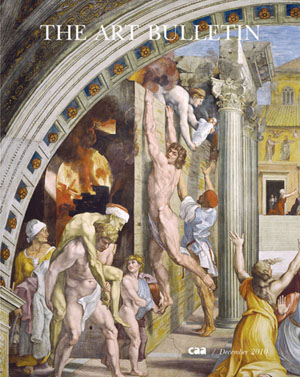
Insightful studies that reframe a Raphael fresco, Robert Rauschenberg’s Combines, and Kano Hōgai’s best-known work are among the six essays in the December 2010 issue of The Art Bulletin, the leading publication of international art-historical scholarship. The issue has been mailed to all individual CAA members who elect to receive the journal, and to all institutional members.
The final issue of the year comprises six essays, two of which delve into art from the Italian peninsula. In “Reflections of Imperialism,” Brenda Longfellow examines the Meta Sudans fountain in Rome, built during the Flavian dynasty, as a signifier of imperial legacy in both Rome and its provinces. For her contribution, Patricia Reilly contends that Raphael’s often-maligned Fire in the Borgo presents the artist’s argument for a new theory of painting. Looking across the Atlantic, Angélica Afandor-Pujol studies the illustrated manuscript known as the “Relación de Michoancán” and investigates issues of mimicry and the appropriation of European artistic traditions by indigenous artists in colonial Mexico.
Moving to the modern times, Chelsea Foxwell reconsiders the iconographic and historical significance of Hōgai’s Merciful Mother Kannon (1888), a masterpiece of Japanese painting, and Tom Folland argues that Rauschenberg’s Combines represent a queering of Abstract Expressionism and, by extension, the culture of postwar modernism. In “The State of Art History,” Terry Smith explores ideas of the contemporary within discourse on modern art and proposes a framework for globally considering the art of today.
In the Reviews section, Gabriela Siracusano assesses Veiled Brightness, a multiauthored book on the history of Maya color. Charles Darwin’s relationship to the visual arts is the focus of Rachael Delue four-book analysis, and Erika Naginski reviews The Blind Spot: An Essay on the Relations between Painting and Sculpture in the Modern Age.
Please read the full table of contents for more details. The next issue, to be published in March 2011, will feature essays on the Bocca della Verità in Rome; the “finger-bone” relics of a Buddha found in Shaanxi Province, China; and relationships between German painting and Czech Cubism.