CAA News Today
Leave the Conference—Please!
posted by Christopher Howard — December 20, 2016
Have some free time? Looking for a good place to brainstorm 2018 session ideas over a drink? Want food recommendations other than Yelp? We love our attendees at the conference, but we also want you to leave. To help, CAA has compiled a list of staff members’ favorite places offsite. Here are a few highlights.
For drinks in midtown, CAA recommends the Library Bar, a cozy spot in the Hudson Hotel with a fireplace, books, and a pool table, and Tanner Smith’s, which boasts a great happy hour and superb cocktails. For those heading downtown, Henrietta Hudson in the West Village is a friendly bar for lesbians. In nearby Greenwich Village is Julius’, the site of a 1966 “sip in” that protested a state regulation prohibiting bars and restaurants from serving homosexuals. If watching NBA basketball or NHL hockey is your thing, the place to go is Boxers, New York’s preeminent gay sports bar, located in Hell’s Kitchen.
Everyone must eat! Within a few blocks of the conference CAA staff can recommended these three restaurants, among several others: China Grill serves upmarket Asian fusion; Fig & Olive offers upscale season Mediterranean fare and a great happy hour; and Nougatine at Jean-Georges is the home of a tasty and reasonably priced prix-fixe lunch.
A short cab or train ride away from the conference hotels are: Elephant & Castle, a charming café in the West Village; Vanessa’s Dumpling House, which dishes up inexpensive dumplings and amazing sesame pancakes, in Union Square; and Yuka, a sushi restaurant on the Upper East Side famous for its all-you-can-eat option. In the same neighborhood as Yuka is Candle 79, serving eclectic, health-conscious organic vegan dishes in swanky surroundings.
Although the Museum of Modern Art is only a half-block away from the Hilton, CAA staff recommends trekking uptown to the Met Cloisters, the Metropolitan Museum of Art’s outpost for medieval European art, as well as to various locations in Harlem for Art in FLUX. An organization whose politics lean left is Interference Archive, a library, gallery, and archive of activist and social-justice movement materials in Brooklyn.
A popular but lesser-known historical site is the Lower East Side Tenement Museum, which tells the story of urban immigration in the United States. A favorite place of contemplation for one CAA staff member is the Irish Hunger Memorial, a site in lower Manhattan that marks the struggle against hunger amid a sublime view of the New York Harbor.
Staff Interview: Katie Apsey
posted by CAA — December 19, 2016
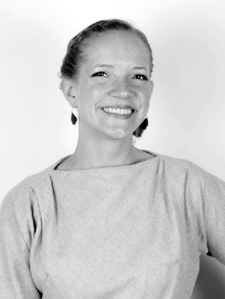
Katie Apsey
The next in a series of interviews with staff members is a conversation with Katie Apsey, CAA manager of programs.
How long have you worked at CAA?
I have worked at CAA just over one year now. I originally started in the Publications Department as data coordinator for the graduate-school directories and moved over to the Programs Department when Lauren Stark left her position to pursue work in the archives field.
What do you do at CAA?
Many different things! I do the administrative work for all programs related to the conference: session submissions for the Annual Conference Committee’s review, ARTexchange applications, submissions to the various conference publications and the conference website, special events, business meetings, poster sessions, appointments for mentoring sessions, and more! I also help the juries for the annual Awards for Distinction as well as the conference travel grants. Both are quite rewarding.
What does CAA mean to you?
I became a member of CAA long ago when I graduated with a BA in photography and was searching for my first job. At that point in my career, membership was a way for me to determine the state of the field—what kind of jobs and opportunities and career paths there were for me as a young artist. As my career shifted away from art practice and toward museum work and then art history, CAA became a network for keeping up with peers rather than a resource for the job market.
Can you talk about one of your favorite member moments?
It would be too hard to pick one moment of engagement with a member. While working in the Speaker Ready Room I overhear amazing conversations between session chairs and their speakers while they prepare before or recombobulate after their sessions. Observing the uniqueness of each group and noting the different approaches that session chairs take when creating thoughtful panels is equally inspiring. I always learn things about new theories, historiographies, artists, and exhibitions through osmosis while I am running around doing management tasks!
What do you like best about the arts and working in the arts?
This sounds so cliché, but I like being surrounded by creative people and getting inspired and challenged by them: people who know that the “right” or “best” answer is an ambiguous, moving target; people who, after they are done with the business of an email, send me a link to an article, exhibition, or artist’s webpage; people who know the value of thinking deeply or uniquely; and people who do what they do not for the money but for their belief in the importance of discourse.
Do you have a favorite moment from the Annual Conference?
When I attended as a regular member, my favorite moments were seeing my academic heroes speak or listening to the annual Distinguished Artist Interviews. Now that I work for CAA “behind the scenes,” my favorite moments have become working with the room monitors onsite. These are the people that check conference badges at the doors to session rooms. I enjoy hearing what they are working on with their art or scholarship, pointing them toward sessions they may have overlooked in the program, and taking in the stories of the retired professors who are volunteering their time.
You are writing your dissertation on Native American art, and the CAA office is up the street from the Smithsonian Institution’s National Museum of the American Indian (NMAI). Have you visited the museum often since working here?
Yes, I feel very lucky to be so close to the museum’s New York branch. One of the main curators there, Kathleen Ash-Milby, is a powerhouse who focuses on contemporary Native American art, which is what I write about most often, so I value seeing the exhibitions at the George Gustav Heye Center as soon as they open. The museum also has the film and media center with rare digital content and a cozy educational library that I like to visit on my lunch break. It is the perfect spot for even fifteen minutes of reading outside the office, or for watching a VHS tape from the NMAI collection of performances that hasn’t been digitized yet! A lot of tourists visit lower Manhattan, but many of them don’t know they can go inside the Customs House—the building that houses the museum—for free, so it still remains a quiet refuge with rotating exhibitions and frequent nighttime events. In fact, I attended a MuseumHue event there about art and social change just a few weeks ago!
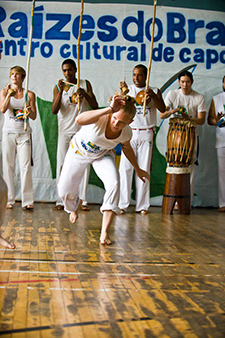
Katie Apsey practices the Brazilian martial art of capoeira (photograph provided by Capoeira Vida)
You have performed and taught dance. What are your specialities and favorites?
Oh, I could go on for hours about this. I love whatever classes I can take. As a company dancer, I felt like contemporary dance challenged me the most intellectually. It really pushes the boundaries of expansive concepts like “movement,” “performance,” and “choreography.” Closer to my heart, though, are samba dance and the Brazilian martial art of capoeira, both of which feed my soul. Samba is physically demanding yet joyful and amazingly fun to perform. I love looking into the crowd from the stage and seeing hundreds of people smiling back or even dancing themselves because they can’t sit still. Conceiving of and making new costumes uses my creativity in a different way.
There are many types of samba—including carnival mas group/Rio-style samba, Bahian-style samba de roda, and Orisha dances associated with Candomblé—that speak to different needs, abilities, histories, lives, and energies. Dance is an art form that grows with a person over time and answers their needs in the moment. Capoeira is the same way. It is actually a martial art, not dance. It challenges both my body (I swear someday I will still be able to learn a back flip … in my thirties) as well as my mind (in the strategy of the game). Capoeira even challenges my musical abilities in having to learn all the songs and instruments while trying to sing in tune!
New in caa.reviews
posted by CAA — December 16, 2016
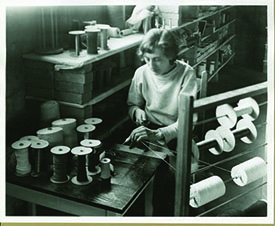
Anni Albers spooling thread (n.d.). Photo by Claude Stoller. Courtesy Western Regional Archives, State Archives of North Carolina, Asheville, NC.
Sunanda K. Sanyal visits the solo exhibition Zanele Muholi: Isibonelo/Evidence at the Brooklyn Museum. For the last decade, Zanele Muholi, “who identifies herself more as a visual activist than an artist,” has created photo and video projects to document “multiple facets of LGBT life in South Africa, focusing particularly on hate crimes against the community.” Read the full review at caa.reviews.
Holly Gore reviews Leap before You Look: Black Mountain College 1933–1957 at the Hammer Museum. The exhibition “offers an earthbound view on this storied institution, as seen through over two hundred artworks created by students and faculty.” Ultimately, the show’s “uplifting effect is grounded in physical encounter,” and the artworks “feel ever-vital, never dusty.” Read the full review at caa.reviews.
Midori Yamamura discusses the sixth edition of The Echigo–Tsumari Art Triennale in Nīgata, Japan. “The world’s largest international exhibition,” the placed-based triennale featured “180 new works in addition to 200 preexisting projects” and impelled viewers “to rethink consumer society, urban lifestyle, and the corporate world as not necessarily happier choices.” Read the full review at caa.reviews.
caa.reviews publishes over 150 reviews each year. Founded in 1998, the site publishes timely scholarly and critical reviews of studies and projects in all areas and periods of art history, visual studies, and the fine arts, providing peer review for the disciplines served by the College Art Association. Publications and projects reviewed include books, articles, exhibitions, conferences, digital scholarship, and other works as appropriate. Read more reviews at caa.reviews.
Announcing Candidates for CAA’s Board – Vote in Early January 2017
posted by Vanessa Jalet — December 16, 2016
The CAA Board of Directors comprises professionals in the visual arts who are elected annually by the membership to serve four-year terms. Please read the CAA By-laws on Nominations, Elections, and Appointments for more information on the process.
Meet the Candidates
The 2016–17 Nominating Committee has selected a slate of five candidates for election to the CAA Board of Directors for the 2017–21 term. Click the names of the candidates below to read their statements and resumes before casting your vote. The candidates are:
About the Board
The Board of Directors is charged with CAA’s long-term financial stability and strategic direction; it is also the Association’s governing body. The board sets policy regarding all aspects of CAA’s activities, including publishing, the Annual Conference, awards and fellowships, advocacy, and committee procedures.
HOW TO VOTE
CAA members may vote for up to four(4) candidates, including one write-in candidate (who must be a CAA member). The four candidates receiving the most votes will be elected to the board. CAA members may cast their votes and submit their proxies online beginning in early January 2017; no paper ballots will be mailed. Please have your CAA user/member ID# and password handy when you are ready to vote. All voting must take place by 6:00 PM (EST) on Thursday, February 16, 2017.
The results of the 2017 Board of Directors election will be announced at the second part of the Annual Business meeting – the myCAA segment – scheduled from 12:15 to 1:15 p.m. on Friday, February 17, 2017, in the East Ballroom, 3rd Floor, at the New York Hilton Midtown Hotel, 1335 Avenue of the Americas, Ny NY 10019
Questions? Contact Vanessa Jalet, executive liaison, at (212) 392-4434 or vjalet@collegeart.org
Solo Exhibitions by Artist Members
posted by CAA — December 15, 2016
See when and where CAA members are exhibiting their art, and view images of their work.
Solo Exhibitions by Artist Members is published every two months: in February, April, June, August, October, and December. To learn more about submitting a listing, please follow the instructions on the main Member News page.
December 2016
Midwest

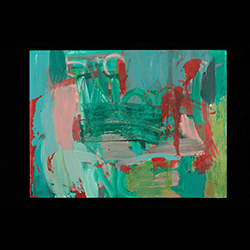 Stacy Leeman, Darrow’s Words W7, oil on wood, 12 x 16 in. (artwork © Stacy Leeman)
Stacy Leeman. Sharon Weiss Gallery, Columbus, Ohio, September 1–25, 2016. Vermont Meditations. Painting.
Northeast

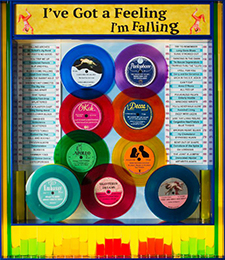 Jerry Meyer, I’ve Got a Feeling I’m Falling, 2015, mixed media, 30 x 26½ x 7¼ in. (artwork © Jerry Meyer)
Jerry Meyer. Denise Bibro Fine Arts, New York, September 15–October 29, 2016. Very Long Distance. Installation.
South

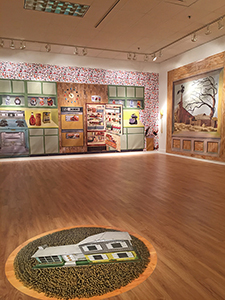 Sue Johnson, installation view of Home of Future Things, prints on vinyl and found objects (artwork © Sue Johnson; photograph by the artist)
Sue Johnson. Martha and Robert Fogelman Galleries of Contemporary Art, University of Memphis, Memphis, Tennessee, September 16–November 11, 2017. Sue Johnson: Home of Future Things. Installation.

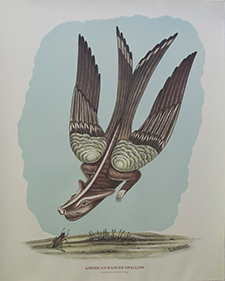 Beauvais Lyons, Ornithological Quadrupeds: American Badger Swallow, 2012, hand-printed lithograph, 28 x 22 in. (artwork © Beauvais Lyons)
Beauvais Lyons. Ridderhof Martin Gallery, University of Mary Washington, Fredericksburg, Virginia, October 27–December 4, 2016. The Association for Creative Zoology. Lithography and installation.
West

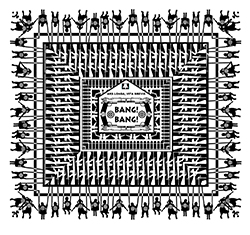 Margi Weir, Bang! Bang!, 2015–16, vinyl, dimensions variable (artwork © Margi Weir)
Margi Weir. Central Features Gallery, Albuquerque, New Mexico, October 15–November 19, 2016. Bang! Bang! Mixed media.
People in the News
posted by CAA — December 15, 2016
People in the News lists new hires, positions, and promotions in three sections: Academe, Museums and Galleries, and Organizations and Publications.
The section is published every two months: in February, April, June, August, October, and December. To learn more about submitting a listing, please follow the instructions on the main Member News page.
December 2016
Academe

Jacki Apple has retired from Art Center College of Design in Pasadena, California, after thirty-three years of teaching in the Humanities and Sciences Department, where she served as a faculty-elected codirector in the absence of a chair from 2012 to 2014.
Kathryn Bunn-Marcuse has accepted a tenure-track position at the University of Washington in Seattle. She will hold a joint appointment as assistant professor in the Division of Art History and curator of Northwest Native American art at the Burke Museum.
Faye Raquel Gleisser has been appointed assistant professor of art history in the Henry Radford Hope School of Fine Arts at Indiana University in Bloomington.
Morten Steen Hansen has become a lecturer in the Division of Art History at the University of Washington in Seattle.
Dan Paz has been appointed lecturer by the University of Washington in Seattle for the Division of Art’s program in interdisciplinary visual arts.

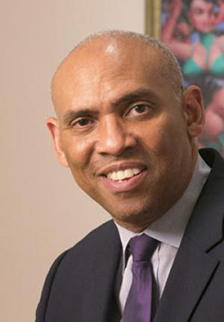 Richard J. Powell
Richard J. Powell has stepped down as dean of humanities at Duke University in Durham, North Carolina. He will remain John Spencer Bassett Professor of Art and Art History.
Kate Roberts has been appointed lecturer in Division of Art’s 3D4M program for ceramics, glass, and sculpture at the University of Washington in Seattle.
David Yager has been inaugurated as president of University of the Arts in Philadelphia. He joined the school last year after serving as dean of the Arts Division and distinguished professor of art at the University of California, Santa Cruz.
Museums and Galleries
Birgitta Augustin has left her position as associate curator of Asia art and acting head of the Department of the Arts of Asia and the Islamic World at the Detroit Institute of Arts in Michigan.
Meredith Dean, previously an administrator for the Association of Art Museum Curators, has joined the Museum of Modern Art in New York as development assistant for exhibition and program funding.
Kevin Dumouchelle has joined the Smithsonian Institution’s National Museum of African Art as curator. Previously he oversaw the African and Pacific Islands collections at the Brooklyn Museum in New York.
Erin Hanas, formerly academic programs coordinator at Duke University’s Nasher Museum of Art in Durham, North Carolina, has become associate curator of academic programs for the Institute for Contemporary Art at Virginia Commonwealth University in Richmond.

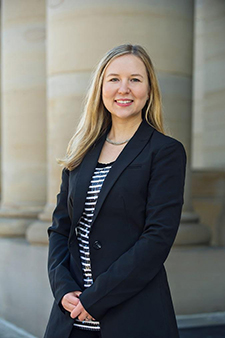 Lehti Keelmann (photograph provided by the University of Michigan Museum of Art)
Lehti Keelmann has been appointed assistant curator of Western art at the University of Michigan Museum of Art in Ann Arbor, where she will oversee the collection of European art spanning the medieval period through the twentieth century.

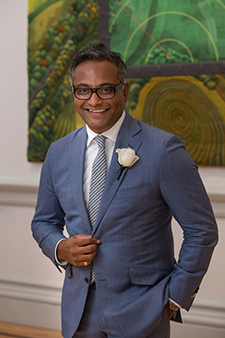 Abraham Thomas (photograph by Pepe Gomez)
Abraham Thomas, previously director of the Sir John Soane’s Museum in London, England, has been named Fleur and Charles Bresler Curator-in-Charge at the Smithsonian American Art Museum’s Renwick Gallery in Washington, DC.
Institutional News
posted by CAA — December 15, 2016
Read about the latest news from institutional members.
Institutional News is published every two months: in February, April, June, August, October, and December. To learn more about submitting a listing, please follow the instructions on the main Member News page.
December 2016
The Archives of American Art, part of the Smithsonian Institution in Washington, DC, has received a three-year grant of up to $900,000 from the Walton Family Foundation to support the ongoing digitization of the archives’ collection, enabling the organization to double its current rate. The Archives of American Art is obliged to match the grant, to be given in three installments.
The Archives of American Art, part of the Smithsonian Institution in Washington, DC, has announced a long-term partnership with the Terra Foundation for American Art to support the digitization of the archives’ collections. Terra has made a $4.5 million commitment, $4 million of which is a challenge grant to be matched by the Smithsonian, to seed an endowment for ongoing digitization. The remaining $500,000 will provide operating support for the current digitization program.
California State University, Long Beach, has received a grant from the Graham Foundation to support an exhibition, Robert Irwin: Site Determined, at the University Art Museum.

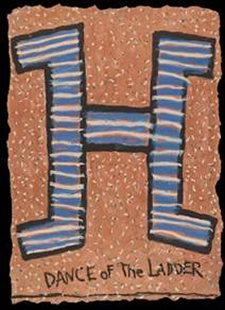 Harmony Hammond, Dance of the Ladder, 1981 (artwork © Harmony Hammond; photograph provided by the Getty Research Institute)
The Getty Research Institute in Los Angeles, California, has acquired the archive of the artist, writer, curator, and scholar Harmony Hammond. The donation includes correspondence, photographs, original source material for her art, professional papers, publication drafts, editioned prints, original artwork, files, and a slide registry devoted to lesbian artists.

 The main entrance to the Metropolitan Museum of Art (photograph by Brett Beyer)
The Metropolitan Museum of Art in New York has reaffirmed its long-term cooperative partnership with the Ministry of Culture of the Government of India by renewing a Memorandum of Understanding for five additional years.
The Metropolitan Museum of Art in New York has been named the world’s top museum in TravelAdvisor’s Travelers’ Choice Awards, based on the quality and quantity of reviews and ratings over a twelve-month period, for the second year in a row.
The Museum of Modern Art in New York has received a grant from the Graham Foundation to support an exhibition, Frank Lloyd Wright at 150: Unpacking the Archive, scheduled for June 12–October 1, 2017.

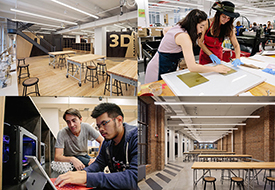 Scenes from the Parsons Making Center at the New School (photographs by Matt Matthews and Michael Moran)
Parsons School of Design in New York has opened the Parsons Making Center at the New School, a hub for a network of making spaces that provide university students with state-of-the-art tools to design projects in a range of disciplines.
Princeton University Art Museum in Princeton, New Jersey, has received a $150,000 Museums for America grant from the Institute of Museum and Library Services to support the ongoing Collections Discovery Initiative, designed to ensure that Princeton’s Asian art collection can be shared with the broadest possible audiences, especially with scholars and researchers. The grant will allow the museum to enhance and standardize the cataloguing of its Asian art holdings, develop rich educational materials, and restructure its Asian art microsite into an in-depth sustainable resource with an innovative new interface.

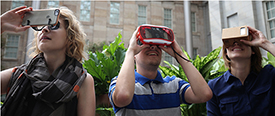 Using virtual-reality technology, you can now experience the exhibition WONDER on your mobile device (photograph provided by the Smithsonian American Art Museum)
The Smithsonian American Art Museum in Washington, DC, has launched Renwick Gallery WONDER 360, an immersive 360-degree virtual-reality app for Apple and Android mobile devices. The app allows audiences to explore the entirety of the museum’s 2015–16 exhibition WONDER, presented at its Renwick Gallery, in 3D; it also expands the visitor experience through emerging technologies and is the first virtual-reality mobile app the Smithsonian has offered.
The Society of Architectural Historians, based in Chicago, Illinois, has received a grant from the Graham Foundation to support a public program, a half-day seminar on “Making and Re-Making Glasgow: Heritage and Sustainability,” at its upcoming conference in Scotland.
The University of Houston in Texas has created a new College of the Arts, comprising the School of Art, the Moores School of Music, the School of Theatre and Dance, the Blaffer Art Museum, the Cynthia Mitchell Woods Center for the Arts, the Center for Arts Leadership, and the Graduate Program for Arts Management.

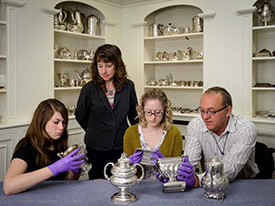 Bruno Pouliot, senior objects conservator (far right), and Ann Wagner, curator of decorative arts (standing), examine coatings on silver objects during Phase I (2013–15) of the IMLS-funded project, alongside the former conservation technicians Maggie Bearden (left) and Kaitlin Andrews (right) (photograph provided by the Winterthur Museum, Garden, and Library)
The Winterthur Museum, Garden, and Library in Winterthur, Delaware, has received a $110,759 grant from the Institute of Museum and Library Services for a project on preventive care for metal objects, which Winterthur deems its highest conservation treatment priority.
Grants, Awards, and Honors
posted by CAA — December 15, 2016
CAA recognizes its members for their professional achievements, be it a grant, fellowship, residency, book prize, honorary degree, or related award.
Grants, Awards, and Honors is published every two months: in February, April, June, August, October, and December. To learn more about submitting a listing, please follow the instructions on the main Member News page.
December 2016

Devon Baker, a PhD student in art history at Temple University in Philadelphia, Pennsylvania, has been awarded a 2016–17 Jane and Morgan Whitney Fellowship by the Metropolitan Museum of Art in New York. She will conduct research for her dissertation, which explores print culture in Renaissance Lombardy, using printmaking to examine larger themes of mobility, north-south exchange, and transmateriality.
Amy Beecher, an artist based in New York and Providence, Rhode Island, has received a fall 2016 fellowship from the MacDowell Colony in Peterborough, New Hampshire, in the interdisciplinary artist category.
Daniella Berman, a doctoral candidate at New York University’s Institute of Fine Arts, has been awarded a 2016–17 Theodore Rousseau Fellowship by the Metropolitan Museum of Art to work on her dissertation, which considers the unfinished history paintings of the French Revolution and identifies an emergent aesthetic of “unfinishedness” developed by artists in response to the shifting sociopolitical landscape.
Douglas Brine, associate professor of art history at Trinity University in San Antonio, Texas, has accepted a 2016–17 J. Clawson Mills Scholarship at the Metropolitan Museum of Art in New York to undertake research and writing for his book project, “The Art of Brass in the Burgundian Netherlands: Makers, Markets, Patrons, Products.”
Emily Casey, a PhD candidate in art history at the University of Delaware in Newark, has been given a Sylvan C. Coleman and Pam Coleman Memorial Fund Fellowship for 2016–17 by the Metropolitan Museum of Art in New York. She will examine representations of oceanic space in American art and material culture to show how colonial and early national identities were constructed in relation to these.
Joshua Cohen, assistant professor at City College, City University of New York, has received a 2016–17 Jane and Morgan Whitney Fellowship from the Metropolitan Museum of Art to complete a book that tracks modernist appropriations of African sculpture by European and African artists between 1905 and 1980.
Joelle Dietrick, assistant professor of art and digital studies at Davidson College in Davidson, North Carolina, has accepted a Pollock-Krasner Foundation award to support her studio production during the 2016–17 academic year before she goes to Hamburg, Germany, for her Fulbright Global Award (April–July 2017). As part of the Fulbright, Dietrick will travel to Santiago, Chile, and Hong Kong, China, during the next two winter breaks.
Brad Hostetler, who earned a PhD in art history last year at Florida State University in Tallahassee, has been awarded a 2016–17 Jane and Morgan Whitney Fellowship from the Metropolitan Museum of Art in New York to complete revisions for a book project, “Enshrining Sacred Matter: The Form, Function, and Meaning of Reliquaries in Byzantium, 843–1204.”
Amy Huang, a doctoral candidate in the history of art and architecture at Brown University in Providence, Rhode Island, and an adjunct lecturer for Boston University in Massachusetts, has received a 2016–17 Jane and Morgan Whitney Fellowship from the Metropolitan Museum of Art in New York. She will research visual modes of remembrance in Chinese paintings through seventeenth-century Nanjing and investigate how memory operated through texts, images, and historic sites.
Frances Jacobus-Parker, a PhD student in art and archaeology at Princeton University in Princeton, New Jersey, has been given a Jane and Morgan Whitney Fellowship for 2016–17 by the Metropolitan Museum of Art in New York, where he will work on the first comprehensive study of the oeuvre of the pivotal American artist Vija Celmins.
Samuel Johnson, who earned his PhD in the history of art and architecture at Harvard University in Cambridge, Massachusetts, in 2015, has been awarded a Leonard A. Lauder Fellowship by the Metropolitan Museum of Art in New York. In 2016–17 Johnson will study the effects of the papiers collés of Georges Braques and Pablo Picasso on the photographs of El Lissitzky, László Moholy-Nagy, and Man Ray.
Anna Jozefacka, an adjunct professor at Hunter College, City University of New York, has been awarded a 2016–17 Leonard A. Lauder Fellowship by the Metropolitan Museum of Art to conduct research on Cubism’s relationship to the evolution of modern architectural and interior design in the first three decades of the twentieth century.
Julia McHugh, a doctoral student in art history at the University of California, Los Angeles, has accepted a Douglass Foundation Fellowship in American Art for 2016–17 from the Metropolitan Museum of Art in New York to work on her dissertation, which examines the ways in which patrons used tapestries and other textiles to adorn interiors, both domestic and sacred, in seventeenth- and eighteenth-century Peru.

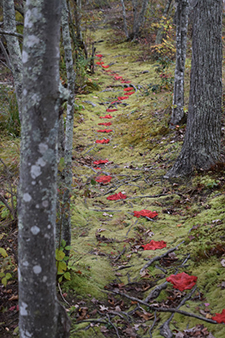 Patricia Miranda, Invasive, 2016 (artwork © Patricia Miranda)
Patricia Miranda, an artist, curator, educator, and founder of MAPSpace, a gallery in Port Chester, New York, has completed an October 2016 residency at I-Park Residency in East Haddam, Connecticut.
Jiha Moon, an artist who lives and works in Atlanta, Georgia, has received a 2016 Artadia Award.
Elyse Nelson, a PhD candidate in the history of art at New York University’s Institute of Fine Arts, has been given a Jane and Morgan Whitney Fellowship by the Metropolitan Museum of Art. During 2016–17 she will work on a dissertation that explores the Italian neoclassical sculptor Antonio Canova’s renewed relationship with his British patrons after Napoleon’s defeat in 1814.
Giulia Paoletti, a core lecturer at Columbia University in New York, has been awarded a 2016–17 Andrew W. Mellon Postdoctoral Curatorial Fellowship by the Metropolitan Museum of Art to research and assist with the development and preparation for a planned reinstallation and renovation of the African art galleries.
John Richardson, professor of art and chair of the James Pearson Duffy Department of Art and Art History at Wayne State University in Detroit, Michigan, has received the 2016 Lifetime Achievement Award from the Mid America College Art Association.
Miriam Said, a doctoral student in the history of art at the University of California, Berkeley, has accepted a 2016–17 Frances Markoe Fellowship by the Metropolitan Museum of Art in New York to explore material-based mechanisms of ritual affect as it was manifested in and between the Near East and Greece in the first millennium BC.
John A. Tyson, a recent recipient of a PhD in art history from Emory University in Atlanta, Georgia, has joined the National Gallery of Art in Washington, DC, as a 2016–17 participant in the fellowship and internships program. He will assist the Department of Modern Art with research for the upcoming Rachel Whiteread retrospective and lead tours in the newly reinstalled East Building permanent and special exhibition galleries.
Aaron Wile, a PhD candidate in the history of art and architecture at Harvard University in Cambridge, Massachusetts, has accepted a Chester Dale Fellowship from the Metropolitan Museum of Art in New York. During 2016–17 he will complete his dissertation, “Painting, Authority, and Experience at the Twighlight of the Grand Siècle, 1690–1721,” and begin transforming it into a book manuscript, consulting materials at the museum.
Katharine Wright, who earned her PhD in art history at the Institute of Fine Arts, New York University, in 2015, has been awarded an Andrew W. Mellon Curatorial Research/Collections Specialist Fellowship for 2016–17 by the Metropolitan Museum of Art to catalogue the Department of Modern and Contemporary Art’s collection of American modernism.
Tara Zanardi, an associate professor at Hunter College, City University of New York, has accepted a 2016–17 Jane and Morgan Whitney Fellowship from the Metropolitan Museum of Art to research the Porcelain Room at the Royal Palace in Aranjuez, a tour-de-force in its implementation and display of porcelain, the interior exemplifies Charles III’s innovative artistic and political strategies at court.
Exhibitions Curated by CAA Members
posted by CAA — December 15, 2016
Check out details on recent shows organized by CAA members who are also curators.
Exhibitions Curated by CAA Members is published every two months: in February, April, June, August, October, and December. To learn more about submitting a listing, please follow the instructions on the main Member News page.
December 2016

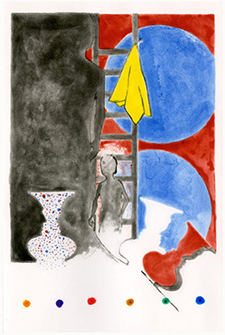 Jasper Johns, Untitled, 2012, intaglio (spitbite, aquatint), 21 x 16 in., edition of 30 (artwork © Jasper Johns)
Guy Ben-Ari and Leah Wolff. No Regrets. LeRoy Neiman Gallery, Columbia University, New York, October 19–November 10, 2016.

 Chitra Ganesh, Shimmering Pulse, 2009, exhibition print from a digital file (artwork © Chitra Ganesh)
Rashmi Viswanathan and Zoe S. Kwok. Contemporary Stories: Revisiting South Asian Art Narratives. Princeton University Art Museum, Princeton, New Jersey, October 22, 2016–January 22, 2017.
Noon Forum Programs at the 2017 Conference Open to the Public
posted by CAA — December 15, 2016
Special forums at the 2017 Annual Conference in New York—taking place during the lunch hour on Wednesday, Thursday, and Saturday—will provide an opportunity for attendees to hear from colleagues, address critical issues, and continue the conversation outside the session grid. With these forums CAA hopes to provide open access to the conference to the public.
The Noon Forum Programs offer two formats. Hot Topics will address critical, time-sensitive issues in the field. The New York conference has slated sessions on “Advocating for Your Department” and “Art Criticism.”
Key Conversations feature scholars, artists, and arts professionals discussing key issues in their fields. Already scheduled for the February meeting are “Navigating Public Opposition to Museum Exhibitions,” “Learning from Experience: Fair Use in Practice,” “Hrag Vartanian with Amin Husain and Nitasha Dhillon,” and “Memorial Session.”
These programs will begin at 12:15 PM and end at 1:15 PM; they are free and open to the public. Please feel free to bring your lunch!