CAA News Today
CAA’s Office Is Moving to 50 Broadway
posted Jul 12, 2011
After two years of research and numerous site visits in the five boroughs of New York, CAA signed a fifteen-year lease for a new office at 50 Broadway in lower Manhattan. The property—located in a rich historical district near Wall Street, Battery Park, Trinity Church, the National Museum of the American Indian, and the National September 11 Memorial and Museum—is owned by the 50 Broadway Realty Corporation, an entity of the United Federation of Teachers, which is headquartered in the building. The move comes at the end of CAA’s twenty-five-year lease at 275 Seventh Avenue in Chelsea.
The affordable, furnished office of approximately 9,500 square feet is located on a single floor with a variety of building amenities, including an auditorium, meeting rooms, and a staff cafeteria. It also features natural light through windows on the east, west, and north sides. Since the new office comes largely furnished, CAA has invested little in construction, equipment, and furniture, other than the purchase of a few desks, bookshelves, and a conference table and chairs. Two significant changes, a new telephone system and a new internet service provider, will improve member communications. The installation of carpet, resurfacing of concrete corridors, and repainting of office walls are currently under way and should be completed prior to the move day: Saturday, July 23, 2011.
Meanwhile, CAA staff has been reorganizing and purging files, archiving materials, completing a space utilization analysis, relocating books and periodicals, and coordinating logistics with the movers and with the managements of the old and new buildings. The physical move will happen in one day, and—aside from the normal readjustment period required to be comfortably relocated—CAA expects no interruption in services or operations: the main website, the Online Career Center, caa.reviews, and other online services and publications will all function normally.
CAA is excited about the prospect of becoming a player in lower Manhattan’s ongoing revitalization efforts for residential, commercial, and cultural purposes. The new address for the organization beginning Monday, July 25, 2011, is: College Art Association, 50 Broadway, 21st Floor, New York, NY 10004. The primary telephone and fax numbers will remain the same: 212-691-1051 and 212-627-2381, respectively. CAA staff, however, will be unavailable from Thursday, July 21, through Monday morning, July 25; the telephone and fax numbers will also not be working during that time.
The CAA Board of Directors and staff wish to thank the legal acumen of Steven Alden and Jeffrey Cunard of Debevoise & Plimpton LLC and the real-estate expertise of Carri Lyon of Cushman & Wakefield in securing the new location. Everyone is welcome to attend an open house at the new CAA office, to be held on Saturday afternoon, October 22, 2011.
Committee on Women in the Arts Picks for July-August 2011
posted Jul 10, 2011
Each month, CAA’s Committee on Women in the Arts selects the best in feminist art and scholarship. The following exhibitions and events should not be missed. Check the archive of CWA Picks at the bottom of the page, as several museum and gallery shows listed in previous months may still be on view or touring.
July–August 2011

Pablo Picasso, Woman with Bangs, 1902, oil on canvas, 24⅛ x 20¼ in. Cone Collection, Baltimore Museum of Art. BMA 1950.268 (artwork © 2011 Estate of Pablo Picasso/Artists Rights Society [ARS], New York; photograph provided by the Jewish Museum)
Collecting Matisse and Modern Masters: The Cone Sisters of Baltimore
Jewish Museum
1109 Fifth Avenue, New York, NY 10128
May 6–September 25, 2011
The Cone sisters of Baltimore, Claribel and Etta, were a beacon of taste through their collection of modern art. The Jewish Museum has extracted fifty works from a collection of approximately three thousand that blossomed from purchases of works by Pablo Picasso and Henri Matisse—as early as 1905. After an introduction to the Parisian avant-garde by Gertrude and Leo Stein, the Cone Sisters accrued and displayed modernist treasures alongside an elegant collection of textiles and furniture from Africa, Asia, and Europe. The exhibition will gather these works, photographs, and archival material, allowing the public to ascertain their unrelenting appreciation of art objects.
Dara Birnbaum: Arabesque
Marian Goodman Gallery
24 West 57th Street, 4th Floor, New York, NY 10019
June 28–August 26, 2011
This summer, Marian Goodman Gallery will exhibit Dara Birnbaum’s new multichannel video piece Arabesque (2011) alongside a miniretrospective of early work such as the rarely seen Attack Piece, Mirroring, and Everything’s Gonna Be Alright. Arabesque, a meditation on the recurring “power struggle between male and female” that Birnbaum recognizes in her work, is inspired by the composer Clara Schumann’s work, life, and relationship with her much more famous husband, the composer Robert Schumann. This struggle arguably connects the work to her otherwise dissimilar video work from 1975–76, in which Birnbaum confronted gender inequality in the media, pop culture, and even her relationships with her male collaborators.

Cecil Beaton, Gertrude Stein, 1935, gelatin-silver print. Cecil Beaton Studio Archive at Sotheby’s. CM3794 (photograph provided by the Contemporary Jewish Museum)
Seeing Gertrude Stein: Five Stories
Contemporary Jewish Museum
736 Mission Street, San Francisco, CA 94103
May 12–September 6, 2011
The Contemporary Jewish Museum in San Francisco is spearheading an exploration of Gertrude Stein’s colossal creative ambitions and the legacy of her involvement in the arts. The exhibition mingles personal and acquired artifacts among five “stories,” or subcategories, of her life. The first, “Picturing Gertrude,” documents the writer’s transformations in appearance and her interpersonal magnetism through portraits by Man Ray, Cecil Beaton, and other artists. “Domestic Stein” uncovers the intimate relationship between Stein and her life-long partner, Alice B. Toklas, while presenting details from their eccentric homes in Paris and the south of France. “The Art of Friendship” reveals Stein’s influence on a younger generation of queer artists and writers through her collaborations with dance and opera. “Celebrity Stein”concentrates on Stein’s lecture tour across the United States in 1934–35, documented extensively by the media, and also her experience during both World Wars. Last, “Legacies” spotlights the impact of her undisguised sexuality, brash experimentation, and charm on artists such as Andy Warhol and Glenn Ligon. The exhibition will travel to the National Portrait Gallery in Washington, DC, from October 14, 2011, to January 22, 2012. Check the website of the Contemporary Jewish Museum for a number of lectures, performances, and events pertaining to the exhibition.
Claude Cahun
Jeu de Paume
1 place de la Concorde, Paris, France
May 24–September 25, 2011
Claude Cahun, born Lucy Renée Mathilde Schwob, was a vanguard French artist interested in bending the social perception of gender. Her androgynous photographic self-portraits from the 1920s not only fluctuated fluidly between male and female personae, they also presented innovative visual techniques like staging and montage. Although she was affiliated with the Surrealists in the 1930s, her theatrical emphasis on exposing predesigned assumptions about contemporary women inflamed their confrontations with reality. Despite this antagonism, Cahun’s photocollages and slew of writings—much of which is on display at Jeu de Paume—contributed to the momentum of the movement. Performance is inescapable in her photographs, which underscores her influence on photographers such as Cindy Sherman and Nan Goldin. This exhibition—the first large-scale presentation of her work in her native France in sixteen years—will travel to the Art Institute of Chicago and La Virreina Centre de la Imatge in Barcelona during 2011–12.

Guerrilla Girls, Erase Discrimination, 1999, ink on rubber, 1⅛ x 2½ x ¼ in. each. Collection of the Akron Museum of Art (artwork © Guerrilla Girls; photograph provided by the National Museum of Women in the Arts)
The Guerrilla Girls Talk Back
National Museum of Women in the Arts
1250 New York Avenue NW, Washington DC 20005
June 17–October 17, 2011
Since 1985 the legendary, gorilla-masked feminist collective the Guerrilla Girls have, in their own words, been “fighting discrimination with facts, humor, and fake fur.” The National Museum of Women in the Arts is celebrating more than twenty-five years of the group’s “guerrilla tactics” in fighting sexism and racism in the art world with the exhibition The Guerrilla Girls Talk Back. The show includes examples and documentation of the anonymous collective’s posters, stickers, billboards, books, and performances, which combine snarky satire with disturbing statistics to demonstrate the institutional exclusion of women and artists of color from both art history and contemporary art exhibitions.
Modern Women: Single Channel
MoMA PS1
22-25 Jackson Avenue, Long Island City, NY 11101
January 23–August 8, 2011
Alexandra Schwartz, curator of contemporary art at the Montclair Art Museum, gathered this group of single-channel videos by eleven female artists from the Museum of Modern Art’s permanent collection. Spanning from the 1960s to the late 1990s, the international selection offers the technical experiments of artists such as Pipilotti Rist and Kristin Lucas as well as conceptually groundbreaking precedents set by Joan Jonas and VALIE EXPORT. As a whole, the exhibition challenges the limitations of narrative, documentation, and popular culture. Although gender and sexuality are imminant concepts in the work, Modern Women: Single Channel emphasizes how the female gaze has evolved over the last forty years in the singular medium of video.

Ruth Gruber, Children playing chess aboard the Henry Gibbins, 1944 (artwork © Ruth Gruber; photograph provided by the International Center of Photography)
Ruth Gruber, Photojournalist
International Center of Photography
1133 Avenue of the Americas, New York, NY 10036
May 20–August 28, 2011
The Brooklyn-born Ruth Gruber is a famed photojournalist who began her career in the Soviet Arctic and Siberian Gulag in 1935. She continued to conquer unchartered territory in Alaska, capturing some of the first color images of the terrain and its natives in the early 1940s. Gruber activated her humanitarian inklings during World War II, documenting the migration of one thousand Jewish refugees to the United States from Europe in 1944 and later recording the difficulties of Jewish emigration into Palestine. The exhibition will include never-before-seen color photographs and vintage prints as well as contemporary prints from original negatives taken from Gruber’s personal archives.
Affiliated Society News for July 2011
posted Jul 09, 2011
American Council for Southern Asian Art
The fifteenth biennial symposium of the American Council for Southern Asian Art (ACSAA) will take place at the University of Minnesota in Minneapolis from September 22 to 25, 2011. The engaging event will feature speakers presenting a wide range of papers on historical and contemporary art from South Asia, Southeast Asia, and the Himalayan region. Please direct any questions about the symposium to Rick Asher at the University of Minnesota. You may download a PDF of the full program, registration, and related information.
Art Historians of Southern California
Three years ago, Sandra Esslinger, PhD, and Cristina Hernandez, MA, two Mt. San Antonio College professors and members of the Art Historians of Southern California (AHSC), attempted to charter a resolution that would require only an MA to teach art history in California Community Colleges. They were rejected and turned to CAA for support, but there was no mention of community colleges in CAA’s Standards and Guidelines. Esslinger chaired a CAA task force that, among other things, amended the Standards of Retention and Tenure of Art Historians to include language for community colleges. The change justified resubmitting the resolution to the Academic Senate for California Community Colleges. Two professors from Napa Valley Community College, Erik Shearer, MFA, and Amanda Badgett, PhD, joined the campaign, and AHSC reinforced the effort with relentless member support. The proposed revision was fortified by over seventy letters and passed unanimously by the academic senators.
Arts Council of the African Studies Association

The Arts Council of the African Studies Association (ACASA) recently concluded the fifteenth triennial symposium on African art, entitled “Africa and Its Diasporas in the Marketplace: Cultural Resources and the Global Economy,” held March 23–26, 2011, at the University of California, Los Angeles (UCLA). With the assistance of a generous grant from the Getty Foundation, ACASA brought fifteen colleagues from Africa to participate as presenters in addition to nineteen graduate students and four additional colleagues from the continent supported by ACASA’s own funds. Corinne Kratz from Emory University gave the keynote speech, entitled “Recurring Wodaabe: Proliferating Images of Pastoralists, Gender, and Performance.” Forty-six panels covered past and modern nodes of art-historical inquiry, photography, modes of exhibiting and funding, and contemporary art establishments in Africa. The number of panels has doubled since the original incarnation of the symposium in 1986, highlighting an evolving interest in the field.
ACASA has named new officers to its board: Steven Nelson of UCLA is president; Jean M. Borgatti of Clark University in Worcester, Massachusetts, is past president; and Lisa Binder from the Museum for African Art in New York is president elect and vice president. Continuing as secretary and treasurer is Carol Magee of the University of North Carolina, Chapel Hill, and the independent scholar Joyce Youmans will remain the newsletter editor. The board also welcomed several new members: Shannen Hill, University of Maryland, College Park; Kinsey Katchka, independent curator; and John Peffer, Ramapo College.

Jessica Winegar’s Creative Reckonings won the 2011 Arnold Rubin Book Award for a single-authored book
In 2011, ACASA honored two leaders in the field: Rowland Abiodun, John C. Newton Professor of the History of Art and Black Studies at Amherst College in Amherst, Massachusetts, and Doran Ross, curator emeritus at UCLA’s Fowler Museum. The organization also presented a handful of book awards and honorable mentions. The Arnold Rubin Book Award for a single-authored book was given to Jessica Winegar for Creative Reckonings: The Politics of Art and Culture In Contemporary Egypt (Stanford: Stanford University Press, 2006), with an honorable mention going to Steven Nelson for From Cameroon to Paris: Mousgoum Architecture in and out of Africa (Chicago: University of Chicago Press, 2007). The Arnold Rubin Award for books with multiple authors was bestowed on Henry John Drewal’s edited volume, Sacred Waters: Arts for Mami Wata and Other Divinities in Africa and the Diaspora (Bloomington: Indiana University Press, 2008); the honorable mention went to Inscribing Meaning (Milan: 5Continents Press, 2007) by Christine Mullen Kreamer, Polly Nooter Roberts, Elizabeth Harney, and Allyson Purpura. The Roy Sieber Outstanding Dissertation Award was given to Alexander Bortolot for “A Language for Change: Creativity and Power in Mozambican Makonde Masked Performance, circa 1900–2004” (Columbia University, 2007), with an honorable mention for Nichole Bridges’s “Contact, Commentary, and Kongo Memory: Perspectives on Loango Coast Souvenir Ivories, ca. 1840–1910” (University of Wisconsin, Madison, 2009).
Association of Art Historians
The Association of Art Historians (AAH), based in the United Kingdom, has named Alison Yarrington as its new chair, to serve a three-year term. An expert in sculpture, Yarrington is dean of the Faculty of Arts and Social Sciences at the University of Hull in England and governor of the Glasgow School of Art in Scotland. She has long been involved with AAH and is committed to its mission of promoting the professional practice and the public understanding of art history.
Association of Historians of American Art
The Association of Historians of American Art (AHAA) will sponsor two sessions at CAA’s 2012 Annual Conference in Los Angeles. Wendy Katz from the Sheldon Museum of Art at the University of Nebraska in Lincoln will chair the shorter, professional session, “Ideology, Industry, and Instinct: The Art of Labor,” and Erica Schneider of Framingham State University in Framingham, Massachusetts, will lead the longer, scholarly session, “American Symbolism.”
The next AHAA symposium, chaired by David Dearinger and Melissa Renn, will take place in Boston, Massachusetts, on October 12–13, 2012. Please visit the AHAA website later this summer for more details on the event.
Historians of British Art
The Historians of British Art (HBA) have welcomed new board members: Dianne Sachko Macleod, University of California, Davis; Morna O’Neill, Wake Forest University; and Emily Talbot, University of Michigan, Ann Arbor. The organization has also chosen its new officers: Peter Trippi, editor of Fine Art Connoisseur, is president; Colette Crossman of the Blanton Museum of Art, University of Texas at Austin, is first vice president; Craig Hanson of Calvin College is second vice president; and Jongwoo Kim from the University of Louisville, a new board member, is treasurer and membership chair.
International Association of Art Critics

Peter Schjeldahl, art critic for the New Yorker, will deliver the International Association of Art Critics (AICA-USA) fifth annual Distinguished Critic Lecture in the Tishman Auditorium at the New School in New York on Thursday, November 17, 2011, 6:30–8:00 PM. The topic of his talk is “The Critic as Artist, in 2011: Is updating Oscar Wilde possible? It seems worth a try.” An American art critic, a celebrated poet, and an educator, Schjeldahl has been a staff writer at the New Yorker since 1998. Before that he wrote on art for Village Voice from 1980 to 1998, as well as for the New York Times, Artforum, Art in America, Vogue, and Vanity Fair. The author of four books, including The Hydrogen Jukebox: Selected Writings of Peter Schjeldahl, 1978–1990 (Berkeley: University of California Press, 1991), he received CAA’s Frank Jewett Mather Award in 1980 and a John Simon Guggenheim Memorial Fellowship in 1995.
Presented by AICA with the Vera List Center for Art and Politics, the Distinguished Critic Lecture at the New School addresses current issues in the world of art criticism. General admission for the Schjeldahl talk is $8; free for all students, AICA members, and New School faculty, staff, and alumni with a valid ID.
Leonardo/International Society for the Arts, Sciences, and Technology
The San Francisco–based Leonardo/International Society for the Arts, Sciences, and Technology (Leonardo/ISAST) has appointed Jeffrey N. Babcock as interim executive director. A current member and former chairman of Leonardo/ISAST’s governing board, Babcock has more than thirty years of experience as a senior nonprofit arts and academic executive, consultant, event and media producer, and entrepreneur. He has been actively involved in creative technologies throughout his career, collaborating with arts technology engineers and artists to produce and present complex projects.
Paul Thomas, associate professor in the College of Fine Art at the University of New South Wales in Sydney, Australia, will moderate a Leonardo Education and Art Forum (LEAF) education workshop in collaboration with the Australian Forum at ISEA2011 Istanbu. Called “Transdisciplinary Visual Arts, Science, and Technology Renewal Post–New Media Assimilation” and sponsored by the National Institute for Experimental Arts, the workshop will address issues encountered while developing transdisciplinary art–science research, teaching, and meshing curricula from diverse fields.
Submissions are now being accepted for ISEA2012 Albuquerque: Machine Wilderness. This symposium will consist of a conference, to be held September 19–24, 2012, with events exploring the discourse of global proportions on the subject of art, technology, and nature. Deadline: October 1, 2011.
Mid America College Art Association
Wayne State University in Detroit, Michigan, will host the next conference of the Mid-America College Art Association (MACAA) from October 3 to 6, 2011. The call for papers will be posted soon to the organization’s website.
National Council on Education for the Ceramic Arts

The National Council on Education for the Ceramic Arts (NCECA) will hold its next symposium, titled “Shared Journeys II,” at West Virginia University in Morgantown from October 14 to 16, 2011. The event will explore achievements in Chinese ceramics and its influence in the West by examining legacies and tensions of craftsmanship, pedagogy, philosophy, and social currents. Representatives from the Jingdezhen Ceramic Institute and contemporary artists versed in overglaze and underglaze painting, slab construction, hand building, and wheel throwing will join American presenters for demonstrations and lectures. Visit the NCECA website for information on programming, travel, and lodging—and also to register.
New Media Caucus
The New Media Caucus (NMC) has produced the first print-on-demand version of its scholarly journal, Media-N, available via Lulu. The theme of the issue, from Fall 2010, is “Dynamic Coupling.” NMC applauds the persistence and determination of those who made this significant moment possible, among them the designer Rachel Beth Egenhoefer, the associate editor Juliet Davis, and the editor-in-chief Pat Badani. In addition, the organization gives a sincere thanks to Jessica Westbrook and Adam Trowbridge, editors of the original online version of the issue, and also three contributors and reviewers: Rachel Clarke, Jim Jeffers, and James Khazar. A portion of the funds from each Media-N purchase will contribute to the organization’s exploration of digital media for conceptual and artistic purposes. MNC plans to continue its dual publication model—online and print-on-demand—in the future.
Public Art Dialogue
The eponymous journal of Public Art Dialogue, published twice a year by Taylor and Francis, debuted in the spring of 2011 with a themed issue on “Reinterpreting the Canon.” Public Art Dialogue is one of multiple benefits included with a paid membership in the organization. Other member benefits include the opportunity to participate in the annual Public Art Portfolio Review, coordinated by Renee Piechocki, in which experienced public-art administrators, artists, consultants, and curators offer feedback on the work of graduate students, emerging artists, and established artists. Read about the inaugural portfolio review, which took place in February 2011 at the CAA Annual Conference.
Society for Photographic Education
The website of the Society for Photographic Education (SPE) now features galleries in which members can upload up to six distinct portfolios with up to thirty images each. Anyone can view public portfolios, and SPE members can interactively browse and comment on work from the entire SPE community.
Society for the Study of Early Modern Women

Suzanne G. Cusick’s Francesca Caccini at the Medici Court received a 2010 Book Award from the Society for the Study of Early Modern Women
The Society for the Study of Early Modern Women (SSEMW) formally announced the 2010 winners of its annual awards, along with the honorable mentions, at its October 2010 meeting. The names of the seven categories, the recipients, and their books and projects follow.
The winner of the Book Award is Suzanne G. Cusick’s Francesca Caccini at the Medici Court: Music and the Circulation of Power (Chicago: University of Chicago Press, 2009), and the honorable mention goes to Dena Goodman for Becoming a Woman in the Age of Letters (Ithaca: Cornell University Press, 2009). Daniella Kostroun and Lisa Vollendorf took the Collaborative Project Award for Women, Religion, and the Atlantic World (1600–1800) (Toronto: University of Toronto Press, 2009). Julie Campbell and Anne R. Larsen received an honorable mention for Early Modern Women and Transnational Communities of Letters (Burlington, VT: Ashgate, 2009).
The Josephine A. Roberts Scholarly Edition Award was bestowed upon Sarah E. Owens, the editor and translator of Journey of Five Capuchin Nuns (Toronto: Iter and the Centre for Reformation and Renaissance Studies, 2009). Lynne Tatlock’s similar work as editor and translator, published as Meditations on the Incarnation, Passion, and Death of Jesus Christ (Chicago: University of Chicago Press, 2009), written in the seventeenth century by Catharina Regina von Greiffenberg, received an honorable mention. Elizabeth I and Her Age: Authoritative Texts, Commentary, and Criticism (New York: W. W. Norton, 2009), edited by Donald Stump and Susan M. Felch, won the Translation or Teaching Edition Award.
The Essay or Article Award went to Dana Wessell Lightfoot for “The Projects of Marriage: Spousal Choice, Dowries, and Domestic Service in Early Fifteenth-Century Valencia,” published in Viator in 2009. Crystal B. Lake received an honorable mention for “Redecorating the Ruin: Women and Antiquarianism in Sarah Scott’s Millenium Hall,” published in English Literary History (or ELH) in 2009.
The Graduate Student Conference Paper Award was shared by Michelle DiMeo and Brian Oberlander. DiMeo presented “Lady Katherine Ranelagh or Lady Margaret Orrery? Reattributing Authorship for ‘The Boyle Family Receipt Book’” at the Modern Language Association’s 2009 annual conference, held in Philadelphia, Pennsylvania, and Oberlander spoke on “Susanne as Symbol in the Sixteenth-Century French Chanson” at a meeting of the American Musicological Society’s Midwest chapter in Berea, Ohio, in the same year.
An audio CD from Candace Smith and her ensemble Cappella Artemisia called Soror Mea, Sponsa Mea, Arte e Musica nei Conventi Femminili in Italia tra Cinque e Seicento (Poligrafo, 2009), which accompanied the publication of proceedings from a 2005 conference, received the Arts and Media Award.
Visual Resources Association
The Visual Resources Association (VRA) presented the winners of the organization’s highest honors at a Convocation ceremony on March 25, 2011, at the VRA and Art Libraries Society of North America’s second joint conference, held in Minneapolis, Minnesota. Eileen Fry received the Distinguished Service Award for her contributions to visual resources and image management. Comments from Fry’s nominators and a discussion of her engagement with research, service, and innovation over her thirty-five year career can be found online. In addition, VRA presented the Nancy DeLaurier Award for distinguished achievement to Renate Wiedenhoeft. Spearheading Saskia and Scholars Resource, Wiedenhoeft has provided high-quality images for teaching art history for over forty-five years. Her acceptance remarks can also be found online. Relatedly, VRA has published images from and information about the awards presentation as well as conference presentations.
Apply for Service on a CAA Committee
posted Jul 08, 2011
 CAA invites you to apply for service on one of its nine innovative, productive Professional Interests, Practices, and Standards Committees, which address crucial issues in the visual arts and propose solutions that advance CAA’s goals and the profession as a whole. Working on a committee is also an excellent way to network with other members.
Committee activity is busiest at the Annual Conference, where each group usually presents one or two sessions. Other committees do more: the Services to Artists Committee conceives and implements ARTspace, ARTexchange, and the Media Lounge, and the Students and Emerging Professionals Committee puts together lunchtime programming on professional-development topics for the Student and Emerging Professionals Lounge.
Throughout the year, committee activities are more diverse, and you will have the opportunity to bring up topics important to you and your colleagues for discussion and action. If developments in pedagogy interest you, apply for the Education Committee. Worried about artists’ copyright or the high cost of image reproduction? The Committee on Intellectual Property monitors and advises on these pressing issues.
This year, two committees conducted surveys directed at their particular CAA constituencies. The Museum Committee sought input from museum and gallery professionals, and the International Committee queried members based outside the United States and foreign-born artists and scholars working in America. The Professional Practices Committee tackles urgent professional matters such as the increase of adjuncts in higher education; it also writes and revises Standards and Guidelines that, once approved by the CAA Board of Directors, become authoritative and comprehensive documents for art-related disciplines. The Committee on Diversity Practices has added a hitherto underserved area, older and senior professionals, to its list of concerns, and the Committee on Women in the Arts publishes the monthly CWA Picks of exhibitions and events related to feminist art and scholarship, among other projects.
Committee members serve three-year terms (2012–15), with at least one new member rotating onto a committee each year. Candidates must possess expertise appropriate to the committee’s work and be current CAA members. Members of all committees volunteer their services without compensation. The following vacancies are open for terms beginning in February 2012:
- Committee on Diversity Practices: three members
- Committee on Intellectual Property: one member
- Committee on Women in the Arts: two members
- Education Committee: two members
- International Committee: two members
- Museum Committee: three members
- Professional Practices Committee: two members
- Services to Artists Committee: four members
- Student and Emerging Professionals Committee: three members
CAA’s president and vice president for committees will review all candidates in late November 2011 and make appointments in early December, prior to the 2012 Annual Conference in Los Angeles, where CAA will conclude its yearlong Centennial Celebration. All new members are introduced to their committees during their respective business meetings at the conference.
Nominations and self-nominations should include a brief statement (no more than 150 words) describing your qualifications and experience and an abbreviated CV (no more than two pages). Please send all materials to Vanessa Jalet, CAA executive assistant. Deadline: October 14, 2011.
Image: The Student and Emerging Professionals Committee hosted a breakfast at the American Folk Art Museum during the 2011 Annual Conference (photograph by Bradley Marks)
NEH and NEA Face Significantly Reduced Federal Budgets
posted Jul 08, 2011
On July 8, 2011, the US House of Representatives Appropriations Subcommittee on the Interior, which allocates funding for the National Endowment for the Arts (NEA) and the National Endowment for the Humanities (NEH), passed a bill with steep cuts for both federal agencies for fiscal year 2012. Approved by an 8–5 vote, the plan will provide the NEA and NEH with only $135.2 million apiece—a $20 million cut from their current levels and $11 million less than President Barack Obama’s initial request.
The full House Appropriations Committee (click to see names and states), scheduled to consider the bill early next week, is expected to adopt similar funding cuts. If your representative sits on this committee, CAA urges you to ask him or her to oppose these and any cuts to the NEA and NEH. Call the House switchboard at 202-225-3121; an operator can transfer you to the office of your representative.
For more information about advocacy for museums, or to get the names of your representatives in Congress, please visit Speak Up for Museums, a project of the American Association of Museums.
New Appointments to CAA’s Journals
posted Jul 05, 2011
Earlier this spring, the president of the CAA Board of Directors, Barbara Nesin, has confirmed new appointments to the editorial boards of CAA’s three scholarly journals, in consultation with then–vice president for publications, Anne Collins Goodyear. The appointments took effect on July 1, 2011.
Art Journal
Art Journal has announced its next editor-in-chief: Lane Relyea, an art critic and associate professor in the Department of Art Theory and Practice at Northwestern University in Evanston, Illinois. Since the 1990s Relyea has contributed to Artforum, Parkett, Frieze, and Afterall, among other publications. His book D.I.Y. Culture Industry: Signifying Practices, Social Networks, and Other Instrumentalizations of Everyday Art is forthcoming from MIT Press. Relyea will succeed Katy Siegel of Hunter College, City University of New York, and begin his three-year term on July 1, 2012, with the preceding year as editor designate.
Joining the Art Journal Editorial Board for four-year terms are Doryun Chong, associate curator of painting and sculpture at the Museum of Modern Art in New York, and Saloni Mathur, associate professor at the University of California, Los Angeles. Chong is a contributing editor at Art Asia Pacific and worked as associate curator of visual arts at the Walker Art Center in Minneapolis, Minnesota, from 2003 to 2009. His recent exhibitions include Bruce Nauman: Days (2010) and Haegue Yang: Integrity of the Insider (2009–10). Mathur, a specialist in the art of South Asia, wrote India by Design: Colonial History and Cultural Display (Berkeley: University of California Press, 2007). Her recently compiled volume, The Migrant’s Time: Rethinking Art History and Diaspora, is forthcoming from Yale University Press.
The Art Bulletin
Rachael DeLue, assistant professor at Princeton University in Princeton, New Jersey, has been named the next reviews editor of The Art Bulletin, succeeding Michael Cole of Columbia University in New York. A specialist in American art, DeLue focuses on visual language in culture as it pertains to race, stereotypes, and beauty, and her most recent publication, Landscape Theory (New York: Routledge, 2008), coedited with James Elkins, considers its titular subject from an interdisciplinary perspective. DeLue will serve one year as reviews editor designate before beginning her three-year term on July 1, 2012.
In addition, two CAA members have joined the the Art Bulletin Editorial Board for four-year terms: Dana Leibsohn, Priscilla Paine Van der Poel Professor of Art at Smith College in Northampton, Massachusetts; and Steven Ostrow, professor at the University of Minnesota in Minneapolis and chair of its Department of Art History. Leibsohn concentrates on visual culture in colonial Latin America, highlighting the relevance of maps and modes of literacy in particular. A recent grant from the National Endowment for the Humanities is supporting her collaborative multimedia project, “Vistas: Colonial Latin American Visual Culture 1520–1820.” Ostrow has extensive knowledge of early Italian visual culture and has published on a variety of subjects, including sculpture and illuminated manuscripts, with an emphasis on patronage, iconography, and artistic practice. Most recently he contributed an essay to Rome Italy Renaissance: Essays in Art History Honoring Irving Lavin on His Sixtieth Birthday (New York: Italica, 2009).
The Art Bulletin Editorial Board also has a new chair, appointed from within its ranks: Thelma Thomas, associate professor at the Institute of Fine Arts, New York University, will serve for two years. Thomas specializes in Byzantine and Eastern Christian art and architecture, leading seminars such as “Material Culture in Late Antiquity: Textiles,” and “Byzantine Art and Architecture: 9th–15th Century.”
caa.reviews
The caa.reviews Editorial Board welcomes a new member, Tomoko Sakomura, assistant professor at Swarthmore College in Swarthmore, Pennsylvania, who will serve for four years. Currently the journal’s field editor for books on Japanese art, she is working on a book project called Poetry as Image: The Visual Culture of Waka Poetry in Late Medieval Japan.
Five new field editors for books and exhibitions have recently been chosen by the editorial board to serve three-year terms. Joseph Alchermes of Connecticut College in New London will commission reviews of exhibitions of pre-1800 art in New York and the Northeast, and Kirsten Swenson of the University of Nevada, Las Vegas, is field editor for exhibitions in the Southwest. Aida Wong of Brandeis University in Waltham, Massachusetts, will assign reviews of books on Chinese and Korean art; Pamela Jones of the University of Massachusetts, Boston, will do the same for books on early modern and southern European art; and Juliet Bellow of American University in Washington, DC, will cover books on nineteenth-century art.
Sheryl Reiss, lecturer at the University of Southern California in Los Angeles, began her three-year term as editor-in-chief of caa.reviews on July 1, 2011, succeeding Lucy Oakley, head of education and programs at the Grey Art Gallery, New York University. CAA will publish an interview with Reiss, who served on the journal’s editorial board from 2001 to 2005, later this summer.
CAA Files Amicus Brief for the Supreme Court Case of Golan v. Holder
posted Jun 24, 2011
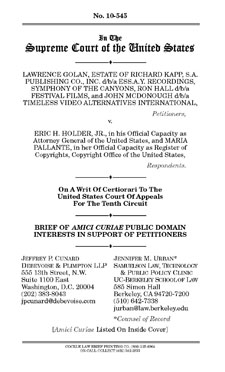 This week CAA filed an amicus brief in the case of Golan v. Holder, which the United States Supreme Court will likely hear later this year. The issue raised in Golan v. Holder is if Congress could, consistent with the First Amendment, remove certain foreign works from the public domain and bring them back into copyright when it enacted the Uruguay Round Agreements Act (URAA) of 1994. A lower court, the US Court of Appeals for the Tenth Circuit, held that the URAA was constitutional. When the Supreme Court agreed to hear the case, Jeffrey P. Cunard, CAA’s counsel, was asked if CAA would join several like-minded organizations and individuals in signing onto a brief that would support the importance of the public domain. The Executive Committee of the CAA Board of Directors considered the importance of the public domain (works no longer in copyright) as a wellspring of resources for artists, scholars, and other creators while discussing the detrimental effect of removing works from the public domain. The committee also noted that a filing by CAA in Golan v. Holder would be consistent with the organization’s filing of an amicus brief in the Supreme Court case of Eldred v. Ashcroft. In that 2003 decision, the court determined that Congress did not violate the First Amendment when it extended the term of copyright through the Sonny Bono Copyright Term Extension Act of 1998. After reviewing drafts of the current brief, the Executive Committee authorized the filing of the Golan v. Holder brief on June 20, 2011. To learn more about Golan v. Holder and the issues at stake, please review the following articles, published online in March and April 2011:
- Lyle Denniston, “A Major Test of Copyright Power,” SCOTUSblog, March 7, 2011
- Edward Lee, “Golan v. Holder: Supreme Court to Review Copyrighting Works in Public Domain,” Huffington Post, March 9, 2011
- Shannon Mo, “Cert. Granted in Golan v. Holder,” Re:Marks, April 1, 2011
The principal author of the brief, Jennifer Urban of the Samuelson Law, Technology, and Public Policy Clinic at the University of California’s School of Law in Berkeley, received assistance from Cunard and his firm, Debevoise & Plimpton LLP. Others signing onto the brief include individual writers, musicians, and scholars as well as other organizations. Cunard extends his thanks to Anne Collins Goodyear, curator at the National Portrait Gallery and CAA vice president for Annual Conference, for providing the excellent example of a visual artist, Marcel Duchamp, using a public-domain work, the Mona Lisa, to create a new one (pp. 14–15). The brief also cites other artists, from Pablo Picasso and Jasper Johns to Banksy and Shepard Fairey. In addition, Cunard has noted the extensive reference to CAA’s involvement in the orphan-works proceeding (pp. 33–35), which helps the brief support the proposition that the URAA’s copyright restoration of many foreign works had exacerbated the orphan-works problem. CAA’s involvement in Golan v. Holder is the latest event in its long history of advocacy efforts regarding freedom of speech and copyright issues. On behalf of all CAA members, the board is grateful to Cunard, one of the nation’s leading experts in copyright law, for the work he has put into the brief and for his continued support of the organization.
Request for Materials for the CAA Archive
posted Jun 23, 2011
In honor of its yearlong Centennial celebration, CAA has initiated a project to collect, catalogue, and make accessible many written, photographic, and electronic documents relating to its past. This effort will complement the history chronicled in The Eye, the Hand, the Mind: 100 Years of the College Art Association, edited by Susan Ball. This summer and fall, CAA plans to post dozens of text-searchable PDFs of CAA News from 1976 to 2001 and full conference programs since the late 1930s, among other publications, on its website.
Particularly in its early years but even in recent times, CAA did not preserve every document that it produced. Materials not collected or saved include: conference programs prior to 1937; catalogues from CAA’s traveling-exhibition program, active from 1929 to 1937; documentation of member surveys; Placement Bureau listings before 1968; and membership brochures, forms, and related materials predating 1990. CAA hopes that members may have copies of these, along with personal photographs and other visual or textual ephemera from meetings and events in decades past.
If you possess materials that might help fill gaps in CAA’s historical archive and are willing to donate or have CAA scan them, send a brief description of the items to Lauren Stark, CAA manager of programs and archivist. Please do not mail anything to the CAA office until she discusses your materials with you.
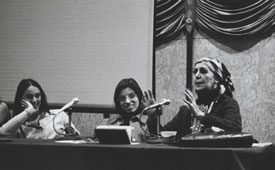
Image: Louise Nevelson addresses the audience at a “rowdy” and “tumultuous” conference session called “Women Artists Speak Out,” while Martha Edelheit (left) and Patricia Mainardi (center) look on. Read about the panel in the Spring 1973 Art Journal (photograph by Nina Howell Starr)
Solo Exhibitions by Artist Members
posted Jun 22, 2011
See when and where CAA members are exhibiting their art, and view images of their work.
Solo Exhibitions by Artist Members is published every two months: in February, April, June, August, October, and December. To learn more about submitting a listing, please follow the instructions on the main Member News page.
June 2011
Abroad

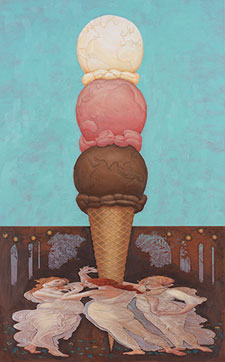 Kent Christensen, Three Graces, 2011, oil on linen, diptych, 58 x 36 in. (artwork © Kent Christensen)
Kent Christensen. Eleven Fine Art, London, England, April 1–May 14, 2011. Sensory Overload. Oil on linen and panel.

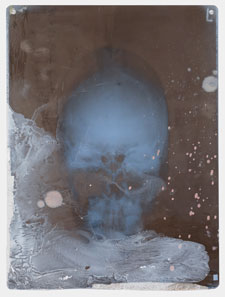 Cora Cohen, R 77, 2011, acrylic, Flashe, and tape on roentgenograph, 15⅝ x 11¾ in. (artwork © Cora Cohen)
Cora Cohen. Field Institute Hombroich, Raketenstation Museum Insel Hombroich, Neuss, Germany, June 7–26, 2011. Cora Cohen – Altered X Rays. Installation of paintings on exposed x-ray film.

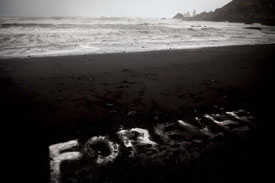 Nicole Pietrantoni, If you take a picture it will last longer, 2011, site-specific installation, white flour and hand-cut stencil, 4 x 28 ft. (artwork © Nicole Pietrantoni)
Nicole Pietrantoni. Icelandic Printmakers’ Association (Íslensk Grafík), Reykjavik, Iceland, May 14–29, 2011. Know Your Place. Mixed media.
Mid-Atlantic

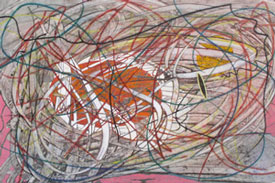 Pat Adams, Coming From II, 2005, oil, acrylic, and isobutyl methacrylate with sand on paper on wood, 14⅝ x 22 in. (artwork © Pat Adams)
Pat Adams. National Association of Women Artists, New York, June 7–29, 2011. Pat Adams. Painting and mixed media.

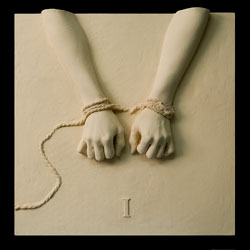 Virginia Maksymowicz, Station I, 2005, Hydrocal FGR 95, 24 x 24 x 6 in. (artwork © Virginia Maksymowicz; photograph by the artist)
Virginia Maksymowicz. Memorial Hall, Basilica of the National Shrine of the Immaculate Conception, Washington, DC, March 9–April 25, 2011. The Stations of the Cross. Sculptural relief.
Midwest

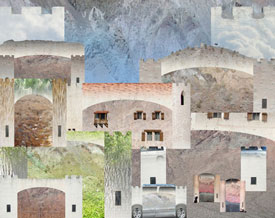 Les Barta, Scotty’s Palette, 2008, computer photoconstruction (artwork © Les Barta)
Les Barta. Galesburg Civic Art Center Gallery, Galesburg, Illinois, May 20–June 18, 2011. Les Barta. Photoconstruction.
Northeast

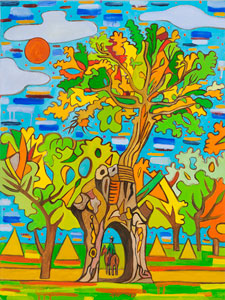 Susan Bee, Autumn Fantasy, 2011, oil on linen, 18 x 14 in. Collection of Leslee Smoke (artwork © Susan Bee)
Susan Bee. A.I.R. Gallery, Brooklyn, New York, May 25–June 19, 2011. Recalculating: New Paintings. Oil on linen.

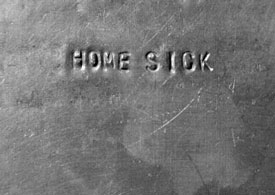 Monica Bock, Home Sick (artwork © Monica Bock)
Monica Bock. SoHo20 Gallery, New York, May 31–June 25, 2011. Home Sick. Sculpture.

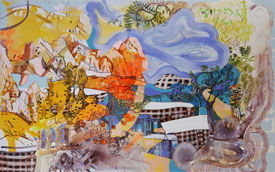 Elisabeth Condon, I’d Like to Try This Perfect Life, 2011, acrylic on linen, 44½ x 72 in. (artwork © Elisabeth Condon)
Elisabeth Condon. Lesley Heller Workspace, New York, April 13–May 15, 2011. Climb the Black Mountain. Acrylic and oil on linen.

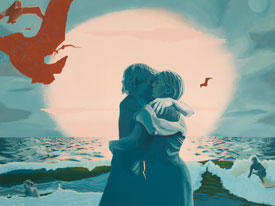 Jen P. Harris, Pacific, 2009, oil on linen, 60 x 80 in. (artwork © Jen P. Harris; photograph by Susan Alzner)
Jen P. Harris. Daniel Cooney Fine Art, New York, June 9–30, 2011. American Kiss. Painting and work on paper.

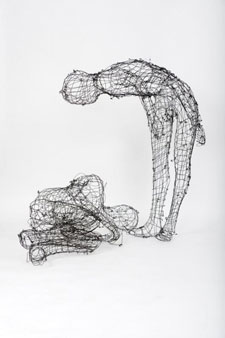 Elizabeth Keithline, Two Figures, wire, 96 x 72 x 24 in. (artwork © Elizabeth Keithline)
Elizabeth Keithline. Danforth Museum, Framingham, Massachusetts, May 4–June 5, 2011. Smarter/Faster/Higher. Wire sculpture.

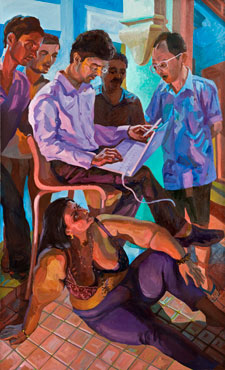 Joan Marie Kelly, Zones of Contact, oil on canvas, 188 x 115 cm (artwork © Joan Marie Kelly)
Joan Marie Kelly. Blue Mountain Gallery, New York, July 12–30, 2011. Zones of Contact: The Public Art of Joan Marie Kelly. Oil on canvas.

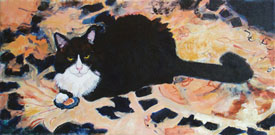 Annie Shaver-Crandell, Colby at Her Ease: Homage to Olympia, 2011, acrylic on canvas, 12 x 24 in. (artwork © Annie Shaver-Crandell)
Annie Shaver-Crandell. Paula Barr Chelsea, New York, May 5–14, 2011. Speaking Likenesses: Portraits of Cats and Dogs. Acrylic on canvas.
South

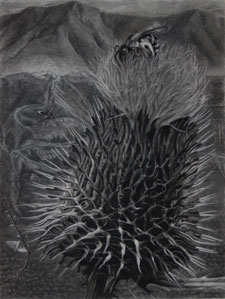 Curtis Bartone, Lode, 2011, charcoal on paper, 40 x 30 in. (artwork © Curtis Bartone)
Curtis Bartone. Telfair Art Museum, Savannah, Georgia, February 4–June 26, 2011. Domain: Drawings, Etchings, and Lithographs by Curtis Bartone. Charcoal on paper, lithography, etching, and aquatint.

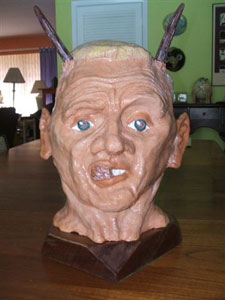 Dennis Joyce, The Steakeater, 2009, ceramic, wood, and steak knives, 16 x 10 x 10 in. (artwork © Dennis Joyce; photograph by the artist)
 Dennis Joyce. B.I.G. (Barrier Island Group) Arts, Sanibel, Florida, April 2–30, 2011. Expressive, Energetic, Explorative Exhibit. Sculpture and painting.

Vesna Pavlović. Gordon Contemporary Artists Project Gallery, Frist Center for the Visual Arts, Nashville, Tennessee, June 24–September 11, 2011. Vesna Pavlović: Projected Histories. Photography.
West

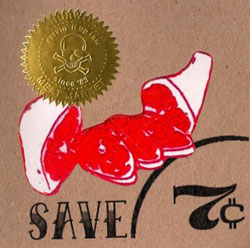 Sarah Hurwitz, invitation card for Hurwitz Meat Market (artwork © Sarah Hurwitz)
Sarah Hurwitz. Eye Lounge, Phoenix, Arizona, May 20–June 11, 2011. Hurwitz Meat Market. Installation.
June Issue of The Art Bulletin Publishes Essays on Bruegel, Guston, Degas, and Fragonard
posted Jun 20, 2011
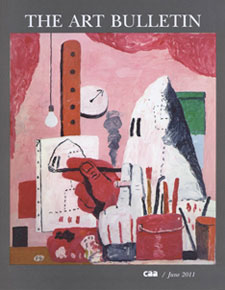 Essays in the June 2011 issue of The Art Bulletin, the leading publication of international art-historical scholarship, examine a range of topics that include works by Pieter Bruegel the Elder, Philip Guston, Edgar Degas, and Jean-Honoré Fragonard. A fifth essay on aesthetics and a collection of important book reviews round out the issue, which has been mailed to all individual CAA members who elect to receive the journal, and to all institutional members. The issue is dedicated to the memory of the late Anne L. Schroder, an expert on eighteenth- and nineteenth-century French art; one of her final essays appears in it.
Leading off the issue is Margaret A. Sullivan’s article that uncovers the beginnings of genre in Bruegel’s debt to stoicism, ancient satire, and the art of Pieter Aertsen. Next, Schroder explores Fragonard’s later career through two revived projects, his illustrations for La Fontaine’s Contes et nouvelles (1788–1809) and his unfinished painting series, the Progress of Love. For “Hegel’s Contested Legacy,” Jason Gaiger reexamines the Hegelian inheritance in art history in light of newly published transcripts of the lectures on aesthetics and, in doing so, raises broader questions about the concourse between art history and philosophy.
Looking at French art in the nineteenth century, André Dombrowski reveals layered political and historical significations embedded in Degas’s Place de la Concorde (ca. 1875), an urban genre portrait of Viscount Lepic and his daughters. For his contribution, Robert Slifkin finds that Guston’s unsettling return to figuration in the 1960s, which partook in a larger “1930s renaissance,” used the disjunction between two moments to comment on the present.
The June 2011 issue includes reviews of two books on humor in Greek vase painting and Roman visual culture, two on Chinese painting, one on medieval Buddhist sculpture, and one on forgery in premodern German art, as well as an exhibition review of Art of Two Germanys/Cold War Cultures, which appeared in Los Angeles, Nuremberg, and Berlin in 2009–10.
Please see the full table of contents for June for more details. The next issue, to be published in September 2011, will feature essays on Roman mosaic floors, an emblematic Michelangelo cartoon for a fresco, portraiture in France after 1789, and the American painter John Sloan.