CAA News Today
Representative Tim Huelskamp from Kansas Offers Amendment to Eliminate NEH Funding
posted by CAA — July 26, 2011
Jessica Jones Irons, executive director of the National Humanities Alliance (NHA), sent the following Humanities Action Alert by email on Monday, July 25, 2011. Founded in 1981, NHA is a nonprofit organization that works to advance national humanities policy in the areas of research, education, preservation, and public programs.
Rep. Tim Huelskamp from Kansas Offers Amendment to Eliminate NEH Funding
Dear Colleague:
This afternoon, the US House of Representatives began debating the Interior, Environment, and Related Agencies spending bill (H.R. 2584). In last week’s action alert, I mentioned that amendments could be offered on the floor that would further reduce funding for the National Endowment for the Humanities beyond the $135 million in FY 2012 funding approved by the Appropriations Committee ($19.7 million, or 13 percent cut from the current year).
Just hours ago, Rep. Tim Huelskamp (R-KS) offered an amendment to reduce funding in the Interior bill by $3 billion in various accounts, including $1.9 billion in EPA spending, as well as complete elimination of the National Endowment for the Humanities and the National Endowment for the Arts (among other programs). The Huelskamp amendment failed by voice vote, but a recorded vote was requested, and is expected to take place tonight.
Even if the current measure fails, additional amendments to weaken funding for NEH may be offered during this week’s floor consideration of the FY12 Interior bill. If you have not already done so, please email your representative and ask him or her to:
- Oppose any amendments to eliminate or further cut NEH funding in the FY12 Interior bill (H.R. 2584)
- Speak on the floor in support of the humanities and the benefits that NEH provides your community
If you would prefer to call the office directly, you can do so through the Capitol Switchboard at 202-224-3121
Earlier today, the Congressional Humanities Caucus Cochairs, Reps. David Price (D-NC) and Tom Petri (R-WI), issued a Dear Colleague letter urging members to oppose the Huelskamp amendment. Reps. Price and Petri are still planning to lead a bipartisan “strike the last word” effort to protect NEH and provide members an opportunity to join their colleagues on the House floor to speak in support of the humanities. The timing of this effort is likely to coincide with the reading of the bill portion that references NEH funding (expected within the next 1–2 days).
Thank you for taking action. We will continue to post updates as new information becomes available.
Sincerely,
Jessica Jones Irons
Executive Director
National Humanities Alliance
Letter to House of Representatives Protesting Further NEA Budget Cuts
posted by CAA — July 25, 2011
The Executive Committee of the Board of Directors approved the addition of CAA’s name to a letter protesting the proposed budget cuts to the National Endowment for the Arts. Thomas L. Birch, legislative counsel for the National Assembly of State Arts Agencies, spearheaded the initiative and sent the missive to the US House of Representatives today.
Letter to US House of Representatives Protesting Further NEA Budget Cuts
July 25, 2011
US House of Representatives
Washington, DC 20515
Dear Representative,
As the FY12 Interior Appropriations bill comes to the floor for consideration by the full House, we write to urge you to prevent further cuts to funding for the National Endowment for the Arts (NEA). The direct federal investment in the artistic capacity of our nation supports thousands of jobs, strengthens communities, improves lifelong learning, and boosts this country’s international competitive advantage.
Every US Congressional district benefits from an NEA grant, leveraging additional support from a diverse range of private sources to combine funding from government, business, foundation, and individual donors. The NEA awarded almost 2,400 grants in those districts in FY10. The NEA has provided strategic leadership and investment in the arts for more than forty years. Americans can now see professional productions and exhibitions of high quality in their own hometowns. Among the proudest accomplishments of the NEA is the growth of arts activity in areas of the nation that were previously underserved or not served at all, especially in rural and inner-city communities.
Nationally, there are 668,267 businesses in the United States involved in the creation or distribution of the arts that employ 2.9 million people including visual artists, performing artists, managers, marketers, technicians, teachers, designers, carpenters, and workers in a wide variety of trades and professions. By direct grants and through allocations to each state, NEA dollars are distributed widely to strengthen the arts infrastructure and ensure broad access to the arts for communities across the country.
The NEA funds school-based and community-based programs that help children and youth acquire knowledge and understanding of, and skills in, the arts. The NEA also supports educational programs for adults, collaborations between state arts agencies and state education agencies, and partnerships between arts institutions and educators.
We understand fully the shared sacrifice that we all must make in order to help get our nation’s fiscal house in order. But funding for the National Endowment for the Arts was already reduced by $12.5 million in FY11, and the FY12 Interior bill currently includes an additional $20 million in funding cuts. We urge you to prevent any further reduction to the investment in our nation’s arts and culture infrastructure when the Interior Appropriations bill is considered on the House floor.
Sincerely,
American Architectural Foundation
American Federation of Musicians
American Music Center
Americans for the Arts
Association of Art Museum Directors
Association of Performing Arts Presenters
Chamber Music America
Chorus America
College Art Association
Dance/USA
Fractured Atlas
League of American Orchestras
Literary Network
Local Learning: The National Network for Folk Arts in Education
National Alliance for Media Arts and Culture
National Alliance for Musical Theatre
National Assembly of State Arts Agencies
National Association of Latino Arts and Culture
National Council for the Traditional Arts
National Performance Network
OPERA America
Performing Arts Alliance
Society for the Arts in Healthcare
Theatre Communications Group
NEH and NEA Face Significantly Reduced Federal Budgets
posted by CAA — July 08, 2011
On July 8, 2011, the US House of Representatives Appropriations Subcommittee on the Interior, which allocates funding for the National Endowment for the Arts (NEA) and the National Endowment for the Humanities (NEH), passed a bill with steep cuts for both federal agencies for fiscal year 2012. Approved by an 8–5 vote, the plan will provide the NEA and NEH with only $135.2 million apiece—a $20 million cut from their current levels and $11 million less than President Barack Obama’s initial request.
The full House Appropriations Committee (click to see names and states), scheduled to consider the bill early next week, is expected to adopt similar funding cuts. If your representative sits on this committee, CAA urges you to ask him or her to oppose these and any cuts to the NEA and NEH. Call the House switchboard at 202-225-3121; an operator can transfer you to the office of your representative.
For more information about advocacy for museums, or to get the names of your representatives in Congress, please visit Speak Up for Museums, a project of the American Association of Museums.
CAA Files Amicus Brief for the Supreme Court Case of Golan v. Holder
posted by Christopher Howard — June 24, 2011
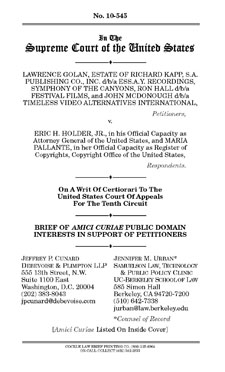 This week CAA filed an amicus brief in the case of Golan v. Holder, which the United States Supreme Court will likely hear later this year. The issue raised in Golan v. Holder is if Congress could, consistent with the First Amendment, remove certain foreign works from the public domain and bring them back into copyright when it enacted the Uruguay Round Agreements Act (URAA) of 1994. A lower court, the US Court of Appeals for the Tenth Circuit, held that the URAA was constitutional. When the Supreme Court agreed to hear the case, Jeffrey P. Cunard, CAA’s counsel, was asked if CAA would join several like-minded organizations and individuals in signing onto a brief that would support the importance of the public domain. The Executive Committee of the CAA Board of Directors considered the importance of the public domain (works no longer in copyright) as a wellspring of resources for artists, scholars, and other creators while discussing the detrimental effect of removing works from the public domain. The committee also noted that a filing by CAA in Golan v. Holder would be consistent with the organization’s filing of an amicus brief in the Supreme Court case of Eldred v. Ashcroft. In that 2003 decision, the court determined that Congress did not violate the First Amendment when it extended the term of copyright through the Sonny Bono Copyright Term Extension Act of 1998. After reviewing drafts of the current brief, the Executive Committee authorized the filing of the Golan v. Holder brief on June 20, 2011. To learn more about Golan v. Holder and the issues at stake, please review the following articles, published online in March and April 2011:
- Lyle Denniston, “A Major Test of Copyright Power,” SCOTUSblog, March 7, 2011
- Edward Lee, “Golan v. Holder: Supreme Court to Review Copyrighting Works in Public Domain,” Huffington Post, March 9, 2011
- Shannon Mo, “Cert. Granted in Golan v. Holder,” Re:Marks, April 1, 2011
The principal author of the brief, Jennifer Urban of the Samuelson Law, Technology, and Public Policy Clinic at the University of California’s School of Law in Berkeley, received assistance from Cunard and his firm, Debevoise & Plimpton LLP. Others signing onto the brief include individual writers, musicians, and scholars as well as other organizations. Cunard extends his thanks to Anne Collins Goodyear, curator at the National Portrait Gallery and CAA vice president for Annual Conference, for providing the excellent example of a visual artist, Marcel Duchamp, using a public-domain work, the Mona Lisa, to create a new one (pp. 14–15). The brief also cites other artists, from Pablo Picasso and Jasper Johns to Banksy and Shepard Fairey. In addition, Cunard has noted the extensive reference to CAA’s involvement in the orphan-works proceeding (pp. 33–35), which helps the brief support the proposition that the URAA’s copyright restoration of many foreign works had exacerbated the orphan-works problem. CAA’s involvement in Golan v. Holder is the latest event in its long history of advocacy efforts regarding freedom of speech and copyright issues. On behalf of all CAA members, the board is grateful to Cunard, one of the nation’s leading experts in copyright law, for the work he has put into the brief and for his continued support of the organization.
2011 Advocacy Days in Washington, DC
posted by Christopher Howard — May 24, 2011
Humanities Advocacy Day took place on March 6–8, 2011, and Arts Advocacy Day on April 4–5, 2011. Five members of the CAA Board of Directors represented CAA: Linda Downs, Barbara Nesin, Judith Thorpe, and Jean Miller, who contribute reports below, and Andrea Kirsh. CAA’s development and marketing manager, Sara Hines, also joined the ranks of attendees, which ranged from seasoned arts administrators, artists, scholars, curators, and educators to young students aspiring to enter these fields.
Humanities Advocacy Day
Linda Downs is CAA executive director and recently became secretary of the National Humanities Alliance board of directors.
On March 8, I represented CAA during Humanities Advocacy Day in Washington, DC. Sponsored by the National Humanities Alliance (NHA), this three-day event gathered advocates from across the country to meet on Capitol Hill to inform their senators and representatives about the importance of the humanities in their districts and to support federal funding for the National Endowment for the Humanities (NEH). Advocates usually don’t meet their representatives directly, but their staffers tally every visit and report on messages sent.
This year, more than two hundred people from colleges, universities, professional associations, and state humanities organizations visited 107 House and Senate offices representing thirty-four states. Participants asked that Congress maintain the NEH’s enacted level of $167.5 million for fiscal year 2010. The strong attendance indicated how important this annual event is and, in particular, that an increasing number of art-minded citizens were highly concerned about the proposed Congressional budget reduction that would eliminate the NEH. With colleagues from the state of New York, I targeted new members of Congress to inform them about the importance of the humanities in their districts.
Preceding Humanities Advocacy Day was the NHA annual meeting, which took place March 6–7 and included advocacy training, a workshop on finding grants, and panel presentations. In his keynote address, David Skorton, president of Cornell University, emphasized the importance of humanities education for cultural understanding and for the security of the United States. During a luncheon, Leslie Berlowitz, president of the American Academy of Arts and Sciences, announced the launch of the Commission on the Humanities and Social Sciences, which will bring together scholars and corporate leaders to propose steps to strengthen the humanities nationally. On one panel, three individuals demonstrated how effective, important, and creative current humanities research is: Ashley Marshall, a postdoctoral fellow at Johns Hopkins University, uses digital statistics to reinterpret eighteenth-century studies; Tara McPherson, associate professor in the School of Cinematic Arts at the University of Southern California, established the Vectors Journal at her school, an online venture that introduces an interactive publishing platform to humanities scholars; and Damon Dozier, director of public affairs at the American Anthropological Association, described the association’s RACE project that explores all aspects of the concept of race and has attracted hundreds of thousands of viewers over the past three years.
The humanities community made a strong impact on Congress this year. At this time of writing (late April 2011), the NEH remains in the Congressional budget, albeit at a reduced amount.
Arts Advocacy Day
Barbara Nesin is an artist, a professor and department chair of art foundations at the Art Institute of Atlanta in Georgia, and the president of the CAA Board of Directors.
Sponsored by Americans for the Arts, Arts Advocacy Day offered a full day of training followed by a second day of meeting Congressional representatives on Capitol Hill with the aim of preserving federal funding for the arts during an especially challenging economic period. During my first time attending the event, I learned how to speak about not just the intrinsic value of the arts, but also their real economic value in this country and the importance of the arts in education. In training sessions hosted by Americans for the Arts, my colleagues and I were given the voting history and committee work of our representatives and, when in conversation with them later, were told to highlight how the arts function as a business magnet, create jobs and tax revenue, attract tourism, and foster the country’s creative advantage internationally. We didn’t neglect education, as the arts strengthen academic performance in a variety of disciplines, such as science, technology, English, and math, and contribute to an innovative, competitive workforce.
This year, advocates had to prepare a unified message that was pertinent to current budget and political realities. Furthermore, those of us who wear more than one hat—for me, being a CAA board member, a professor and administrator, and a resident of Georgia—needed to understand the context of each position in relation to the overall mission for the day. We had to make a strong case to save the NEA’s budget for fiscal year 2012 and to maintain $40 million appropriated for the Department of Education’s Arts in Education programs and grants.
Americans for the Arts provided me with a wealth of information about pressing state issues, identifying key politicians with critical influence and importantly emphasizing that now is not the time to point out disparities in federal support between, for example, the visual and performing arts. What was the right approach? A consistent, nonpartisan message supported by facts and real-life examples, practical solutions, and a convincing, definite ask.
Before coming to DC, I had consulted my home institution’s public-relations department to determine appropriate topics and strategies. I also reviewed issues close to CAA’s heart, ready to share information about tax reform in the arts: preserving incentives for charitable giving, extending the IRA Charitable Rollover, and rejecting attempts to create a hierarchy for deductions to nonprofits that discriminates against the arts. I also wanted to ask for support for the Artist–Museum Partnership Act—something CAA has advocated for many years—which would allow artists to deduct from their federal income tax the fair-market-value of works of art donated to and retained by nonprofit institutions. (Currently artists can only deduct the cost of their materials used to make the work). Improving the visa process for foreign guest artists was also on my list of topics.
Even though representatives from Georgia raced to attend emergency meetings regarding the difficult budget negotiations that threatened to close down the government that very week, my group managed to meet several of them and speak to the staff of others. In some cases, staffers invited us to leave informational materials provided by Americans for the Arts, which outline major funding issues and, through maps and statistics, pinpointed concentrations of arts-related business in each representative’s district—with actual dollar amounts.
Since my school has already cultivated excellent relationships with several Congressional leaders in my state, I built on that firm groundwork by sharing a sincere “thank you” for the specific ways in which each had already supported the arts, regardless of his party or voting record. These representatives—whether recognized friends of the arts or not—responded supremely to people from their own district, whether by residence or place of employment. On that local turf, there was not one who had not made some effort to demonstrate their concern for arts education and some type of arts programming to their own community. From that point, conversations went one of two ways.
To those who had previously opposed arts funding, I emphasized the significance of the arts to economic development—that is to say, I talked jobs, jobs, jobs. Armed with hard figures that proved how the arts generate substantial employment and investment in specific districts and nationally, I made the case that opposing arts funding puts many people out of work and damages local economies that depend on the arts to attract employers and business activity. Keep in mind that even a single arts event generates not only sales of tickets or art objects, but also uses numerous surrounding services and accommodations, including printers, web designers, restaurants, and hotels. These are not insignificant dollars, and no politician wants to be viewed by constituents as opposing much-needed, economically healthy free enterprise. In addition, staunch supporters of cutting taxes listened with interest when my group spoke about implementing tax benefits that would have a real impact on estates and museum collections. If such representatives were at all concerned about swing votes in their district, it would not cost much in real dollars for them to support some form of arts funding. Even a slight increase would have a dramatic and highly visible effect—something investors might call an attractive “rate of return.”
In the offices of strong supporters of the arts is where I successfully addressed other issues that CAA has been working on. Staffers in Representative John Lewis’s office told me that orphan works was not on their radar before but will be now, promising to research the subject and bring it to Lewis’s attention. Finally, we offered ourselves as resources to these elected officials and asked them for advice on what we could do to assist them.
I was gratified to see a good number of graduate students among the five hundred plus attending Arts Advocacy Day. As a CAA member and an art educator, I was keenly interested in what students had to say, especially when speaking from their personal experience. One young woman finishing her master’s in arts administration made an impassioned plea for assurance of jobs when she graduates. When I described CAA to them, several students in programs of social policy and arts administration were excited about becoming actively involved in the organization, particularly in the area of advocacy. CAA needs to continue building these connections.
As the largest organization for the visual arts in the country, CAA has significant membership numbers—more than 12,000 individuals and 1,800 institutions—that amplify considerably when counting those who belong to the affiliated societies, making us a potentially powerful voice. Congress listens to voting constituents. Although CAA doesn’t vote, it does represent an exponential body of voters. If we want the visual arts better represented on a national level, CAA is an ideal body to do so year round.
This year’s was a success: participants helped preserve federal funding for the arts in large measure, with much smaller cuts than originally proposed, and saw first-hand our full potential reach and influence. I encourage as many members as possible to attend future Arts Advocacy Days.
Arts Advocacy Day
Judith Thorpe is an artist, professor of photography, and head of the Department of Art and Art History at the University of Connecticut in Storrs. She is also a member of the CAA Board of Directors.
Two years ago, riding on the recent election of Barack Obama and the promise of increased funding for the arts and humanities, participants in Arts and Humanities Advocacy Days felt vibrancy and excitement in the air. The atmosphere in Congressional offices during Arts Advocacy Day in 2011 contrasted with that optimism tremendously. Facing budget and partisanship battles daily, federal legislators threatened once again to not just reduce but extinguish all NEA initiatives and Department of Education programs for Arts in Education. In the end, Congress did not axe the endowment as feared and returned $25 million to Arts in Education for fiscal year 2012. Truth be told, these amounts are so small that their impact on the national budget is negligible. These annual skirmishes, however, continue to reflect the raging ideological battles regarding the arts in this country.
Events of a week in which Congress canceled appropriations hearings and a budget stalemate nearly closed down the federal government subdued advocacy meetings with senators, representatives, and their aides. My group from Connecticut found it difficult to advocate more than flat funding for the NEA, but we asked the offices of Senators Joseph Lieberman and Richard Blumenthal and Representatives Rosa L. DeLauro, John Larson, Joe Courtney, Jim Himes, and Chris Murphy to renew their commitment to the arts and to join or continue serving on the Congressional Art Caucus and the Senate Cultural Caucus.
In order to benefit the arts and humanities—and the interests of CAA in particular—we must develop a means to send advocates to meet specifically with key members of Congress during the annual Arts, Humanities, and Museums Advocacy Days. CAA’s vast number of professionals in academia, museums, and elsewhere should be heard in a focused manner, and members of the CAA Board of Directors may need to get more involved in organizing participation in the three national advocacy days.
Attending this year sharpened my awareness of how members of Congress perceive the role of the arts differently in this country. That said, I was heartened to see bipartisan support for the arts and encouraged to advocate continued and greater support for the arts. It was quite a civics class!
Arts Advocacy Day
A member of the CAA Board of Directors, Jean Miller is associate dean of administrative affairs of the College of Visual Arts and Design at the University of North Texas in Denton. She also oversees her school’s Design Research Center in Dallas.
I became acquainted with Americans for the Arts and attended Arts Advocacy Day for the first time in 2009 as a representative of CAA’s Professional Practices Committee and a resident of the state of Maryland. This year, I represented CAA as a board member and cochair of the International Council of Fine Arts Deans (ICFAD) Advocacy Task Force. Now a Texas resident, I also made efforts to cultivate a relationship with members of Texans for the Arts.
Although Arts Advocacy Day has a similar structure and comparable messages from year to year, the underlying sense of urgency during the 2011 proceedings made it markedly different from those of 2009. This was due in part to the possibility of the government shutting down during the budget talks. All advocates intensely felt the charged atmosphere during the Americans for the Arts–sponsored Congressional Arts Breakfast and later on Capitol Hill when meeting representatives and their staff.
Like my colleagues above, I was impressed by the record attendance of over five hundred advocates from around the country, gathering to communicate a consistent message about the value of art and culture in our lives to Congress. Actors Kevin Spacey and Alec Baldwin and several other celebrities joined attendees over the course of the two days to lend their voices in support of the arts and artists. As they spoke candidly about their mentors and career opportunities, these individuals served as great moral support and inspired us to strategize together to position the arts better in the national budget conversation.
To help frame discussions with legislators and their staff, advocacy leaders urged us to take a practical, bipartisan approach to all conversations. At the same time, they also encouraged us to send a clear, strong, and persistent message to Congress about sustaining NEA funding—not increasing it as we had asked in the past—and to share stories about how the NEA has had a strong impact on our communities and states.
Were we successful? I believe that yes, as a committed group of arts professionals and students, we took the time to study current issues, applied an advocacy framework to discuss important points, and stood up as citizens to increase visibility for the arts locally and nationally. Was it enough? Unfortunately no. What else could CAA do as an organization? Perhaps we can strengthen ties with its affiliated societies, which in sum represent over 300,000 people, and use a large collective voice in support of advocacy efforts. With the affiliates, CAA can design strategies to reach the political leaders who are in positions of making the tough budget decisions. With many CAA staff and board members involved in strengthening connections to affiliated societies and working on advocacy and outreach, I think this is entirely possible.
CAA Advocacy for Artists, Art Historians, and Art Museums
posted by Christopher Howard — May 23, 2011
CAA is the principal national and international voice of the academic and professional community in the visual arts; the organization was founded on the principle of advocating the visual arts and actively continues that engagement today (see The Eye, The Hand, The Mind: 100 Years of the College Art Association, edited by Susan Ball). The principal goal of CAA advocacy is to address issues of critical importance in the visual arts that benefit artists, art historians, and museum workers and to inform the public.
CAA specifically advocates change and improvements in these areas:
- Government funding for the arts and humanities
- Freedom of expression and against censorship
- Intellectual-property rights
- Preservation of the artistic integrity of public spaces
- Higher education and technologies to facilitate distance learning
- Philanthropy for the arts and humanities
- Tax policy as it applies to CAA members
- Conditions in universities, museums, and other workplace environments of CAA members
CAA cosponsors and regularly sends representatives to the annual Arts, Humanities, and Museum Advocacy Days in Washington, DC. Email petitions are requested of CAA members throughout the year when legislation is being considered in Congress related to specific issues. This year’s advocacy message to Capitol Hill focused on maintaining the funding levels of the National Endowment for the Arts and the National Endowment for the Humanities.
Recent issues related to freedom of expression and censorship on which CAA has taken a public position include:
- Incarceration of the Chinese artist Ai Weiwei
- Removal of David Wojnarowicz’s video from the Hide/Seek exhibition at the National Portrait Gallery
- Proposed removal of the John T. Biggers mural at Texas Southern University
- Removal of the Department of Labor mural in Augusta, Maine
- Adrian Piper’s placement on the Transportation Security Administration Watch List
- Supreme Court amicus brief in support of petition for review regarding artists whose vehicular artwork was removed by the City of San Marcos, Texas
- Supreme Court amicus brief asserting the unconstitutionality of a federal law criminalizing the depiction of animal cruelty in United States v. Stevens
In addition, CAA has been involved in intellectual-property rights, as described below.
Orphan Works
CAA participated actively in US Copyright Office proceedings to study orphan works and, thereafter, actively supported legislation—yet to be passed by Congress—that would require users to conduct work-by-work, due-diligence searches to identify and find the copyright holder. If that search failed to identify or find the copyright holder, the work could be used without the threat of injunctive relief or statutory damages. If the copyright holder emerges after the work has been researched and used, he or she could still sue the user for copyright infringement, but a losing defendant would only be required to pay the normal license fee; the proposed legislation includes a safe harbor for museums that removed works expeditiously. It is unclear if any orphan-works legislation will be reintroduced in this or subsequent Congresses. After the March 2011 decision of Judge Denny Chin of the US Court of Appeals Second Circuit rejecting the settlement of the Google Books litigation, CAA’s counsel was approached by Public Knowledge (“a D.C. public interest group working to defend citizen’s rights in the emerging digital culture”) asking if CAA remained interested in orphan-works legislation and, if so, to sign a letter to Congress requesting that orphan-works legislation be reintroduced.
Cost for Reproducing Images of Artwork in Museum Collections
In recent member surveys, one of the most critical issues articulated was the high cost of reproduction rights of works in museum collections that are not under copyright. CAA has requested formal attention to this issue from the Association of Art Museum Directors.
Fair Use
CAA’s Committee on Intellectual Property, chaired by Doralyn Pines and Christine Sundt, is reviewing and proposing revisions to the Intellectual Property in the Arts section of the CAA website. The committee will also review a draft set of fair-use guidelines being prepared by the Art Law Committee of the New York Bar Association and the Visual Resources Association; after such review, the CAA Board of Directors may be asked to endorse the updated guidelines.
Extension of Copyright Term
CAA signed a Supreme Court amicus brief regarding the retroactive application of the extension of copyright term in Eldred v. Ashcroft. The Copyright Term Extension Act of 1998 was challenged with the original complaint filed on January 11, 1999. CAA was an amicus when the case was brought to the Supreme Court, which held on January 15, 2003, that the Copyright Term Extension Act of 1998 was constitutional (see the March 2003 CAA News).
Artist-Museum Partnership Act
CAA actively supports the Artist-Museum Partnership Act, which establishes fair-market-value tax deductions for works given by artists instead of the current limitation to cost of materials. Information on the progress of the Artist-Museum Partnership Act is published in the weekly CAA News email, posted in the Advocacy section of the website, and communicated to the Services to Artists Committee. If and when a bill is subject to a vote in Congress, CAA will urge all members, affiliated societies, and committees to contact their representatives.
Coalition on the Academic Workforce
CAA is a member of the Coalition on the Academic Workforce, which recently prepared a survey of contingent faculty. Over 30,000 individuals completed the questionnaire—many were CAA members—and the results will be tabulated this spring. Information on all aspect of working conditions is included in this survey and will assist in informing future standards and practices. CAA’s Professional Practices Committee and Education Committee are kept informed of the survey and its tabulation and will analyze the results and determine action to take that will benefit CAA members. Contingent faculty is currently responsible for 76 percent of teachers in American colleges and universities. CAA supports equitable hiring, representation, and benefits for this growing segment of the faculty.
How It Works
How does advocacy work at CAA? CAA both monitors advocacy issues and is approached by universities, colleges, organizations, and individuals who raise issues via CAA’s counsel, officers and members of the board, executive director, deputy director, affiliated societies, or other partner organizations such as the National Coalition Against Censorship, the Association of Art Museum Directors, or the associations of the American Council of Learned Societies. If an issue warrants action and is consistent with the advocacy policy, CAA will prepare a response. Depending on the importance and complexity of the issue, CAA will prepare an email, letter of support, or statement; cosign a letter with other organizations; or, in exceptional circumstances when legal action is required, prepare an amicus brief or support proposed legislation. All advocacy issues brought to CAA’s attention are reviewed by the counsel and the executive director. Consistent with the organization’s Advocacy Policy, the Executive Committee and, if necessary, partner organizations also review the issues. Important matters where legal action is involved will be brought to the board.
At the February 2011 board meeting, Andrea Kirsh, then vice president for external affairs, volunteered to work as CAA’s advocacy coordinator. She has since actively assisted in carrying out research and drafting letters and statements. CAA members who would like to be informed of the organization’s advocacy efforts—and spread the word—can send an email to nyoffice@collegeart.org.
Letter to Art Schools and Departments about Orphan Works
posted by Christopher Howard — May 18, 2011
During summer 2010, Linda Downs, CAA executive director, and Andrea Kirsh, then vice president of external affairs, visited more than a dozen deans and chairs of art and art-history departments in New York and Philadelphia to better understand the needs of their students and faculty. One topic that arose among studio artists was CAA’s stance on orphan works, which some perceived as not protecting artists. Downs explained that CAA was indeed aware of balancing the interests of artists and art historians. Following this, the Board of Directors thought that all studio departments should understand CAA’s position and has thus sent the following letter to them.
Dear Colleagues
This letter is intended to address concerns about CAA’s advocacy on behalf of orphan-works legislation. An orphan work is any copyrighted work—book or other text, picture, music, recording, film, etc.—for which the copyright owner cannot be identified or located. Everyone recognizes that there is an orphan-works problem. The inability to clear rights for orphan works often precludes their use, by scholars, publishers, students, and creators. The US Copyright Office documented the considerable extent of this problem, and the CAA submitted comments to the Copyright Office describing the adverse effect of the orphan-works problem on artistic creation and scholarship.
The Copyright Office recommended legislation that would amend copyright law to allow orphan works to be used without an undue risk of suit to the user—of statutory damages or an injunction—assuming that the user conducted a diligent search for the copyright owner and properly attributed the work as an orphan work. That has been the basis of the legislative proposal seriously considered by Congress. CAA has only supported those proposals which are appropriately balanced. Should the copyright owner pursue and prevail in an action for infringement against a user, the legislation requires appropriate compensation for use of the work.
In advocating for orphan-works legislation, CAA has taken full account of the concerns of artists, designers, and photographers that such legislation, if enacted, would allow bad-actor copyright infringers to avoid statutory damages or injunctive relief.
The legislation supported by CAA would require users to conduct diligent searches, with the parameters of such a search elaborated in the legislation itself, to identify and locate copyright owners as a precondition of having such works become eligible for orphan-works treatment. The last legislative proposals, supported by CAA, are detailed and meaningful, but they also are not inappropriately or unduly burdensome. They include searches of Copyright Office records and the use of other appropriate databases and other resources. In any litigation, the burden would be placed on the users to demonstrate that their searches complied with the requirements of the law.
CAA is aware of fears that artists whose works cannot easily be signed, or have other identifying information attached to them, that are “born orphan” because they never are associated with identifying information, or that can easily be stripped of identifying information and be made available on the internet, are or might readily become orphaned. Concerns have been expressed that such works could be used unfairly and unscrupulously, without appropriate compensation and attribution. Other concerns have been raised that users might prefer to use works that appear to be orphaned (and avoid having to pay for them) in lieu of engaging creative artists to create new works.
CAA is not unmindful of these concerns. CAA encourages artists to consider the advantages of registering their works with the US Copyright Office (www.copyright.gov/eco/). A diligent search under orphan-works legislation would include the office’s records.
For CAA’s statement on orphan works, please refer to www.collegeart.org/publications/ow. If you have further concerns about the implications of orphan-works legislation, we would be happy to discuss them.
Sincerely,

Barbara Nesin, MFA
President, College Art Association
Humanities Action Alert: Update on House and Senate Dear Colleague Letters
posted by CAA — April 15, 2011
Jessica Jones Irons, executive director of the National Humanities Alliance (NHA), emailed the following Humanities Action Alert on April 15, 2011. Founded in 1981, NHA is a nonprofit organization that works to advance national humanities policy in the areas of research, education, preservation, and public programs.
House and Senate Dear Colleague Letters
As you know, Congress just passed a final, compromise bill on funding for the current fiscal year (FY 2011). Along with cuts to most federal agencies and accounts, there are significant reductions in spending for critical humanities programs. NEH funding was cut by approximately $12.5 million (7.5%), with a final level for FY 2011 of $154.69 million (including a .2% across-the-board rescission). Far more drastic cuts were made to two critical Department of Education accounts: Title VI/Fulbright Hays International Education Programs (cut by $50 million—about 40%), and Teaching American History grants (cut by $73 million—about 61%). We will continue to post updates to the NHA website on efforts to restore funding to these and other programs.
In the meantime, ongoing advocacy efforts for FY 2012 humanities funding continue. Last Friday we let you know about two Dear Colleague letters circulating in the House and Senate in support of the humanities. If you have not done so already, please take a few minutes to contact your Members of Congress and ask them to sign the NEH dear colleague.
The deadline for Representatives to indicate their interest in signing the House letter, sponsored by Rep. David Price (D-NC), is today (April 15). The deadline for Senators to sign the Senate letter, sponsored by Senator Tom Udall (D-NM), is April 25.
The Alliance has set up template messages for you to customize. Click here to send a message to your Representative. Click here to send a message to your Senators. If you would prefer to call the offices directly, you can do so through the Capitol Switchboard at (202) 224-3121.
Updated lists of signers are available here.
Sincerely,
Jessica Irons
Executive Director
National Humanities Alliance
Ask Your Congressional Representatives to Sign a Dear Colleague Letter Supporting the NEH
posted by CAA — April 11, 2011
Jessica Jones Irons, executive director of the National Humanities Alliance (NHA), emailed the following Humanities Action Alert on April 8, 2011. Founded in 1981, NHA is a nonprofit organization that works to advance national humanities policy in the areas of research, education, preservation, and public programs.
House and Senate Dear Colleague Letters
Please help support the humanities by taking a few minutes to write your Members of Congress and ask them to sign a Dear Colleague letter regarding FY 2012 funding for the National Endowment for the Humanities. As you may know, President Obama’s FY 2012 Budget proposes $146.3 million in funding for NEH—more than $21 million in cuts to the agency. Although funding for FY 2011 (the current fiscal year) still remains uncertain today, the FY 2012 appropriations process is in full swing, and we must continue our advocacy efforts for the next fiscal year.
House Dear Colleague Letter
Representative David Price (D-NC) is currently circulating a Dear Colleague letter in support of the National Endowment for the Humanities (NEH). The letter, addressed to the Chair and Ranking Member of the House Appropriations Subcommittee, requests $167.5 million in FY 2012 funding for the NEH. This is the same level of funding the agency received in FY 2010. A copy of the letter is available here. Please ask your Representative to sign on to this letter. Click here to send an email today. The Alliance has set up a template message for you to customize for your Representative.
Senate Dear Colleague Letter
Senator Tom Udall (D-NM) is currently circulating a Dear Colleague letter in support of the National Endowment for the Humanities (NEH) and the National Endowment for the Arts (NEA). The letter, addressed to leaders on the Senate Appropriations Committee and Subcommittee, requests $167.5 million in FY 2012 funding for the NEH and the NEA. This is the same level of funding both agencies received in FY 2010. A copy of the letter is available here. Please ask your Senators to sign on to this letter. Click here to send an email today. The Alliance has set up a template message for you to customize for your Senators.
Thank you for your assistance on this important issue. The signatures on these letters will provide an important record of support for federal humanities funding in both the House and the Senate.
Sincerely,
Jessica Jones Irons
Executive Director
National Humanities Alliance
CAA Letter Regarding the Chinese Artist Ai Weiwei
posted by Christopher Howard — April 08, 2011
CAA sent the following letter regarding the Chinese artist Ai Weiwei to the editor of the New York Times on Friday, April 8, 2011. Read more about the international art community’s response at CultureGrrl.
Letter to the Editor
To the Editor:
The College Art Association, the world’s largest organization of visual arts professionals, is extremely concerned about the fate of Ai Weiwei since he was taken into police custody when attempting to board a plane to Hong Kong on April 3rd. He has not been accused of specific crimes.
We are deeply alarmed that Ai would be subject to such extreme methods of repression because of his unfettered work and outspokenness. Ai’s work has garnered international accolades, recognized as an indication of the vitality of the visual arts in China. He is well known in art circles in New York, where he lived for a number of years, and his choice to return to Beijing was seen as part of the renewal of the arts in China.
The College Art Association supports freedom of expression for all artists and looks forward to Ai’s prompt release.
Sincerely,
Barbara Nesin, MFA
President, College Art Association