CAA News Today
Annual Conference Committee Seeks Members
posted by CAA — March 11, 2016
CAA invites nominations and self-nominations for at-large members of the Annual Conference Committee to serve a three-year term, beginning on May 1, 2016. We welcome all members to participation in the nomination process. Working with the Programs Department staff, this committee selects the sessions and shapes the program of the Annual Conference. The committee ensures that the program will reflect the goals of the association and of the Annual Conference, namely, to make the conference an effective place for intellectual, aesthetic, and professional learning and exchange, and to provide opportunities for participation that are fair, equal, and balanced.
The Annual Conference Committee meets at least two times a year at the call of the vice president for Annual Conference and the committee’s chair. Members must be available throughout May and June to review and select 2017 conference content from the submitted proposals. Please send a 150-word letter of interest and a CV to Katie Apsey, CAA manager of programs. Deadline: April 15, 2016.
Committee on Women in the Arts Picks for March 2016
posted by CAA — March 10, 2016
Each month, CAA’s Committee on Women in the Arts selects the best in feminist art and scholarship. The following exhibitions and events should not be missed. Check the archive of CWA Picks at the bottom of the page, as several museum and gallery shows listed in previous months may still be on view or touring.
March 2016
Lise Haller Baggesen: Mothernism
Contemporary Art Museum for Austin
Laguna Gloria, 3809 West 35th Street, Austin, TX
February 13–Mary 22, 2016
The Gatehouse Gallery at the Betty and Edward Marcus Sculpture Park at Laguna Gloria presents Mothernism by Lise Haller Baggesen, a large-scale installation with a “nod to the bright pop of midcentury Danish interior designer Verner Panton as well as snoezelenrooms, a Dutch therapy technique from the 1970s.” The bright, cozy interior, with disco balls and plush purple carpet, regularly calls back visions from disco culture.
Baggesen describes the work as “a nomadic tent camp audio installation … dedicated to staking out and making speakable the ‘mother-shaped hole in contemporary art discourse.’” Published as a book in 2014, the installation previously came to life an audio-visual presentation in which Baggesen read essays as her alter ego, Queen Leeba, “an amalgam of Donna Summer and a proto-feminist, Scandinavian love goddess.” In this iteration, Mothernism is more like entering a painting, “inviting the viewer into her painting-as-installation, a figure/ground relationship so upended as to become participatory, or relational.”
The exhibition in Austin also contains newly commissioned work, The Mothernist’s Audio Guide to Laguna Gloria, celebrating the history of the Driscoll Villa at Laguna Gloria and the original designer and owner, Clara Driscoll, all through Baggesen’s artistic style, incorporating her knowledge of art history, pop culture, politics, and music.
Tip of Her Tongue: Xandra Ibarra: Nude Laughing, Cassils: The Powers That Be, Shirin Neshat: Possessed
The Broad
221 South Grand Avenue, Los Angeles, CA
April 2, 2016
8:30 PM
Downtown Los Angeles’s new art venue, the Broad, features Tip of Her Tongue, a three-part exhibition by the feminist artists Shirin Neshat, Xandra Ibarra, and Cassils, focusing on language and embodiment. Curated by Jennifer Doyle, professor of English at the University of California, Riverside, and a member of Human Resources Los Angeles, a collectively run art space dedicated to supporting performance and interdisciplinary modes of expression, the program contains a thirteen-minute video, Possessed (2001) by Neshat, and two live performances, Nude Laughing by Ibarra and The Powers That Be by Cassils.
Neshat’s video presents a woman roaming the streets of an Iranian city without her cador. The woman, played by Shohreh Aghdashloo, is ignored until she takes a public platform, where her “private suffering becomes public and political.” In Nude Laughing by Ibarra, the Oakland-based artist’s “engages the skin and skein of race.” Drawing inspiration from John Currin’s painting Laughing Nude, Ibarra herself is nude and encased in a nylon skin cocoon along with “white lady accoutrements … negotiating the simultaneous joys and pains of subjections, abjection, and personhood.” Rounding out the performances, the national premiere of The Powers That Be by Cassils is a collaborative effort with the fight choreographer Mark Steger. In the two-person fight, Cassils is left to spar alone with an invisible force. The performance will be lit by car headlights and performed in the Broad’s parking garage to a score by Kadet Kuhne, played across car stereos.
Tickets to the performances can be purchased on the Broad’s website.
Lecture: Julia Bryan-Wilson on Ruth Asawa and Louise Bourgeois
Berkeley Art Museum and Pacific Film Archive
2155 Center Street, Berkeley, CA
April 1, 2016
12:15 PM
Julia Bryan-Wilson, associate professor of modern and contemporary art at the University of California, Berkeley, and the author of the forthcoming book Art in the Making: From the Studio to Crowdsourcing (with Glenn Adamson), will present a lunchtime talk on Ruth Asawa and Louis Bourgeois, two artists currently on exhibition in Architecture of Life at the Berkeley Art Museum and Pacific Film Archive. Bryan-Wilson’s research interests include feminist and queer art, textile handicraft, and questions of materiality—all germane to different aspects of Asawa’s and Bourgeois’s work.
Architecture of Life, on view through May 29, is the inaugural exhibition in the museum’s new building. “It explores the ways that architecture—as concept, metaphor, and practice—illuminates various aspects of life experience: the nature of the self and psyche, the fundamental structures of reality, and the power of the imagination to reshape our world.” The exhibition has over two hundred works of art in various media, including scientific illustrations and architectural drawings.
Nancy Friedemann-Sánchez: Travelers and Settlers
Museum of Nebraska Art
2401 Central Avenue, Kearney, NE
January 9–April 3, 2016
The Museum of Nebraska Art presents Travelers and Settlers, a solo exhibition by the Colombian-born artist Nancy Friedemann-Sánchez. Curated by Teliza Rodriguez, this engaging and introspective installation is the artist’s exploration of the experience of identity, memory, and gender.
Friedemann-Sánchez’s installation comprises paintings, sculptures, and objects—a mixed-media environment inhabited by family heirlooms alongside carved wooden boats and black mirrorlike panels that hold pearled sconces. Here the artist creates a visual novel narrated in different voices interweaved through a synchronicity of dialogues, passages, punctuations, and silences about hybrid culture and ownership, narratives that portray spiritual and physical transit.
In her project statement the artistwrites, “Anchored in feminism, my art is infused by American and Colombian cultural forms that are dominant or subordinate.” Born in Colombia and having immigrated to the United States as a grown-up, she developed her bilingual art naturally. Travelers and Settlers unfolds in this way: her multinarrative on cultural memory, migration, and the pursuit of the American dream, a bicultural and transcultural experience speaks of difference and opposites.
As Robert Mahoney states in his extensive essay about Friedemann-Sánchez’s project: “As a whole, Travelers & Settlers read as an elegiac litany to sacred space reclaimed from the pushes and pulls of modern history, with the artist acting as guider of souls, urging us to gain a deeper appreciation of the unspoken realities of cultural translation, and, beyond all that, arrive safely again at our common humanity.”
Dafna Maimon: Modern Lives
Lilith Performance Studio
Bragegatan 15, Malmö, Sweden
March 10–12 and 17–19, 2016
Lilith Performance Studio in Malmö presents Modern Lives, a new performance by the Finnish/Israeli artist Dafna Maimon (b. 1982), who lives and works in Berlin. Her work, which includes performance, short film, video, texts, and sculpture, explores and engages with human narratives that challenge stereotypical constructions. Questioning the unclear limits of identity, the self, and the body, her performances expose the economy of affect-based ties, community, and collaboration on a grassroots level.
Modern Lives draws its starting point from the life of Ulrica Maimon, the artist’s mother, who created an alter ego for herself in the early 2000s: Mrs. Gyllendaal Af Berntas. Mrs. Gyllendaal, a 1860s goldsmith’s widow moved into Maimon’s apartment, which has been furnished in the corresponding period style. Throughout the years, Gyllendaal’s biography developed, along with her wardrobe and everyday tasks, inviting family and friends to participate in the roleplay.
For Modern Lives at Lilith Performance Studio, Maimon has built up a full-sized domestic arena for the widow. This performative space becomes a construction site where the “self” can be seen as a multilayered entity, an emotional landscape in motion, a surreal and melancholic world in which its inhabitants echo themselves as prisoners of their own condition. Throughout this piece, the artist fuses her mother’s playful inner fantasies with her own absurdist expression, choreographing and representing several different bodies as one.
Modern Lives is presented as an ongoing a repetitive structure during which audience members are encouraged to visit and stay for as long as they wish.
Maud Sulter: Syrcas
Autograph ABP
Rivington Place, London, EC2A 3BA
January 15–April 2, 2016
Autograph ABP proudly presents Syrcas,an installation of sixteen original photomontages, curated by Mark Sealy, of a seminal body of work created by Maud Sulter (1960–2008). Born in Glasgow of Scots and Ghanaian descent, Sulter was an active feminist in London communities in the early 1980s. She had worked with a women’s education group to program Check It, a groundbreaking two-week show at the Drill Hall that showcased black women’s creativity. Along her influential practice, Sulter continuously explored the presence of Africa in Europe in a variety of media: text, photography, sound, and performance. Her work as artist, writer, and curator questions the lack of representation of black women in the histories of art and photography and critically investigates the complex experiences of the African diaspora in European history and culture over the past six hundred years.
Created during the early 1990s, Syrcas is Sulter’s most intricate and layered body of work. Through the technique of photomontage, this series aims to revive the forgotten history of the genocide of black Europeans during the Holocaust. The installation includes a reproduction of Sulter’s poem “Blood Money.” Written in 1994, the poem was inspired by the German photographer August Sanders’s series of images of Circus Workers (1926–32) and represents a tormenting tale of a young African woman and her family caught up in war, dealing with the constant threat of discrimination, violence, and persecution.
CAA at 2016 The Armory Show
posted by CAA — March 10, 2016
 Last week marked The Armory Show’s annual takeover of New York City, bringing galleries and artists from all over the globe to Piers 92 and 94 on the banks of the Hudson River from March 3 to 6. Packed with exhibitors, artworks, and art enthusiasts, The Amory Show offered extensive visual offerings, alongside special projects and programming. CAA staff visited The Armory, taking in many of the noteworthy displays and activities on site.
An interactive installation hosted by Artsy stood at the entrance to The Armory. The booth was covered by the artist Douglas Coupland’s Slogans for the 21st Century, which also adorned tote bags distributed to visitors. Statements such as “I miss my pre-internet brain,” “You and your selfie are merging,” and “I can feel the money leaving my body” offered wry commentary on the intersection of art, commerce, and technology at a site where these issues merged in a particularly potent way.
Also at the Artsy booth was Deep Face: Comunicate with your future self, a photo booth that created “de-recognition” portraits of visitors. The photo—emailed to participants in a four-frame GIF format—features a black-and-white portrait overlaid with multicolored shapes. Coupland’s deliberate marking of faces aims to disrupt increasingly common facial recognition technologies, which add another layer of complexity to our relationship to the digital age.
Technology and art also merged in many of the artworks on display. The artist Shih Chieh Huang transformed the Ronald Feldman Fine Arts booth into a psychedelic under-the-seascape. In the darkened booth, an electronic jellyfish-like creature moved its tentacles and flashed its light in rhythmic patterns. Made from plastic bags, plastic bottles, highlighters, and other everyday objects, Disphotic Zone merges the artist’s studies of bioluminescent creatures with childhood memories and an interest in the mutability of perception.
 More traditional artistic methods of painting and sculpture were also on view at The Armory. Especially dazzling was Barkley L. Hendricks’ Photo Bloke (2016) on display at the Jack Shainman Gallery booth, a large-scale oil and acrylic painting of a man in an electric pink suit and white sneakers standing before a similarly pink background. Adam Henry’s minimal, rainbow-hued canvases at the Brussels–based Meessen de Clercq’s booth were a delight to witness.
Other highlights included Sislej Xhafa’s sculpture Wyatt and Sky (2016), a life-sized mannequin in a cowboy hat lying face-down on the floor of Blain Southern’s booth with balloons tied tightly around his arms, legs, and torso, and the well-curated installation of works by Lygia Clark, Irma Blank, and Nobuo Sekie at Alison Jacques Gallery. Kapwani Kiwanga’s sculptures made out of steel and sisal fibers were intriguingly tactile.
 This year’s fair also featured a focus on design, tasking designers to create site-specific works that were on displays in Piers 92 and 94. Sung Jang’s MOBI (2015), installed in the entrances to the stairwells connecting the two piers, completely transformed the usually mundane experience of moving between the two areas. In 20 Steps (2015–6) by Studio Drift, a moving installation made from glass tubes, wire, and steel hung suspended over a large lounge area like a breathing exoskeleton.
Beyond the art viewing and booth hopping, The Armory also plans forums, panels, and conversations for its annual visitors. This year’s events included a section dedicated to Focus: African Perspectives—Spotlighting Artistic Practices of Global Contemporaries. Curated by Julia Grosse and Yvette Mutumba, Focus: African Perspectives included galleries from Africa, the work of African and African Diaspora artists, and a two-day symposium that brought together artists, gallerists, curators, and scholars for conversations. Panelists included El Anatsui, Kapwani Kiwanga, Kimberli Gant, Patrick Mudekereza, and others.
 Alongside Focus: African Perspectives was Open Forum, a series of talks on modern and contemporary art, featuring curators, gallerists, artists, writers, and more. The range of topics covered by these panels included Andy Warhol, the role of design in contemporary art, and the future of art.
Especially lively was a conversation between Jerry Saltz, the senior art critic at New York Magazine and a prolific social media user, and Benjamin Genocchio, the executive director of The Armory Show. In “Like, Swipe and Double Tap: Visual Criticism in the Digital Age,” Saltz and Genocchio discussed the power of social media and the ways in which it has changed the evolving field of art criticism as well as the art world at large. Saltz took care to underscore the importance of owning your own critical language, especially in an era when the traditional system of criticism has been disrupted.
Photo Captions
Sislej Xhafa, Wyatt and Sky, 2016, mannequin, helium balloons (artwork © Sislej Xhafa)
Barkley L. Hendricks, detail of Photo Bloke, 2016, oil and acrylic on linen, 72 x 48 in. (artwork © Barkley L. Hendricks)
Sung Jang, installation view of MOBI, 2015, Pier 92 and 94 stairwell entrances (artwork © Sung Jang)
Installation view of Alison Jacques Gallery’s Booth at The Armory, 2016
Serve on a CAA Award Jury
posted by Katie Apsey — March 10, 2016
CAA invites nominations and self-nominations for individuals to serve on eight of the twelve juries for the annual Awards for Distinction for three years (2016–19). Terms begin in May 2016; award years are 2017–19. CAA’s twelve awards honor artists, art historians, authors, curators, critics, and teachers whose accomplishments transcend their individual disciplines and contribute to the profession as a whole and to the world at large.
Candidates must possess expertise appropriate to the jury’s work and be current CAA members. They should not hold a position on a CAA committee or editorial board beyond May 31, 2016. CAA’s president and vice president for committees appoint jury members for service.
The following jury vacancies will be filled this spring:
- Alfred H. Barr Jr. Award: three members
- Art Journal Award: two members
- Arthur Kingsley Porter Prize: two members
- CAA/AIC Award for Distinction in Scholarship and Conservation: two members
- Charles Rufus Morey Book Award: three members
- Distinguished Lifetime Achievement Award for Writing on Art: two members
- Distinguished Teaching of Art Award: one member
- Frank Jewett Mather Award: one member
Nominations and self-nominations should include a brief statement (no more than 150 words) outlining the individual’s qualifications and experience and an abbreviated CV (no more than two pages). Please send all materials by email to Katie Apsey, CAA manager of programs; submissions must be sent as Microsoft Word or Adobe PDF attachments. For questions about jury service and responsibilities, contact Tiffany Dugan, CAA director of programs. New deadline: May 20, 2016.
News from the Art and Academic Worlds
posted by Christopher Howard — March 09, 2016
Each week CAA News publishes summaries of eight articles, published around the web, that CAA members may find interesting and useful in their professional and creative lives.
Art Galleries Face Pressure to Fund Museum Shows
Galleries have always provided scholarly support for museums exhibiting their artists’ work. Now they’re expected to provide money, too. In today’s exploding art market and amid diminishing corporate donations and mounting exhibition costs, nonprofit museums have been leaning more heavily on commercial galleries to help pay for shows featuring work by artists the galleries represent. (Read more from the New York Times.)
Help Desk: Critic or Collector?
I want to write a review of a dazzling painting show. While I can’t afford the artist’s paintings, I want to buy a work on paper. Is there an ethical problem of covering this exhibition and buying a piece that is not in it—as long as I don’t write about the artist in the future? (Read more from Daily Serving.)
Co-opting “Official” Channels through Infrastructures for Openness
News recently broke about a new service called DOAI that is designed to support open access. It is not a publishing model or a repository but rather a type of infrastructure. When a user inputs a DOI, DOAI connects the user to a freely available copy of the publication. (Read more from the Scholarly Kitchen.)
Why the Rauschenberg Foundation’s Easing of Copyright Restrictions Is Good for Art and Journalism
The Robert Rauschenberg Foundation has announced it would ease copyright restrictions on art belonging to the artist. The move will make images of Rauschenberg’s work much easier to access and disseminate. It will do this in a number of ways. (Read more from the Los Angeles Times.)
Taking the Family with You on a Fellowship
Seared in my mind is the memory of a day in 2006 when I received my award letter for a much-coveted fellowship in the social sciences at the Institute for Advanced Study. My daughter had just turned four, and I was a recently divorced single mother with a former partner living five thousand miles away. I cried tears of joy at being accepted, followed by tears of sadness for having to turn it down. (Read more from Vitae.)
Archaeology’s Information Revolution
Archaeology, as a way of examining the material world, has always required a certain deftness in scale. You must be able to zoom in very close—at the level of, say, a single dirt-encrusted button—then zoom out again to appreciate why that one ancient button is meaningful. Carrying out that task is now possible in ways that were, until very recently, barely imaginable. (Read more from the Atlantic.)
Read and Unread
Social-media use and text messaging aren’t leading college students to ignore email, according to a new study. But that doesn’t mean students read every email they get. Those findings come from Bowling Green State University, where researchers surveyed 315 students in a variety of majors about their use of email, social media, and text messaging. (Read more from Inside Higher Ed.)
And That’s Me with the Mona Lisa!
An art museum is built for contemplation, exploration, and exhilaration. It’s a place to lose yourself as you’re transported into a wondrous world of color and light, a journey that can leave you dazzled, disturbed, and deeply moved. Or, you can just take a selfie while standing in front of a masterpiece. (Read more from Pacific Standard.)
Annual Conference Committee Seeks Members
posted by CAA — March 08, 2016
CAA invites nominations and self-nominations for at-large members of the Annual Conference Committee to serve a three-year term, beginning May 1, 2016. Working with the Programs Department staff, this committee selects the sessions and shapes the program of the Annual Conference. The committee ensures that the program will reflect the goals of the association and of the Annual Conference, namely, to make the conference an effective place for intellectual, aesthetic, and professional learning and exchange, and to provide opportunities for participation that are fair, equal, and balanced.
The Annual Conference Committee meets at least two times a year at the call of the vice president for Annual Conference and the committee’s chair. Members must be available throughout May and June to review and select 2017 conference content from the submitted proposals. Please send a 150-word letter of interest and a CV to Katie Apsey, CAA manager of programs. Deadline: April 15, 2016.
New and Forthcoming in CAA’s Journals
posted by CAA — March 08, 2016
 Art Journal Open
“Knight’s Heritage: Karl Haendel and the Legacy of Appropriation,” brings together the artist Karl Haendel and the scholar Natilee Harren, with an introduction by web editor Gloria Sutton, and a response text by the artist and writer Nate Harrison. Harren’s three-part essay looks closely at appropriation as an artistic practice through a case study of three specific episodes in Haendel’s career. Harrison provides a response to each essay by Harren to historically contextualize this enduring artistic tradition. Haendel’s contribution Oral Sadism & The Vegetarian Personality (Approximately) draws on the artist’s extensive archival collection of some ten thousand found images and photographs, which he uses as source material for his drawings. Haendel animated 135 images from his analogue archive especially for Art Journal Open, his first foray into the online presentation of his source imagery.
 Art Journal
Artists’ projects by Amy Adler and Jason Simon are highlighted in the Winter 2015 issue of Art Journal. It also features extended essays by Cynthia Chris with Jason Simon on the economics of video art as it nears the half-century mark, and by Daniel Rosenberg on the presentation of complex data about war and disaster in large photographic works by the Dutch artist Gert Jan Kocken; a short essay by Liz Kotz introduces the Adler project. In addition to reviews of books by Matthew Kentridge and Hannah Feldman, the issue includes a review of three exhibitions and catalogues on artists of the Dusseldorf school, as well as an annotated bibliography by Gavin Kroeber on the intersection of art, urbanism, and landscape.
The forthcoming Spring 2016 issue, the first edited by Rebecca M. Brown, features an artist’s project with pen-and-ink drawings and text by Julia Oldham, essays by Emma Chubb and Natilee Harren, and a multiauthor forum organized by Jordana Moore Saggese on diversity and difference. Books by Gil Hochberg, Ros Murray, and Anthony Gardner are reviewed, and an annotated bibliography by James Walsh focuses on books from six centuries that he consulted while creating his artist’s book The Arctic Plants of New York City.
 The Art Bulletin
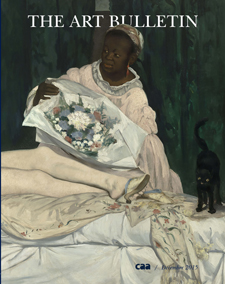
The cover of the December 2015 issue of The Art Bulletin presents an unusual view of Édourad Manet’s painting Olympia: it shows just the right side of the 1863 work, cropping out most of the central figure, but bringing into focus both the courtesan’s black maid, the subject of Darcy Grimaldo Grigsby’s essay “Still Thinking about Olympia’s Maid,” and the elaborate shawl draped over the bed, examined by Therese Dolan in “Fringe Benefits: Manet’s Olympia and Her Shawl.” The issue also features essays by Sun-Ah Choi on the medieval reception of the Mahābodhi Temple statue of the Buddha and by Lisa Pon on the visual and auditory impacts of Raphael’s tapestries for the Sistine Chapel, as well as the recurring “Whither Art History?” feature, in which Filiz Yenişehirlioğlu explores the global reach of Ottoman art and architecture.
The forthcoming March 2016 issue includes essays by Erik Inglis, Paola Demattè, Richard Taws, Jacopo Galimberti, and Youngna Kim. In addition, Nancy Um makes her debut as reviews editor of the journal, with four reviews linked by a theme of artistic exchange and material transmission.
 caa.reviews
CAA’s online book and exhibition review journal publishes content continuously on a newly updated platform. Recently published book reviews include Victoria L. Rovine’s African Fashion, Global Style: Histories, Innovations, and Ideas You Can Wear (Bloomington: Indiana University Press, 2014) reviewed by Erin M. Rice; David Young Kim’s The Traveling Artist in the Italian Renaissance: Geography, Mobility, and Style (New Haven: Yale University Press, 2014) reviewed by Christian K. Kleinbub; and Cynthia Mills’s Beyond Grief: Sculpture and Wonder in the Gilded Age Cemetery (Washington, DC: Smithsonian Institution Scholarly Press, 2014) reviewed by Melissa Dabakis.
Reviews of recent exhibitions include Cubism: The Leonard A. Lauder Collection at the Metropolitan Museum of Art (October 20, 2014–February 16, 2015), reviewed by Michaël Amy; and Rivera and Frida Kahlo in Detroit at Detroit Institute of Arts (March 15–July 12, 2015), reviewed by Delia Cosentino.
Taylor & Francis Online
In addition to their print subscription(s), CAA members receive online access to current and back issues of Art Journal and The Art Bulletin. Taylor & Francis, CAA’s publishing partner, also provides complimentary online access to Word and Image, Design and Culture, and Public Art Dialogue for CAA members. To access these journals, please log into your account at collegeart.org and click the link to the CAA Online Publications Platform on Taylor & Francis Online.
College Art Association
The College Art Association is dedicated to providing professional services and resources for artists, art historians, and students in the visual arts. CAA serves as an advocate and a resource for individuals and institutions nationally and internationally by offering forums to discuss the latest developments in the visual arts and art history through its Annual Conference, publications, exhibitions, website, and other programs, services, and events. CAA focuses on a wide range of advocacy issues, including education in the arts, freedom of expression, intellectual-property rights, cultural heritage and preservation, workforce topics in universities and museums, and access to networked information technologies. Representing its members’ professional needs since 1911, CAA is committed to the highest professional and ethical standards of scholarship, creativity, criticism, and teaching. Learn more about CAA at www.collegeart.org.
Top image: Karl Haendel working in his studio, 2001 (photograph © Florian Maier-Aichen)
Marilyn Stokstad Has Died
posted by CAA — March 07, 2016
Marilyn Stokstad, a distinguished art historian and president of the CAA Board of Directors from 1978 to 1980, has died. She was 87 years old.
Stokstad was a professor in the Department of Art History at the University of Kansas in Lawrence, where she began her career in 1958. She also served as the director of the KU Museum of Art (now the Spencer Museum of Art) at her school from 1961 to 1968. Though Stokstad retired in the early 2000s, she remained active in the field.
Stokstad was a long-time CAA supporter, giving at the Patron level for many years, and attended and presented at numerous Annual Conferences. In addition to her widely known textbook Art History, she contributed four articles to Art Journal. Additional books by Stokstad are listed on Amazon.
Build your Online Presence with Wix
posted by CAA — March 07, 2016
 CAA has partnered with Wix, the leading cloud-based development platform that makes it simple to go online with a beautiful, professional and functional web presence. As a CAA member, you will receive 25% off of Wix’s Yearly Combo Premium Package. The Wix website builder has everything you need to create a fully personalized, high-quality free website, whether to promote your business, showcase your art, set up an online shop or just test out new ideas. Build your online presence today. Contact our membership department today to find out how you can receive this special discount.
Thanks to 2016 Career Services Mentors and Workshop Leaders
posted by CAA — March 03, 2016
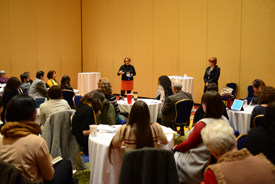 CAA wishes to thank the many artists, scholars, curators, critics, educators, and other professionals in the visual arts who generously served as Career Services mentors—for the Artists’ Portfolio Review, Career Development Mentoring, the Mock Interviews, and the Professional Development Roundtable Discussions—during the 2016 Annual Conference in Washington DC. CAA also appreciates the work of the leaders of the Professional Development Workshops and the speakers at Orientation.
Orientation
Susan Altman, Middlesex County College; Michael Aurbach, Vanderbilt University; and Terri Weissman, University of Illinois, Urbana-Champaign.
Artists’ Portfolio Review
Susan Canning, College of New Rochelle; Jill Conner, Independent Critic and Curator; Brian Curtis, University of Miami; Peter Kaniaris, Anderson University; Suzanne Lemakis, Citigroup (retired); Craig Lloyd, Mt. St. Joseph University; Judith Pratt, Judith Pratt Studio; and David Voros, University of South Carolina.
Career Development Mentoring
Susan Altman, Middlesex County College; Michael Aurbach, Vanderbilt University; Leda Cempellin, South Dakota State University; James Farmer, Virginia Commonwealth University; Toni Guglielmo, Getty Leadership Institute, Claremont Graduate University; Dennis Ichiyama, Purdue University; Mark O’Grady, Pratt Institute; Christopher Olszewski, Savannah College of Art and Design; Doralynn Pines, Metropolitan Museum of Art (retired); Judith Pratt, Judith Pratt Studio; Florence Quideau, Borough of Manhattan Community College, City University of New York; Andrew Jay Svedlow, University of Northern Colorado; Ann Tsubota, Raritan Valley Community College; Philip Van Keuren, Southern Methodist University; and Chad Wesley Airhart, Carson-Newman University.
Professional Development Roundtable Discussions
Michael Aurbach, Vanderbilt University; Peter Kaniaris, Anderson University; Brian Curtis, University of Miami; Suzanne Lemakis, Citigroup (retired); and Leo Morrissey, Georgian Court University.
Mock Interview Sessions
Susan Altman, Middlesex County College; Maria Ann Conelli, Brooklyn College, City University of New York, Brooklyn; Erin C. Devine, Northern Virginia Community College; Carole Garmon, University of Mary Washington; Christian J. Gerstheimer, El Paso Museum of Art; Terence Hannum, Stevenson University; Kim Hartswick, City University of New York; David Howarth, Zayed University; Dennis Ichiyama , Purdue University; Matt King, Virginia Commonwealth University; Andrea Kirsh, Independent Scholar and Rutgers University; Jason Lahr, University of Notre Dame; David LaPalombara, Ohio University; Jo-Ann Morgan, Western Illinois University; Mark O’Grady, Pratt Institute; Arthur Blake Pierce, Valdosta State University; Thomas Post, Kendall College of Art and Design, Ferris State University; Patricia Joan Sarro, Youngstown State University; Mattie M. Schloetzer, National Gallery of Art; and Megan Koza Young, Prospect New Orleans.
Brown Bag Lunches and Sessions
Leda Cempellin, South Dakota State University; Rachel P. Kreiter, Spelman College; Sooyoun Lee, Cornell University; Brittany Lockard, Wichita State University; Tamryn McDermott, George Mason University and Northern Virginia Community College; Lauren Puzier, Sotheby’s Institute of Art; Annie Storr, Montserrat College of Art; Jenny Tang, Yale University; and Amanda S. Wright, University of South Carolina; and Megan Koza Young, Prospect New Orleans.
Professional Development Workshops
Susan Altman, Middlesex County College; Barbara Bernstein, Virginia Center for the Creative Arts and University of Virginia; Steven Bleicher, Coastal Carolina University; Mika Cho, California State University, Los Angeles; Chris Coleman, University of Denver; Curtis Fletcher, University of Southern California; Ronda Grizzle, Scholars’ Lab, University of Virginia Library; Sharon Leon, George Mason University; Lisa Reilly, University of Virginia; Gigi Rosenberg, Author and Artist; David Sokol, University of Illinois, Chicago (emeritus); and Blaise Tobia, Drexel University.