CAA News Today
Committee on Women in the Arts Picks for February 2012
posted by CAA — February 10, 2012
Each month, CAA’s Committee on Women in the Arts selects the best in feminist art and scholarship. The following exhibitions and events should not be missed. Check the archive of CWA Picks at the bottom of the page, as several museum and gallery shows listed in previous months may still be on view or touring.
February 2012

Alina Szapocznikow, Petit Dessert I (Small Dessert I), 1970–71, colored polyester resin and glass, 3 3/16 x 4 5/16 x 5⅛ in. Kravis Collection (artwork © Estate of Alina Szapocznikow/Piotr Stanislawski/ADAGP, Paris; photograph by Thomas Mueller and provided by Broadway 1602, New York, and Galerie Gisela Capitain, Cologne)
Alina Szapocznikow: Sculpture Undone, 1955–1972
Hammer Museum
University of California, Los Angeles, 10899 Wilshire Boulevard, Los Angeles, CA 90024
February 5–April 29, 2012
Alina Szapocznikow: Sculpture Undone, 1955–1972 is the inaugural United States museum survey for this underrepresented Polish artist. A Holocaust survivor who died in 1973 at the age of forty-seven, Szapocznikow is widely acknowledged by her artist peers as one of the most significant sculptors of the twentieth century. She pioneered the use of unconventional sculptural materials, such as polyester and polyurethane, and constructed a visual language that addressed the body’s pain and regeneration. The exhibition includes approximately sixty sculptures, fifty works on paper, and numerous photographic works, demonstrating the tremendous range of Szapocznikow’s vision and continuing influence on twentieth- and twenty-first-century artists.
Maya Lin
Heinz Architectural Center
Carnegie Museum of Art, 4400 Forbes Avenue, Pittsburgh, PA 15213
February 11–May 13, 2012
An exhibition of work by Maya Lin explores her diverse career as architect, artist, and dedicated environmentalist. The twenty-one sculptures and drawings on view range from room-sized installations evocative of geological topography to intricately designed wall installations. Lin has made one new work inspired by Pittsburgh’s three rivers, Pin River – Ohio (Allegheny & Monongahela), specifically for the Carnegie Museum, and her new memorial video project, What is Missing?, will be screened in the museum’s Scaife Lobby.

Shares and Stakeholders: The Feminist Art Project Day of Panels
Abramson Auditorium
Museum of Contemporary Art, Los Angeles, 250 South Grand Avenue, Los Angeles, CA 90012
February 25, 2012
This year’s Feminist Art Project Day of Panels, organized by the artists Audrey Chan and Elana Mann and held in conjunction with the CAA Annual Conference, asks the question: What are the stakes—and who are the stakeholders—of the feminist future? The conversations will address the greater inclusivity of a contemporary feminist art that embraces a multiplicity of identities and philosophies. Topics of discussion will include: feminist art educational models, the roles of men in feminist art, interventionist art strategies, radical queer art making, and feminism as a daily humanist practice. This event is free and open to the public.

Katharine Pyle, “He knocked against a tin pan that clattered down with a tremendous din,” from Three Little Kittens by Katharine Pyle (New York: Dodd, Mead and Company, 1920), 1920, graphite, ink, and gouache on illustration board, 7⅞ x 6⅜ in. Lent by David and Sarah Wyeth (photograph provided by the Delaware Art Museum)
Tales of Folk and Fairies: The Life and Work of Katharine Pyle
Delaware Art Museum
2301 Kentmare Parkway, Wilmington, DE 19806
February 18–September 9, 2012
This exhibition presents seventy-one works by the celebrated children’s book author and illustrator Katharine Pyle (1863–1938). A native of Wilmington, Katherine Pyle was encouraged from a young age to pursue poetry and illustration by her older brother, the famed illustrator Howard Pyle. She studied at the Philadelphia School of Design for Women and at the Drexel Institute of Art and Science, also in Philadelphia. Her work was stylistically aligned with her brother, and also with Beatrix Potter, Walter Crane, and Aubrey Beardsley. Pyle’s subjects were taken from Norse and Greek mythology, fairy tales, and animal stories, and her 1923 illustrations for Anna Sewell’s novel Black Beauty are among her best-known work.
A Complex Weave: Women and Identity in Contemporary Art
Perlman Teaching Museum
Weitz Center for Creativity, Carleton College, 320 Third Street East, Northfield, MN 55057
January 13–March 11, 2012
This exhibition, curated by Martin Rosenberg and J. Susan Isaacs, looks at the current state of feminist art practices and the range of materials and theories used by contemporary artists. Personal and political identity is explored in painting, drawing, sculpture, photography, and needlework. The roster of artists include: Blanka Amezkua, Sarah Amos, Helene Aylon, Siona Benjamin, Zoe Charlton, Sonya Clark, Annet Couwenberg, Lalla A. Essaydi, Judy Gelles, Sharon Harper, Julie Harris, Fujiko Isomura, Tatiana Parcero, Philemona Williamson, April Wood, and Flo Oy Wong.

Kathryn Spence, Short sharp notes, a long whistled trill on one pitch, clear phrases (detail), 2010–11 (artwork © Kathryn Spence; photograph by Rick Schwab and provided by Stephen Wirtz Gallery, San Francisco)
Kathryn Spence: Dirty and Clean
Aldrich Contemporary Art Museum
258 Main Street, Ridgefield, CT 06877
January 29, 2011–June 10, 2012
The German-born, San Francisco-based artist Kathryn Spence uses found, dirty, and discarded materials to explore the complexities of humanity’s relationship to garbage and its place in our ecosystem. Spence, an avid bird-watcher and nature enthusiast, creates life-sized animal models from scraps of paper, fabric, string, and wire. Her work plays with the idea of dirt and dirtiness as both a purifying source and as a by-product of human waste and greed.
Committee on Women in the Arts Picks for January 2012
posted by CAA — January 10, 2012
Each month, CAA’s Committee on Women in the Arts selects the best in feminist art and scholarship. The following exhibitions and events should not be missed. Check the archive of CWA Picks at the bottom of the page, as several museum and gallery shows listed in previous months may still be on view or touring.
January 2012

Jenny Saville, Bleach, 2008, oil on canvas, 99 5/16 x 73 11/16 in. Collection of Lisa and Steven Tananbaum (artwork © Jenny Saville)
Jenny Saville
Norton Museum of Art
1451 South Olive Avenue, West Palm Beach, FL 33401
November 30, 2011–March 4, 2012
Jenny Saville is the inaugural exhibition of the Norton Museum of Art’s Recognition of Art by Women (RAW) series, and the first solo American museum exhibition of the British figurative artist. This exhibition will bring together her most recognizable monumental figure and portrait paintings along with drawings from her recent series Reproduction drawing (based on the Leonardo cartoon of The Virgin and Child with St. Anne and John the Baptist from the National Gallery, London) depicting mother and child images. The presentation will include twenty-eight canvases and drawings dating from 1992 to 2011 and smaller studies, not previously shown, from the artist’s studio.
In Wonderland: The Surrealist Adventures of Women Artists in Mexico and the United States
Los Angeles County Museum of Art
5905 Wilshire Boulevard, Los Angeles, CA 90036
January 29–May 6, 2012
The Surrealist movement in art is most often identified with male artists, many of whom objectified women in their paintings. Numerous female artists at the time, however, developed their own identity-based imagery. This exhibition looks at female Surrealists working in the United States and Mexico and contains 175 works in a variety of media that were created between 1931 and 1968 by artists such as Lee Miller, Yayoi Kusama, and Frida Kahlo.

Nancy Holt, Sun Tunnels: Sunset, 1976, Great Basin Desert, Utah, 1976, detail of composite of four photographs reproduced from original 35mm transparencies, (artwork © Nancy Holt)
Nancy Holt: Sightlines
Tufts University Art Gallery
Aidekman Arts Center, Tufts University, 40 Talbot Avenue, Medford, MA 02155
January 19–April 1, 2012
Since the late 1960s, Nancy Holt has created a far-reaching body of work, including Land Art, films, videos, site-specific installations, artist’s books, concrete poetry and major sculpture commissions. Nancy Holt: Sightlines showcases the artist’s transformation from the perception of the landscape through the use of different observational modes in her early films, videos, and related works from 1966–80.
Cathy Wilkes
Carnegie Museum of Art
4400 Forbes Avenue, Pittsburgh, PA 15213
November 12, 2011–February 26, 2012
Carnegie Museum of Art presents the first solo American museum exhibition to combine the painting and sculptural installations of the Irish artist Cathy Wilkes. Often examining personal experiences, including motherhood, Wilkes is best known for vulnerable, haunting sculptures and installations in which sculpted and found objects are altered and arranged into humanistic—if sometimes disturbing—domestic scenes. Including nine paintings, a recent sculpture, and a newly commissioned installation, this exhibition provides a comprehensive view of Wilkes’s practice.

Margaret Murphy, Reclining Woman (after Kurosawa), 2007, watercolor and acrylic on paper, 20 x 14 in. (artwork © Margaret Murphy)
Margaret Murphy, A Ten-Year Survey; Decoding the Marketplace: coupons, dollar stores, and eBay
Harold B. Lemmerman Gallery
New Jersey City University, Hepburn Hall, Room 323, 2039 Kennedy Boulevard, Jersey City, NJ 07305
January 30–March 7, 2012
This exhibition highlights varied bodies of work created during the last decade by the artist Margaret Murphy. Included in the exhibition are the Tarot Cards series (1997–2000), the Sweet 16 series (2005–7), and the Parlor Paintings (2006–7). Seen together for the first time, these paintings and collages demonstrate Murphy’s insightful feminist critique of the American consumer culture and misrepresentation of women as seen through commodity objects such as porcelain figurines and product packaging.
Andrea Fraser, Men on the Line, KPFK
National Center for the Preservation of Democracy
111 North Central Avenue, Los Angeles, CA 90012
January 23, 2012
Vaginal Davis, My Pussy is Still in Los Angeles (I Only Live in Berlin)
Bullock Department Store Wilshire
3050 Wilshire Boulevard, Fifth Floor, Los Angeles, CA 90010
January 29, 2012
In late January, West of Rome Public Art will host performances by two legendary and controversial feminist artists as part of Pacific Standard Time’s Performance and Public Art Festival. Both works are part of a series inspired by the Los Angeles–based Woman’s Building (1973–81), whose history and influence is currently explored in the PST exhibition Doin’ It in Public.

Zoe Strauss, South Philly (Mattress Flip Front), 2001/2003 (negative/print), chromogenic print, image: 6⅞ x 10⅛ in./sheet: 8 x 10⅜ in. Philadelphia Museum of Art. Purchased with funds contributed by Theodore T. Newbold and Helen Cunningham, 2003 (artwork © Zoe Strauss)
Zoe Strauss: Ten Years
Philadelphia Museum of Art
26th Street and the Benjamin Franklin Parkway, Philadelphia, PA 19130
January 14–April 22, 2012
This midcareer survey of the work of Zoe Strauss, a resident of south Philadelphia, focuses on her decade-long public art project in which each year on the first Sunday in May she exhibited more than two hundred of her photographs in a space beneath a section of Interstate 95 in south Philadelphia. Most of her subjects are disenfranchised people or places.
Solo Exhibitions by Artist Members
posted by CAA — December 22, 2011
See when and where CAA members are exhibiting their art, and view images of their work.
Solo Exhibitions by Artist Members is published every two months: in February, April, June, August, October, and December. To learn more about submitting a listing, please follow the instructions on the main Member News page.
December 2011
Abroad

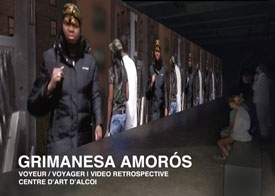
Grimanesa Amoros. Galeria Aranapoveda, Centre d’art d’Alcoi, Madrid, Spain, September 22–December 4, 2011. Voyeur/Voyager. Video.
Midwest

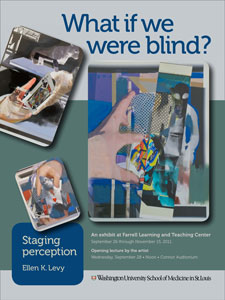
Ellen K. Levy. Washington University School of Medicine in Saint Louis, Farrell Learning and Teaching Center, Saint Louis, Missouri, September 26–November 15, 2011. Stealing Attention. Mixed media.

 Installation view of Sharon Louden’s Merge at the Weisman Art Museum (artwork © Sharon Louden)
Sharon Louden. Weisman Art Museum, University of Minnesota, Minneapolis, Minnesota, October 1, 2011–May 20, 2012. Merge. Installation.
Northeast

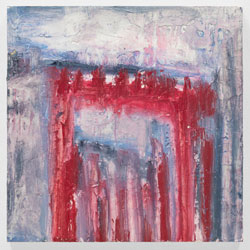 Darla Bjork, Fire on the Mountain, 2010, encaustic and oil stick, 16 x 16 in. (artwork © Darla Bjork)
Darla Bjork. SoHo20 Chelsea Gallery, New York, November 1–26, 2011. Fire Series: Recent Paintings. Painting.

 Leila Daw, Flow (artwork © Leila Daw)
Leila Daw. A.I.R. Gallery, Gallery II, Brooklyn, New York, September 7–October 1, 2011. Ways to Find. Mixed media.

David C. Driskell. DC Moore Gallery, New York, January 5–February 4, 2012. Creative Spirit: The Art of David C. Driskell.

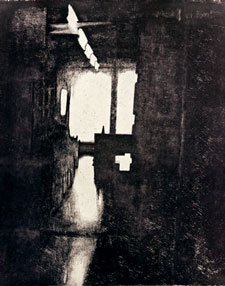 John McDevitt King, The Next Yesterday, 2011, softground, 23½ x 22 in. (artwork © John McDevitt King)
John McDevitt King. VanDeb Editions, New York, October 6–28, 2011. Soft Ground: Prints and Drawings. Printmaking and drawing.
Deborah Wing-Sproul. Center for Maine Contemporary Art, Gallery 3, Rockport, Maine, October 1–December 11, 2011. still/moving: Deborah Wing-Sproul. Performance, video, sculpture, printmaking, and photography.
West
Deborah Cornell. Los Angeles Center for Digital Art, Los Angeles, California, September 8–30, 2011. Biogems, Species Boundaries, and Games of Chance. Digital printmaking.

 Patrick Luber, Picture Window, 2010, mixed media with digital picture frame, 21 x 28 x 10 in. (artwork © Patrick Luber)
Patrick Luber. Isaac Lincoln Gallery, Northern State University, Aberdeen, South Dakota, November 10, 2011–January 4, 2012. Matter of Belief. Sculpture.
Report from the October 2011 Board of Directors Meeting
posted by Linda Downs — December 19, 2011
The fall meeting of the CAA Board of Directors took place on Sunday, October 23, 2011, in New York. Twenty-two board members were joined by eight staff members and one guest.
Anne Collins Goodyear was elected by the board as president-elect. Her term of office begins in May 2012 and will conclude at the end of April 2014. Goodyear is associate curator of prints and drawings at the National Portrait Gallery, Smithsonian Institution, in Washington, DC. She has served on the CAA board since 2006 as vice president for external affairs and vice president for publications and is currently vice president for Annual Conference. As vice president for publications, Goodyear headed a task force that reviewed all editorial safeguards and procedures for CAA’s three journals. She is an art historian who has contributed to the field through major exhibitions, including Inventing Marcel Duchamp: The Dynamics of Portraiture in 2009. She is only the second art museum curator to lead CAA in thirty years (the first being Joshua C. Taylor, director of the National Museum of American Art in Washington, DC, in 1981). Before stepping into the presidency, Goodyear will lead a task force on the Annual Conference to explore future web-based extensions.
The Professional Practices Committee, chaired by Charles Wright of Western Illinois University, worked with subcommittees over the past several years and updated five existing but outdated standards and added one new document to CAA’s Standards and Guidelines. Maria Ann Conelli, vice president for committees, presented these standards to the board for approval. The board adopted these standards and commended the subcommittees and the Professional Practices Committee for their outstanding work in providing the field with this critical information. The new standards reflect and correspond to the guidelines of the National Association of Schools of Art and Design and regional accreditation commissions where applicable.
Beauvais Lyons of the University of Tennessee, Knoxville, chaired the task force to update Professional Practices for Artists, first published in 1977. Extensive changes were made in sections pertaining to the code of ethics, copyright, safe use of materials and equipment, and exhibition and sales. The task-force members were: Charles Wright, Western Illinois University, Chair of the Professional Practices Committee; Brian Bishop, Framingham State University; Margaret Lazzari, University of Southern California; and James Hopfensperger, Western Michigan University.
Judith Thorpe of the University of Connecticut chaired the task force to update Standards for the Bachelor of Arts and Bachelor of Fine Arts Degrees in Studio Art. A section on multidisciplinary curricula was added, and extensive changes were made to sections on the BFA and studio curriculum and on faculty and staff. The task force comprised: Denise Mullen, Oregon College of Art and Crafts and CAA board; Sergio Soave, Ohio State University; Frederick Cartwright, University of Saint Francis; and Cora Lynn Deibler, University of Connecticut.
Susan Waller of the University of Missouri, Saint Louis and John Klein of Washington University in Saint Louis made up the task force that revised Peer Review in CAA Publications from 2004. The task force consulted the current editors-in-chief and editors-designate of The Art Bulletin and Art Journal as well as members of the Publications Committee that oversees the editorial boards of CAA’s three journals. The standards included a definition of peer review and addressed works submitted to the journals by artists.
Jim Hopfensperger of Western Michigan University chaired the task force on Standards for the Retention and Tenure of Art and Design Faculty, whose members were: Carolyn Cardenas, Utah State University; Dana Clancy, Boston University; Andrea Eis, Oakland University; Amy Hauft, Virginia Commonwealth University; Janet Hethorn, University of Delaware; Robert Hower, University of Texas at Arlington; Patricia Olynyk, University of Massachusetts, Dartmouth; Sergio Soave, Ohio State University; Adrian Tio, University of Massachusetts, Dartmouth; and Star Varner, Southwestern University. The revised standards recommend transparency in matters of renewal, retention, promotion, and tenure; specified contact hours; and added the categories of collaborative artworks, situated artworks, online work, commissions, consultations, and/or curatorial work to documentation to be considered for retention and promotion review.
A new document, Standards for the Associate of Fine Arts Degree in Studio Art, was developed to recognize that 50 percent of all college students in the United States attend institutions offering two-year degree programs. Bertha Gutman, Delaware County Community College, chaired the task force, whose members were: Carmina L. Cianciulli, Tyler School of Art, Temple University; Sandra Esslinger, Mt. San Antonio College; Martina Hesser, Mesa College; David Koffman, Georgia Perimeter College; and Christina McNearney, Pima Community College.
CAA’s deputy director, Michael Fahlund, announced that CAA had received 168 applications for the Professional-Development Fellowship in Visual Art and 19 for the Professional- Development in Art History. The juries will meet in December to select three visual-art fellows and two art-history fellows with awards of $5,000 each. The awardees will be honored at the Annual Conference in Los Angeles.
Patricia McDonnell, vice president for external affairs, presented the first of three reports on membership development to the board. She thanked Nia Page, director of membership, development and marketing, for the work that she and her staff carried out to identify all national and international sources of future CAA members. The board has requested a plan to increase membership revenue over the next three years, and this comprehensive first-phase report was reviewed and accepted by the board. It was also announced that two new full-time staff members have been hired: Hannah O’Reilly Malyn, development associate, and Nancy Nguyen, institutional membership assistant.
The board approved new guidelines for board liaisons to the Professional Interests, Practices, and Standards Committees. The new guidelines include acting in an advisory (without vote) capacity by attending their assigned committee meetings and reporting back to the vice president of committees, thereby bringing issues of critical importance to the vice president and the board and back to the committees from the board.
Paul Jaskot of DePaul University chaired the Task Force on the Use of Human and Animal Subjects in Art and presented its recommendations to the board. Members of the task force included Wayne Enstice, University of Cincinnati; Michael Golec, School of the Art Institute of Chicago; Ellen Levy, independent artist; Marlena Novak, independent artist; Bernard Rollin, University of Colorado; and Kristine Stiles, Duke University. The task force researched and presented existing guidelines for the use of animals and humans in experiments and performance; sampled existing practices in the art world; prepared and sent a survey to members regarding attitudes about the use of animals in art; and compiled a short bibliography of ethical and artistic debate on these subjects. The task force produced a set of principles and questions that artists and other professionals in the visual arts can consult when using animals and human subjects in art. The task force suggested that another task force be established to develop formal guidelines on the use of animals in art and to develop a page on the CAA website for related resources in the future. The board accepted the recommendations of the task force, commended Paul and the task-force members for their work on this difficult subject, and decided to postpone the formation of another task force, since five new task forces were being presented at the meeting and needed prioritization by the executive director.
A resolution to establish a Task Force on the Annual Conference was presented to the board by Goodyear. The task force, approved by the board, will address electronic extensions of the conference in order to reach a larger, international membership. The vice president announced that the 2013 Annual Conference Committee has reviewed the 279 session proposals that were submitted and selected 111 for the New York conference. In addition to the 111 peer-reviewed sessions there will be 23 affiliated-society sessions, 3 committee sessions, 20 contemporary issues/studio art sessions, 8 educational and professional practices sessions, 53 historical studies sessions, and 4 Open Forms sessions.
Goodyear also announced that 150 people have applied for the Getty Foundation International Travel Grant Program. The jury will meet in November to select twenty awardees, who will receive a free CAA membership for a year, free registration, and free travel and hotel to the 2012 conference in Los Angeles. The program is intended to acclimate art historians or artists teaching art history in developing college art departments to become acquainted with the session proposal submission process, to assist them in networking with colleagues, and to address common professional issues. The project is supported by a grant from the Getty Foundation. The CAA project manager is Janet Landay.
A resolution was presented by a board member, Jean Miller of the University of North Texas, and approved by the board to establish a Task Force on Design. This group will conduct research on design programs in order to attract more designers to CAA membership. A resolution was presented by another board member, Judith Thorpe, to increase participation in CAA by its affiliated societies. The resolutions were approved with the proviso that the formation of the task forces be delayed until Downs determines when the staff support will be available to assist the task forces.
The Executive Committee approved affiliated-society status for the Diasporic Asian Art Network (DAAN).
The annual audit was presented by EisnerAmper, Accountants and Advisors. There were no recommendations, and the chief financial officer, Teresa López, was commended for her work. Copies of the audit will be made available at the Annual Members’ Business Meeting, taking place on Friday, February 24, 2012, at the CAA Annual Conference in Los Angeles; it can also be obtained directly from López. The treasurer, John Hyland Jr., presented a balanced budget. CAA’s investment manager, Domenic Colasecco from Boston Trust, presented a thorough report on the investment portfolio.
At the request of the board, Downs presented a comprehensive report on funding sources at CAA including membership (representing 42 percent of all revenue); earned revenue including grants (45 percent); private contributions (.5 percent); and investment drawdown (9.4 percent). The board will set a specific date to discuss ideas on increasing private contributions to CAA funds.
Downs commended the CAA staff for a successful move to the new office at 50 Broadway and especially thanked Fahlund, who coordinated the move; López, who managed the move’s financial aspects; and Michael Goodman, director of information technology, who oversaw the installation of the new phone system and all the office computers, copiers, and machines, and also helped make necessary changes to the website. The move will assist in a budget reduction because of a five-year lease reduction rebate provided by the City of New York through the Lower Manhattan Development Corporation.
Open House
Open House at the CAA office, from left: Minerva Navarrete, Michael Fahlund, and Sydelle Zemering
As part of the meetings taking place that weekend for the three journals’ editorial boards, the Annual Conference Committee, and the full Board of Directors, the CAA staff organized an Open House for members at the organization’s new office on Saturday, October 22, 2011. Close to fifty members visited the office and met board and staff members. Two delightful visitors were Minerva Navarrete and Sydelle Zemering, former CAA staff members who regaled us with stories of their experiences at CAA during the 1950s, when the office was in a Madison Avenue townhouse. One board member, Roger Crum of the University of Dayton, introduced several members to the National September 11 Memorial and Museum and the World Trade Center construction site from the vantage point of the twentieth floor of the Club Quarters, World Trade Center hotel. (CAA belongs to the Club Quarters network in major cities around the world, and members receive discounts on room reservations.) This particular Club Quarters is on the southern edge of the World Trade Center site and has extraordinary views of the construction of the towers and the memorial’s fountains. Crum made a presentation on the concept of memorializing September 11 and the skyscraper engineering and safeguards going into the seven towers. After the Open House, several members also visited Occupy Wall Street in Zuccotti Park, just a few blocks north. CAA’s new neighborhood is very lively, with many tourists, commemorators, construction crews, and demonstrators.
People in the News
posted by CAA — December 17, 2011
People in the News lists new hires, positions, and promotions in three sections: Academe, Museums and Galleries, and Organizations and Publications.
The section is published every two months: in February, April, June, August, October, and December. To learn more about submitting a listing, please follow the instructions on the main Member News page.
December 2011
Academe

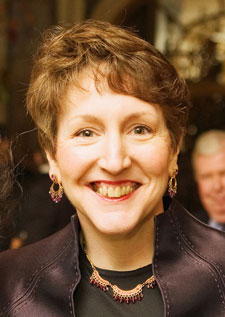 Maria Ann Conelli
Maria Ann Conelli, formerly executive director of the American Folk Art Museum in New York, has been appointed dean of the School of Visual, Media, and Performing Arts at Brooklyn College, City University of New York.
Marc Gerstein, professor of art history at the University of Toledo in Ohio, will retire at the end of the fall 2011 semester. Gerstein spent thirty-one years in Toledo, first with the Toledo Museum of Art and, since 1987, with the University of Toledo.

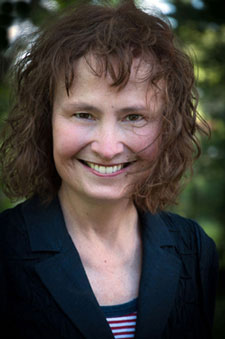 Martha Langford
Martha Langford has been appointed research chair and director of the Gail and Stephen A. Jarislowsky Institute for Studies in Canadian Art at Concordia University in Montreal, Quebec. She began her five-year term on July 1, 2011.
Sandra Maxa, a graphic designer and educator, has become a faculty member at the Maryland Institute College of Art in Baltimore. She will teach during academic year 2011–12.
Aaron McIntosh has been appointed to the faculty of the Maryland Institute College of Art in Baltimore for the 2011–12 school year.

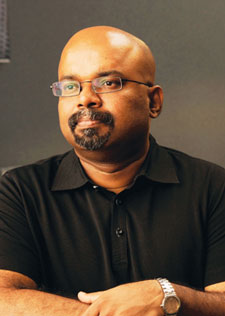 Gunalan Nadarajan
Gunalan Nadarajan, vice provost of research at the Maryland Institute College of Art in Baltimore, has been appointed to a new position at his school: vice provost of research and graduate studies.
Mark Sanders, a graphic designer and educator, has joined the Maryland Institute College of Art in Baltimore as a faculty member for academic year 2011–12.

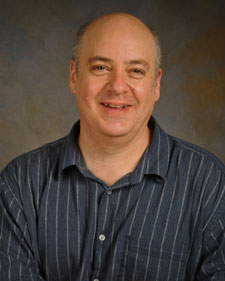 Greg Shelnutt (photograph provided by Clemson University)
Greg Shelnutt, professor of sculpture at Clemson University in South Carolina, has been appointed chairman of the Department of Art at his school. He succeeds Michael Vatalaro, who retired after thirty-five years.
Museums and Galleries
James Peck, most recently Robert S. and Grace B. Kerr Fellow at the University of Oklahoma’s Charles M. Russell Center for the Study of Art and the American West, has become curator of collections at the Rockwell Museum of Western Art in Corning, New York.
Will South, formerly chief curator of the Dayton Art Institute in Ohio, has been appointed chief curator of the Columbia Museum of Art in Columbia, South Carolina.
Organizations and Publications
Marcia E. Vetrocq, editor-in-chief of Art in America from 2008 to 2011, has joined the editorial team at Art + Auction.
Institutional News
posted by CAA — December 17, 2011
Read about the latest news from institutional members.
Institutional News is published every two months: in February, April, June, August, October, and December. To learn more about submitting a listing, please follow the instructions on the main Member News page.
December 2011
The American Academy in Rome in Italy has received a 2011 grant from the Graham Foundation, intended to help present and produce publications, exhibitions, films, initiatives in new media, and other programs.

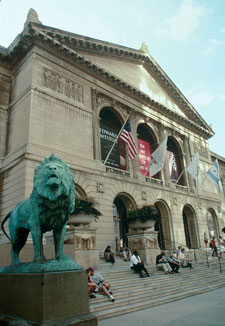 South view of the Michigan Avenue façade of the Art Institute of Chicago (photograph provided by the Art Institute of Chicago)
The Art Institute of Chicago in Illinois has been awarded a 2011 grant from the Graham Foundation, intended to help present and produce publications, exhibitions, films, initiatives in new media, and other programs.
The Brooklyn Museum in New York has won a 2011 National Medal for Museum and Library Service from the Institute of Museum and Library Services, a federal agency. Four other museums and five libraries also received medals, chosen from the institute’s director, Susan Hildreth, following a call for nominations.
The California Institute of the Arts in Valencia has been named America’s Number 1 College for Students in the Arts in a report recently released by Newsweek and the Daily Beast.
The Canadian Centre for Architecture in Montreal, Quebec, has earned a 2011 grant from the Graham Foundation, intended to assist the presentation and production of publications, exhibitions, films, initiatives in new media, and other programs.

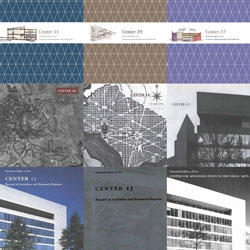
The Center for Advanced Study in the Visual Arts at the National Gallery of Art in Washington, DC, has published the entire archive of past Center reports from 1980–81 to the present. These thirty-one reports contain information about the center’s fellowships, meetings, research, and publications, as well as research reports by fellows in residence for each academic year.
The Frick Art Reference Library, based at the Frick Collection in New York, has announced that research database records in its Photoarchiv created since 1996, and all future records created for the existing collection and for new acquisitions, are now accessible via the New York Art Resources Consortium’s online catalogue, Arcade. The records offer detailed historical documentation for the works of art, including basic information about the artist, title, medium, dimensions, date, and owner of the work, as well as former attributions, provenance, variant titles, records of exhibition and condition history, and biographical information about portrait subjects.
Maryland Institute College of Art in Baltimore has launched the Baltimore Art and Justice Project, the first project of its kind in the United States to identify, amplify, and connect arts-based practitioners advancing the cause of social justice in a particular city. The project, in partnership with a citywide advisory committee, kicked off with a two-year, $150,000 grant from the Open Society Foundations in New York.
Maryland Institute College of Art in Baltimore will offer two new graduate programs in 2012: an master of professional studies in information visualization and a master of arts in critical studies. In addition, the college will expand its undergraduate offerings in the fall with new concentrations in game arts, sound art, and sustainability and social practice.

 Dana Seidel has been named director of the the Rutgers Center for Digital Filmmaking (photograph by Enrique Alvarez Fanjul)
The Mason Gross School of the Arts and the School of Arts and Sciences at Rutgers University in New Brunswick, New Jersey, have established an education and professional hub for filmmaking. Directed by Dena Seidel, the Rutgers Center for Digital Filmmaking will offer a seven-course certificate program, beginning in spring 2012, and will also house the Rutgers Film Bureau.
Parsons the New School for Design in New York has announced a new master of arts in design studies, to begin in fall 2012. Based in the School of Art and Design History and Theory, the program will shape a new generation of thinkers to critically address historical, philosophical, and social issues related to design practices, products, and discourses. It is geared toward those seeking to pursue a career in design research, writing, curating, consulting, or criticism, as well as designers seeking to incorporate design research into their practice.
The Philadelphia Museum of Art in Pennsylvania has received a 2011 grant from the Graham Foundation, intended to help present and produce publications, exhibitions, films, initiatives in new media, and other program.

The School of Visual Arts in New York will begin offering a master of arts in critical theory and the arts in fall 2012. Chaired by Robert Hullot-Kentor and based on the Frankfurt School of Social Research, the program will bring together leading minds in philosophy, sociology, and art criticism to examine critical theory in relation to contemporary culture and the arts.
The University of Virginia Art Museum in Charlottesville has received a four-year, $315,000 grant from the Andrew W. Mellon Foundation to fund a new, full-time academic curator who will aid and expand the museum’s curatorial and academic programming mission as a teaching museum. The curator will also play an essential role in developing initiatives that integrate the museum with innovation in the humanities across the university.

 Anonymous (Mexican), Mother and Child, 100 BC–AD 200, earthenware, white slip with black and red paint, 37.2 x 30.9 x 23.2 cm. Walters Art Museum, Baltimore, gift of John G. Bourne, 2009 (photograph provided by the Walters Art Museum)
The Walters Museum of Art in Baltimore, Maryland, has been awarded a $4 million bequest from the estate of John Bourne of Santa Fe, New Mexico, to endow a center for the study, conservation, interpretation, and display of the arts of the ancient Americas. The funds accompany Bourne’s donation of seventy works of art, as well as 230 additional planned gifts.
Winterthur Museum, Garden, and Library has received the gift of $3 million from a museum trustee, John L. McGraw and his wife Marjorie, to endow its director of museum collections, a post held by Linda S. Eaton. The endowment of the position—named the John L. and Marjorie P. McGraw Director of Collections—ensures that this vital aspect of Winterthur’s operations will be funded permanently into the future and reflects the institution’s commitment to the exceptional scholarship, publications, and exhibitions for which it is known.
Grants, Awards, and Honors
posted by CAA — December 15, 2011
CAA recognizes its members for their professional achievements, be it a grant, fellowship, residency, book prize, honorary degree, or related award.
Grants, Awards, and Honors is published every two months: in February, April, June, August, October, and December. To learn more about submitting a listing, please follow the instructions on the main Member News page.
December 2011

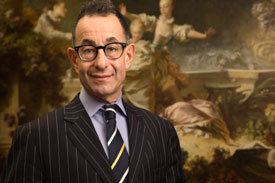 Colin Bailey (photograph by Michael Bodycomb)
Colin B. Bailey, deputy director and Peter Jay Sharp Chief Curator of the Frick Collection in New York, has received the insignia of Officer of the Order of Arts and Letters from the French government.

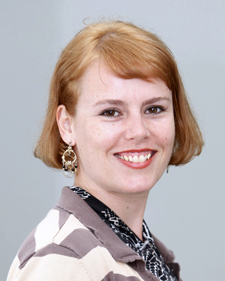 Caetlynn Booth
Caetlynn Booth, a recent graduate in painting from Mason Gross School of the Arts Graduate Program in Visual Arts at Rutgers University in New Brunswick, New Jersey, has received a Fulbright scholarship to Berlin, Germany, for academic year 2011–12. She will conduct research for a project titled “The Work of Adam Elsheimer and the Spiritual Power of Painting.”
Andrea Bowers has received a grant from Art Matters to support a video project documenting DREAM-activist youth in California fighting the deportation of undocumented students.
Robert Gero has received a grant from Art Matters to support travel to Hungary, Romania, Bulgaria, and Slovakia for research and interviews with the Roma.
Hope Ginsburg has received a grant from Art Matters to support travel her ongoing social artwork project, called Sponge. The artist will travel to the reef atolls off the coast of Belize to study the sea sponges that grow there.
Sheila Pepe has received a grant from Art Matters to support the international iterations of Common Sense, an ongoing installation and participatory performance involving a large-scale crocheted drawing.

 Margaret Samu
Margaret Samu, adjunct assistant professor in the Art History Department of Stern College for Women at Yeshiva University, has received a Swann Foundation Fellowship for Caricature and Cartoon at the Library of Congress. The fellowship will enable her to study late-nineteenth-century Russian caricatures about art from the library’s strong holdings of satirical publications. She will use this material for a chapter of her book manuscript entitled Russian Venus.
Exhibitions Curated by CAA Members
posted by CAA — December 15, 2011
Exhibitions Curated by CAA Members
Check out details on recent shows organized by CAA members who are also curators.
Exhibitions Curated by CAA Members is published every two months: in February, April, June, August, October, and December. To learn more about submitting a listing, please follow the instructions on the main Member News page.
December 2011

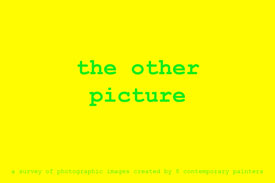
Michael Behle. The Other Picture. Gallery FAB, University of Missouri, Saint Louis, Missouri, October 24–November 30, 2011.
Reni Gower. Papercuts. Space 301, Centre for the Living Arts, Mobile, Alabama, October 14–December 17, 2011.

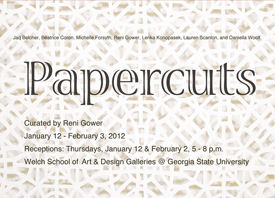
Reni Gower. Papercuts. Ernest G. Welch School of Art and Design Galleries, Georgia State University, Atlanta, Georgia, January 12–February 3, 2012.

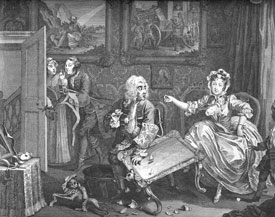 William Hogarth, plate 2 of The Harlot’s Progress, 1732 (printed 1744), etching and engraving, image: 8 7/16 x 6⅛, sheet: 17⅛ x 22 1/16 in. (artwork in the public domain)
Rena Hoisington. Print by Print: Series from Dürer to Lichtenstein. Baltimore Museum of Art, Baltimore, Maryland, October 30, 2011–March 25, 2012.

 An electron micrograph of basalt moon lava by Kurt Hollocher of the Union College Department of Geology, displayed as a Duratrans print on an LED light box
Adrienne Klein. Mineral. Castrucci Gallery, Union College, Schenectady, New York, May 21–December 31, 2011.

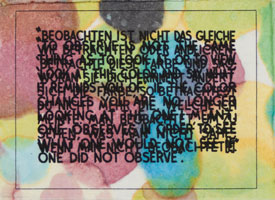 Mel Bochner, If the Color Changes…, 2003, monoprint with engraving and embossment on hand-dyed Twinrocker handmade paper, 2¾ x 3¾ in. Collection of Sally and Wynn Kramarsky (artwork © Mel Bochner; photograph by Laura Mitchell)
N. Elizabeth Schlatter. Art=Text=Art: Works by Contemporary Artists. University of Richmond Museums, Richmond, Virginia, August 17–October 16, 2011.

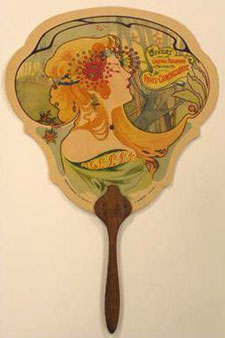 Fernand Toussaint, Grand Magasins de nouveautes, 1895, lithographic promotional fan, 12 x 7⅞ in. Robert L. Hoskins and Erwin A. Raible Collection of Fin de Siècle French Prints, a gift to Grand Valley State University from Elaine Rutowski Shay
Claire L. Kovacs. Posters, Fans, and Songbooks: 19th-Century Prints by Toulouse-Lautrec and His Contemporaries. Krasl Art Center, St. Joseph, Michigan, September 16–October 30, 2011.

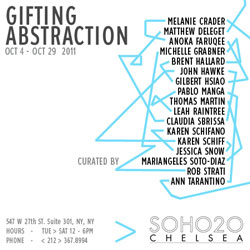
Mariangeles Soto-Diaz, Rob Strati, and Ann Tarantino. Gifting Abstraction. SoHo20 Chelsea Gallery, New York, October 4–29, 2011.
Lili White. Another Experiment by Women Film Festival. Millennium Film Workshop, New York, November 5, 2011.
Books Published by CAA Members
posted by CAA — December 15, 2011
Publishing a book is a major milestone for artists and scholars—browse a list of recent titles below.
Books Published by CAA Members appears every two months: in February, April, June, August, October, and December. To learn more about submitting a listing, please follow the instructions on the main Member News page.
December 2011


Samantha Baskind and Larry Silver. Jewish Art: A Modern History (London: Reaktion Books, 2011).

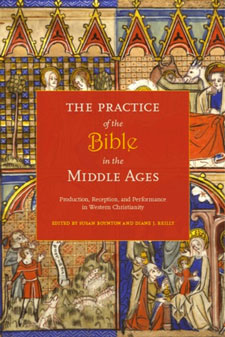
Susan Boynton and Diane J. Reilly. The Practice of the Bible in the Middle Ages: Production, Reception, and Performance in Western Christianity (New York: Columbia University Press, 2011).


Sheila Crane. Mediterranean Crossroads: Marseille and Modern Architecture (Minneapollis: University of Minnesota Press, 2011).

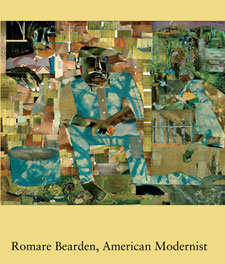
Ruth Fine and Jacqueline Francis, eds. Romare Bearden, American Modernist (Washington, DC: National Gallery of Art, 2011).

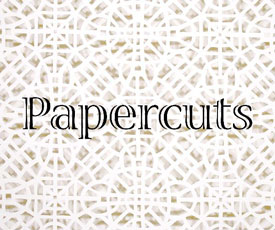
Reni Gower. Papercuts: The Art of Contemporary Paper Cutting (San Francisco: Blurb, 2011).

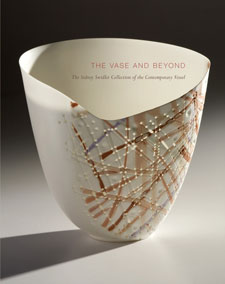
Martha Drexler Lynn and Diana L. Daniels. The Vase and Beyond: The Sidney Swidler Collection of the Contemporary Vessel (Sacramento, CA: Crocker Art Museum, 2010).


Rebecca Peabody, Andrew Perchuk, Glenn Phillips, and Rani Singh, with Lucy Bradnock, eds. Pacific Standard Time: Los Angeles Art, 1945–1980 (Los Angeles: Getty Research Institute and the J. Paul Getty Museum, 2011).

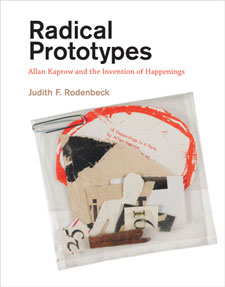
Judith Rodenbeck. Radical Prototypes: Allan Kaprow and the Invention of Happenings (Cambridge, MA: MIT Press, 2011).


Anna Sokolina, ed. Arkhitektura i Antroposofiia [Architecture and Anthroposophy], 2nd ed. (Moscow: KMK Scientific Press, 2010).
Committee on Women in the Arts Picks for December 2011
posted by CAA — December 10, 2011
Each month, CAA’s Committee on Women in the Arts selects the best in feminist art and scholarship. The following exhibitions and events should not be missed. Check the archive of CWA Picks at the bottom of the page, as several museum and gallery shows listed in previous months may still be on view or touring.
December 2011

Henrietta de Beaulieu Dering Johnston, Henriette Charlotte Chastaigner (Mrs. Nathaniel Broughton), 1711, pastel on paper; 14 2/5 x 11 3/5 in. Gibbes Museum of Art, Gift of Victor A. Morawetz (artwork in the public domain)
Breaking Down Barriers: 300 Years of Women in Art
Gibbes Museum of Art
135 Meeting Street, Charlestown, SC 29401
October 28, 2011–January 8, 2012
This exhibition, drawn from the museum’s permanent collection, examines the challenges that women artists have faced over the past three hundred years. The oldest works are by Henrietta de Beaulieu Dering Johnston (ca. 1674–1729), who is considered the first female professional artist in America. Among the most recent contributions are those by artists who work in Charleston today.
Nan Goldin: Scopophilia
Matthew Marks Gallery
522 West 22nd Street, New York, NY 10011
October 29–December 23, 2011
Scopophilia (“the love of looking”) combines Nan Goldin’s autobiographical photographs with those taken in the Louvre Museum after hours. A video, complete with the artist’s commentary and soaring choral music, is shown in a darkened viewing room. Both the photographs and video deal with themes of love and desire.
Sarah Sze: Infinite Line
Asia Society
725 Park Avenue, New York, NY 10021
December 16, 2011–March 25, 2012
Sarah Sze: Infinite Line comprises two-dimensional works on paper and a new large-scale, site-specific installation. Sze uses everyday objects such as milk cartons, takeout cups, bars of soap, feathers, lamps, ladders, pebbles, potted plants, pens, plastic bottles, tools, and twigs, which are transformed in her installations by their associations.
Sanja Iverković: Sweet Violence
Museum of Modern Art
11 West 53rd Street, New York, NY 10019
December 18, 2011–March 25, 2012
This first US museum exhibition of the Croatian feminist, activist, and video and performance artist Sanja Iverković covers four decades of her career. Roxana Marcoci, curator in the Department of Photography, has brought together a group of videos and media installations, including Sweet Violence (1974), Personal Cuts (1982), Practice Makes a Master (1982/2009), General Alert (Soap Opera) (1995), and Rohrbach Living Memorial (2005), along with one hundred photomontages.