
CAA News Today
December Obituaries in the Arts
posted Dec 14, 2009
CAA recognizes the lives and achievements of the following artists, architects, scholars, teachers, collectors, and other important figures in the visual arts. Of note is John Carey’s text on the artist and author Robert Kaupelis, written especially for CAA.
- Samuel Bookatz, an artist who worked in many styles and media, including oil and tempera paintings and ranging from realist to abstract, died on November 16, 2009, at the age of 90
- John Craxton, a painter who also created scenery and costume designs for opera and ballet productions, died on November 17, 2009, at the age of 87
- Jeanne-Claude Denat de Guillebon, who collaborated with her husband Christo Javacheff on many environmental art projects, died on November 18, 2009. She was 74
- Luciano Emmer, a distinguished Italian cinema director best known for his many art documentaries, including a film about Pablo Picasso, died on September 16, 2009, at the age of 91
- Rachel Evans-Milne, an artist of the original YBA generation, a teacher, and a counselor of children and young adults, died in November 2009 at the age of 44
- Peter Forakis, a California-based artist known for his geometric abstract sculptures, died on November 26, 2009, at age 82. Forakis was also a founder of the Park Place Gallery in New York in the early 1960s
- Walter Grallert, an architect, architectural conservator, poet, and environmentalist, died on November 27, 2009, at the age of 79
- Claude Harrison, a painter and the author of A Portrait Painter’s Handbook, died on September 13, 2009. He was 87
- Ikuo Hirayama, a painter whose subjects involved imagery of Buddhism and the Silk Road, died on December 2, 2009, at the age of 79
- Thomas Hoving, a former director of the Metropolitan Museum of Art, died on December 10, 2009. He was 78
- Alfred Hrdlicka, an Austrian artist whose controversial works, often containing religious themes, were done in metal, paint, and pencil, died on December 5, 2009. He was 81
- Robert Kaupelis, an artist, art teacher, and author of Learning to Draw, died on June 12, 2009, at the age of 81. John Carey contributes a special text on Kaupelis for CAA.
- Michael Kidner, an English abstract painter and sculptor whose precise and hard-edged images were often at odds with the style of the New York School, died on November 29, 2009. He was 92
- Harry C. McCray, Jr., the chairman of the board of trustees at the Nelson-Atkins Museum of Art, died on November 28, 2009, at the age of 76
- Jan Mitchell, a collector of pre-Columbian gold pieces, which he donated to the Metropolitan Museum of Art, and a founding member of the Israel Museum in Jerusalem, died on November 28, 2009. He was 96
- Daniel Rowen, a modernist architect who designed houses, apartments, and commercial spaces, died on November 17, 2009, at the age of 56
- Larry Sultan, a photographer and CalArts professor who used found images from industrial and government archives for his and Mike Mandel’s book Evidence, died on December 13, 2009. He was 63
- Anna McCullough Tyler, an art historian, teacher, and artist of abstract monoprints, died on November 29, 2009, at the age of 79
- Eddy Walker, an architect who improved housing conditions and designed and renovated community buildings in Leeds, died in November 2009. He was 59
- Harry Weinberger, a painter and collector of masks, which inspired him and appear throughout his oeuvre, died on September 10, 2009. He was 85
- Malcolm Wells, an architect, writer, and teacher whose unconventional approach included designs for earth-friendly structures, died on November 27, 2009. He was 83.
- Charis Wilson, a model and the inspiration for many of Edward Weston’s photographs, died on November 20, 2009. She was 95
Read all past obituaries in the arts on the CAA website.
Robert Kaupelis: In Memoriam
posted Dec 14, 2009
John Carey, an artist and art teacher, is the editorial cartoonist for Greater Media Newspapers in central New Jersey.
First there was Kimon Nicolaïdes’s Natural Way to Draw (1941), then there was Robert Beverly Hale’s Drawing Lessons from the Great Masters (1964). Then in 1966 came Robert Kaupelis’s Learning to Draw. It was a book smart enough and egalitarian enough to employ old and modern masters’ examples along with students’ work; the point was the dynamics of application, not only the procedures of attempting realism. I discovered that book in 1972 in my high school library in Richmond, Kentucky. The book offered me and my generation what we knew but didn’t quite trust yet—the processes of mark-making, be it gentle, violent, nuanced, or bold. We had seen those applications in artworks we admired—old and new—but we hadn’t had it broken down in a philosophy with lessons before. When I saw that the author of Learning to Draw taught at New York Univeristy I knew where I wanted to go to college. Three years later I was in Kaupelis’s classroom.
Describing a great teacher is a bit like explaining a great performance. There is context, delivery, insight, and presence; there is also something else: the mark left. That mark is often as elusive as an actor’s impact, but as in theater, there are now and then a few mentors that remain definitive for us in their transformative and indelible effects. In this regard Kaupelis was a star. His energy and intelligence demanded attention, and in turn one realized that a reciprocity of that demand was expected in the presentation of one’s artwork and in the articulation of one’s efforts. It was also understood that respect came only from very hard, serious work. And it was great fun. “Change!” was something often heard in the art studio (along with Frank Sinatra, Ray Charles, and Beethoven LPs); Kaupelis would shout “Change!” to models he kept busy, finding one quick pose after another as our young tentative arms began to loosen up with quick contour and gesture drawings in our search for some beauty with our own mark-making. After a few of these energized classes a Kaupelis student never looked at art in the same way again. The lessons of Learning to Draw had met the energy of the man behind it. Change had happened.
Kaupelis, who died on June 12, 2009, began teaching at NYU in 1956. He was born in Amsterdam, New York, in 1928 and educated in Buffalo and at Columbia University. In 1975 he was the subject of a chapter in a Herbert Livesey book surveying higher education called The Professors, where he was cited as one of the nation’s outstanding art educators. In 1980 Kaupelis wrote his second Watson-Guptill drawing book, Experimental Drawing, which reinforced his exuberant amalgam of stressing the fundamentals of art along with encouraging innovative and, at times, refreshingly quirky approaches: fifty nonstop drawings in three hours, drawing from out-of-focus slides, drawing the model with eyes shut. This newer book was almost as significant as Learning to Draw because at the time it was published drawing had become a very undervalued curriculum in university programs; it was a time when drawing was considered by many as old-fashioned and nearly irrelevant.
As an artist Kaupelis emerged as the New York School rose to prominence, and when nonobjective American art found its place on the world stage. His own work reflected that influence in its vibrancy and spontaneity. He was, as the critic John Canaday wrote, a seductive colorist. Eventually geometry and sharp, taped edges also merged and interacted with the wetter, looser applications. While the paintings of Kaupelis represented some of his philosophies about aesthetics, I never felt they fully matched his ability to illuminate and celebrate the art of others—the art in galleries and museums and the work of his students. He wrote and spoke of art the way Martin Scorsese speaks of movies—with a compulsive, obsessive, comprehensive insight. He thought and taught art like a man intoxicated with the anticipation of romance—that ineffable state of mind where joy and passion merge with love.
Kaupelis asked a lot from his readers and students. His main demand was: “LOOK!”—look at this: at this sepia wash Constable landscape; this Sheeler charcoal still life; this De Kooning gouache; this pen-and-ink Manet portrait; this Rauschenberg collage; this Pontormo red-chalk figure dancing off the page with a gesture line of astonishing confidence, speed, and grace! Look at this form, this line, this shade, this figure, this edge, this space! Look at your assimilation of them all! How many future artists, curators, art historians, cartoonists, animators, illustrators and teachers were asked to LOOK by Kaupelis during his thirty years at NYU and in his two important drawing books, Learning to Draw and Experimental Drawing? Thousands.
Kaupelis said drawing was anything intended as art which left a mark. He left his.
NEA Convenes with Arts-Organization Leaders to Discusses Recent Survey
posted Dec 11, 2009
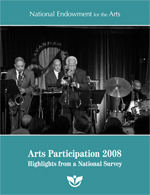 Joan Shigekawa, senior deputy chairman of the National Endowment for the Arts (NEA), convened a roundtable discussion yesterday with national arts service organizations, regional arts organizations, and NEA staff to discuss the NEA’s 2008 Survey of Public Participation in the Arts, the nation’s largest and most representative study of adults’ arts participation habits.
Representatives from forty organizations participated, including Linda Downs, CAA executive director, as well as leaders from the Association of Art Museum Directors, Dance/USA, the Future of Music Coalition, the National Association of Latino Art and Culture, the National Center for Creativity in Aging, the National Network for Folk Arts in Education, and the New England Foundation for the Arts.
The convening began with a greeting from NEA chairman Rocco Landesman, followed by a summary presentation of the survey’s findings from Sunil Iyengar, NEA director of research. Representatives from three organizations offered formal responses—Helen De Michiel from the National Alliance for Media Arts and Culture, Carlton Turner from Alternate ROOTS, and Jesse Rosen from the League of American Orchestras—following which Shigekawa led a frank, freewheeling conversation about how these findings should inform the arts community’s work going forward, as well as how the survey should be expanded and refined in the future.
“It is important that the National Endowment for the Arts have regular conversation with the arts community about how the public participates in the arts, and what we can do to connect more Americans with more art, more often,” said Shigekawa. “Our research shows a strong connection between arts participation and civic participation, but art only works when the public participates. Today was a chance for the NEA staff to hear and learn from the service organizations that work with our country’s arts organizations, and we look forward to many more such opportunities.”
The 2008 Survey of Public Participation in the Arts, which was conducted in partnership with the US Census Bureau, asked more than 18,000 people 18 years of age and older about their frequency of arts engagement. CAA reported on the findings of the survey, which has been conducted five times since 1982, in June. Here are a few more statistics about American participation in the arts:
- Generation Y reports taking fewer arts classes and lessons. When people ages 18 to 24 were asked if they had taken an art class or lesson at some point in their lives, they reported lower rates of participation than previous generations for all art forms compared in this study (by 6 to 23 percentage points, depending on the art form, from 1982 to 2008)
- Arts participation correlates with higher civic participation. People who participate in the arts are two to three times as likely to engage in positive civic and individual activities—such as volunteering, attending sporting events, and participating in outdoor activities—than nonarts participants
- New England and Pacific region residents had some of the highest rates of attendance (42 percent of adults in each region) for the arts activities traditionally measured in the survey. In addition, the Plains states of Kansas and Nebraska have some of the highest participation rates for personal performance or creation of art nationwide. Twenty percent of adults in Kansas said they played a musical instrument. In Nebraska, that rate was nearly 18 percent. (Nationwide, 13 percent—or 29 million Americans—reported playing a musical instrument.)
A related research note on arts participation measured in regions and states will be released soon. The NEA will release additional topic-specific reports on the roles of age, race and ethnicity, arts learning, media use, and arts creation and performance. The survey, geographic research note, questionnaire, raw data, and user’s guide are available on the NEA website.
NEA Convenes with Arts-Organization Leaders to Discusses Recent Survey
posted Dec 11, 2009
Joan Shigekawa, senior deputy chairman of the National Endowment for the Arts (NEA), convened a roundtable discussion yesterday with national arts service organizations, regional arts organizations, and NEA staff to discuss the NEA’s 2008 Survey of Public Participation in the Arts, the nation’s largest and most representative study of adults’ arts participation habits.
Representatives from forty organizations participated, including Linda Downs, CAA executive director, as well as leaders from the Association of Art Museum Directors, Dance/USA, the Future of Music Coalition, the National Association of Latino Art and Culture, the National Center for Creativity in Aging, the National Network for Folk Arts in Education, and the New England Foundation for the Arts.
The convening began with a greeting from NEA chairman Rocco Landesman, followed by a summary presentation of the survey’s findings from Sunil Iyengar, NEA director of research. Representatives from three organizations offered formal responses—Helen De Michiel from the National Alliance for Media Arts and Culture, Carlton Turner from Alternate ROOTS, and Jesse Rosen from the League of American Orchestras—following which Shigekawa led a frank, freewheeling conversation about how these findings should inform the arts community’s work going forward, as well as how the survey should be expanded and refined in the future.
“It is important that the National Endowment for the Arts have regular conversation with the arts community about how the public participates in the arts, and what we can do to connect more Americans with more art, more often,” said Shigekawa. “Our research shows a strong connection between arts participation and civic participation, but art only works when the public participates. Today was a chance for the NEA staff to hear and learn from the service organizations that work with our country’s arts organizations, and we look forward to many more such opportunities.”
The 2008 Survey of Public Participation in the Arts, which was conducted in partnership with the US Census Bureau, asked more than 18,000 people 18 years of age and older about their frequency of arts engagement. CAA reported on the findings of the survey, which has been conducted five times since 1982, in June. Here are a few more statistics about American participation in the arts:
- Generation Y reports taking fewer arts classes and lessons. When people ages 18 to 24 were asked if they had taken an art class or lesson at some point in their lives, they reported lower rates of participation than previous generations for all art forms compared in this study (by 6 to 23 percentage points, depending on the art form, from 1982 to 2008)
- Arts participation correlates with higher civic participation. People who participate in the arts are two to three times as likely to engage in positive civic and individual activities—such as volunteering, attending sporting events, and participating in outdoor activities—than nonarts participants
- New England and Pacific region residents had some of the highest rates of attendance (42 percent of adults in each region) for the arts activities traditionally measured in the survey. In addition, the Plains states of Kansas and Nebraska have some of the highest participation rates for personal performance or creation of art nationwide. Twenty percent of adults in Kansas said they played a musical instrument. In Nebraska, that rate was nearly 18 percent. (Nationwide, 13 percent—or 29 million Americans—reported playing a musical instrument.)
A related research note on arts participation measured in regions and states will be released soon. The NEA will release additional topic-specific reports on the roles of age, race and ethnicity, arts learning, media use, and arts creation and performance. The survey, geographic research note, questionnaire, raw data, and user’s guide are available on the NEA website.
Executive Summary of the New CAA Strategic Plan
posted Dec 10, 2009
 The executive summary for CAA’s Strategic Plan 2010–2015 is now available for download from the CAA website. During the strategic-planning process, a task force comprising members of the Board of Directors, CAA staff and committees, and more reviewed the mission, needs, and long-term goals of CAA. The 2010–2015 plan contains new mission, vision, and values statements and identifies seven important goals of the organization that are intended to meet the needs of all members in the visual arts.
The seven goals outlined in the plan focus on promoting the visual arts and meeting the needs of CAA’s membership, while expanding the programs, publications, and finances in order to do so. Some important strategies for accomplishing these goals include strengthening CAA’s ability to represent the visual arts, improving communication with national and international members, and establishing and identifying new sources of earned revenue. In his letter prefacing the summary, Paul B. Jaskot, CAA president, states, “With the plan in place, CAA will be able to advocate for the visual arts nationally and internationally and create new opportunities for dialogue among our members.”
For more details, see Jaskot’s letter, download the executive summary, and read the new mission, vision, and values statements.
Finalists for CAA’s 2010 Morey and Barr Book Awards
posted Dec 08, 2009
CAA is pleased to announce the finalists for the Charles Rufus Morey Book Award and the Alfred H. Barr, Jr., Award for 2010. The winners of both prizes, along with the recipients of other Awards for Distinction, will be announced in early January and presented in February during Convocation at the 2010 Annual Conference in Chicago.
The Charles Rufus Morey Book Award honors an especially distinguished book in the history of art, published in any language between September 1, 2008, and August 31, 2009. The four finalists are:
- Matthew Biro, The Dada Cyborg: Visions of the New Human in Weimar Berlin (Minneapolis: University of Minnesota Press, 2009)
- Cammy Brothers, Michelangelo, Drawing, and the Invention of Architecture (New Haven: Yale University Press, 2008)
- Carrie Lambert-Beatty, Being Watched: Yvonne Rainer and the 1960s (Cambridge, MA: MIT Press, 2008)
- Shelley Perlove and Larry Silver, Rembrandt’s Faith: Church and Temple in the Dutch Golden Age (University Park: Pennsylvania State University Press, 2009)
The Alfred H. Barr, Jr., Award for museum scholarship is presented to the author(s) of an especially distinguished catalogue in the history of art, published between September 1, 2008, and August 31, 2009, under the auspices of a museum, library, or collection. The three finalists are:
- Andrea Bayer, ed., Art and Love in Renaissance Italy (New York: Metropolitan Museum of Art, in association with Yale University Press, 2008)
- Debra Diamond, Catherine Glynn, and Karni Singh Jasol, Garden and Cosmos: The Royal Paintings of Jodhpur (Washington, DC: Arthur M. Sackler Gallery, Smithsonian Institution, 2008)
- Sarah Greenough, Looking In: Robert Frank’s “The Americans” (Washington, DC: National Gallery of Art, 2009)
Convocation at the 2010 Annual Conference, which includes the awards ceremony, takes place on Wednesday evening, February 10, 5:30–7:00 PM, in Grand EF, East Tower, Gold Level, Hyatt Regency Chicago. The event is free and open to the public.
For more information about CAA’s Awards for Distinction, please contact Lauren Stark, CAA manager of programs, at 212-691-1051, ext. 248.
New CAA Standards and Guidelines
posted Dec 07, 2009
Mary-Ann Milford-Lutzker is CAA’s vice president for committees. She is also professor of Asian art history, Carver Chair in East Asian Studies, and provost and dean of the faculty at Mills College in Oakland, California.
In line with CAA’s practice to update $500 payday loans online same day regularly its Standards and Guidelines for professional practices in the fields of art and art history, the Board of Directors approved three revised guidelines for art historians and a new one for academic art administrators at its meeting on October 25, 2009. This work was carried out by four task forces, established by CAA’s president Paul B. Jaskot and executive director Linda Downs, that were overseen by the Professional Practices Committee.
Professional Practices for Art Historians
Authentications and Attributions (2009): The task force appointed by President Jaskot established the need for a stand-alone and separate document for art historians regarding authentications and attributions of works of art. It was determined that no other issue is more urgent for, and its consequences so specific to, the welfare of the profession than dealing with inauthenticity and false attributions. Not only is the integrity of artists and collections at stake, but the economic well-being of art historians who engage in trying to separate the false from the true is also endangered.
Information about authentications and attributions formerly appeared in A Code of Ethics for Art Historians and Guidelines for the Professional Practice of Art History.
Guidelines for Curatorial-Studies Programs (2009): A growing number of colleges and universities across the country have instituted programs in curatorial studies. The revisions for the document, first published in 2004, are intended to help art departments and administrators organizing curricula and to aid faculty advisors and students determining which curatorial-studies programs are appropriate for an individual’s specific interests, abilities, and career goals.
Standards for Retention and Tenure of Art Historians (2009): This guideline, last revised in 2005, has been amended to embrace community and two-year colleges. Inclusion of community colleges into these standards will make this document relevant for art-history faculty who attempt to achieve the highest stands of professional practices in such institutions. It will also help to validate the objectives of professionals who have few peers to support them in their efforts to improve the practice of art history at their institutions.
Professional Practices for Academic Art Administrators
Standards and Guidelines for Academic Art Administrators (2009): This document will serve as a resource for emerging, new, and current academic art administrators, as well as benefiting other CAA members seeking guidance regarding the role of academic art administrators operating in a visual-arts context. The task force was made up of administrators from diverse geographical regions and varied professional experiences that included program directors, chairs and division heads, directors of schools of art, associate deans, deans, and vice presidents http://loans-cash.net/how-it-works.php .
Acknowledgments
I want to thank all the members of the four task forces (listed respectively on the webpages of their Standards and Guidelines), who worked together to revise and create these Standards and Guidelines. In particular I want to acknowledge the work of Maxine Payne, chair of the Professional Practices Committee, who so diligently worked on all this material and encouraged each task force along the way.
New CAA Member Benefit: Humanities E-Book
posted Dec 04, 2009
 Humanities E-Book, a project of the American Council of Learned Societies (ACLS), offers unlimited access to its collection of nearly three thousand cross-searchable, full-text titles across the humanities and related social sciences. Titles, which include fifty-six CAA Monographs on the Fine Arts, have been selected and peer reviewed by ACLS constituent learned societies for their continued importance and value in teaching and researching. The collection, which grows by about five hundred books a year, includes both in- and out-of-print titles published from the 1880s to the present. Humanities E-Book titles also link to publishers’ websites and to online reviews in JSTOR, Project MUSE, and other sites.
Individual Subscriptions
As a special benefit of CAA membership, individual members can acquire a twelve-month, renewable subscription to Humanities E-Book for $35, which helps sustain the resource for the entire scholarly community.
Individual subscriptions are an attractive option for those whose institutions do not already subscribe to Humanities E-Book, or for CAA members who might not be affiliated with a subscribing institution. Please check this list to see if your institution subscribes.
When completing the Humanities E-Book’s online purchase module, choose the College Art Association from the Society Affiliation pull-down menu and enter your CAA member number. Be sure to review the terms of service before subscribing. For inquiries, please write to subscriptions@hebook.org or call 212-697-1505.
Institutional Subscriptions
Humanities E-Book offers a special 10 percent discount on subscriptions to institutional CAA members. Subscriptions range from $450 to $3,125, depending on the size of your institution.
Institutional subscription information, including pricing, is available on the Humanities E-Book website. For a free trial, a subscription for your school, museum, or organization, or further information, please write to info@hebook.org and mention that you are an institutional CAA member.
CAA Announces 2009 Wyeth Publication Grant Recipients
posted Dec 02, 2009
CAA is pleased to announce four recipients of the Wyeth Foundation for American Art Publication Grant for 2009:
- Hiroko Ikegami, The Great Migrator: Robert Rauschenberg and the Global Rise of American Art, MIT Press
- Kevin D. Murphy, Jonathan Fisher of Blue Hill, Maine: Commerce, Culture, and Community on the Eastern Frontier, University of Massachusetts Press
- David Raskin, Donald Judd’s Local Orders: Art, Principles, and Activism, Yale University Press
- Alison Syme, A Touch of Blossom: John Singer Sargent and the Queer Flora of Fin-de-Siècle Art, Pennsylvania State University Press
Since 2005, Wyeth grants have annually supported one or more book-length scholarly manuscripts in the history of American art, visual studies, and related subjects that have been accepted by a publisher on their merits but cannot be published in the most desirable form without a subsidy.
For purposes of this grant program, “American art” is defined as art created in the United States, Canada, and Mexico prior to 1970.
Application criteria and guidelines for the Wyeth Grant are available at www.collegeart.org/wyeth or from nyoffice@collegeart.org. Deadline: October 1, 2010.
CAA Joins Coalition Issuing Statement on Censorship in Response to Threats of Violence
posted Dec 01, 2009
The College Art Association has joined the National Coalition Against Censorship, the American Association of University Professors, and other leading groups in academia, civil liberties, journalism, and free speech to issue a Statement of Principle and Call to Action urging governments, institutions, and private individuals to support freedom of expression and academic freedom, and to resist caving in to threats of violence.
This statement (see below) is a response to a number of incidents, specifically the decision by Yale University officials to remove all images of Mohammed from Jytte Klausen’s book, The Cartoons That Shook the World. This scholarly treatise examines the violent response in 2005 to twelve drawings by Danish cartoonists depicting the prophet Mohammed. While Yale officials cited “generic” fears of violence as the reason for excising all the images, there have been no actual threats of violence.
The statement, which follows a letter sent to Yale in September 2009 regarding the images in Klausen’s book, acknowledges that violence has been a common response to controversial words and images throughout human history and is now threatening the commitment to free speech, raising concerns about “fear-induced self-censorship.”
While the statement is immediately in response to the incident at Yale, religion is only one of a number of prominent issues known to incite violence. Recent examples of self-censorship in the visual arts include an exhibition at the San Francisco Art Institute in 2008 that was cancelled in response to violent threats from animal-rights activists, and an instance in 2006 in which the Whitechapel Gallery in London made the decision not to exhibit twelve works by Hans Bellmer, declaring that they were too dangerous to display because the sexual overtones would offend the Muslim population in the area.
Statement of Principle: Free Expression at Risk, at Yale and Elsewhere
A number of recent incidents suggest that our long-standing commitment to the free exchange of ideas is in peril of falling victim to a spreading fear of violence. Not only have exhibitions been closed and performances canceled in response to real threats, but the mere possibility that someone, somewhere, might respond with violence has been advanced to justify suppressing words and images, as in the recent decision of Yale University to remove all images of Mohammed from Jytte Klausen’s book, The Cartoons that Shook the World.
Violence against those who create and disseminate controversial words and images is a staple of human history. But in the recent past, at least in liberal democracies, commitment to free speech has usually trumped fears of violence. Indeed, as late as 1989, Salman Rushdie’s Satanic Verses continued to be published, sold, and read in the face of a fatwa against its author and in the face of the murder and attempted murder of its translators and publishers. In 1998, the Manhattan Theater Club received threats protesting the production of Terrence McNally’s play, Corpus Christi, on the ground that it was offensive to Catholics. After initially canceling the play, MTC reversed its decision in response to widespread concerns about free speech, and the play was performed without incident.
There are signs, however, that the commitment to free speech has become eroded by fears of violence. Historical events, especially the attacks of September 2001 and subsequent bombings in Madrid and London, have contributed to this process by bringing terrorist violence to the heart of liberal democracies. Other events, like the 2004 murder of Dutch film director Theo Van Gogh in apparent protest against his film “Submission,” and the threats against Ayaan Hirsi Ali, who wrote the script and provided the voice-over for the film, demonstrated how vulnerable artists and intellectuals can be just for voicing controversial ideas. Under such threats, the resolve to uphold freedom of speech has proved to be lamentably weak: in the same year as Van Gogh’s murder, Behzti, a play written by a British Sikh playwright, was canceled days after violence erupted among protesters in Birmingham, England on opening night.
In response to rising concerns about fear-induced self-censorship, in 2005 the Danish newspaper Jyllands-Posten published an article, “The face of Mohammed,” which included twelve cartoon images. The cartoons became the focus of a series of violent political rallies in the Middle East in February 2006 and a subject of worldwide debate pitting free speech against “cultural sensitivity.”
For all the prominence of religion in such debates, threats of violence against words and images are not the sole province of religious extremists. In 2005, a politically controversial professor’s scheduled speech at Hamilton College in Clinton, NY was canceled in response to threats of violence. In 2008, the San Francisco Art Institute closed a controversial video exhibition in response to threats of violence against faculty members by animal rights activists. Later that year, the University of Nebraska-Lincoln canceled a speech by former Weatherman and education theorist William Ayers citing security concerns.
The possibility of giving offense and provoking violence has entered the imagination of curators, publishers and the public at large, generating more and more incidents of preemptive self-censorship: in 2006, for instance, London’s Whitechapel gallery declared twelve works by Surrealist master Hans Bellmer too dangerous to exhibit because of fears that the sexual overtones would be offensive to the large Muslim population in the area; and publisher Random House canceled the 2008 publication of Sherry Jones’ The Jewel of Medina because “it could incite acts of violence.” The suppression of images in Jytte Klausen’s book is the latest, but not likely to be the last in the series of such incidents.
Words and images exist in complex socio-political contexts. Suppressing controversial expression cannot erase the underlying social tensions that create the conditions for violence to begin with, but it does create a climate that chills and eventually corrupts the fundamental values of liberal democracy.
A Call to Action
The incident at Yale provides an opportunity to re-examine our commitment to free expression. When an academic institution of such standing asserts the need to suppress scholarly work because of a theoretical possibility of violence “somewhere in the world,” it grants legitimacy to censorship and casts serious doubt on their, and our, commitment to freedom of expression in general, and academic freedom in particular.
The failure to stand up for free expression emboldens those who would attack and undermine it. It is time for colleges and universities in particular to exercise moral and intellectual leadership. It is incumbent on those responsible for the education of the next generation of leaders to stand up for certain basic principles: that the free exchange of ideas is essential to liberal democracy; that each person is entitled to hold and express his or her own views without fear of bodily harm; and that the suppression of ideas is a form of repression used by authoritarian regimes around the world to control and dehumanize their citizens and squelch opposition.
To paraphrase Ben Franklin, those who would give up essential liberty to purchase a little temporary safety, will get neither liberty nor safety.
Joan E. Bertin, Executive Director, National Coalition Against Censorship
Cary Nelson, President, American Association of University Professors
Endorsed by:
American Association of University Professors
American Civil Liberties Union
American Federation of Teachers
American Society of Journalists and Authors
Center for Democracy and Technology
Center for Inquiry
College Art Association
First Amendment Lawyers Association
First Amendment Project
Foundation for Individual Rights in Education
International Publishers Association
Modern Language Association
National Coalition Against Censorship
National Council of Teachers of English
National Education Association
People For the American Way Foundation