CAA News Today
The Art Bulletin Seeks Reviews Editor
posted Aug 19, 2008
 As the current term of the Art Bulletin reviews editor is coming to its conclusion, CAA invites applicants for the next term, July 1, 2009–June 30, 2012 (with service as incoming reviews editor designate from February to June 2009). The Art Bulletin, published quarterly by CAA, is the leading publication of art history in English.
Candidates should be art scholars with stature in the field and experience in editing book and/or exhibition reviews; institutional affiliation is not required. Candidates should be published authors of at least one book.
The reviews editor is responsible for commissioning all book and exhibition reviews in The Art Bulletin. He or she selects books and exhibitions for review, commissions reviewers, and determines the appropriate length and character of reviews. The reviews editor also works with authors and CAA’s director of publications in the development and preparation of review manuscripts for publication. He or she is expected to keep abreast of newly published and important books and recent exhibitions in the fields of art history, criticism, theory, visual studies, and museum publishing. This is a three-year term, which includes membership on the Art Bulletin Editorial Board.
The reviews editor attends the three annual meetings of the Art Bulletin Editorial Board—held in the spring and fall in New York and in February at the CAA Annual Conference—and submits an annual report to CAA’s Publications Committee. CAA reimburses the reviews editor for travel and lodging expenses for the spring and fall New York meetings in accordance with its travel policy, but he or she pays these expenses to attend the conference.
Candidates must be current CAA members and should not be serving on the editorial board of a competitive journal or on another CAA editorial board or committee. Nominators should ascertain their nominee’s willingness to serve before submitting a name; self-nominations are also welcome. Please send a statement describing your interest in and qualifications for appointment, CV, and at least one letter of recommendation to: Director of Publications, Art Bulletin Reviews Editor Search, CAA, 275 Seventh Ave., 18th Floor, New York, NY 10001. Deadline: September 15, 2008; finalists will be interviewed on October 24, 2008, in New York.
Annual Conference Travel Grants
posted Aug 18, 2008
CAA offers Annual Conference travel grants to graduate students in art history and studio art and to international artists and scholars. The grants are funded by donations from the contribution check-off on the CAA membership form. CAA warmly thanks those members who made voluntary contributions to this fund.
Graduate Student Conference Travel Grant
This $150 grant is awarded to advanced PhD and MFA graduate students as partial reimbursement of expenses for travel to the 2009 Annual Conference in Los Angeles. To qualify for the grant, students must be current CAA members. Candidates should include a completed application form, a brief statement by the student stipulating that he or she has no external support for travel to the conference, and a letter of support from the student’s adviser or head of department. For application forms and more information, please contact Lauren Stark at 212-691-1051, ext. 248, or lstark@collegeart.org. Send application materials to: Lauren Stark, Graduate Student Conference Travel Grant, CAA, 275 Seventh Ave., 18th Floor, New York, NY 10001. Deadline: September 26, 2008.
International Member Conference Travel Grant
CAA presents a $500 grant to artists or scholars from outside the United States as partial reimbursement of expenses for travel to the 2009 Annual Conference in Los Angeles. To qualify for the grant, applicants must be current CAA members. Candidates should include a completed application form, a brief statement by the applicant stipulating that he or she has no external support for travel to the conference, and two letters of support. For application forms and additional information, please contact Lauren Stark at 212-691-1051, ext. 248, or lstark@collegeart.org. Send materials to: Lauren Stark, International Member Conference Travel Grant, CAA, 275 Seventh Ave., 18th Floor, New York, NY 10001. Deadline: September 26, 2008.
CAA Seeks Award Nominations
posted Aug 12, 2008
Recognize someone who has made extraordinary contributions to the fields of art and art history by nominating him or her for one of twelve CAA Awards for Distinction. Award juries consider your personal letters of recommendation when making their selections. In the letter, state who you are; how you know (of) the nominee; how the nominee and/or his or her work or publication has affected your practice or studies and the pursuit of your career; and why you think this person (or, in a collaboration, these people) deserves to be recognized. We also urge you to contact five to ten colleagues, students, peers, collaborators, and/or coworkers of the nominee to write letters. The different perspectives and anecdotes from multiple letters of nomination provide juries with a clearer picture of the qualities and attributes of the candidates.
The twelve Awards for Distinction are:
- The Distinguished Feminist Award honors a person who, through his or her art, scholarship, or advocacy, has advanced the cause of equality for women in the arts
- The Charles Rufus Morey Book Award honors an especially distinguished book in the history of art, published in the English language. (To give the jury the full opportunity to evaluate each submission fairly, please send your nomination by July 31, 2008)
- The Alfred H. Barr, Jr., Award for museum scholarship is presented to the author or authors of an especially distinguished catalogue in the history of art, published in the English language under the auspices of a museum, library, or collection. (To give the jury the full opportunity to evaluate each submission fairly, please send your nomination by July 31, 2008)
- The Arthur Kingsley Porter Prize is awarded for a distinguished article published in The Art Bulletin by a scholar of any nationality who is under the age of thirty-five or who has received the doctorate no more than ten years before the acceptance of the article for publication
- The Art Journal Award is presented to the author of the most distinguished contribution (article, interview, conversation, portfolio, review, or any other text or visual project) published in Art Journal
- The Frank Jewett Mather Award is awarded to an author of art journalism that has appeared in whole or in part in North American publications
- The Distinguished Teaching of Art Award is presented to an individual who has been actively engaged in teaching art for most of his or her career
- The Distinguished Teaching of Art History Award is presented to an individual who has been actively engaged in teaching art history for most of his or her career
- The Artist Award for a Distinguished Body of Work is given to a living artist of national or international stature for exceptional work through exhibitions, presentations, or performances
- The Distinguished Artist Award for Lifetime Achievement celebrates the career of an artist who has demonstrated particular commitment to his or her work throughout a long career and has had an impact nationally and internationally on the field
- The CAA/Heritage Preservation Award for Distinction in Scholarship and Conservation honors outstanding contributions by one or more persons who, individual or jointly, have enhanced understanding of art through the application of knowledge and experience in conservation, art history, and art
- The Distinguished Lifetime Achievement Award for Writing on Art celebrates the career of an author of note and includes the publication of art criticism, art history, art biography, and/or art theory
All nomination campaigns should include one copy of the nominee’s CV (limit: two pages). Nominations for book and exhibition awards should be for authors of books published or works exhibited or staged between September 1, 2007, and August 31, 2008. No more than ten letters per candidate are considered. For more information, please write to Claire Vancik, CAA programs assistant. Deadline: July 31, 2008, for the Morey and Barr awards; August 31, 2008, for all others.
New Editorial-Board Members and Field Editors
posted Aug 06, 2008
CAA welcomes the following people to the editorial boards of its three scholarly journals, and to the caa.reviews Council of Field Editors.
New Journal Editorial-Board Members
Natalie Kampen of Barnard College has joined the Art Bulletin Editorial Board. The Art Journal Editorial Board welcomes Jan Estep, Regis Center for Art at the University of Minnesota; Karin Higa, Japanese American National Museum; and Terence E. Smith, University of Pittsburgh. Laura Auricchio of Parsons the New School for Design has joined the caa.reviews Editorial Board. All members serve four-year terms.
New caa.reviews Field Editors
caa.reviews welcomes three new field editors, who will serve three-year terms for the journal: Linda Komaroff of the Los Angeles County Museum of Art will commission reviews of books on Islamic art; Marjorie Munsterberg of City College of New York, City University of New York, will commission reviews of books on nineteenth-century art; and Jon Seydl of the Cleveland Museum of Art will commission reviews of exhibitions in the Midwest.
Chair a Chicago Conference Session
posted Aug 01, 2008
CAA holds its 98th Annual Conference in Chicago, Illinois, from Wednesday, February 10, to Saturday, February 13, 2010. The Annual Conference Committee invites session proposals that cover the breadth of current thought and research in art, art and architectural history, theory and criticism, pedagogical issues, museum and curatorial practice, conservation, and developments in technology. Session proposals are accepted through an online submission process at http://conference.collegeart.org/2010.
The process of fashioning the conference program is a delicate balancing act. The 2010 program is shaped by four broad submission categories: Historical Studies, Contemporary Issues/Studio Art, Educational and Professional Practices, and Open Forms.
Also included in the mix are sessions presented by affiliated societies, CAA committees, and, for balance and programmatic equity, open sessions (which have a broad, inclusive topic or theme). Most program sessions, however, are drawn from submissions by individual members; the committee greatly depends on the participation of the CAA membership in forming the conference.
The Annual Conference Committee welcomes session proposals that include the work of established artists and scholars, along with that of younger scholars, emerging and midcareer artists, and graduate students. Particularly welcome are those sessions that highlight interdisciplinary work. Artists are especially encouraged to propose sessions appropriate to dialogue and information exchange relevant to artists.
The committee considers proposals from CAA members only. Once selected, session chairs must remain current members through 2010. No one may chair a session more than once in a three-year period. (That is, individuals who chaired sessions in 2008 or 2009 may not chair a session in 2010.)
Sessions may bring together scholars and participants in a wide range of fields, including but not limited to: anthropology, history, economics, philosophy, religion, literary theory, and new media. In addition, the committee seeks topics that have not been addressed in recent conferences or areas that have traditionally been underrepresented.
Proposals need not conform to traditional panel formats; indeed, experimentation is highly desirable. To this end, CAA presents Open Forms, a session category that encourages the submission of experimental and nontraditional formats (e.g., roundtables, performances, forums, conversations, multimedia presentations, and workshops). Open Forms sessions may be preformed, with participants chosen in advance by session chairs. Please note that these sessions require advance planning by the session chair; apply only if you have the time required to attend to such tasks.
Sessions selected by the Annual Conference Committee for the 2010 conference are considered regular program sessions; that is, they are 2½-hours long, are scheduled during the eight regular program time slots during the four days of the conference, and require a conference badge for admission. With the exception of the Open Forms category, CAA session proposals may not be submitted as preformed panels with a list of speakers. Proposals for papers for the 2010 sessions are solicited through the 2010 Call for Participation, published in February 2009.
Each CAA affiliated society and CAA committee may submit one proposal that follows the guidelines outlined above. A letter of support from the society or committee must accompany the submission. The Annual Conference Committee considers it, along with the other submissions, on the basis of merit.
Session Categories
Below are descriptions of the four general submission categories.
- Historical Studies: This category broadly embraces all art-historical proposals up to the third quarter of the twentieth century
- Contemporary Issues/Studio Art: This category is intended for studio-art proposals, as well as those concerned with contemporary art and theory, criticism, and visual culture
- Educational and Professional Practices: This category pertains to session proposals that develop along more practical lines and address the educational and professional concerns of CAA members as teachers, practicing artists and critics, or museum curators
- Open Forms: This category encourages experimental and alternative formats that transcend the traditional panel, with presentations whose content extends to serve the areas of contemporary issues, studio art, historical studies, and educational and professional practices
Proposal Submission Guidelines
For the 2010 conference, all session proposals are completed online. Please visit http://conference.collegeart.org/2010 to begin your application. Prospective chairs must include the following in their proposal:
- Top sheet: a completed session-proposal form, which must be filled out online and then printed. Please size your hard copy to fit an 8½ x 11 inch sheet of paper
- Second sheet: if you have prior approval of one of CAA’s affiliated societies or a CAA committee to submit an application for a sponsored session, you must include an official letter of support from the society or committee. If you are not submitting an application for a sponsored session, please skip this step
- Third sheet: your CV and, if applicable, the CV of your cochair; no more than two pages in length each
Please mail eighteen (18) collated and stapled copies of your entire session-proposal application to the CAA manager of programs (mailing address appears at the end of the article). Do not use paper clips.
The Annual Conference Committee makes its selection solely on the basis of merit. Where proposals overlap, CAA reserves the right to select the most considered version or, in some cases, to suggest a fusion of two or more versions from among the proposals submitted.
The submission process must be completed online. Eighteen printed, stapled, and collated copies of your completed application must be sent by mail to: Manager of Programs, Sessions 2010, CAA, 275 Seventh Ave., 18th Floor, New York, NY 10001. Deadline: September 1, 2008; no late applications are accepted.
For questions, please contact Susan DeSeyn-Lodise, CAA sessions coordinator.
Spring Meiss Winners
posted Jul 30, 2008
CAA has awarded five Millard Meiss Publication Grants for spring 2008. Thanks to the generous bequest of the late Prof. Millard Meiss, these grants are given twice annually to publishers to support the publication of scholarly books in art history and related fields.
The grantees are:
- Molly Aitken, The Intelligence of Tradition: Form and Meaning in Mewar Painting (Yale University Press)
- Elissa Auther, String, Felt, Thread, and the Hierarchy of Art and Craft in American Art, 1961–1979 (University of Minnesota Press)
- Marin F. Hanson and Patricia Cox Crews, eds., American Quilts in the Modern Age, 1870–1940: A Catalog from the International Quilt Study Center (University of Nebraska Press)
- Richard King, ed., Art and the Artist in Cultural Revolution China (University of British Columbia Press)
- Judith Ostrowitz, Interventions: Native American Art for Far-Flung Territories, (University of Washington Press)
Books eligible for a Meiss grant must already be under contract with a publisher on a subject in the arts or art history. Authors must be current CAA members. Application criteria and guidelines are available online or from nyoffice@collegeart.org. Deadlines: March 15 and October 1 of every year
Art Journal Seeks Editor-in-Chief
posted Jul 26, 2008
As the current term of the Art Journal editor-in-chief is coming to its conclusion, CAA invites applicants for the next term, July 1, 2009–June 30, 2012 (preceded by a term as editor designate from November 2008 to June 2009). Art Journal, published quarterly by CAA, promotes informed discussion about issues across disciplines in twentieth- and twenty-first-century art, nationally and internationally.
Candidates may be artists, art historians, art critics, art educators, curators, or other art professionals; institutional affiliation is not required.
Advised by the Art Journal Editorial Board, the editor-in-chief is responsible for the content and character of the journal. He or she reads all submitted manuscripts and reviews all submitted artist projects, sends them to peer reviewers, provides guidance to authors and artists concerning the form and content of submissions, and makes final decisions regarding the acceptability of all submissions for publication. The editor-in-chief is not responsible for commissioning reviews. The editor-in-chief works closely with CAA staff in New York, where the publication is produced. This is a half-time position. CAA may negotiate course release or other compensation for the editor.
The editor-in-chief attends the three annual meetings of the Art Journal Editorial Board—held in the spring and fall in New York and in February at the Annual Conference—and submits an annual report to CAA’s Publications Committee. CAA reimburses the editor-in-chief for travel and lodging expenses for the spring and fall New York meetings in accordance with its travel policy, but he or she pays these expenses to attend the conference.
Candidates must be current CAA members and should not be serving on the editorial board of a competitive journal or on another CAA editorial board or committee. Nominators should ascertain their nominee’s willingness to serve before submitting a name; self-nominations are also welcome. Please send a statement describing your interest in and qualifications for appointment, CV, and at least one letter of recommendation to: Director of Publications, Art Journal Editor-in-Chief Search, CAA, 275 Seventh Ave., 18th Floor, New York, NY 10001. Deadline: September 15, 2008; finalists will be interviewed October 23, 2008, in New York.
July CAA News Now Online
posted Jul 02, 2008
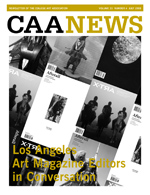 The July CAA News has been posted to the CAA website. You can download a 1.6-megabyte PDF of the issue by clicking on the cover at right.
In the issue, CAA News talks to the editors of two art magazines with roots in Los Angeles: X-TRA and Afterall. Also included are CAA’s new procedures for developing professional standards and guidelines; a report on the recent Board of Directors meeting in May; and information on registration rates for the upcoming Los Angeles conference and travel grants to attend it.
The deadline for submissions to the September issue is July 10, 2008. Please send yours to Christopher Howard, CAA News editor.
CAA News Back in Print in September
posted Jul 01, 2008
Beginning with the September 2008 issue, CAA News will once again be printed and mailed to all individual and institutional members six times a year.
In July 2007, the newsletter transformed from printed publication to a PDF document distributed online primarily to balance the previous year’s budget. The decision, made by the CAA Board of Directors, was not a permanent one.
Going from 32–48 pages to 16–24 pages per issue, the new CAA News will focus largely on organizational business, providing updates on the Annual Conference; listing individual- and institutional-member achievements; publishing calls for participation for CAA committees, editorial boards, awards committees; and more.
At the same time, CAA plans to beef up its website, with more online-only content. Former newsletter sections such as the Advocacy Update and the Obituaries, for example, will be exclusive to the web as part of a larger initiative to revamp the CAA website. We want www.collegeart.org to become an indispensable resource for artists and scholars, curators and educators, and critics and other arts professionals throughout the year.
CAA News will continue to appear as a PDF document on the website; past issues go back to March 2002. Posted at the beginning of the month of publication, the newsletter can be read immediately—before the printed publication arrives in your mailbox.
If you wish to receive CAA News in electronic format only, please contact CAA Member Services.
Special House Hearing Highlights NEA and NEH Programs
posted May 15, 2008
On May 8, 2008, a hearing was held by the Healthy Families and Communities Subcommittee in the House of Representatives to discuss the National Endowment for the Arts (NEA) and the National Endowment for the Humanities (NEH). While the subcommittee has jurisdiction over NEH and NEA authorization, this was an informational hearing only.
The following individuals provided testimony on the national impact of NEH and NEA programs: Ken Burns, documentary filmmaker; Bruce Cole, NEH chairman; Dana Gioia, NEA chairman; William Glacken, mayor of Freeport, New York; Jeanne Schmedlen, director of special projects and chief of protocol office for the speaker of the Pennsylvania House of Representatives; Katrine Watkins, librarian at Shaler Area Intermediate School in Glenshaw, Pennsylvania; and former US Army Captain Ryan Kelly, a participant in Operation Homecoming, an NEA-sponsored program.
The panelists emphasized the importance of NEH and NEA grants to their work and asked that Congress continue to support arts and humanities programming. Testimony focused on the agency’s special initiatives, including the NEH’s We the People Bookshelf and Picturing America programs, as well as the NEA’s Mayors Institute on Urban Design and Operation Homecoming. Chairwoman Carolyn McCarthy (D-NY) praised the NEA and NEH programs presented and identified them as essential to defining “what is America.” She also reiterated the importance of the arts and humanities to American society.