CAA News Today
Affiliated Society News for July 2013
posted by CAA — July 09, 2013
American Council for Southern Asian Art
The American Council for Southern Asian Art (ACSAA) invites members to contribute information regarding recent publications, exhibitions, conferences, or other newsworthy items for publication in the 2013 Bulletin. Submissions should be sent to the Bulletin’s editor, Melody Rodari.
Art, Literature, and Music in Symbolism and Decadence
Art, Literature, and Music in Symbolism and Decadence (ALMSD) will present two workshops under the title “Symbolist Movement and Mental Illnesses” at the Congress of Comparative Literature, taking place in July 17–24, 2013, in Paris, France. The moderator for both events is Rosina Neginsky, ALMSD president. The workshops are scheduled for Friday, July 19, between 2:30 and 6:45 PM. Neginsky is also presenting a paper, “Flaubert’s Herodias: Pictorial or Ekphratic?” on Monday, July 22, 2013, between 11:00 AM and 12:30 PM.
Community College Professors of Art and Art History
Community College Professors of Art and Art History (CCPAAH) is reaching out to new members: please visit the blog and keep up with the organization on Facebook. CCPAAH sponsored two sessions over the past year. Both “Teaching All of Our Students: Few Majors, Fewer Transfers, Many Others” at the CAA Annual Conference in New York and “The Value of Writing in the Foundation Year: Exploring New Approaches” at the Foundations in Art: Theory and Education (FATE) biennial conference in Savannah, Georgia, were well attended and very successful.
CCPAAH invites its members to submit proposals for papers to be presented at the next CAA Annual Conference, taking place February 12–15, 2014, in Chicago. The session, “Starting the Conversation: Engaging Students in the Studio and Art History,” will examine innovative ways to engage students in all kinds of courses: studio, digital, art history, art appreciation, and online. Paper topics should highlight best practices and might include: inventive ways to get students engaged in coursework; writing assignments beyond the standard art-history research paper; collaborative work; and using technology to help students become active learners. Please send all questions regarding CAA proposals to CCPAAH@gmail.com. The deadline for submittal of proposals is July 20, 2013. For more information about upcoming events and for general inquiries about the organization, write to CCPAAH@gmail.com.
Historians of Islamic Art Association

The Historians of Islamic Art Association (HIAA) plans to hold its fourth biennial symposium in October 2014 at the new Aga Khan Museum in Toronto, Ontario. The symposium theme and the call for participation will be announced this summer.
International Sculpture Center
On April 25, 2013, International Sculpture Center (ISC) honored Wayne E. Potratz of the University of Minnesota with its prestigious Outstanding Educator Award for 2013. Over one hundred of Potratz’s friends, colleagues, and former students came to witness him receiving the award and to congratulate him on his many exceptional achievements as both an educator and an artist. ISC established the Outstanding Educator Award program in 1996 to recognize individual artist-educators who have excelled at teaching sculpture in institutions of higher learning. Potratz, who earned his master’s degree in 1966 at the University of California, Berkeley, has been a faculty member in the University of Minnesota’s Department of Art since 1969. He chaired the department from 1985 to 1998 and is currently Professor and Scholar of the College. His work has been exhibited in 30 solo or two-person exhibitions and in 340 group exhibitions regionally, nationally, and internationally since 1964; it is also represented in 28 public and corporate collections and in 165 private collections. Potratz was a cofounder of the International Conference on Contemporary Cast Iron Art and has an extensive record of lectures, workshops, and professional service since 1966. For award details or to nominate an outstanding educator, please visit the ISC website.
Italian Art Society
The Italian Art Society (IAS) has announced the location of the fifth annual IAS/Kress Foundation Lecture in Italy for spring 2014: the Università di Pisa. Established North American scholars who wish to speak on ancient to modern art in the region of Pisa and Tuscany are welcome to apply (deadline: January 4, 2014). IAS thanks Sarah Blake McHam of Rutgers University, who spoke to a full house as the fourth annual IAS/Kress Lecture speaker. Her presentation, called “Laocoön, or Pliny Vindicated,” took place at the Fondazione Marco Besso in Rome on May 28, 2013.
IAS is pleased to announce its second Research and Publication Grant up to $1,000 (deadline: November 1, 2013). The society is also accepting applications for two $500 Travel Grants to support graduate students and/or emerging or independent scholars giving conference papers on Italian art in 2014 (deadline: November 1, 2013) and for grants for IAS members abroad to travel and present papers in IAS sessions at American conferences (deadline: October 7, 2013).
IAS had well-attended sessions at the 2013 meetings for CAA, the Renaissance Society of America, and the Society of Architectural Historians, and at the International Congress of Medieval Studies. IAS will sponsor sessions at the same conferences in 2014. See http://italianartsociety.org/conferences-lectures for details.
National Council of Arts Administrators

The 2013 annual conference of the National Council of Arts Administrators (NCAA) is moving to September; registration is now open. The conference, called “Huh? The Value of Uncertainty and Doubt in the Arts,” will convene in beautiful and temperate Richmond, Virginia. Richard Roth and Joe Seipel of Virginia Commonwealth University have ambitious plans for an amazing event, which will offer timely and forward-looking sessions, an administrator’s workshop, a program for partners and spouses, and much more. As always, NCAA enthusiastically welcomes any and all interested professionals to its conference. Register by September 3, 2013, for the advance rate of $275 ($325 after September 3 and $350 onsite). Please also reserve your hotel room by August 26 for the NCAA group rate of $175/night at the beautiful Jefferson Hotel. Please visit the conference website for speakers, schedule, events, travel, and FAQ.
The NCAA website has been redesigned and has migrated to a new hosting service. Please visit the redesigned site to renew your membership and to update your contact information. Membership provides access to the Members Area, where you can post positions, email the membership, create member communities, link to resources for arts administrators, and avail yourself of other valuable services.
Society for Photographic Education

The Society for Photographic Education (SPE) seeks curators, professors, gallerists, art historians, and scholars to review student and/or professional member portfolios at SPE’s fifty-first annual conference in Baltimore, taking place March 6–9, 2014. Portfolio reviewers receive a discounted admission to the four-day event in exchange for their participation. Please visit the SPE website for more information on the conference offerings. To express interest in serving as a portfolio viewer, write to info@spenational.org.
Society of Architectural Historians
The Society of Architectural Historians (SAH) is please to announce the H. Allen Brooks Travelling Fellowship. This new fellowship will provide a $50,000 award to allow a recent graduate or emerging scholar to study by travel for one year. The fellowship is not for conducting research. Instead, Prof. Brooks intended the recipient to study by travel and contemplation while observing, reading, writing, or sketching. The goals of the fellowship are as follows: to see and experience architecture and landscapes firsthand; to think about his or her profession deeply; and to acquire knowledge useful for the recipient’s future work, contribution to the profession, and contribution to society. The fellowship recipient may travel to any country or countries during the one-year period. The application deadline is October 1, 2013.
Society of Historians of East European, Eurasian, and Russian Art and Architecture
The Society of Historians of East European, Eurasian, and Russian Art and Architecture (SHERA) is soliciting proposals of papers for its sponsored session, “Decentering Art of the Former East,” at CAA’s 2014 Annual Conference in Chicago. The session seeks to move beyond traditional binaries of East and West and rethink how the art of the region it studies can be understood in an increasingly global art history. The chairs seek historically grounded case studies of Russian, Eastern European, and Eurasian art from the Byzantine era to modern times that productively explore these issues. Interested contributors should contact the session’s cochairs, Masha Chlenova and Kristin Romberg, for more details. The deadline for proposals is August 1, 2013.
SHERA is delighted to welcome three new institutional members: the Hillwood Estate, Museum, and Gardens in Washington, DC, with its comprehensive collection of Russian imperial art and outstanding research library; the Institute of Modern Russian Culture at the University of Southern California, a major research center dedicated to the intellectual and material culture of Russia; and the Zimmerli Art Museum at Rutgers University, which holds both Russian imperial art and the world’s largest collection of Soviet nonconformist art.
SHERA maintains an active listserv and Facebook page and is currently creating a new website. New individual and institutional members are welcome. Please direct your inquiries for more information to SHERA.artarchitecture@gmail.com.
Visual Resources Association

The thirty-second annual conference of the Visual Resources Association (VRA) will be held in Milwaukee, Wisconsin, from March 12 to 15, 2014. Proposals are now being solicited for the program sessions, workshops, papers, posters, special interest/user groups, and case studies. You access the Google Docs version of the conference proposal form, which can also be found on VRA’s conferences page. Questions about the proposal process and the various presentation formats included in the VRA conference program can be directed to Steven Kowalik, vice president for conference programming. The proposal deadline is July 15, 2013.
Women’s Caucus for Art
The Women’s Caucus for Art (WCA) announces the 2014 recipients of its Lifetime Achievement Awards: Phyllis Bramson, Harmony Hammond, Adrian Piper, and Faith Wilding. The recipients for the 2014 President’s Art and Activism Awards are Janice Nesser-Chu and Hye-Seong Tak Lee. Please join WCA for the awards celebration on Saturday, February 15, 2014, in Chicago. The celebration will be held during the annual WCA and CAA conferences. The awards ceremony, open free of charge to the public, will take place from 6:00 to 7:30 PM, followed by a ticketed gala from 8:00 to 10:00 PM at the Museum of Contemporary Art, Chicago. The ticketed gala will include a walk-around gourmet dinner, open bar, and the opportunity to congratulate the awardees. Mark your calendars! Gala tickets will be available for sale in the fall.
NYC Undergraduate Residency Seeks Host Institution
posted by Emmanuel Lemakis — July 08, 2013
The New York Center for Art and Media Studies (NYCAMS) offers a one-semester, sixteen-credit-hour undergraduate residency for visual artists, designers, and creative writers in New York. Our programs combine rigorous classroom study with internship and fieldwork experience, providing our students broad and competitive platforms for entering the arts professions. For eight years, NYCAMS has operated successfully as an off-campus program of Bethel University, serving over three hundred students from twenty-two partner institutions. However, current economic and enrollment challenges necessitate the search for a new host institution. NYCAMS is seeking administrative and fiscal oversight from a college or university with a vision for serving the next generation of young artists through interdisciplinary modes of instruction, collaborative models of learning, and dedicated professional mentorship. To learn more, please contact NYCAMS director John Silvis.
News from the Art and Academic Worlds
posted by Christopher Howard — July 03, 2013
Each week CAA News publishes summaries of eight articles, published around the web, that CAA members may find interesting and useful in their professional and creative lives.
Images of Works of Art in Museum Collections: The Experience of Open Access
This report describes the current approach of eleven art museums in the United States and the United Kingdom to the use of images of works of art in their collections, where the underlying works are in the public domain. Each approach is slightly different. By presenting the thought processes and methods of these institutions, this report aims to inform the decision making of other museums that are considering open access to images in their collections. (Read more from the Andrew W. Mellon Foundation.)
SNAAP Report Focuses on the Impact of Gender, Race, and Socioeconomic Status on Arts Graduates
Findings from a national study released last week by the Strategic National Arts Alumni Project (SNAAP) show that a postsecondary arts education affords some unique advantages for women, minorities, and disadvantaged students. However, significant gaps remain and inequalities persist related to school debt, racial diversity within artistic occupations, and disparities in earnings by gender. The report, An Uneven Canvas: Inequalities in Artistic Training and Careers, details findings from more than 65,000 arts alumni of all ages from 120 institutions in the United States and Canada. (Read more from Indiana University.)
Warhol Foundation Settles Case against Insurance Firm
The Andy Warhol Foundation for the Visual Arts has reached a settlement with the Philadelphia Indemnity Insurance Company, ending a case that lasted more than two years. The company agreed to pay the “lion’s share” of the foundation’s legal fees stemming from two lawsuits brought by the collectors Joe Simon and Susan Shaer in 2007, according to a press release from the foundation. (Read more in the Art Newspaper.)
Of Mice and Manet
The humble mouse is a doughty workhorse of science. Every day, in laboratories around the world, the little critters are subjected to all manner of carefully controlled insults, from electric shocks to the induction of cancer, all in the name of research. But the mice in the lab of Shigeru Watanabe, a psychologist at Keio University in Japan, have a more enjoyable life than most. Specifically, he is exploring their taste in fine art. (Read more in the Economist.)
Five Facts about Professional Artists in the United States
Instagram and Etsy have made everyone seem like artistic geniuses, but according to the National Endowment for the Arts, artists make up only 1.4 percent of the US labor force. Last week, we learned much more about the roughly 2 million artists in the workforce thanks to the NEA study, “Equal Opportunity Data Mining: National Statistics about Working Artists.” The study, based on census data, classifies artists by occupation, demographics, and region. Here are five of the more surprising findings. (Read more in the Washington Post.)
Museums Faulted on Restitution of Nazi-Looted Art
Not until 1998, when forty-four nations including the United States signed the groundbreaking Washington Principles on Nazi-Confiscated Art, did governments and museums formally embrace the idea that they have a special responsibility to repair the damage caused by the wholesale looting of art owned by Jews during the Third Reich’s reign. Now, fifteen years later, historians, legal experts, and Jewish groups say that some American museums have backtracked on their pledge to settle Holocaust recovery claims on the merits. (Read more in the New York Times.)
The Googleheim Museum of Art
Google may have set out to “organize the world’s information,” but thanks to the creativity of a huge variety of artists, designers, hackers, and other tinkerers it’s become something else: an art museum hidden within a search engine. Because a slew of people have found clever ways to exploit or misuse Google’s tools and algorithms and endless troves of data, Google has accidentally become a mother lode of artistic inspiration (and, often humorously, a passive artistic collaborator.) (Read more from Yahoo News.)
Amazon to Launch Virtual Art Gallery
Amazon.com is expected to launch an online art gallery later this year. The online retailer of books, electronics, and apparel aims to offer over 1,000 art objects from at least 125 galleries, according to dealers who have been approached by the website’s business-development group. Amazon executives told one dealer that 109 galleries have already agreed to participate. (Read more in the Art Newspaper.)
New Members Sought for CAA’s Professional Interests, Practices, and Standards Committees
posted by Vanessa Jalet — July 02, 2013
Get involved in an issue that you care about! CAA invites members to apply for service on one of its nine Professional Interests, Practices, and Standards Committees. These committees address critical issues in the visual arts in an attempt to deal with, and respond to, the pressing concerns of CAA’s members.
Communicating via listserv throughout the year, each committee takes on the objectives it has set for itself, which include: programming ARTspace at the Annual Conference; establishing best practices, standards, and guidelines; sharing and examining pedagogical practices; examining new and developing technologies; addressing issues critical to emerging professionals as well as concerns of diversity and gender; extending the reach of CAA internationally; and clarifying and debating matters of fair use, copyright, and open access. This vigorous exchange of information reveals common goals and leads to solutions that will help CAA members to weather their changing professional landscape.
Committees are active at the Annual Conference in February, where each presents one or two sessions on a subject of its choosing. These sessions, sometimes collaborations between committees and sometimes dealing with workforce issues, are meant to be of immediate value to CAA members. Also at the conference, the committees hold face-to-face business meetings and discuss the past year’s accomplishments while targeting ideas for future projects. Participation on a committee is an excellent and fruitful way to network with other CAA members; for some individuals it is a stepping-stone to service on the organization’s Board of Directors.
The public face of several CAA committees appears most visibly at the conference. The Services to Artists Committee, for example, conceives nearly all content and programming for ARTspace, ARTexchange, and the Media Lounge, while the Student and Emerging Professionals Committee organizes events on professional-development issues that take place in the Student and Emerging Professionals Lounge.
Online, the Committee on Women in the Arts publishes the monthly CWA Picks of exhibitions and events related to feminist art and scholarship, among other activities. Last year, the Museum Committee conducted a survey of museum-based members; it also advocates greater access to museum image collections. After conducting a survey of its own, the International Committee warmly welcomed and hosted twenty travel-grant recipients who attended the New York conference from around the world.
The Professional Practices Committee continues to study, develop, and revise CAA’s Standards and Guidelines, so that these documents, once approved by the CAA board, become authoritative, comprehensive documents for art-related disciplines. The Committee on Diversity Practices is compiling syllabi that consider diversity and inclusiveness in curricula and the classroom. The Committee on Intellectual Property completely updated all intellectual-property information on CAA’s website and continues to monitor the tricky terrain of copyright and fair use, which dramatically affects the work lives of artists and scholars.
Committee members serve three-year terms (2013–16), with at least one new member rotating onto a committee each year. Candidates must be current CAA members and possess expertise appropriate to the committee’s work. Members of all committees volunteer their services without compensation. Committee work is not for the faint of heart; it is expected that once appointed to a committee, a member will involve himself or herself in an active and serious way.
The following vacancies are open for terms beginning in February 2014:
- Committee on Diversity Practices: 4 members
- Committee on Intellectual Property: 3 members
- Committee on Women in the Arts: 2 members
- Education Committee: 3 members
- International Committee: 4–5 members
- Museum Committee: 3 members
- Professional Practices Committee: 5 members
- Services to Artists Committee: 6–7 members
- Student and Emerging Professionals Committee: 4 members
CAA’s president, vice president for committees, and executive director review all candidates in early November and make appointments in December, prior to the Annual Conference. New members are introduced to their committees during their respective business meetings at the conference.
Nominations and self-nominations should include a brief statement (no more than 150 words) describing your qualifications and experience and an abbreviated CV (no more than 2–3 pages). Please send all materials to Vanessa Jalet, CAA executive liaison. Deadline: October 11, 2013.
Download the 2013 Abstracts and Directory of Attendees
posted by Christopher Howard — July 01, 2013
 Registrants for the 2013 Annual Conference in New York may download the Abstracts and Directory of Attendees. These publications, available as PDFs, summarize the contents of hundreds of papers and talks that were presented in program sessions and list the names and contact information for those attendees who registered by both the early and advance deadlines.
Program sessions are alphabetized by the chair’s last name and appear in the contents pages (4–10). An index in the back of the publication names all the speakers. Alternatively, use your Adobe Reader to conduct a keyword search for terms relevant to your interests. Similarly, the Directory of Attendees helps with networking and communication after the conference.
To download the two publications, registrants can log into their CAA account, click the “Conference Registrant Information” image, and then click the Abstracts and/or Directory of Attendees icon to download a PDF. The Abstracts and Directory of Attendees are part of the registration package; there is no added cost to paid or complimentary registrants for access to these publications.
Conference attendees who purchased single-time slot tickets, or those who want the Abstracts but did not go to New York, may attain the document for a charge: $30 for CAA members and $35 for nonmembers. The Abstracts and Directory of Attendees will remain on the CAA website for download or sale through July 31, 2013.
Beginning with the 2010 conference in Chicago, CAA offers its Abstracts exclusively as a PDF download. Past issues of the printed publication from 1999 to 2009 are also available. The cost per copy is $30 for CAA members and $35 for nonmembers. For more information and to order, please contact Roberta Lawson, CAA office coordinator.
News from the Art and Academic Worlds
posted by Christopher Howard — June 26, 2013
Each week CAA News publishes summaries of eight articles, published around the web, that CAA members may find interesting and useful in their professional and creative lives.
Humanities Committee Sounds an Alarm
A new national corps of “master teachers” trained in the humanities and social sciences and increased support for research in “endangered” liberal-arts subjects are among the recommendations of a major report delivered last week on Capitol Hill. The report comes amid concern about low humanities enrollments and worries that the Obama administration’s emphasis on science education risks diminishing a huge source of the nation’s intellectual strength. (Read more in the New York Times.)
The Humanities “Crisis”—Are Museums and Higher Education Doing All They Can?
Our public museums and libraries and our colleges and universities occupy a privileged cultural space and have earned respect born of their missions to foster and disseminate knowledge. By historical standards, public museums and libraries have been open institutions, and more people than ever are taking advantage of higher education. But what is possible in terms of scale and what constitutes “open” have moved fast and far recently. To date, most museums, colleges, and universities have not yet embraced the radical expansion to their missions that is now possible. (Read more in e-Literate.)
Do Unpaid Internships Lead to Jobs? Not for College Students
The common defense of the unpaid internship is that, even if the role doesn’t exactly pay, it will pay off eventually in the form of a job. Turns out, the data suggests that defense is wrong, at least when it comes to college students. For three years, the National Association of Colleges and Employers has asked graduating seniors if they’ve received a job offer and if they’ve ever had either a paid or unpaid internship. And for three years, it’s reached the same conclusion: unpaid internships don’t seem to give college kids much of a leg up when it comes time to look for employment. (Read more in the Atlantic.)
What Job-Placement Data Would Be Useful?
What data on the job placement of PhDs would be most useful to prospective graduate students and job candidates? “Any data at all,” came the reply from one respondent to an informal survey on graduate-school placement. The sense of frustration with the lack of reliable information was clear in the responses. The survey asked, “What data would be the most useful to you on the job-placement rates of individual PhD programs?” One respondent replied, “honest data; no lies.” Another wrote: “Any data would have been nice. I was given the impression that a PhD would lead to a job, but now I know that isn’t the case at all.” (Read more in the Chronicle of Higher Education.)
Half of Faculty Say Their Job Is More Difficult Today Than Five Years Ago
If you find yourself working longer hours or maybe feeling a bit more stressed at the end of the day, you’re not alone. Fifty percent of college faculty who completed the annual Faculty Focus reader survey said that their job is more difficult than it was five years ago. Only nine percent said their job is less difficult, while 33 percent said it’s about the same. (Read more in Faculty Focus.)
Arts and Culture Was Fastest-Growing Philanthropic Cause in 2012
Arts and culture was Americans’ fastest-growing charitable cause in 2012, rising an estimated 7.8 percent to $14.44 billion, according to a leading annual research report on charitable giving. Donations to education rose second fastest, with a 7 percent gain, according to the latest edition of Giving USA, issued last week by the Chicago-based Giving Institute and its research partner, the Lilly Family School of Philanthropy at Indiana University. (Read more in the Los Angeles Times.)
Help Desk: Getting Schooled
I’m an artist in my mid-twenties who has absolutely no formal education. So far I’ve managed to be fairly happy with small but very meaningful visibility, knowing that art making is about process and that it takes time to find one’s self. But I’m starting to hit a wall regarding the growth of my practice and am worried that my lack of “training” might be the problem, so I’m considering going to art school. How important do you think education is in order for someone to be or to become a professional artist? (Read more in Daily Serving.)
Art Museums Better Hurry Up and Get Ready for the Future of 3D Printing
In his living room in San Diego right now, Cosmo Wenman has two life-sized reproductions of the British Museum’s Head of a Horse of Selene, a magnificently lifelike sculpture with flared nostrils that dates to about 432 BC. The original in Britain is made of marble, about three feet end to end. Wenman’s copies, created with an older digital camera and a MakerBot 3D printer, are clearly reproductions as soon as you lift them up. Created in plastic and coated in a bronze patina, they weigh about eight pounds each. (Read more in the Atlantic.)
Contribute to the Art Bulletin Publication Fund
posted by Christopher Howard — June 25, 2013
 As you may already know, 2013 marks the one hundredth anniversary of The Art Bulletin, CAA’s first print publication and a preeminent scholarly journal for the history of art and visual studies. The Art Bulletin covers the full range of art history in essays by some of the world’s most acclaimed scholars of art. Essays from The Art Bulletin have been staples in art-history courses at colleges and universities for decades, and the journal continues to support exemplary scholarship in all areas of art history.
In honor of this important anniversary, CAA invites you to make a contribution to the Art Bulletin Publication Fund. Contributions of $50 or more made before July 1, 2013, will be acknowledged with a special thank you in the September issue, and contributions of $250 or more will be acknowledged in four consecutive issues and on the CAA website for twelve months.
Please join CAA in celebrating The Art Bulletin’s longstanding excellence as a leader in art-historical scholarship. We look forward to many years to come.
Propose a Session for the 2015 Annual Conference in New York
posted by Lauren Stark — June 24, 2013
 CAA invites individual members to propose a session for the 103rd Annual Conference, taking place February 11–14, 2015, in New York. Proposals should cover the breadth of current thought and research in visual art, art and architectural history, theory and criticism, pedagogical issues, museum and curatorial practice, conservation, and developments in technology. For full details on the submission process for the conference, please review the information published on the Chair a 2015 Annual Conference Session webpage.
The Annual Conference Committee welcomes session proposals from established artists and scholars, along with those from younger scholars, emerging and midcareer artists, and graduate students. Particularly welcome are proposals that highlight interdisciplinary work. Artists are especially encouraged to propose sessions appropriate to dialogue and information exchange relevant to artists.
The submission process for the 2015 conference is now open. In order to submit a proposal, you must be a current CAA member. Deadline extended to Tuesday, September 10, 2013.
Image: A. Major, Bird’s-Eye View of the Great New York and Brooklyn Bridge, and Grand Display of Fireworks on Opening Night … May 24, 1883, 1883, color lithograph, 18⅞ x 26¼ in. Metropolitan Museum of Art, New York (artwork in the public domain)
Solo Exhibitions by Artist Members
posted by CAA — June 22, 2013
See when and where CAA members are exhibiting their art, and view images of their work.
Solo Exhibitions by Artist Members is published every two months: in February, April, June, August, October, and December. To learn more about submitting a listing, please follow the instructions on the main Member News page.
June 2013
Abroad

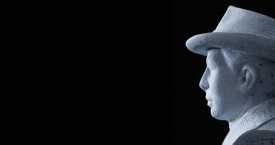 Sam Durant, Black Flag, Unfinished Marble (Renzo Novatore), 2011, Carrara marble carved at Telara Studio d’Arte by Adriano Gerbi and Mauro Tonazzini, Sara Atzeni (assistant), and production manager Maria Teresa Telara, satin flag, and steel pipe; variable dimensions (bust: 52 cm x 29 cm x 32 cm) (artwork © Sam Durant)
Sam Durant. Museo d’arte contemporanea Roma, Rome, Italy, April 23–September 8, 2013. La stessa storia.
Midwest

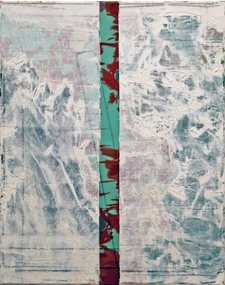 Hartmut Austen, Zip, 2012, oil on canvas, 20 x 16 in. (artwork © Hartmut Austen)
Hartmut Austen. Art Building West Gallery, University of Iowa, Iowa City, Iowa, April 16–21, 2013. Grant Wood Fellowship Exhibition. Drawing and painting.

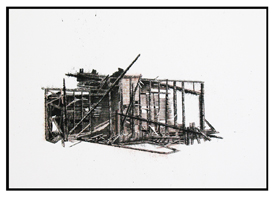 Margi Weir, Frontline/Detroit:Bones 2a, 2010, sumi ink, india ink, and tusche on rag paper, 29 x 40 in. (artwork © Margi Weir)
 Margi Weir. Kishwaukee College Art Gallery, Malta, Illinois, October 22–November 15, 2012. Margi Weir: Observations and Innuendos. Painting and drawing.
Northeast

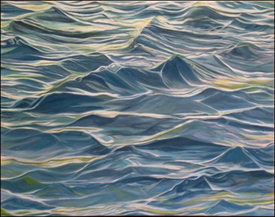 Federicka Foster, Hudson River XIV, 2013, oil on canvas, 48 x 60 in. (artwork © Federicka Foster)
Fredericka Foster. Fischbach Gallery, New York, April 25–May 25, 2013. Water Way. Painting.

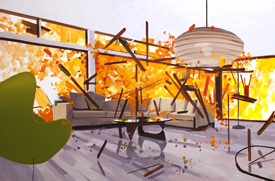 Ben Grasso, Noguchi Table, 2013, oil on panel, 48 x 72 in. (artwork © Ben Grasso)
Ben Grasso. Thierry Goldberg Gallery, New York, June 9–July 14, 2013. Ben Grasso. Painting.

 Katerina Lanfranco Boundless, 2013, mixed media and flameworked glass, 8½ x 6½ in. (artwork © Katerina Lanfranco)
Katerina Lanfranco. Nancy Hoffman Gallery, New York, June 20–August 2, 2013. Wildflowers and Floating Worlds. Mixed-media installation, painting, and sculpture.

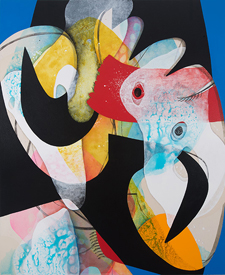 Carrie Moyer, Hook, Line & Sinker, 2012, acrylic, graphite, and glitter on canvas, 72 x 60 in. Collection of the artist (artwork © Carrie Moyer)
Carrie Moyer. Frances Young Tang Teaching Museum and Art Gallery, Skidmore College, Saratoga Springs, New York, January 26–May 19, 2013. Carrie Moyer: Pirate Jenny. Painting.

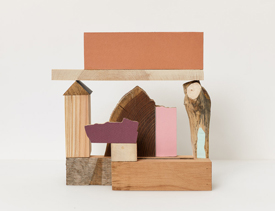 Jim Osman, Trunk, 2013, wood and paper, 10 x 10 x 4 in. (artwork © Jim Osman)
Jim Osman. Lesley Heller Workspace, New York, March 10–April 14, 2013. Jim Osman: Stack. Sculpture.

 Tim Ripley, War Games, 2013, oil on panel, 16 x 16 in. (artwork © Tim Ripley)
Tim Ripley. Denise Bibro Fine Art, New York, April 4–May 11, 2013. Soft Cell. Painting.

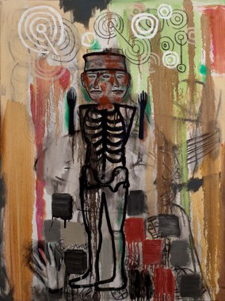 Jaune Quick-to-See Smith, The Face of Ancient America, 2013, oil on canvas, 48 x 36 in. (artwork © Jaune Quick-to-See Smith)
Jaune Quick-to-See Smith. Accola Griefen Gallery, New York, February 28–April 6, 2013. Water and War. Painting.

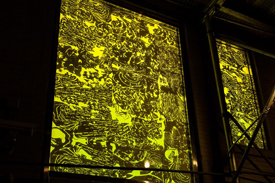 Ann Tarantino, installation view of Topoanalysis, 2013, lasercut paper on glass, dimensions variable (artwork © Ann Tarantino)
Ann Tarantino. Mixed Greens, New York, March 21–May 24, 2013. Topoanalysis. Installation.

Dannielle Tegeder. Ruth and Elmer Wellin Museum of Art, Hamilton College, Clinton, New York, May 11–July 28, 2013. Dannielle Tegeder: Painting in the Extended Field. Painting, drawing, sculpture, and installation.

 Invitation card for Idelle Weber: The Pop Years
Idelle Weber. Hollis Taggart Galleries, New York, March 28–April 25, 2013. Idelle Weber: The Pop Years. Painting, sculpture, collage, watercolor, and gouache.

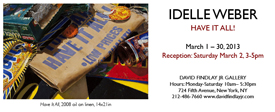 Invitation card for Have It All!
Idelle Weber. David Findlay Jr. Gallery, New York, March 1–30, 2013. Have It All! Painting.
South

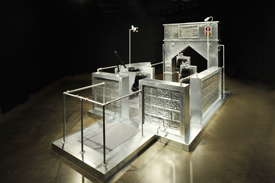 Michael Aurbach, Administrative Spectacle, 2012, mixed media, 8 x 9 x 16 ft. (artwork © Michael Aurbach)
Michael Aurbach. McIlroy Gallery, Mattie Kelly Arts Center, Northwest Florida State College, Niceville, Florida, June 10–July 19, 2013. Work by Aurbach: New and Used. Sculpture.

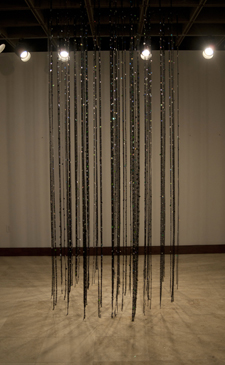 Kelly Sturhahn, Night Fall, 2013, black lace with handsewn sequins, 16 x 5 x 5 ft. (artwork © Kelly Sturhahn)
Kelly Sturhahn. 6th Street Container, Miami, Florida, May 17–July 14, 2013. Transient Patterns. Installation and work on paper.

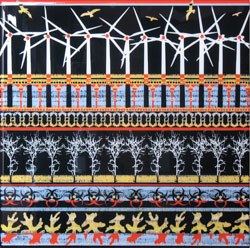 Margi Weir, Antimacassar 4, 2012, acrylic, vinyl, and resin on panel, 48 x 40 in. (artwork © Margi Weir)
Margi Weir. York County Center for the Arts, Rock Hill, South Carolina, March 22–April 28, 2013. Social Fabric: Works by Margi Weir. Painting, drawing, and vinyl installation.
West

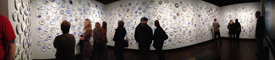 Julie Green, installation view of The Last Supper: 500 Plates, 2000–13 (ongoing), cobalt blue on kiln-fired ceramics, 8 x 35 ft. (artwork © Julie Green; photograph by Richard Herskowitz)
Julie Green. Jordan Schnitzer Museum of Art, University of Oregon, Eugene, Oregon, March 1–April 7, 2013. Julie Green: The Last Supper. Painted porcelain plates.

 Hazel Antaramian Hofman, Akhbar Shoes II, 2012, charcoal and pastel, 24 x 18 in. (artwork © Hazel Antaramian Hofman)
Hazel Antaramian Hofman. Armenian Museum, Fresno, California, March 21–August 30, 2013. Repatriation and Deception: Post World War II Soviet Armenia. Painting and drawing.

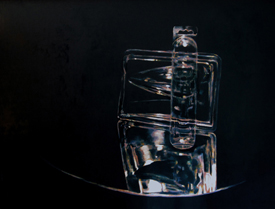 Michael Ryan, Preventative Measures, 2012, oil on linen, 36 x 48 in. (artwork © Michael Ryan)
 Michael Ryan. The Lab, San Francisco, California, February 22–March 30, 2013. Mere Reflections. Painting and sculpture.
Call to Action by the Commission on the Humanities and Social Sciences
posted by CAA — June 20, 2013
At the end of a day-long presentation on June 21st, a group of 200 academic corporate and government leaders gathered in the Capitol Atrium to hear “The Heart of the Matter,” a new report created by members of the Commission on the Humanities and Social Sciences and supported by members of Congress about their personal and professional views on the value of the humanities. The three major goals of the report are to increase the literacy and knowledge of history for all Americans to help build better citizens; to invest in research and teaching; and to expand international cultural knowledge and awareness through the study of languages and international study.
The report addresses the hardest hit disciplines of language and literature as well as the drastically underfunded Fulbright Fellowship programs. Actor John Lithgow cited Senator Fulbright, a champion of the international education program that has benefitted thousands of students and enriched the country in incalculable ways, for a relatively small government investment. The report also calls for greater interactivity and communication between academics and the public and for open access to research. John W. Rowe, cochair of the Commission and retired Chairman and Chief Executive Officer, Exelon Corporation, urged everyone in the humanities to get out in their communities, cities, and states to advocate the value of the humanities. David Brooks, New York Times reporter and PBS commentator, addressed the communication gap between academia and the public. He stated his belief that in the past the humanities’ importance and relevance in society suffered amid the turn toward political, gender, and race issues that severed dialogue between academia and the public, and turned attention away from the core value of the humanities.
The Commissioners, who are leaders in the corporate, academic, legal, governmental, and philanthropic communities, focused on the value, need for support, and societal applications of the humanities and social sciences. The two recurring themes in the presentations extolled the wisdom of America’s founders who, as Senator Lamar Alexander quoted from the writer David McCullough, were “marinated in the humanities.” And almost every presenter recalled the transformative experience of their own college humanities courses. Pauline Yu, President of the American Council of Learned Societies stated that the country flourishes when it follows the example of its founders. Senator Karl Eikenberry, former U.S. Ambassador to Afghanistan and retired U.S. Army Lieutenant General, cited the need for more informed historians to warn the government against overreaching internationally. He characterized the humanities and social sciences as a wellspring of soft power.
Richard Broadhead, President of Duke University and cochair of the Commission, believes that the major issue facing the country today is how to bring the greatest number of people to reach their fullest abilities. He sees the current discussions about education as narrowing the issues to pragmatic concerns; parents, for example, might say that they do not want their children to study the humanities instead of science, technology, engineering, and math (STEM disciplines). Broadhead pointed out that the humanities and STEM disciplines are not at opposition but are interrelated and integrated. This concept was, in fact, graphically presented in a promotional film made by Ken Burns and George Lucas which used the image of a stem (read STEM) of a flower (read the humanities).
The report calls for support for the humanities from all sectors of the country, and the program provided many strong arguments to use, value, and nurture them. The hope is that this dialogue will continue on Capitol Hill to restore funding, and that it will provide greater exchange between the academy and the public for greater understanding of the importance of the humanities. Lithgow said he sensed a fresh breeze of bipartisanship that wafted through the Capitol yesterday with the focus on the humanities.
The report does not specifically address the visual arts, but it does address a greater focus on research and teaching in higher education. In the last four years there has been greater national emphasis on K-12 education and this report may assist in bringing the national dialogue around to higher education federal funding. The concept of a Culture Corps similar to AmeriCorps could serve to bring greater public access to the humanities and greater public-academic interchange. And, it could also provide the bridge between graduate school and the career path for students in the humanities. The report is a good catalyst for discussion and change. Let’s hope that the “fresh breeze” continues.