
CAA News Today
Art Bulletin Editorial Board Seeks Three Members
posted by Alyssa Pavley — January 28, 2013
 CAA invites nominations and self-nominations for three individuals to serve on the Art Bulletin Editorial Board for a four-year term, July 1, 2013–June 30, 2017. The ideal candidate has published substantially in the field and may be an academic, museum-based, or independent scholar; institutional affiliation is not required. The Art Bulletin features leading scholarship in the English language in all aspects of art history as practiced in the academy, museums, and other institutions.
The editorial board advises the Art Bulletin editor-in-chief and assists him or her to seek authors, articles, and other content for the journal; guides its editorial program and may propose new initiatives for it; performs peer review and recommends peer reviewers; and may support fundraising efforts on the journal’s behalf. Members also assist the editor-in-chief to keep abreast of trends and issues in the field by attending and reporting on sessions at the CAA Annual Conference and other academic conferences, symposia, and events in their fields.
The Art Bulletin Editorial Board meets three times a year: twice in New York in the spring and fall and once at the CAA Annual Conference in February. CAA reimburses members for travel and lodging expenses for the two New York meetings in accordance with its travel policy, but members pay these expenses to attend the conference. Members of all editorial boards volunteer their services to CAA without compensation.
Candidates must be current CAA members and should not be serving on the editorial board of a competitive journal or on another CAA editorial board or committee. Members may not publish their own work in the journal during the term of service. Nominators should ascertain their nominee’s willingness to serve before submitting a name; self-nominations are also welcome. Please send a statement describing your interest in and qualifications for appointment, a CV, and your contact information to: Chair, Art Bulletin Editorial Board, College Art Association, 50 Broadway, 21st Floor, New York, NY 10004; or email the documents to Alyssa Pavley, CAA editorial assistant. Deadline: April 15, 2013.
caa.reviews Editorial Board Seeks One Member
posted by Alyssa Pavley — January 28, 2013
CAA invites nominations and self-nominations for one individual to serve on the caa.reviews Editorial Board for a four-year term, July 1, 2013–June 30, 2017. Candidates may be artists, art historians, critics, curators, educators, or other professionals in the visual arts with stature in the field and experience in writing or editing book and/or exhibition reviews; institutional affiliation is not required. The journal also seeks candidates with a strong record of scholarship and at least one published book or the equivalent who are committed to the imaginative development of caa.reviews. An online journal, caa.reviews is devoted to the peer review of new books, museum exhibitions, and projects relevant to art history, visual studies, and the arts.
The editorial board advises the editor-in-chief of and field editors for caa.reviews and helps them to identify books and exhibitions for review and to solicit reviewers, articles, and other content for the journal; guides its editorial program and may propose new initiatives for it; and may support fundraising efforts on the journal’s behalf. Members also assist the editor-in-chief to keep abreast of trends and issues in the field by attending and reporting on sessions at the CAA Annual Conference and other academic conferences, symposia, and events in their fields.
The caa.reviews Editorial Board meets three times a year: twice in New York in the spring and fall and once at the CAA Annual Conference in February. CAA reimburses members for travel and lodging expenses for the two New York meetings in accordance with its travel policy, but members pay these expenses to attend the conference. Members of all editorial boards volunteer their services to CAA without compensation.
Candidates must be current CAA members and should not be serving on the editorial board of a competitive journal or on another CAA editorial board or committee. Nominators should ascertain their nominee’s willingness to serve before submitting a name; self-nominations are also welcome. Please send a statement describing your interest in and qualifications for appointment, a CV, and your contact information to: caa.reviews Editorial Board, College Art Association, 50 Broadway, 21st Floor, New York, NY 10004; or email the documents to Alyssa Pavley, CAA editorial assistant. Deadline: April 15, 2013.
caa.reviews Seeks Field Editors for Books and Exhibitions
posted by Alyssa Pavley — January 28, 2013
CAA invites nominations and self-nominations for six individuals to join the caa.reviews Council of Field Editors, which commissions reviews within an area of expertise or geographic region, for a three-year term: July 1, 2013–June 30, 2016. An online journal, caa.reviews is devoted to the peer review of new books, museum exhibitions, and projects relevant to art history, visual studies, and the arts.
The journal seeks four field editors for books in four areas: African art, theory and historiography, Egyptian and ancient Near Eastern art, and American art. In addition, two field editors are needed for exhibitions in two areas: on the West Coast covering art after 1800 and in New York and internationally, covering exhibitions of modern and contemporary art. Candidates may be artists, art historians, critics, curators, educators, or other professionals in the visual arts; institutional affiliation is not required.
Working with the caa.reviews editor-in-chief, the caa.reviews Editorial Board, and CAA’s staff editor, each field editor selects content to be reviewed, commissions reviewers, and reviews manuscripts for publication. Field editors for books are expected to keep abreast of newly published and important books and related media in his or her field of expertise, and those field editors for exhibitions should be aware of current and upcoming exhibitions (and other related projects) in their geographic regions.
The Council of Field Editors meets annually at the CAA Annual Conference. Field editors must pay travel and lodging expenses to attend the conference. Members of all CAA committees and editorial boards volunteer their services without compensation.
Candidates must be current CAA members and should not be serving on the editorial board of a competitive journal or on another CAA editorial board or committee. Nominators should ascertain their nominee’s willingness to serve before submitting a name; self-nominations are also welcome. Please send a statement describing your interest in and qualifications for appointment, a CV, and your contact information to: caa.reviews Editorial Board, College Art Association, 50 Broadway, 21st Floor, New York, NY 10004; or email the documents to Alyssa Pavley, CAA editorial assistant. Deadline: April 15, 2013.
CAA Seeks Publications Committee Member
posted by Alyssa Pavley — January 25, 2013
CAA invites nominations and self-nominations for one member at large to serve on its Publications Committee for a three-year term, July 1, 2013–June 30, 2016. Candidates, who must possess expertise appropriate to the committee’s work, may be artists, art historians, critics, curators, educators, or other professionals in the visual arts; institutional affiliation is not required.
Meeting three times a year, the Publications Committee is a consultative body that advises the CAA Publications Department staff and the CAA Board of Directors on publishing projects. It provides oversight for the editorial boards of The Art Bulletin, Art Journal, and caa.reviews, as well as the juries for CAA’s book grants; sponsors a practicum session at the Annual Conference; and, with the CAA vice president for publications, serves as liaison to the board, membership, editorial boards, book-grant juries, and other CAA committees.
The Publications Committee meets three times a year: twice in New York in the spring and fall and once at the CAA Annual Conference in February. CAA reimburses members for travel and lodging expenses for the two New York meetings in accordance with its travel policy, but members pay these expenses to attend the conference. Members of all CAA committees volunteer their services without compensation.
Candidates must be current CAA members and should not be serving on another CAA editorial board or committee. In addition, they may not be individuals who have served as members of a CAA editorial board within the past five years. Nominators should ascertain their nominee’s willingness to serve before submitting a name; self-nominations are also welcome. Appointments are made by the CAA president in consultation with the vice president for publications. Please send a statement describing your interest in and qualifications for appointment, a CV, and your contact information to: Publications Committee, College Art Association, 50 Broadway, 21st Floor, New York, NY 10004; or email the documents to Alyssa Pavley, CAA editorial assistant. Deadline: April 15, 2013.
Mellon Foundation Helps CAA Initiate a Publishing Award for Emerging Scholars
posted by Christopher Howard — January 23, 2013
The Andrew W. Mellon Foundation has awarded the College Art Association (CAA) a one-year grant of $60,000 to administer the Meiss/Mellon Author’s Book Award. The award is a temporary measure to provide financial relief to early-career scholars in art history and visual studies who are responsible for paying for rights and permissions for images in their publications. The Meiss/Mellon Author’s Book Award will provide grants directly to emerging scholars to offset the high costs of image acquisition. Recipients will be selected on the basis of the quality and financial need of their project, and awards will be made twice during the year (in the spring and fall) in conjunction with CAA’s Millard Meiss Publication Fund awards to publishers. CAA anticipates awarding between eight and ten Meiss/Mellon Author’s Book Awards in 2013.
The Meiss/Mellon Author’s Book Award supports image rights and reproduction costs for books on topics in art history and visual studies. The Society of Architectural Historians (SAH) also received one year of funding from the Andrew Mellon Foundation and will award grants to emerging scholars who are publishing monographs on the built environment. Both the CAA and SAH awards will provide leading authors in the early stages of their careers with the financial resources to acquire images for scholarly publications. For information about the SAH award, visit www.sah.org or contact Beth Eifrig at info@sah.org.
Applications for the first round of the Meiss/Mellon Author’s Book Award are now being accepted. The deadline for submission is March 15, 2013, with a second round of applications due on September 15, 2013. CAA will administer the Meiss/Mellon Author’s Book Award according to guidelines developed for the Millard Meiss Publication Fund grant, an award established in 1975 by a generous bequest from the late Professor Millard Meiss. The jury for the award, comprising distinguished, mid-career or senior scholars whose specializations cover a broad range of art scholarship, has discretion over the number of and size of the awards. For further information about the award and to apply, please visit www.collegeart.org/meissmellon.
CAA seeks to alleviate high reproductions rights costs related to publishing in the arts. With funding from a separate grant from the Andrew W. Mellon Foundation, CAA recently initiated a project to explore the overall impact of copyright on the arts and how different understandings of copyright affect creative and scholarly choices in the visual arts. Over a four-year period, from 2013–2016, CAA will produce an issues report and a code of best practices for fair use in the creation and curation of artworks and scholarly publishing in the visual arts.
For further information please contact Virginia Reinhart, CAA marketing and communications associate, at vreinhart@collegeart.org or 212-392-4426. For information on applying to the Meiss/Mellon Author’s Book Award, please contact Alex Gershuny, CAA editorial associate, at agershuny@collegeart.org or 212-392-4424.
Applications for Spring Grants from the Millard Meiss Publication Fund
posted by CAA — January 14, 2013
 CAA is accepting applications for spring 2013 grants through the Millard Meiss Publication Fund. Thanks to a generous bequest by the late art historian Millard Meiss, the twice-yearly program supports book-length scholarly manuscripts in any period of the history of art and related subjects that have been accepted by a publisher but require further subsidy to be published in the fullest form.
The publisher, rather than the author, must submit the application to CAA. Awards are made at the discretion of the jury and vary according to merit, need, and number of applications. Awardees are announced six to eight weeks after the deadline. For the complete guidelines, application forms, and a fuller grant description, please visit the Meiss section of the CAA website or write to nyoffice@collegeart.org. Deadline: March 15, 2013.
Image: The University of Oklahoma Press received a Meiss grant in fall 2010 to help publish Megan E. O’Neil’s book, Engaging Ancient Maya Sculpture at Piedras Negras, Guatemala (2012).
New Editions of Graduate Programs in the Arts
posted by Betty Leigh Hutcheson — January 04, 2013
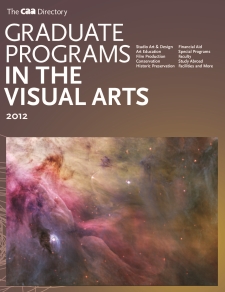 CAA has updated its directories of graduate programs in the arts, revising current entries and adding new ones. CAA’s comprehensive guides—listing 650 programs across five countries—provide prospective graduate students with the information they need to begin the application process. Graduate Programs in Art History covers four program types: History of Art and Architecture, Arts Administration, Curatorial and Museum Studies, and Library Science. Graduate Programs in the Visual Arts presents program listings in Studio Art and Design, Art Education, Film Production, and Conservation and Historic Preservation.
Organized alphabetically by school name within each program type, entries describe curricula, class size, faculty and specializations, admission and degree requirements, library and studio facilities, opportunities for fellowships and assistantships, and the availability of health insurance. To get a better sense of the content, look at these sample entries.
Individual programs types can be purchased separately as ebook or print volumes. You can also purchase individual entries in two ways: search the directories by program type, faculty specialization, awarded degrees, country, region, state, availability of health insurance, and whether or not part-time students are admitted, or browse by institution name to download individual entries as PDF files.
The directories also serve as key professional references for career-services representatives, department chairs, graduate and undergraduate advisors, librarians, professional-practices educators, and professors interested in helping emerging generations of artists and scholars find success.
For more details and to order the directories, please contact Roberta Lawson at 212-392-4404.
December 2012 Issue of The Art Bulletin
posted by Christopher Howard — December 12, 2012
The December 2012 issue of The Art Bulletin, the leading publication of international art-historical scholarship, presents the fourth installment of a feature series that will continue through at least 2013. In Regarding Art and Art History, Rebecca Zorach reflects on politics and teaching. The subject of this issue’s Notes from the Field is detail, with twelve texts by artists, scholars, professors, conservators, and archaeologists: Susan Hiller, Spike Bucklow, Johannes Endres, Carlo Ginzburg, Joan Kee, Spyros Papapetros, Adrian Rifkin, Joanna Roche, Nina Rowe, Alain Schnapp, Blake Stimson, and Robert Williams. The Interview presents the German art historian Horst Bredekamp in conversation with the American scholar Christopher Wood. An installation view of Hiller’s Witness (2002), as seen as Tate London, appears on the cover.
The opening three long-form essays address the art of Italy. The first, by J. Keith Doherty, offers a new interpretation of the Judgment of Paris myth as it is depicted in Roman wall paintings. Robert Glass’s contribution, “Filarete’s Hilaritas: Claiming Authorship and Status on the Doors of St. Peter’s,” is a close reading of the Italian Renaissance sculptor’s bronze relief on the doors of St. Peter’s Basilica in the Vatican. David M. Stone’s article, “Signature Killer: Caravaggio and the Poetics of Blood,” considers the artist’s signature in his Beheading of Saint John the Baptist from 1608. Luisa Elena Alcalá’s “‘A Call to Action’: Visual Persuasion in a Spanish American Painting” analyzes a Central American painting from the mid-1680s sent to Madrid from Mexico as a tactic to lobby for continued royal support. Finally, Philip Cottrell explores the unpublished papers of the nineteenth-century English connoisseur George Scharf, who organized the celebrated exhibition Art Treasures of the United Kingdom in Manchester in 1857.
The Reviews section leads off with David J. Roxburgh’s take on the new galleries for the Art of the Arab Lands, Turkey, Iran, Central Asia, and Later South Asia at the Metropolitan Museum of Art in New York. Next, Elizabeth Hill Boone considers Carolyn Dean’s A Culture of Stone: Inka Perspectives on Rock, and Jesús Escobar looks at Gauvin Alexander Bailey’s The Andean Hybrid Baroque: Convergent Cultures in the Churches of Colonial Peru. Nicola Suthor’s book Bravura: Virtuosität und Mutwilligkeit in der Malerei der Frühen Neuzeit is appraised by Andreas Beyer, and Molly Emma Aitken’s study The Intelligence of Tradition in Rajput Court Painting, is evaluated by Pika Ghosh. The section concludes with Michael Leja’s assessment of the Crystal Bridges Museum of American Art in Bentonville, Arkansas.
CAA sends The Art Bulletin to all institutional members and to those individuals who choose to receive the journal as a benefit of their membership. The next issue of the quarterly publication, to appear in March 2013, will feature essays on the strategic use of microarchitecture in Christian ivory carvings of the thirteenth century, perspectival “distortions” in Paul Cézanne’s paintings and the political implications of his repudiation of perspective, and appellations of photography that circulated in China between 1840 and 1911, which trace the emergence of a new understanding of visual truth in Chinese art.
Support CAA’s Journals through the Publications Fund
posted by CAA — December 05, 2012
As 2012 comes to a close and CAA looks toward the year to come, it is time for us to consider the future of our publications. CAA’s long-standing, highly regarded print journals, The Art Bulletin and Art Journal, deliver much of the world’s leading scholarship in art history and visual studies. CAA member support of the Publications Fund helps maintain each publication’s preeminent position. I encourage you to join our growing list of donors this year.
The Art Bulletin, which covers the full range of art history in essays by some of the world’s most acclaimed art scholars, marks its centennial in 2013, celebrating one hundred years of exemplary scholarship and leadership in the field. Art Journal, in print since 1929, is an ever-evolving forum for topics in modern and contemporary art. Next spring will see the first issue of its new editor-in-chief, Lane Relyea. The youngest CAA publication, the born-digital caa.reviews, annually presents hundreds of reviews of books, exhibitions, publications, projects, conferences, and symposia as the sole art journal devoted exclusively to reviews. Founded in 1998, it celebrates its fifteenth anniversary this year with an Annual Conference panel discussion about its origin, evolution, and future. Together, these three journals promote new scholarship and practices in the visual arts to an international audience.
At a time when academic publishing offers fewer venues for discussion and debate, the visibility and vitality of The Art Bulletin, Art Journal, and caa.reviews continue to broaden. The journals reach tens of thousands of readers annually and remain essential resources—none of which would be possible without the support of donors.
Contributors who give at a level of $250 or higher are prominently acknowledged in the publication they support for four consecutive issues, as well as on the publication’s website for one year. On behalf of the artists, scholars, writers, and reviewers who publish in the journals, I hope CAA can count on your support this year.
Thank you for your consideration of this request. Your ongoing commitment is essential to our success—and very much appreciated.
With best regards,

Anne Collins Goodyear
CAA Board President
CAA Mails 2013 Conference Information and Registration
posted by Emmanuel Lemakis — October 23, 2012
 This week CAA will begin mailing Conference Information and Registration, which provides important details, instructions, and deadlines for attending and participating in the 101st Annual Conference, to all individual and institutional CAA members. Nonmembers and those wanting a digital file now can download a PDF of the booklet. The conference will take place February 13–16, 2013, in New York.
Following sections on registration and CAA membership, Conference Information and Registration describes travel, lodging, and transportation options and explains the basic processes for candidates seeking jobs and employers placing classifieds and renting booths and tables in the Interview Hall. In addition, the publication lists topics for eleven Professional-Development Workshops. If you want to connect with former and current professors and students, consult the Reunions and Receptions page. The booklet includes paper forms for CAA membership, conference registration, workshops, special events, and mentoring enrollment.
The contents of Conference Information and Registration also appear on the conference website, which is being updated regularly between now and the February meeting. You may also choose to join CAA and register online.