CAA News Today
New Study on PhD Completion
posted by Christopher Howard — September 09, 2008
Inside Higher Ed reports that a new study from the Council of Graduate Schools reveals that significant gaps exist—by demographic groups and academic disciplines—in who finishes PhD programs. Generally, foreign, male, and white students are more likely to earn their doctorates after ten years than are their counterparts who are American, female, or minority. The study is part of the council’s PhD Completion Project, a seven-year, grant-funded initiative that addresses the issues surrounding PhD completion and attrition.
The report, PhD Completion and Attrition: Analysis of Baseline Demographic Data from the PhD Completion Project, is the second in a series of monographs from the council. It focuses on ten-year and seven-year completion rates by demographic characteristics (gender, citizenship, and race/ethnicity) based on data, submitted by twenty-four institutions, on students who entered their PhD programs in academic years 1992–93 through 2003–4. The report presents cumulative and annual completion rates from various perspectives: overall, by field, by institution type, and by time of entry into the PhD program. Completion between years seven and ten is also discussed.
Report on Arts Education and Funding Published
posted by Christopher Howard — September 09, 2008
 Policymakers have underestimated the critical role of arts learning in supporting a vibrant nonprofit cultural sector, according to a RAND Corporation report just published. The study, written by Laura Zakaras and Julia F. Lowell and entitled Cultivating Demand for the Arts: Arts Learning, Arts Engagement, and State Arts Policy, was commissioned by the Wallace Foundation and conducted by RAND.
Despite decades of effort to make high-quality works of art available to Americans, demand for the arts has failed to keep pace with supply. Audiences for classical music, jazz, opera, theater, and the visual arts have declined as a percentage of the population, and the percentage of these audiences age thirty and younger has fallen even more.
“For decades, public funding of the arts has focused on building supply and expanding access to the arts, but it has neglected the cultivation of audiences capable of appreciating the arts,” said the coauthor Laura Zakaras, an arts researcher at RAND. “If we are not teaching the young how to engage with works of art, they are not likely to become involved in the arts as adults.”
Calling on evidence that experiencing and studying the arts in childhood increase the likelihood of arts participation later in life, the study recommends policymakers in both the arts and education to devote greater attention to cultivating demand for the arts by supporting more and better arts education.
At the public school level, researchers note, arts content standards have been almost universally mandated by the states and are broadening teaching practices, but state, local, and district policies are not providing the resources or time in the school day to implement these standards. In fact, there is evidence that high-stakes standardized testing has led to reduced class time for the arts and humanities in the past five years, according to the study. Arts organizations and colleges have been helpful in complementing school-based arts education, but it is not enough to fill the void.
Analyzing grant-making data, researchers show that state arts agencies, which have historically focused on providing grants to arts organizations, have directed less than 10 percent of their grants over the last twenty years toward activities that target arts learning. In most states, grants are not part of a comprehensive strategy to promote youth or adult arts learning.
However, some state arts agencies are bucking this trend. Rhode Island and New Jersey, for example, have forged relationships with their state departments of education, other state agencies, and members of the arts community to develop comprehensive statewide plans for improving arts education in public schools.
In New Jersey, the state’s arts agency helped develop a survey of arts education that has raised awareness of the inadequacy of its provision in the schools. Concerned residents are now pushing for the adoption of a number of new policies, including inclusion of per-pupil arts spending in New Jersey’s Comparative Spending Guide for public schools. In Rhode Island, the state arts agency was instrumental in successful efforts to adopt a standards-based high school graduation requirement in the arts.
Based on these findings, the authors recommend that state arts agencies and policymakers gauge how well their states are doing by conducting surveys of arts education; developing specific high school graduation requirements in the arts; recognizing and publicizing arts learning programs considered exceptional by experts in the field; and advocating for changes in state policy that increase the amount and breadth of arts learning opportunities. According to the authors, a healthy demand for the arts is critical to a vibrant nonprofit arts sector. Policies that focus on supporting the supply of the arts and broadening access to the arts are not sufficient for building that demand.
Survey on Library and Museum Digitization Published
posted by Christopher Howard — September 04, 2008
Research and Markets, a publisher of international marketing and research data based in Dublin, Ireland, has just produced The International Survey of Library and Museum Digitization Projects. The study presents and summarizes data on digitization programs at academic, public, and government libraries and museums in the United States, Canada, Australia, Germany, the United Kingdom, and more. Discussed are issues related to staffing, training, funding, outsourcing, permissions and copyright clearance, cataloguing, software and applications selection, and marketing. The International Survey is available for sale on the Research and Markets website.
September CAA News Published
posted by Christopher Howard — August 28, 2008
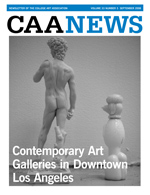 The September CAA News has just been published. With the newsletter back in print, individual and institutional members will receive a copy in the mail next month; the newsletter is also available immediately as a PDF download.
The September issue celebrates the tenth anniversary of caa.reviews, the online journal that launched in fall 1998. Also, in preparation for the 2009 Annual Conference, the issue contains an article on the hottest contemporary art galleries downtown in Los Angeles, including those in Chinatown.
A number of important deadlines for participation in CAA activities also appear: calls for nominations for editor-in-chief of Art Journal and reviews editor of The Art Bulletin (September 15); for conference travel grants (September 26); for applications for graduate-student fellowships (October 1); and more.
The deadline for submissions to the November issue is September 10; please send them to Christopher Howard, CAA managing editor. If you wish to receive CAA News in electronic format only, please contact CAA Member Services.
caa.reviews Needs Field Editors for Art Exhibitions
posted by Betty Leigh Hutcheson — August 21, 2008
CAA invites nominations and self-nominations for two field-editor positions for exhibition reviews in caa.reviews for a four-year term, through June 30, 2012. Each field editor covers a geographic region of the United States; needed now are editors covering art exhibitions in the Northwest and Southeast United States.
caa.reviews is an online journal devoted to the peer review of new books, museum exhibitions, and projects relevant to the fields of art history, visual studies, and the arts. Candidates may be artists, art historians, art critics, art educators, curators, or other art professionals; institutional affiliation is not required. Field editors should live in the region covered.
Each field editor commissions reviews of important museum and gallery exhibitions for caa.reviews. He or she selects shows to be reviewed, commissions reviewers, determines the appropriate character of the reviews, and works with reviewers to develop manuscripts for publication. These field editors work with the caa.reviews Editorial Board as well as the caa.reviews editor-in-chief and CAA’s staff editor. Each field editor is expected to keep abreast of current and upcoming exhibitions (and other related projects) in his or her geographic region.
The Council of Field Editors meets annually at the CAA Annual Conference. Field editors must pay travel and lodging expenses to attend the conference.
Candidates must be current CAA members and should not be serving on the editorial board of a competitive journal or on another CAA editorial board or committee. Nominators should ascertain their nominee’s willingness to serve before submitting a name; self-nominations are also welcome. Send a statement describing your interest in and qualifications for appointment, CV, and contact information to: Chair, caa.reviews Editorial Board, CAA, 275 Seventh Ave., 18th Floor, New York, NY 10001. Deadline extended: September 15, 2008.
The Art Bulletin Seeks Reviews Editor
posted by CAA — August 19, 2008
 As the current term of the Art Bulletin reviews editor is coming to its conclusion, CAA invites applicants for the next term, July 1, 2009–June 30, 2012 (with service as incoming reviews editor designate from February to June 2009). The Art Bulletin, published quarterly by CAA, is the leading publication of art history in English.
Candidates should be art scholars with stature in the field and experience in editing book and/or exhibition reviews; institutional affiliation is not required. Candidates should be published authors of at least one book.
The reviews editor is responsible for commissioning all book and exhibition reviews in The Art Bulletin. He or she selects books and exhibitions for review, commissions reviewers, and determines the appropriate length and character of reviews. The reviews editor also works with authors and CAA’s director of publications in the development and preparation of review manuscripts for publication. He or she is expected to keep abreast of newly published and important books and recent exhibitions in the fields of art history, criticism, theory, visual studies, and museum publishing. This is a three-year term, which includes membership on the Art Bulletin Editorial Board.
The reviews editor attends the three annual meetings of the Art Bulletin Editorial Board—held in the spring and fall in New York and in February at the CAA Annual Conference—and submits an annual report to CAA’s Publications Committee. CAA reimburses the reviews editor for travel and lodging expenses for the spring and fall New York meetings in accordance with its travel policy, but he or she pays these expenses to attend the conference.
Candidates must be current CAA members and should not be serving on the editorial board of a competitive journal or on another CAA editorial board or committee. Nominators should ascertain their nominee’s willingness to serve before submitting a name; self-nominations are also welcome. Please send a statement describing your interest in and qualifications for appointment, CV, and at least one letter of recommendation to: Director of Publications, Art Bulletin Reviews Editor Search, CAA, 275 Seventh Ave., 18th Floor, New York, NY 10001. Deadline: September 15, 2008; finalists will be interviewed on October 24, 2008, in New York.
New Editorial-Board Members and Field Editors
posted by Christopher Howard — August 06, 2008
CAA welcomes the following people to the editorial boards of its three scholarly journals, and to the caa.reviews Council of Field Editors.
New Journal Editorial-Board Members
Natalie Kampen of Barnard College has joined the Art Bulletin Editorial Board. The Art Journal Editorial Board welcomes Jan Estep, Regis Center for Art at the University of Minnesota; Karin Higa, Japanese American National Museum; and Terence E. Smith, University of Pittsburgh. Laura Auricchio of Parsons the New School for Design has joined the caa.reviews Editorial Board. All members serve four-year terms.
New caa.reviews Field Editors
caa.reviews welcomes three new field editors, who will serve three-year terms for the journal: Linda Komaroff of the Los Angeles County Museum of Art will commission reviews of books on Islamic art; Marjorie Munsterberg of City College of New York, City University of New York, will commission reviews of books on nineteenth-century art; and Jon Seydl of the Cleveland Museum of Art will commission reviews of exhibitions in the Midwest.
Spring Meiss Winners
posted by Christopher Howard — July 30, 2008
CAA has awarded five Millard Meiss Publication Grants for spring 2008. Thanks to the generous bequest of the late Prof. Millard Meiss, these grants are given twice annually to publishers to support the publication of scholarly books in art history and related fields.
The grantees are:
- Molly Aitken, The Intelligence of Tradition: Form and Meaning in Mewar Painting (Yale University Press)
- Elissa Auther, String, Felt, Thread, and the Hierarchy of Art and Craft in American Art, 1961–1979 (University of Minnesota Press)
- Marin F. Hanson and Patricia Cox Crews, eds., American Quilts in the Modern Age, 1870–1940: A Catalog from the International Quilt Study Center (University of Nebraska Press)
- Richard King, ed., Art and the Artist in Cultural Revolution China (University of British Columbia Press)
- Judith Ostrowitz, Interventions: Native American Art for Far-Flung Territories, (University of Washington Press)
Books eligible for a Meiss grant must already be under contract with a publisher on a subject in the arts or art history. Authors must be current CAA members. Application criteria and guidelines are available online or from nyoffice@collegeart.org. Deadlines: March 15 and October 1 of every year
Art Journal Seeks Editor-in-Chief
posted by CAA — July 26, 2008
As the current term of the Art Journal editor-in-chief is coming to its conclusion, CAA invites applicants for the next term, July 1, 2009–June 30, 2012 (preceded by a term as editor designate from November 2008 to June 2009). Art Journal, published quarterly by CAA, promotes informed discussion about issues across disciplines in twentieth- and twenty-first-century art, nationally and internationally.
Candidates may be artists, art historians, art critics, art educators, curators, or other art professionals; institutional affiliation is not required.
Advised by the Art Journal Editorial Board, the editor-in-chief is responsible for the content and character of the journal. He or she reads all submitted manuscripts and reviews all submitted artist projects, sends them to peer reviewers, provides guidance to authors and artists concerning the form and content of submissions, and makes final decisions regarding the acceptability of all submissions for publication. The editor-in-chief is not responsible for commissioning reviews. The editor-in-chief works closely with CAA staff in New York, where the publication is produced. This is a half-time position. CAA may negotiate course release or other compensation for the editor.
The editor-in-chief attends the three annual meetings of the Art Journal Editorial Board—held in the spring and fall in New York and in February at the Annual Conference—and submits an annual report to CAA’s Publications Committee. CAA reimburses the editor-in-chief for travel and lodging expenses for the spring and fall New York meetings in accordance with its travel policy, but he or she pays these expenses to attend the conference.
Candidates must be current CAA members and should not be serving on the editorial board of a competitive journal or on another CAA editorial board or committee. Nominators should ascertain their nominee’s willingness to serve before submitting a name; self-nominations are also welcome. Please send a statement describing your interest in and qualifications for appointment, CV, and at least one letter of recommendation to: Director of Publications, Art Journal Editor-in-Chief Search, CAA, 275 Seventh Ave., 18th Floor, New York, NY 10001. Deadline: September 15, 2008; finalists will be interviewed October 23, 2008, in New York.
July CAA News Now Online
posted by Christopher Howard — July 02, 2008
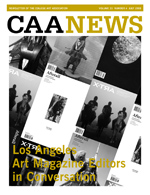 The July CAA News has been posted to the CAA website. You can download a 1.6-megabyte PDF of the issue by clicking on the cover at right.
In the issue, CAA News talks to the editors of two art magazines with roots in Los Angeles: X-TRA and Afterall. Also included are CAA’s new procedures for developing professional standards and guidelines; a report on the recent Board of Directors meeting in May; and information on registration rates for the upcoming Los Angeles conference and travel grants to attend it.
The deadline for submissions to the September issue is July 10, 2008. Please send yours to Christopher Howard, CAA News editor.