CAA News Today
Two More Days to Vote in the 2010–14 Board of Directors Election
posted by Vanessa Jalet — February 11, 2010
CAA invites all members to cast their vote in the current Board of Directors election. Voting ends on Friday, February 12, at 5:00 PM CST. The following six candidates have been chosen by the 2009 Nominating Committee for the current slate:
- Peter Barnet, Metropolitan Museum of Art
- Roger Crum, University of Dayton
- Conrad Gleber, La Salle University
- Arthur F. Jones, University of North Dakota
- Jean M. K. Miller, Towson University
- Sabina Ott, Columbia College Chicago
Please click on each candidate’s name above to read his or her statement and biography—and to watch their special video introductions—before casting your vote for up to four candidates.
About the Election
CAA members may vote for no more than four candidates or may cast votes for write-in candidates (who must be CAA members). The four candidates receiving the most votes will be elected to the board. CAA members may cast their votes and submit their proxies by mail or electronically.
Election results are announced at the close of the Annual Members’ Business Meeting at the Chicago conference, and new board members take office in the spring.
If you have requested your ballot on paper, a ballot and proxy were mailed to you in mid-December. Return them via post by Friday, February 12, 2010, at 5:00 PM CST.
If you have elected to vote online, you have received email notices since mid-December with instructions for voting online. This emails include a PIN for you to vote and to return your proxy. All online voting must be completed by Friday, February 12, 2010, at 5:00 PM CST. If you wish to vote during the conference, CAA is providing a computer for online voting in the registration area.
If you are still receiving your ballot and proxy by postal mail, kindly change your email communication status to “vote online” in the Account Log In section of the CAA website. Voting online is considerably less expensive, and in these difficult economic times it is critical for CAA to save costs where it can.
About the Board
The CAA Board of Directors is responsible for all financial and policy matters related to the organization. It promotes excellence in scholarship and teaching in the history and criticism of the visual arts, and it encourages creativity and technical skill in the teaching and practice of art. CAA’s board is also charged with representing the membership on issues affecting the visual arts and humanities.
2009 Nominating Committee
Members of the 2009 Nominating Committee are: Mary-Ann Milford-Lutzker, Mills College, vice president for committees and committee chair (ex officio without vote); Jacki Apple, Art Center College of Design; Linda Downs, CAA executive director (ex officio, without vote); Ken Gonzales-Day, Scripps College and CAA board; James Hopfensperger, Western Michigan University; Suzanne McCullagh, Art Institute of Chicago; Edward M. Noriega, Troy University and CAA board; William Wallace, Washington University in St. Louis and CAA board; and Charles A. Wright, Western Illinois University.
Voice Your Concerns at CAA’s Annual Business Meeting
posted by Vanessa Jalet — February 03, 2010
 While at next week’s Annual Conference in Chicago, be sure to attend the Annual Members’ Business Meeting on Friday, February 12, 5:15–6:15 PM. The meeting—held in Grand EF, East Tower, Gold Level, Hyatt Regency Chicago—is open to all current CAA members. CAA President Paul Jaskot will preside
Representatives from the Board of Directors and members of the CAA staff will review the year’s accomplishments and financial status, and the results of the 2010 board election will be announced. The board and staff will also be on hand to respond to your questions, so please come and share your insights and concerns.
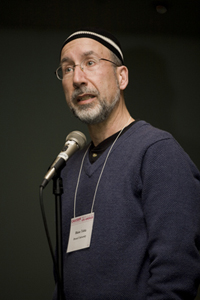
Image: Blaise Tobia, professor of digital media at Drexel University, speaks at the 2009 Annual Members’ Business Meeting (photograph by Kenna Love)
Barbara Nesin Is CAA President-Elect
posted by Christopher Howard — December 16, 2009
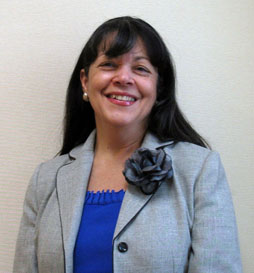 Barbara Nesin, the department chair of art foundations at the Art Institute of Atlanta, has been elected president of CAA’s Board of Directors for a two-year term, beginning May 2010. A member of the board since 2006, Nesin has served as secretary for the past two years. She will succeed Paul B. Jaskot, professor of art history at DePaul University in Chicago, who has served as president since May 2008.
An artist and educator, Nesin says, “The work of those who make, interpret, and preserve images in our global culture has never been more important than it is now. As a visual artist who has participated in the formulation of our association’s Strategic Plan for the next five years, I am particularly excited about this opportunity to tangibly demonstrate CAA’s special commitment to expanding services to our artist members. In addition, I view the work of art historians, museum professionals, and teachers as integral and inseparable from the work of artists and designers, and will advocate on their behalf. I am also excited about CAA’s renewed focus on developing partnerships with a variety of institutions, including our own affiliated societies, in order to further CAA’s goals.”
Previous to her appointment at the Art Institute of Atlanta earlier this year, Nesin was associate professor at Spelman College in Atlanta, where she chaired the Department of Art from 2002 to 2005. Before that, she taught art at Front Range Community College in Fort Collins, Colorado—the largest community college in the state—while directing its Visual Art Program.
After receiving a BFA in 1975 from Pratt Institute in Brooklyn, Nesin earned an MBA in 1984 at Long Island University in New York. She worked in the financial industry for twelve years—as a registered representative of the New York Stock Exchange and a vice president and department head of pension trust administration—before attending graduate school, earning her MFA in drawing and mixed media at Indiana State University in Terre Haute in 1996.
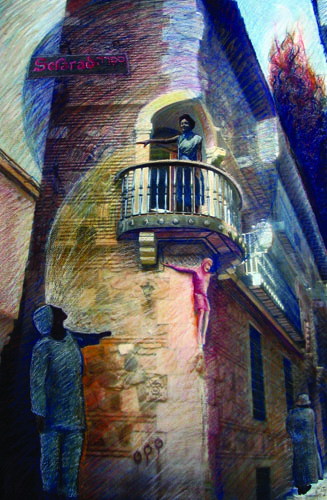 An overarching theme in Nesin’s art is a visual bridging of cultural differences by making connections to all aspects of her mixed-diaspora heritage. While her work is clearly about cultural narratives, it is difficult to place it neatly in existing categories. Nesin comments, “Narrow definitions of identity seem outdated in this age of globalization, which follows centuries of migration, exchange, acculturation, and syncretism. We seem to have plenty of new media for deeply entrenched paradigms, and not enough truly independent thinking.” Her mixed-media paintings and drawings often include photo transfers, retablos, and installations in which she employs a strategy of métissage—“mixing” in the political sense articulated by Françoise Lionnet as a practice of cultural survival—to navigate the layered terrain of humanity.
Her work has been shown internationally, most recently in the 2009 Havana Biennial in Cuba and in Cryptablos: Creole, Black & Jewish, a solo exhibition at the Dillard University Art Gallery in New Orleans. She has also presented work in solo shows in Atlanta, New York, Chicago, and Accra, Ghana, among others, and in juried and invitational group exhibitions across the United States. She maintains her studio at the Arts Exchange in Atlanta.
Nesin has traveled to Africa, Europe, the Middle East, and the Caribbean, including numerous trips to Haiti. Her research, which informs her creative work, has been published in Anales del Caribe, Higher Education Exchange, and the Journal of Haitian Studies. Current projects include two books in progress and a creative collaboration with English faculty from Birmingham Southern University in Alabama, funded by a grant from Associated Colleges of the South.
At CAA, Nesin was chair of the Committee on Diversity Practices (2006–9) and cochair of the Governance Task Force (2007–9), which researched and drafted the proposed changes to the CAA By-laws. She also served on the Steering Committee, which wrote the recently approved 2010–2015 Strategic Plan. As secretary of the board, Nesin served on the Executive, Finance and Budget, and Audit Committees. She was also a board member of the Haitian Studies Association from 2005 to 2009 and was the president of Foundations in Art: Theory and Education (FATE), a CAA affiliate, for two years, following eight years of board service.
The CAA board chooses its next president from among the elected directors in the fall of the current president’s final year of service, providing a period in which the next president can learn the responsibilities of the office and prepare for his or her term. For more information on CAA and the Board of Directors, please contact Vanessa Jalet, CAA executive assistant.
Artwork: Barbara Nesin, Sefarad, from the series Art in a Time of War, 2005, mixed media, 36 x 24 in. (artwork © Barbara Nesin; photograph provided by the artist)
Executive Summary of the New CAA Strategic Plan
posted by Christopher Howard — December 10, 2009
 The executive summary for CAA’s Strategic Plan 2010–2015 is now available for download from the CAA website. During the strategic-planning process, a task force comprising members of the Board of Directors, CAA staff and committees, and more reviewed the mission, needs, and long-term goals of CAA. The 2010–2015 plan contains new mission, vision, and values statements and identifies seven important goals of the organization that are intended to meet the needs of all members in the visual arts.
The seven goals outlined in the plan focus on promoting the visual arts and meeting the needs of CAA’s membership, while expanding the programs, publications, and finances in order to do so. Some important strategies for accomplishing these goals include strengthening CAA’s ability to represent the visual arts, improving communication with national and international members, and establishing and identifying new sources of earned revenue. In his letter prefacing the summary, Paul B. Jaskot, CAA president, states, “With the plan in place, CAA will be able to advocate for the visual arts nationally and internationally and create new opportunities for dialogue among our members.”
For more details, see Jaskot’s letter, download the executive summary, and read the new mission, vision, and values statements.
Candidates Announced for the 2010–14 Board of Directors Election
posted by Vanessa Jalet — November 11, 2009
The 2009 Nominating Committee has selected the following slate of six candidates for election to the CAA Board of Directors for 2010–14 terms:
- Peter Barnet, Metropolitan Museum of Art
- Roger Crum, University of Dayton
- Conrad Gleber, La Salle University
- Arthur F. Jones, University of North Dakota
- Jean M. K. Miller, Towson University
- Sabina Ott, Columbia College Chicago.
The board is charged with CAA’s long-term financial stability and strategic direction; it is also the association’s governing body. The board sets policy regarding all aspects of CAA’s activities, including publishing, the Annual Conference, awards and fellowships, advocacy, and committee procedures.
CAA members will elect four members from the above slate to the board. In early December, CAA will post biographies of the six candidates, as well as video statements prepared by each nominee. In mid-December, a ballot and a proxy will be sent by email to all CAA members eligible to vote.
If you are still receiving your ballot and proxy by postal mail, kindly change your email communication status to “vote online” in the Account Log In section of the CAA website. Voting online is considerably less expensive, and in these difficult economic times it is critical for CAA to save costs where it can.
You should return your ballot and proxy online before the Annual Members’ Business Meeting at the 2010 Annual Conference in Chicago. Voting ends at 5:00 PM CST on Friday, February 12, 2010. Results are announced at the close of the meeting, and new board members take office in the spring. If you wish to vote during the conference, CAA provides a computer in the registration area for electronic ballots.
Members of the 2009 Nominating Committee are: Mary-Ann Milford-Lutzker, Mills College, vice president for committees and committee chair (ex officio without vote); Jacki Apple, Art Center College of Design; Linda Downs, CAA executive director (ex officio, without vote); Ken Gonzales-Day, Scripps College and CAA board; James Hopfensperger, Western Michigan University; Suzanne McCullagh, Art Institute of Chicago; Edward M. Noriega, Troy University and CAA board; William Wallace, Washington University in St. Louis and CAA board; and Charles A. Wright, Western Illinois University.
The committee seeks at-large members for 2010. Please send a nomination or self-nomination.
Nominating Committee Seeks Members
posted by Vanessa Jalet — November 11, 2009
CAA invites you to help shape our Board of Directors by serving on the 2010 Nominating Committee. Each year, this committee nominates and interviews candidates for the CAA board and selects the final slate for the membership’s vote. (Read the names and affiliations of current candidates for the 2010–14 terms.)
The current Nominating Committee will select new members of its own committee at its business meeting held at the 2010 Annual Conference in Chicago. Once selected, all Nominating Committee members are called on to propose a minimum of five and a maximum of ten candidates for the board. Service on the committee also involves conducting telephone interviews with board candidates during the summer and meeting by conference call in September 2010 to select the final board slate. Finally, all committee members must attend the Nominating Committee’s business meeting at the Annual Conference in New York to select the 2011 committee.
Nominations and self-nominations should include a brief statement of interest and a two-page CV. Please send all materials to: Mary-Ann Milford-Lutzker, Vice President for Committees c/o CAA Executive Assistant, CAA, 275 Seventh Ave., 18th Floor, New York, NY 10001. Materials may also be sent by email as Microsoft Word attachments. Deadline: December 30, 2009.
Maria Ann Conelli Joins the CAA Board
posted by Vanessa Jalet — August 25, 2009
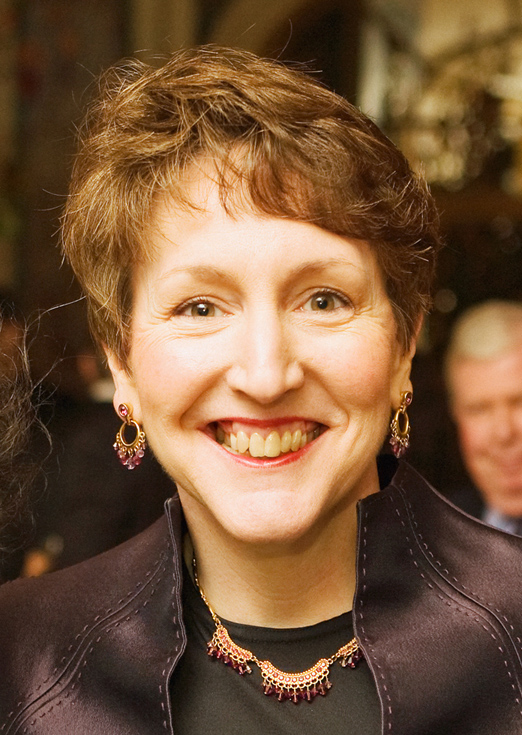 Maria Ann Conelli, executive director of the American Folk Art Museum in New York since 2005, was elected by the CAA Board of Directors at its May 2009 meeting to replace Faya Causey, who has resigned. Conelli will serve the remainder of Causey’s term, through 2012 (unless she is elected to the Executive Committee of the board).
From 2001 to 2005, Conelli was dean of the School of Graduate Studies at the Fashion Institute of Technology, State University of New York. During the 1990s she was chair and faculty member for the MA Program in the History of Decorative Arts at Parsons School of Design in Manhattan. Conelli earned a doctorate in art history and a master of philosophy from Columbia University, and an MA and BA, respectively, at the Institute of Fine Arts at New York University and Brooklyn College, City University of New York. The recipient of several fellowships, including ones from the Getty and the American Academy in Rome, she has given papers on Renaissance art and architecture in the US and UK.
The CAA board and staff are pleased that Conelli has agreed to serve at this critical time, as the new strategic plan is being developed, because of her extensive experience in planning in both academia and art museums.
2009 Member Survey Results
posted by Michael Fahlund — July 16, 2009
As part of information-gathering pursuant to the preparation of CAA’s 2010–2015 Strategic Plan, a 2009 member survey was developed, coordinated, and carried out by a team under the leadership of Elizabeth Knapp, vice president in the Research Division of the marketing firm Leo Burnett Worldwide, to determine member preferences, awareness of CAA publications and programs, and motivations for joining and renewing membership.
In total, 1,451 CAA members responded to the online survey, a response rate of 11 percent (which is within an acceptable range for statistical analysis). The final sample was then weighted to accurately reflect the total CAA membership based on membership type. The results are an enlightening view into CAA members’ views and opinions, revealing important strengths but also giving direction to how the organization can use the next strategic plan to improve its programs and services.
Demographically speaking, CAA members are more likely to be female (70 percent), within the age range of 35–49 (34 percent), Caucasian (87 percent), and in academic settings (73 percent), and to have ten years or more of professional experience (48 percent).
The top three reasons individuals gave for joining CAA and renewing their memberships were for job postings (69 percent), networking (54 percent), and debate in the visual arts (50 percent).
CAA is perceived as most relevant to art historians (78 percent agree). From artist members, enthusiasm for ARTspace at the Annual Conference was one of the higher-ranking areas of interest (61 percent). CAA is viewed as a well-known organization among peers (75 percent agree) and a well-run organization (51 percent agree). Members who responded to the question about CAA’s roles believe the most important are advocacy for artists, art historians, and university art museums (24 percent), a conference provider (21 percent), and a leader of creative and intellectual discourse (17 percent). The most common contact points between members and CAA are through publications and emails. The Art Bulletin has the strongest reputation among members (64 percent). The most used features of the CAA website are membership renewal (76 percent), conference registration (70 percent), and CAA News (60 percent). At least half the members also visit the CAA website regularly. A near majority of members (45 percent) have interest in social networking through CAA.
The CAA Annual Conference is perceived as important for networking (68 percent) and career development (62 percent), an opportunity for intellectual exchange about the visual arts (58 percent), and relevant to professional development (53 percent). At the conference, members mostly likely attend sessions (76 percent), the Book and Trade Fair (65 percent), and, as noted above, ARTspace (61 percent). The most popular conference topics are criticism and theory (33 percent) and contemporary art history (31 percent).
The most popular publication topics for the future are curriculum development for teaching studio and art-history courses; legal and copyright issues in publishing; career-development strategies; and standards and guidelines in the visual arts in academia. Members agree that digital publications are valuable because they can be searched online (76 percent), are environmentally friendly (71 percent), can expand readership and distribution (59 percent), and can include dynamic content (56 percent). Members are undecided on the future of digital publications, but 49 percent of respondents do not favor online, non–peer reviewed publications.
CAA continues to advocate on issues of importance to members and to the visual arts. Among these, members feel that full-time vs. adjunct status is most important (50 percent), followed by intellectual-property issues (38 percent) and salary equity (39 percent).
In efforts to increase its visibility and recognition for the programs and services it provides, CAA is eager to know how members react to or view its name. While some members felt that the name “College Art Association” or “CAA” is not descriptive of what the organization does, or that it does not fit the mission, 65 percent believe that the name is understood in the field of visual arts. Name recognition and identity will be assessed as part of CAA’s communications activities in the strategic plan.
Other directions gathered from this survey that will be addressed in the strategic plan are to: 1) increase programming and publications for artists; 2) attract more young professionals; 3) increase the diversity of members; 4) increase career-development sessions at the conference; 5) increase interactive communications; 6) develop practical peer-reviewed publications; and 7) continue working on advocacy issues, particularly related to adjunct faculty.
CAA thanks its members for participating in this recent survey. Comments and responses have been extremely helpful and are being used to guide changes and improvements in the organization’s services.
Petition to Support University Galleries and Museums
posted by CAA — July 14, 2009
Several university art museums or their school administrations have recently sold, or have attempted to sell, artworks and objects in their collections to offset operating costs. In response to this, CAA has joined a task force supporting the educational importance of preserving collections at university museums and galleries. The task force—which includes representatives from the American Association of Museums, the Association of Art Museum Directors, the Association of College and University Museums and Galleries, and the Samuel H. Kress Foundation—has established a two-pronged effort: 1) to recognize museums as integral educational resources in the university accreditation process; and 2) to heighten public awareness of the educational value of art museum collections.
Members of the task force are meeting with accreditation organizations throughout the country to enlist their support for the recognition of art museums as integral educational resources.
A petition has been prepared that reaffirms the integrity and value of university and college museums.
Please show support for our efforts by adding your name and affiliation to this petition, which will be published in the Chronicle of Higher Education this fall. Please encourage your university, college, or museum to sign it as well.
Thank you for your support on this critical issue.
Paul B. Jaskot, President, and Linda Downs, Executive Director
New Faces for CAA Journals
posted by Christopher Howard — July 10, 2009
Paul Jaskot, president of the CAA Board of Directors, has made new appointments to CAA’s three scholarly journals.
Karen Lang, associate professor of art history at the University of Southern California, has been appointed the next editor-in-chief of The Art Bulletin, succeeding Richard J. Powell of Duke University. Lang begins her three-year term on July 1, 2010, with the preceding year as editor designate.
Michael Cole is the new reviews editor for The Art Bulletin, succeeding David J. Roxburgh of Harvard University, who served the journal for three years. Cole became reviews editor designate in February and took over from Roxburgh this month.
Joining the Art Bulletin Editorial Board for four-year terms beginning July 1, 2009, are: Linda Komaroff, Los Angeles County Museum of Art; Thelma K. Thomas, Institute of Fine Arts, New York University; and Eugene Wang, Harvard University. The newly selected editorial-board chair is Natalie Kampen of Barnard College, who will serve for two years.
At Art Journal, Howard Singerman of the University of Virginia has been appointed the new reviews editor; he will take over from Liz Kotz of the University of California, Riverside, and serve from July 1, 2010, to June 30, 2013, with a year as reviews editor designate starting this month.
Also at Art Journal, Rachel Weiss of the School of the Art Institute of Chicago and Constance DeJong of Hunter College, City University of New York, have joined the Art Journal Editorial Board for the next four years.
Now on the caa.reviews Editorial Board is Michael Ann Holly of the Sterling and Francine Clark Art Institute, who will serve for four years. In addition, seven new field editors for books and related media have been chosen:
- Molly Emma Aitken, City College, City University of New York, South and Southeast Asian art
- Darby English, University of Chicago, contemporary art
- Jonathan Massey, Syracuse University, architecture and urbanism, 1800–present
- Adelheid Mers, School of the Art Institute of Chicago, arts administration and museum studies (a new field-editor position)
- Tanya Sheehan, Rutgers University, photography
- Janis Tomlinson, University Museums at the University of Delaware, Spanish art
- Tony White, Indiana University, Bloomington, artist’s books and books for artists (a new field-editor position)
Field editors work with the journal for three years, starting on July 1, 2009.
All editors and editorial-board members are chosen from an open call for nominations and self-nominations, published in at least two issues of CAA News (usually January and March) and on the CAA website.