
CAA News Today
Service as a Mock Interviewer
posted by Lauren Stark — January 20, 2015
For the 2015 Annual Conference in New York, the Student and Emerging Professionals Committee seeks established professionals to volunteer as practice interviewers for the Mock Interview Sessions. Participating as an interviewer is an excellent way to serve the field and to assist with the professional development of the next generation of artists and scholars.
In these sessions, interviewers pose as a prospective employer, speaking with individuals in a scenario similar to the Interview Hall at the conference. Each session is composed of approximately 10–15 minutes of interview questions and a quick review of the application packet, followed by 5–10 minutes of candid feedback. Whenever possible, the committee matches interviewers and interviewees based on medium or discipline.
Interested candidates must be current CAA members and prepared to give six successive twenty-minute interviews with feedback in a two-hour period on one or both of these days: Thursday, February 12, 11:00 AM–1:00 PM and 3:00–5:00 PM; and Friday, February 13, 9:00–11:00 AM and 1:00–3:00 PM. Conference registration, while encouraged, is not required to be a mock interviewer. Desired for the sessions are art historians, art educators, designers, museum-studies professionals, critics, curators, and studio artists with tenure and/or experience on a search committee. You may volunteer for one, two, three, or all four Mock Interview Sessions.
Please send your name, affiliation, position, contact information, and the days and times that you are available to Megan Koza Young, chair of the Student and Emerging Professionals Committee. Deadline: January 31, 2015.
The Mock Interview Sessions are not intended as a screening process by institutions seeking new hires.
2015–2016 Nominating Committee Seeks Members
posted by Vanessa Jalet — November 20, 2014
CAA invites you to help shape the future of the organization by serving on the 2015–2016 Nominating Committee. Each year, this committee nominates and interviews potential candidates for the CAA Board of Directors and selects the final slate for the membership’s vote. The candidates for the 2015–19 board election were announced on November 10, 2014.
The Board of Directors and the Nominating Committee strive to find the best candidates that represent the broad subdisciplines and practitioners represented in the membership. The current Nominating Committee will choose the new members of its own committee at its business meeting, to be held at the 2015 Annual Conference in New York in February. Once selected, all committee members must propose, in the spring, a minimum of five and a maximum of ten people for the board. Service on the committee also involves conducting telephone interviews with candidates during the summer and meeting in fall 2015 in New York to select the final board slate. Finally, all Nominating Committee members attend their next business meeting, at the 2016 Annual Conference in Washington, DC, to select the succeeding committee.
Nominations and self-nominations should include a brief statement of interest and a 3–4 page condensed CV. Please email a statement and your CV as Word attachments, with the subject line “2015–2016 Nominating Committee,” to the attention of Charles A. Wright, CAA vice president for committees, care of Vanessa Jalet, CAA executive liaison. Deadline: December 19, 2014.
CAA Seeks Jury Members for the Terra Foundation Publication Grant
posted by Betty Leigh Hutcheson — October 20, 2014
The College Art Association (CAA) seeks nominations and self-nominations for one US scholar and two scholars based outside the United States to serve on the jury of CAA’s Terra Foundation for American Art International Publication Grant through June 30, 2017. Candidates must be actively publishing scholars with expertise in any branch of American art history, visual studies, or a related field with demonstrated seniority and achievement; institutional affiliation is not required.
The Terra Foundation for American Art awarded CAA a major, three-year grant to administer an annual program to support book-length scholarly manuscripts in the history of American art. The Terra Foundation for American Art International Publication Grant will award funds of up to $15,000 to US and non-US publishers for books that examine American art in an international context, increase awareness of American art internationally through publication outside the United States, allow wider audiences to access important texts through translation, and/or result from international collaboration. For grant guidelines, detailed eligibility requirements and application instructions, please visit www.collegeart.org/terrafoundation.
Members of the Terra Foundation International Publication Jury meet once each year to select awardees. The first meeting of the jury will take place at CAA’s Annual Conference in New York on February 11, 2014. Subsequent meetings will take place via teleconference each February. Two months prior to the meeting, CAA staff will provide all application materials and reader’s reports to jurors for review prior to the jury meeting. Jurors for this grant would serve as volunteers and would not be entitled to receive compensation for service, however, travel and hotel expenses for the 2014 jury meeting will be paid by the College Art Association.
US candidates must be CAA members in good standing and should not currently serve on another CAA editorial board or committee. Jury members may not themselves apply for a grant in this program during their three-year term of service. Nominators should ascertain their nominee’s willingness to serve before submitting a name; self-nominations are also welcome. Please send a letter describing your interest in and qualifications for appointment, a curriculum vitae, and contact information to: Terra Foundation for American Art International Publication Grant, College Art Association, 50 Broadway, 21st Floor, New York, NY 10004; or send all materials as email attachments to Betty Leigh Hutcheson, bhutcheson@collegeart.org. Deadline: December 1, 2014.
About CAA
The College Art Association is dedicated to providing professional services and resources for artists, art historians, and students in the visual arts. CAA serves as an advocate and a resource for individuals and institutions nationally and internationally by offering forums to discuss the latest developments in the visual arts and art history through its Annual Conference, publications, exhibitions, website, and other programs, services, and events. CAA focuses on a wide range of advocacy issues, including education in the arts, freedom of expression, intellectual-property rights, cultural heritage and preservation, workforce topics in universities and museums, and access to networked information technologies. Representing its members’ professional needs since 1911, CAA is committed to the highest professional and ethical standards of scholarship, creativity, criticism, and teaching. Learn more about CAA at www.collegeart.org.
About the Terra Foundation
The Terra Foundation for American Art is dedicated to fostering exploration, understanding, and enjoyment of the visual arts of the United States for national and international audiences. Recognizing the importance of experiencing original works of art, the foundation provides opportunities for interaction and study, beginning with the presentation and growth of its own art collection in Chicago. To further cross-cultural dialogue on American art, the foundation supports and collaborates on innovative exhibitions, research, and educational programs. Implicit in such activities is the belief that art has the potential both to distinguish cultures and to unite them.
Mock Interviewers Needed for the 2015 Conference
posted by Lauren Stark — September 12, 2014
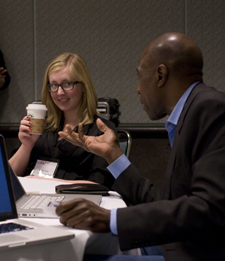
For the 2015 Annual Conference in New York, the Student and Emerging Professionals Committee seeks established professionals to volunteer as practice interviewers for the Mock Interview Sessions. Participating as an interviewer is an excellent way to serve the field and to assist with the professional development of the next generation of artists and scholars.
In these sessions, interviewers pose as a prospective employer, speaking with individuals in a scenario similar to the Interview Hall at the conference. Each session is composed of approximately 10–15 minutes of interview questions and a quick review of the application packet, followed by 5–10 minutes of candid feedback. Whenever possible, the committee matches interviewers and interviewees based on medium or discipline.
Interested candidates must be current CAA members and prepared to give six successive twenty-minute interviews with feedback in a two-hour period on one or both of these days: Thursday, February 12, 11:00 AM–1:00 PM and 3:00–5:00 PM; and Friday, February 13, 9:00–11:00 AM and 1:00–3:00 PM. Conference registration, while encouraged, is not required to be a mock interviewer. Desired for the sessions are art historians, art educators, designers, museum-studies professionals, critics, curators, and studio artists with tenure and/or experience on a search committee. You may volunteer for one, two, three, or all four Mock Interview Sessions.
Please send your name, affiliation, position, contact information, and the days and times that you are available to Megan Koza Young, chair of the Student and Emerging Professionals Committee. Deadline: January 31, 2015.
The Mock Interview Sessions are not intended as a screening process by institutions seeking new hires.
Image: A Mock Interview at the 2012 Annual Conference (photograph by Bradley Marks)
Mentors Needed for the 2015 Annual Conference
posted by Lauren Stark — August 26, 2014
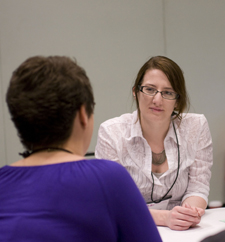 For the 103rd Annual Conference, taking place February 11–14, 2015, in New York, CAA seeks established professionals in the visual arts to volunteer as mentors for two Career Services programs: the Artists’ Portfolio Review and Career Development Mentoring. Participating as a mentor is an excellent way to serve the field and to assist the professional growth of the next generation of artists and scholars.
Art historians and studio artists must be tenured; critics, museum educators, and curators must have five years’ experience. Curators and educators must be currently employed by a museum or university gallery.
Artists’ Portfolio Review
CAA seeks artists, critics, curators, and educators to serve in the Artists’ Portfolio Review. In this program, mentors review and provide feedback on digital images or DVDs of work by artist members in personal twenty-minute consultations. Whenever possible, CAA matches artists and mentors based on medium or discipline. Mentors provide an important service to artists, enabling them to receive professional criticism of their work.
Interested candidates must be current CAA members and prepared to give five successive twenty-minute critiques in a two-hour period on one of the two days of the review: Thursday, February 12, and Friday, February 13, 2015, 8:00 AM–NOON and 1:00–5:00 PM each day. Conference registration, while encouraged, is not required to be a mentor. Please send a brief letter of interest and your CV to Lauren Stark, CAA manager of programs. Deadline extended: January 9, 2015.
Career Development Mentoring
CAA seeks mentors from all areas of studio art, art history, art education, film and video, graphic design, the museum professions, and other related fields to serve in Career Development Mentoring. In this program, mentors give valuable advice to emerging and midcareer professionals, reviewing cover letters, CVs, digital images, and other pertinent job-search materials in personal twenty-minute consultations. Whenever possible, CAA matches participants and mentors based on medium or discipline.
Interested candidates must be current CAA members and prepared to give five successive twenty-minute critiques in a two-hour period on one of the two days of the review: Thursday, February 12, and Friday, February 13, 2015, 8:00 AM–NOON and 1:00–5:00 PM each day. Conference registration, while encouraged, is not required to be a mentor. Please send a brief letter of interest and your CV to Lauren Stark, CAA manager of programs. Deadline extended: January 9, 2015.
Career Development Mentoring is not intended as a screening process by institutions seeking new hires. CAA does not accept applications from individuals whose departments are conducting a faculty search in the field in which they are mentoring. Mentors should not be attending the conference as candidates for positions in the same field in which mentees may be applying.
Image: A mentoring session at the 2012 Annual Conference in Los Angeles (photograph by Bradley Marks)
Art History Teaching Resources Seeks Lesson Plans
posted by Christopher Howard — August 14, 2014
Do you have a great lesson plan you want to take some time to codify and share? Funded by a Samuel H. Kress Foundation grant for digital resources, Art History Teaching Resources (AHTR), a peer-populated platform for instructors and a collectively authored online repository of art-history teaching content, seeks contributors for specific subject areas in the art-history survey. This is the second call for participation (the first went out in early 2014).
AHTR is particularly interested the following sections in art and architecture for publication in early fall 2014:
- Jewish and Early Christian Art and Architecture
- Byzantine Art and Architecture
- Islamic Art and Architecture
- Chinese Art and Architecture (early/pre-1279)
- Chinese Art and Architecture (after 1279)
- Japanese Art and Architecture (early)
- Japanese Art and Architecture (modern)
- Korean Art (early)
- Korean Art and Architecture (modern)
- Art and Architecture of Africa
- Early Medieval Art in Europe
- Romanesque Art and Architecture
- Gothic Art and Architecture
- Art of Pacific Cultures
- Eighteenth- and Early-Nineteenth-Century Art in Europe and North America
- Eighteenth- and Nineteenth-Century Sculpture
- Twentieth-Century Sculpture
AHTR is also interested in receiving proposals for thematic art-history survey lesson plans. The editors have already received plans that engage with, for example, “Race and Identity” and “Transnationalism and Citizenship.” Please propose a thematic plan germane to the survey-level class.
For each content area, AHTR seeks lecture and lesson plans similar to those developed for its sections on the Americas (pre-1300) and Feminist Art. (Please see a great example here.) Full template guidelines will be given for the sections to be included in each plan; writers will be expected to review and amend their plan (if necessary), once edited by AHTR. These plans, which will be posted to the AHTR website in fall 2014, are supported by $250 writing grants made possible by the Kress award.
AHTR is looking for contributors who:
- Have strong experience teaching the art-history survey and strong interest in developing thoughtful, clear, and detailed lesson plans in particular subject areas
- Are committed to delivering lecture content (plan, PowerPoint, resources, activities) for one to two (a maximum of two) content areas in a timely manner. Each content area will be supported by a $250 Kress writing grant.
- Are able to make a September deadline for submission and an early October deadline for any edits.
- Want to engage with a community of peers in conversations about issues in teaching the art-history survey
AHTR’s intention is to offer monetary support for the often-unrewarded task of developing thoughtful lesson plans, to make this work freely accessible (and thus scalable), and to encourage feedback on them so that the website’s content can constantly evolve in tandem with the innovations and best practices in the field. In this way, AHTR wants to encourage new collaborators to the site—both emerging and experienced instructors in art history—who will enhance and expand teaching content. It also wishes to honor the production of pedagogical content at the university level by offering modest fellowships to support digital means of collaboration among art historians.
Please submit a short, teaching-centered CV and a brief statement of interest that describes which subject area(s) you wish to tackle to teachingarthistorysurvey@gmail.com. These initial texts should be delivered to AHTR in September 2014. Collaboration on content for further subject areas will be solicited throughout 2014.
CAA Seeks Members for Its Professional Interests, Practices, and Standards Committee
posted by Vanessa Jalet — July 01, 2014
Get involved in an issue that you care about! CAA invites members to apply for service on one of its nine Professional Interests, Practices, and Standards Committees. These committees address critical issues in the visual arts in an attempt to deal with, and respond to, the pressing concerns of CAA’s members.
Communicating via listserv throughout the year, each committee takes on the objectives it has set for itself, which include: programming ARTspace at the Annual Conference; establishing best practices, standards, and guidelines; sharing and examining pedagogical practices; examining new and developing technologies; addressing issues critical to emerging professionals as well as concerns of diversity and gender; extending the reach of CAA internationally; and clarifying and debating matters of fair use, copyright, and open access. This vigorous exchange of information reveals common goals and leads to solutions that will help CAA members to weather their changing professional landscape.
Committees are active at the Annual Conference in February, where each presents one or two sessions on a subject of its choosing. These sessions, sometimes collaborations between committees and sometimes dealing with workforce issues, are meant to be of immediate value to CAA members. Also at the conference, the committees hold face-to-face business meetings and discuss the past year’s accomplishments while targeting ideas for future projects. Participation on a committee is an excellent and fruitful way to network with other CAA members; for some individuals it is a stepping-stone to service on the organization’s Board of Directors.
The public face of several CAA committees appears most visibly at the conference. The Services to Artists Committee, for example, conceives nearly all content and programming for ARTspace, ARTexchange, and the Media Lounge, while the Student and Emerging Professionals Committee organizes events on professional-development issues that take place in the Student and Emerging Professionals Lounge during the conference.
Online, the Committee on Women in the Arts publishes the monthly CWA Picks of exhibitions and events related to feminist art and scholarship, among other activities. CAA’s Museum Committee is currently reviewing several of CAA’s Standards and Guidelines as they relate to museums. This committee also organizes conference sessions on museum leadership and exhibition history and works to provide resources for professionals in academic art museums.
The International Committee warmly welcomed twenty travel-grant recipients from around the world at the 2014 Annual Conference in Chicago and will host fifteen travel-grant recipients at the 2015 conference in New York.
The Professional Practices Committee continues to study, develop, and revise CAA’s Standards and Guidelines, so that these documents, once approved by the CAA board, become authoritative, comprehensive documents for art-related disciplines. The Committee on Diversity Practices’ current projects include organizing a 2015 conference session called “Diversity and Pedagogy: The Global Factor,” overseeing the Resource Directory for Diversity Practices, and expanding CAA mentoring programs.
The Committee on Intellectual Property updated the Image Resources page on CAA’s website and continues to monitor the tricky terrain of copyright and fair use, which dramatically affects the work lives of artists and scholars. The Education Committee is currently launching new initiatives concerning curriculum, pedagogy, and the scholarship of teaching and learning. This committee especially seeks new members from studio art, design and/or museums.
Committee members serve three-year terms (2014–17), with at least one new member rotating onto a committee each year. Candidates must be current CAA members and possess expertise appropriate to the committee’s work. Members of all committees volunteer their services without compensation. Committee work is not for the faint of heart; it is expected that once appointed to a committee, a member will involve himself or herself in an active and serious way.
The following vacancies are open for terms beginning in February 2015:
- Committee on Diversity Practices: 3–4 members
- Committee on Intellectual Property: 3 members
- Committee on Women in the Arts: 6 members
- Education Committee: 2–3 members
- International Committee: 2 members
- Museum Committee: 4 members
- Professional Practices Committee: 5 members
- Services to Artists Committee: 5 members
- Student and Emerging Professionals Committee: 2–3 members
CAA’s president, vice president for committees, and executive director review all candidates in early November and make appointments in December, prior to the Annual Conference. New members are introduced to their committees during their respective business meetings at the conference.
Nominations and self-nominations should include a brief statement (no more than 150 words) describing your qualifications and experience and an abbreviated CV (no more than 2–3 pages). Please send all materials to Vanessa Jalet, CAA executive liaison. Deadline: October 17, 2014.
Juror Sought for the Millard Meiss Publication Fund
posted by CAA — June 30, 2014
CAA seeks nominations and self-nominations from an architectural historian or an art historian with a specialization in Islamic, East Asian, or contemporary art to serve on the jury for the Millard Meiss Publication Fund for a four-year term, ending on June 30, 2018. Candidates must be actively publishing scholars with demonstrated seniority and achievement; institutional affiliation is not required.
The Meiss jury awards subsidies to support the publication of book-length scholarly manuscripts in the history of art and related subjects. Members review manuscripts and grant applications twice a year and meet in New York in the spring and fall to select the awardees. CAA reimburses jury members for travel and lodging expenses in accordance with its travel policy.
Candidates must be current CAA members and should not be serving on another CAA editorial board or committee. Jury members may not themselves apply for a grant in this program during their term of service. Nominators should ascertain their nominee’s willingness to serve before submitting a name; self-nominations are also welcome. Please send a letter describing your interest in and qualifications for appointment, a CV, and contact information to: Millard Meiss Publication Fund Jury, College Art Association, 50 Broadway, 21st Floor, New York, NY 10004; or send all materials as email attachments to Alex Gershuny, CAA editorial manager. Deadline: July 22, 2014.
New Appointments to CAA’s Editorial Boards
posted by Christopher Howard — June 24, 2014
The president of CAA’s Board of Directors, DeWitt Godfrey, has made appointments to the editorial boards of CAA’s three scholarly journals, in consultation with the editorial boards and the vice president for publications, Suzanne Preston Blier. The appointments take effect on July 1, 2014.
Art Journal
Two new members-at-large have joined the Art Journal Editorial Board. Tirza True Latimer is an associate professor at the California College of the Arts in San Francisco and chair of its graduate program in visual and critical studies. Janet Kraynak is an associate professor of contemporary art history at the New School in New York, with joint appointment at Parsons the New School for Design and Eugene Lang College. The terms for Latimer and Kraynak extend until June 30, 2018.
The Art Bulletin
The Art Bulletin has announced its next reviews editor: Nancy Um, associate professor in the Department of Art History at Binghamton University, State University of New York, and a scholar of Islamic art and visual culture. For the past year, Um has been a scholar in residence at the Getty Research Institute in Los Angeles. From 2011 to 2014, she served as the inaugural reviews editor of the International Journal of Islamic Architecture. Um is the author of The Merchant Houses of Mocha: Trade and Architecture in an Indian Ocean Port (University of Washington Press, 2009), as well as many essays and book chapters. Um will succeed Rachael DeLue of Princeton University, beginning a three-year-term as reviews editor on July 1, 2015, with the preceding year as reviews editor designate.
caa.reviews
The caa.reviews Editorial Board welcomes two new members-at-large: Meredith Cohen and Suzanne Hudson. Cohen is a historian of the art, architecture, and urbanism of medieval Europe and an assistant professor of art history at the University of California, Los Angeles. Hudson is an assistant professor of art history and fine arts at the University of Southern California in Los Angeles and currently serves as the caa.reviews field editor for exhibitions of modern and contemporary art on the West Coast. Both Cohen and Hudson will serve four-year terms on the editorial board, from July 1, 2014, to June 30, 2018.
The caa.reviews Council of Field Editors has four new members. Phillip Bloom, an assistant professor of art history at the University of Indiana in Bloomington and a visiting researcher at the Institute for Advanced Studies on Asia at the University of Tokyo for 2013–14, will commission reviews of books on Chinese art. Edward A. Vazquez, assistant professor of history of art and architecture at Middlebury College in Vermont, will be the field editor for exhibitions of modern and contemporary art in the northeastern United States. Megan Cifarelli, an associate professor at Manhattanville College in Purchase, New York, and chair of her school’s program in art history, will assign reviews of books on ancient Egyptian and Near Eastern art for the journal. Finally, Pamela M. Fletcher, a professor of art history and codirector of the Digital and Computational Studies Initiative at Bowdoin College in Brunswick, Maine, joins caa.reviews to oversee reviews of digital projects in the visual arts.
Report on the May 4, 2014, CAA Board of Directors Meeting
posted by Linda Downs — June 18, 2014
The Strategic Plan 2015-2020 was approved by the directors and the following priorities were established by the new president, DeWitt Godfrey:
- Advocate for workforce issues particularly for part-time faculty;
- Review the Professional Interests, Practices and Standards committees to ensure addressing critical issues in the visual arts field;
- Increase membership nationally, internationally and in terms of diversity; increase communication with members, including social communication;
- Find ways of extending the annual conference to a larger group of members; and
- Enhance utilization of digital capabilities by journal authors and promote digital expertise.
The directors are grateful to the Strategic Planning Task Force chaired by president emerita Anne Collins Goodyear and all the members who contributed to the development of this new plan.
The directors gratefully approved the endowment gift by Mary Douglas Edwards of $50,000 to support travel and registration to attend the CAA annual conference by women who are emerging scholars pursuing a doctoral degree or who have received their Ph.D. within two years prior to the submission of the application for the award of the grant and who will present research papers at an art history session at the conference with strong preference for papers on any topic pertaining to the art of ancient Greece or Rome, Medieval Europe from 400 – 1400, or Europe and North American from 1400 – 1950.
The directors approved the IRS Form 990 for Fiscal Year Ended June 30, 2013.
The directors approved CAA joining the Partner Program of the Society of Architectural Historians.
The directors also approved the Resolution to commend the Women’s Art Journal requested by the Committee on Women in the Arts for the maintenance of high quality scholarship that serves as a forum for re-examining feminist concerns of the women’s art movement. A letter of commendation was sent to Joan Marter, Professor of Art History, Rutgers University and Editor, Women’s Art Journal.
The directors established a Task Force on Design, chaired by Debra Riley Parr, , to investigate and make recommendations to the directors on 1) tenure and promotion standards for designers; 2) CV guidelines for designers; 3) representation of design fields in all the professional committees; and 4) scheduling sessions at the annual conference on design issues.
The directors decided to evaluate the Professional- Development Fellowships in Art History and Visual Arts in light of the current job market and in the context of the Strategic Plan 2015-2020 and to temporarily suspend the program.